
Life, 1928-05-24 · page 22 of 38
Life — May 24, 1928 — page 22: what you’re looking at
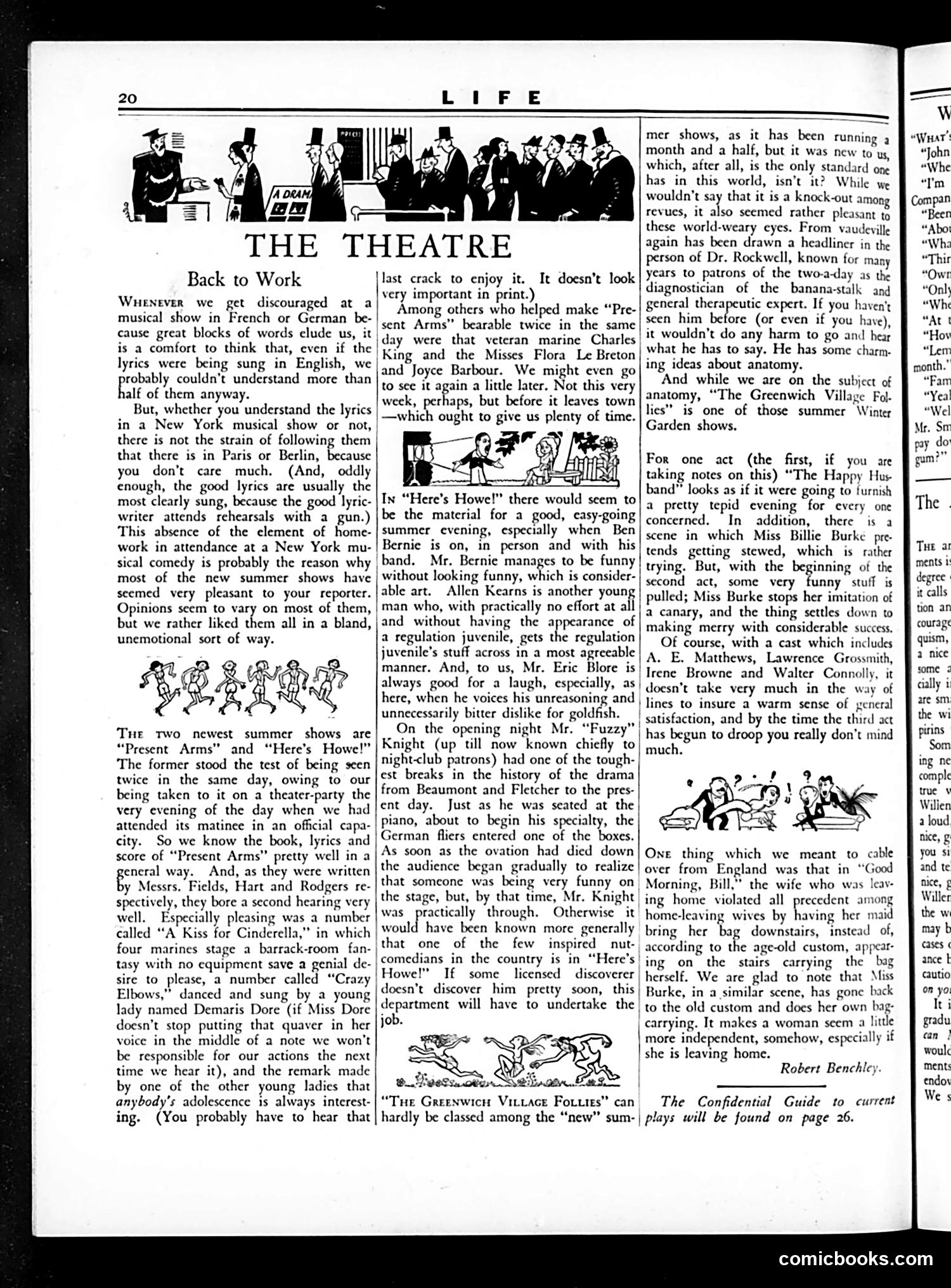
A restored page from Life, 1928-05-24. Page through the whole issue in the reader above.
📄 Transcribed text from this page (OCR, searchable)
Machine-transcribed from the original scan — historical spelling and the odd misread are preserved.
TH Back to Work WHENEVER we get discouraged at a musical show in French or German be- cause great blocks of words clude us, it is a comfort to think that, even if the lyrics were being sung in English, we prepay couldn’t understand more than alf of them anyway. But, whether you understand the lyrics in a New York musical show or not, there is not the strain of following them that there is in Paris or Berlin, because you don’t care much. (And, oddly enough, the good lyrics are usually the most clearly sung, because the good lyric- writer attends rehearsals with a gun.) This absence of the element of home- work in attendance at a New York mu- sical comedy is probably the reason why most of the new summer shows have seemed very pleasant to your reporter. Opinions seem to vary on most of them, but we rather liked them all in a bland, unemotional sort of way. Tue two newest summer shows are “Present Arms” and ‘“‘Here’s Howe!” The former stood the test of being seen twice in the same day, owing to our being taken to it on a theater-party the very evening of the day when we had attended its matinee in an official capa- city. So we know the book, lyrics and score of “Present Arms” pretty well in a pencral way. And, as they were written yy Messrs. Fields, Hart and Rodgers re- spectively, they bore a second hearing very well. Especially pleasing was a number called ‘‘A Kiss for Cinderella,” in which four marines stage a barrack-room fan- tasy with no equipment save a genial de- sire to please, a number called “Crazy Elbows,” danced and sung by a young lady named Demaris Dore (if Miss Dore doesn’t stop putting that quaver in her voice in the middle of a note we won't be responsible for our actions the next time we hear it), and the remark made by one of the other young ladies that anybody's adolescence is always interest- ing. (You probably have to hear that THEATRE | It doesn’t look last crack to enjoy it. very important in print.) Among others who helped make “Pre- sent Arms’ bearable twice in the same |day were that veteran marine Charles | King and the Misses Flora Le Breton and Joyce Barbour. We might even go to see it again a little later. Not this very week, perhaps, but before it leaves town | —which ought to give us plenty of time. In “Here's Howe!” there would seem to be the material for a good, easy-going summer evening, especially when Ben Bernie is on, in person and with his band. Mr. Bernie manages to be funny without looking funny, which is consider- able art. Allen Kearns is another youn; man who, with practically no effort at all jand without having the appearance of a regulation juvenile, gets the regulation juvenile’s stuff across in a most agreeable manner. And, to us, Mr. Eric Blore is always good for a laugh, especially, as here, when he voices his unreasoning and unnecessarily bitter dislike for goldfish. On the opening night Mr. “Fuzzy Knight (up till now known chiefly to night-club patrons) had one of the tough- est breaks in the history of the drama from Beaumont and Fletcher to the pres- ent day. Just as he was seated at the piano, about to begin his specialty, the German fliers entered one of the boxes. As soon as the ovation had died down the audience began gradually to realize that someone was being very funny on the stage, but, by that me, Mr. Knight was practically through. Otherwise it would have been known more generally that one of the few inspired nut- comedians in the country is in “Here's | Howe!” If some licensed discoverer doesn’t discover him pretty soon, this department will have to undertake the job. “Tue Greenwich Vivace Forties” can hardly be classed among the “new” sum- mer shows, as it has been running a month and a half, but it was new to us, which, after all, is the only standard one has in this world, isn’t it? While we wouldn't say that it is a knock-out among revues, it also seemed rather pleasant to these world-weary cyes. From vaudeville again has been drawn a headliner in the person of Dr. Rockwell, known for many years to patrons of the two-a-day as the diagnostician of the banana-stalk and general therapeutic expert. If you haven't seen him before (or even if you have), it wouldn't do any harm to go and hear what he has to say. He has some charm- ing ideas about anatomy. And while we are on the subject of anatomy, “The Greenwich Village Fol- lies” is one of those summer Winter Garden shows. For one act (the first, if you are taking notes on this) “The Happy Hus band” looks as if it were going to furnish a pretty tepid evening for every one concerned. In addition, there is a scene in which Miss Billie Burke pre- tends getting stewed, which is rather trying. But, with the beginning of the second act, some very funny stuff is pulled; Miss Burke stops her imitation of a canary, and the thing settles down to making merry with considerable success. Of course, with a cast which includes A. E, Matthews, Lawrence Grossmith, Irene Browne and Walter Connolly, it | doesn’t take very much in the way of | lines to insure a warm sense of general | satisfaction, and by the time the third act has begun to droop you really don’t mind much. One thing which we meant to cable over from England was that in ‘Good | Morning, Bill,” the wife who was leav- |ing home violated all precedent among home-leaving wives by Raving her maid bring her bag downstairs, instead of, according to the age-old custom, appcat- ing on the stairs carrying the bag herself. We are glad to note that Miss | Burke, in a similar scene, has gone back | to the old custom and does her own bag- carrying. It makes a woman seem a little more independent, somehow, especially if she is leaving home. Robert Benchley. The Confidential Guide to current | plays will be found on page 26. “Wrat: “John “Whe “I'm Compan “Been “Abo “Wh: “Thir “Owr “Onl; “Whe “At “Hov “Lem month.” “Fam “Yeal “Wel Tue at ments 1: degree it calls on an courage quism, a mice some 2 cally i are sm the wi Willen a loud nice, g you si and te axe, Wille the w may b Cases ¢ ance | aautio on yo! Iti gradu can } woulc ments endo We s comicbooks.com