
Life, 1928-05-24 · page 10 of 38
Life — May 24, 1928 — page 10: what you’re looking at
What you’re looking at
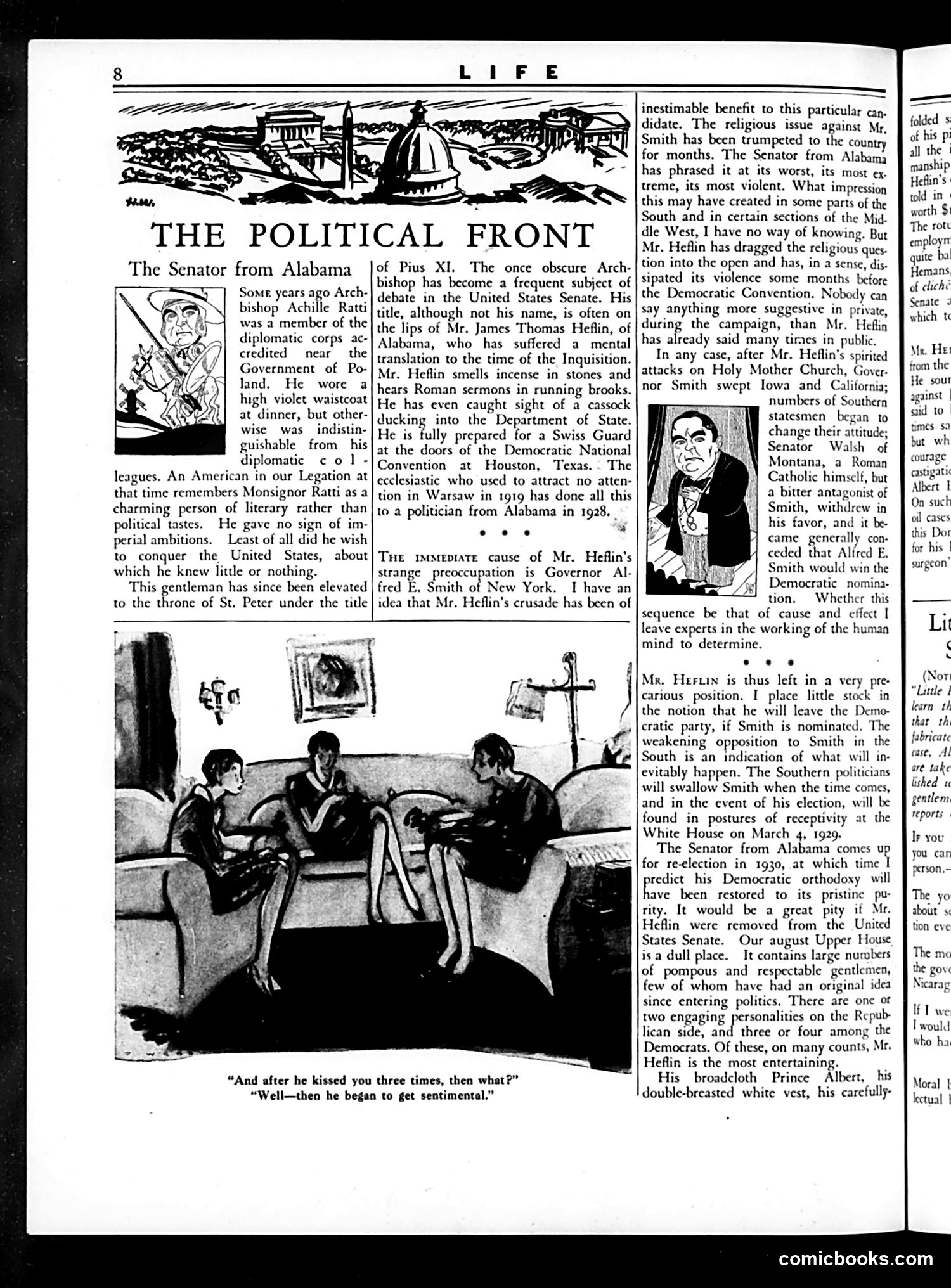
This page satirizes **Senator James Thomas Heflin of Alabama**, depicted in the left caricature. The article discusses Heflin's crusade against Archbishop Achille Ratti (later Pope Pius XI), whom Heflin accused of inciting anti-Democratic sentiment. The main cartoon shows a domestic scene where a woman asks a man, "And after he kissed you three times, then what?" to which he responds, "Well—then he began to get sentimental." The satire mocks Heflin's volatile personality and his seemingly emotional, unpredictable political behavior. The text suggests his opposition to Smith (likely Al Smith, a Catholic Democrat) is religiously motivated and politically destabilizing for the Democratic party in the South, portraying Heflin as an unreliable, mercurial figure whose dramatic crusades undermine Democratic unity.
📄 Transcribed text from this page (OCR, searchable)
Machine-transcribed from the original scan — historical spelling and the odd misread are preserved.
' errr THE POLITICAL FRONT The Senator from Alabama Some years ago Arch- bishop Achille Ratti was a member of the diplomatic corps ac- credited near the Government of Po- land. He wore a high violet waistcoat at dinner, but other- wise was _indistin- guishable from his diplomatic co | - leagues. An American in our Legation at that time remembers Monsignor Ratti as a charming person of literary rather than political tastes. He gave no sign of im- perial ambitions. Least of all did he wish to conquer the United States, about which he knew litle or nothing. This gentleman has since been elevated to the throne of St. Peter under the title of Pius XI. The once obscure Arch- bishop has become a frequent subject of debate in the United States Senate. His title, although not his name, is often on the lips of Mr. James Thomas Heflin, of Alabama, who has suffered a mental translation to the time of the Inquisition. Mr. Heflin smells incense in stones and hears Roman sermons in running brooks. He has even caught sight of a cassock ducking into the Department of State. He is fully prepared for a Swiss Guard at the doors of the Democratic National Convention at Houston, Texas. . The ecclesiastic who used to attract no atten- tion in Warsaw in 1919 has done all this to a politician from Alabama in 1928. | see a Tue imepiate cause of Mr. Heflin’s strange preoccupation is Governor Al- fred E. Smith of New York. I have an idea that Mr. Heflin’s crusade has been of je “And after he kissed you three times, then what?” “Well—then he began to get sentimental.” inestimable benefit to this particular cap. didate. The religious issue against Mr, Smith has been trumpeted to the coun for months. The Senator from Alabama has phrased it at its worst, its most ex- treme, its most violent. What impression this may have created in some parts of the South and in certain sections of the Mid- dle West, I have no way of knowing. But Mr. Heflin has dragged the religious ques. tion into the open and has, in a sense, dis. sipated its violence some months before the Democratic Convention. Nobody can say anything more suggestive in private, during the campaign, than Mr. Heflin has already said many times in public. In any case, after Mr. Heflin’s spirited attacks on Holy Mother Church, Gover- nor Smith swept Iowa and California; numbers of Southern statesmen began to change their attitude; Senator Walsh of Montana, a Roman Catholic himself, but a bitter antagonist of Smith, withdrew in his favor, and it be came generally con- ceded that Alired E. Smith would win the Democratic nomina- tion. Whether this sequence be that of cause and effect [ leave experts in the working of the human mind to determine. . ee Mr. Herwin is thus left in a very pre- carious position. I place little stock in the notion that he will leave the Demo- cratic party, if Smith is nominated. The weakening opposition to Smith in the South is an indication of what will in- evitably happen. The Southern politicians will swallow Smith when the time comes, and in the event of his election, will be found in postures of receptivity at the White House on March 4, 1929. The Senator from Alabama comes up for re-election in 1930, at which time I redict his Democratic orthodoxy will fave been restored to its pristine pu- rity. It would be a great pity if Mr. Heflin were removed from the United States Senate. Our august Upper House isa dull place. It contains large nurobers of pompous and respectable gentlemen, few of whom have had an original idea since entering politics. There are one of two engaging personalities on the Repub- lican side, ed three or four among the Democrats. Of these, on many counts, Mr. Heflin is the most entertaining. His broadcloth Prince Albert, his double-breasted white vest, his carefully- folded s of his pi all the | manship Heflin’s told in worth $1 The rote employ quite bal Hemans of cliché Senate < which t Me. He from the He sour against _ sid to times sa but wh courage castigati Albert 1 On such ail cases this Dor for his | surgeon’ Lit : (Nor! “Liule | learn th that th fabricate case. Al are take lished gentlem, reports Ir you you can person.- The yo about ton eve The mo the gow Nicarag If 1 we I would who ha Moral | lectual | comicbooks.com