
Life, 1928-05-24 · page 17 of 38
Life — May 24, 1928 — page 17: what you’re looking at
What you’re looking at
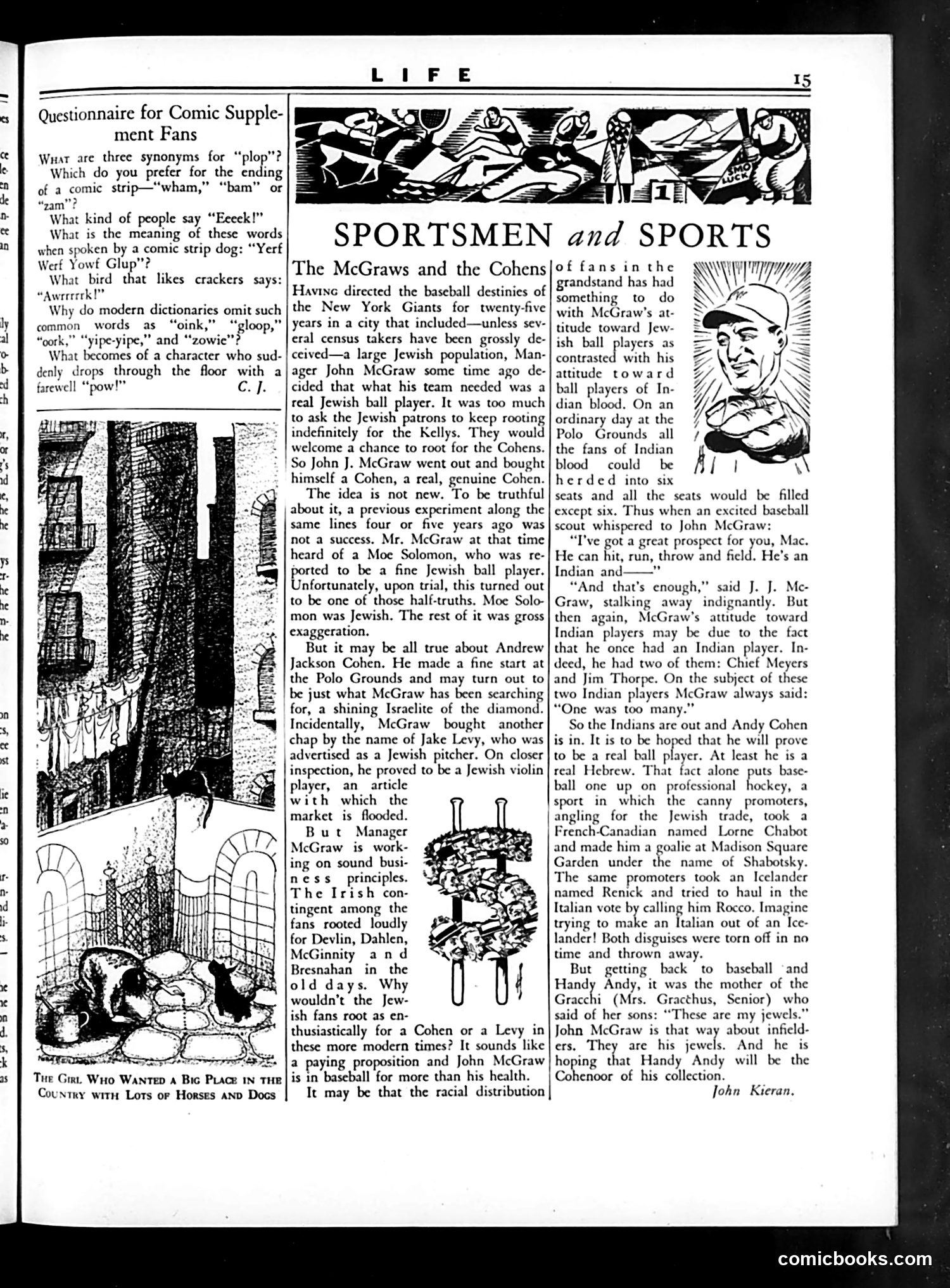
This article by John Kieran discusses Jewish participation in baseball, specifically focusing on John McGraw (manager of the New York Giants) and his attitudes toward Jewish players. The text describes McGraw's initial reluctance to recruit Jewish players, despite census data showing a large Jewish population in New York. It recounts failed attempts to sign Jewish athletes—including a violinist named Jake Levy and others—before eventually recruiting Andrew Cohen. The article critiques McGraw's ethnic prejudice while noting some progress. It references attempts to recruit other Jewish and immigrant athletes (Italian, Icelandic) for various sports, suggesting broader discrimination in professional athletics during this era. The cartoon illustrates a woman seeking a rural property with horses and dogs—seemingly unrelated to the main article's focus on baseball and ethnic discrimination in sports.
📄 Transcribed text from this page (OCR, searchable)
Machine-transcribed from the original scan — historical spelling and the odd misread are preserved.
as a RPwrSEOR 0 Berra AA Questionnaire for Comic Supple- ment Fans Wuat are three synonyms for “plop”? Which do you prefer for the ending of a comic strip—“wham,” “bam” or “2am”? What kind of people say “Eeeck!” What is the meaning of these words when spoken by a comic strip dog: “Yerf Werf Yowf Glup”? What bird that likes crackers says: “Awreerrk!” Why do modern dictionaries omit such common words as “oink,” ‘‘gloop,” “oork,” “yipe-yipe,”” and “‘zowie"’? What becomes of a character who sud- denly drops through the floor with a farewell “pow!” CJ Cos oy sorta Tue Gra. WHo Wantep A Bic PLace IN THE Country wit Lots or Horses anv Docs SPORTSMEN and SPORTS The McGraws and the Cohens Havine directed the baseball destinies of the New York Giants for twenty-five years in a city that included—unless sev- eral census takers have been grossly de- ceived—a large Jewish population, Man- ager John McGraw some time ago de- cided that what his team needed was a real Jewish ball player. It was too much to ask the Jewish patrons to keep rooting indefinitely for the Kellys. They would welcome a chance to root for the Cohens. So John J. McGraw went out and bought himself a Cohen, a real, genuine Cohen. The idea is not new. To be truthful about it, a previous experiment along the same lines four or five years ago was not a success. Mr. McGraw at that time heard of a Moe Solomon, who was re- ported to be a fine Jewish ball player. Unfortunately, upon trial, this turned out to be one of those half-truths. Moe Solo- mon was Jewish. The rest of it was gross exaggeration, But it may be all true about Andrew Jackson Cohen. He made a fine start at the Polo Grounds and may turn out to be just what McGraw has been searching for, a shining Israelite of the diamond. Incidentally, McGraw bought another chap by the name of Jake Levy, who was advertised as a Jewish pitcher. On closer inspection, he proved to be a Jewish violin player, an article with which the market is flooded. But Manager McGraw is work- ing on sound busi- ness_ principles. The Irish con- tingent among the fans rooted loudly for Devlin, Dahlen, McGinnity and Bresnahan in the old days. Why wouldn’t the Jew- ish fans root as en- thusiastically for a Cohen or a Levy in these more modern times? ir souinds like a ing proposition and John McGraw is Pe paseall toe more than his health. It may be that the racial distribution of fans inthe grandstand has had something to do with McGraw’s at- titude toward Jew- ish ball players as contrasted with his attitude toward ball players of In- dian blood. On an ordinary day at the Polo Grounds all the fans of Indian blood could be herded into six seats and all the seats would be filled except six. Thus when an excited baseball scout whispered to John McGraw: “T've got a great prospect for you, Mac. He can hit, run, throw and field. He’s an Indian and ” “And that’s enough,” said J. J. Me- Graw, stalking away indignantly. But then again, McGraw’s atutude toward Indian players may be due to the fact that he once had an Indian player. In- deed, he had two of them: Chief Meyers and Jim Thorpe. On the subject of these two Indian players McGraw always said: “One was too many.” So the Indians are out and Andy Cohen is in. It is to be hoped that he will prove to be a real ball paver. At least he is a real Hebrew. That fact alone puts base- ball one up on professional hockey, a sport in which the canny promoters, angling for the Jewish trade, took a French-Canadian named Lorne Chabot and made him a goalie at Madison Square Garden under the name of Shabotsky. The same promoters took an Icelander named Renick and tried to haul in the Italian vote by calling him Rocco. Imagine trying to make an Italian out of an Ice- lander! Both disguises were torn off in no time and thrown away. But getting back to baseball “and Handy Andy, it was the mother of the Gracchi (Mrs. Gracthus, Senior) who said of her sons: “These are my jewels.” John McGraw is that way about infield- ers. They are his jewels. And he is ing that Handy Andy will be the enoor of his collection. John Kieran. ho Co! comicbooks.com