
Life, 1928-05-24 · page 26 of 38
Life — May 24, 1928 — page 26: what you’re looking at
What you’re looking at
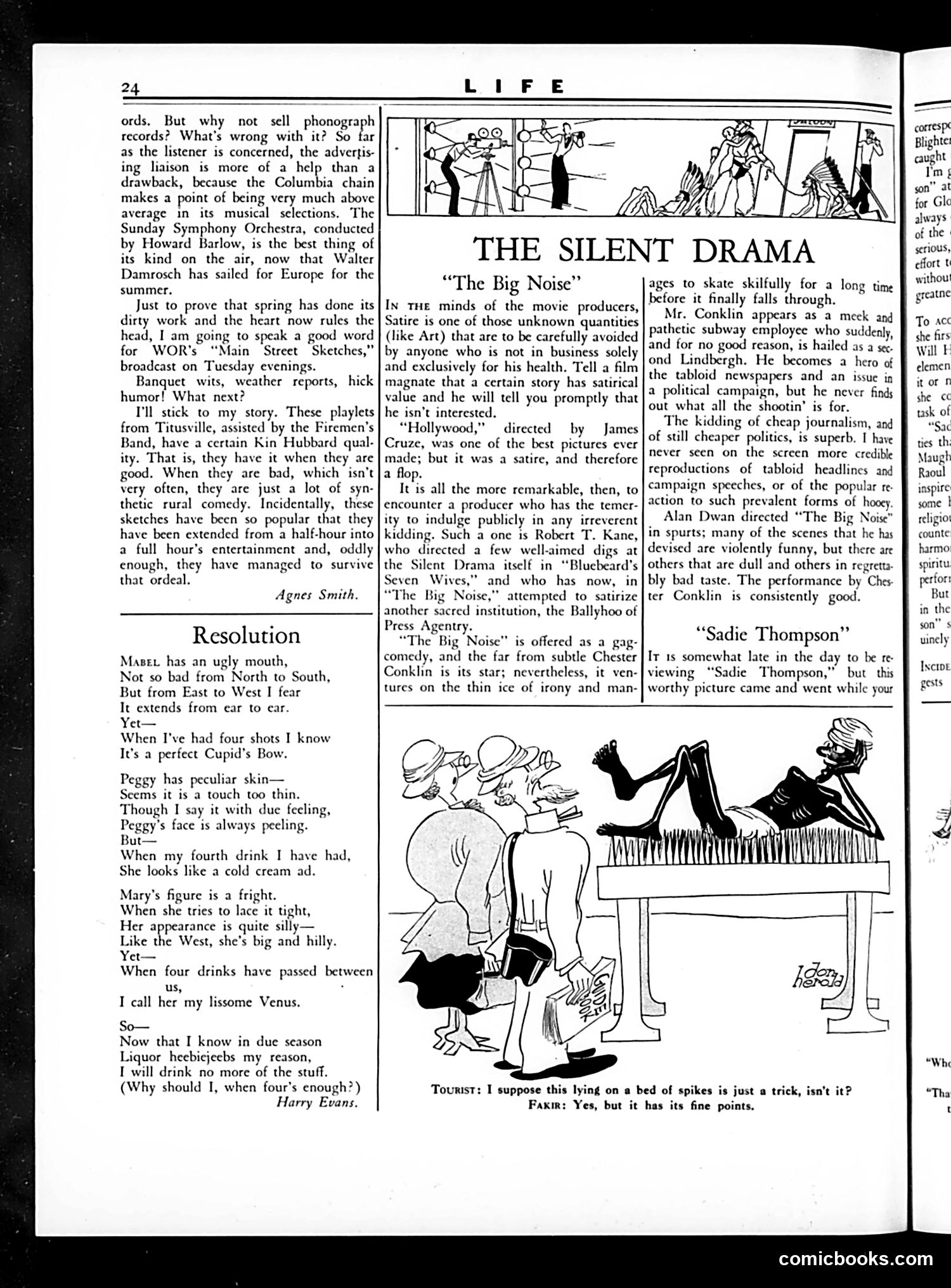
This page from *Life* magazine reviews three films and includes satirical poetry. The main review, "The Big Noise," discusses director Robert T. Kane's rare willingness to satirize Hollywood itself—specifically tabloid journalism, sensationalism, and press agentry. The film stars Chester Conklin as a meek subway worker mistakenly hailed as a hero, becoming entangled in cheap tabloid coverage and political exploitation. The reviewer praises the film's sharp critique of tabloid headlines and public gullibility, noting such satire was uncommon in Hollywood because producers avoided mocking their own industry's practices. The cartoon below depicts two tourists examining a bed of spikes, with one saying it's "just a trick" while the other claims it has "fine points"—likely satirizing tourist gullibility or con artists' ability to make dubious attractions seem legitimate. The "Resolution" poem humorously catalogs women's physical flaws using crude metaphors.
📄 Transcribed text from this page (OCR, searchable)
Machine-transcribed from the original scan — historical spelling and the odd misread are preserved.
ords, But why not sell phonograph records? What's wrong with it? So tar as the listener is concerned, the advertis- ing liaison is more of a help than a drawback, because the Columbia chain makes a point of being very much above average in its musical selections. The Sunday Symphony Orchestra, conducted by Howard Barlow, is the best thing of its kind on the air, now that Walter Damrosch has sailed for Europe for the “i . «99 Summer, re The Big Noise Just to prove that spring has done its]IN tHE minds of the movie producers, dirty work and the heart now rules the | Satire is one of those unknown quantities head, I am going to speak a good word | (like Art) that are to be carefully avoided for WOR's “Main Street Sketches,” | by anyone who is not in business solely broadcast on Tuesday evenings. and exclusively for his health. Tell a film Banquet wits, weather reports, hick | magnate that a certain story has satirical humor! What next? value and he will tell you promptly that T'll stick to my story. These playlets| he isn’t interested. from Titusville, assisted by the Firemen’s} “Hollywood,” directed by James Band, have a certain Kin Hubbard qual-| Cruze, was one of the best pictures ever ity. That is, they have it when they are| made; but it was a satire, and therefore good. When they are bad, which isn’t]a flop. very often, they are just a lot of syn-} It is all the more remarkable, then, to thetic rural comedy. Incidentally, these | encounter a producer who has the temer- sketches have been so popular that they] ity to indulge publicly in any irreverent have been extended from a half-hour into | kidding. Such a one is Robert T. Kane, a full hour's entertainment and, oddly | who directed a few well-aimed digs at enough, they have managed to survive} the Silent Drama itself in “Bluebeard’s that ordeal. seven Wives,” and who has now, in Agnes Smith. he Big Noise,” attempted to satirize another sacred institution, the Ballyhoo of Press Agentry. “The Big Noise” is offered as a gag- comedy, and the far from subtle Chester Conklin is its star; nevertheless, it ven- tures on the thin ice of irony and man- Resolution Maset has an ugly mouth, Not so bad from North to South, But from East to West I fear correspt Blighte: caught I'm son” at for Gle always of the serious, cflort t ages to skate skilfully for a long time without before it finally falls through. greatne Mr. Conklin appears as a meck and To acc pathetic subway employee who suddenly, she firs and for no good reason, is hailed as a sec. B Will f ond Lindbergh. He becomes a hero of elemen the tabloid newspapers and an issue in it or a political campaign, but he never finds Phe cc out what all the shootin’ is for. tsk of The kidding of cheap journalism, and “Sac of still cheaper politics, is superb. I have fP ges th: never seen on the screen more credible Maugh reproductions of tabloid headlines and B Raoul campaign speeches, or of the popular re- J inspire action to such prevalent forms of hooey. some | Alan Dwan directed “The Big Noise” J} religio in spurts; many of the scenes that he has J} counte devised are violently funny, but there are fF harmo others that are dull and others in regrets. JP spiritu bly bad taste. The performance by Ches- rtor ter Conklin is consistently good. But in the F “Sadie Thompson” suey It ts somewhat late in the day to be re I viewing “Sadie Thompson,” but this ts worthy picture came and went while your It extends from ear to ear. Yet— When I've had four shots I know It’s a perfect Cupid’s Bow. Peggy has peculiar skin— Scems it is a touch too thin, Though I say it with due feeling, Peggy's face is always peeling. But— When my fourth drink I have had, She looks like a cold cream ad. Mary’s figure is a fright. When she tries to lace it tight, Her appearance is quite silly— Like the West, she’s big and hilly. Yet— When four drinks have passed between us, . I call her my lissome Venus. So— Now that I know in due season Liquor heebiejeebs my reason, I will drink no more of the stuff. (Why should I, when four’s enough?) Harry Evans. Tourist: I suppose this lying on a bed of spikes is just a trick, isn't it? Fakir: Yes, but it has its fine points. t comicbooks.com