
A complete issue · 42 pages · 1928
Life — May 17, 1928

This is the cover of *Life* magazine from 1928. The prominent headline reads "the second NOW LIFE" in large, bold typography—appearing to announce a major redesign or relaunch of the publication itself. The cover's design is notably modern and geometric, with strong Art Deco styling characteristic of late 1920s graphic design. The masthead sections indicate this issue covers "Amusement News," "Personalities," and "Sport"—standard *Life* magazine content categories of the era. Without additional visible cartoon imagery or satirical figures on this particular page, the primary content appears to be the magazine's self-promotional announcement of its redesign rather than political commentary. The 5-cent price and 1928 date confirm this is from the Jazz Age period.
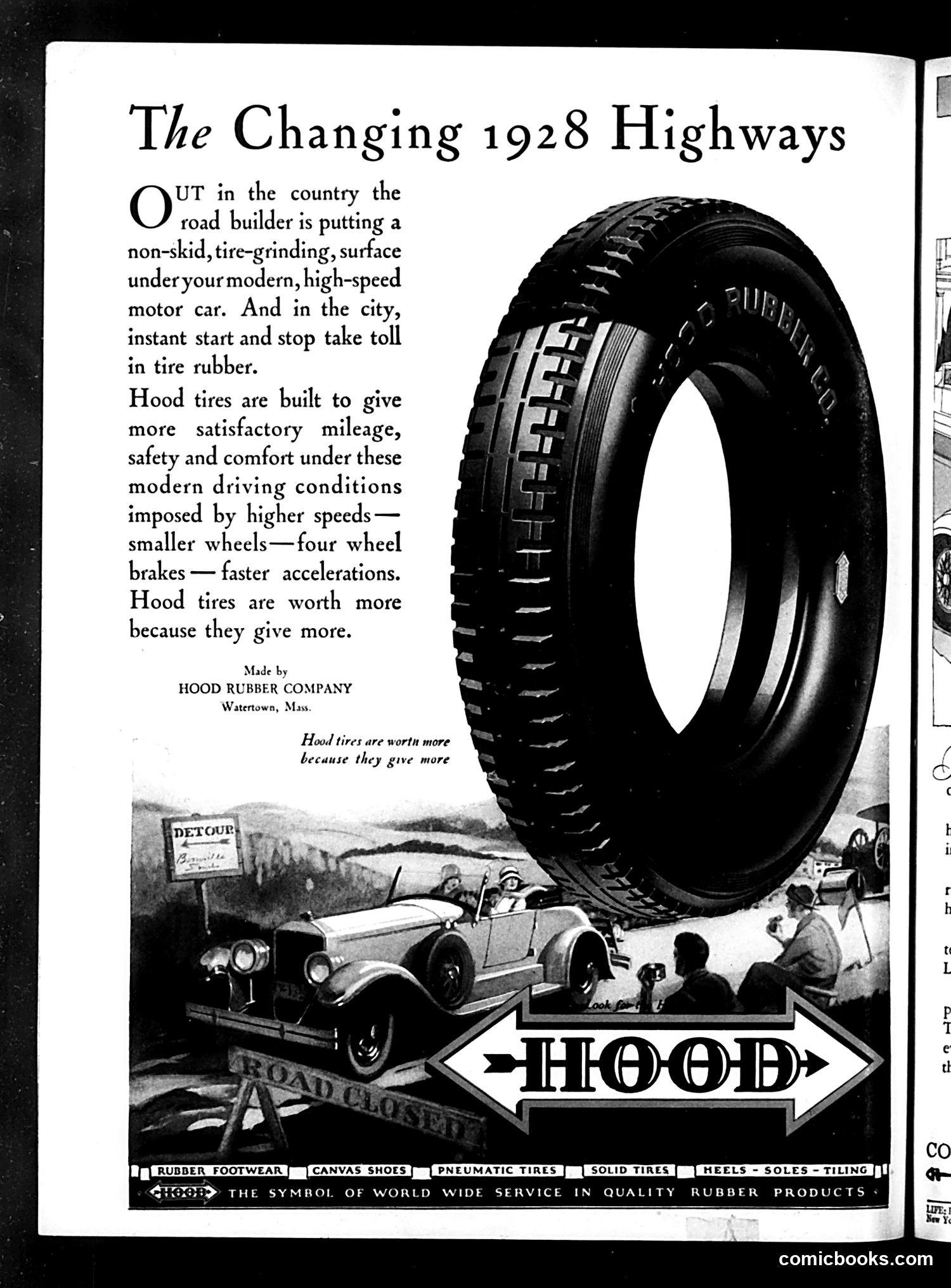
This is primarily **advertising, not satire or political commentary**. It's a 1928 Hood Rubber Company advertisement for tires designed for modern driving conditions. The ad addresses how highways were changing in 1928—roads improving, cars going faster, requiring better tires. Hood tires are promoted as engineered for these new demands: higher speeds, smaller wheels, four-wheel brakes, and rapid acceleration. The visual shows a giant Hood tire displayed at what appears to be a roadside exhibition or fair, with 1920s automobiles and spectators for scale. The tagline "Hood tires are worth more because they give more" emphasizes durability and performance. This reflects the automotive boom of the 1920s and consumer marketing strategies of that era, not political satire.
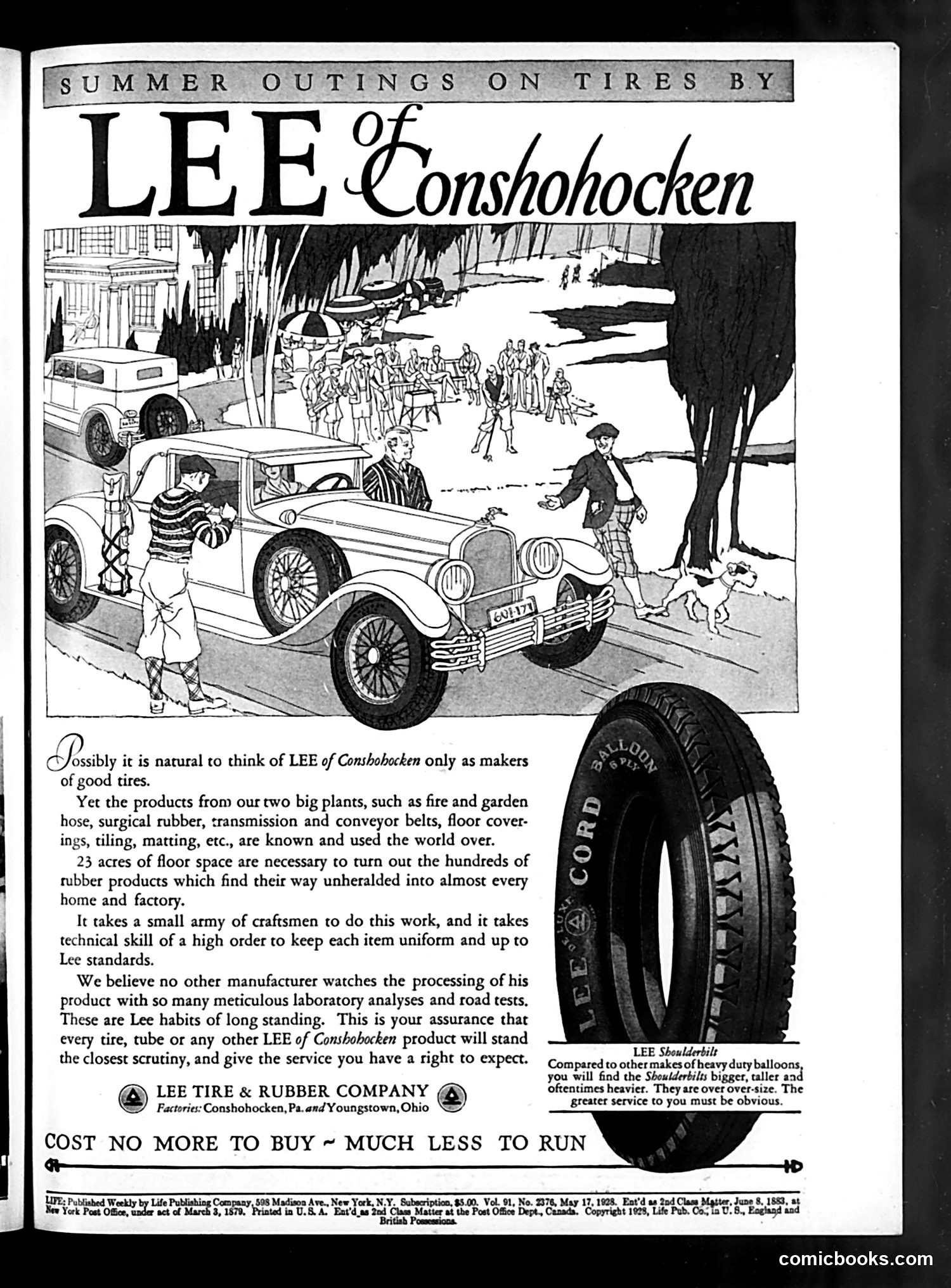
This is primarily a **tire advertisement**, not political satire. The page promotes Lee of Conshohocken tires through an illustrated "summer outing" scene. The illustration depicts a 1920s-era leisure scene: well-dressed people gathered around automobiles near trees, suggesting a picnic or recreational drive. This imagery associates Lee tires with modern leisure activities and prosperity—typical advertising strategy of the era. The text emphasizes Lee's manufacturing credentials: diverse rubber products, quality control, laboratory testing, and "long standing" reliability. The tagline "Cost no more to buy—much less to run" promises value. The large tire image (right side) shows the "Lee Shoulderbilt" model, positioned as superior to competitors' "heavy duty balloons." **This is straightforward commercial advertising, not social or political commentary.**
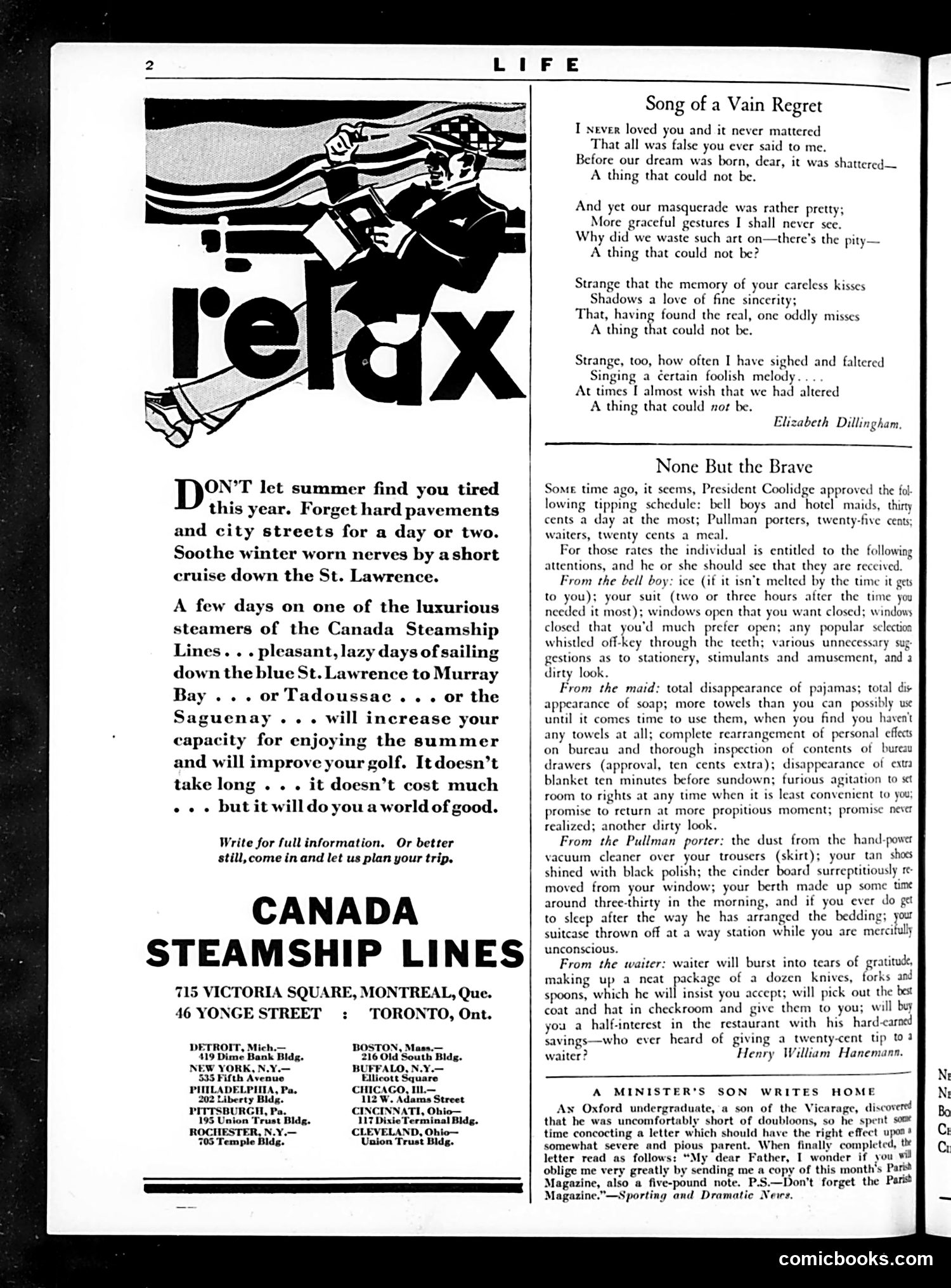
The page is primarily **advertising and literary content** rather than political satire. The dominant image is a **Fernox advertisement** featuring stylized art-deco imagery of a reclining figure—typical 1920s consumer product marketing. The "Song of a Vain Regret" by Elizabeth Dillingham is a romantic poem about a failed relationship, reflecting common magazine verse of the era. The substantive editorial content, "None But the Brave," satirizes **tipping culture and service-industry expectations**—listing absurdly detailed and often contradictory demands guests place on bellhops, maids, Pullman porters, and waiters. The satire criticizes both the unreasonable expectations placed on workers and the workers themselves. This reflects genuine post-WWI tensions over American service standards and labor practices.
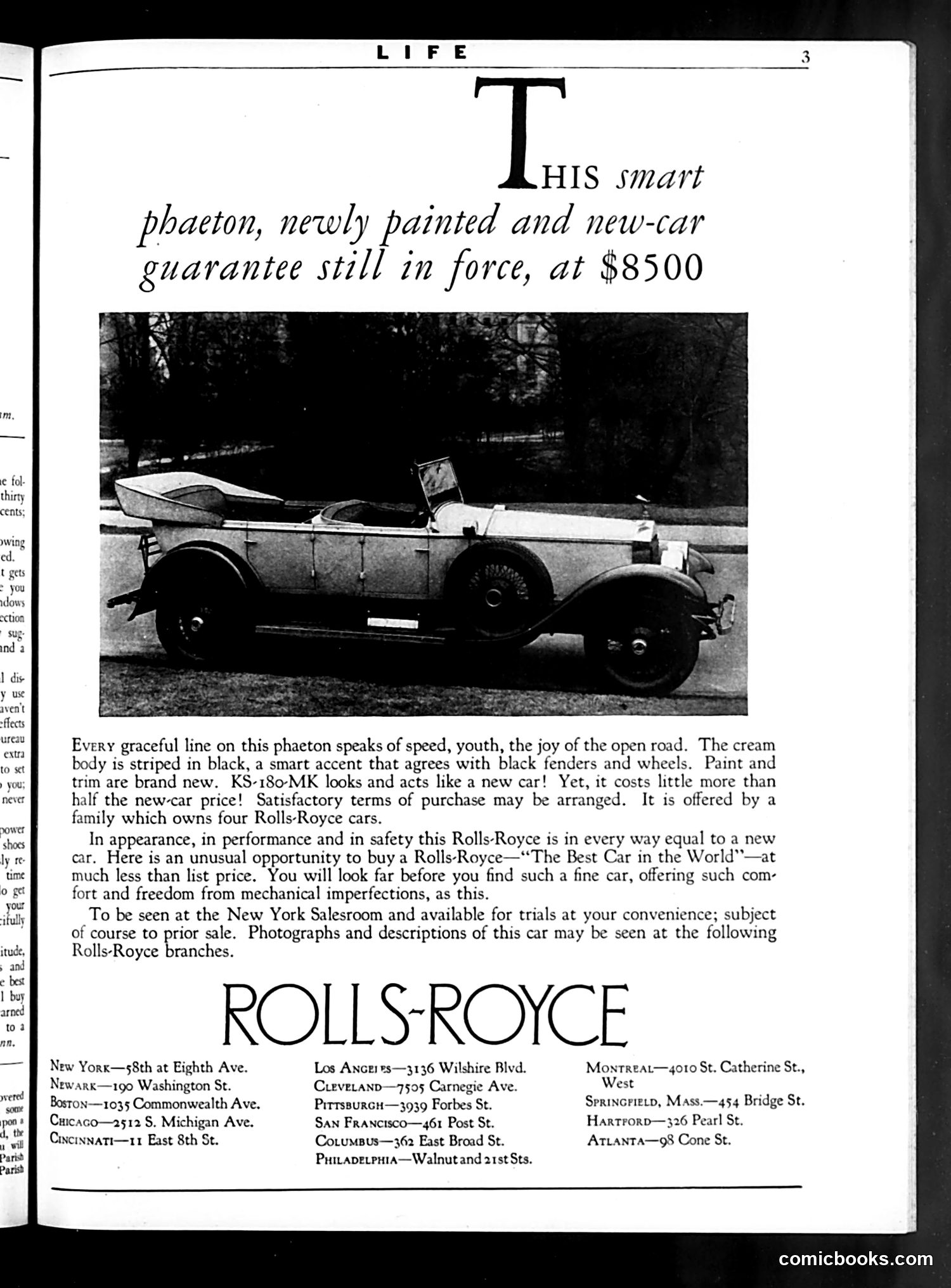
This is **not a cartoon or satire page** — it's a straightforward **automobile advertisement** for Rolls-Royce, appearing in *Life* magazine. The ad features a photograph of a Phaeton model car priced at $8,500. The sales pitch emphasizes that this particular vehicle is "newly painted" with "new-car guarantee still in force," positioning it as nearly equivalent to purchasing new while costing "much less" than the full list price. The text argues this represents an exceptional value: a Rolls-Royce offering "comfort and freedom from mechanical imperfections" at a bargain. The ad concludes with contact information for Rolls-Royce showrooms across major American cities. This reflects the luxury automobile market of the era, targeting wealthy buyers seeking prestige vehicles at discounted prices.
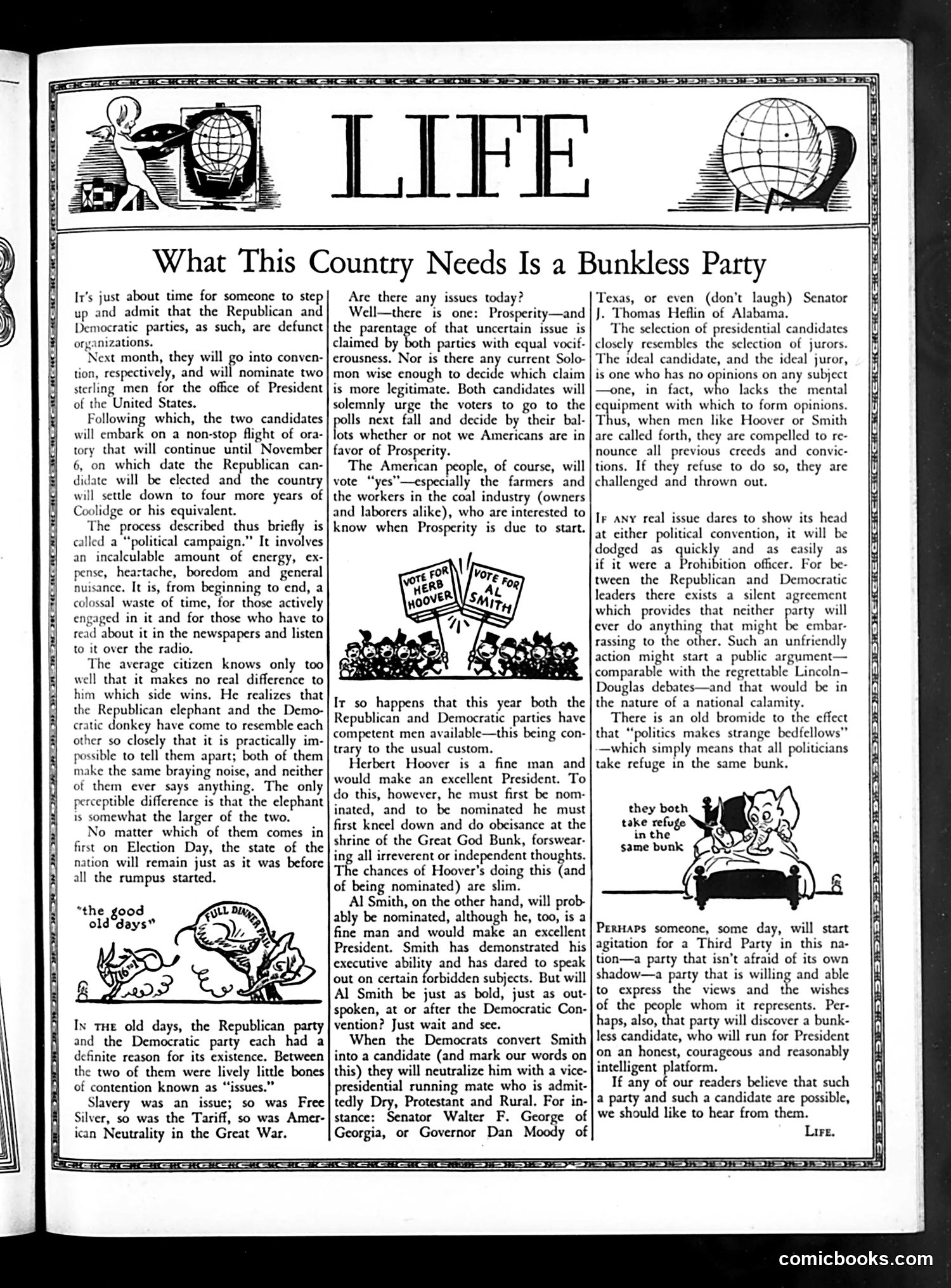
This 1928 editorial argues the U.S. needs a "bunkless party"—a third political party free from entrenched interests. The text criticizes both Republicans and Democrats as indistinguishable, noting they nominate similar candidates (specifically mentioning Herbert Hoover for Republicans and Al Smith for Democrats). The cartoons illustrate this critique: one shows two voting booths labeled identically ("VOTE FOR HOOVER"/"VOTE FOR SMITH"), emphasizing they're interchangeable choices. Another depicts politicians taking refuge in the same bunk, suggesting parties are fundamentally alike despite their rivalry. The author sarcastically observes that real issues (prosperity, prohibition) are obscured by partisan theater. The satire advocates for genuine political alternatives rather than the current two-party system offering voters false choices.
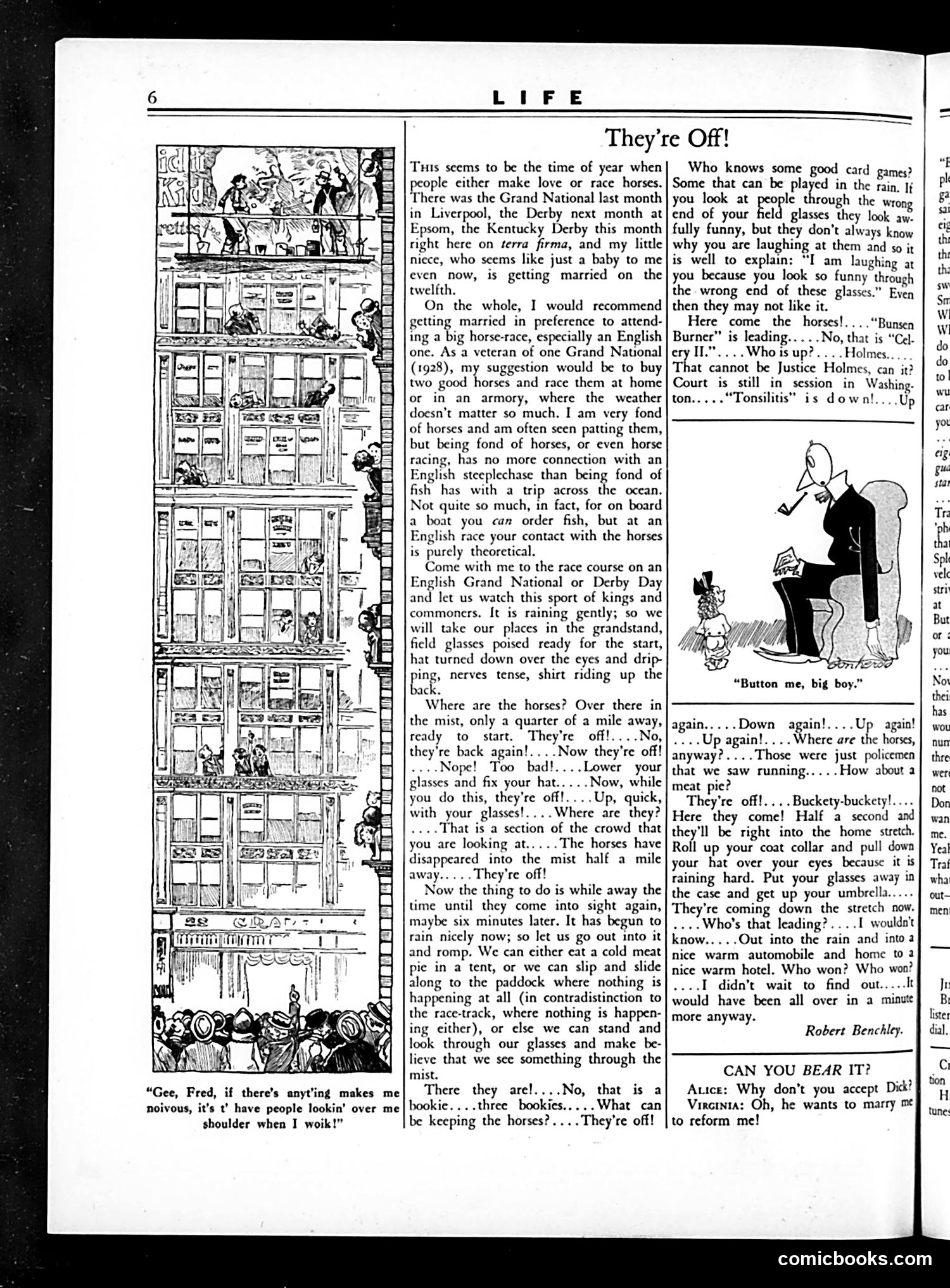
This page satirizes the British horse racing season, specifically the Grand National and Derby races mentioned in the text. The tall building illustration on the left depicts spectators crammed into windows and packed structures watching a race—a visual joke about the crush of crowds at these events. The accompanying article by Robert Benchley humorously describes the chaos of race day: people losing their glasses, shouting confusingly about horse positions, and the general pandemonium. The small cartoon at bottom right shows a man telling a boy to "Button me, big boy"—likely a visual gag playing on racing terminology or class-based awkwardness. The satire mocks both the pretension of English racing culture and the human confusion it generates among spectators.
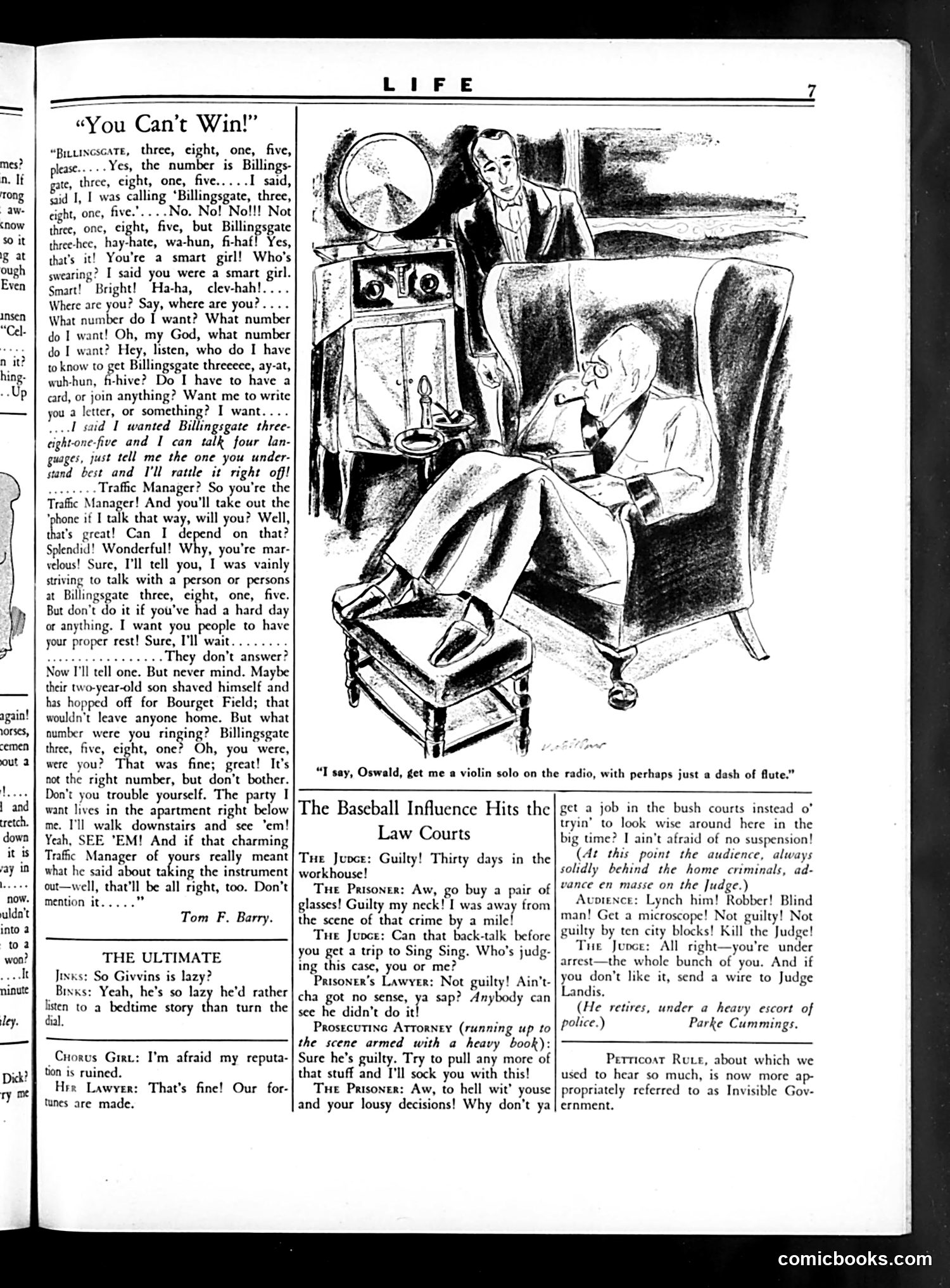
This page contains **three satirical pieces** about communication and legal absurdity: 1. **"You Can't Win!"** (top): A monologue by someone frustrated after repeatedly trying to reach "Billingsgate" by phone, getting transferred between departments. The satire targets **telephone system inefficiency and bureaucratic runarounds**—a common complaint about early 20th-century switchboard operations. 2. **The cartoon** (center): Shows a man in a chair speaking to someone operating what appears to be early radio/broadcast equipment. The caption requests a violin solo "with perhaps just a dash of flute"—mocking **radio programming requests or listener demands**. 3. **"The Baseball Influence Hits the Law Courts"** (bottom): A courtroom sketch satirizing how **casual baseball language has infiltrated legal proceedings**, with characters using sports terminology inappropriately in serious judicial settings.
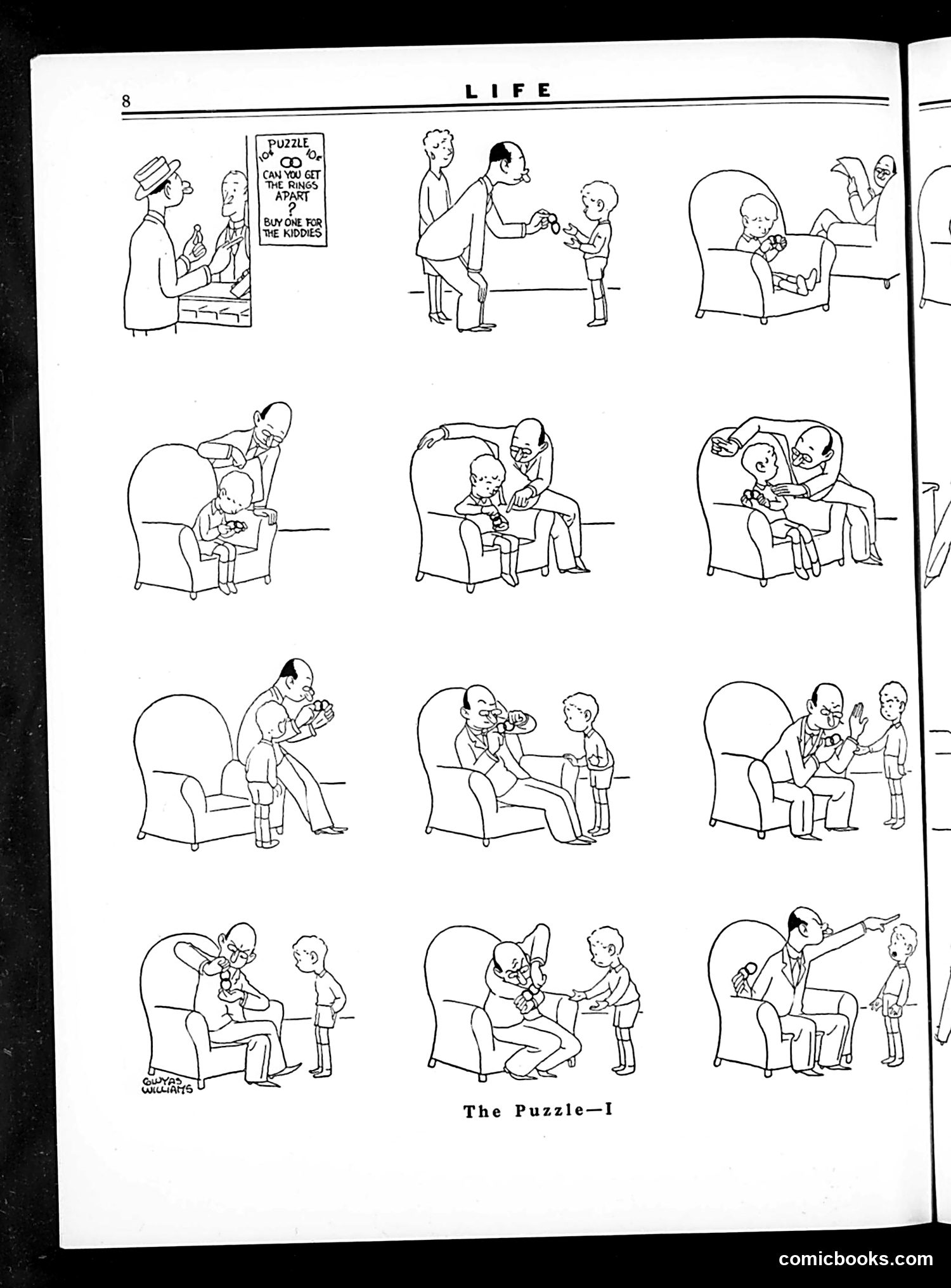
This multi-panel cartoon depicts a father attempting to assemble a jigsaw puzzle while his young son repeatedly interrupts him with questions and requests for attention. The humor lies in the mounting frustration visible in the father's expressions across successive panels as the child's persistence escalates—from simple interruptions to increasingly demanding behavior. The satirical point targets parental patience and the clash between a father's desire for quiet leisure time and the relentless demands of childcare. The top panel shows a store puzzle labeled "Can you get these pieces apart? Buy one. He kidnaps," suggesting the puzzle itself is deliberately frustrating—a meta-joke about the toy's design. This gentle domestic satire reflects mid-20th-century attitudes about father-child dynamics and parental exasperation.
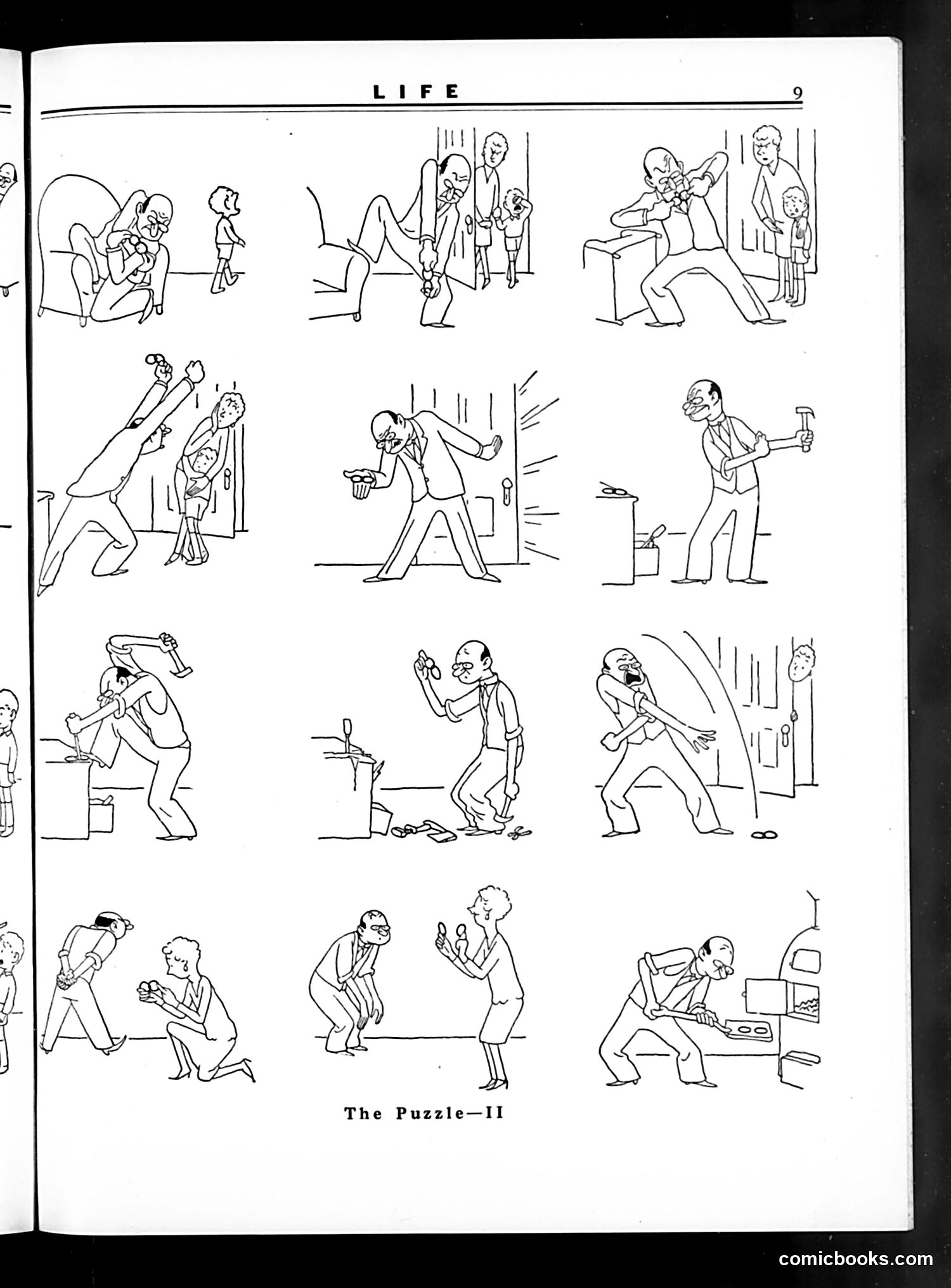
This page presents a visual puzzle or comic strip depicting a domestic dispute between a husband and wife. The sequential panels show escalating conflict: the man appears frustrated or angry while the woman reacts with alarm or resistance. The scenes progress through various confrontational moments—arguing, physical gestures of exasperation, and what appears to be property damage or chaos. The satire likely mocks marital discord common to early 20th-century domestic life, presenting the "puzzle" as: what causes such household conflicts? The exaggerated body language and expressions are typical of Life magazine's humorous commentary on middle-class American relationships. Without a caption explaining the specific resolution, readers were expected to interpret the husband-wife dynamic themselves.
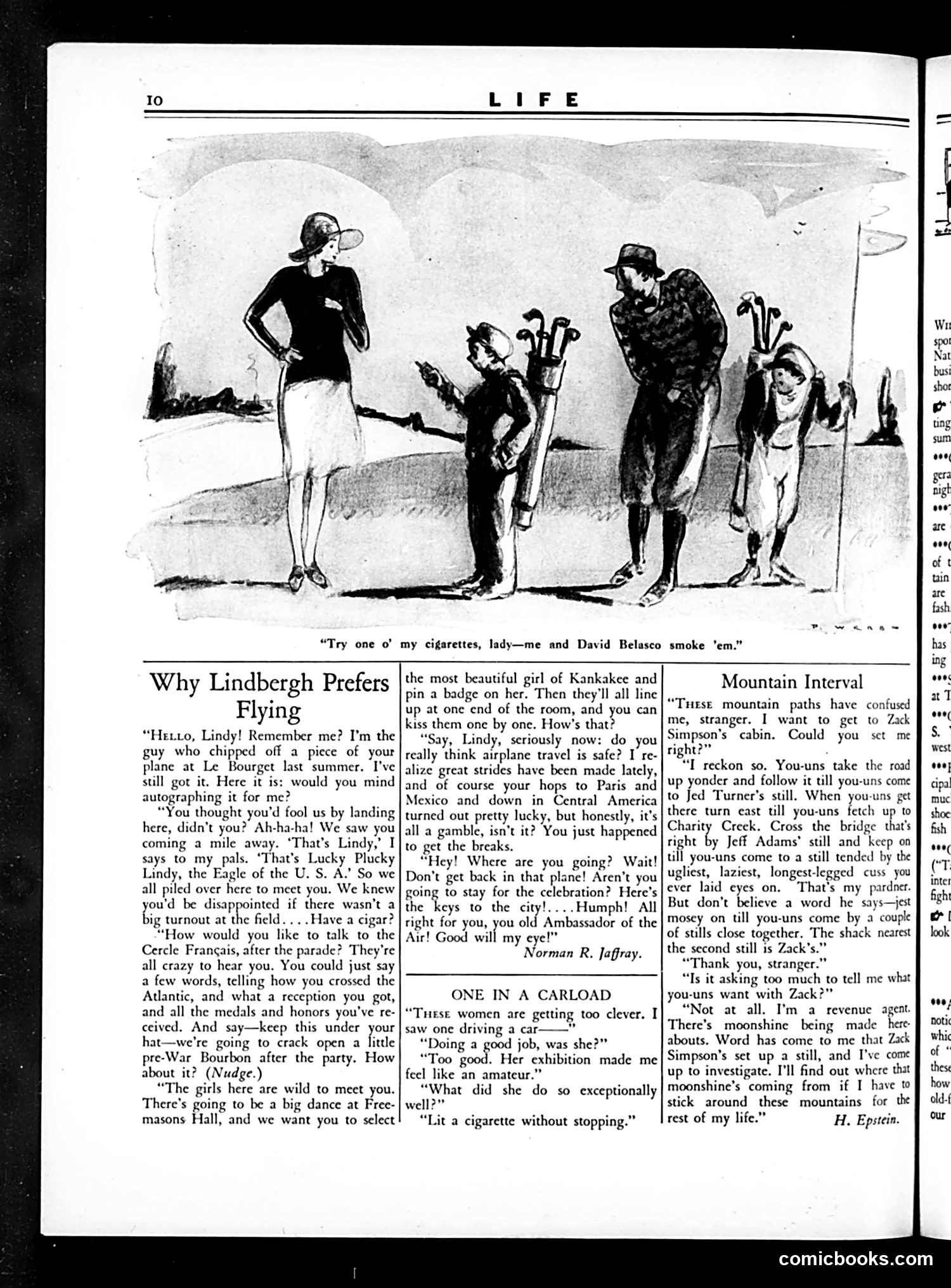
The main cartoon depicts a woman in 1920s attire standing with several men holding golf clubs, with the caption "Try one o' my cigarettes, lady—me and David Belasco smoke 'em." **Key figures and references:** - **David Belasco** was a famous Broadway producer/director of the era, referenced here as a celebrity endorsement - The woman appears to be **Lindbergh** (likely referencing Charles Lindbergh's wife or a female aviator contemporary) - The cartoon satirizes how women were adopting traditionally male behaviors—smoking cigarettes and golfing—during the 1920s **The satire:** The joke mocks the "modern woman" phenomenon of the Jazz Age, showing women entering spaces (smoking, golf) previously reserved for men, while using celebrity endorsement as implied social approval. It reflects anxiety about changing gender roles post-suffrage.
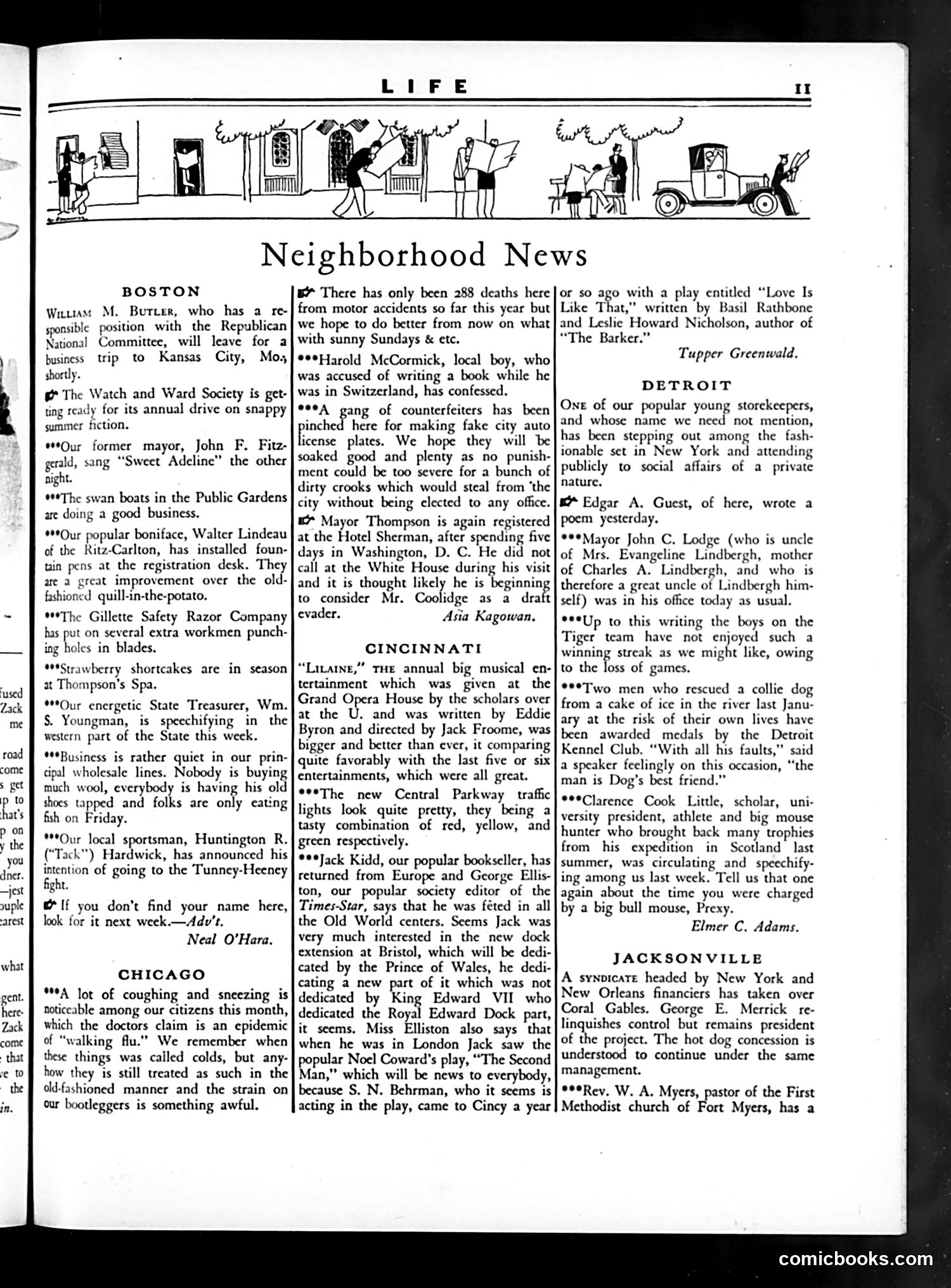
This is a "Neighborhood News" column page featuring brief social and local gossip items from various American cities (Boston, Chicago, Cincinnati, Detroit, Jacksonville). The illustrated header shows everyday neighborhood scenes—people visiting, socializing, working—representing typical community life. The content consists of short, humorous anecdotes about local personalities and happenings: a mayor's involvement in a play, a storekeeper courting in New York, a poet writing, a dog rescue, a university athlete, and various civic activities. The items use gentle satire to poke fun at small-town pretensions and quirky local characters. This appears to be Life magazine's regular "gossip column" format, designed to amuse readers through relatable, lighthearted observations about American suburban and urban community life of the era.
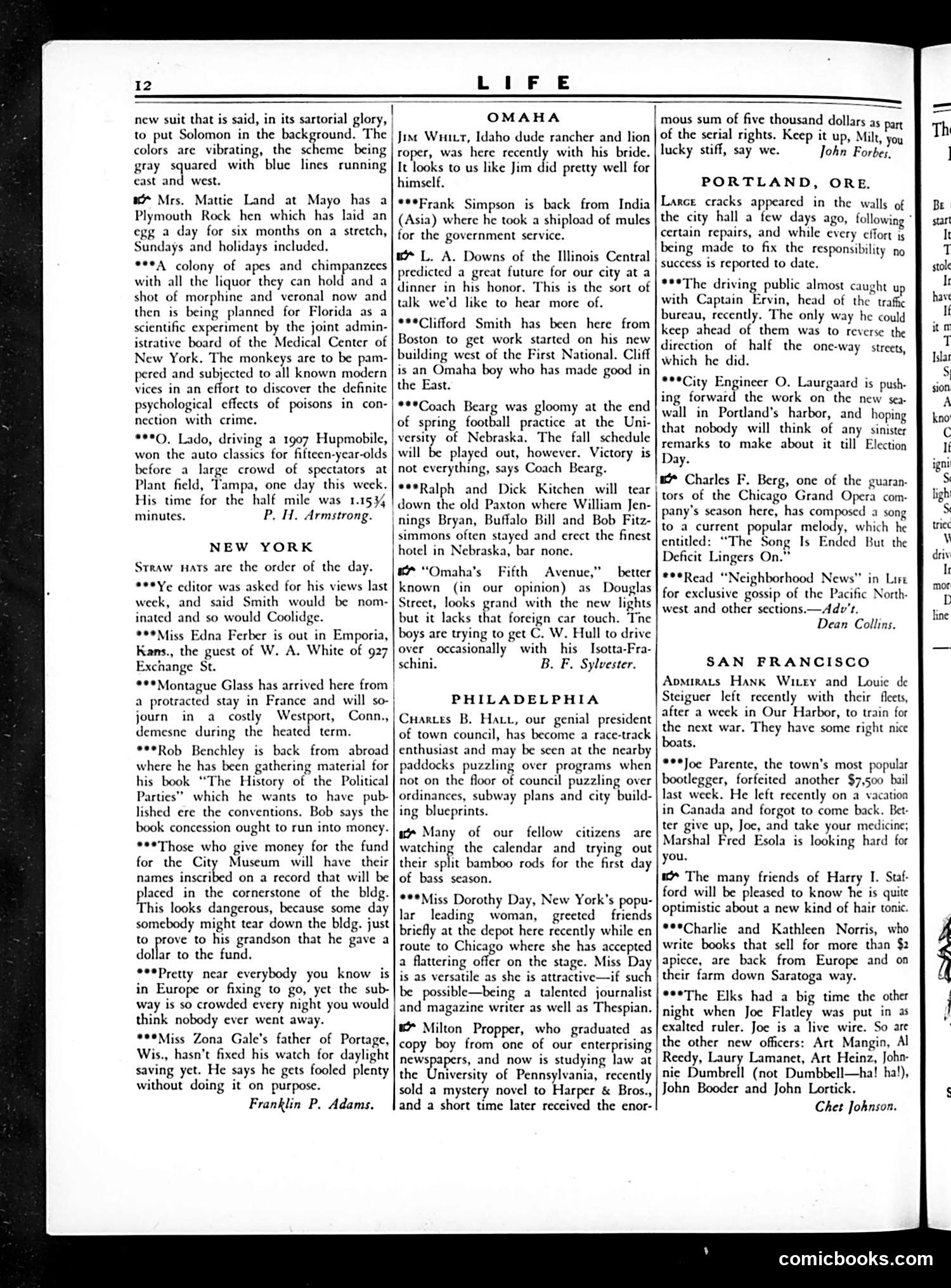
This page from *Life* magazine consists entirely of **gossip and social commentary columns** organized by city (Omaha, New York, Philadelphia, Portland, San Francisco). There are **no cartoons or satirical illustrations** visible. The content reports on local personalities and events: a new building at Omaha's First National City Bank, Chicago Opera Company news, a race-track enthusiast council president in Philadelphia, and various social happenings. The "satire" here is gentle and social rather than political—the magazine mocks small-town gossip, romantic entanglements, and minor civic developments through the affected tone of society column writing itself. Without seeing accompanying illustrations or advertisements, the page's main function appears to be chronicling the trivial doings of minor public figures across American cities.
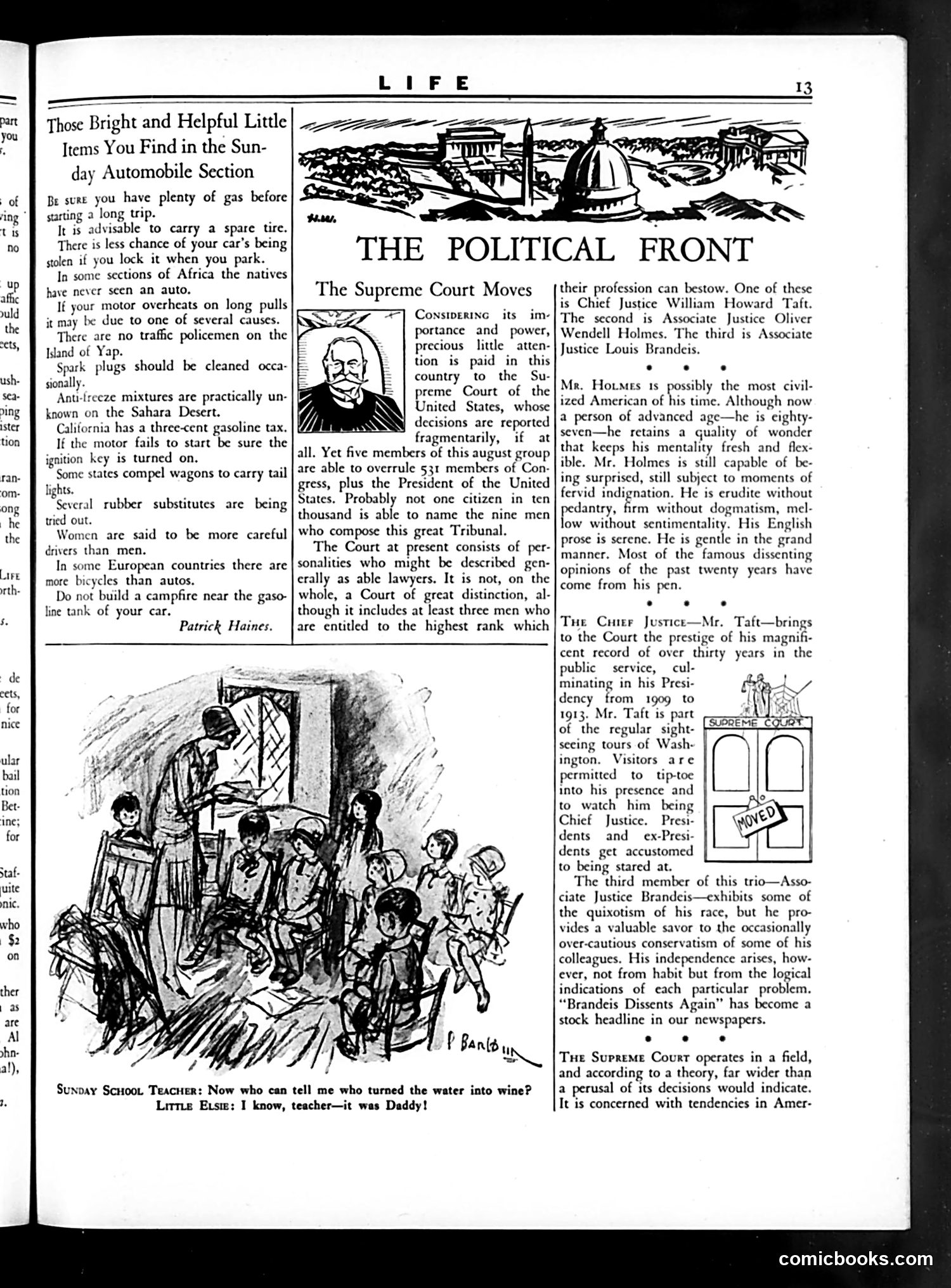
This page discusses the U.S. Supreme Court, emphasizing its importance and the nine justices who compose it. The text identifies three specific justices: Chief Justice William Howard Taft and Associate Justices Oliver Wendell Holmes and Louis Brandeis. The cartoon below depicts a Sunday school scene where a teacher asks "Now who can tell me who turned the water into wine? Little Elise: I know, teacher—it was Daddy!" The joke satirizes how children attribute miraculous or impossible accomplishments to their fathers, likely serving as a humorous commentary on how the general public mythologizes or exaggerates the capabilities of public figures—perhaps a subtle jab at the veneration of Supreme Court justices or political leaders more broadly.
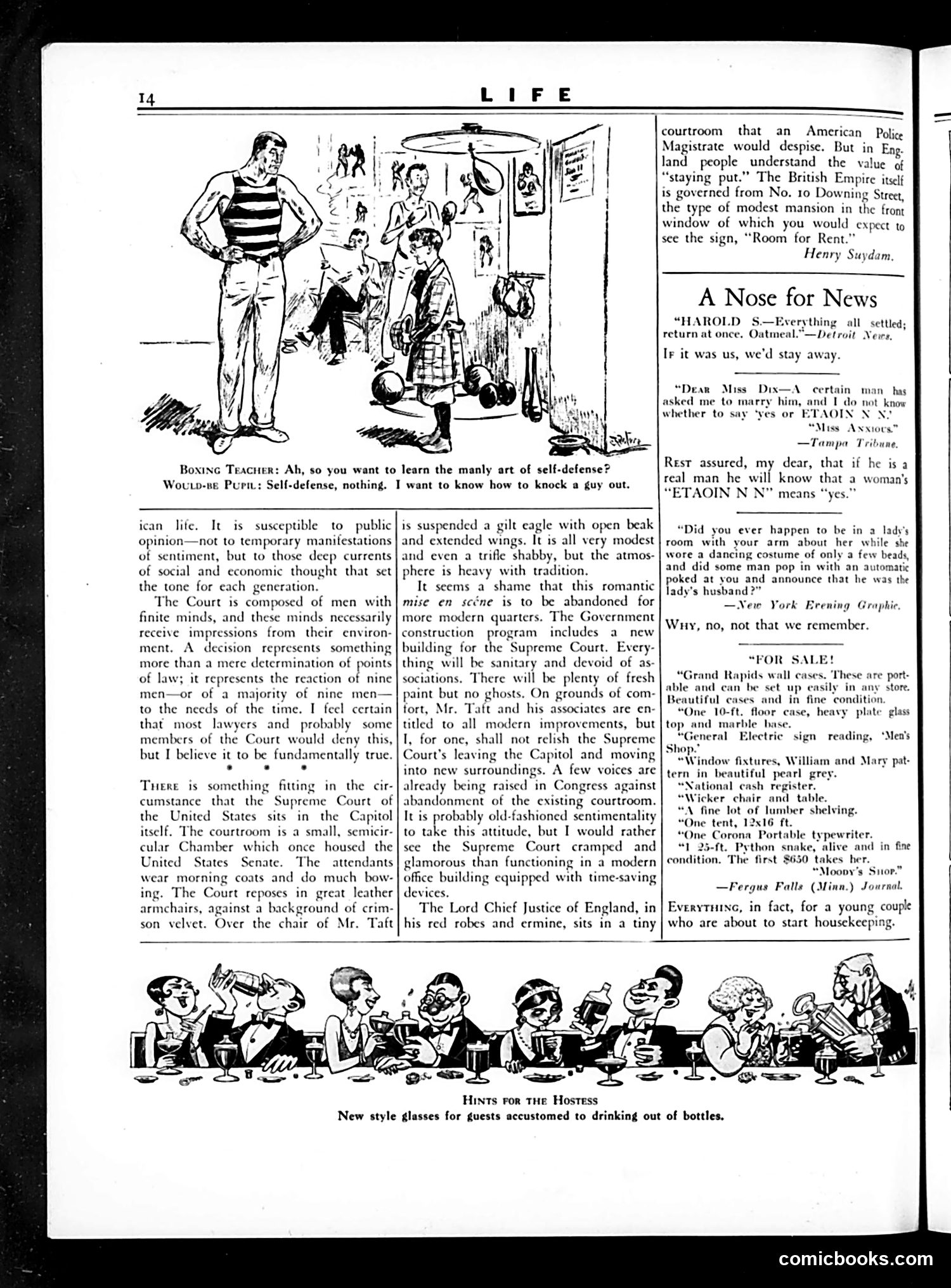
The main cartoon shows a boxing instructor telling a would-be pupil that self-defense means "I want to know how to knock a guy out"—a joke about practical violence versus theoretical martial arts. The page primarily contains **advertising** and brief humorous snippets rather than substantial political satire. The "For Sale!" section lists various household items and novelties. "Hints for the Hostess" at bottom offers comic advice about drinking glasses for bottles—likely Prohibition-era humor, since serving alcohol from bottles was illegal. The other text snippets are romantic/domestic humor ("A Nose for News") typical of Life's general satirical content, not focused on specific political figures or events. This appears to be a **general humor and lifestyle page** rather than pointed political commentary.
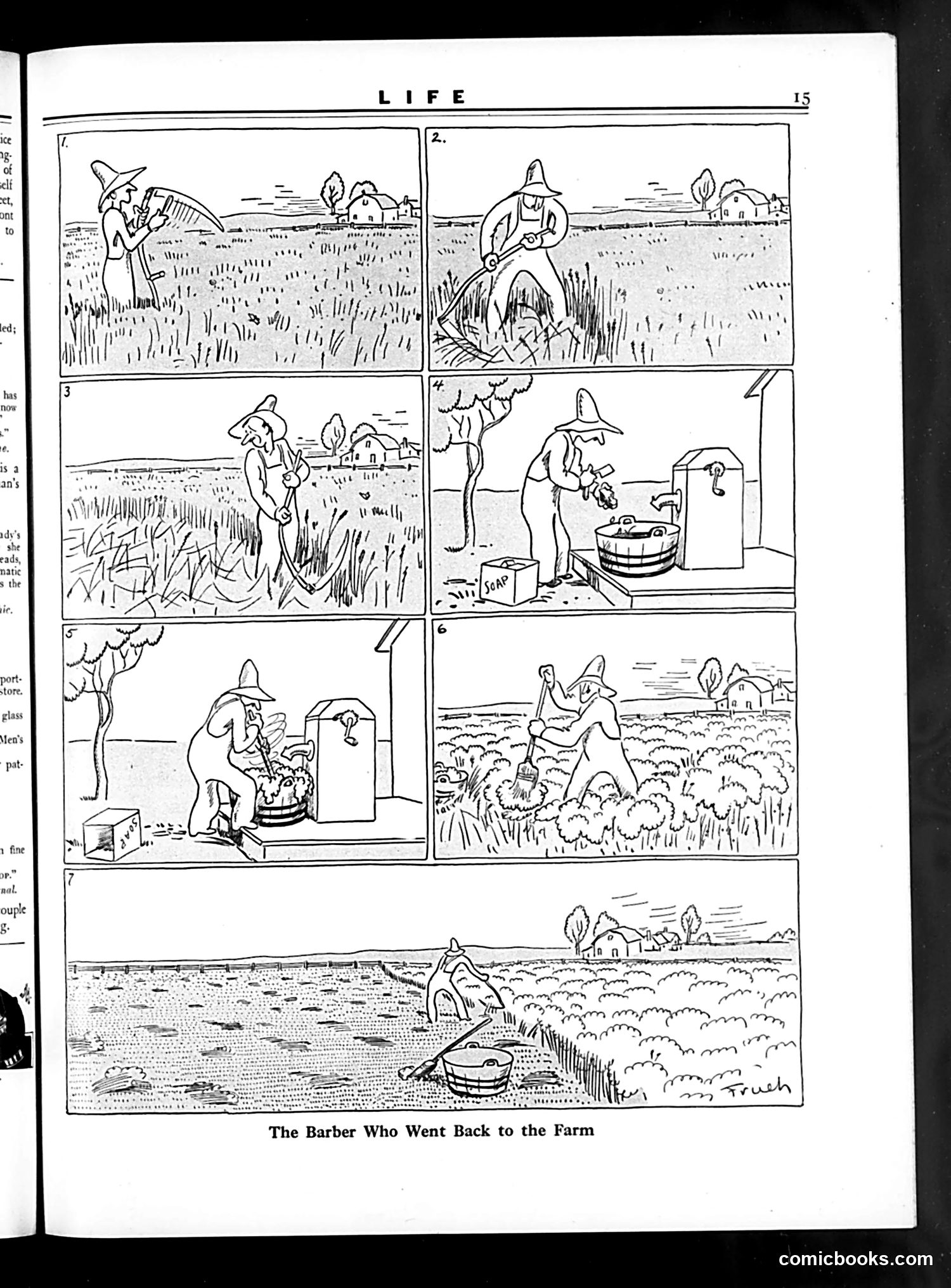
This seven-panel comic tells a humorous story about occupational change during what appears to be an agricultural period in American history. The narrative follows a barber who abandons his urban trade to return to farming. The sequence shows: the barber leaving barber work, attempting farm labor (cutting grain), struggling with physical farm tasks, performing household chores, and ultimately working the land. The satire likely mocks either the romanticization of farm life or the difficulty urbanites face attempting agricultural work—a commentary on the appeal versus reality of returning to rural occupations. The comic reflects early-20th-century tensions between urban and rural American life, when such career transitions were culturally noteworthy enough to merit satirical treatment in *Life* magazine.
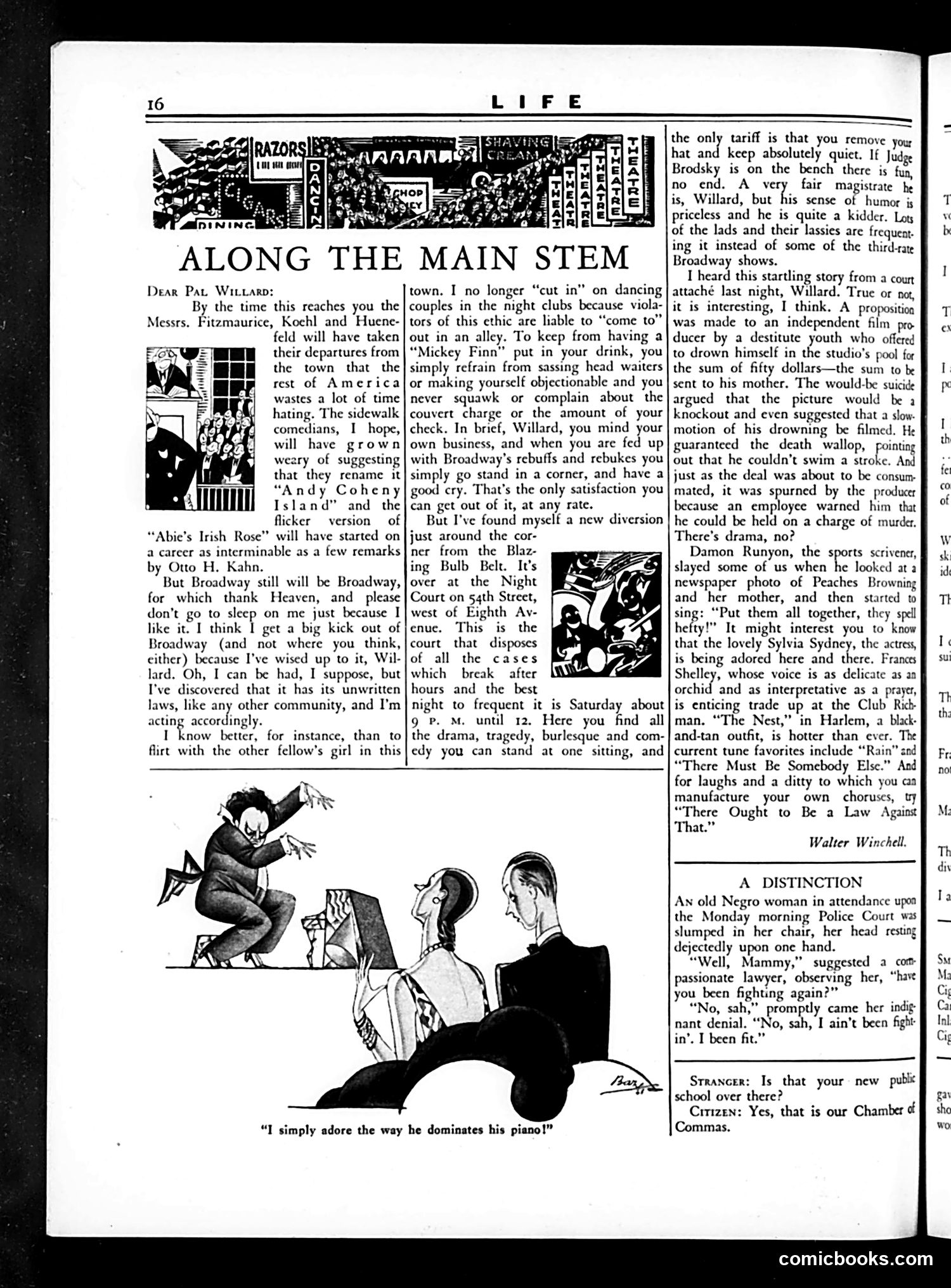
This page contains a column by "Dear Pal Willard" offering Broadway gossip and theater commentary. The main cartoon depicts a man at a piano with two onlookers; the caption reads "I simply adore the way he dominates his piano," likely satirizing pretentious artistic posturing. The text discusses Broadway shows, including mentions of "Abie's Irish Rose" and references to dancer Mickey Finn and actress Sylvia Sydney. A separate brief anecdote titled "A Distinction" presents a humorous exchange between a lawyer and an elderly Black woman in court, with dated racial stereotyping typical of 1920s-era humor. The page exemplifies early Life magazine's focus on urban entertainment, social observation, and period-specific comedic conventions.
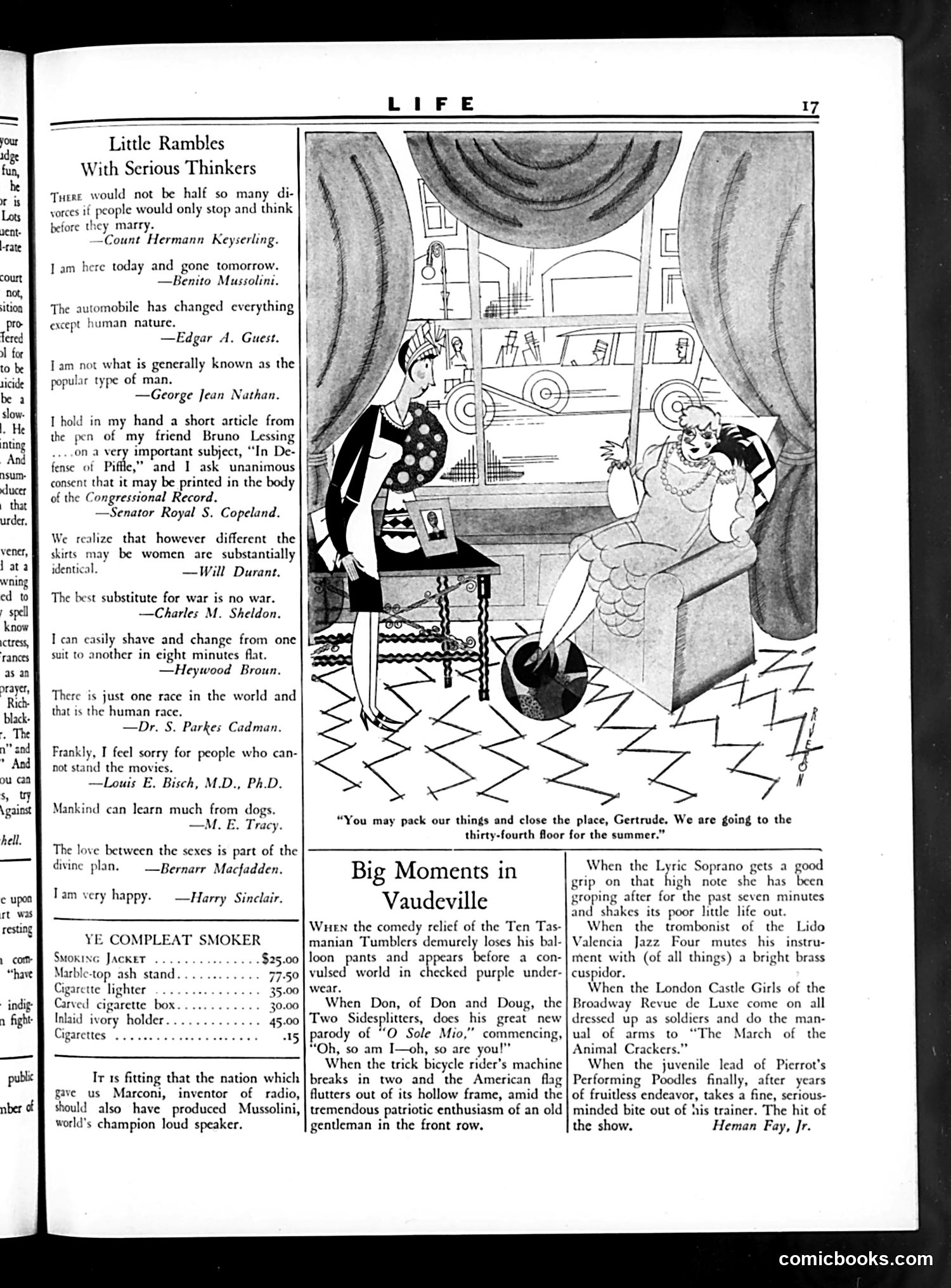
The main cartoon depicts a couple in a modernist apartment preparing to move to the thirty-fourth floor. The woman (labeled "Gertrude") appears to be packing belongings while the man holds what looks like a bowling ball. The joke satirizes urban living trends of the era—specifically the growing popularity of high-rise apartment living and the absurdity of moving frequently between upper floors. The cartoon's humor relies on the contrast between domestic activity (packing) and the impracticality of modern city life. The angular, geometric floor pattern and streamlined furniture suggest the "modern" aesthetic of the 1920s-30s. The "thirty-fourth floor" reference highlights how common vertical urban migration had become among apartment dwellers seeking fashionable addresses.
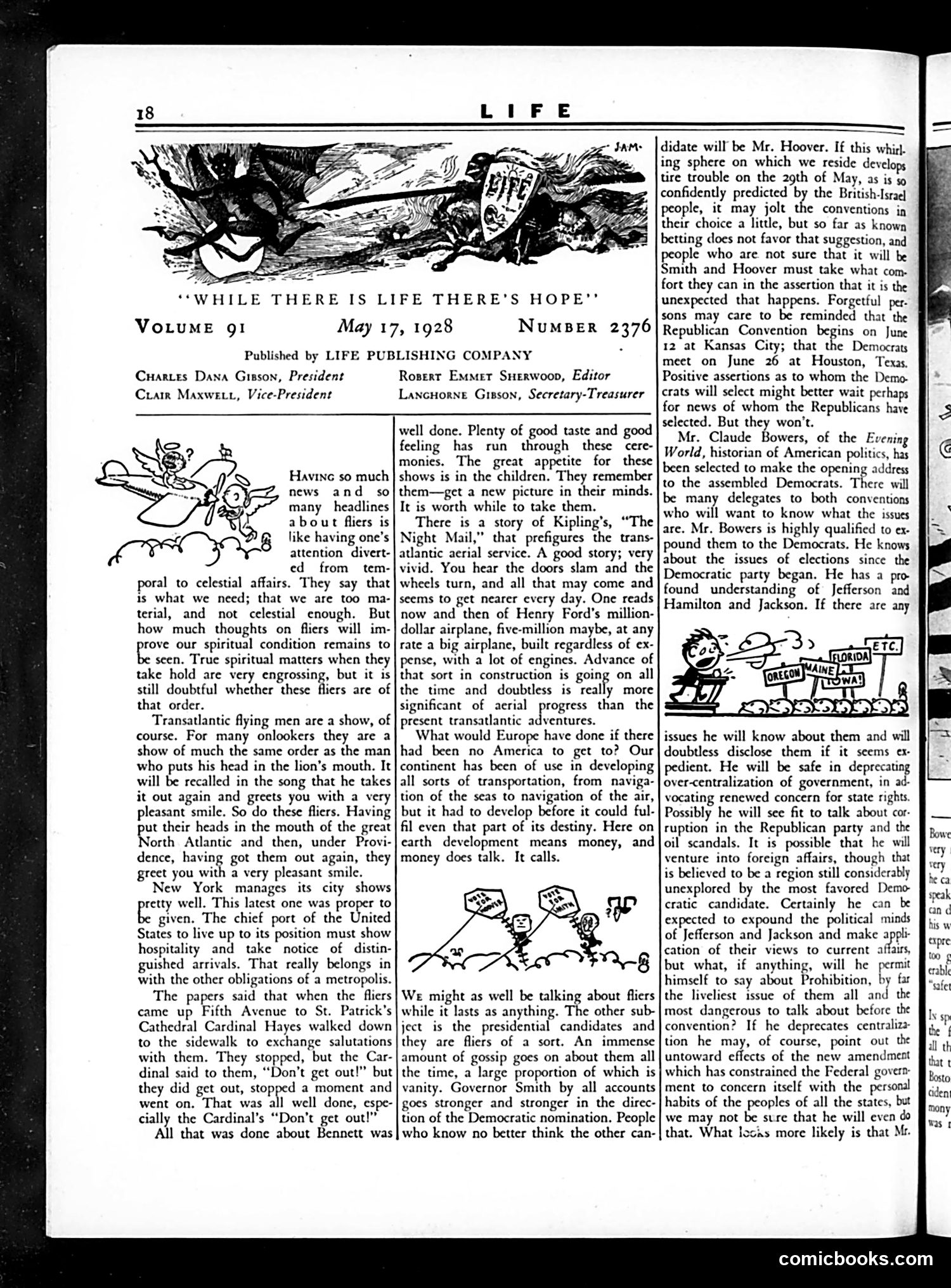
This page satirizes American obsession with transatlantic aviation while dismissing it as entertainment distraction from serious matters—specifically the 1928 presidential election. The main editorial compares transatlantic fliers (appearing to reference recent aviators like Bennett) to circus performers, praising New York's hospitality toward them while questioning their spiritual or practical significance. The piece notes Henry Ford's million-dollar airplane project, suggesting technological advancement matters more than stunts. The real target emerges in the second section: the presidential race. The editor dismisses gossip about candidates as "vanity," noting Governor Smith's growing Democratic support while predicting the Republican nominee will be Mr. Hoover. A joke references a British-Israel prediction of Earth's "tire trouble" on May 29th, sarcastically suggesting this cosmic event might "jolt the conventions in their choice." The cartoons (partially visible) likely mock these political figures and public distraction from substantive campaign issues.
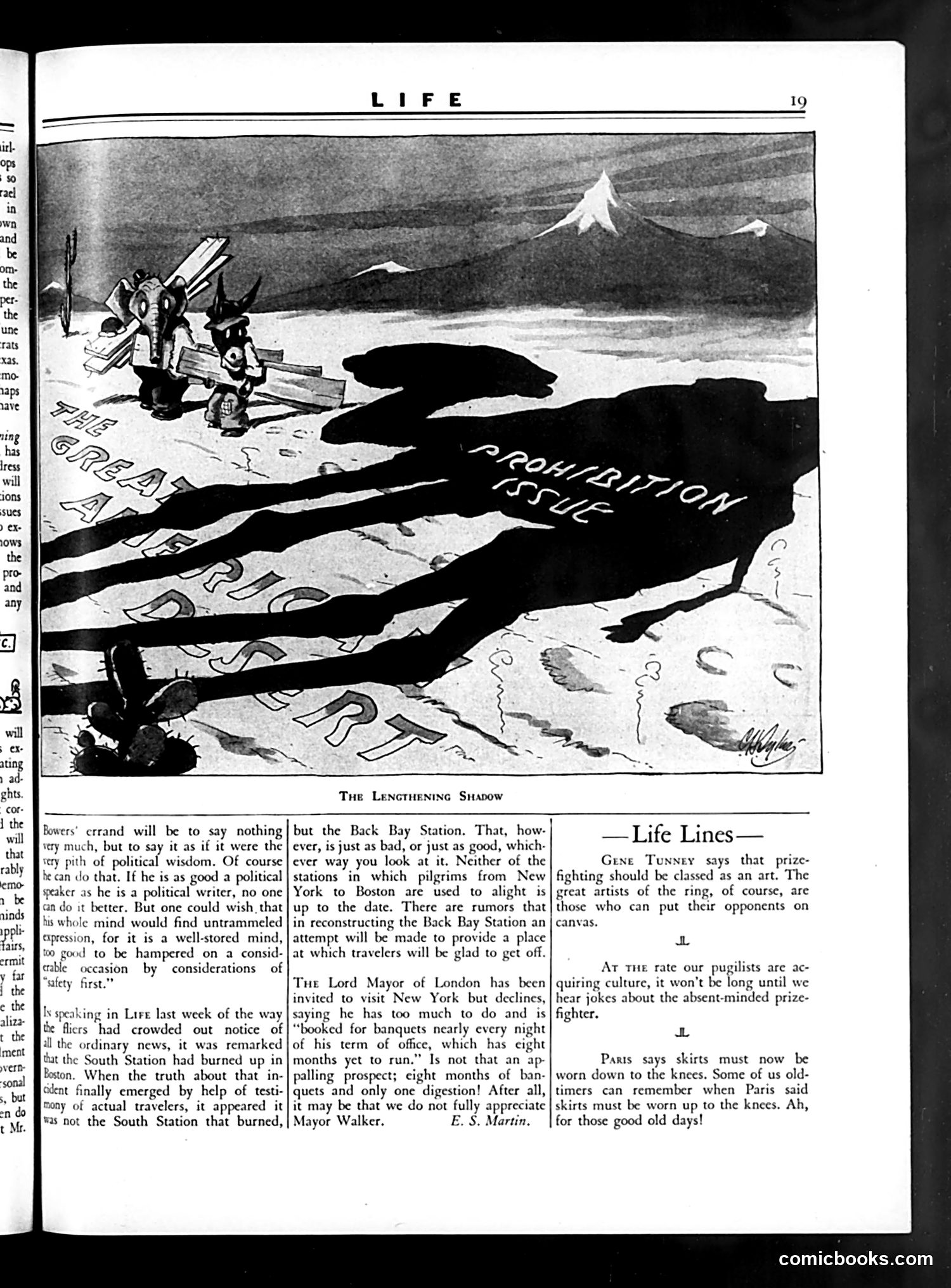
This cartoon satirizes **Prohibition's expanding enforcement**, depicted as a menacing shadow creeping across the landscape. Two figures (appearing to be bootleggers or ordinary citizens) stand amid scattered prohibition-related materials, dwarfed by the ominous silhouette labeled "PROHIBITION" and "ISSUE." The "lengthening shadow" metaphor suggests Prohibition's growing, inescapable reach into American life. The barren, desolate setting—with a distant volcano—emphasizes the bleakness of the policy's consequences. The accompanying text discusses political speakers like Bowers who speak cautiously about contentious issues, and includes sardonic commentary on Boston's Back Bay Station fire (a real incident buried under other news) and London's Lord Mayor declining a New York visit due to excessive banquet obligations. The "Life Lines" section offers brief satirical quips, including one mocking prize-fighter Gene Tunney's claim that boxing is an "art"—a joke about opponents being "put on canvas." **Context**: This reflects 1920s American frustration with Prohibition's strict enforcement and pervasive social impact.
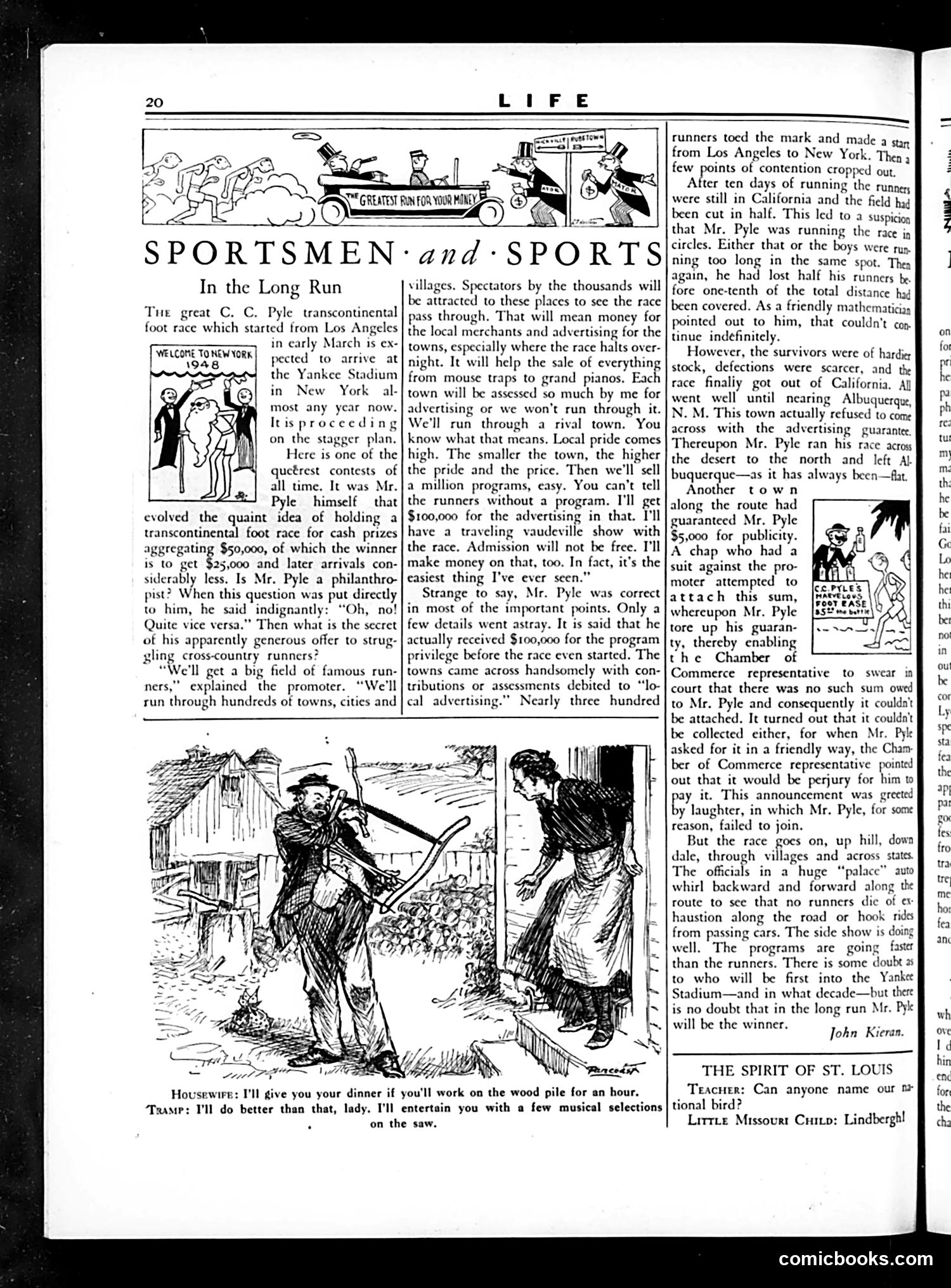
This 1920s *Life* magazine article satirizes promoter C.C. Pyle's transcontinental foot race—a real event that started from Los Angeles toward New York. The satire targets Pyle's entrepreneurial ruthlessness masked as philanthropy. **The joke:** Pyle claims altruism but openly admits extracting money from every angle—charging towns "advertising fees" to run through them, selling programs (claiming runners can't be identified without them), operating a traveling vaudeville show, and profiting enormously while runners drop out en masse. **The cartoon** (bottom left) shows a tramp proposing musical saw entertainment to a housewife—a visual pun on the race's "stagger plan" (slow progress) and general hustling that mirrors Pyle's scheme. **The satire's point:** American capitalism during the Roaring Twenties often dressed naked profit-seeking in noble language. Pyle embodies this perfectly—he's innovative and legally clever, but flagrantly exploitative. The race's comedic failures (losing half the field in California, disputes with towns) prove the scheme prioritizes money over actual runners.
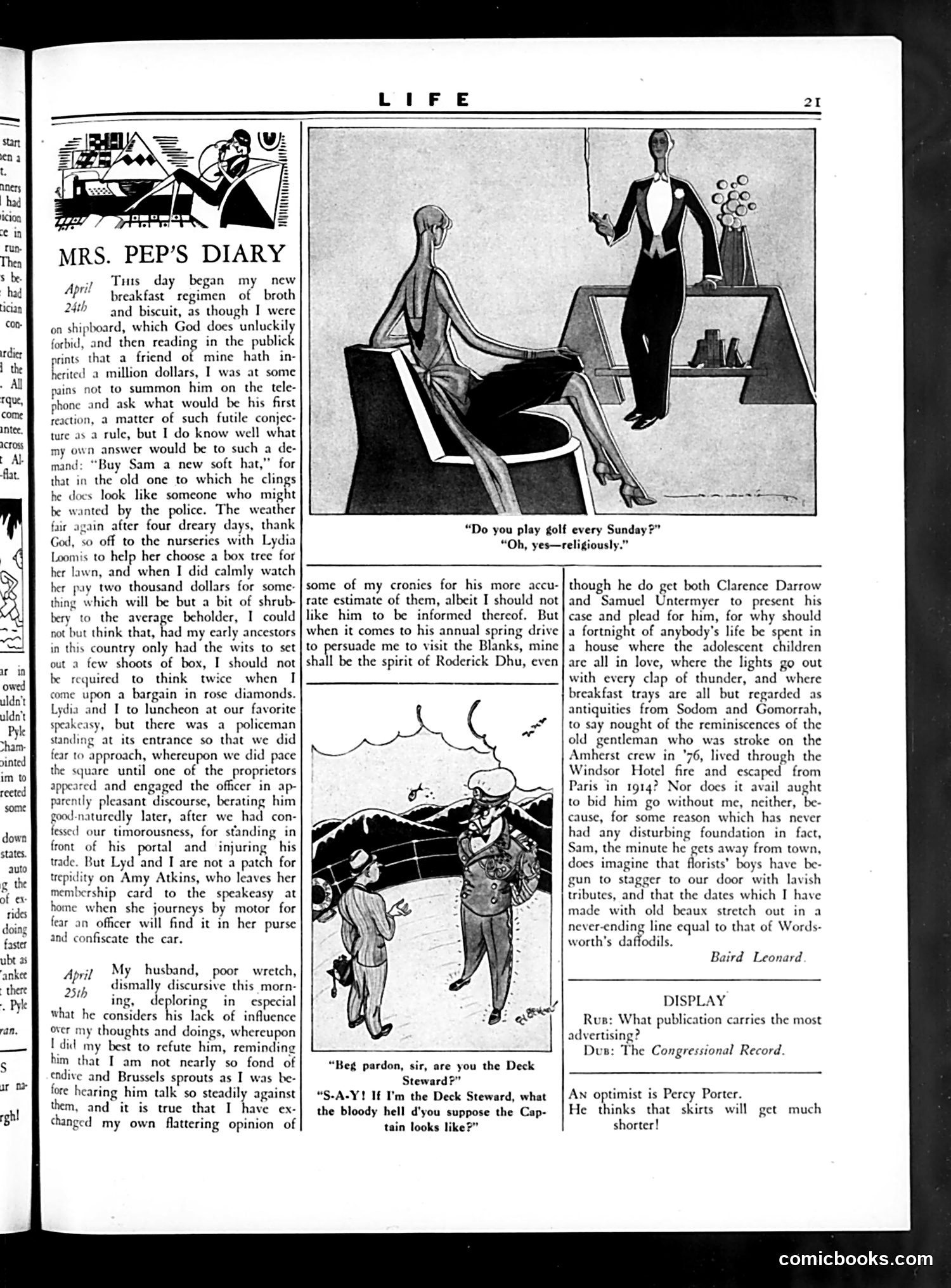
This page from *Life* magazine features satirical diary entries and cartoons reflecting 1920s American social life. **"Mrs. Pep's Diary"** mocks upper-class anxieties: the diarist frets over inherited wealth, frequents speakeasies (illegal during Prohibition), and worries about police encounters. References to "box trees" costing thousands and servants appear absurdly wasteful. **The cartoons** depict leisure-class concerns: one shows a couple at what appears to be a formal dinner, with dialogue about Sunday golf played "religiously"—satirizing the superficial piety of the wealthy. The ship scene mocks class pretension, with a deck steward's crude response to a passenger's question about the captain's appearance. **Overall satire**: The page ridicules 1920s upper-class excess, Prohibition-era speakeasy culture, marital dynamics, and the affectations of wealthy Americans. The humor relies on exaggeration of their trivial concerns and social anxiety, which *Life* used to critique contemporary manners and morality.
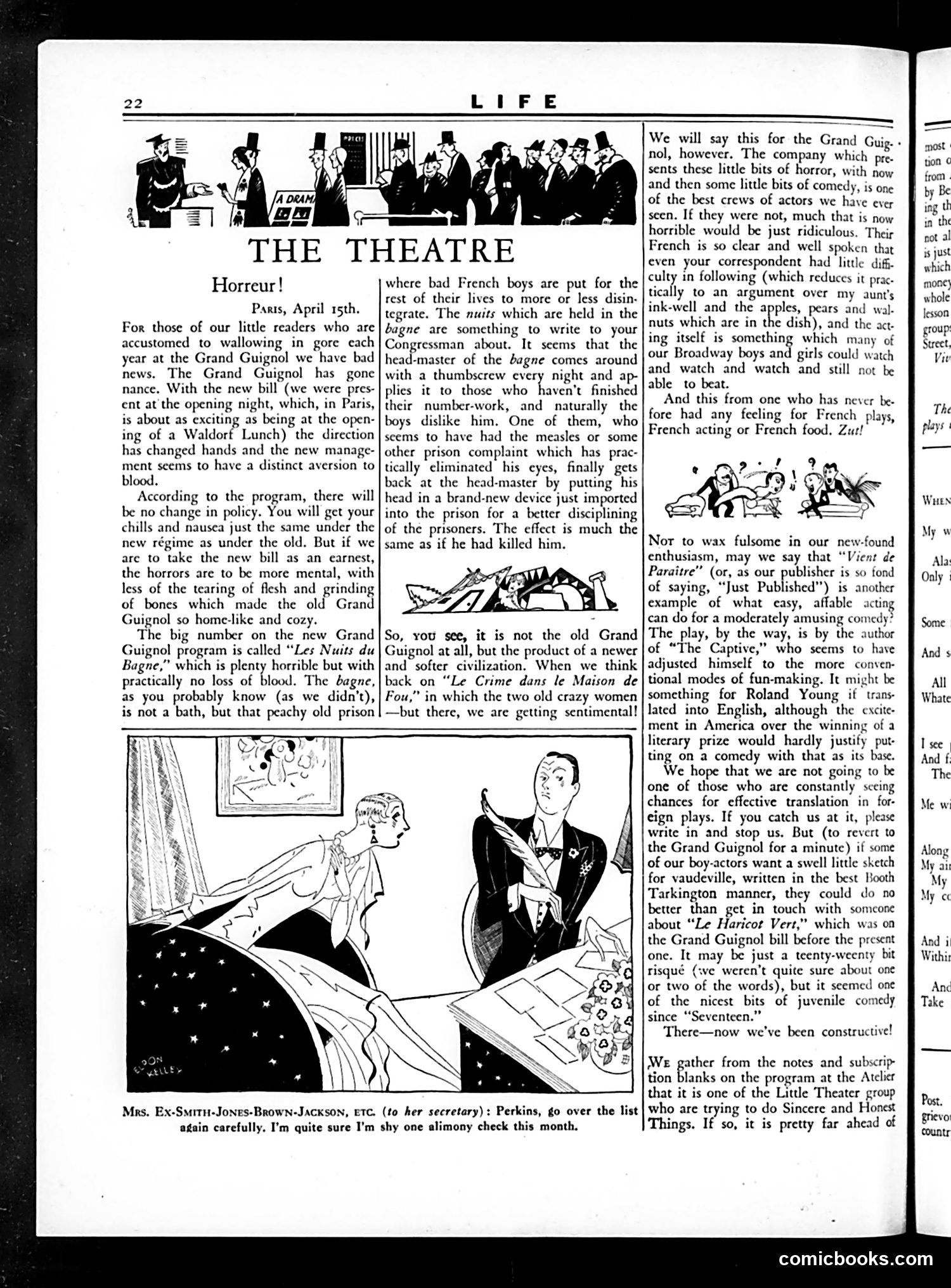
This page reviews the Grand Guignol, a famous Paris theater known for graphic horror performances. The writer humorously reports that new management has made the theater less bloody—shifting from physical gore to psychological horror. The play "Les Nuits du Bagne" (Prison Nights) exemplifies this: instead of explicit violence, it depicts a prisoner's revenge through a torture device, achieving similar effect with less bloodshed. The writer praises the French actors' skill and clear diction, even complimenting their work over Broadway performers. They also mention another production, "Vient de Paraitre," adapted from the author of "The Captive." The bottom cartoon, captioned with a wealthy woman's name listing multiple ex-husbands, jokes about alimony payments—satirizing the expense of serial marriages among the wealthy.
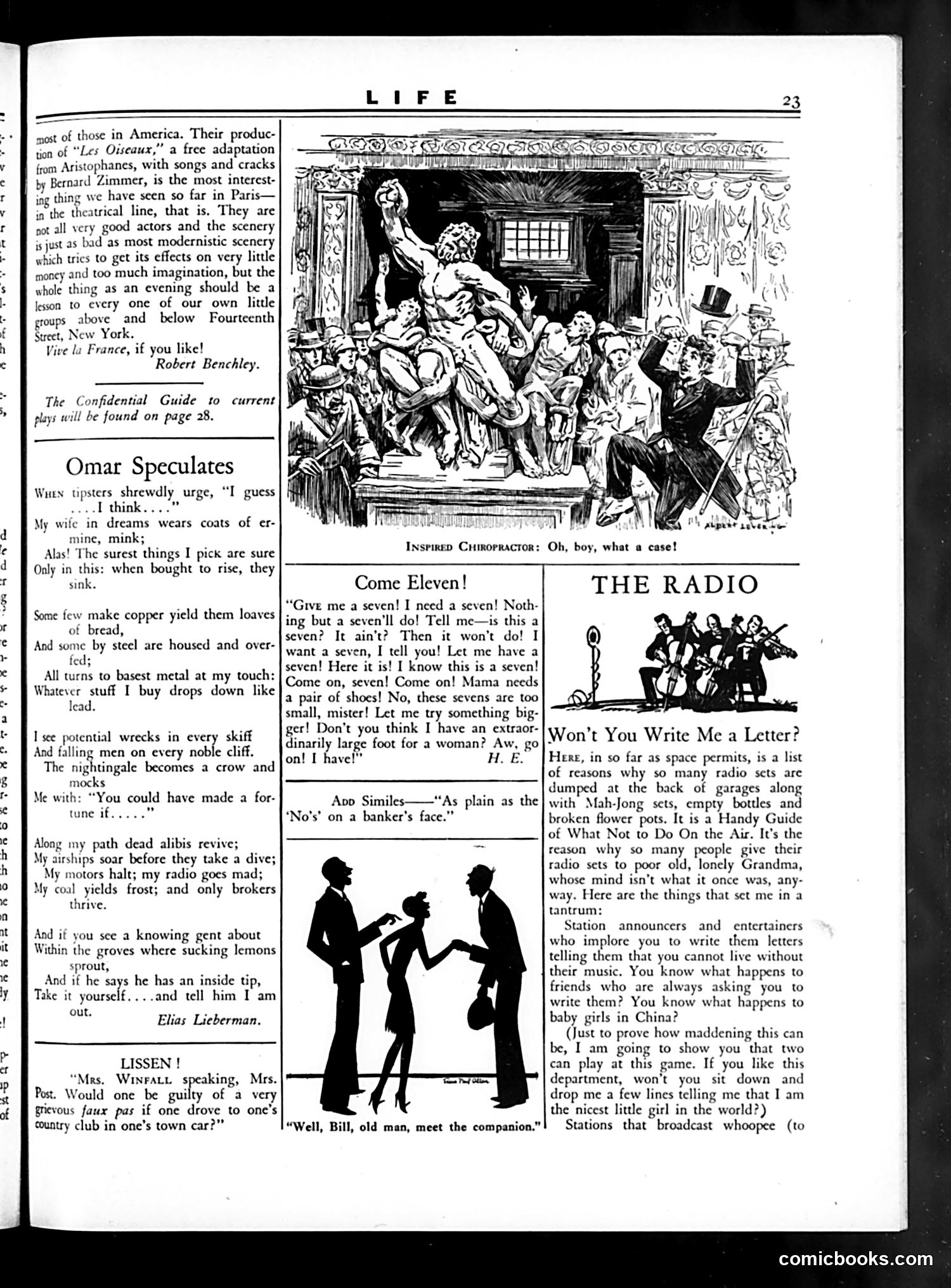
This page contains three distinct humorous pieces satirizing early 1920s American life: **"Omar Speculates"** parodies investment culture, presenting a pessimistic investor whose every financial venture fails—stocks sink, copper yields nothing, radios malfunction. It mocks the era's get-rich-quick mentality and ordinary people's disastrous attempts at speculation. **"Come Eleven!"** ridicules compulsive gambling, depicting a desperate woman pleading for lucky sevens at what appears to be a craps table, invoking "Mama needs shoes"—a period gambling cliché. It satirizes both addiction and the false hopes gambling promotes. **"Won't You Write Me a Letter?"** critiques radio entertainment's manipulative audience engagement tactics. The author mocks broadcasters who constantly beg listeners for fan mail, comparing it to annoying friendships. The sarcastic closing—offering to write back if readers enjoy the column—demonstrates the absurdity these tactics create. The cartoon above depicts an "Inspired Chiropractor" with theatrical/exaggerated positioning, likely mocking dubious medical practices popular in the era.
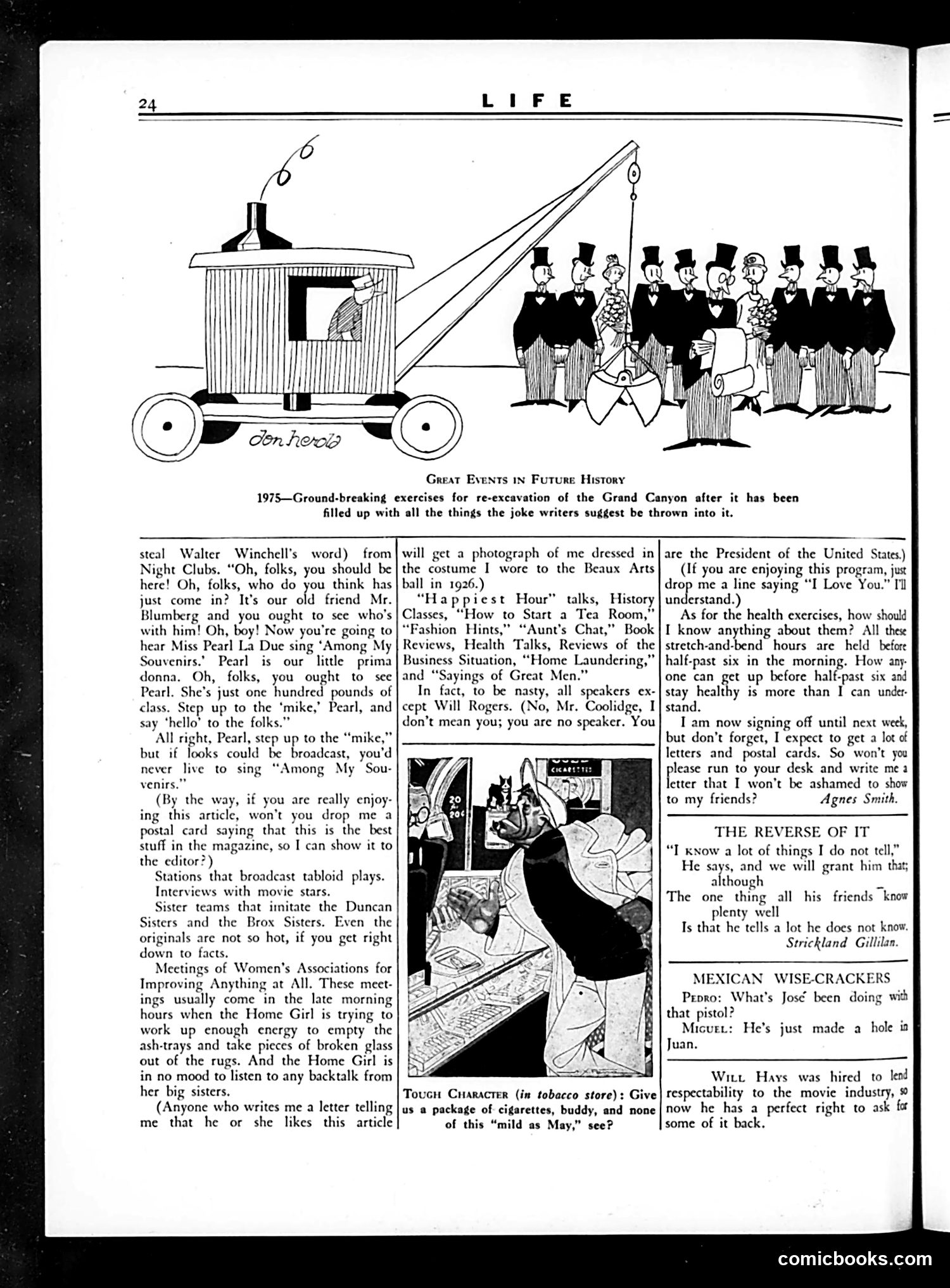
This 1920s *Life* magazine page satirizes American popular entertainment and media excess. The top cartoon mocks the Grand Canyon being filled with "all the things joke writers suggest be thrown into it"—a commentary on how relentlessly comedians recycled stale material and worn-out jokes. The main text parodies radio broadcast programming, specifically mocking Walter Winchell's theatrical announcing style ("Oh, folks!"). It lists vapid programming: tabloid plays, movie-star interviews, imitation sister acts, and women's club meetings—criticizing both the mediocrity of entertainment and radio's intrusion into domestic life. The author sneers at Calvin Coolidge (current President) as "no speaker," and at Will Rogers as an exception to generally poor speakers. The page also includes brief jokes: a Mexican character joke (wordplay on "Juan"), and a jab at Will Hays, the movie industry's "censor," claiming he was hired to add respectability but now has credibility to reclaim. The satire targets 1920s mass media's low quality, tedious repetition, and pervasive commercialism.
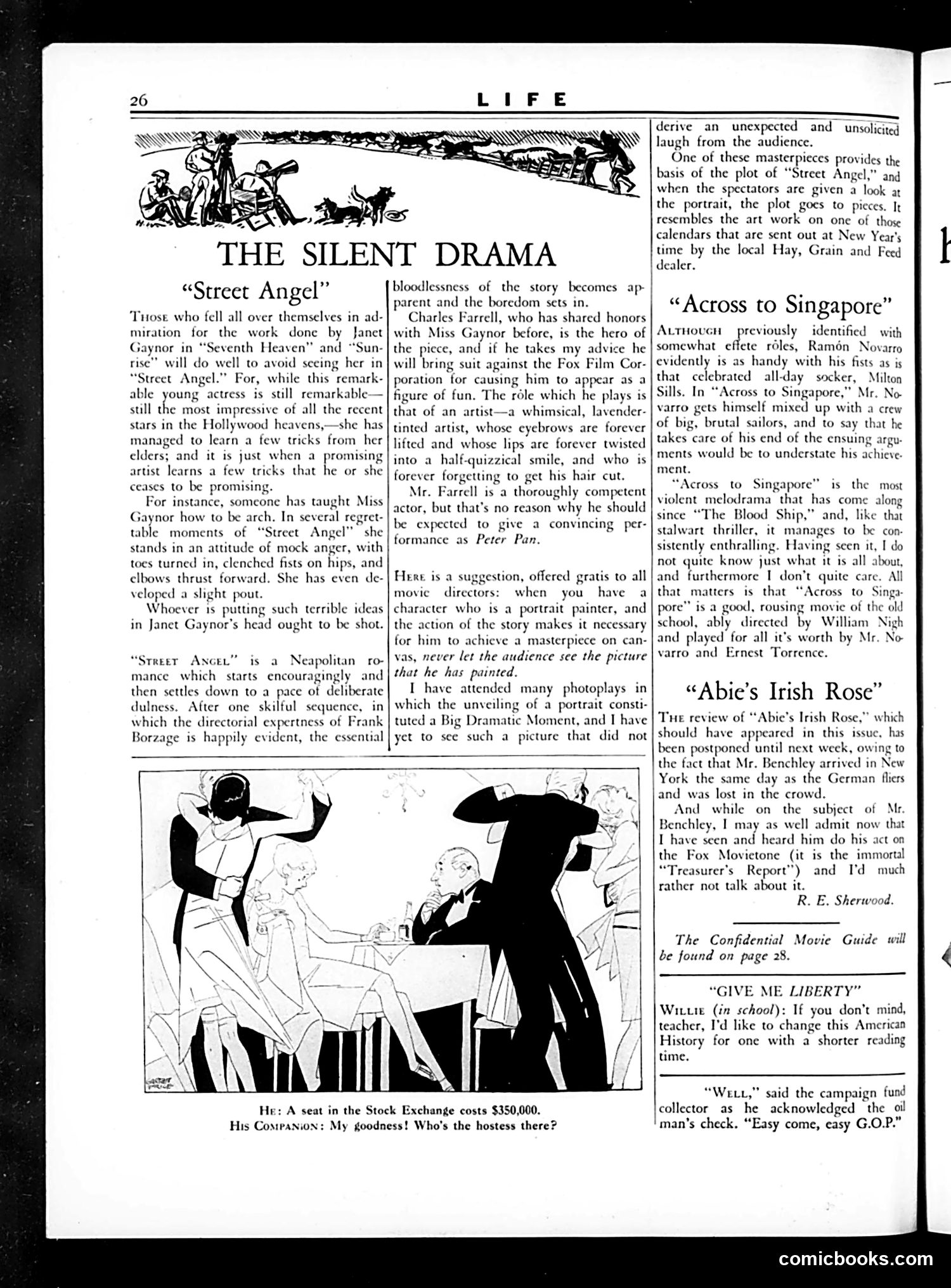
This page from *Life* magazine contains reviews of three silent films, accompanied by a cartoon about wealth and social class. **The Cartoon:** The illustration shows a well-dressed man at what appears to be an exclusive social venue, remarking that a Stock Exchange seat costs $350,000—then asking his companion "Who's the hostess?" The satire targets the absurdity of extreme wealth disparity: someone wealthy enough to casually reference a quarter-million-dollar purchase doesn't know who's hosting the event. It mocks the pretensions and disconnection of the ultra-rich during the prosperous 1920s. **The Reviews:** Film critic R.E. Sherwood critiques Janet Gaynor's affected mannerisms in "Street Angel," praises Ramon Novarro's action sequences in "Across to Singapore," and notes a delayed review of "Abie's Irish Rose" due to a missed appointment with an actor. The page exemplifies *Life*'s satirical approach to American society and entertainment during the Jazz Age.
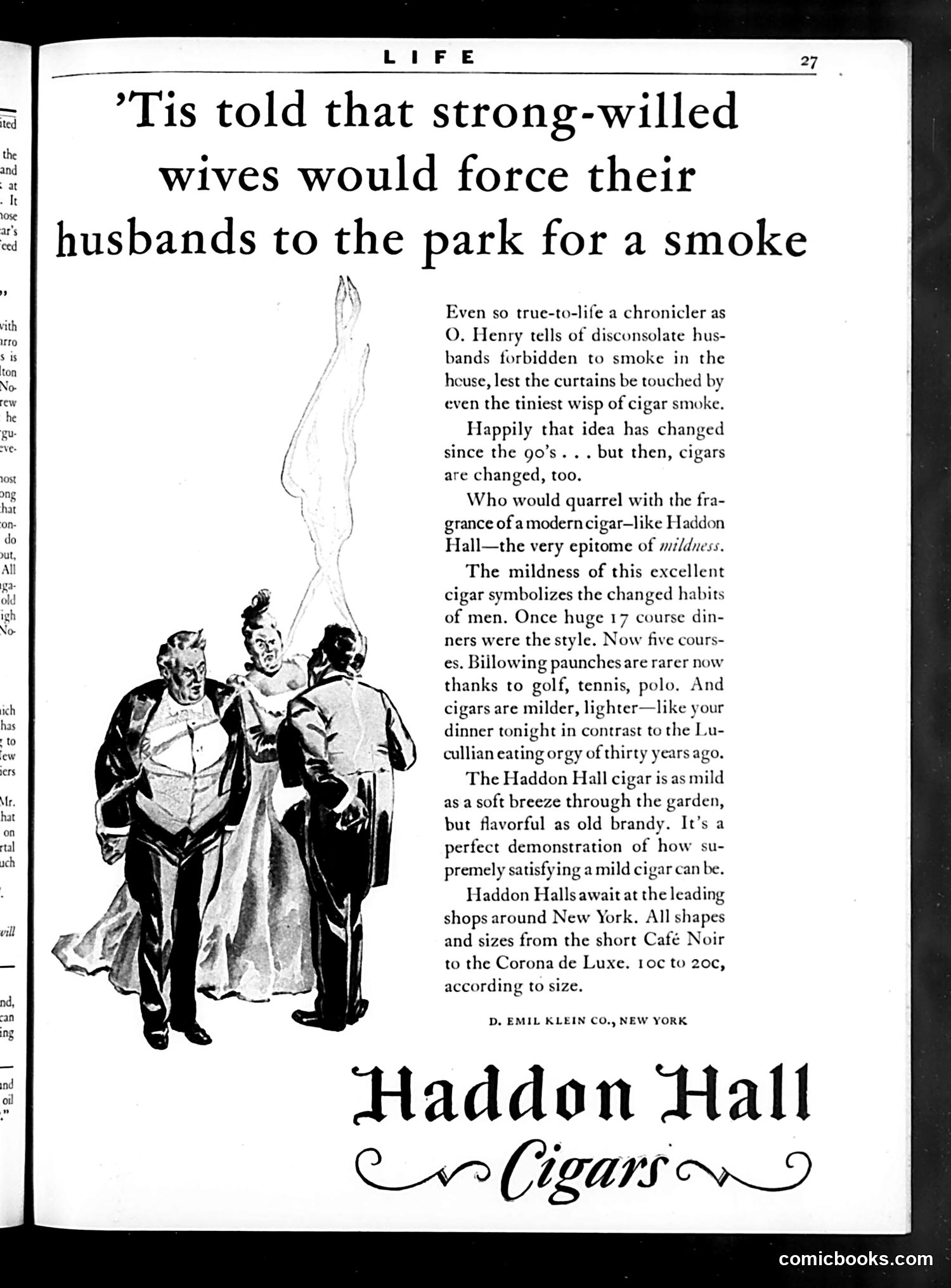
This is primarily a **cigar advertisement**, not political satire. The page uses social commentary as a sales pitch. The opening references a common domestic trope: domineering wives forcing husbands outdoors to smoke, citing O. Henry's stories. The illustration shows three men in formal dress, apparently enjoying cigars together. The ad's argument: **cigar culture has evolved**. Just as men's eating habits have become lighter (17-course dinners → 5 courses) thanks to sports like golf and tennis, cigars too have become milder and less intrusive. Haddon Hall represents this "modern" sensibility—mild enough that wives needn't object to indoor smoking. The satire is gentle: it pokes fun at restrictive Victorian-era wives while positioning the product as evidence of masculine refinement and progress. The pitch essentially claims: buy this cigar and marital harmony follows. This reflects 1920s-30s gender dynamics and consumer advertising's strategy of positioning products as symbols of social change.
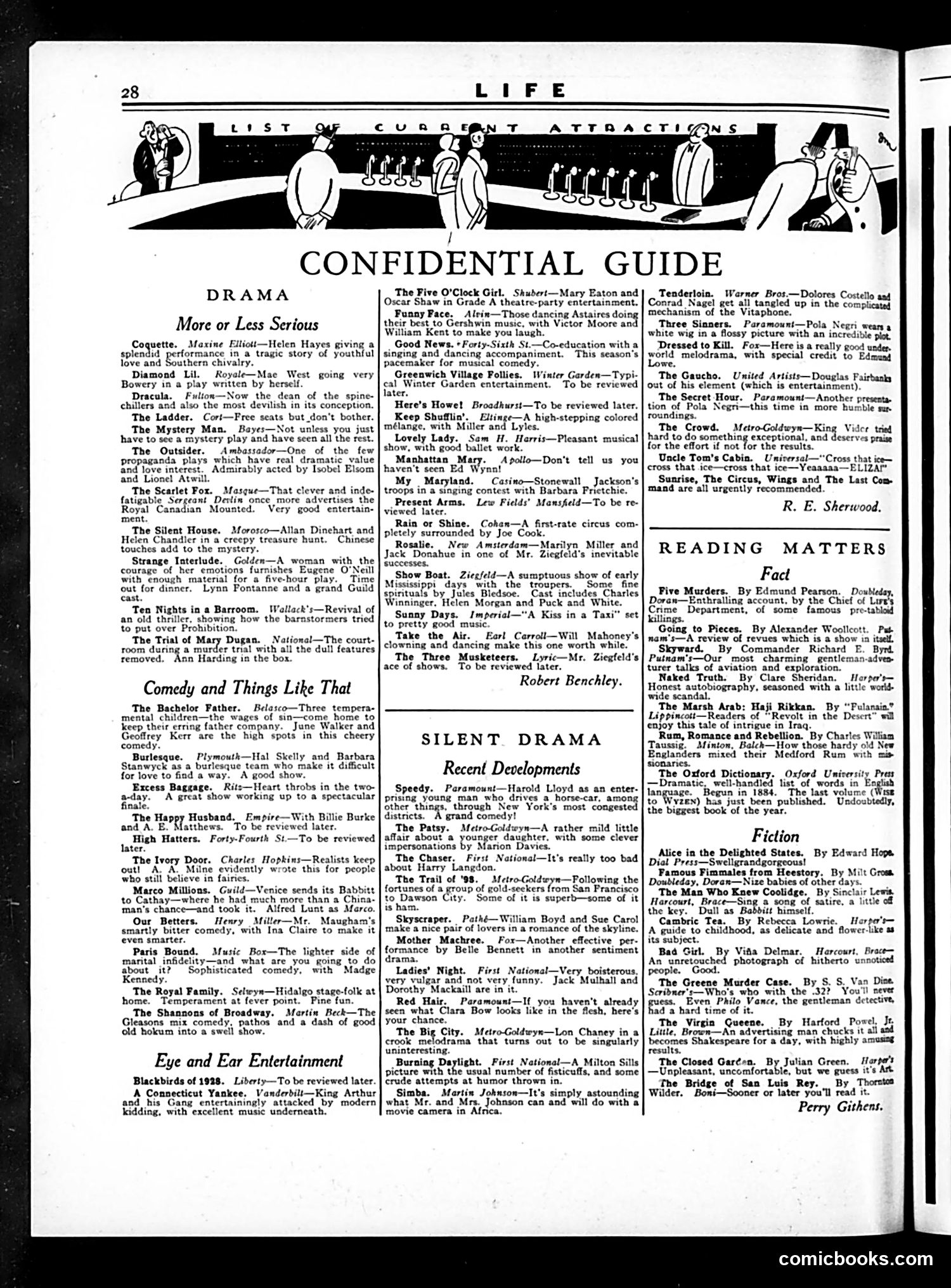
This page is a theater review guide, not political satire. It's a "Confidential Guide" listing current Broadway productions across categories: serious drama, comedy, and musical entertainment. The small cartoon header shows figures examining theatrical attractions, reflecting Life magazine's satirical tone toward entertainment culture. The reviews are brief, punchy critiques. Notable entries include Mae West in *Diamond Lil* (described as "very Bowery"), Eugene O'Neill's *Strange Interlude* (a five-hour play requiring a dinner break), and *The Trial of Mary Dugan* with Ann Harding. Musical reviews highlight the Astaires in *Funny Face* and mention Gershwin music. The guide uses casual, witty language typical of 1920s entertainment journalism—calling one show "Free seats but don't bother" and dismissing another unless "you just have to see a mystery play." This reflects the vibrant Broadway scene of the late 1920s before the stock market crash.
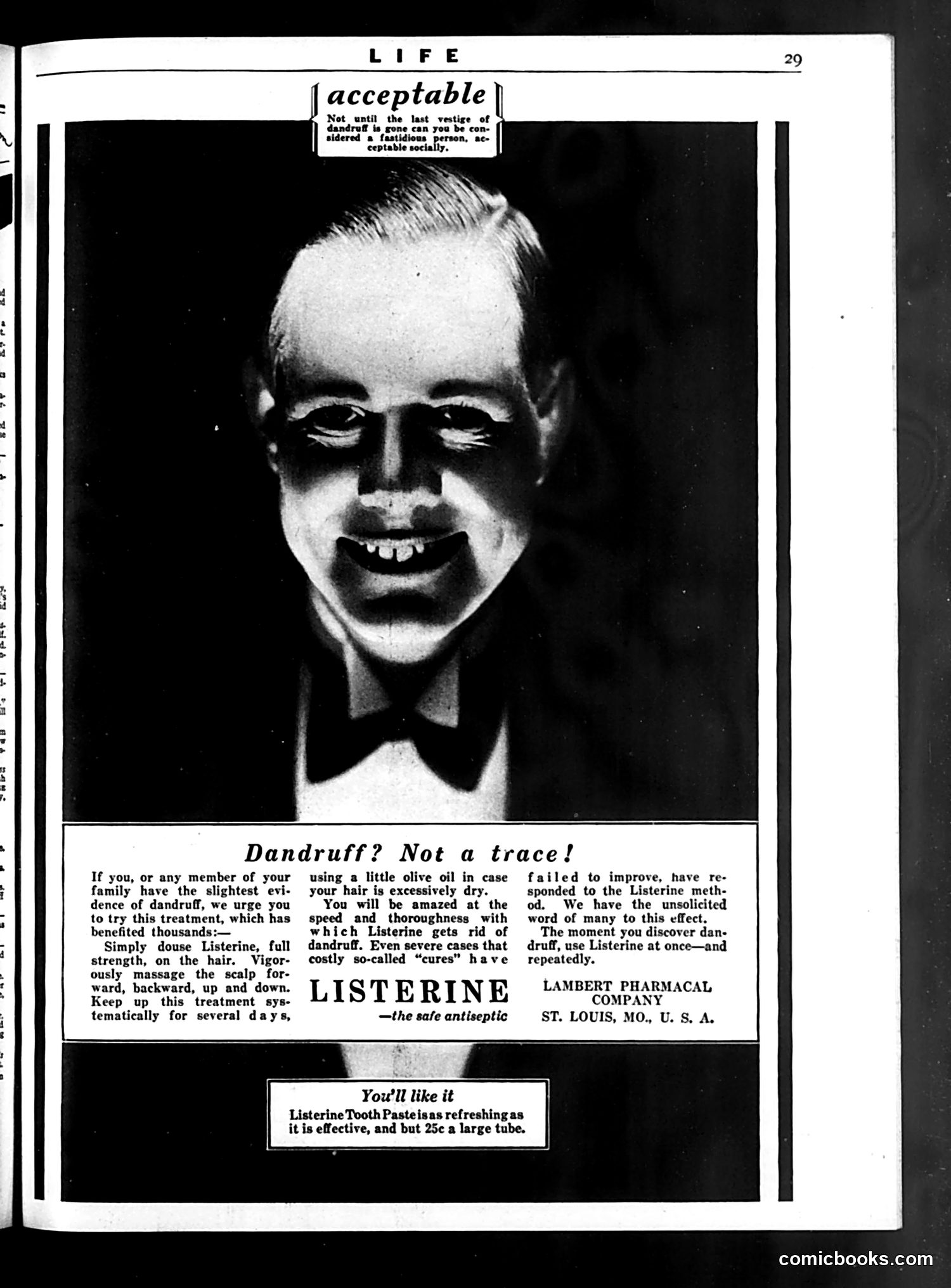
This is primarily a **Listerine advertisement**, not political satire. The page features a full-page ad for Listerine mouthwash and Listerine Tooth Paste, using a photograph of a man in formal attire (bow tie, formal shirt) as the centerpiece. The "satire" is social rather than political: the headline "acceptable" mocks social anxiety about dandruff, suggesting that visible dandruff makes one unacceptable in polite society. The ad exploits this insecurity, claiming Listerine—marketed as a "safe antiseptic"—can cure even severe dandruff through vigorous scalp massage. **The joke for modern readers:** This represents early 20th-century advertising's reliance on shame and social conformity to sell products. The implication that dandruff prevents social acceptability seems absurdly exaggerated today. The formal portrait reinforces the message that cleanliness equals respectability—a common advertising trope of the era. This reflects how vintage ads weaponized embarrassment to drive consumer behavior around personal hygiene products.
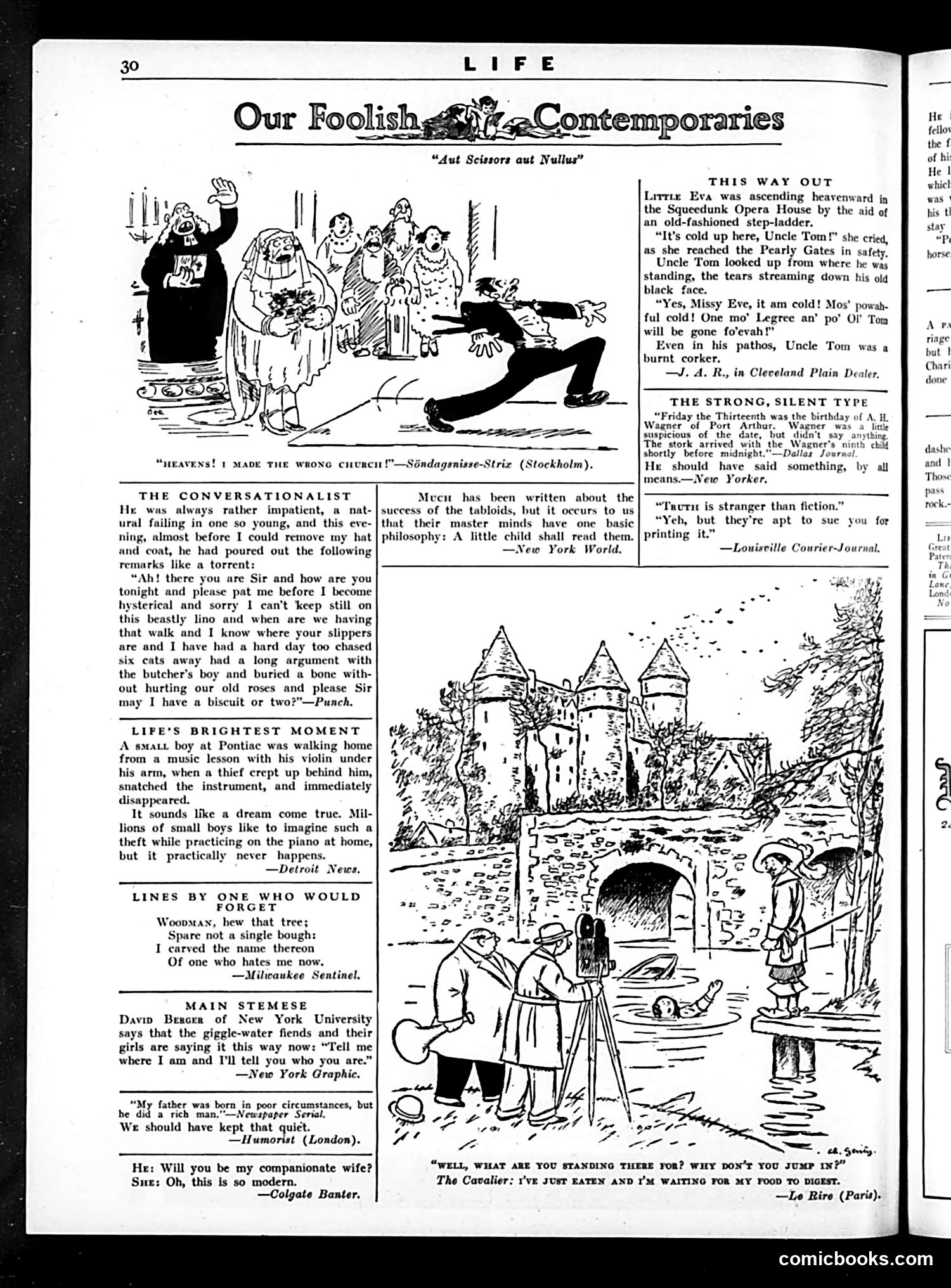
This is a satirical humor compilation page collecting jokes and comic observations from various sources. The main cartoon at top shows a man falling down stairs while others watch—captioned with a Swedish source suggesting someone went to the "wrong church." The page reprints brief humorous anecdotes and one-liners from newspapers and magazines, including: - A "conversationalist" (likely a dog or pet, based on context) talking nonstop - A boy whose violin theft he'd fantasized about actually happening - A man carving a lover's name into a tree, now hating them - "Slang" about giggle-water (Prohibition-era speak for alcohol) - A minstrel show sketch ("Uncle Tom") using dated racial stereotypes - A cautionary tale about Friday the 13th births The bottom illustration shows a man refusing to swim after eating—a common period health belief about digestion and water safety. The satire targets everyday foolishness: impatience, romantic regrets, superstition, and the absurdities of modern life. This reflects Life magazine's role as a venue for light social commentary through reprinted wit.
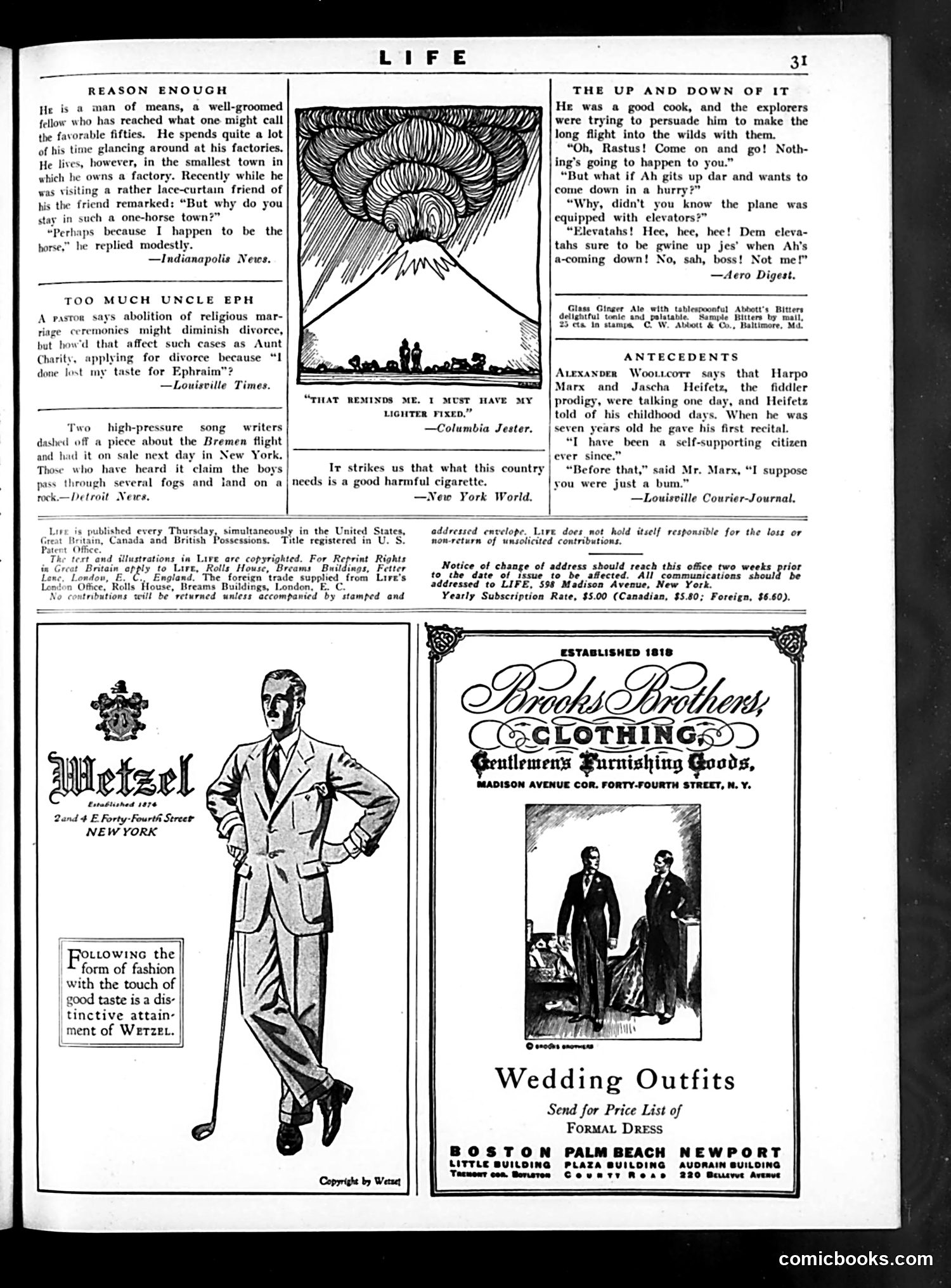
This page contains several brief satirical jokes typical of *Life* magazine's humor section, plus period advertisements. The main cartoons mock social pretension and racial stereotypes common to the era: 1. **"Reason Enough"**: A wealthy factory owner claims he stays in a small town because he's "the horse"—a self-deprecating joke about his importance. 2. **"Too Much Uncle Eph"**: Jokes about divorce, including a dialect-heavy scenario about a character named "Ephraim"—using exaggerated African American vernacular humor. 3. **"The Up and Down of It"**: A racist joke featuring "Rastus," a stereotypical Black character who misunderstands "elevators" on an airplane, confusing the term with elevator mechanics. The advertisements feature men's clothing (Wetzel, Brooks Brothers) and wedding formal wear—typical luxury goods for the magazine's affluent readership. These jokes reflect attitudes toward race and class that modern readers would recognize as offensive stereotyping.
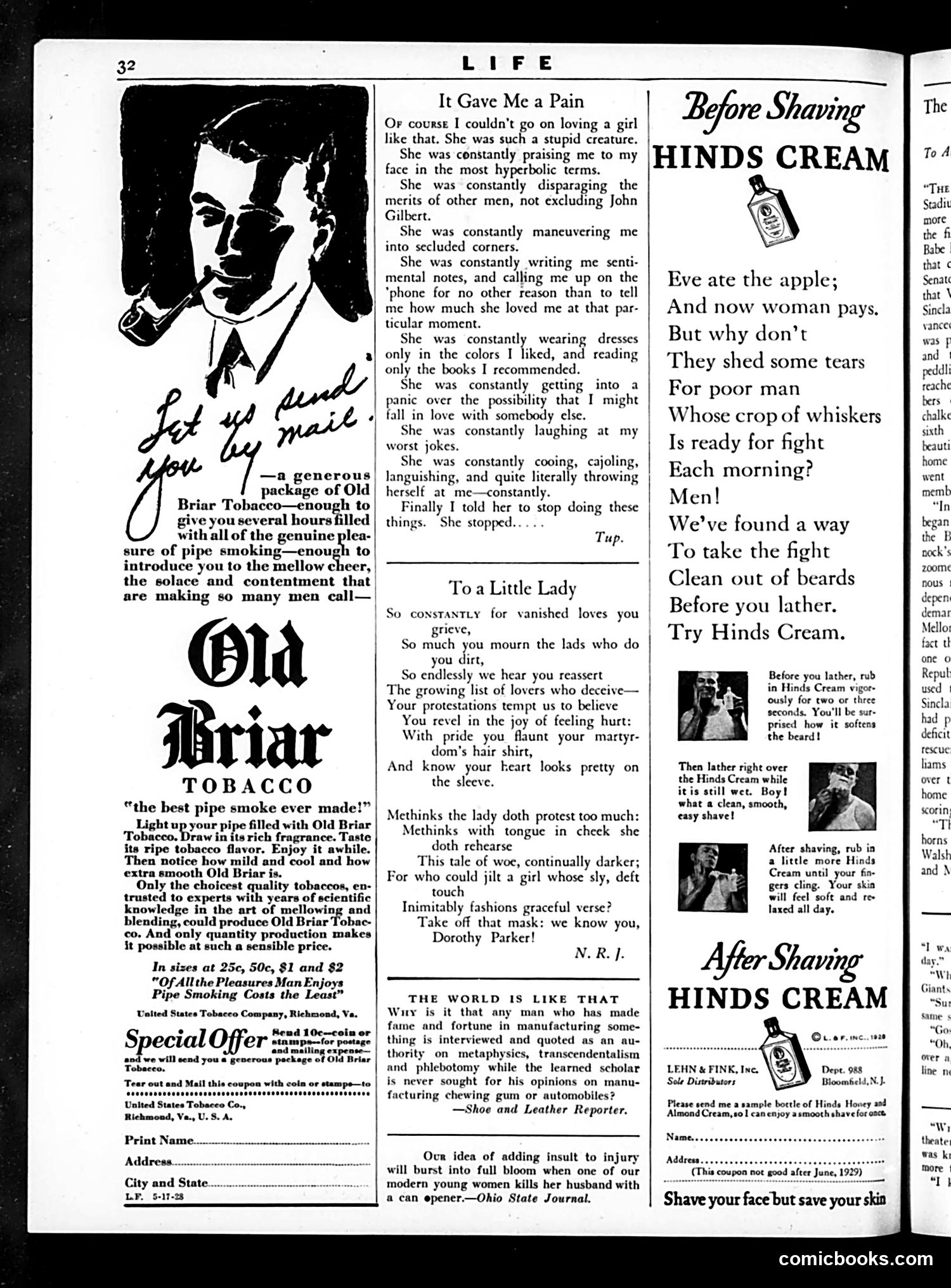
This page contains **satirical commentary and advertisements** rather than political cartoons. The main content includes: **"It Gave Me a Pain"** — A humorous essay mocking a girlfriend who is excessively devoted: she constantly praises him, wears his favorite colors, reads his recommended books, and throws herself at him. The satire targets both her suffocating devotion and his ingratitude for being loved so thoroughly—the joke being his complaint about receiving exactly what most men supposedly want. **"To a Little Lady"** — A poem addressing **Dorothy Parker** (the famous writer and wit), gently mocking her reputation for writing melancholic verses about failed romances. The author suggests she dramatizes heartbreak for literary effect, knowing her "sly, deft touch" with graceful verse makes her attractive despite her complaints. **"The World Is Like That"** — Brief satirical observations about misplaced authority and modern absurdity. The page is otherwise dominated by **Old Briar Tobacco and Hinds Cream advertisements**, typical of 1920s Life magazine content.
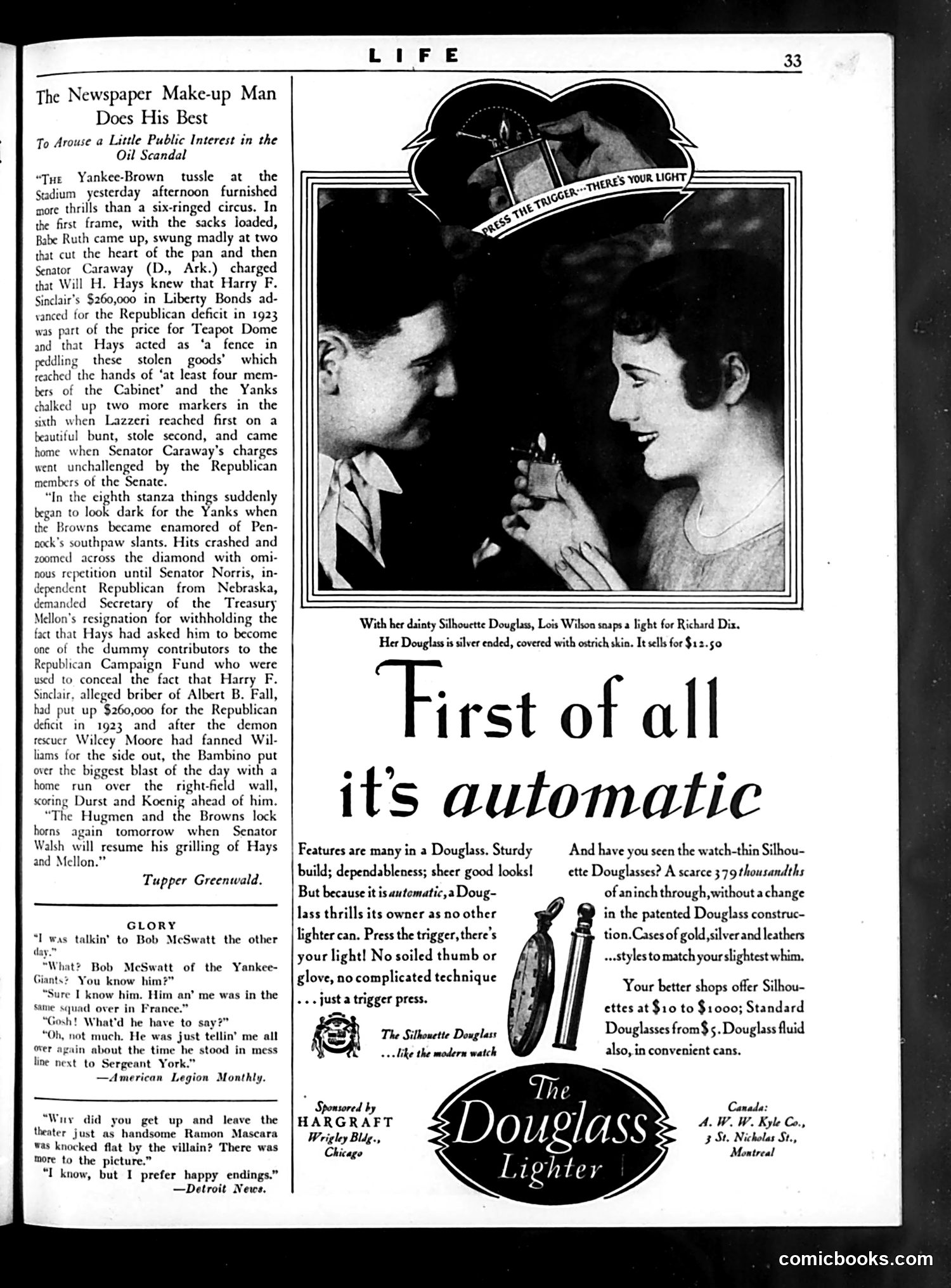
This page satirizes how newspapers sensationalize political scandals by mixing them with sports coverage. The main article, titled "The Newspaper Make-up Man Does His Best," uses a baseball game (Yankees vs. Browns) as a metaphor for the **Teapot Dome scandal**—a major 1920s corruption case involving oil reserves. The text references real figures: Senator **Caraway** and Senator **Norris** (who actually investigated Teapot Dome), **Harry Sinclair** (oil executive), **Albert Fall** (Secretary of Interior who took bribes), and **Secretary Mellon** (Treasury). The satire shows how editors interweave serious governmental corruption allegations with sports drama to attract readers, treating both with equal breathless excitement. The joke: newspapers treat real criminal wrongdoing in government the same way they cover baseball games—as entertainment spectacle rather than serious investigation. The three short anecdotes below further mock trivial public interests. The page also contains a Douglass lighter advertisement unrelated to the political content.
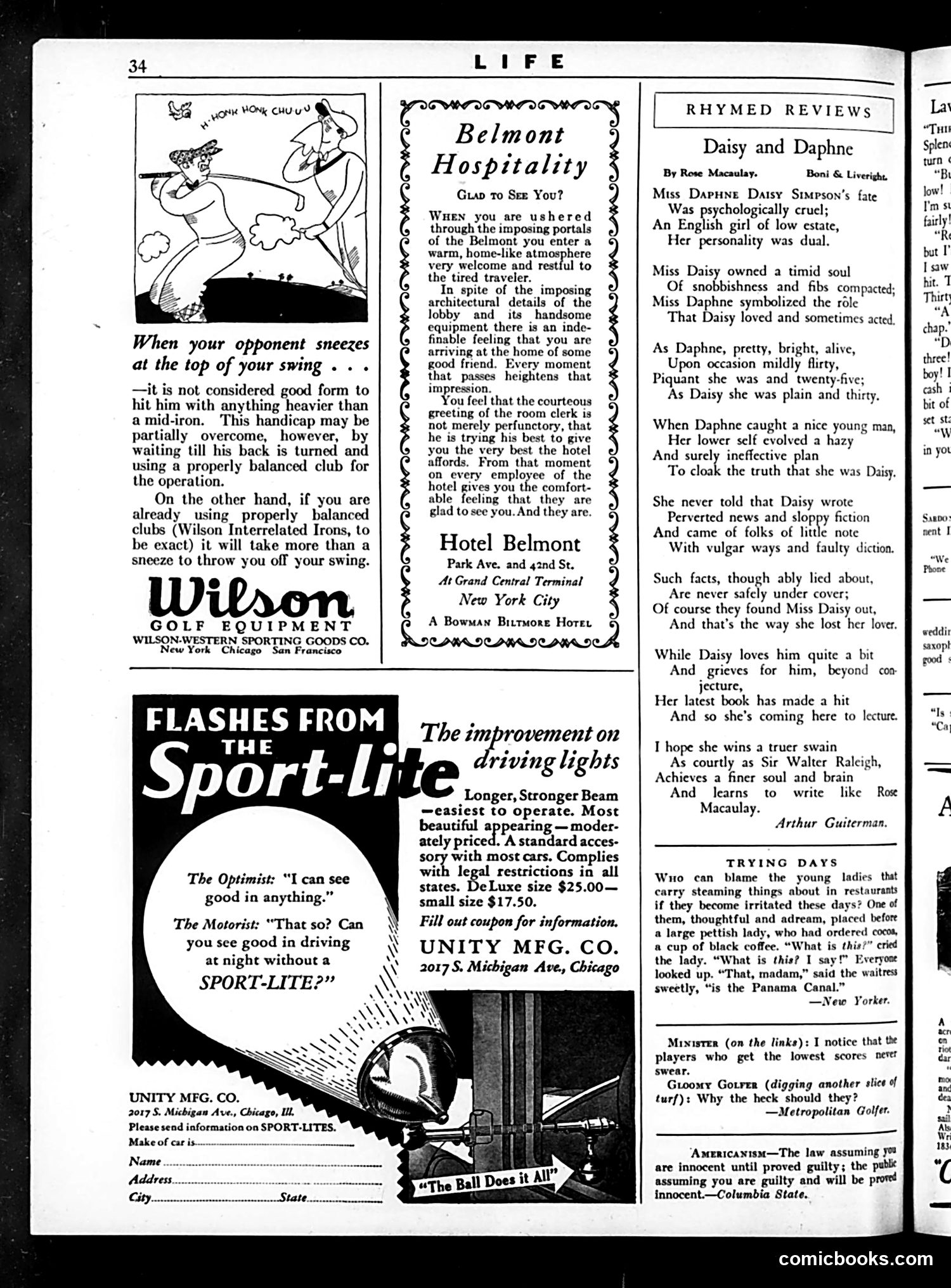
This page mixes advertisements with satirical content typical of *Life* magazine's format. **The Golf Cartoon** humorously advises that while hitting an opponent with a golf club during their swing is unsporting, using properly balanced Wilson clubs prevents distraction anyway—turning product placement into joke setup. **The "Sport-Lite" Ad** uses a dialogue joke: an optimist claims to see good in everything; when asked if he can see good in night driving without headlights, the implication is clearly "no"—a backhanded advertisement for driving lights. **"Daisy and Daphne" (Book Review)** is a satirical poem by Arthur Guiterman reviewing Rose Macaulay's novel. It mocks the protagonist's psychological split personality: "Daisy" is a snobbish, vulgar fiction writer; "Daphne" is her pretentious, charming alter ego. The satire ridicules how she loses her lover when her true identity is discovered, yet profits from publishing a book about the experience—suggesting hypocrisy and that notoriety sells. The page is primarily **advertising with light satire**, not political commentary.
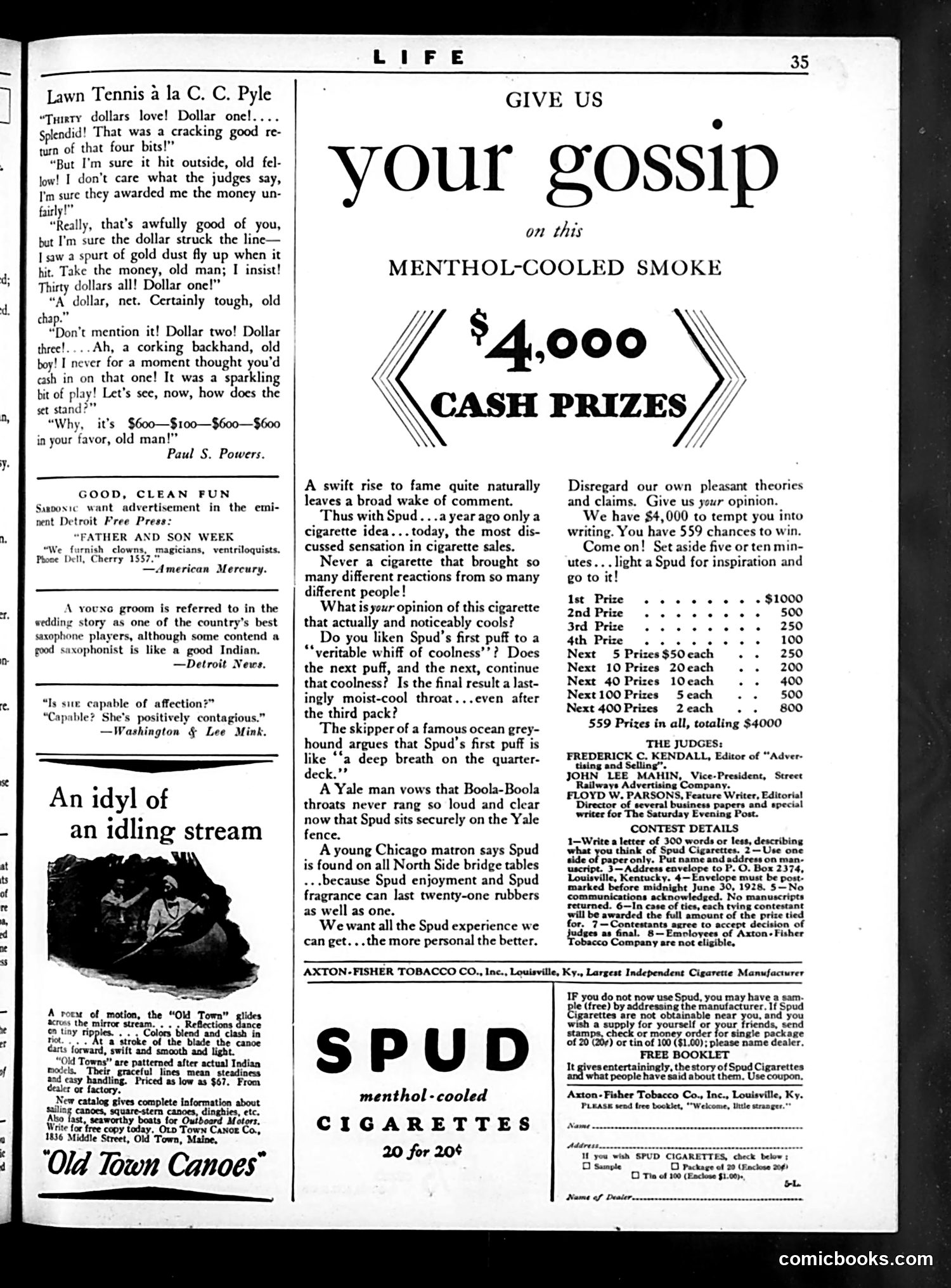
This cartoon satirizes the modern professionalization of tennis, likely referencing C.C. Pyle, a sports promoter who brought commercial tournaments and prize money to lawn tennis in the 1920s. The joke parodies how monetary rewards have corrupted the traditional amateur sport's genteel etiquette. The dialogue shows two players speaking in exaggerated proper English while obsessively tallying prize money in dollars instead of tennis scoring ("$600—$100—$600"). Each volley is treated as a betting transaction rather than sport for sport's sake. The satire suggests that Pyle's commercialization has reduced tennis from a gentleman's pursuit to mere haggling—players now count cash instead of points, and polite compliments about "cracking backhands" mask ruthless money-grabbing. The anachronistic mixing of formal politeness with crude money-counting epitomizes how commercialism corrupts aristocratic traditions.
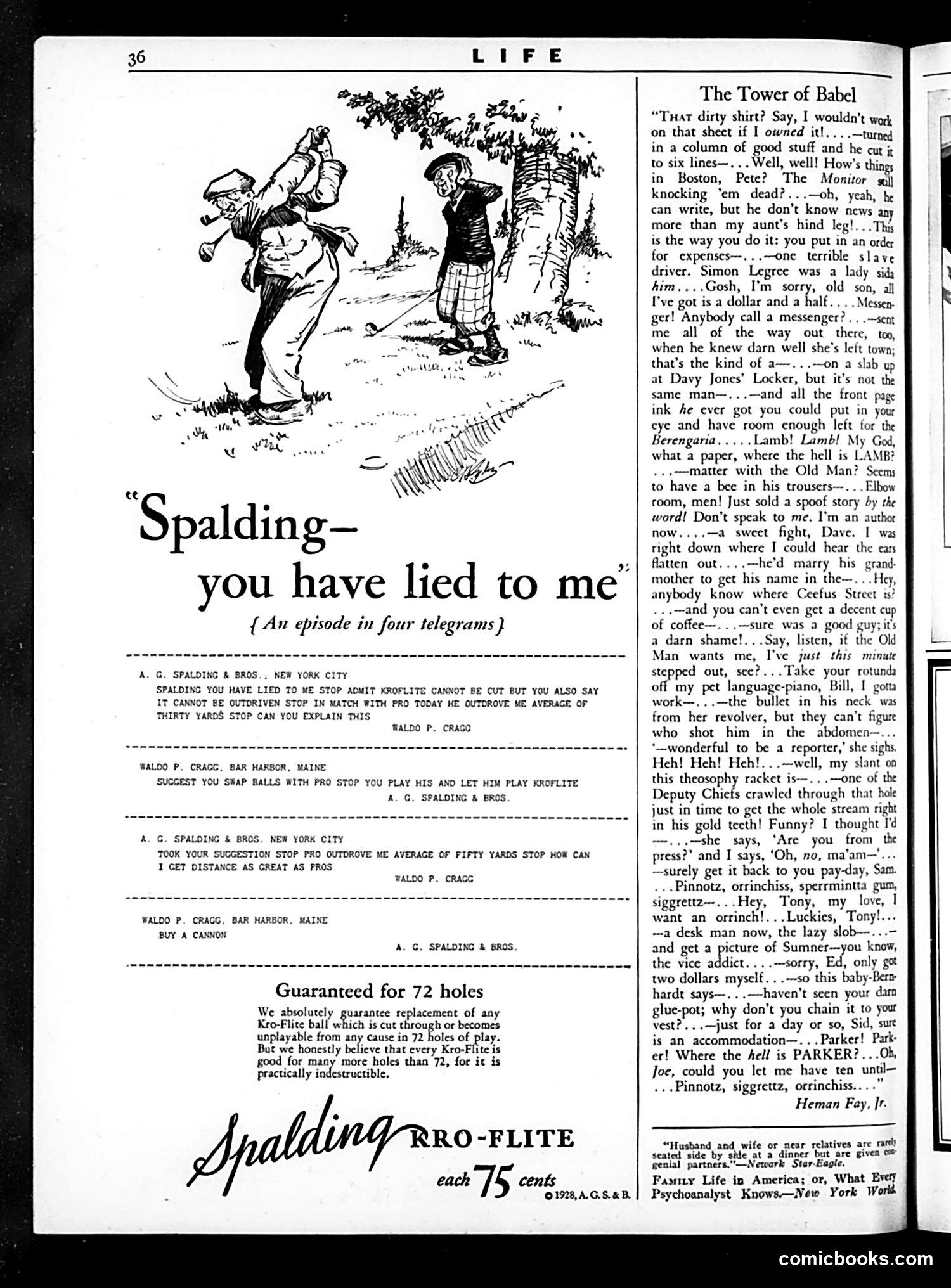
This page contains two separate pieces of satire: **"Spalding—you have lied to me"** is a humorous advertisement for Spalding Kro-Flite golf balls. It satirizes misleading product advertising through fictional telegrams where a customer (Waldo P. Cragg) accuses the company of lying about their ball's performance—it supposedly can't be "cut" or "outdriven," yet he's been badly beaten in matches using it. When he asks how to achieve greater distance, Spalding absurdly suggests "Buy a cannon," exposing the company's inability to justify their product's actual failure. **"The Tower of Babel"** (right column) is a chaotic stream-of-consciousness satirizing a newspaper office. It's a jumble of overheard conversations, complaints, and gossip among journalists—reflecting the frantic, gossipy, and underpaid environment of early 20th-century newsrooms. The title references the Biblical tower where languages became confused; here, the "confusion" is editorial chaos and workplace drama rather than language barriers. Both pieces mock specific American institutions through exaggeration.
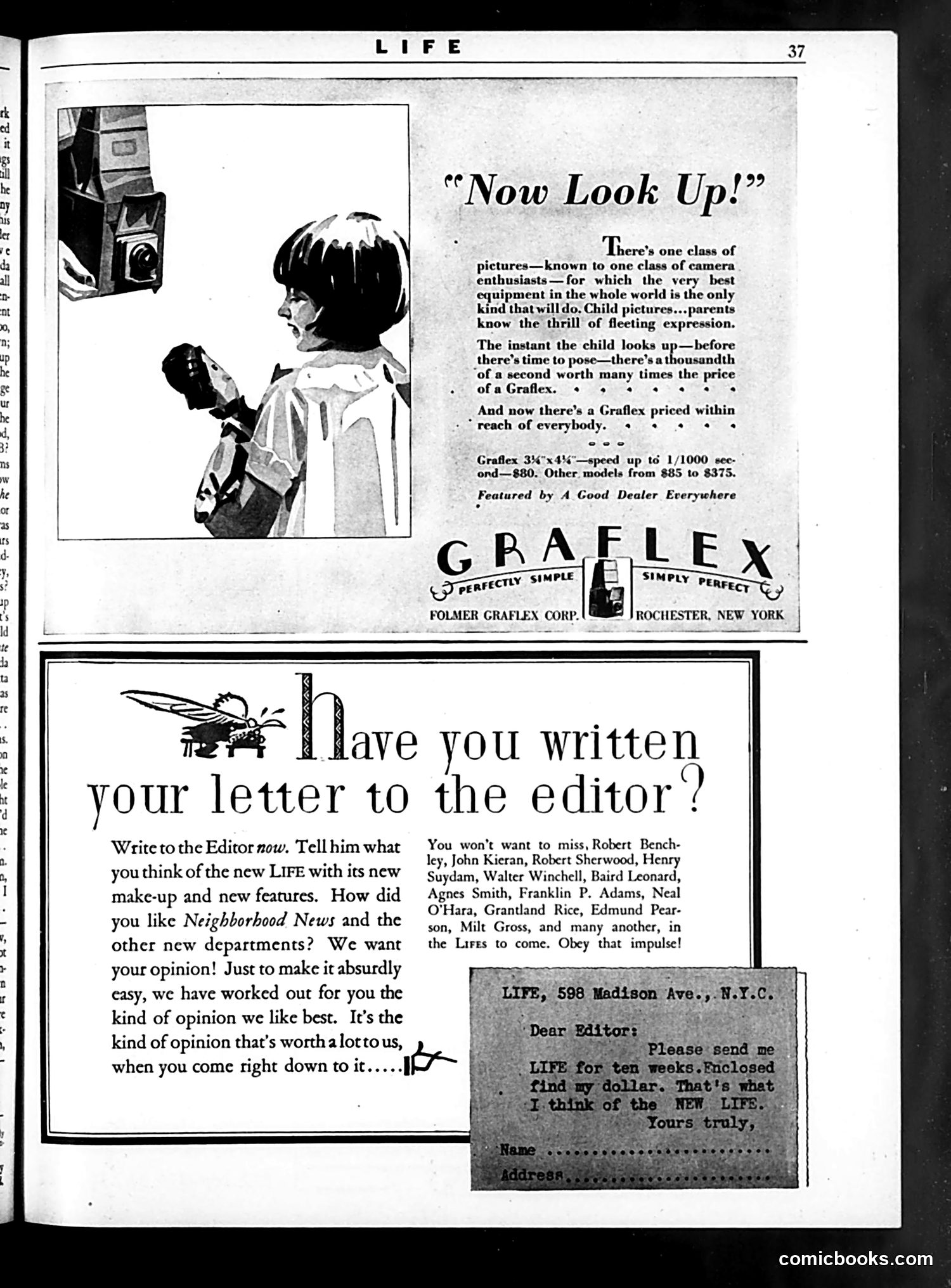
This page contains two distinct elements: a **Graflex camera advertisement** and a **reader engagement promotion**. The **Graflex ad** uses sentimentality to market cameras to parents. It depicts a child looking upward, emphasizing how professional-quality cameras can capture fleeting, candid moments of childhood that cheaper equipment might miss. The pitch is accessible: while Graflex cameras are premium equipment, models now start at $85—within reach of ordinary families rather than just professional photographers. The **"Have you written your letter to the editor?"** section encourages reader participation by promoting LIFE's new redesign and features like "Neighborhood News." It names popular columnists and writers (Robert Benchley, Grantland Rice, etc.) as contributors, attempting to build anticipation for the magazine's evolution. The tone is playfully self-aware—LIFE admits it's suggesting the "kind of opinion" it wants, inviting readers to either comply or disagree. Both sections reflect 1920s-30s marketing: aspirational product placement and community-building through reader engagement.
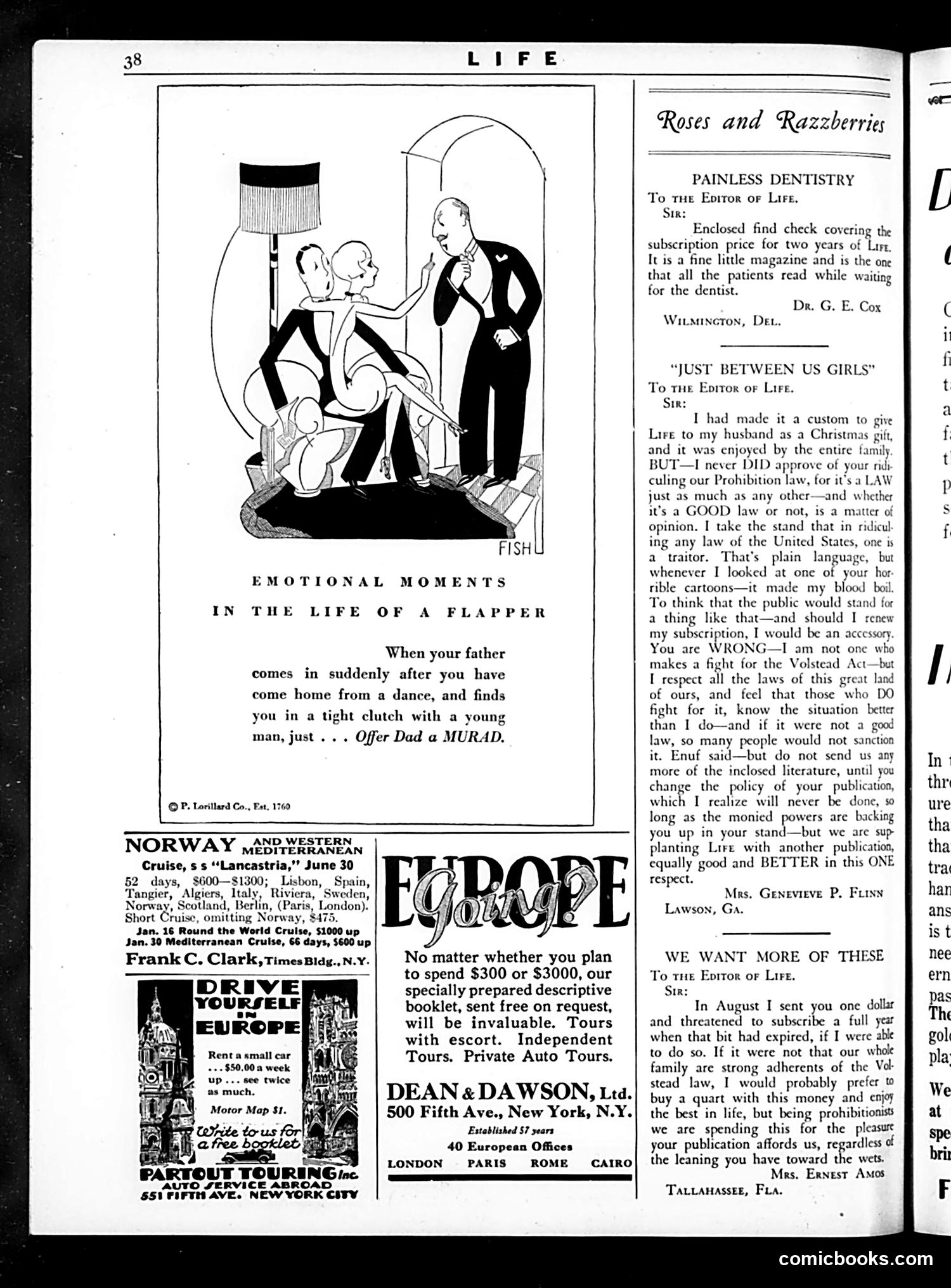
This cartoon satirizes 1920s dating customs and parental authority. It depicts a young woman ("flapper") embracing a man when her father unexpectedly arrives home. The joke's punchline—"Offer Dad a MURAD" (a cigarette brand)—suggests that offering the father a smoke will defuse his anger at finding his daughter in a "tight clutch" with an unmarried man. The cartoon mocks both the strict moral codes parents enforced and the flapper generation's defiance of them. It's also a cigarette advertisement exploiting the scenario for commercial purposes. The page's reader letters reveal contemporary tensions: one reader protests Life's ridicule of Prohibition as unpatriotic, while another praises the magazine's irreverent stance. These letters show Life's satirical editorial position was genuinely controversial during the 1920s.
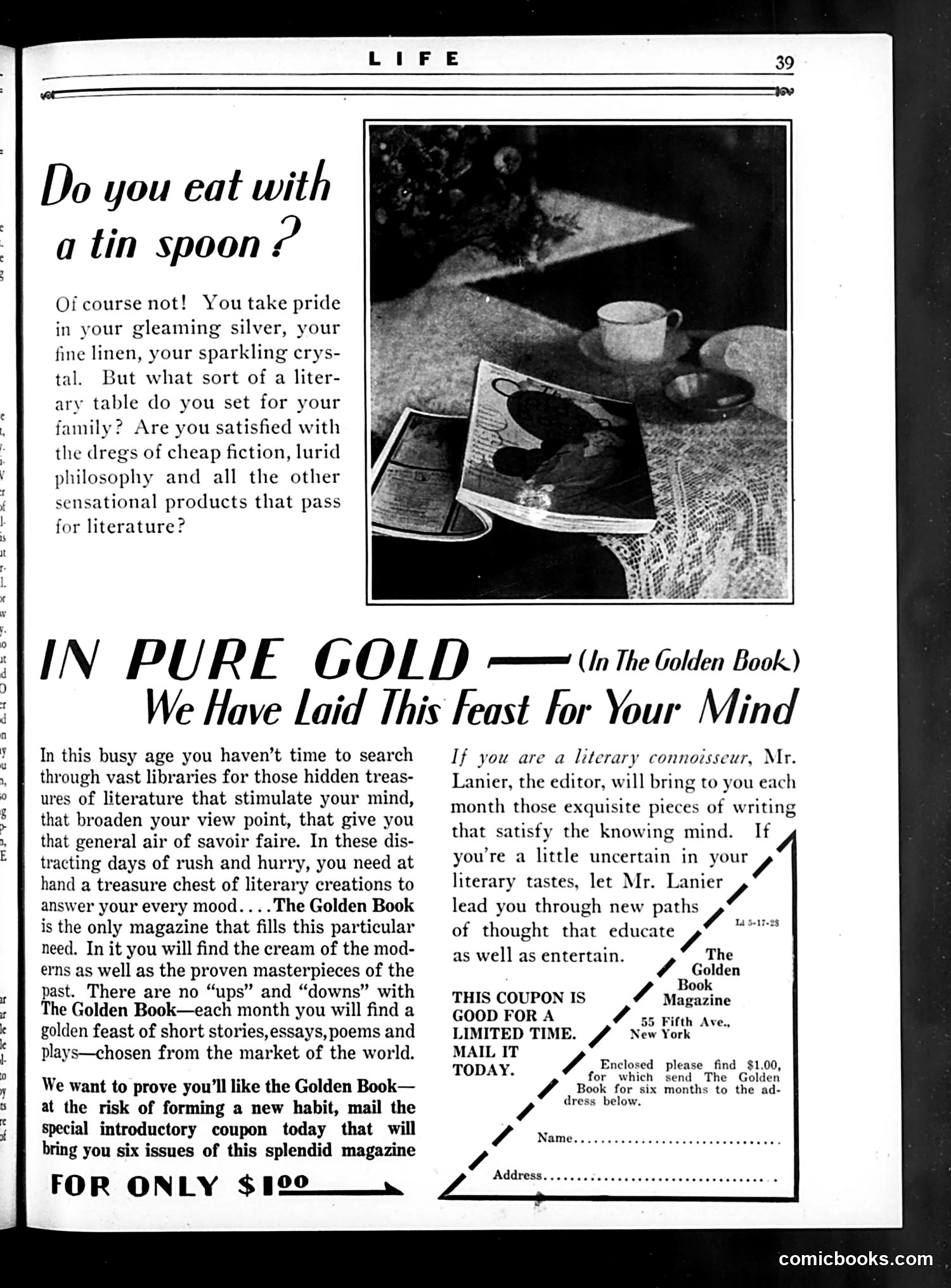
This page is primarily an **advertisement for The Golden Book magazine**, not political satire. The opening rhetorical question—"Do you eat with a tin spoon?"—uses class anxiety as a hook, contrasting fine dining etiquette with intellectual pretension. The ad's central pitch targets aspirational readers: if you lack time to browse libraries for quality literature, *The Golden Book* offers curated "exquisite pieces of writing" monthly. The satire is gentle—mocking both rushed modern life and uncertain literary taste—but the real purpose is commercial: six issues for $1.00 as an introductory offer. The accompanying photograph shows a simple table setting with a cup and magazine, emphasizing accessibility. This represents *Life* magazine's typical blend of social commentary and commercial messaging from the early 20th century.
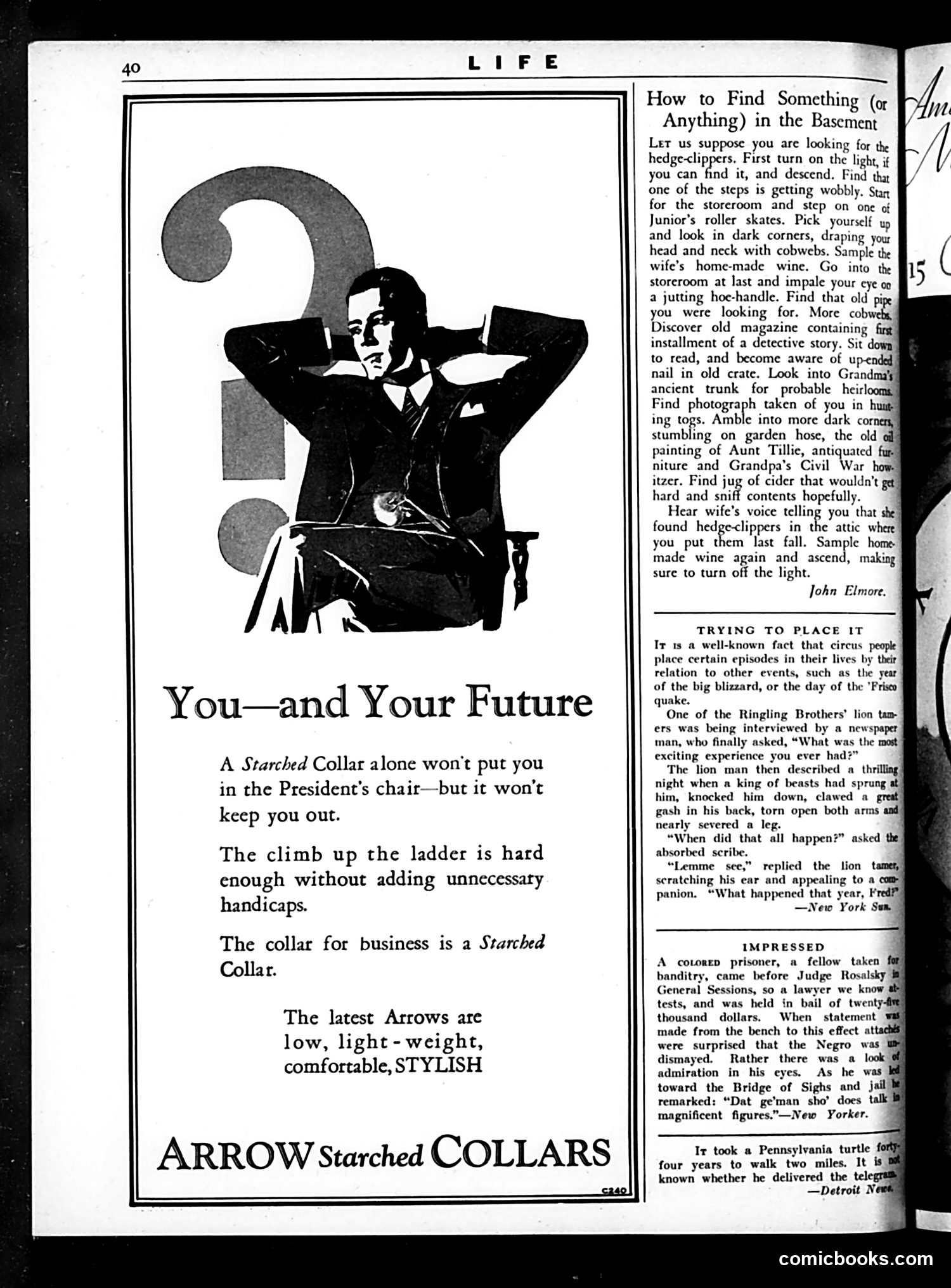
This page is primarily **advertising for Arrow Starched Collars**, with humorous filler content typical of Life magazine's satirical style. ## Main Advertisement The left side features a man in business attire with a question mark, promoting Arrow collars as essential for career advancement. The pitch: a starched collar won't guarantee success ("won't put you in the President's chair") but won't hurt your chances either. ## Humor Pieces The right side contains three brief comedic anecdotes: 1. **"How to Find Something in the Basement"** — a tongue-in-cheek guide humorously detailing the mishaps and discoveries (cobwebs, old photos, homemade wine) one encounters searching basements. 2. **"Trying to Place It"** — jokes about circus performers' poor time-sense, a prisoner's dignity before a judge, and a slow Pennsylvania turtle. These are standard early 20th-century genteel humor: domestic chaos, ethnic stereotypes (the prisoner anecdote), and animal oddities. The content reflects Life's mix of advertising and lighthearted social commentary aimed at middle-class readers.