
Life, 1928-05-17 · page 28 of 42
Life — May 17, 1928 — page 28: what you’re looking at
What you’re looking at
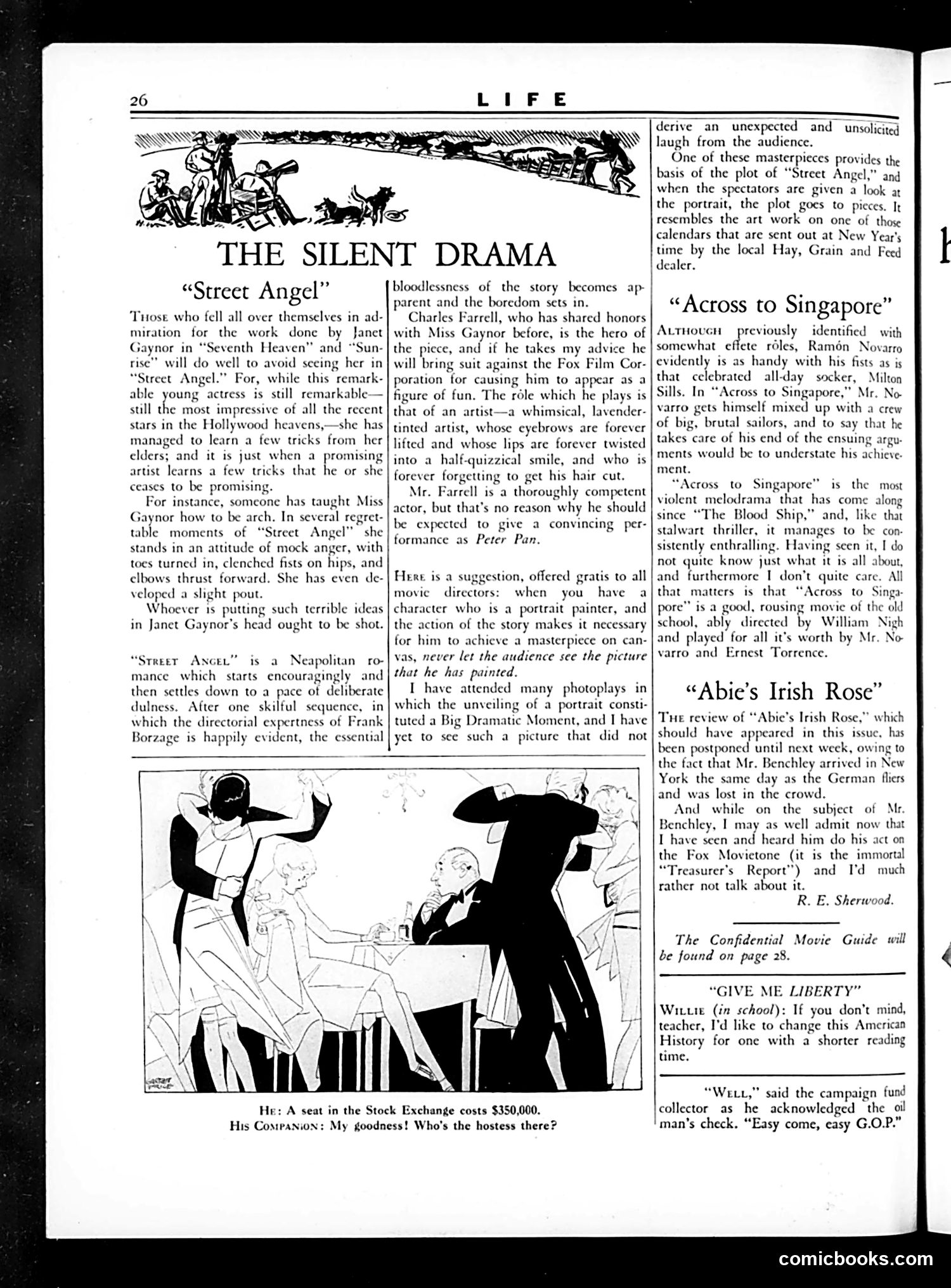
This page from *Life* magazine contains reviews of three silent films, accompanied by a cartoon about wealth and social class. **The Cartoon:** The illustration shows a well-dressed man at what appears to be an exclusive social venue, remarking that a Stock Exchange seat costs $350,000—then asking his companion "Who's the hostess?" The satire targets the absurdity of extreme wealth disparity: someone wealthy enough to casually reference a quarter-million-dollar purchase doesn't know who's hosting the event. It mocks the pretensions and disconnection of the ultra-rich during the prosperous 1920s. **The Reviews:** Film critic R.E. Sherwood critiques Janet Gaynor's affected mannerisms in "Street Angel," praises Ramon Novarro's action sequences in "Across to Singapore," and notes a delayed review of "Abie's Irish Rose" due to a missed appointment with an actor. The page exemplifies *Life*'s satirical approach to American society and entertainment during the Jazz Age.
📄 Transcribed text from this page (OCR, searchable)
Machine-transcribed from the original scan — historical spelling and the odd misread are preserved.
THE SILENT DRAMA “Street Angel” Tuose who fell all over themselves in ad- miration for the work done by Janet Gaynor in “Seventh Heaven” and “Sun- rise’ will do well to avoid sceing her in “Street. Angel.” For, while this remark- able young actress is still remarkable— still the most impressive of all the recent stars in the Hollywood heavens,—she has managed to learn a few tricks from her elders; and it is just when a promising artist learns a few tricks that he or she 's to be promising. For instance, someone has taught Miss Gaynor how to be arch. In several regret- table moments of “Street Angel’ she stands in an attitude of mock anger, with tocs turned in, clenched fists on hips, and elbows thrust forward. veloped a slight pout. Whoever is putting such terrible ideas She has even de- in Janet Gaynor’s head ought to be shot. “Sreeer Ancet” is a Neapolitan ro- mance which starts encouragingly and then settles down to a pace of deliberate dulness. After one skilful sequence, in which the directorial expertness of Frank Borzage is happily evident, the essential is bloodlessness of the story becomes ap: | parent and the boredom sets in. Charles Farrell, who has shared honors with Miss Gaynor before, is the hero of the piece, and if he takes my advice he will bring suit against the Fox Film Cor- poration for causing him to appear as a figure of fun. The role which he plays is that of an artist—a whimsical, tinted artist, whose eyebrows are forever lifted and whose lips are forever twisted into a half-quizzical smile, and who is forever forgetting to get his hair cut. Mr. Farrell is a thoroughly competent actor, but that’s no reason w hy he should be expected to give a convincing per- formance as Peter Pan. lavender- Here is a suggestion, offered gratis to all when you have a character who is a portrait painter, and the action of the story makes it necessary for him to achieve a masterpiece on can- vas, never let the audience see the picture that he has painted. I have attended many photoplays in which the unveiling of a portrait consti- tuted a Big Dramatic Moment, and I have yet to see such a picture that did not movie directors: He: His Compa: A seat in the Stock Exchange costs $350,000. My goodness! Who's the hostess there? derive an unexpected and unsolicited laugh from the audience. One of these masterpieces provides the basis of the plot of “Street Angel,” and when the spectators are given a look at the portrait, the plot goes to pieces. It resembles the art work on one of those calendars that are sent out at New Year's time by the local Hay, Grain and Feed | dealer. “Across to Singapore” AttHoucH previously identified with somewhat dete roles, Ramén Novarro evidently is as handy with his fists as is that celebrated all-day socker, Milton Sills. In “Across to Singapore,” Mr. No- ro gets himself mixed up with a crew of big, brutal sailors, and to say that he takes care of his end of the ensuing argu- ments would be to understate his achieve. ment. “Across to Singapore’ is. the violent melodrama that has come along since “The Blood Ship,” and, like that stalwart thriller, it manages to be con- sistently enthralling. Having seen it, I do not quite know just what it is all about, and furthermore I don’t quite care, All that matters is that ‘Across to pore” is a good, rousing movie of the old school, ably directed by William Nigh and played for all it’s worth by Mr. varro and Ernest Torrence. “Abie’s Irish Rose” Tue review of “Abie’s Irish Rose,” which should have appeared in this issuc, has been postponed until next week, owing to the fact that Mr. Benchley arrived in New | York the same day as the German fliers and was lost in the crowd. And while on the subject Mr. Benchley, I may as well admit now that I have seen and heard him do his act on the Fox Movietone (it is the immortal “Treasurer's Report”) and I'd much rather not talk about it. R. E. Sherwood. most The Confidential Movie Guide will be found on page 28. “GIVE ME LIBERTY” Witute (in school): If you don’t mind, teacher, I'd like to change this American History for one with a shorter reading ume. “We t,” said the campaign fund collector as he acknowledged the oil ‘man’s check, “Easy come, easy G.O.P.” comicbooks.com