
Life, 1928-05-17 · page 22 of 42
Life — May 17, 1928 — page 22: what you’re looking at
What you’re looking at
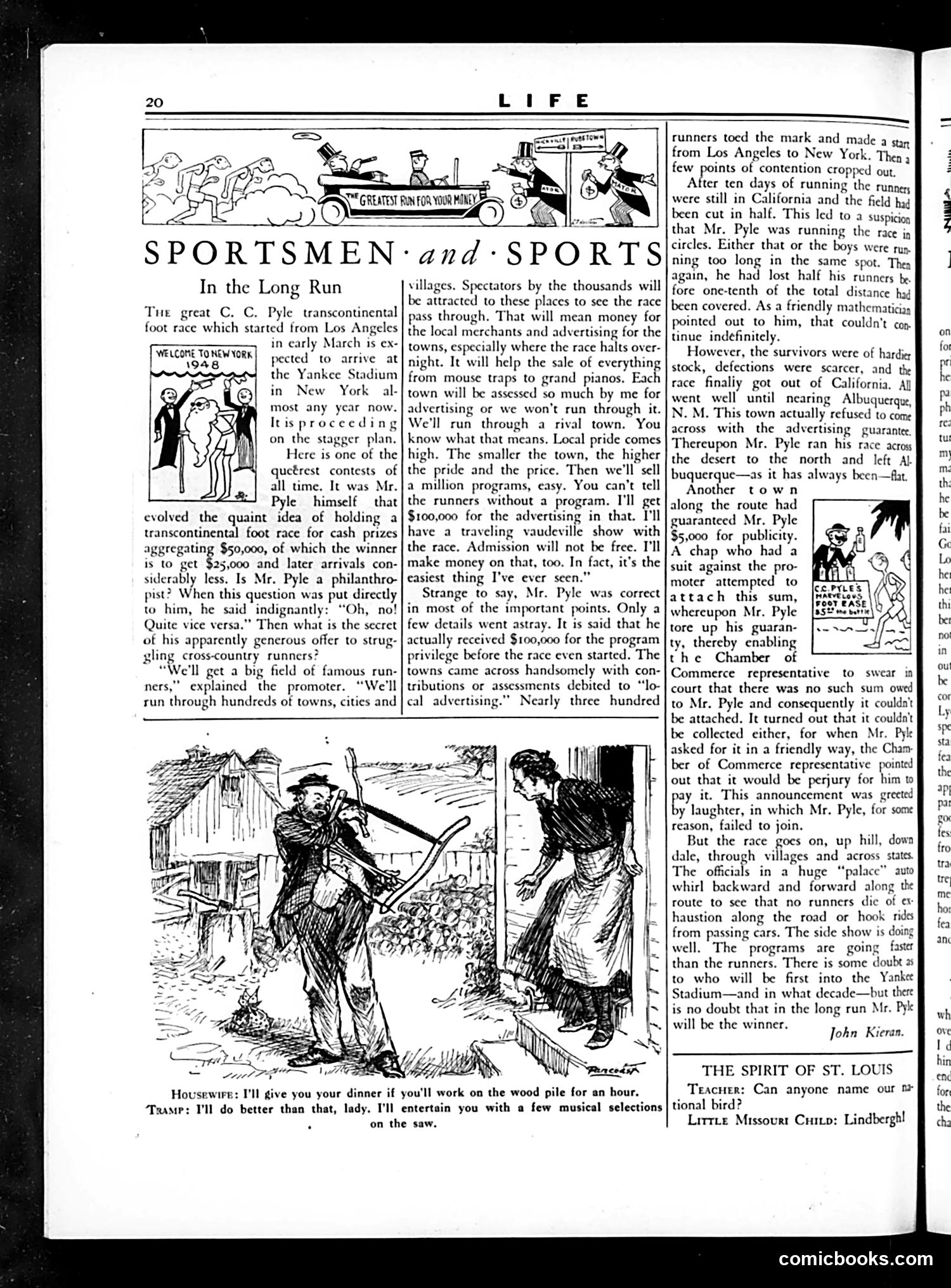
This 1920s *Life* magazine article satirizes promoter C.C. Pyle's transcontinental foot race—a real event that started from Los Angeles toward New York. The satire targets Pyle's entrepreneurial ruthlessness masked as philanthropy. **The joke:** Pyle claims altruism but openly admits extracting money from every angle—charging towns "advertising fees" to run through them, selling programs (claiming runners can't be identified without them), operating a traveling vaudeville show, and profiting enormously while runners drop out en masse. **The cartoon** (bottom left) shows a tramp proposing musical saw entertainment to a housewife—a visual pun on the race's "stagger plan" (slow progress) and general hustling that mirrors Pyle's scheme. **The satire's point:** American capitalism during the Roaring Twenties often dressed naked profit-seeking in noble language. Pyle embodies this perfectly—he's innovative and legally clever, but flagrantly exploitative. The race's comedic failures (losing half the field in California, disputes with towns) prove the scheme prioritizes money over actual runners.
📄 Transcribed text from this page (OCR, searchable)
Machine-transcribed from the original scan — historical spelling and the odd misread are preserved.
SPORTSMEN In the Long Run Tne great C. C. Pyle transcontinental foot race which started from Los Angeles WELCOME TO NEW YORK 1948 in early March is ex- pected to arrive at the Yankee Stadium in New York al- most any year now. Itisproceeding on the stagger plan. Here is one of the quetrest contests of all time. It was Mr. Pyle himself that evolved the quaint idea of holding a transcontinental foot race for cash prizes aggregating $50,000, of which the winner is to get Bees and later arrivals con- siderably less. Is Mr. Pyle a philanthro- pist? When this question was put directly to him, he said indignantly: “Oh, no! Quite vice versa.” Then what is the secret of his apparently generous offer to strug- gling cross-country runners? “We'll get a big field of famous run- ners,”" explained the promoter. “We'll run through hundreds of towns, cities and -and-SPOR 4 villages. Spectators by the thousands will be attracted to these places to see the race pass through. That will mean money for the local merchants and advertising for the towns, especially where the race halts over- night. It will help the sale of everything from mouse traps to grand pianos. Each town will be assessed so much by me for advertising or we won't run through it. We'll run through a rival town. You know what that means. Local pride comes high. The smaller the town, the higher the pride and the price. Then we'll sell a million programs, easy. You can’t tell the runners without a program. I'll get $100,000 for the advertising in that. I'll have a traveling vaudeville show with the race. Admission will not be free. I'll make money on that, too. In fact, it’s the easiest thing I've ever seen.” Strange to say, Mr. Pyle was correct in most of the important points. Only a few details went astray. It is said that he actually received $100,000 for the program privilege before the race even started. The towns came across handsomely with con- tributions or assessments debited to “‘lo- cal advertising.” Nearly three hundred Housewire: I'll give you your dinner if you'll work on the wood pile for an hour. Tramp: I'll do better than that, lady. I'll entertain you with a few musical selections . on the saw. — runners toed the mark and made a start f Los Angeles to New York, rom Le 1g New York. Then 3 few pene of contention cropped out, After ten days of running the runners were still in California and the field had been cut in half. This led to a suspicion that Mr. Pyle was running the race in circles, Either that or the boys were rup. ning too long in the same spot. Thea again, he had lost half his runners be fore one-tenth of the total distance had been covered. As a friendly mathematicias pointed out to him, that couldn't cop. tinue indefinitely. However, the survivors were of hardie, stock, defections were scarcer, and the race finaliy got out of California. Ajj went well until nearing Albuquerque, N. M. This town actually refused to come across with the advertising guarantee. Thereupon Mr. Pyle ran his race actos the desert to the north and left Al buquerque—as it has always been—fiat. Another town along the route had guaranteed Mr. Pyle $5,000 for publicity. A chap who had a suit against the pro- moter attempted to attach this sum, whereupon Mr. Pyle tore up his guaran- ty, thereby enabling the Chamber of Commerce representative to swear in court that there was no such sum owed to Mr. Pyle and consequently it couldn't be attached. It turned out that it couldn't be collected either, for when Mr. Pyle asked for it in a friendly way, the Cham- ber of Commerce representative pointed out that it would be perjury for him w pay it. This announcement was greeted fy laughter, in which Mr. Pyle, for some reason, failed to join. But the race goes on, up hill, down dale, through villages and across states. The officials in a huge “palace” auto whirl backward and forward along route to see that no runners dic of ex haustion along the road or hook rides from passing cars. The side show is doi well. The programs are going faster than the runners. There is some doubt 35 to who will be first into the Yankee Stadium—and in what decade—but there is no doubt that in the long run Mr. Pyk will be the winner, John Kieran. THE SPIRIT OF ST. LOUIS Teacher: Can anyone name our tional bird? Lite Missourt Cuito: Lindbergh! comicbooks.com W