
Life, 1928-05-17 · page 15 of 42
Life — May 17, 1928 — page 15: what you’re looking at
What you’re looking at
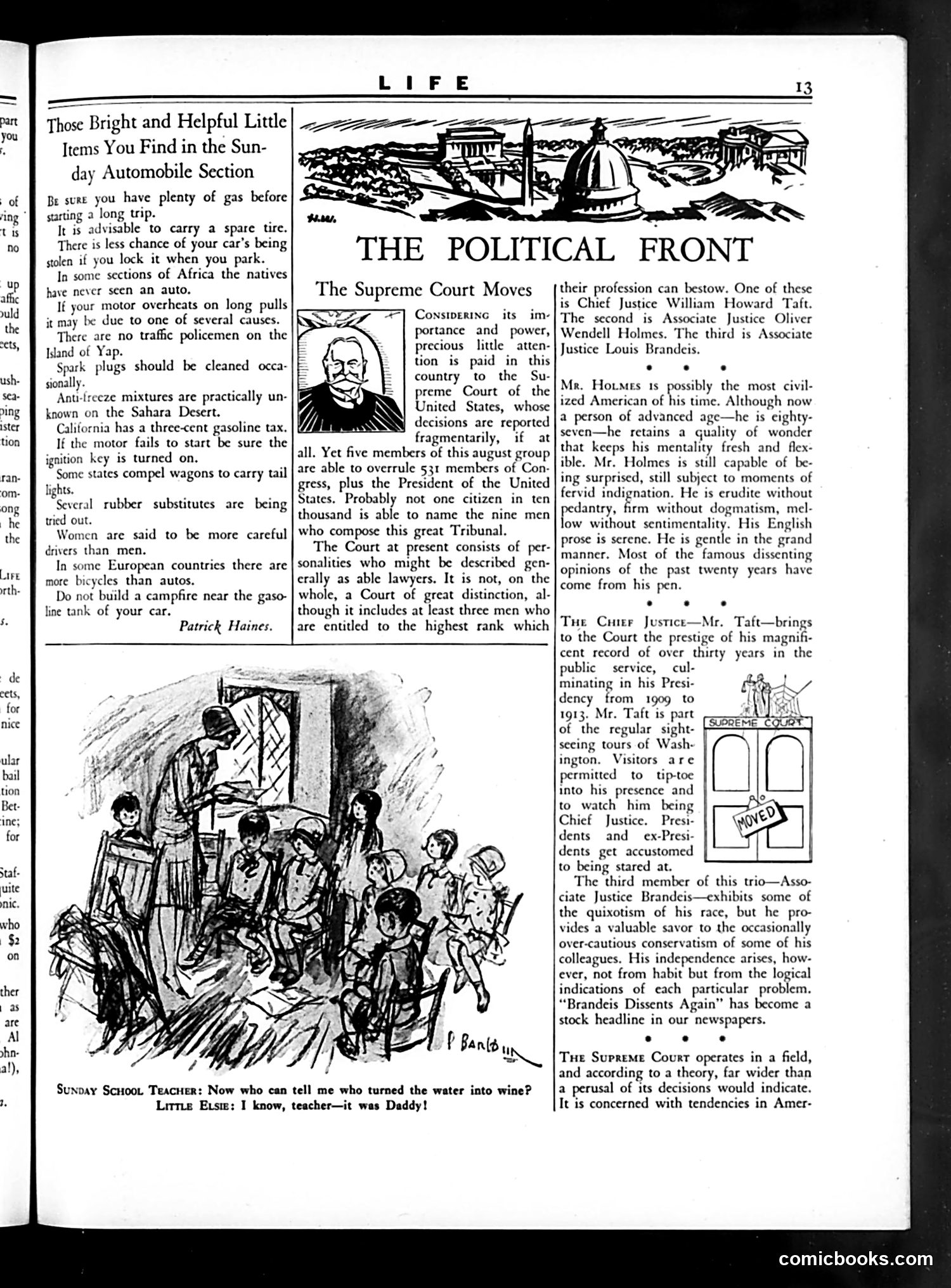
This page discusses the U.S. Supreme Court, emphasizing its importance and the nine justices who compose it. The text identifies three specific justices: Chief Justice William Howard Taft and Associate Justices Oliver Wendell Holmes and Louis Brandeis. The cartoon below depicts a Sunday school scene where a teacher asks "Now who can tell me who turned the water into wine? Little Elise: I know, teacher—it was Daddy!" The joke satirizes how children attribute miraculous or impossible accomplishments to their fathers, likely serving as a humorous commentary on how the general public mythologizes or exaggerates the capabilities of public figures—perhaps a subtle jab at the veneration of Supreme Court justices or political leaders more broadly.
📄 Transcribed text from this page (OCR, searchable)
Machine-transcribed from the original scan — historical spelling and the odd misread are preserved.
LIFE Those Bright and Helpful Little Items You Find in the Sun- day Automobile Section Be sure you have plenty of gas before garting a long trip. It is advisable to carry a spare tire. There is less chance of your car’s being stolen if you lock it when you park. In some sections of Africa the natives have never scen an auto. If your motor overheats on long pulls it may be due to one of several causes. There are no traffic policemen on the Island of Yap. Spark plugs should be cleaned occa- sionally. Anu-lreeze mixtures are practically un- known on the Sahara Desert. California has a three-cent gasoline tax. If the motor fails to start be sure the ignition key is turned on. Some states compel wagons to carry tail lights. “Several rubber substitutes are being tied out. Women are said to be more careful drivers than men. In some European countries there are more bicycles than autos. Do not build a campfire near the gaso- line tank of your car. Patrick Haines. —— ~— BS *: The Supreme Court Moves ConsiperING its im- portance and power, precious little atten- tion is paid in this country to the Su- preme Court of the United States, whose decisions are reported fragmentarily, if at all. Yet five members of this august group are able to overrule 531 members of Con- gress, plus the President of the United States. Probably not one citizen in ten thousand is able to name the nine men who compose this great Tribunal. The Court at present consists of per- sonalities who might be described gen- erally as able lawyers. It is not, on the whole, a Court of great distinction, al- though it includes at least three men who are entitled to the highest rank which NS N EWN Sunoay Scoot Teacher: Now who can tell me who turned the water into wine? Lrme E ste: I know, teacher—it was Daddy! their profession can bestow. One of these is Chief Justice William Howard Taft. The second is Associate Justice Oliver Wendell Holmes. The third is Associate Justice Louis Brandeis. . . . Mr. Howmes 1s possibly the most civil- ized American of his time. Although now a person of advanced age—he is eighty- seven—he retains a quality of wonder that keeps his mentality fresh and flex- ible. Mr. Holmes is still capable of be- ing surprised, still subject to moments of fervid indignation. He is erudite without dantry, Erin without dogmatism, mel- few without sentimentality. His English prose is serene. He is gentle in the grand manner. Most of the famous dissenting opinions of the past twenty years have come from his pen. ° . . Tue Crier Justice—Mr. Taft—brings to the Court the prestige of his magnif- cent record of over thirty years in the public service, cul- minating in his Presi- dency from 1909 to 1913. Mr. Taft is part of the regular sight- seeing tours of Wash- ington. Visitors are permitted to tip-toe into his presence and to watch him being | Chief Justice. Presi- dents and ex-Presi- dents get accustomed to being stared at. The third member of this trio—Asso- ciate Justice Brandcis—exhibits some of the quixotism of his race, but he pro- vides a valuable savor to the occasionally over-cautious conservatism of some of his colleagues. His independence arises, how- ever, not from habit but from the logical indications of each particular problem. “Brandeis Dissents Again” has become a stock headline in our newspapers. . ° . Tue Supreme Court operates in a field, and according to a theory, far wider than a perusal of its decisions would indicate. It is concerned with tendencies in Amer- comicbooks.com