
Life, 1928-05-17 · page 7 of 42
Life — May 17, 1928 — page 7: what you’re looking at
What you’re looking at
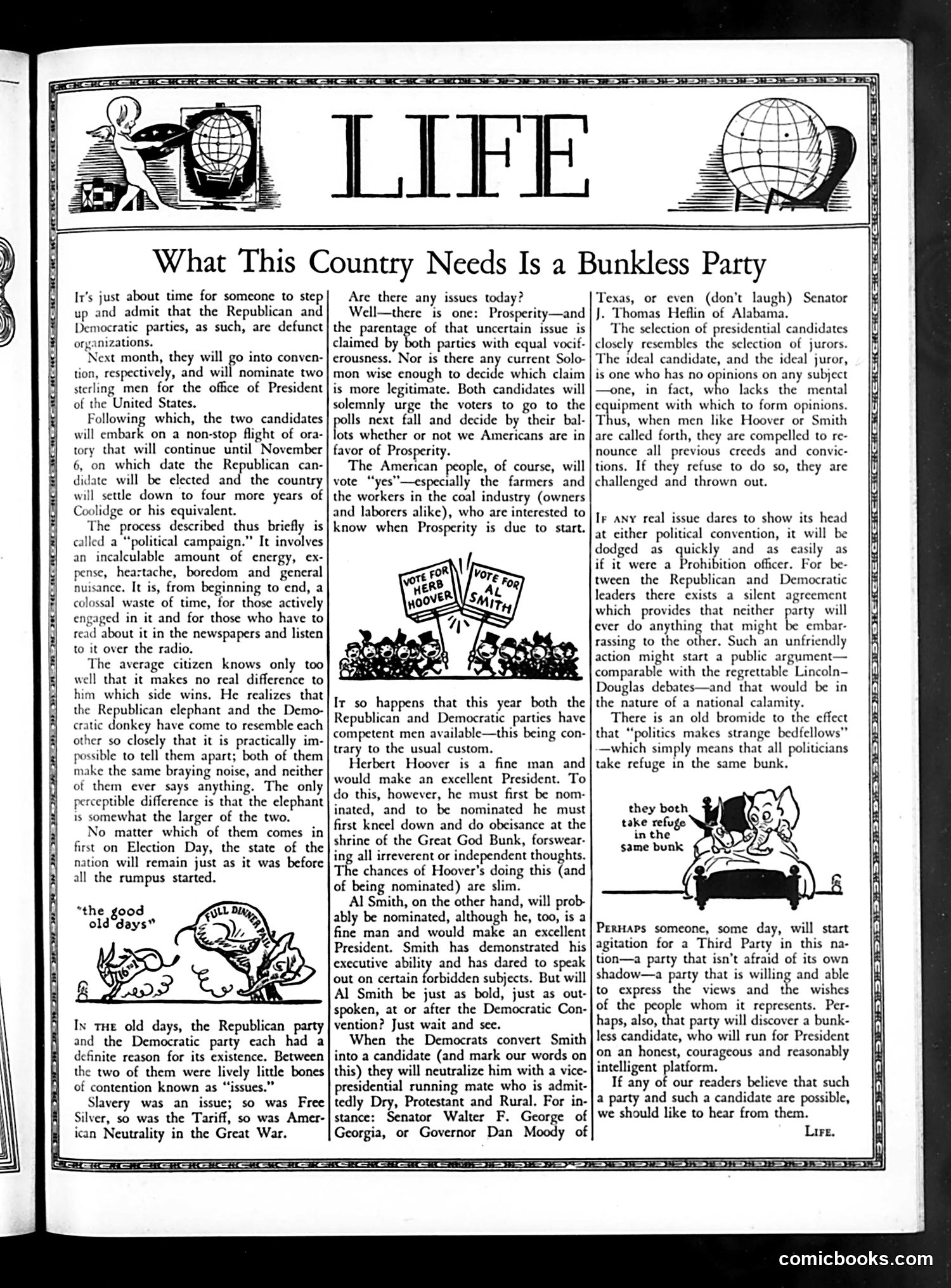
This 1928 editorial argues the U.S. needs a "bunkless party"—a third political party free from entrenched interests. The text criticizes both Republicans and Democrats as indistinguishable, noting they nominate similar candidates (specifically mentioning Herbert Hoover for Republicans and Al Smith for Democrats). The cartoons illustrate this critique: one shows two voting booths labeled identically ("VOTE FOR HOOVER"/"VOTE FOR SMITH"), emphasizing they're interchangeable choices. Another depicts politicians taking refuge in the same bunk, suggesting parties are fundamentally alike despite their rivalry. The author sarcastically observes that real issues (prosperity, prohibition) are obscured by partisan theater. The satire advocates for genuine political alternatives rather than the current two-party system offering voters false choices.
📄 Transcribed text from this page (OCR, searchable)
Machine-transcribed from the original scan — historical spelling and the odd misread are preserved.
What This Country Needs Is a Bunkless Party Ir’s just about time for someone to step up and admit that the Republican and Democratic parties, as such, are defunct organizations. Next month, they will go into conven- tion, respectively, and will nominate two sterling men for the office of President of the United States. Following which, the two candidates will embark on a non-stop flight of ora- tory that will continue until November 6, on which date the Republican can- didate will be elected and the country will settle down to four more years of Coolidge or his equivalent. The process described thus briefly is called a “political campaign.” It involves an incalculable amount of energy, ex- pense, heartache, boredom and _ general nuisance. It is, from beginning to end, a colossal waste of time, for those actively engaged in it and for those who have to read about it in the newspapers and listen to it over the radio. The average citizen knows only too well that it makes no real difference to him which side wins. He realizes that the Republican elephant and the Demo- cratic donkey have come to resemble each other so closely that it is practically im- possible to tell them apart; both of them make the same braying noise, and neither of them ever says anything. The only perceptible difference is that the elephant 1s somewhat the larger of the two. No matter which of them comes in first on Election Day, the state of the nation will remain just as it was before all the rumpus started. “the good old days” In tHe old days, the Republican party and the Democratic party each had a definite reason for its existence. Between the two of them were lively little bones of contention known as “‘issues.”” Slavery was an issue; so was Free Silver, so was the Tariff, so was Amer- ican Neutrality in the Great War. Se Are there any issues today? Well—there is one: Prosperity—and the parentage of that uncertain issue is claimed by foth parties with equal vocif- erousness. Nor is there any current Solo- mon wise enough to decide which claim is more legitimate. Both candidates will solemnly urge the voters to go to the polls next fall and decide by their bal- lots whether or not we Americans are in favor of Prosperity. The American people, of course, will vote “‘yes"—especially the farmers and the workers in the coal industry (owners and laborers alike), who are interested to know when Prosperity is due to start. Ir so happens that this year both the Republican and Democratic parties have competent men available—this being con- trary to the usual custom. Herbert Hoover is a fine man and would make an excellent President. To do this, however, he must first be nom- inated, and to be nominated he must first kneel down and do obcisance at the shrine of the Great God Bunk, forswear- ing all irreverent or independent thoughts. The chances of Hoover's doing this (and of being nominated) are slim. Al Smith, on the other hand, will prob- ably be nominated, although he, too, is a fine man and would make an excellent President. Smith has demonstrated his executive ability and has dared to speak out on certain forbidden subjects. But will Al Smith be just as bold, just as out- spoken, at or after the Democratic Con- vention? Just wait and see. When the Democrats convert Smith into a candidate (and mark our words on this) they will neutralize him with a vice- presidential running mate who is admit- tedly Dry, Protestant and Rural. For in- stance: Senator Walter F. George of Georgia, or Governor Dan Moody of St et et et Texas, or even (don’t laugh) Senator J. Thomas Heflin of Alabama. The selection of presidential candidates closely resembles the selection of jurors. The ideal candidate, and the ideal juror, is one who has no opinions on any subject —one, in fact, who lacks the mental squipinene with which to form opinions. Thus, when men like Hoover or Smith are called forth, they are compelled to re- nounce all previous creeds and convic- tions. If they refuse to do so, they are challenged and thrown out. Ir any real issue dares to show its head at either political convention, it will be dodged as quickly and as easily as if it were a Prohibition officer. For be- tween the Republican and Democratic leaders there exists a silent agreement which provides that neither party will ever do anything that might be embar- rassing to the other. Such an unfriendly action might start a public argument— comparable with the regrettable Lincoln- Douglas debates—and that would be in the nature of a national calamity. There is an old bromide to the effect that “politics makes strange bedfellows” —which simply means that all politicians take refuge in the same bunk. they both take refu inthe e same bunk PerHAPs someone, some day, will start agitation for a Third Party in this na- tion—a party that isn’t afraid of its own shadow—a party that is willing and able to express the views and the wishes of the people whom it represents. Per- haps, also, that party will discover a bunk- less candidate, who will run for President on an honest, courageous and reasonably intelligent platform. If any of our readers believe that such a party and such a candidate are possible, we should like to hear from them. Lire. comicbooks.com