
Life, 1928-05-17 · page 24 of 42
Life — May 17, 1928 — page 24: what you’re looking at
What you’re looking at
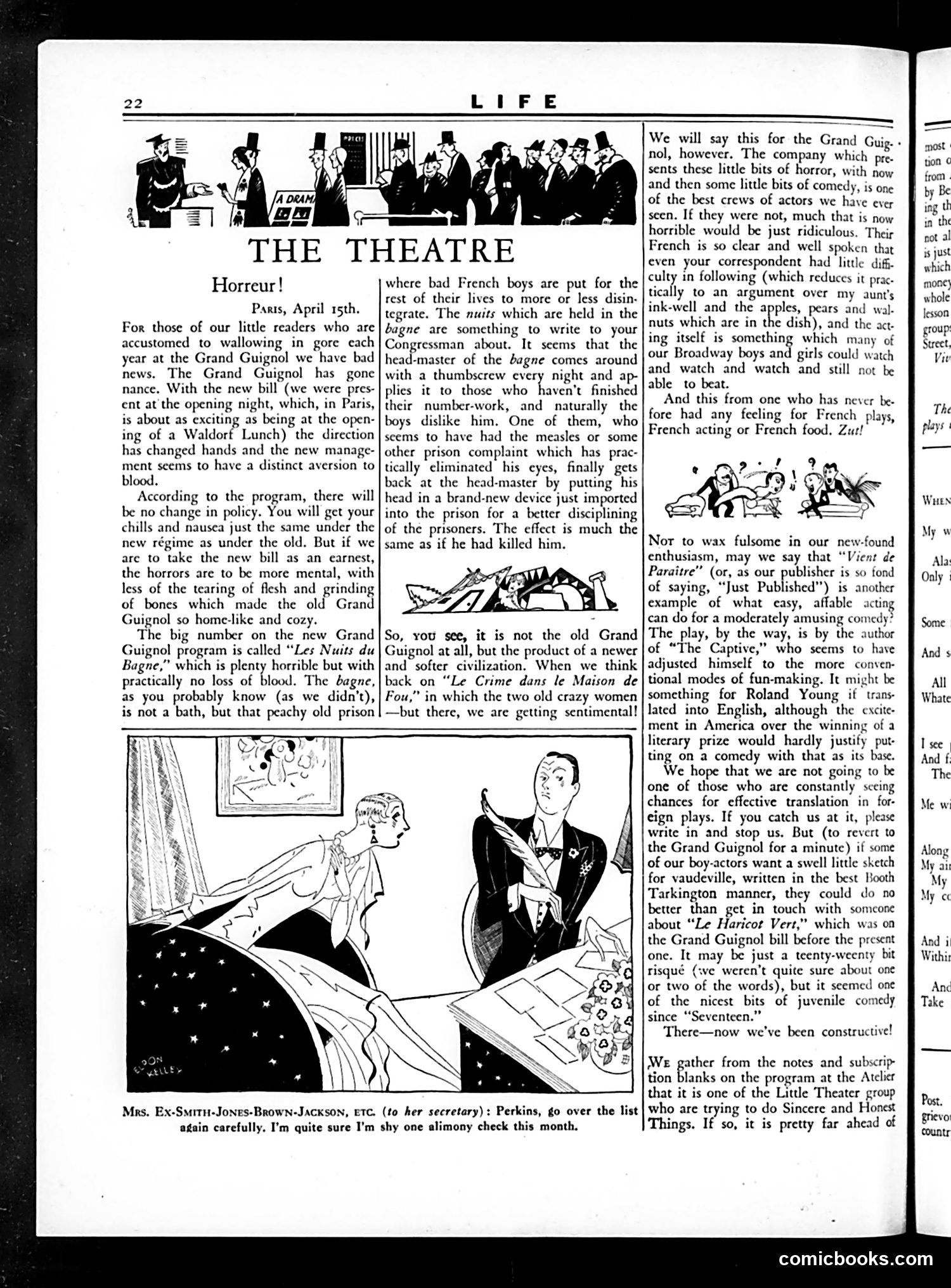
This page reviews the Grand Guignol, a famous Paris theater known for graphic horror performances. The writer humorously reports that new management has made the theater less bloody—shifting from physical gore to psychological horror. The play "Les Nuits du Bagne" (Prison Nights) exemplifies this: instead of explicit violence, it depicts a prisoner's revenge through a torture device, achieving similar effect with less bloodshed. The writer praises the French actors' skill and clear diction, even complimenting their work over Broadway performers. They also mention another production, "Vient de Paraitre," adapted from the author of "The Captive." The bottom cartoon, captioned with a wealthy woman's name listing multiple ex-husbands, jokes about alimony payments—satirizing the expense of serial marriages among the wealthy.
📄 Transcribed text from this page (OCR, searchable)
Machine-transcribed from the original scan — historical spelling and the odd misread are preserved.
— Horreur! Paris, April 15th. For those of our little readers who are accustomed to wallowing in gore each year at the Grand Guignol we have bad news. The Grand Guignol has gone nance. With the new bill (we were pres- ent at the opening night, which, in Paris, is about as exciting as being at the open- ing of a Waldorf Lunch) the direction has changed hands and the new manage- ment scems to have a distinct aversion to blood. According to the program, there will be no change in policy. You will get your chills and nausea just the same under the new régime as under the old. But if we are to take the new bill as an earnest, the horrors are to be more mental, with less of the tearing of flesh and grinding of bones which made the old Grand Guignol so home-like and cozy. The big number on the new Grand Guignol program is called “Les Nuits du Bagne,” which is plenty horrible but with practically no loss of brood. The bagne, as you probably know (as we didn’t), is not a bath, but that peachy old prison — THEATRE where bad French boys are put for the rest of their lives to more or less disin- tegrate. The nuits which are held in the bagne are something to write to your Congressman about. It seems that the head-master of the bagne comes around with a thumbscrew every night and ap- plies it to those who haven't finished their number-work, and naturally the boys dislike him. One of them, who seems to have had the measles or some other prison complaint which has prac- tically eliminated his eyes, finally gets back at the head-master by putting his head in a brand-new device just imported into the prison for a better disciplining of the prisoners. The effect is much the same as if he had killed him. So, you see, it is not the old Grand Guignol at all, but the product of a newer and softer civilization. When we think back on “Le Crime dans le Maison de Fou,” in which the two old crazy women —but there, we are getting sentimental! Mrs. Ex-SmitH-Jones-BrRowN-JACKSON, ETC. (to her secretary): Perkins, go over the list again carefully. I'm quite sure I'm shy one alimony check this month. We will say this for the Grand Guig. nol, however, The company which pre- sents these little bits of horror, with now and then some little bits of comedy, is one of the best crews of actors we have ever seen. If they were not, much that is now horrible would be just ridiculous. Their French is so clear and well spoken that even your correspondent had little diff. culty in following (which reduces it prac- tically to an argument over my aunt's ink-well and the apples, pears and wal- nuts which are in the dish), and the act- ing itself is something which many of our Broadway boys and girls could watch and watch and watch and still not be able to beat. And this from one who has never be- fore had any feeling for French plays, French acting or French food, Zut! Nor to wax fulsome in our new-found enthusiasm, may we say that “Vient de Paraitre” (or, as our publisher is so fond of saying, “Just Published”) is another example of what easy, affable acting can do for a moderately amusing comedy? The play, by the way, is by the author of “The Captive,” who seems to have adjusted himself to the more conven- tional modes of fun-making. It might be something for Roland Young if trans- lated into English, although the excite- ment in America over the winning of a literary prize would hardly justify put ting on a comedy with that as its base. We hope that we are not going to be one of those who are constantly sceing chances for effective translation in for- eign plays. If you catch us at it, please write in and stop us. But (to revert to the Grand Guignol for a minute) if some of our boy-actors want a swell little sketch for vaudeville, written in the best Booth Tarkington manner, they could do no better than get in touch with somcone about “Le Haricot Vert,” which was on the Grand Guignol bill before the present one. It may be just a teenty-weenty bit risqué (we weren't quite sure about one or two of the words), but it seemed one of the nicest bits of juvenile comedy since “Seventeen.” There—now we've been constructive! WE gather from the notes and subscrip- tion blanks on the program at the Atelier that it is one of the Little Theater group who are trying to do Sincere and Honest Things. If so, it is pretty far ahead of [by Be ing th in the not al is just which Wun My w Ala: Only Some And s All Whate I see | And f. The Me wi Along My ait My My cc And i Withir Anc Take comicbooks.com