
Life, 1928-05-17 · page 20 of 42
Life — May 17, 1928 — page 20: what you’re looking at
What you’re looking at
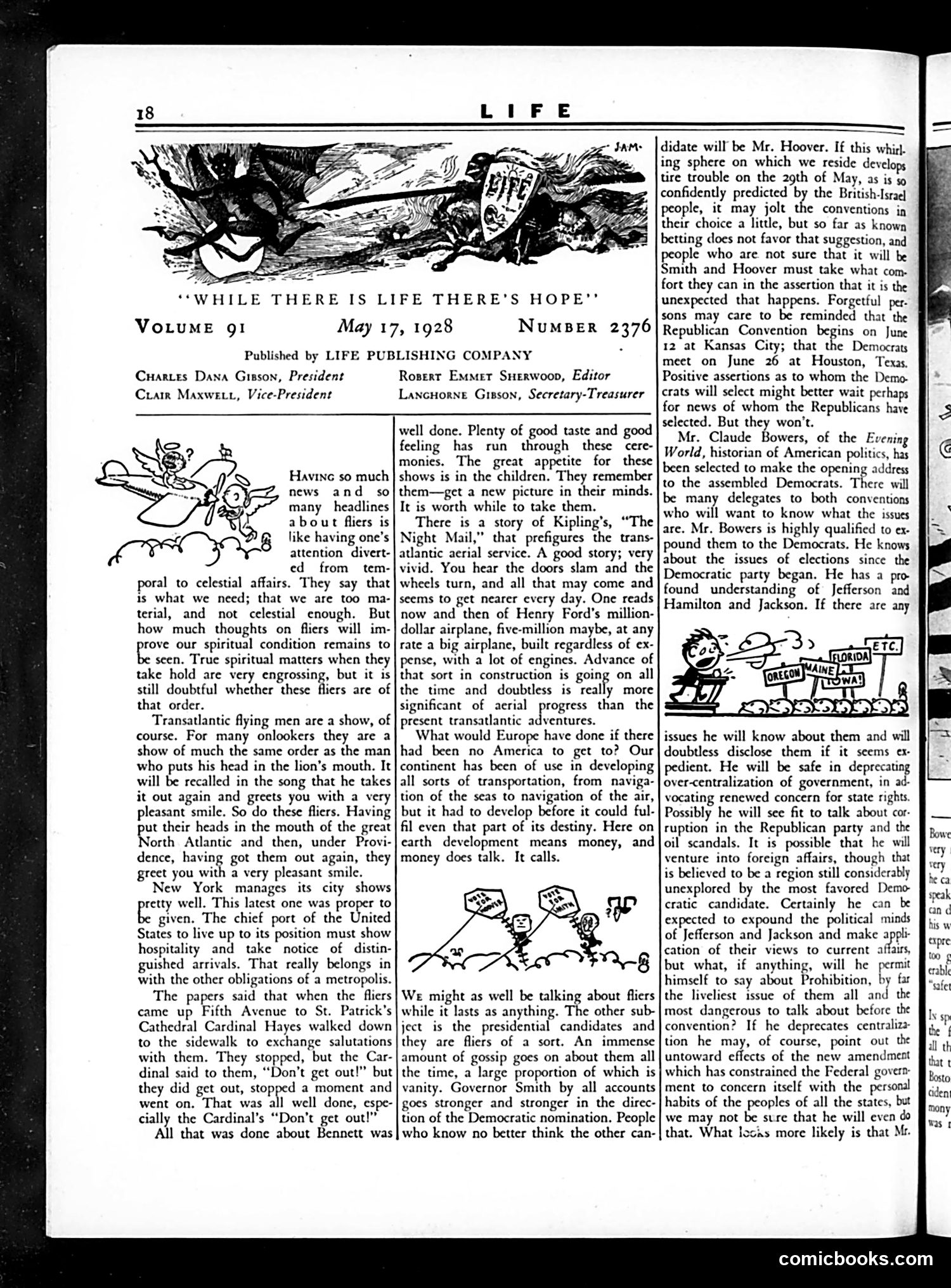
This page satirizes American obsession with transatlantic aviation while dismissing it as entertainment distraction from serious matters—specifically the 1928 presidential election. The main editorial compares transatlantic fliers (appearing to reference recent aviators like Bennett) to circus performers, praising New York's hospitality toward them while questioning their spiritual or practical significance. The piece notes Henry Ford's million-dollar airplane project, suggesting technological advancement matters more than stunts. The real target emerges in the second section: the presidential race. The editor dismisses gossip about candidates as "vanity," noting Governor Smith's growing Democratic support while predicting the Republican nominee will be Mr. Hoover. A joke references a British-Israel prediction of Earth's "tire trouble" on May 29th, sarcastically suggesting this cosmic event might "jolt the conventions in their choice." The cartoons (partially visible) likely mock these political figures and public distraction from substantive campaign issues.
📄 Transcribed text from this page (OCR, searchable)
Machine-transcribed from the original scan — historical spelling and the odd misread are preserved.
VoLUME gI May 17, 1928 NuMBER 2376 Published by LIFE PUBLISHING COMPANY Cuartes Dana Gipson, President Cran Maxwexr, Vice-President Rosert Emmet Suerwoon, Editor LancHorne Gisson, Secretary-Treasurer Havine so much news and so many headlines about fliers is like having one’s attention divert- ed from tem- poral to celestial affairs. They say that is what we need; that we are too ma- terial, and not celestial enough. But how much thoughts on fliers will im- rove our spiritual condition remains to seen. True spiritual matters when they take hold are very engrossing, but it is still doubtful whether these fliers are of that order. Transatlantic flying men are a show, of course. For many onlookers they are a show of much the same order as the man who puts his head in the lion’s mouth. It will be recalled in the song that he takes it out again and greets you with a very pleasant smile. So do these fliers. Having put their heads in the mouth of the great North Adantic and then, under Provi- dence, having got them out again, they greet you with a very pleasant smile. New York manages its city shows pee well. This latest one was proper to given. The chief port of the United States to live up to its position must show hospitality and take notice of distin- guished arrivals. That really belongs in with the other obligations of a metropolis. The papers said that when the fliers came up Fifth Avenue to St. Patrick's Cathedral Cardinal Hayes walked down to the sidewalk to exchange salutations with them. They stopped, but the Car- dinal said to them, “Don’t get out!” but they did get out, stopped a moment and went on. That was all well done, espe- cially the Cardinal’s “Don’t get out!” All that was done about Bennett was well done. Plenty of good taste and good feeling has run through these cere- monies. The great appetite for these shows is in the children. They remember them—get a new picture in their minds. It is worth while to take them. There is a story of Kipling’s, “The Night Mail,” that prefigures the trans- atlantic aerial service. A good story; very vivid. You hear the doors slam and the wheels turn, and all that may come and seems to get nearer every day. One reads now and then of Henry Ford’s million- dollar airplane, five-million maybe, at any rate a big airplane, built regardless of ex- pense, with a lot of engines. Advance of that sort in construction is going on all the time and doubtless is really more significant of aerial progress than the present transatlantic adventures. What would Europe have done if there had been no America to get to? Our continent has been of use in developing all sorts of transportation, from naviga- tion of the seas to navigation of the air, but it had to develop before it could ful- fil even that part of its destiny. Here on earth development means money, and money does talk. It calls. We might as well be talking about fliers while it lasts as anything. The other sub- ject is the presidential candidates and they are fliers of a sort. An immense amount of gossip goes on about them all the time, a large proportion of which is vanity. Governor Smith by all accounts goes stronger and stronger in the direc- ton of the Democratic nomination. People who know no better think the other can- didate will be Mr. Hoover. If this whirl. ing sphere on which we reside develops tire trouble on the 29th of May, as is s9 confidently predicted by the British-Israel people, it may jolt the conventions in their choice a little, but so far as known betting does not favor that suggestion, and people who are not sure that it will be Smith and Hoover must take what com- fort they can in the assertion that it is the unexpected that happens. Forgetful per- sons may care to be reminded that the Republican Convention begins on June 12 at Kansas City; that the Democrats meet on June 26 at Houston, Texas, Positive assertions as to whom the Demo- crats will select might better wait perhaps for news of whom the Republicans have selected. But they won't. Mr. Claude Bowers, of the Evening World, historian of American politics, has been selected to make the opening address to the assembled Democrats. There will be many delegates to both conventions who will want to know what the issues are. Mr. Bowers is highly qualified to ex- pound them to the Democrats. He knows about the issues of elections since the Democratic party began. He has a pro found understanding of Jefferson and Hamilton and Jackson. If there are any issues he will know about them and will doubtless disclose them if it seems ex- pedient. He will be safe in deprecating over-centralization of government, in ad- vocating renewed concern for state rights. Possibly he will see fit to talk about cor- ruption in the Republican party and the oil scandals. It is possible that he will venture into foreign affairs, though that is believed to be a region still considerably unexplored by the most favored Demo cratic candidate. Certainly he can be expected to expound the political minds of Jefferson and Jackson and make appli- cation of their views to current affairs, but what, if anything, will he permit himself to say about Prohibition, by far the liveliest issue of them all and the most dangerous to talk about before the convention? If he deprecates centraliza- tion he may, of course, point out the untoward effects of the new amendment which has constrained the Federal govern ment to concern itself with the personal habits of the peoples of all the states, but we may not be sure that he will even do that. What locas more likely is that Mr. comicbooks.com