
A complete issue · 42 pages · 1928
Life — April 12, 1928
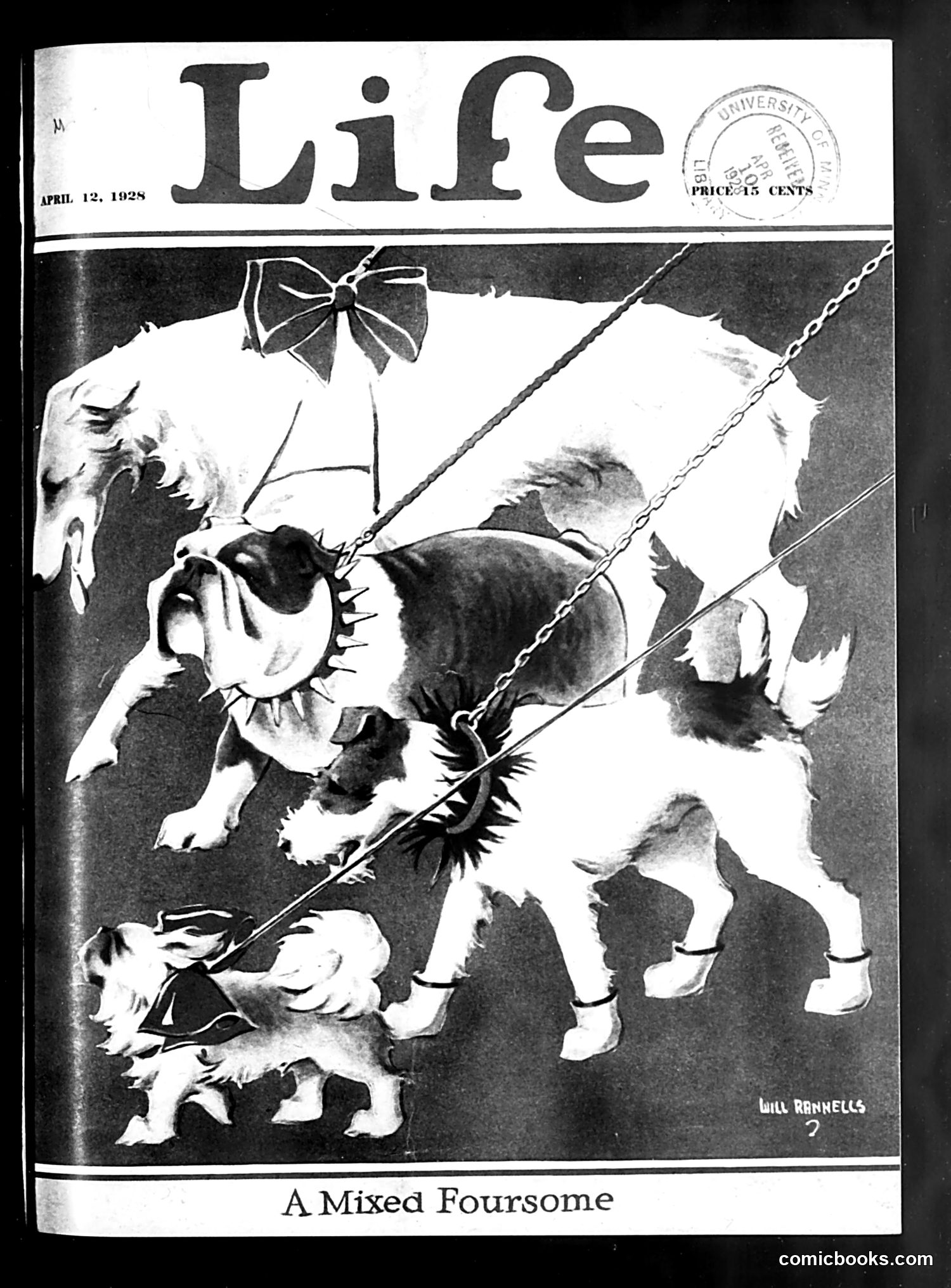
This cover illustration by Will Ranells depicts four small dogs on leashes arranged as if playing golf—a "mixed foursome" on the links. The dogs wear collars and accessories; the central dog sports a distinctive spiked collar and bow. A golf club and ball are visible in the composition. The satire likely plays on the social conventions of 1920s golf culture, where "foursomes" referred to groups of players. By depicting dogs instead of humans, the artist comments on either the pretension of golf society or absurdities within high-society social groupings of the era. The "mixed" element may reference gender mixing or class mixing—common satirical targets in Life magazine's humor about contemporary social dynamics.
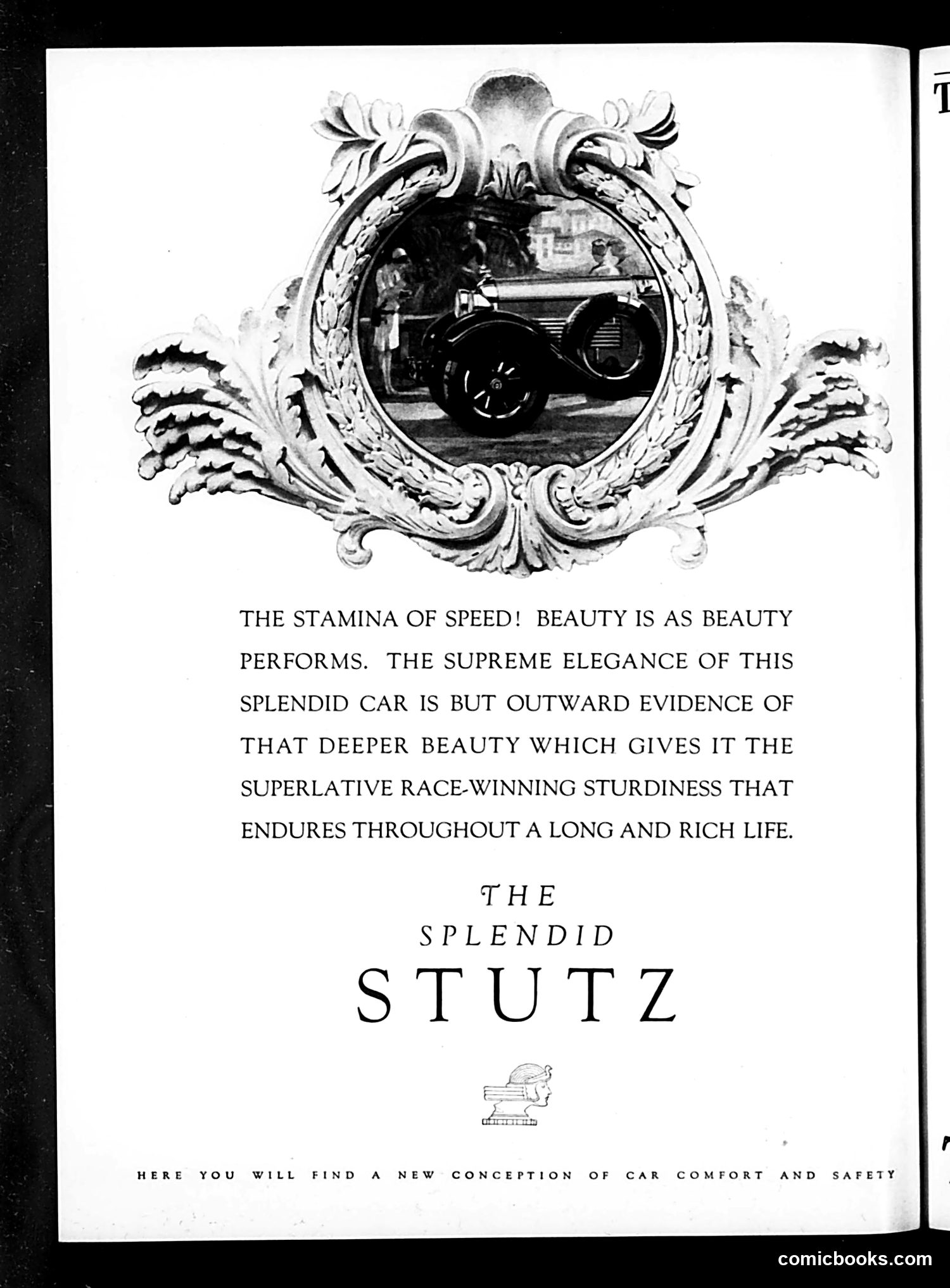
This is a **vintage automobile advertisement**, not a political cartoon. It advertises the Stutz car, a luxury American automobile brand popular in the early 20th century. The ornate baroque frame surrounding the car image is purely decorative, meant to emphasize elegance and prestige. The text employs flowery advertising language typical of the era, claiming the car's beauty reflects "race-winning sturdiness that endures throughout a long and rich life." The reference to "stamina of speed" and "race-winning" likely alludes to Stutz's actual racing success, which was a major selling point for luxury cars at the time. The tagline promises "a new conception of car comfort and safety." This is period commercial marketing, not satire or political commentary.
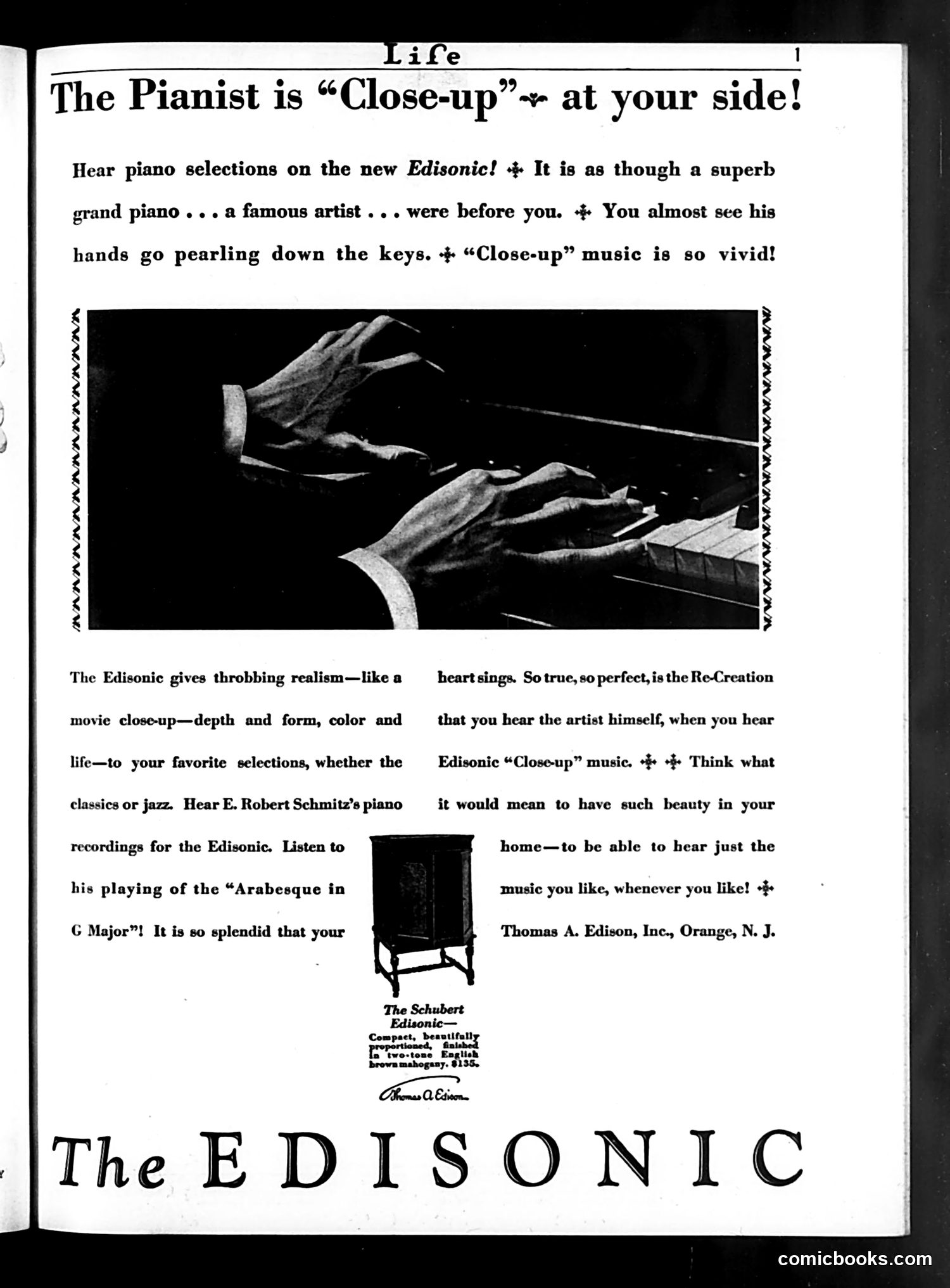
This is **not a cartoon or satire page**, but rather a **straightforward advertisement** for Edison phonographs, specifically the "Edisonic" model. The page promotes the phonograph's audio fidelity by emphasizing "close-up" sound quality—the illusion that a famous pianist performs live before you. The photograph of pianist hands at a keyboard illustrates this appeal. The ad references E. Robert Schmitz's piano recordings, suggesting listeners can hear classical music with remarkable clarity and presence. The product shown is a wooden cabinet-style phonograph. The ad's target audience is affluent home consumers desiring high-quality music reproduction. This represents early 20th-century consumer marketing celebrating technological advancement in sound recording and playback—no political satire is present.
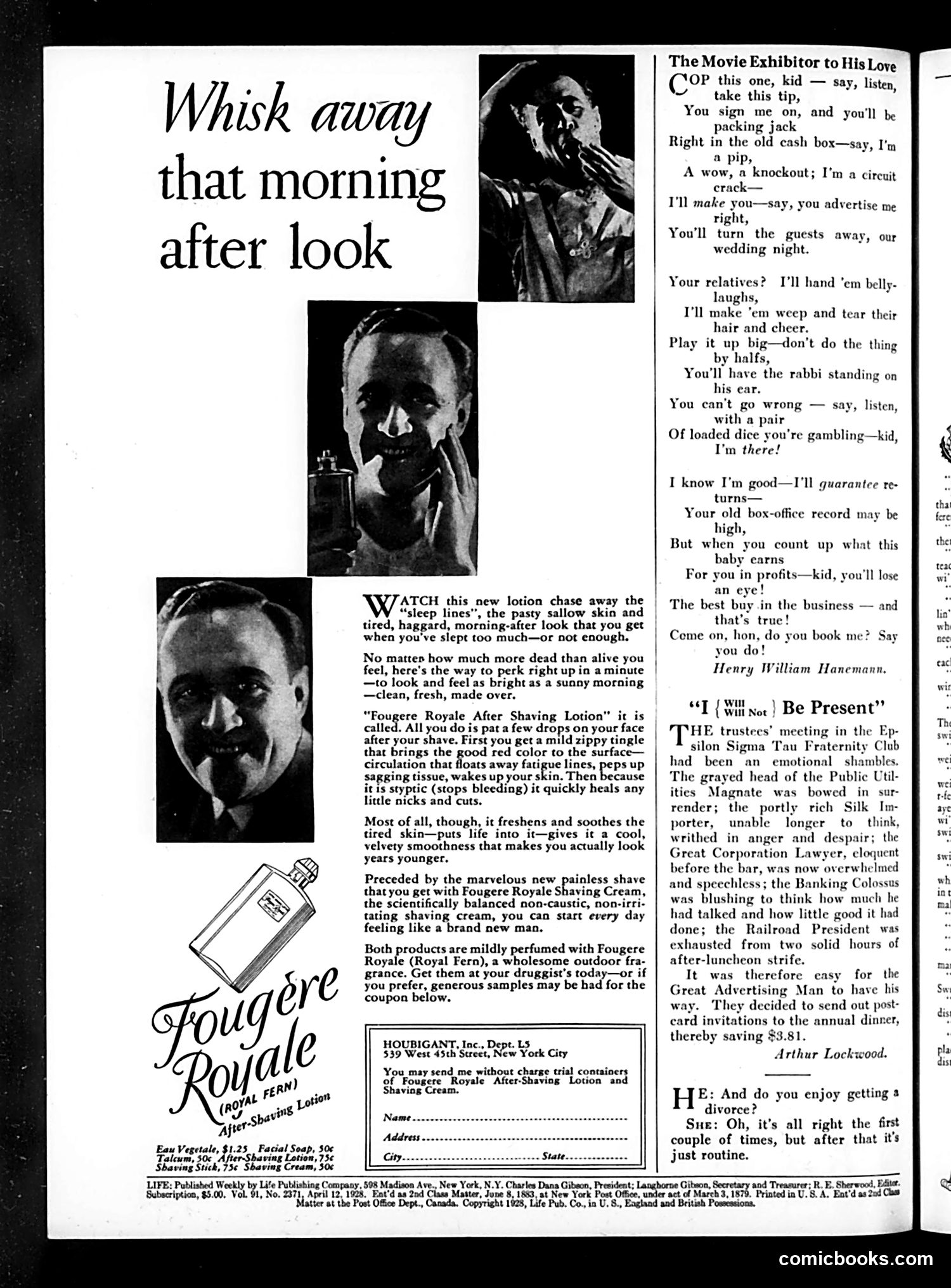
This page is primarily a **Fougère Royale advertisement** for an after-shaving lotion marketed to men. The product promises to eliminate tired, haggard facial appearance through a "painless shave" combined with the lotion's restorative properties. The satirical angle appears mild: the ad copy humorously exaggerates the product's effects, claiming it will make users "look years younger" and provide a "zippy tingle" that counteracts fatigue lines. This reflects typical early-20th-century beauty advertising's grandiose claims. The right column contains unrelated satirical content—"The Movie Exhibitor to His Love" (a cynical poem about showbiz relationships) and office humor about corporate meetings—suggesting this is a miscellaneous editorial/advertising page rather than focused satire on a specific political or cultural target.
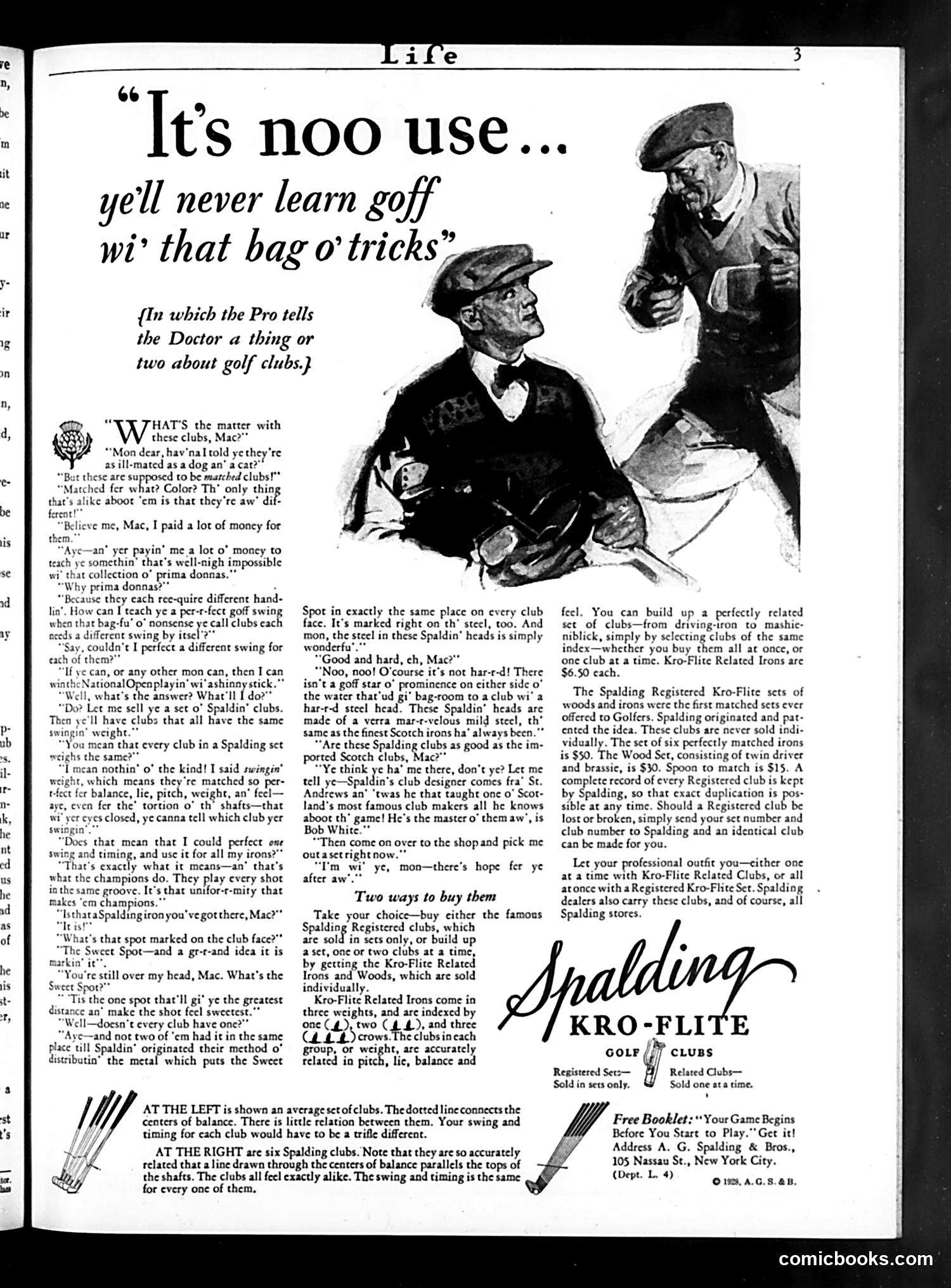
This page is primarily a **Spalding golf club advertisement** disguised as editorial content. The main illustration shows two Scottish men (indicated by their caps and accents in the dialogue) discussing golf clubs. The "satire" frames a common sales pitch: a Pro golfer tells a Doctor that matched club sets are worthwhile despite their cost. The Doctor initially objects that you can't learn golf from equipment alone, but the Pro persuades him that Spalding's precisely-matched clubs—with identical balance and swing weight across the set—actually do improve performance. The Scottish dialect and working-class characters add humor, but this is fundamentally **product placement marketed as humor**. The page promotes Spalding's "Registered" and "Related Clubs" sets, explaining their technical advantages and pricing structure. It's advertising masquerading as entertainment—common practice in early 20th-century magazines.
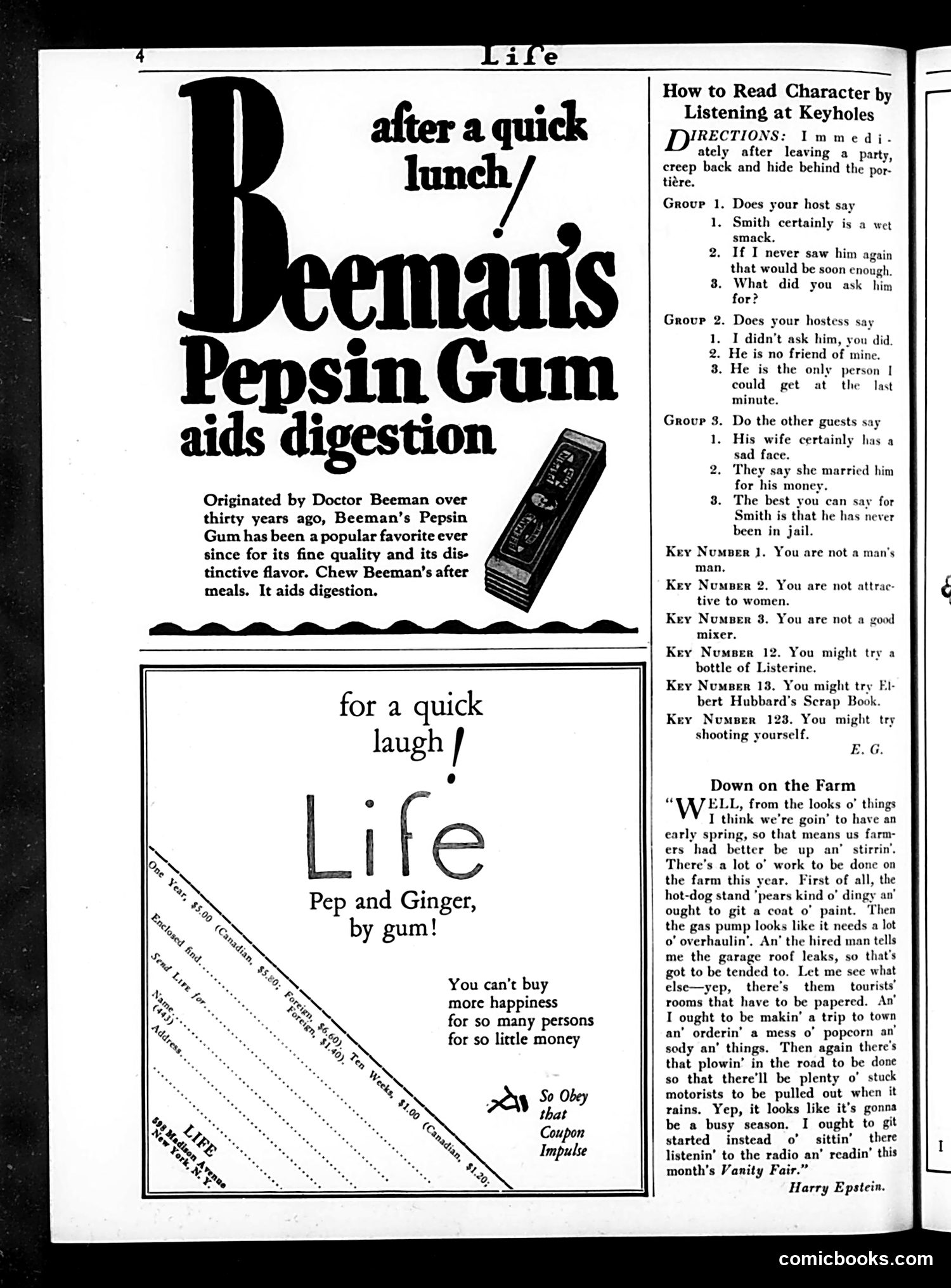
This page is primarily **advertising and humor content** from Life magazine, not political satire. The top half features a **Beeman's Pepsin Gum advertisement**, claiming the product aids digestion. It references "Doctor Beeman" who originated the formula thirty years prior. Below is a **Life brand gum advertisement** with a humorous coupon-style layout, promoting "Pep and Ginger, by gum!" The right column contains **"How to Read Character by Listening at Keyholes,"** a satirical etiquette guide offering absurd "key numbers" for judging guests' character—essentially mocking pretentious social observation and gossip. The bottom section, "Down on the Farm," is a **rural humor column** describing spring farm work and tourist disruptions, written by Harry Epstein. The page reflects early 20th-century consumer culture and small-town American life, mixing advertisements with lighthearted social commentary.
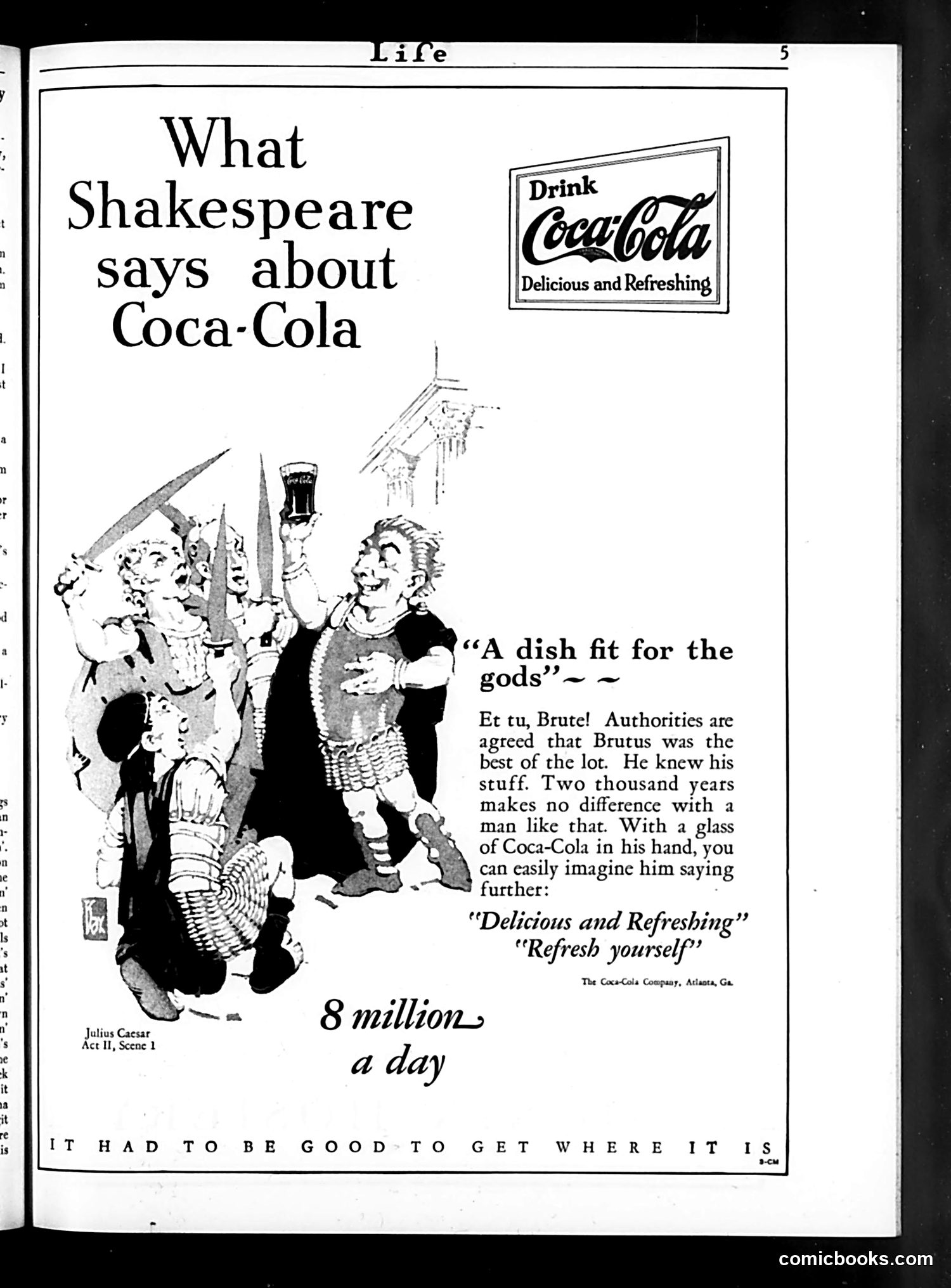
This is a **Coca-Cola advertisement** disguised as satirical commentary, not a genuine political cartoon. The page shows Roman figures (likely from Shakespeare's *Julius Caesar*) holding Coca-Cola glasses, with the headline "What Shakespeare says about Coca-Cola." The ad claims to quote Shakespeare with "A dish fit for the gods," then riffs on the famous line "Et tu, Brute?" to humorously suggest even the historical Brutus would appreciate Coca-Cola's "Delicious and Refreshing" qualities. The joke relies on anachronism—pretending ancient Romans would have enjoyed modern soft drinks. The "8 million a day" consumption statistic appears designed to suggest Coca-Cola's ubiquity and universal appeal. This represents early 20th-century advertising strategy: using literary references and humor to position a product as cultured and universally desirable.
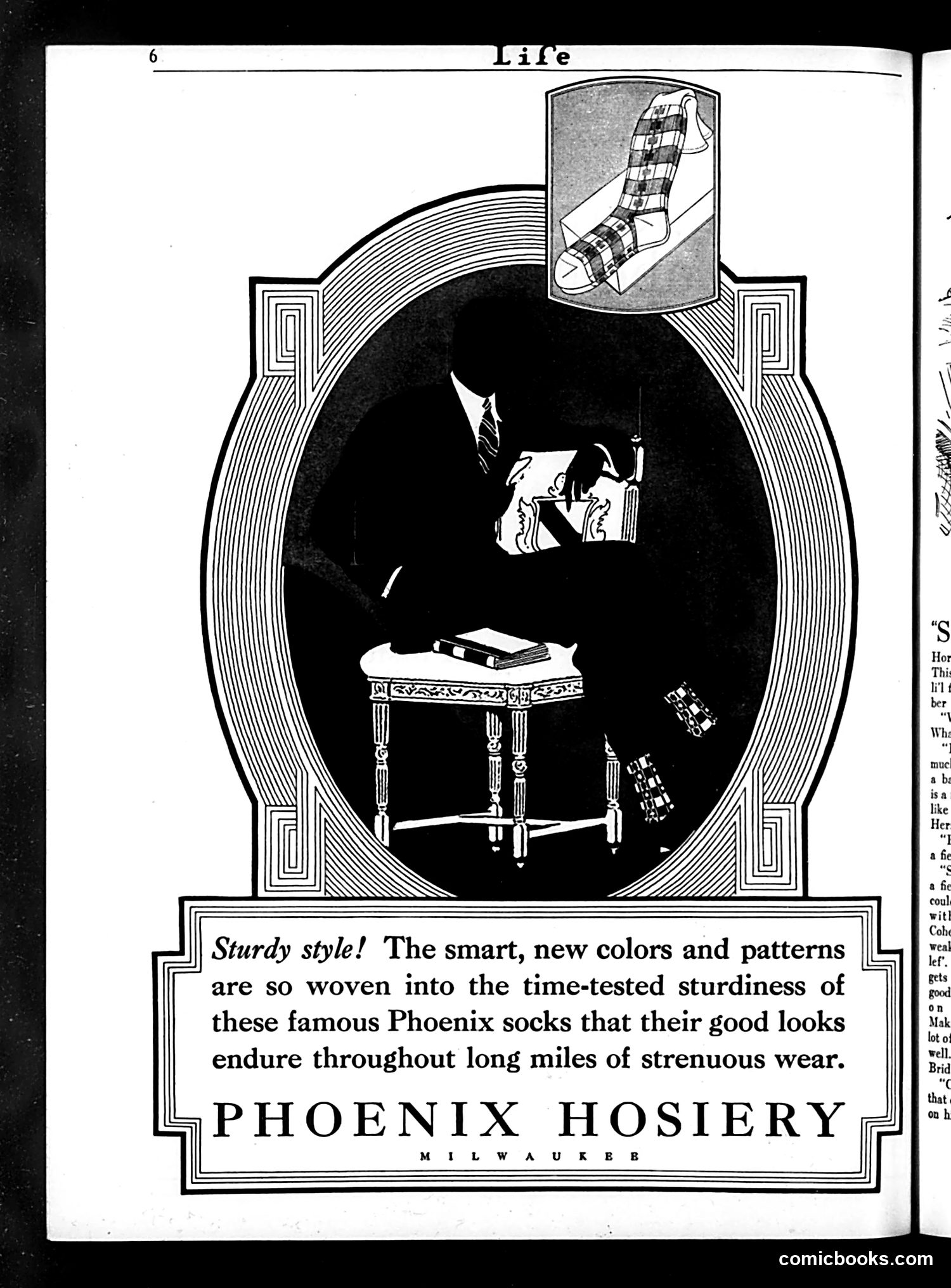
This page is primarily a **product advertisement** for Phoenix Hosiery of Milwaukee, not political satire. The image shows a silhouetted figure hunched over a table with reading materials, wearing a checkered sock (displayed in an inset illustration above). The advertisement emphasizes that Phoenix socks combine stylish "smart, new colors and patterns" with practical durability for "long miles of strenuous wear." The "sturdy style" headline plays on the product's reliability. The dramatic silhouette illustration and art deco framing are typical of 1920s-30s advertising design, meant to convey sophistication and quality to potential customers. This is commercial marketing, not satirical commentary.
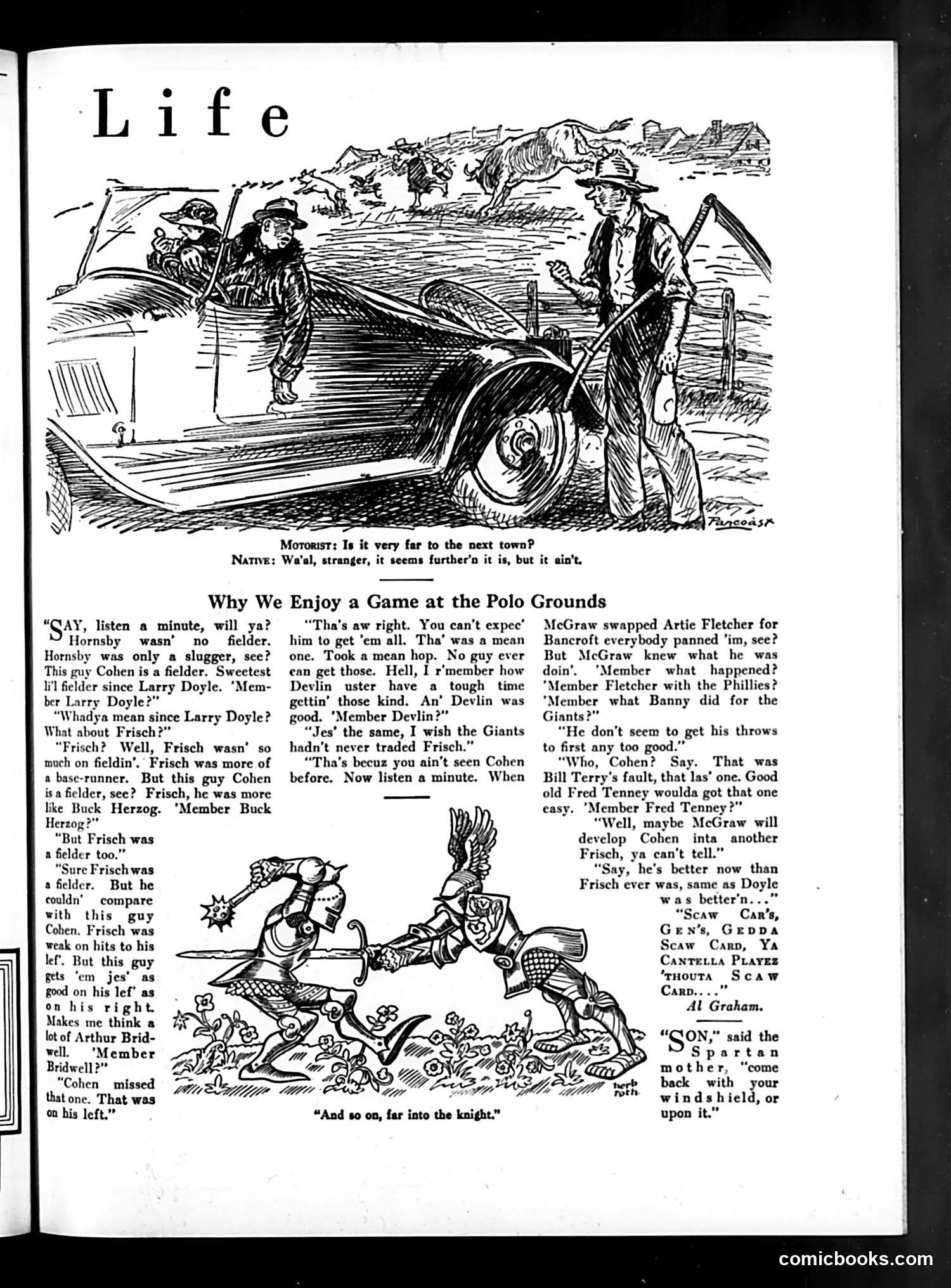
This page contains two separate items: **Top illustration**: A motorist asks a native for directions to the next town. The native's reply—that it's "further'n it is, but it ain't"—is a rural joke about deliberately unhelpful or circular directions, poking fun at backwoods communication styles common in early 20th-century American humor. **Main article**: "Why We Enjoy a Game at the Polo Grounds" discusses baseball players, referencing figures like Artie Fletcher, Larry Doyle, and others associated with what appears to be the New York Giants. The text compares different players' fielding abilities, suggesting this discusses contemporary baseball talent evaluation. The center illustration shows knights in combat, captioned "And so on, far into the knight"—a pun on "knight/night." The page reflects period attitudes about rural dialect humor and sports journalism analysis typical of early 1900s Life magazine.
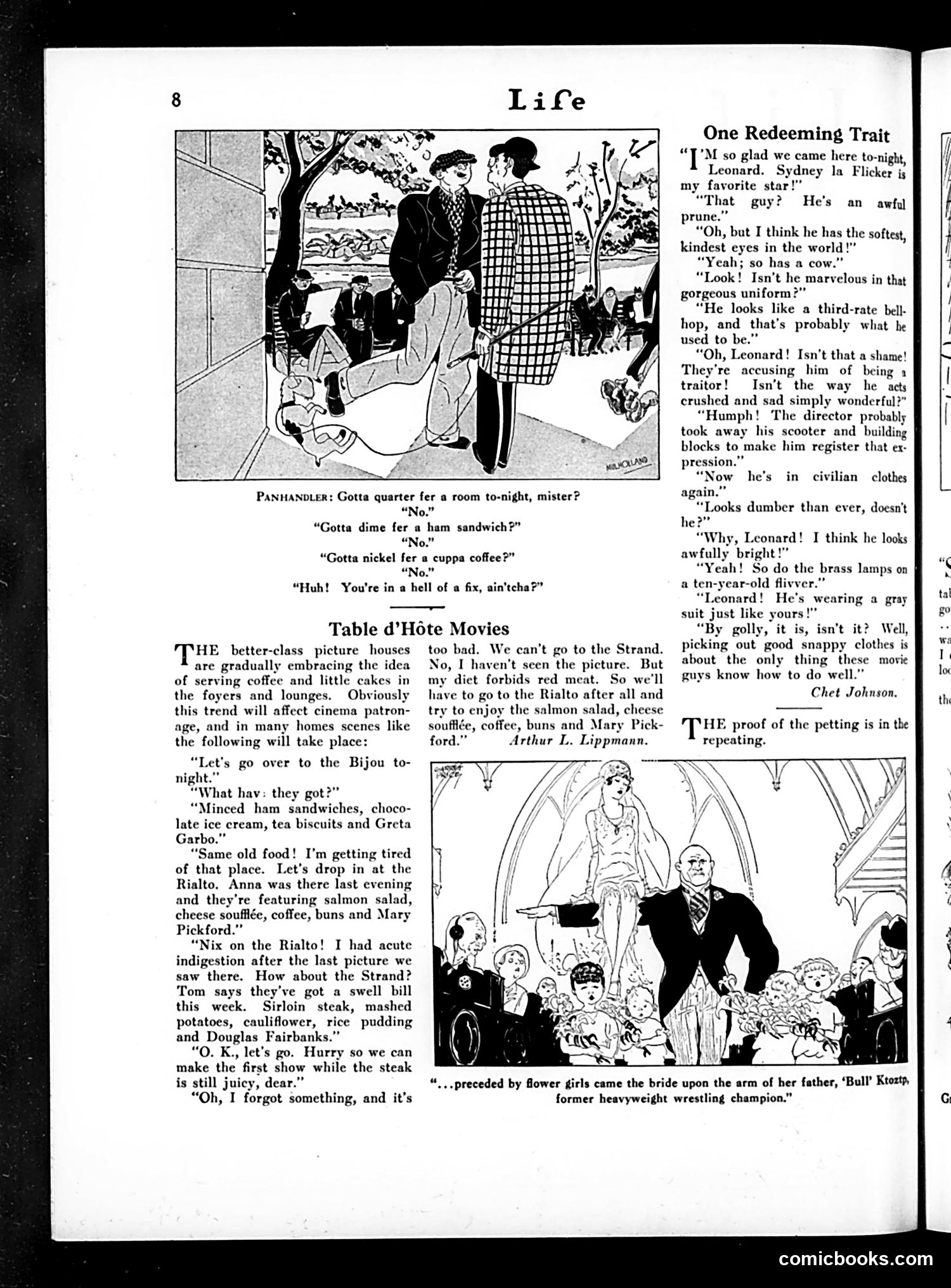
This page contains two distinct sections: **Top Cartoon ("One Redeeming Trait"):** Two women discuss actor Sydney Laflicker, debating his appearance and talent. One defends him despite his poor acting, noting he "has the softest, kindest eyes in the world." The satire mocks how audiences overlook mediocre performances based on physical attractiveness—a recurring critique of Hollywood's star system. **"Table d'Hôte Movies" Section:** A humorous article about better-class restaurants adopting cinema-themed dining, featuring conversations between patrons about where to eat and which movie theaters to visit afterward. The lower illustration shows a wedding scene, likely parodying elaborate film productions. The page satirizes both Hollywood's superficiality and the emerging trend of cinema influencing restaurant culture and social behavior in 1920s America.
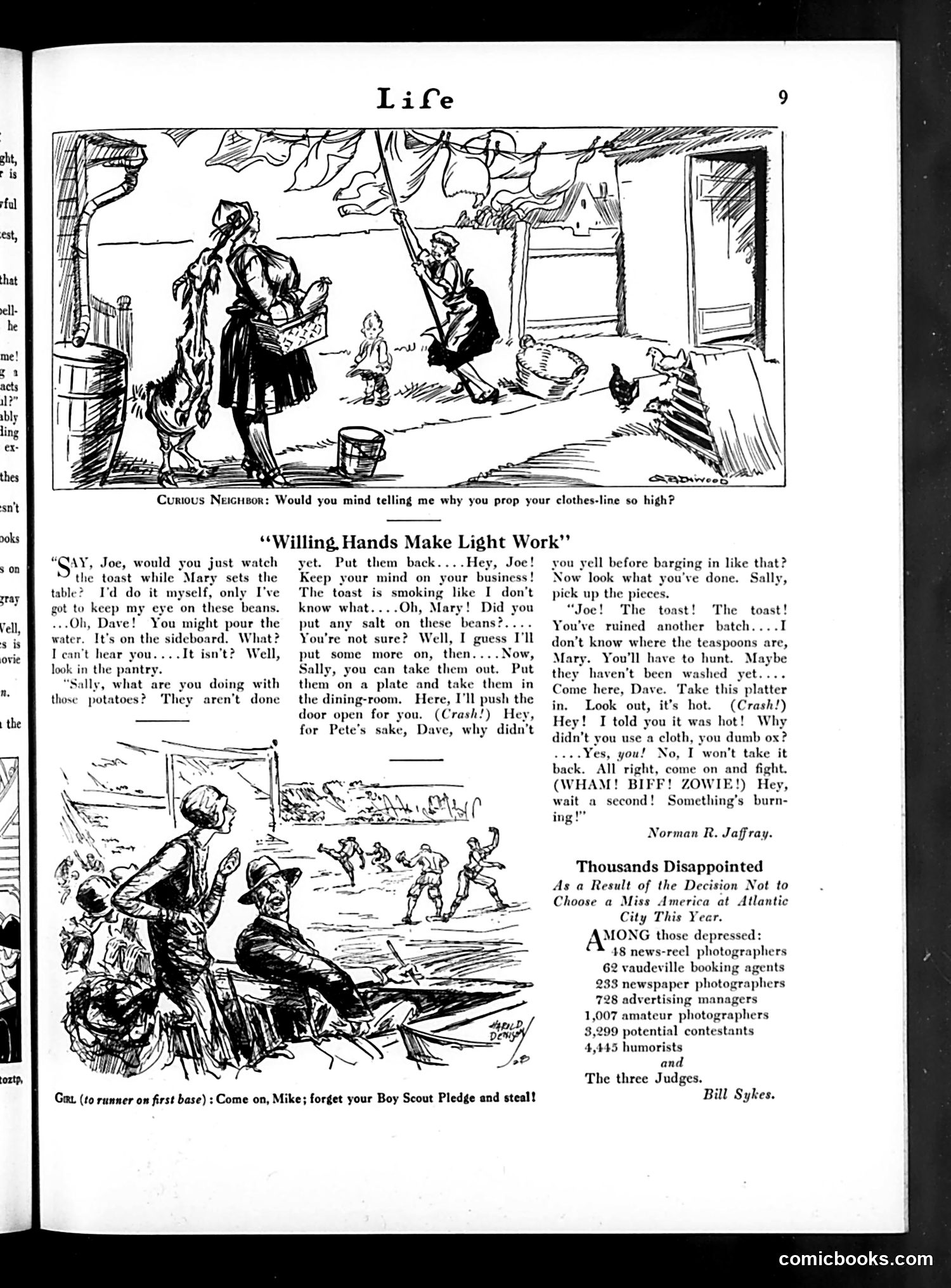
**Top Cartoon: "Willing Hands Make Light Work"** A domestic chaos scene where a husband gives increasingly frantic instructions to his wife about household tasks—handling laundry, toast, salt, teaspoons, and dishes. The joke satirizes the disconnect between men's expectations and the actual complexity of housework. The husband treats multiple simultaneous domestic failures as easily manageable, while the wife clearly cannot keep up. This reflects early-20th-century gender roles where women's domestic labor was undervalued and husbands remained oblivious to its actual difficulty. **Bottom Item: "Thousands Disappointed"** A humorous list noting disappointment that a "Miss America" pageant wasn't held in Atlantic City that year. It catalogs the number of photographers, agents, and contestants denied opportunity—clearly satirizing Americans' enthusiasm for beauty pageants and celebrity photography during this era.
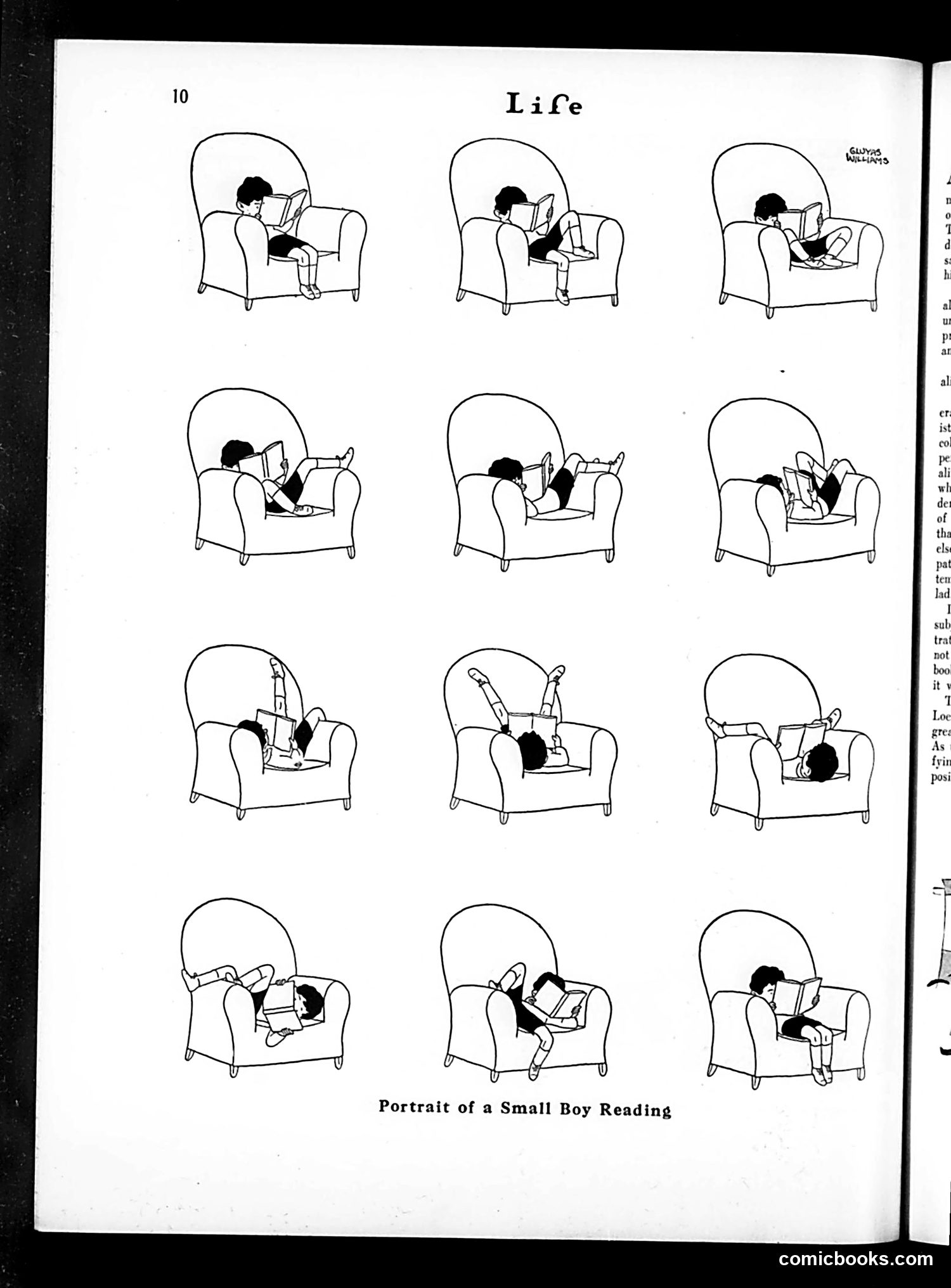
This is a twelve-panel comic strip by Gluyas Williams showing a young boy progressively getting more animated and physically engaged while reading a book in an armchair. He begins sitting calmly, then increasingly squirms, twists, contorts, and sprawls across the furniture as he becomes absorbed in his reading material. The satire gently mocks how children lose physical control and self-awareness when engrossed in exciting stories—they abandon proper posture and decorum. It's a humorous observation of childhood behavior that would have resonated with early 20th-century readers who valued composure and proper sitting positions. The cartoon celebrates the power of reading to captivate young minds, even as it pokes fun at the resulting loss of dignity.
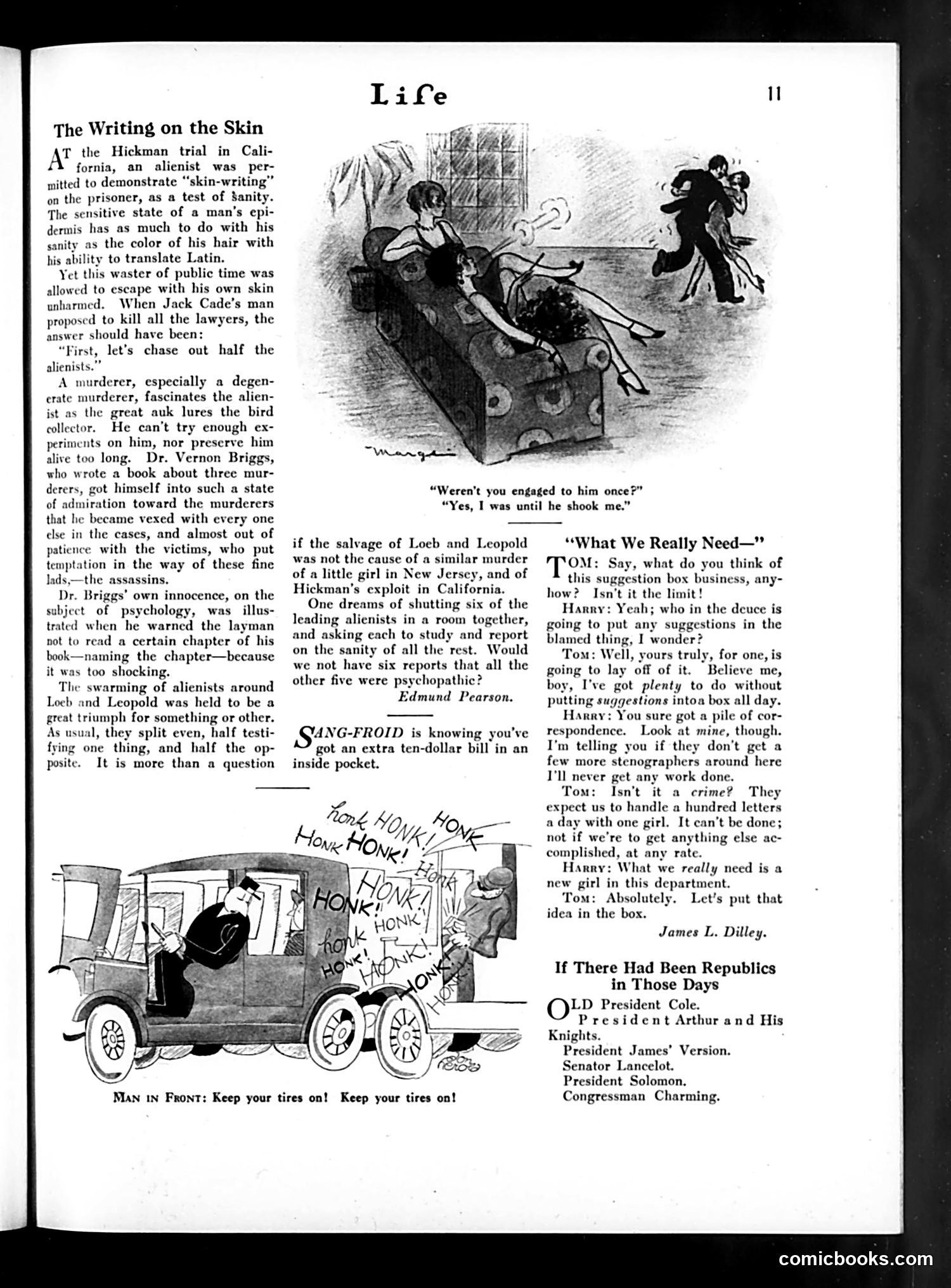
**"The Writing on the Skin"** discusses an alienist's (psychiatrist's) courtroom demonstration at the Hickman trial in California, debating whether criminals' skin conditions reveal mental state. The article references actual murderers Loeb and Leopold and critiques Dr. Vernon Briggs, who wrote about murderers' psychology. **The cartoons** satirize contemporary frustrations: 1. **Top cartoon**: Shows a man escaping on horseback from a woman asking "Weren't you engaged to him once?" — mocking broken engagements. 2. **Middle cartoon**: A car driver honking repeatedly while pedestrians block traffic — satirizing urban congestion and driver frustration with "Keep your tires on!" 3. **"What We Really Need"**: A humorous office dialogue about handling excessive mail and correspondence, suggesting hiring another girl.
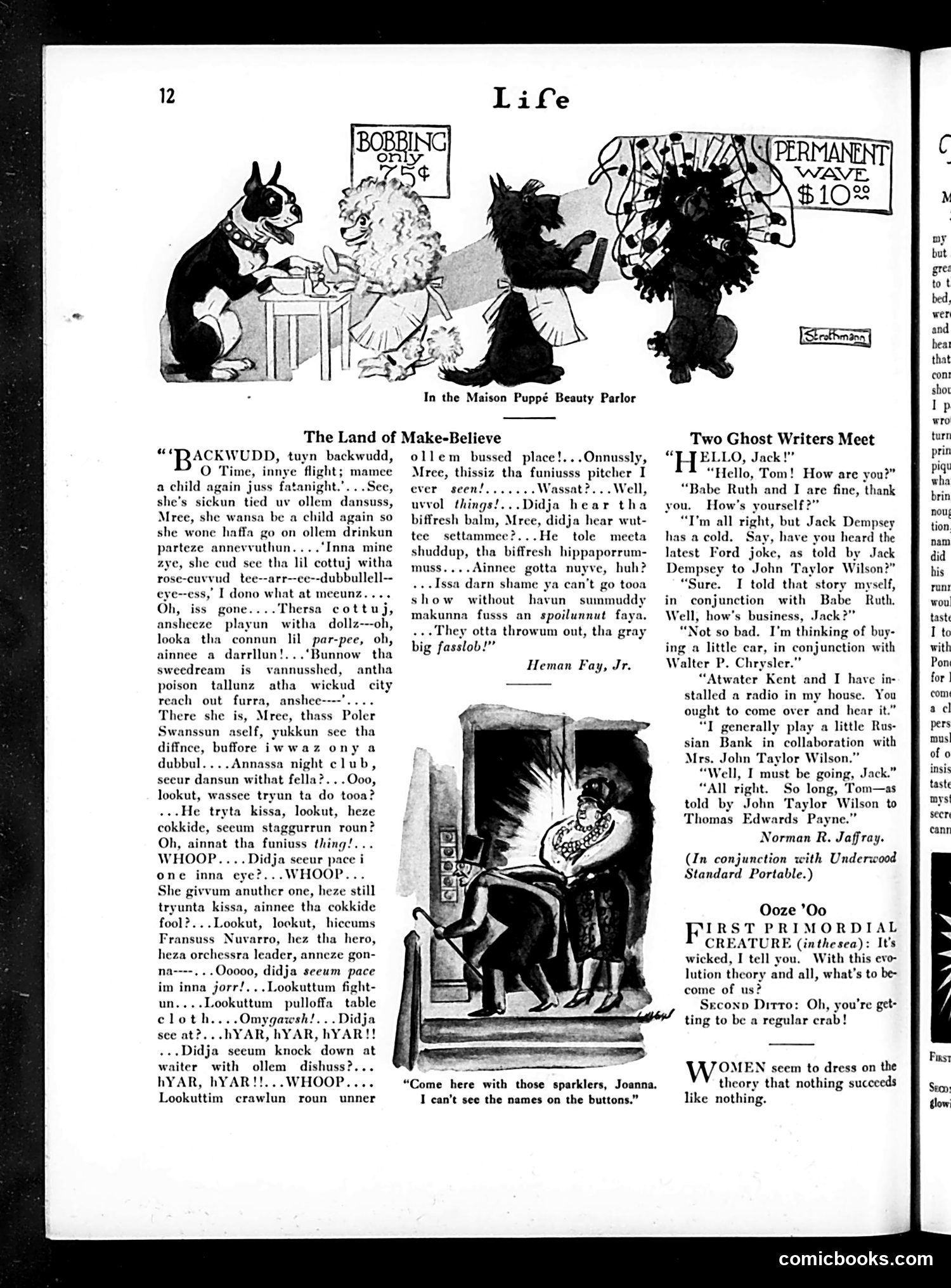
This page contains three satirical pieces: 1. **"In the Maison Puppé Beauty Parlor"** (top cartoon): Dogs receiving beauty treatments—bobbing (25¢) and permanent waves ($10.95)—mocking the expensive beauty procedures available to wealthy women of the era. 2. **"The Land of Make-Believe"** (left): A nonsensical dialect piece parodying absurd children's stories and fairy tales with deliberately jumbled, meaningless language—satirizing poorly-written children's literature. 3. **"Two Ghost Writers Meet"** and **"Ooze 'Oo"** (right): Short humorous pieces about writers and creatures, including radio installation anecdotes and commentary on how "women seem to dress on the theory that nothing succeeds like nothing." The page exemplifies *Life's* style of satirizing everyday consumer culture, literary pretension, and social behavior through visual and verbal humor.
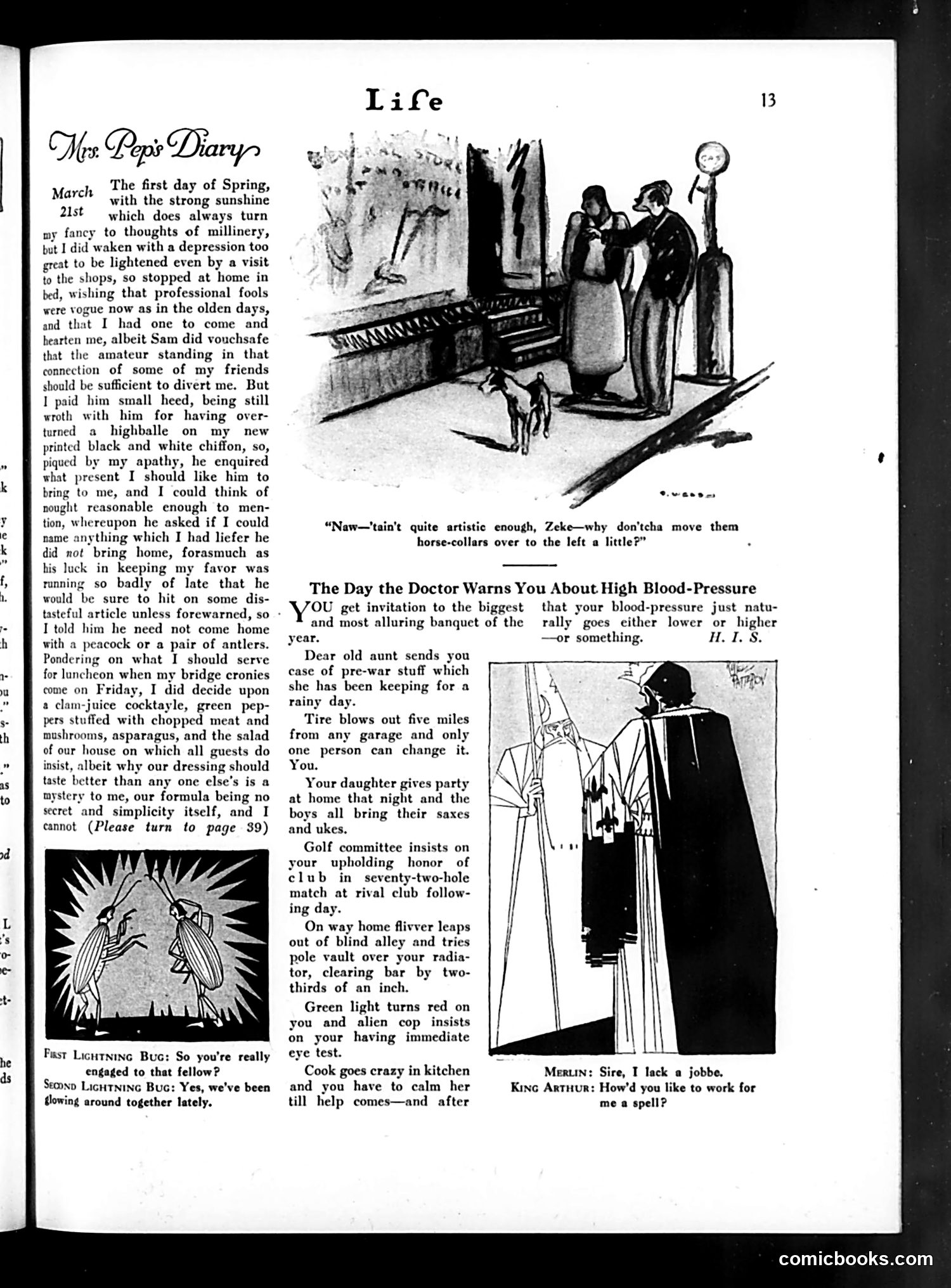
This Life magazine page contains two main sections: **Mrs. Pope's Diary** (left): A personal narrative from March 21st describing mundane domestic life—shopping concerns, social planning, and entertaining details about a dinner party menu. **"The Day the Doctor Warns You About High Blood-Pressure"** (right): A humorous article listing absurd everyday annoyances—tire blowouts, daughters' parties, golf committee obligations, traffic lights, eye tests, and kitchen chaos. The accompanying cartoons illustrate the mounting frustrations. The satire targets modern life's petty accumulating stresses. The "Fast Lightning Bug" cartoon (lower left) shows two insects commiserating about their engagement—a joking anthropomorphization. The "King Arthur" cartoon (right) depicts a medieval wizard offering a magical solution to contemporary problems, satirizing both fantastical thinking and the desire for escape from mundane modern irritations.
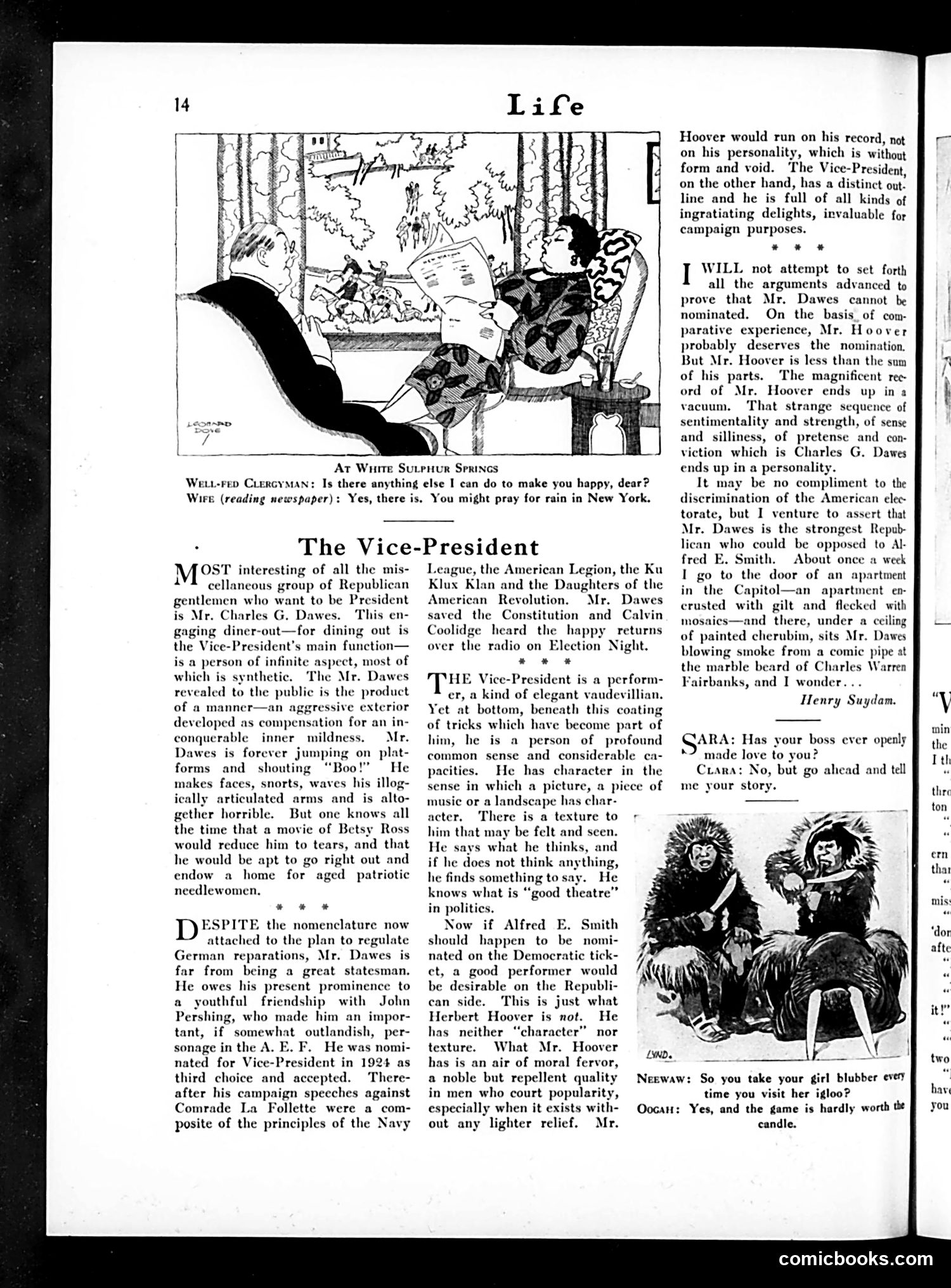
This Life magazine page satirizes the Republican Party's choice of Vice-President. The main article discusses **Charles G. Dawes**, the incumbent Vice-President, versus potential nominee **Alfred E. Smith** (the Democratic candidate). The cartoon at top depicts a clergyman and wife at White Sulphur Springs discussing whether to "pray for rain in New York"—likely alluding to Smith's association with New York and possibly his Catholic faith, which was controversial in 1928. The article praises Dawes's personality and political acumen while noting he's less conventionally "character-driven" than opponents might claim. The satirical point: Republican leadership must choose between a proven administrator (Dawes) and other candidates, with the choice carrying significant campaign implications.
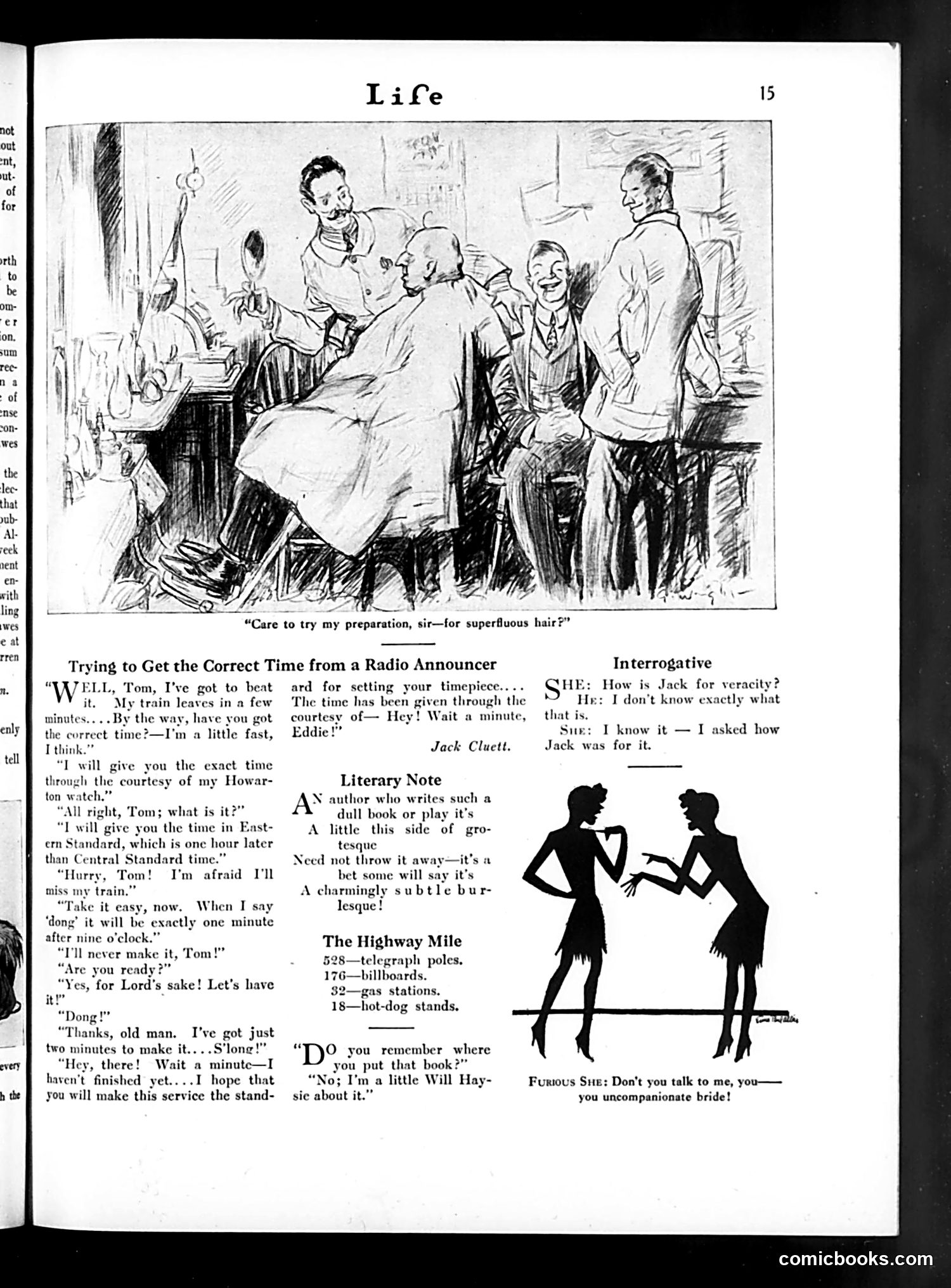
**Main Cartoon:** "Care to try my preparation, sir—for superfluous hair?" depicts a barber or salon worker offering a customer a dubious beauty treatment. The humor relies on the customer's obvious baldness—the irony being that someone with no hair is being sold a product to *remove* hair. This satirizes aggressive sales tactics and the absurdity of beauty industry marketing. **Text Sections Below:** - "Trying to Get the Correct Time from a Radio Announcer" mocks radio announcers' verbosity and tangential storytelling when asked a simple question - "Literary Note" dismisses dull literature as worthless - "The Highway Mile" counts roadside features in measured distances - "Interrogative" presents a brief domestic exchange about a man named Jack The page exemplifies *Life* magazine's light satirical humor targeting everyday American annoyances and social pretensions.
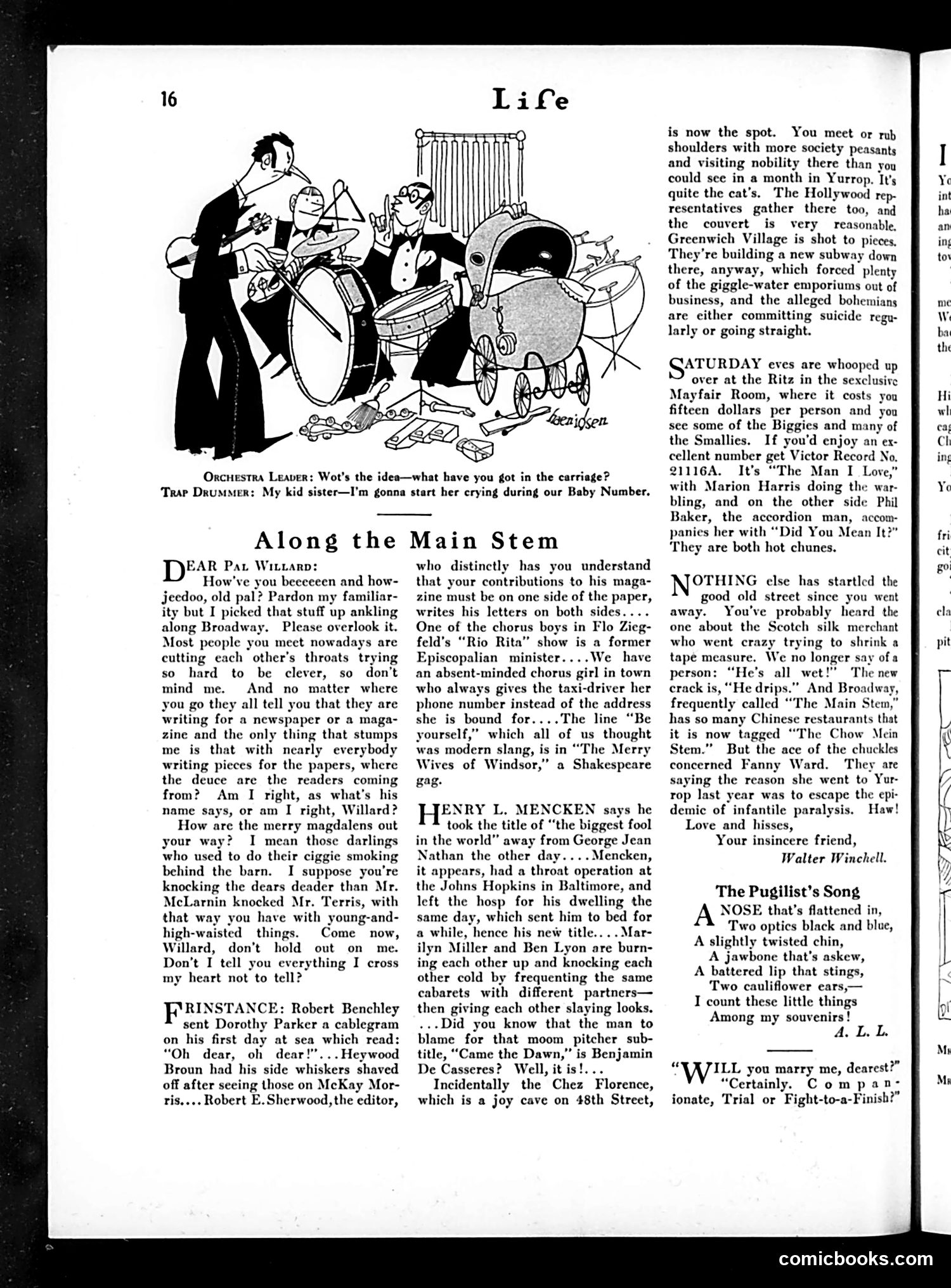
The cartoon at top depicts an orchestra leader confronting a tap drummer about noise from a baby carriage during a musical performance—a visual gag about domestic chaos disrupting professional work. The "Along the Main Stem" advice column addresses Broadway theater district gossip and personalities. Letters reference theatrical figures like Marion Harris and Phil Baker (popular entertainers of the era), discuss the "Main Stem" nickname for Broadway, and mention various show business scandals. The page's satire targets New York's entertainment district culture—its gossip, pretensions, and minor dramas. References to specific shows, performers, and venues would resonate with 1920s readers familiar with Broadway's social scene, though most specific allusions are now obscure without additional historical context.
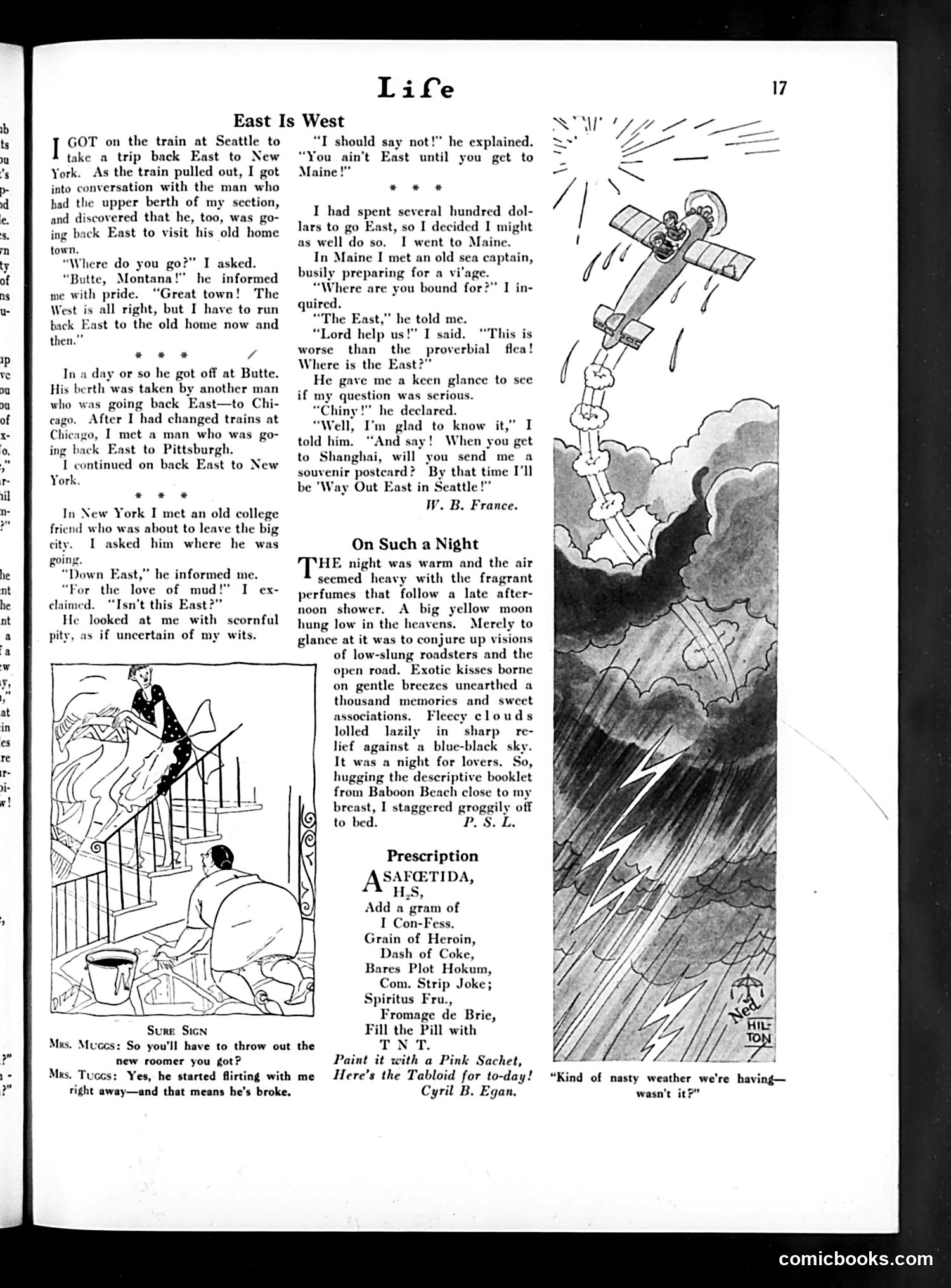
This page contains three separate pieces of humor content: **"East Is West"** (by W.B. France): A traveler's anecdote mocking Americans' geographical confusion. A man traveling East meets skeptics who question whether "East" exists until reaching Maine, and later encounters a sea captain and college friend who express bewilderment about Eastern destinations. The satire targets American parochialism and regional ignorance. **"On Such a Night"** (by P.S.L.): Romantic prose about a moonlit evening, likely meant as sentimental parody or gentle mockery of overwrought romantic literature. **"Sure Sign" and "Prescription"**: Two brief comic vignettes—one about a broken roommate situation, another a nonsensical fake medical prescription, exemplifying Life's characteristic short-form humor. The illustrations are period cartoons rendered in ink, typical of 1920s magazine style.
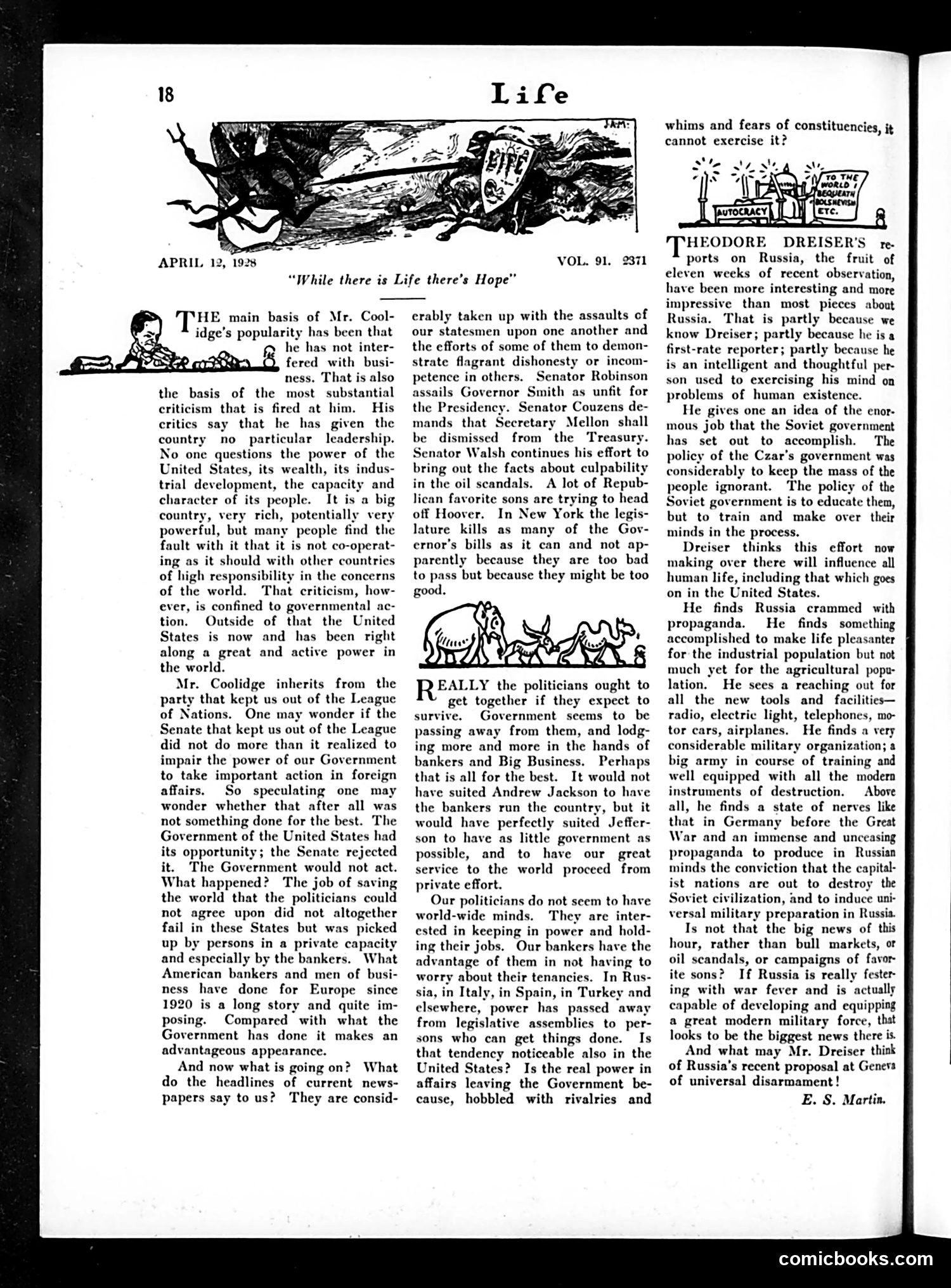
This Life magazine page (April 13, 1928) contains editorial commentary critiquing President Calvin Coolidge's passive leadership style and the broader decline of governmental power in America. The text argues that while Coolidge's non-interference with business initially boosted his popularity, it represents a failure of national leadership. The author notes that private bankers and businessmen have effectively filled the vacuum left by government inaction—particularly regarding post-WWI European recovery. The piece criticizes contemporary politicians for petty infighting (mentioning Senator Robinson attacking Governor Smith, Senator Couzens demanding Secretary Mellon's dismissal, and Senator Walsh investigating oil scandals) while real power shifts toward bankers and business interests. The author observes this pattern globally: in Russia, Italy, Spain, and Turkey, legislative bodies have lost power to decisive executive figures. The question posed is whether America is following this authoritarian trend, with governmental dysfunction ceding authority to unelected business leadership. The accompanying cartoons (though details are unclear) appear to reinforce themes of political weakness and institutional decline.
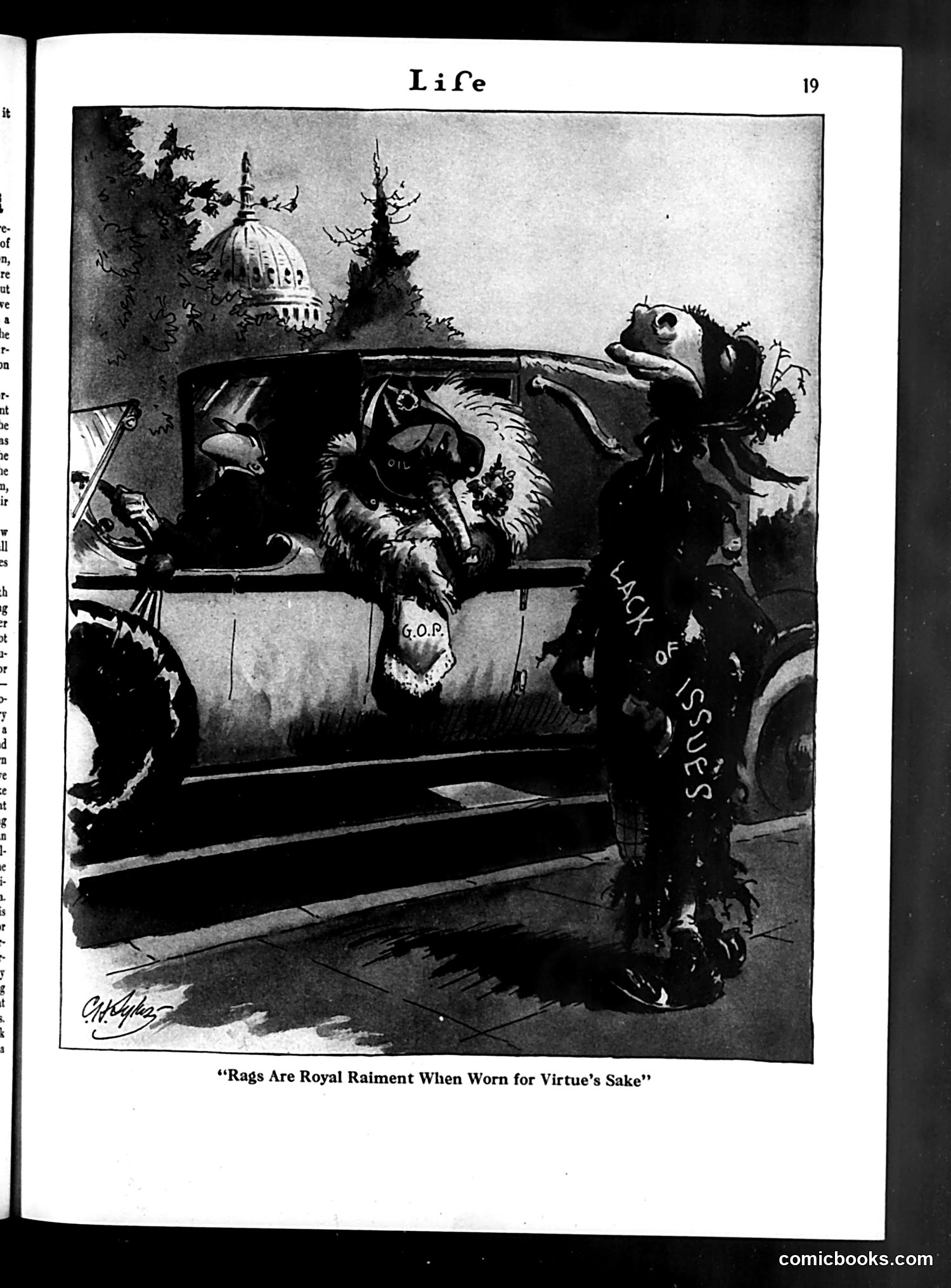
This political cartoon depicts a disheveled figure labeled "Lack of Luck" dressed in tattered rags, standing before an automobile marked "G.O.P." (Republican Party). The Capitol building appears in the background. The figure appears to be a beggar or vagrant personifying misfortune. The caption—"Rags Are Royal Raiment When Worn for Virtue's Sake"—suggests ironic commentary on the Republican Party's presentation of poverty or hardship as morally justified or dignified. The cartoon likely critiques GOP claims about economic conditions or their framing of their political position during a period of economic difficulty, possibly referencing the Great Depression era when this magazine was active. The satire challenges the nobility of their stated rationale.
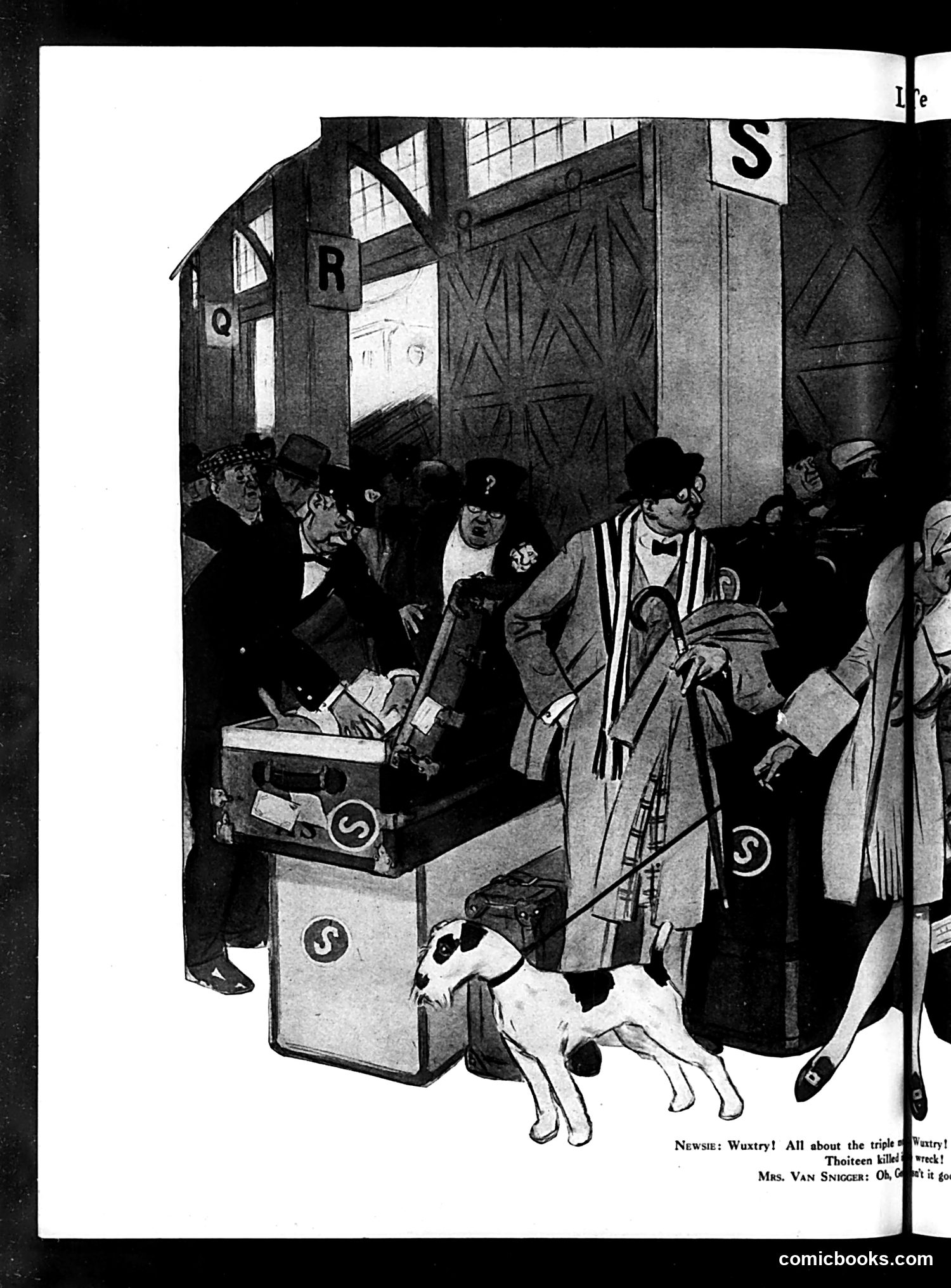
This appears to be a satirical illustration from *Life* magazine depicting a newspaper vendor hawking sensational headlines to pedestrians outside what looks like a train station or public building. The vendor shouts "Wuxtra! All about the triple... Thirteen killed," while a woman identified as "Mrs. Van Snigger" responds dismissively with "Oh." The satire targets **tabloid journalism and sensationalism**—the exaggerated, attention-grabbing crime and disaster headlines used to sell newspapers. The woman's casual indifference to the "thirteen killed" headline suggests the public's jadedness toward constant sensational reporting, or critiques how such sensationalism desensitizes readers to tragedy. The labeled voting booths (marked Q, R, S) suggest this may also reference election-related news cycles, though the OCR text is too fragmented to confirm specific political commentary.
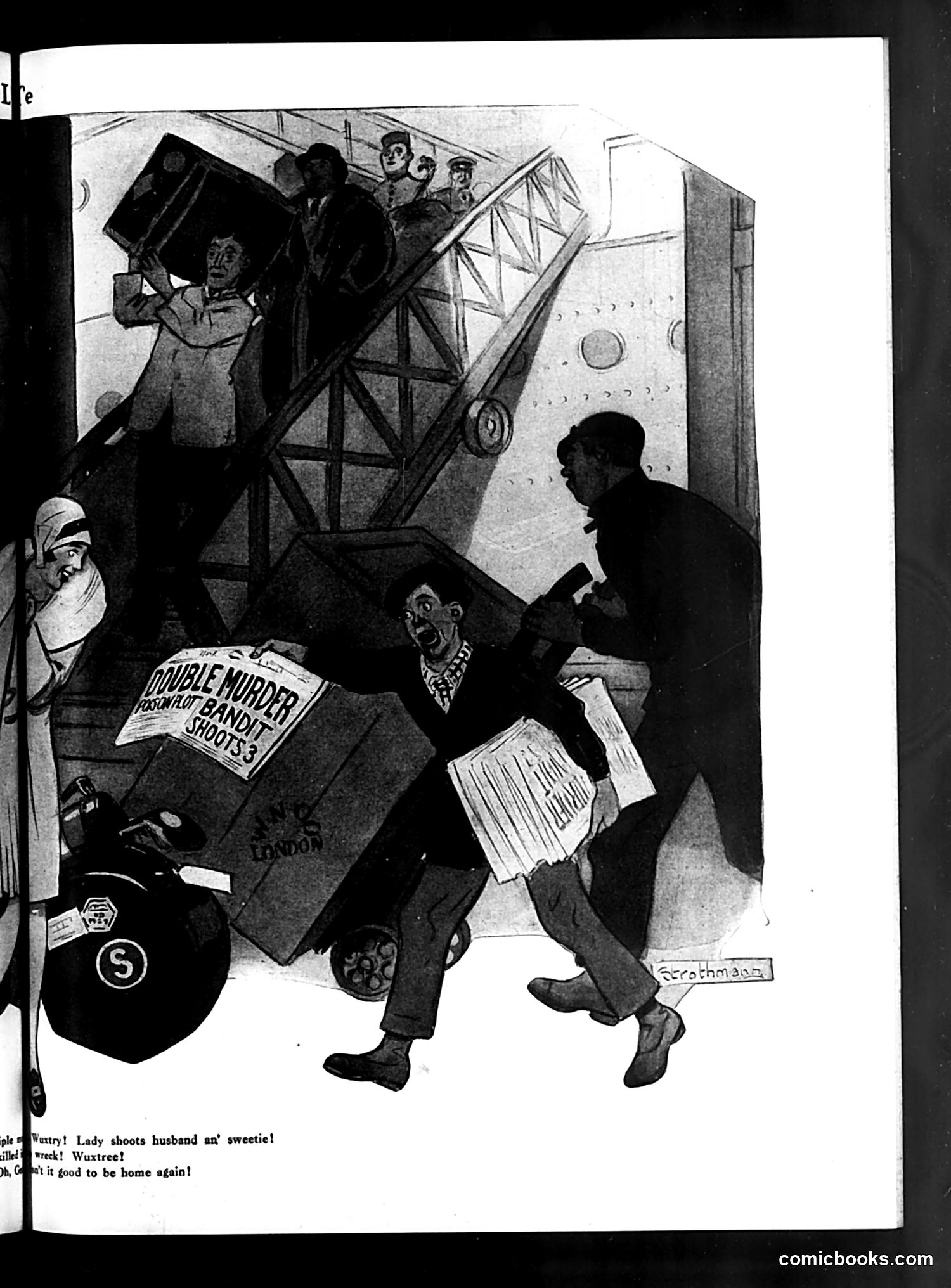
This appears to be a satirical cartoon from Life magazine depicting a crime scene—specifically a murder scenario involving a woman shooting her husband and his mistress. The scene shows what looks like a ship's gangway or airplane stairs, with various onlookers and officials present. The humor derives from the contrast between the sensational crime ("Double Murder") being hawked by newspaper vendors (visible text: "WUXTREE!"—street vendor calls for "extra") and the casual, almost cheerful response from someone arriving home, saying "it good to be home again!"—apparently oblivious to or unfazed by the dramatic domestic tragedy unfolding. The satire likely mocks either tabloid sensationalism, the casual American attitude toward violent crime, or domestic infidelity scandals of the era. The exaggerated expressions and theatrical staging emphasize the melodrama.
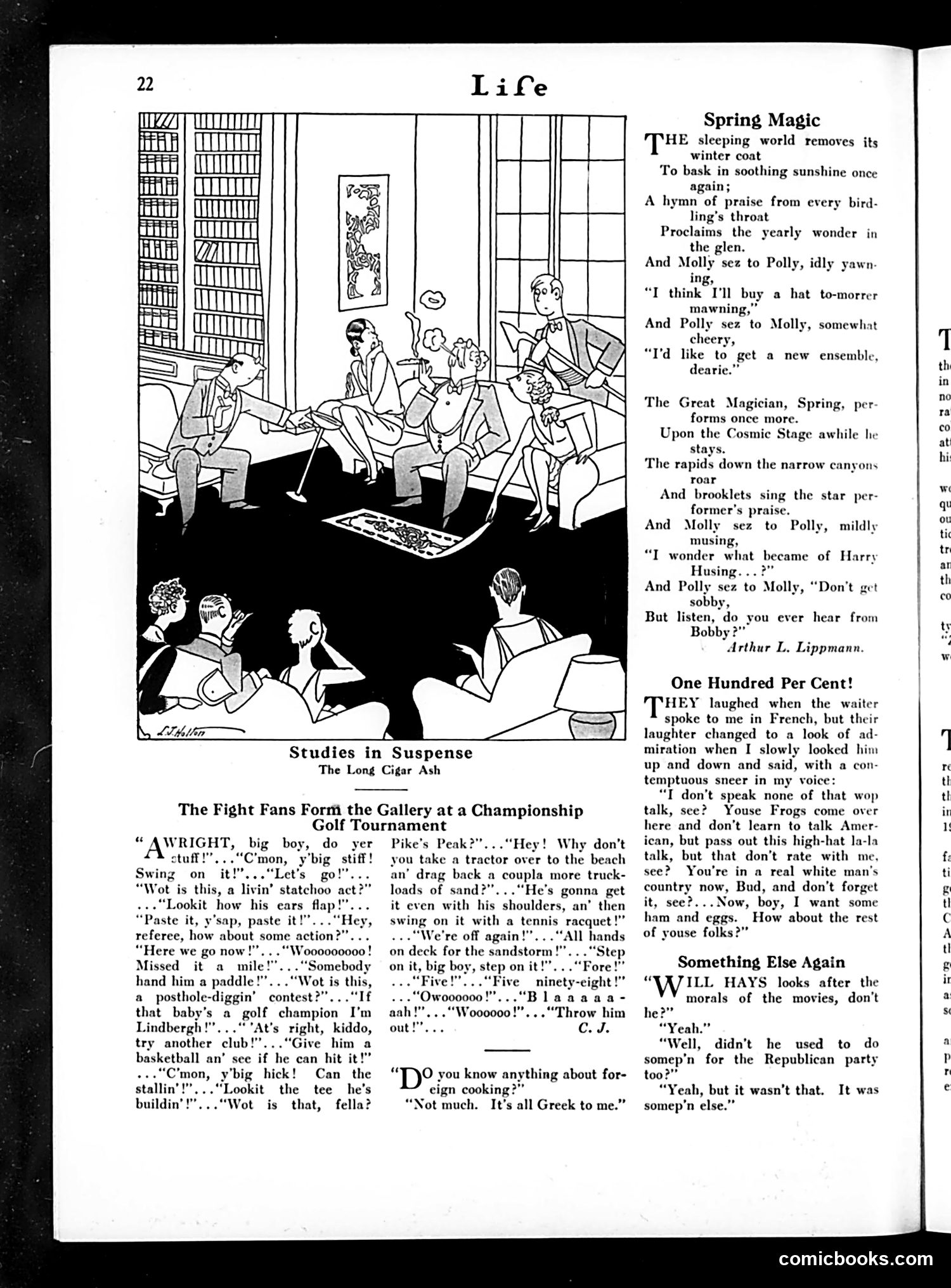
This page contains three separate humorous pieces typical of Life's satirical style: **"Studies in Suspense: The Long Cigar Ash"** - A cartoon showing golf spectators behaving like rowdy boxing fans, shouting crude encouragement ("Swing on it!", "Paste it!"). The satire mocks the contrast between golf's genteel reputation and the uncouth behavior of working-class fans who treat the sport like a prize fight. **"Spring Magic"** - A sentimental poem by Arthur L. Lippmann about spring's renewal, interrupted by dialogue between two women (Molly and Polly) whose mundane concerns about hats and ensembles undercut the poetry's grandeur. The satire gently deflates romantic idealism with domestic reality. **"One Hundred Per Cent!" and "Something Else Again"** - Two brief joke pieces. The first satirizes xenophobic American attitudes, with a man boasting about rudely rejecting a French waiter's language. The second makes a veiled political jab at Will Hays (film industry censor), suggesting involvement with Republican politics. The page reflects 1920s-era American humor: class-conscious, mildly xenophobic, and politically sharp.
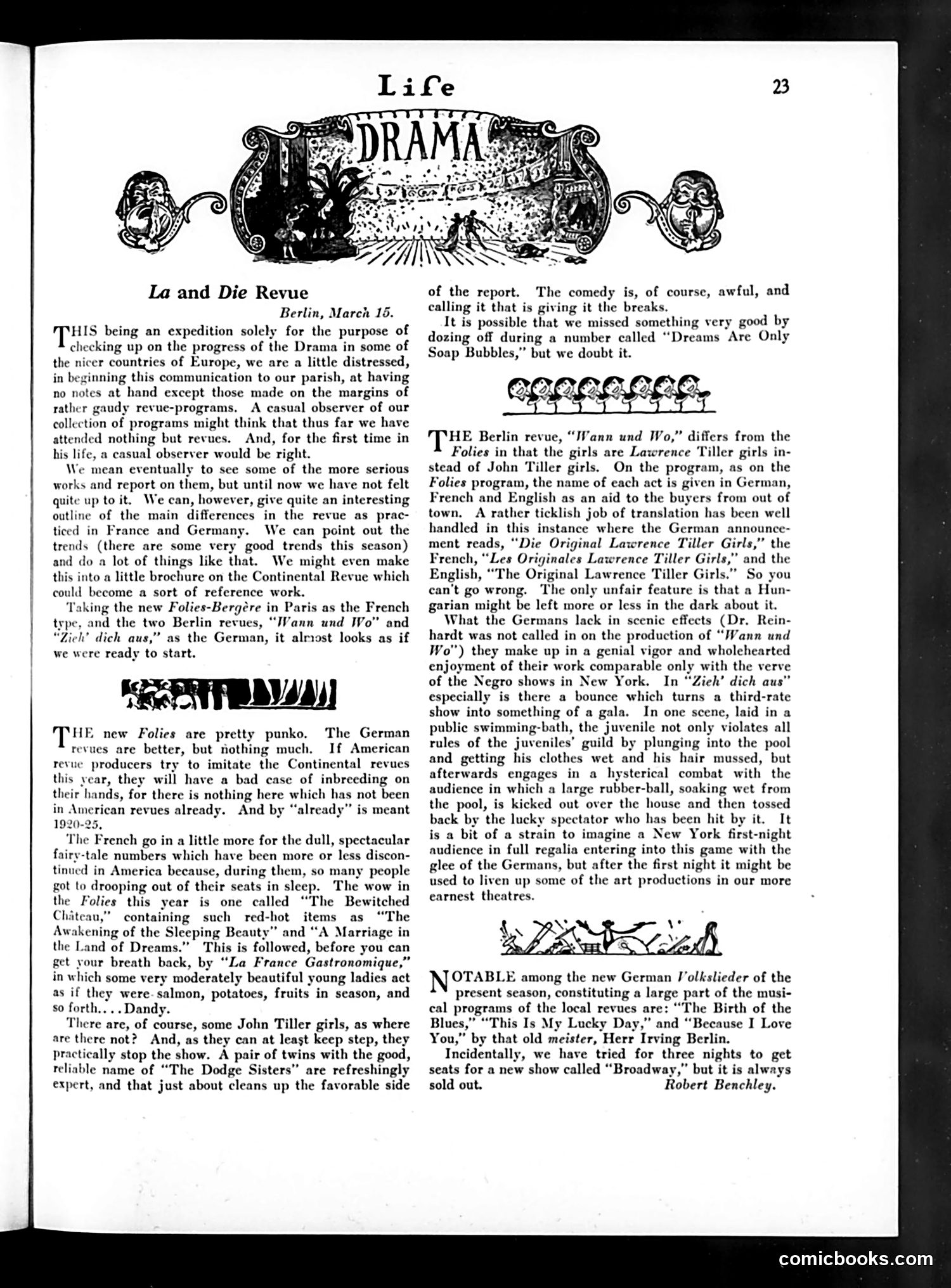
This is a theater review column, not a political cartoon. The author—identified at column's end as Robert Benchley—reports on Continental revue productions in Paris and Berlin (dated March 15-16, likely 1920s). The piece compares French spectacle-heavy revues (the Folies-Bergère) with German ones ("Wann und Wo," "Zieh' dich aus"), noting American producers shouldn't imitate Continental style since nothing here is original to Europe. Benchley mocks the French revue's elaborate but sleep-inducing fairy-tale numbers while crediting the Germans' enthusiastic vigor—though he notes their staging lacks the scenic effects of Dr. Reinhardt's productions. He praises the Tiller Girls (professional chorus lines) and "The Dodge Sisters" as actual talent amid otherwise "awful" comedy. The column's tone is wry, insider-gossip theater criticism typical of *Life* magazine's satirical approach to high culture.
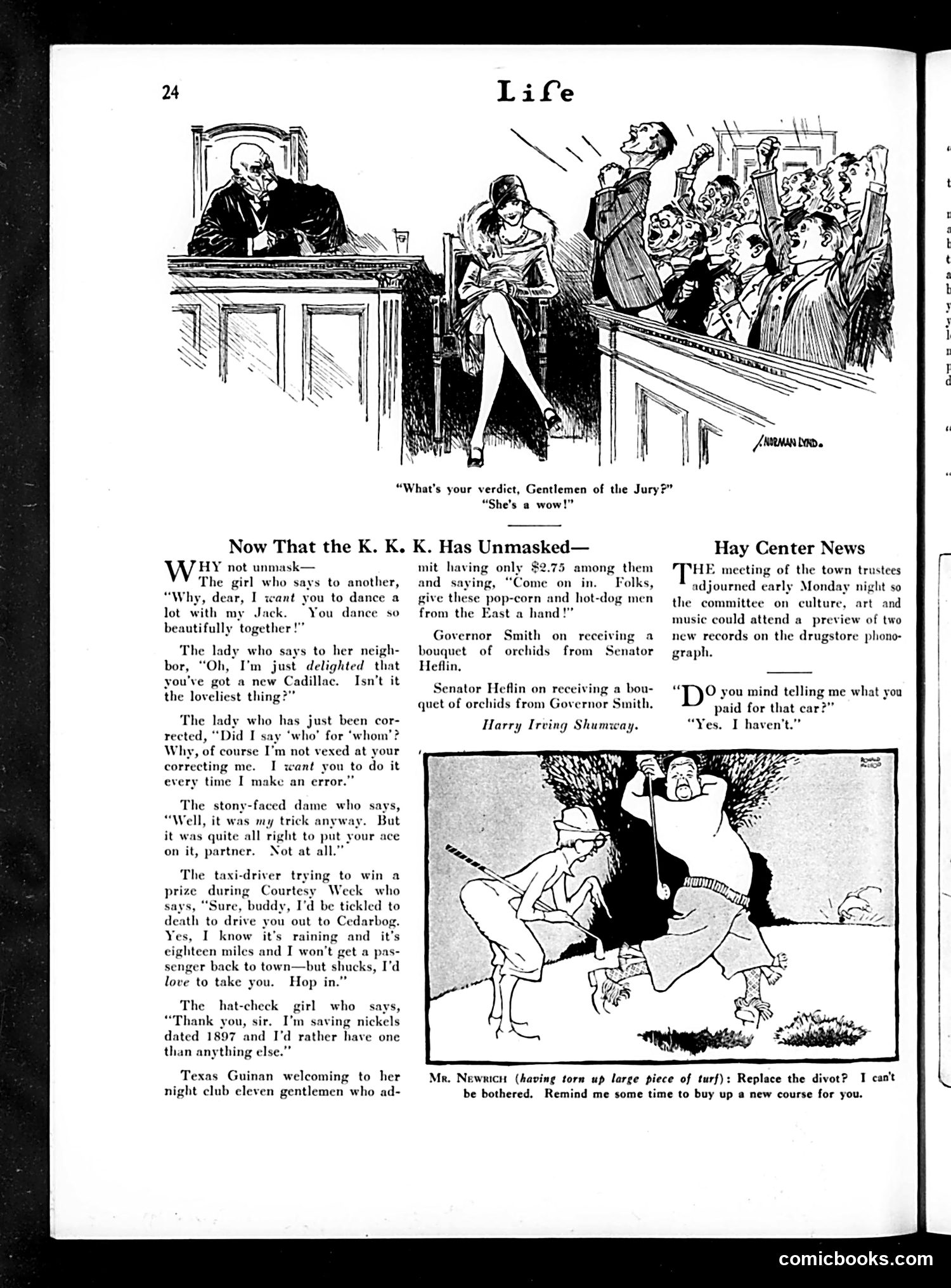
The main cartoon depicts a courtroom scene where a woman on trial receives a "wow" verdict from jurors, satirizing public fascination with scandalous trials of the 1920s. The article "Now That the K.K.K. Has Unmasked" uses the recent exposure of the KKK's membership to launch broader social satire about hypocrisy. It catalogs everyday deceptions: women feigning friendship while matchmaking, false modesty about material goods, insincere politeness, and fake courtesy. The references to "Texas Guinan" (a famous speakeasy hostess), Governor Smith and Senator Heflin (likely referring to the contentious 1928 presidential race), and a working-class taxi driver all mock the era's class tensions and pretense. The bottom cartoon about "Mr. Newrich" (new rich) satirizes wealthy upstarts' carelessness and arrogance—tearing up golf course turf without concern, then casually expecting to buy new land. Overall, the page critiques 1920s American pretense, materialism, and the gap between public morality and private behavior.
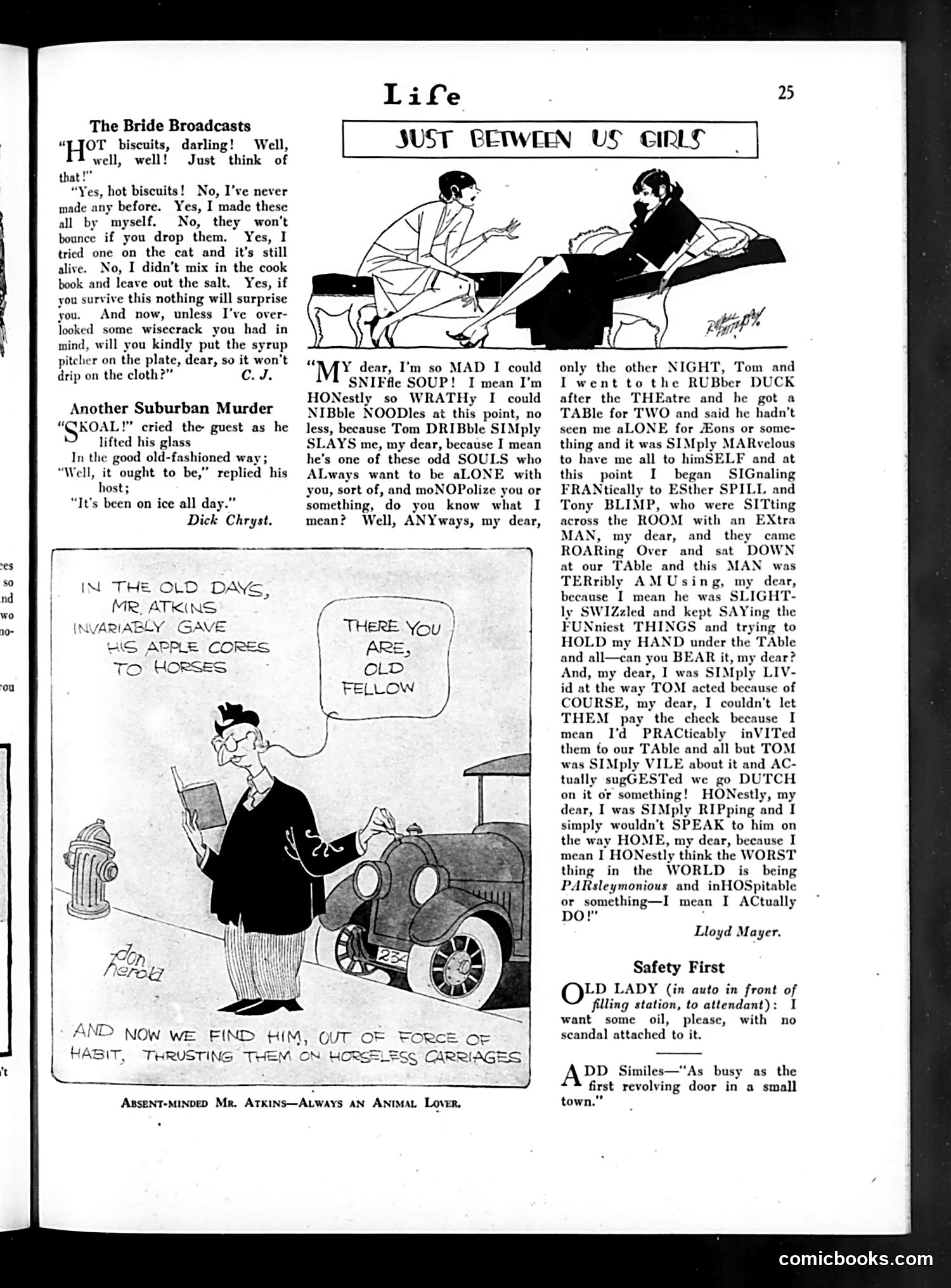
This page contains humor about early 20th-century social conventions and domestic life: **"The Bride Broadcasts"** satirizes newlywed women boasting about cooking abilities on early radio broadcasts, exaggerating their incompetence with absurd claims (biscuits that won't bounce, testing on the cat). **"Another Suburban Murder"** is a brief joke: a guest exclaims "Koal!" (coal?) as an insult, told it "ought to be" because it's been "on ice all day"—wordplay on keeping things fresh versus the bitter quality of coal. **"Just Between Us Girls"** mocks affected female speech patterns of the era, with emphasized syllables throughout. A woman complains about a man wanting alone time with her, then humorously sabotages his intentions by inviting others to join them. The satire targets both excessive theatrical delivery and hypocritical social behavior. **"Safety First"** contains a brief joke about an old woman requesting oil "with no scandal attached"—likely referencing oil industry corruption scandals of the time. The cartoons reflect 1920s-era concerns: radio novelty, gender roles, and affectation.
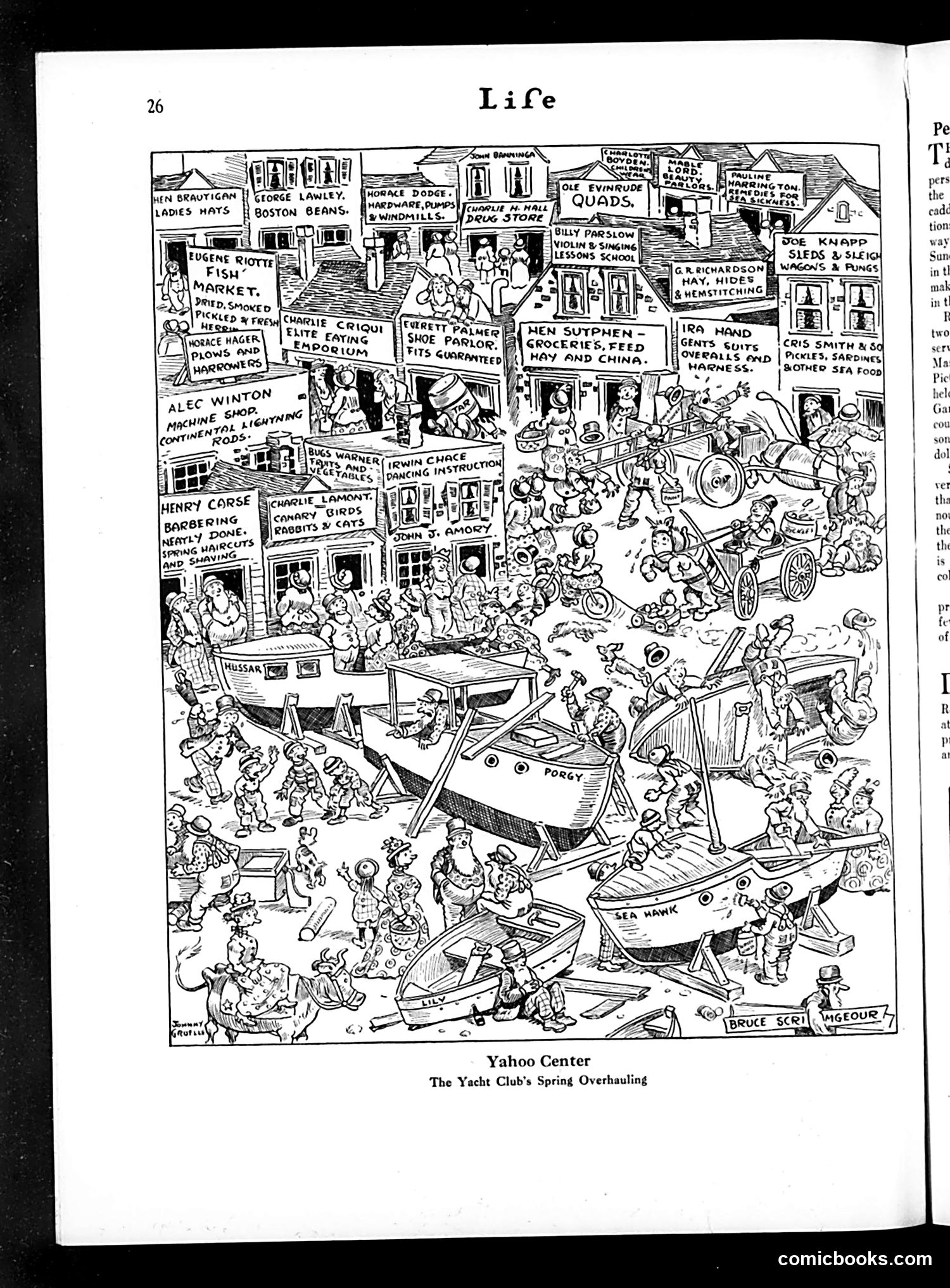
This is a detailed satirical illustration titled "Yahoo Center: The Yacht Club's Spring Overhauling." It depicts a bustling seaside community scene with numerous small businesses and activities labeled throughout—fish markets, hardware stores, shoe parlors, violin lessons, and sailing vessels being repaired. The satire appears to mock the contrast between the genteel "Yacht Club" implied by the title and the decidedly unglamorous, chaotic reality shown: working-class commerce, manual labor, and ordinary townsfolk crowding around boats. The dozens of labeled shops and services suggest commercial rather than leisurely activity. This likely satirizes either: (1) the pretensions of a yacht club claiming sophistication while situated in a humble working harbor, or (2) spring boat maintenance season's transformation of an orderly community into organized chaos. The humor derives from the gap between aspirational leisure-class identity and actual working-class reality.
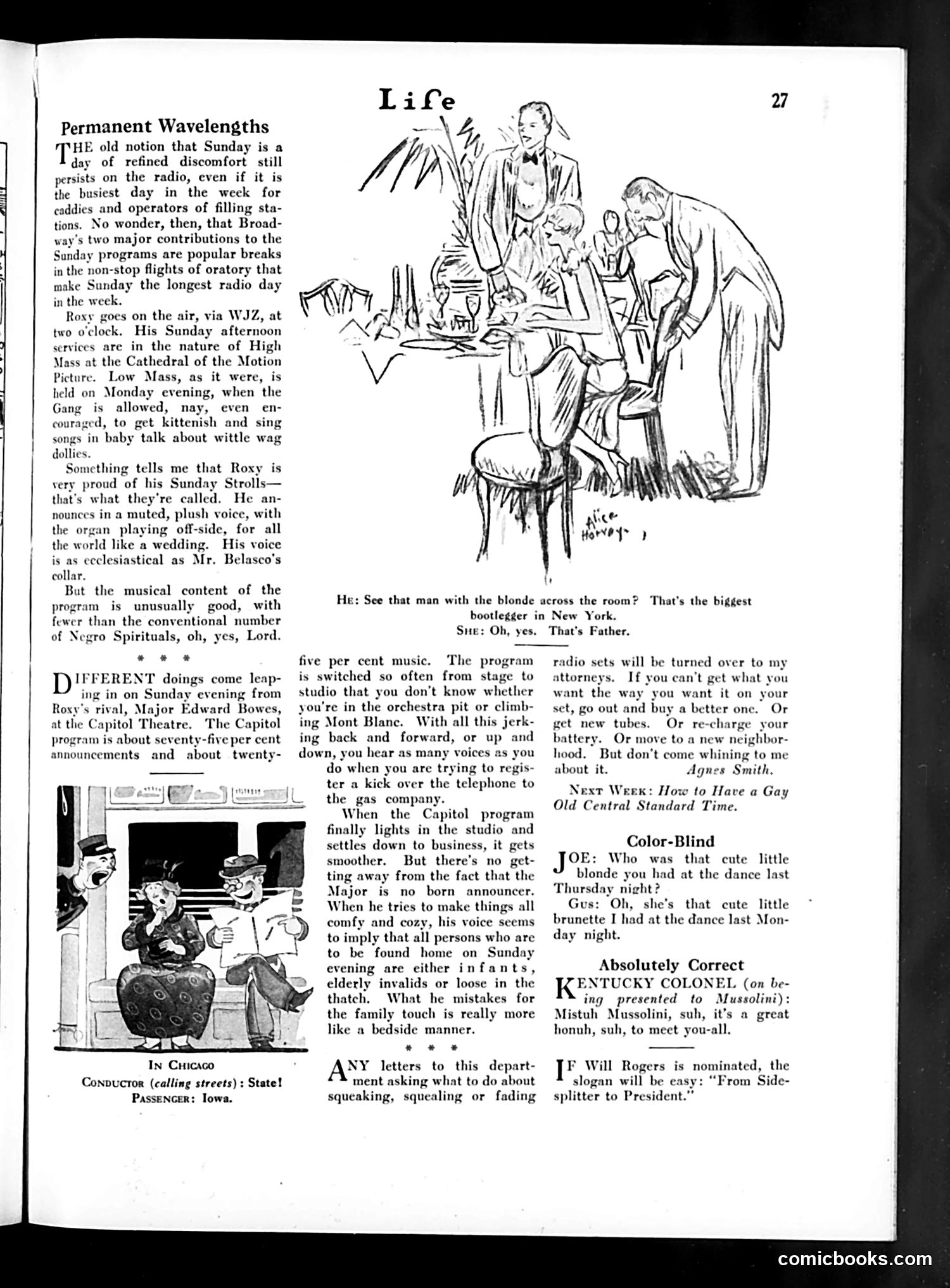
This page satirizes early 1920s radio programming, specifically two competing Sunday shows: "Roxy's Sunday Strolls" (via WJZ) and Major Edward Bowes's Capitol Theatre program. The satire mocks how these broadcasts treat Sunday as a sacred, overly formal occasion. Roxy is caricatured as pretentious—his "ecclesiastical" voice mimics a wedding ceremony with organ accompaniment. Bowes is criticized as an incompetent announcer whose constant switching between stage and studio confuses listeners about their actual location. The sketch cartoon (bottom left) shows a conductor and passenger, with dialogue mocking regional speech patterns. The overall critique suggests these popular radio programs, despite their fame, suffer from excessive formality, poor production, and condescending attitudes toward their audiences—treating Sunday listeners as infants or invalids requiring bedside-manner treatment rather than genuine entertainment.
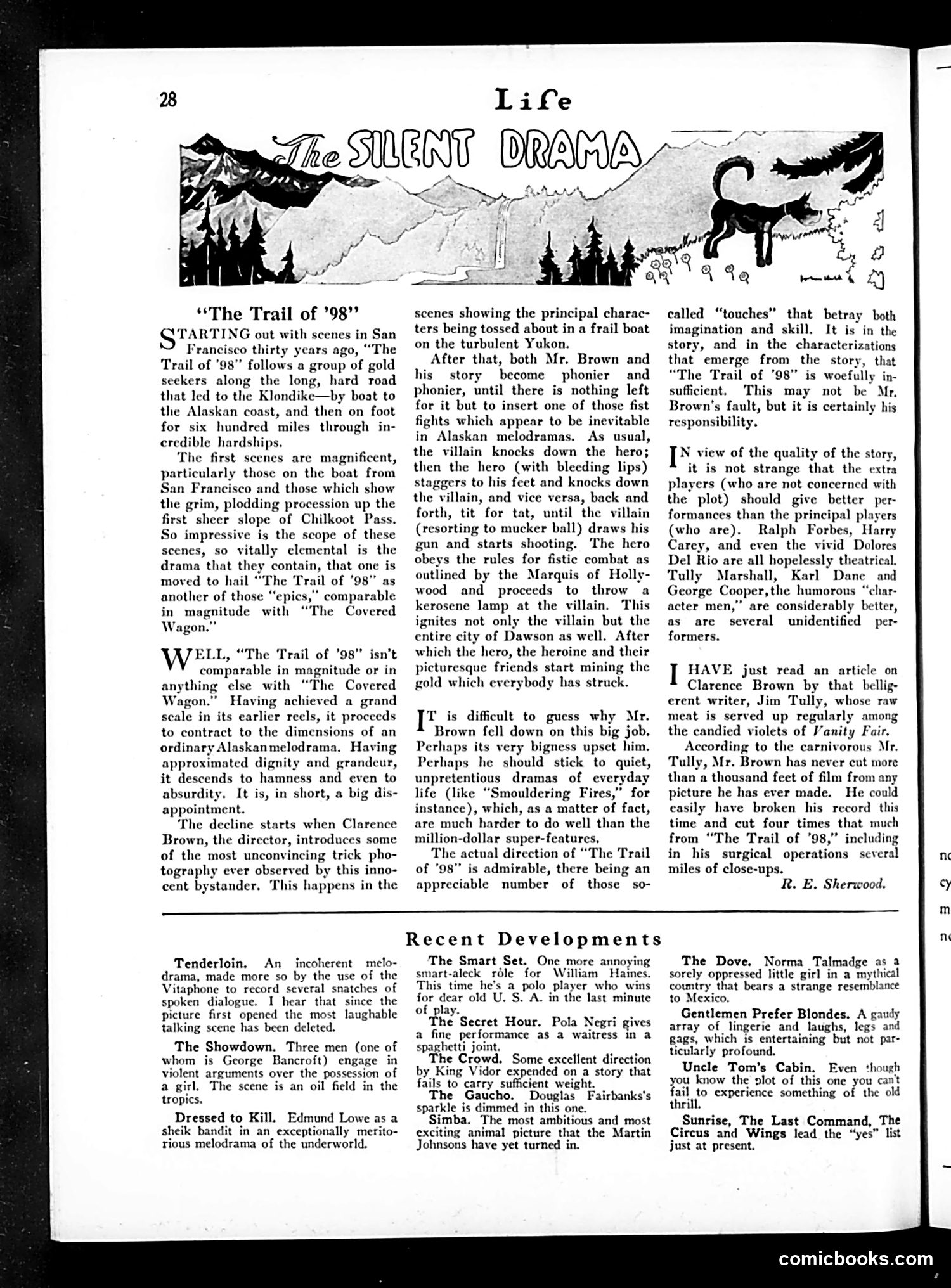
This page reviews **"The Trail of '98,"** a silent film about 1890s Klondike gold seekers directed by Clarence Brown. The critic praises the film's opening scenes—the San Francisco departure and Chilkoot Pass sequence—comparing them favorably to "The Covered Wagon" (a celebrated epic). However, the review condemns the film's second half as a descent into cheap melodrama. Once the story shifts to the Yukon settlement, it devolves into predictable clichés: unconvincing trick photography, a tired love triangle, and a climactic fistfight that literally sets the town of Dawson on fire. The critic suggests Brown lost control of an ambitious project, advising he stick to quieter dramas where his talent is evident. The page also briefly reviews other current releases (Tenderloin, The Crowd, The Gaucho), continuing Life magazine's role as a cultural arbiter of popular entertainment.
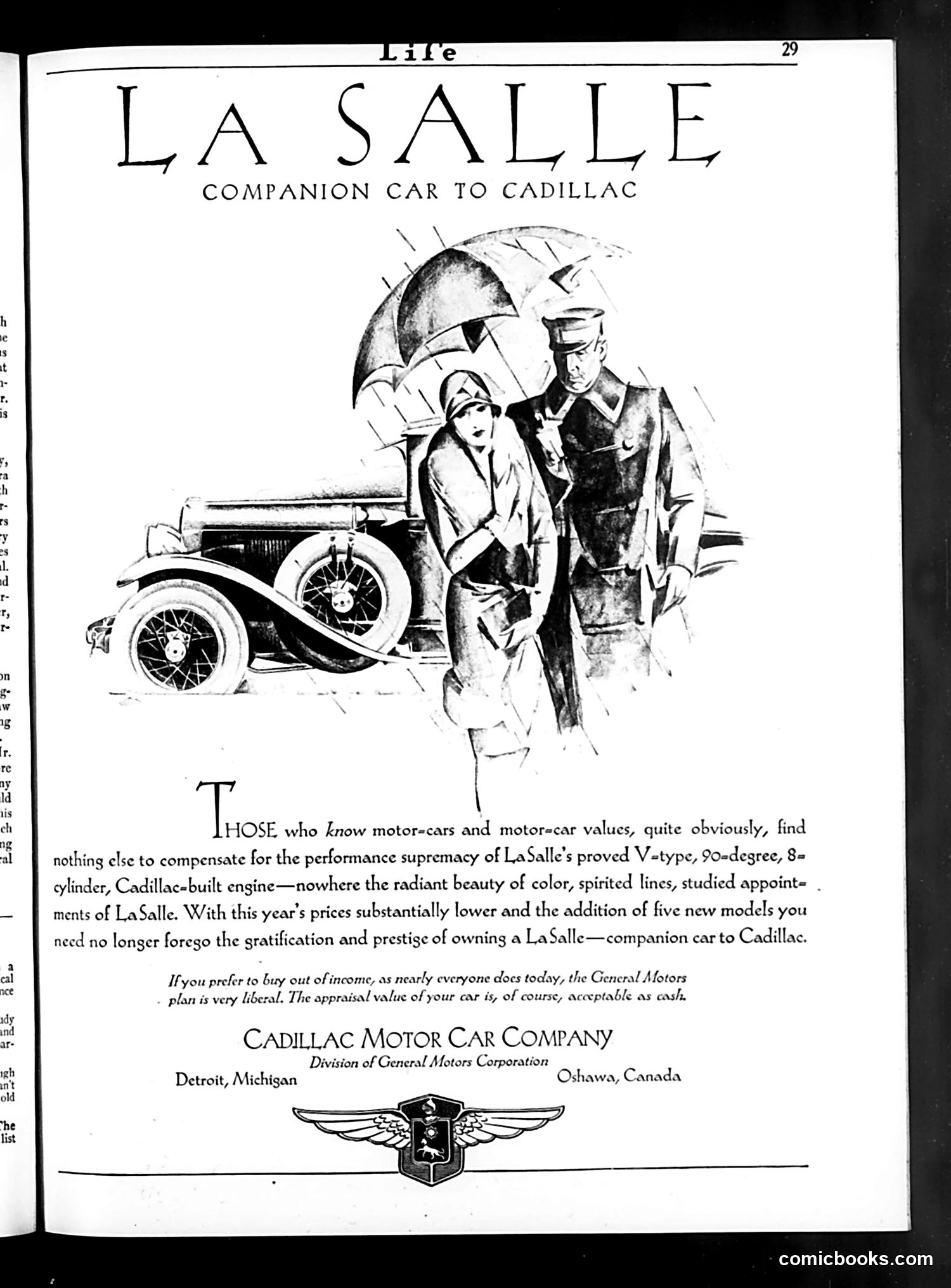
This is a **car advertisement**, not political satire. It's a full-page ad from Life magazine promoting the LaSalle automobile as a more affordable alternative to Cadillac (both General Motors products). The illustration shows a well-dressed couple with an umbrella near a LaSalle car, emphasizing elegance and prestige. The ad's appeal targets middle-class aspirations: it promises luxury styling and Cadillac-quality engineering at lower prices, making ownership accessible through GM's liberal financing plans. The key sales pitch is that buyers "need no longer forego the gratification and prestige of owning a LaSalle"—suggesting the car conveys social status. The mention of "acceptable appraisal value" references trade-in financing, a relatively modern concept at the time. This reflects 1920s-30s consumer culture: marketing automobiles as both practical transportation and status symbols for upwardly mobile Americans.
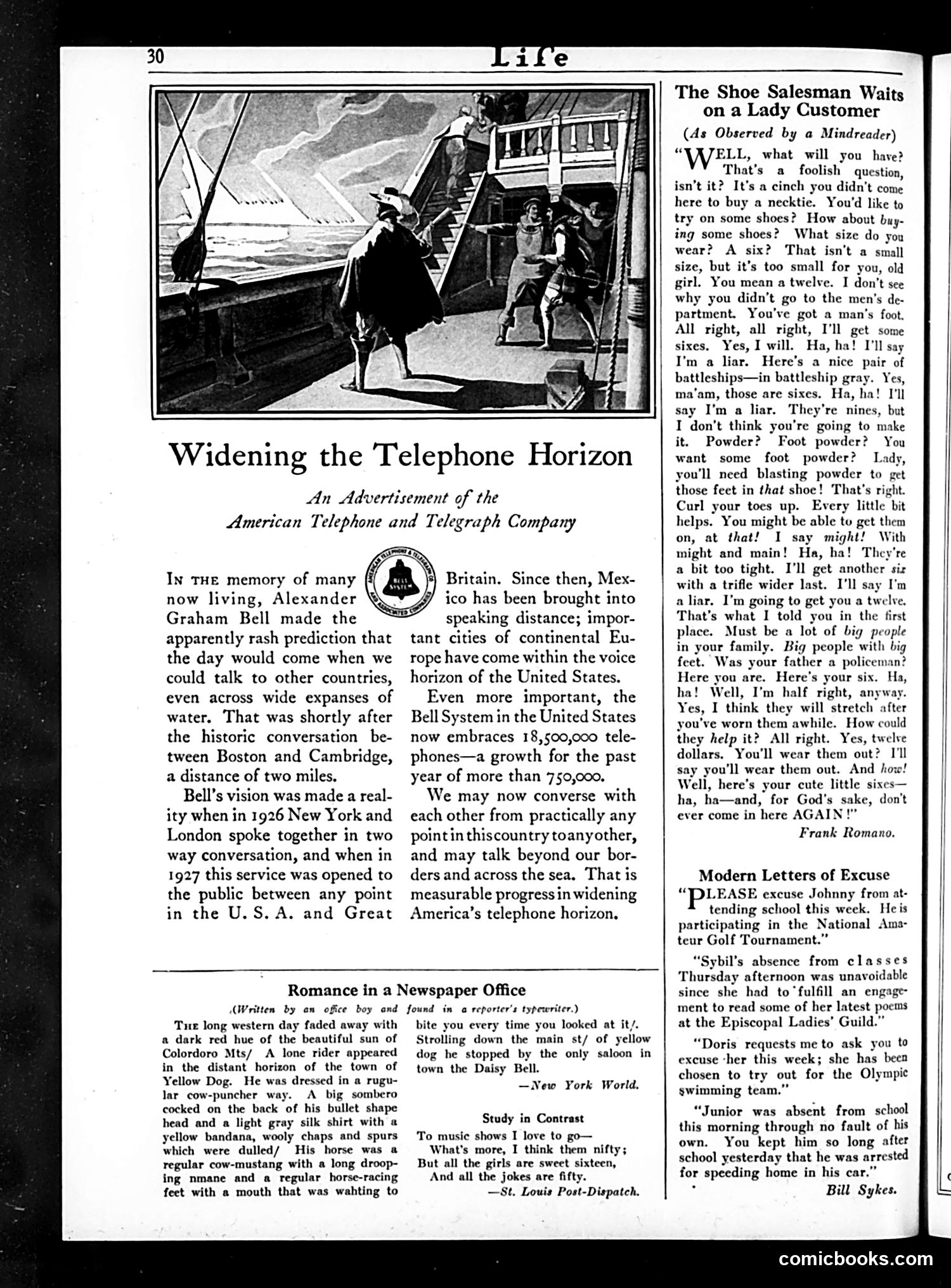
This satirical piece uses the "mindreader" format to mock both shoe salesmen and their customers. The salesman's internal monologue reveals his contempt for a woman customer, whom he judges as having oversized feet requiring deceptive selling tactics. The humor relies on period assumptions: the salesman consistently lies about shoe sizes (claiming sixes when they're nines), uses increasingly absurd exaggerations ("blasting powder"), and makes insulting references to her family ("big people with big feet"). The satire targets retail dishonesty and the gendered dynamics of service work—the salesman's patronizing attitude toward a woman customer who apparently lacks assertiveness to challenge his obvious falsehoods. The piece reflects 1920s consumer culture and working-class attitudes, mocking both retail deception and female passivity as shoppers.
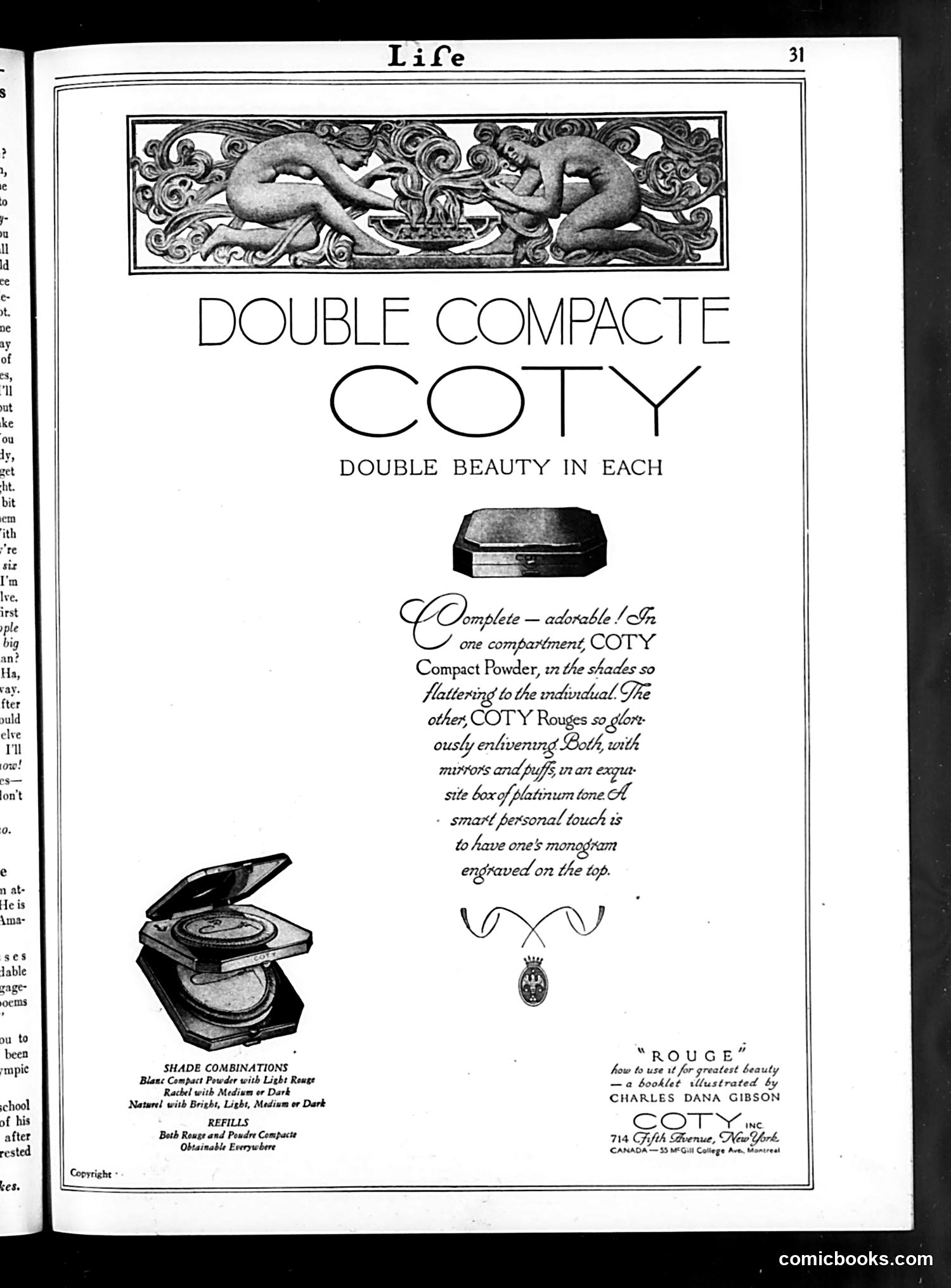
This is **not a cartoon or satire**—it's a **cosmetics advertisement** for COTY brand compact powder and rouge products. The page appears in *Life* magazine, page 31. The decorative header features classical cherubs in an ornamental baroque style, purely decorative. The ad promotes a dual-compartment compact containing both powder and rouge, marketed as "double beauty in each." The advertisement emphasizes luxury details: the platinum-tone case, mirrors and puffs, and the option to have one's monogram engraved. It references **Charles Dana Gibson** (likely the famous illustrator of the "Gibson Girl") as creator of a "Rouge" instructional booklet on proper application. The product lists various shade combinations and notes that refills are available everywhere. This represents typical early-20th-century advertising strategy: linking cosmetics to elegance, personalization, and aesthetic authority through celebrity association.
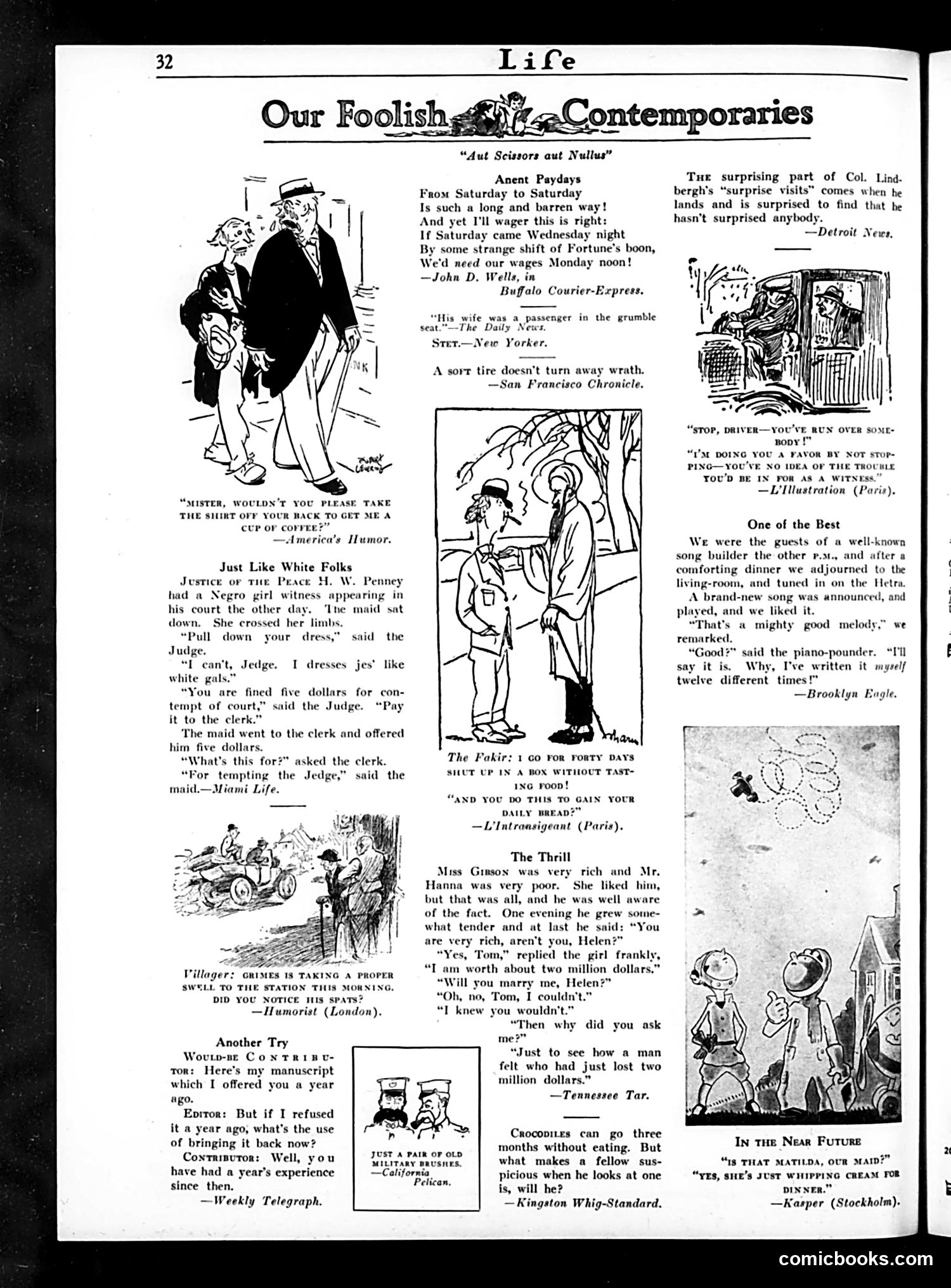
This page from *Life* magazine collects brief humorous anecdotes and cartoon jokes about contemporary social issues circa the 1920s. **Key themes:** - **Economic anxiety**: "Anent Paydays" jokes about workers waiting desperately for payday; "The Thrill" satirizes wealth disparity through a poor man's reaction to losing a hypothetical fortune. - **Racial attitudes**: "Just Like White Folks" depicts a Black witness misunderstanding a judge's instruction, playing on racist stereotypes about dialect and intelligence. - **Colonel Lindbergh reference**: A dig at Lindbergh's famous surprise visits—mocking that he's no longer actually surprising anyone. - **Class humor**: British and continental European jokes about servants, military brushes, and domestic staff. - **Reject persistence**: "Another Try" jokes about a writer repeatedly submitting rejected manuscripts. The cartoons use exaggerated illustration styles typical of 1920s satirical magazines. Most humor depends on period-specific class consciousness, gender roles, and casual racial stereotyping now considered offensive.
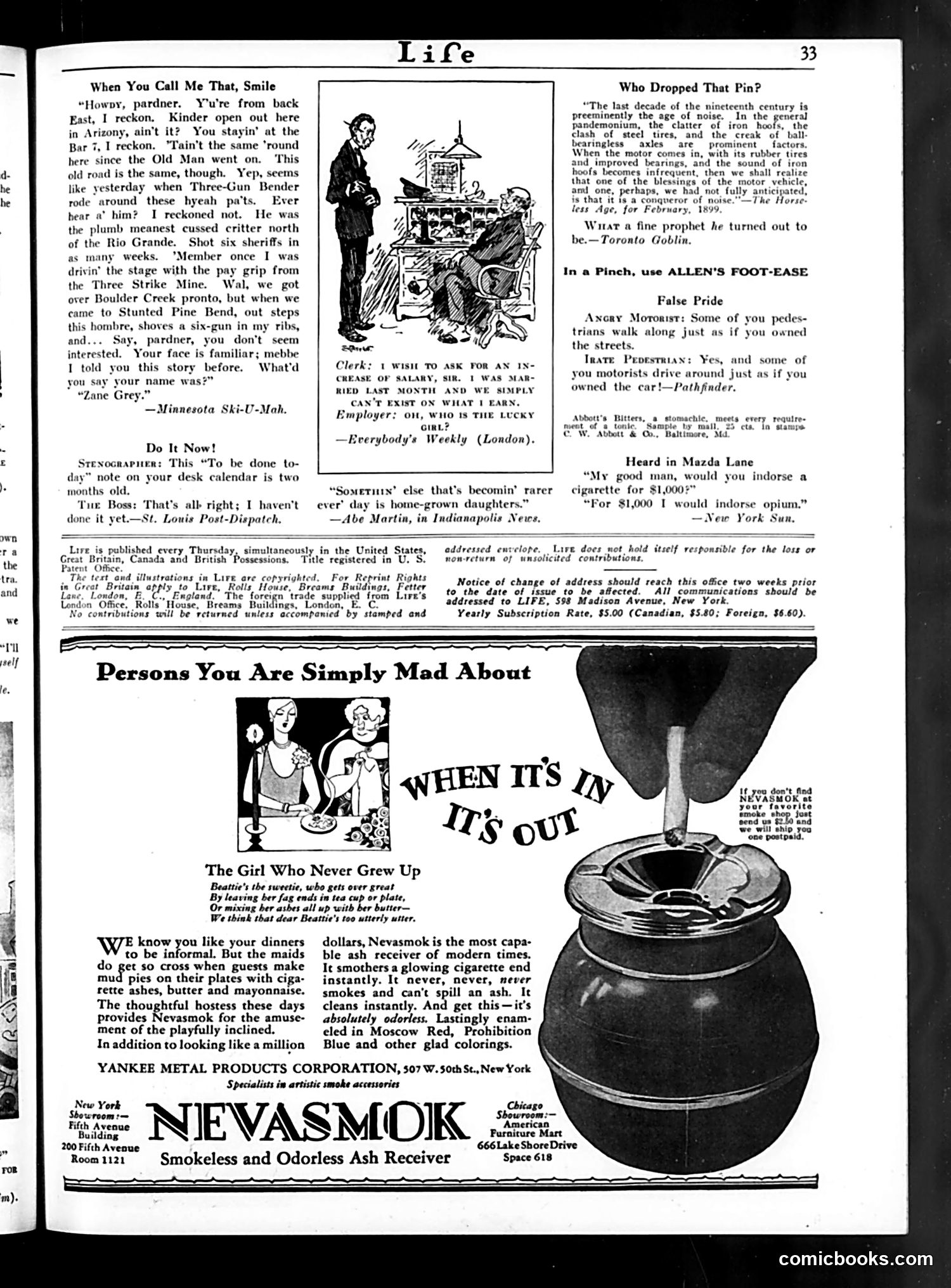
This page contains several brief satirical pieces and advertisements typical of Life's format. **"When You Call Me That, Smile"**: A humor piece mocking Western/frontier dialect and clichéd storytelling. An Eastern visitor endures a long-winded tall tale from a stereotypical cowboy about the outlaw "Three-Gun Bender," only to reveal he's actually Zane Grey—the famous Western fiction author. The joke: the real author of such tales is bored by an amateur's attempt. **Office humor pieces** mock workplace absurdities: a stenographer's outdated calendar note, an employee seeking a raise immediately after being hired. **"False Pride"**: Satirizes the tension between pedestrians and motorists—both groups act entitled to public space, each resenting the other's arrogance. **"Who Dropped That Pin?"**: Quotes a 1899 prediction that automobiles would reduce noise pollution—ironically undermined by reality. The **Nevasmok advertisement** promotes a smokeless ash receiver for cigarettes, addressing "The Girl Who Never Grew Up"—a woman who behaves childishly at dinner parties, leaving cigarette ash everywhere. The satire targets class pretension, generational behavior, and modern technology's unfulfilled promises.
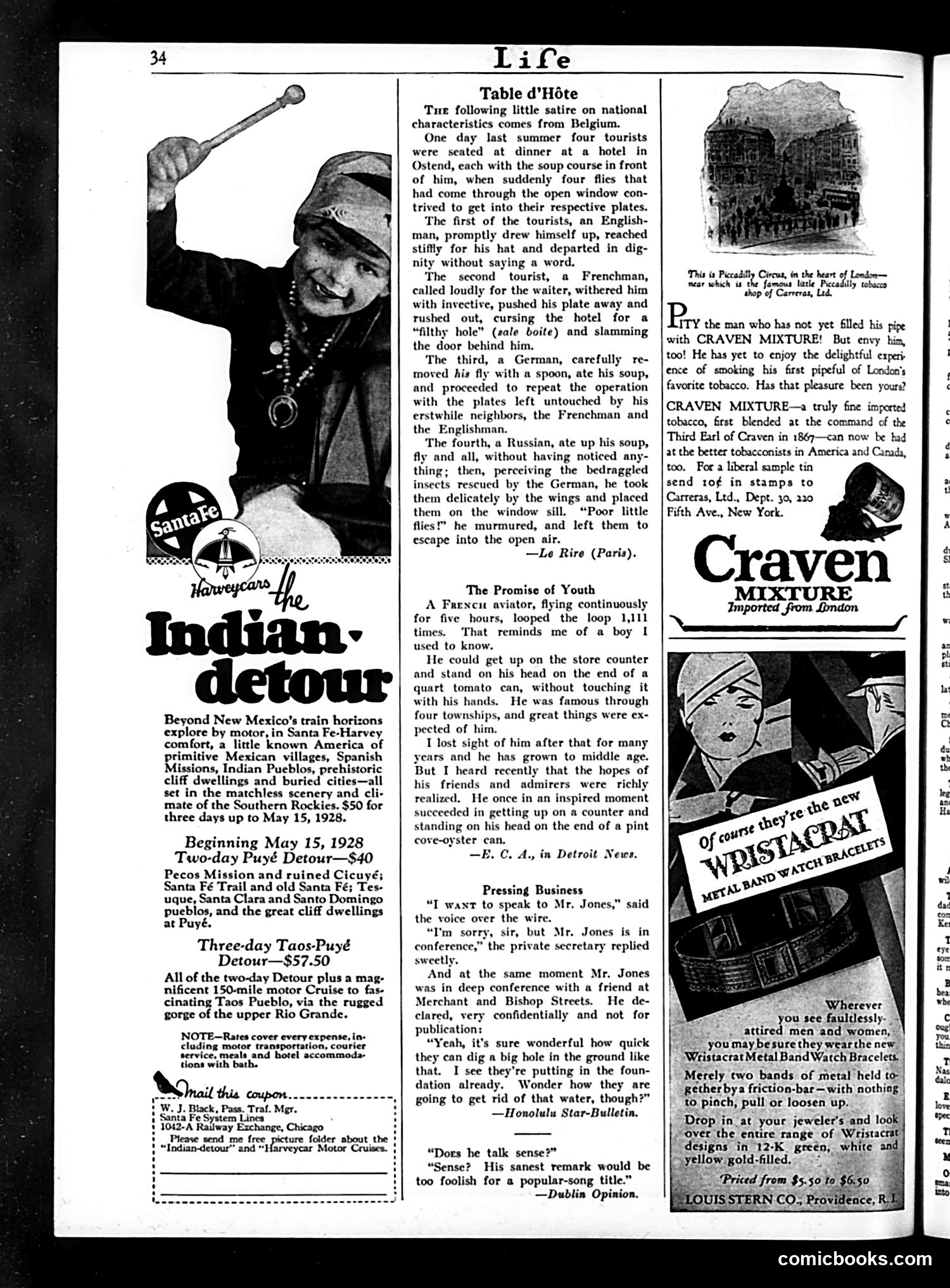
This page combines travel advertising with three satirical pieces about national stereotypes. **Main Cartoon/Content:** The large left illustration depicts "The Indian Detour"—a Santa Fe Railway motor-tour advertisement promoting Southwestern tourism to Mexican villages, pueblos, and cliff dwellings. **Three Satirical Stories:** 1. **"Table d'Hôte"** (from Belgian publication *Le Rire*): A joke about four tourists at dinner, each responding differently when flies land in their soup. The Englishman leaves dignified silence; the Frenchman curses loudly; the German methodically removes his fly and eats others' leftovers; the Russian eats the fly unnoticed, then compassionately saves the others. It's ethnic stereotyping: English restraint, French volatility, German efficiency/greed, Russian obliviousness/sentimentality. 2. **"The Promise of Youth"**: A boy famous for balancing on tomato cans grows up disappointing everyone—he can now only balance on smaller oyster cans. 3. **"Pressing Business"**: A secretary claims her boss is "in conference" while he's actually gossiping about construction site water problems. The page reflects 1920s humor conventions: stereotyping nationalities and mocking office pretense.
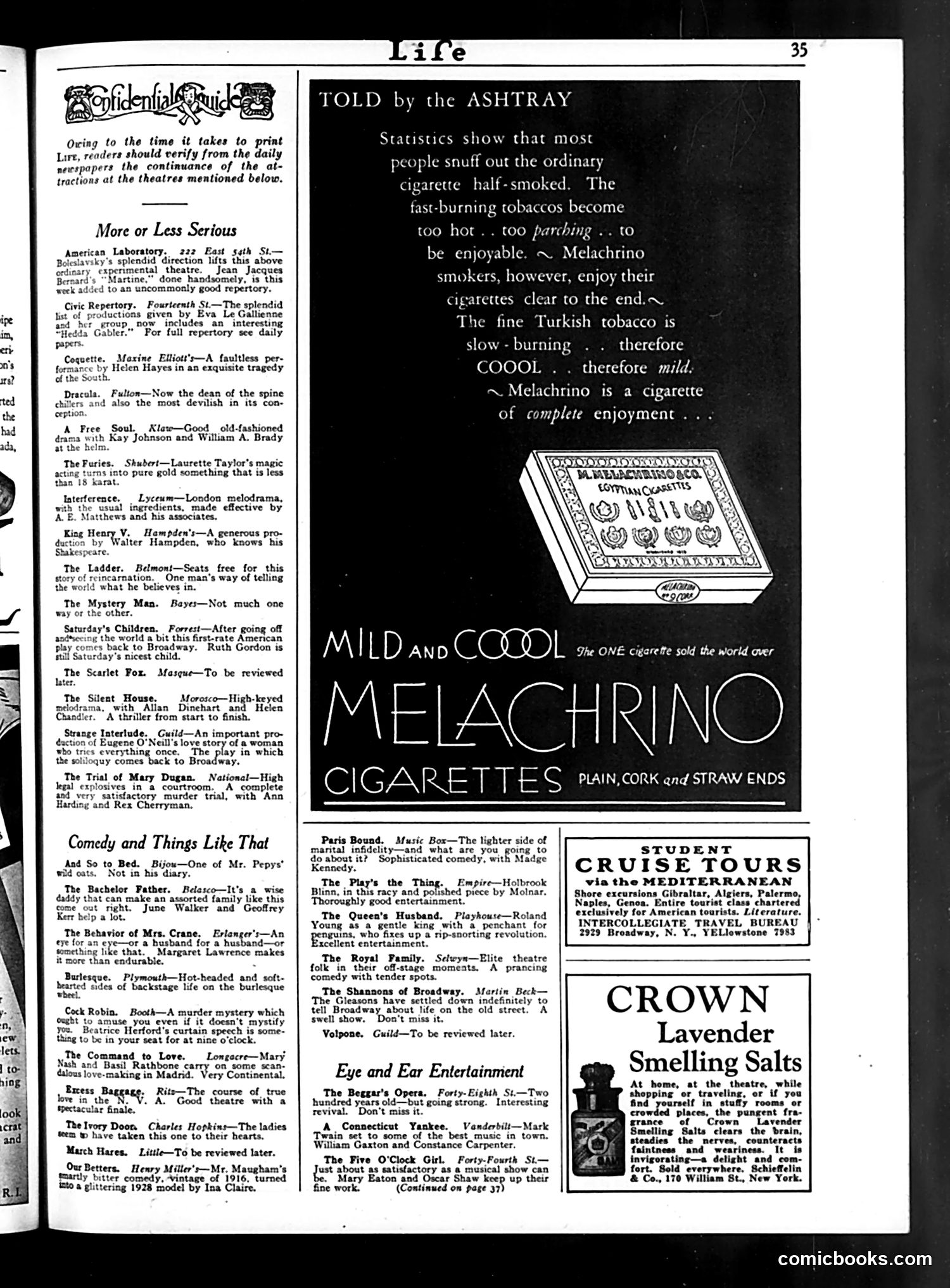
This page consists primarily of theater listings and reviews for Broadway productions, typical of Life magazine's entertainment coverage in the 1920s. The left column catalogs current plays—both serious dramas (like Eugene O'Neill's "Strange Interlude") and comedies—with brief critical assessments. The dominant right-side content is a Melachrino cigarette advertisement titled "TOLD by the ASHTRAY." The ad employs satirical humor by personifying an ashtray as a speaker offering "statistics" about smoking habits. It claims most people discard cigarettes half-smoked because ordinary tobacco burns too hot and becomes unenjoyable, but Melachrino's Turkish tobacco burns slowly and cool, remaining "mild" and providing "complete enjoyment" through the final drag. The advertisement uses pseudo-scientific claims typical of early 20th-century cigarette marketing—before health dangers were widely acknowledged—to suggest product superiority based on comfort and smoothness rather than any health consideration.
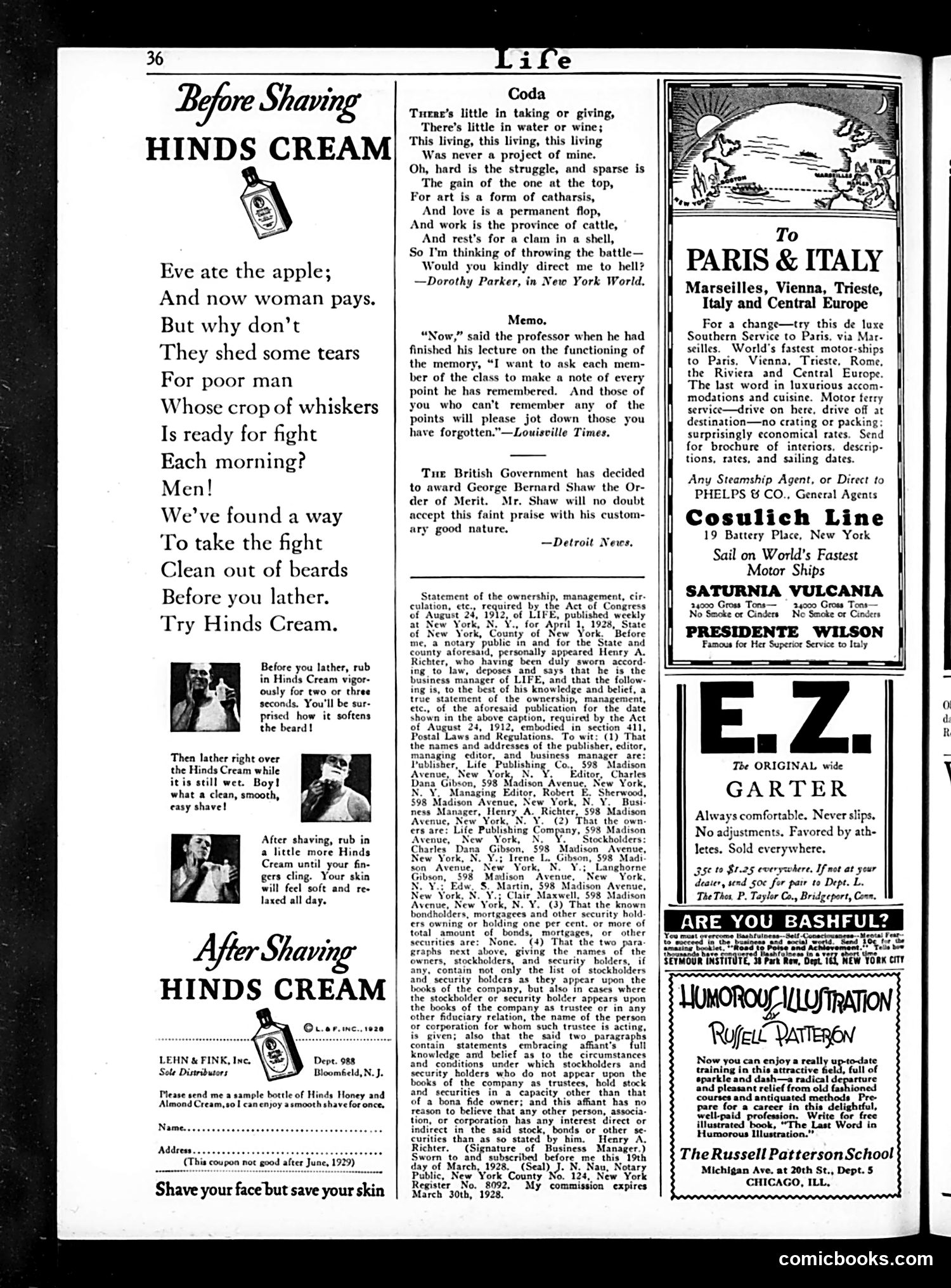
This page is primarily **advertising and editorial content**, not political satire. The main feature is a **Hinds Cream shaving product advertisement** that opens with a mild social jab: "Eve ate the apple; / And now woman pays," suggesting women bear consequences of men's actions. The ad then pivots to humor about men's daily shaving struggle, positioning Hinds Cream as relief. The page also includes **humorous short items**: Dorothy Parker's sardonic poem about life's futility (reflecting 1920s literary cynicism), and a joke about a professor asking students to note what they've forgotten—classic absurdist humor. A brief note mentions **George Bernard Shaw receiving the Order of Merit**, predicting his characteristically dismissive response. The remaining space contains **legal ownership statements** required by Congress, listing Life's publishers and editors (Charles Dana Gibson prominent among them). There is **no political cartoon**—the page represents typical 1920s magazine content: advertising, light verse, and bureaucratic notices.
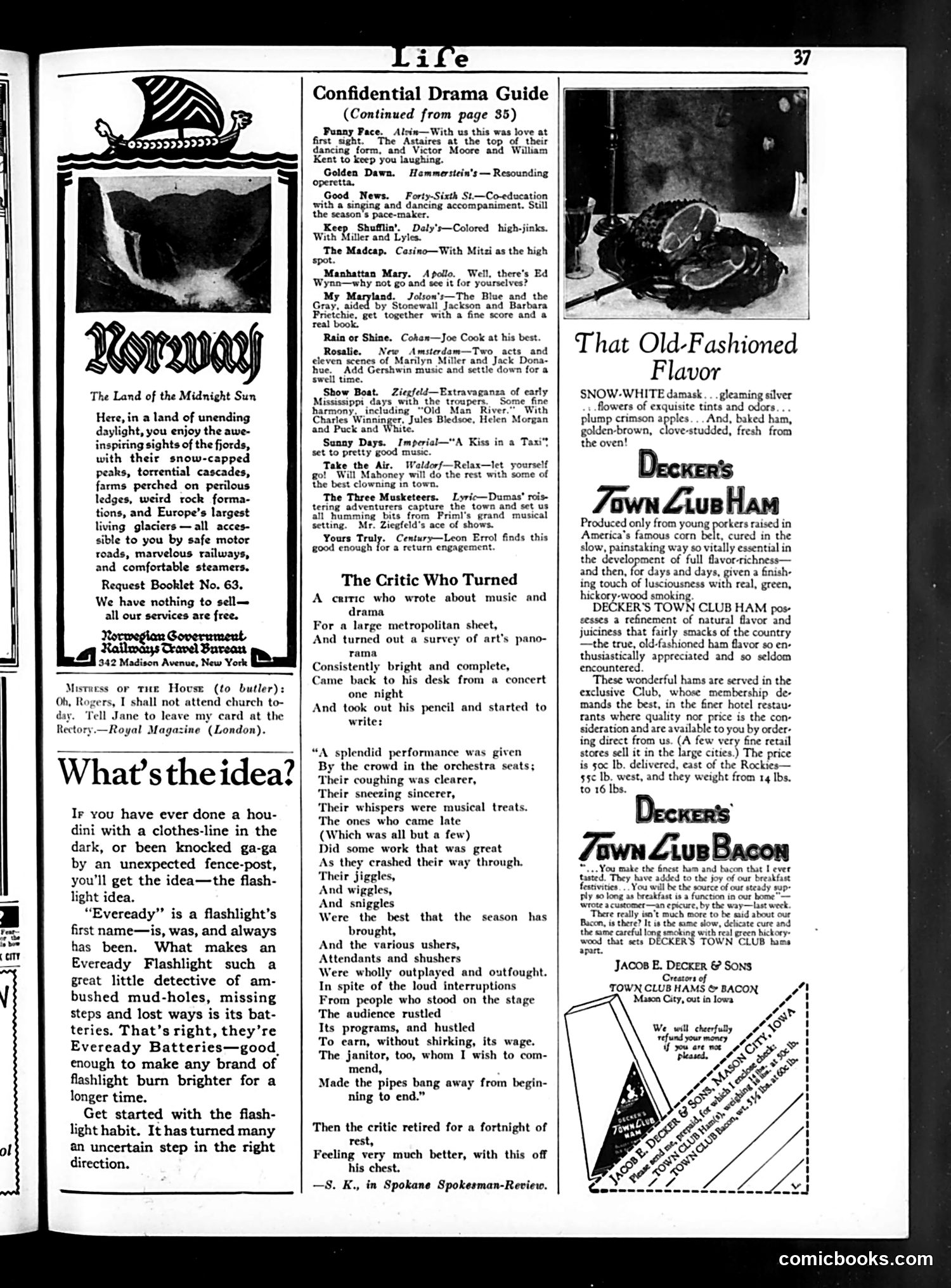
This page mixes advertising with entertainment content typical of 1920s Life magazine. **Top left:** A travel advertisement for Norway's "Land of the Midnight Sun," promoting fjords and glaciers via comfortable steamers—targeting affluent American tourists. **Center:** A "Confidential Drama Guide" reviewing Broadway shows (Funny Face, Good News, Show Boat, etc.), reflecting the era's vibrant theater scene. **"What's the idea?"** section: An advertisement for Eveready flashlight batteries, using humorous scenarios (clothesline mishaps, fence-posts) to pitch reliability. **"The Critic Who Turned":** A satirical poem mocking theater critics. The joke: a music-and-drama critic writes a glowing review—but *praises* the audience's disruptive behavior (coughing, sneezing, late arrivals, usher interactions) instead of the actual performance. It's satire on pretentious criticism and audience rudeness during live performances. **Right side:** Advertisements for Decker's ham and bacon, emphasizing quality and mail-order availability.
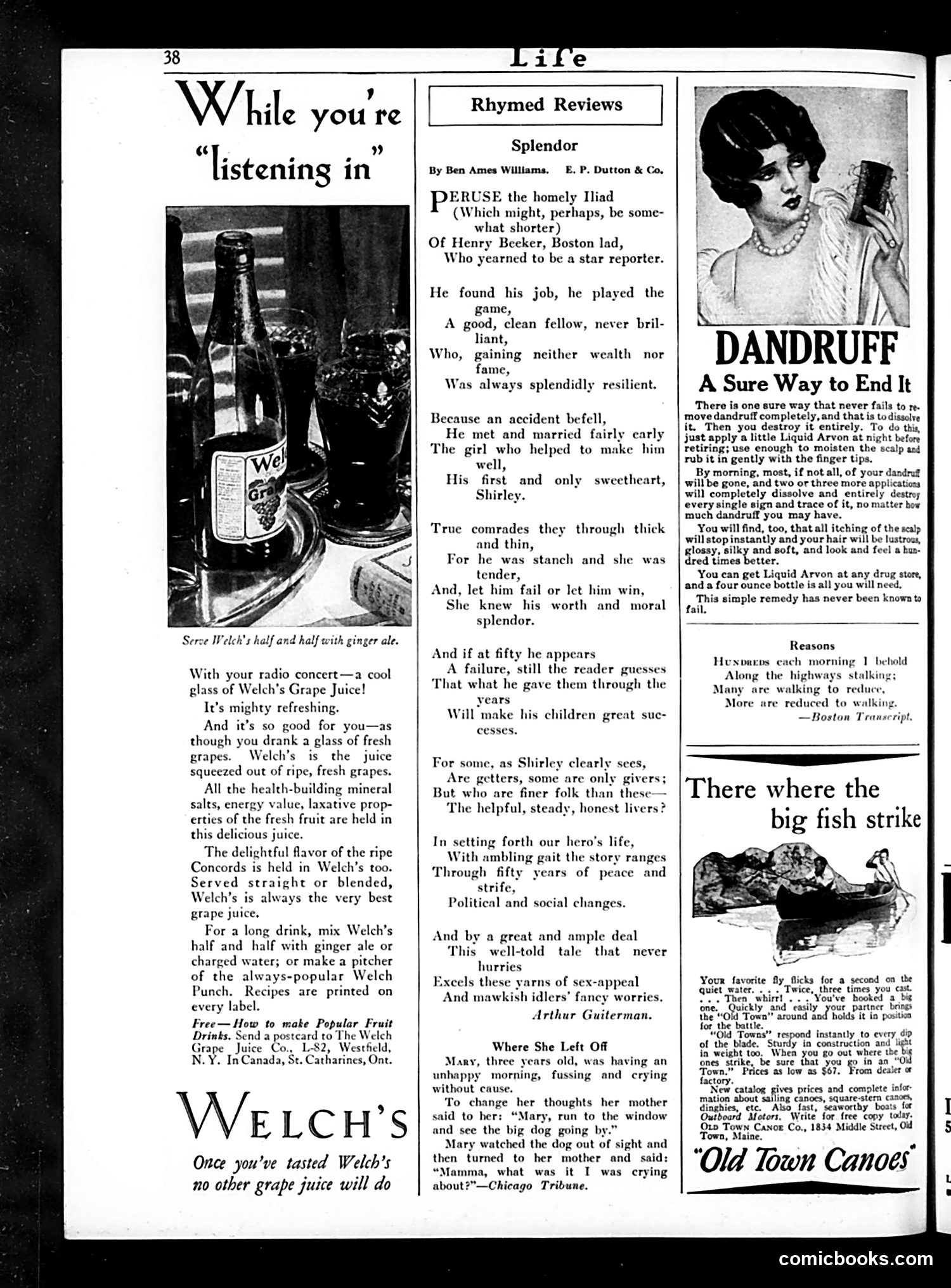
This page from *Life* magazine consists primarily of **advertisements and literary content** rather than political satire or editorial cartoons. The main elements are: 1. **Welch's Grape Juice ad** (left): A product advertisement encouraging radio listeners to drink grape juice during concerts—a common marketing tie-in with the emerging radio entertainment medium of the 1920s-30s. 2. **"Splendor" book review** (center): A rhymed review by Arthur Guiterman of a novel about Henry Becker, an ordinary Boston reporter who lives a quiet, moral life. The review praises the book for celebrating honest, humble people rather than sensational storytelling. 3. **"Dandruff" ad** (right): A patent medicine advertisement for "Liquid Arvon," claiming to cure dandruff. 4. **Miscellaneous humorous items**: A brief anecdote about a toddler forgetting why she was crying, and advertisements for canoes and other products. There are **no political cartoons or satirical commentary** visible on this page—it's a standard commercial and entertainment page from the magazine's interior.
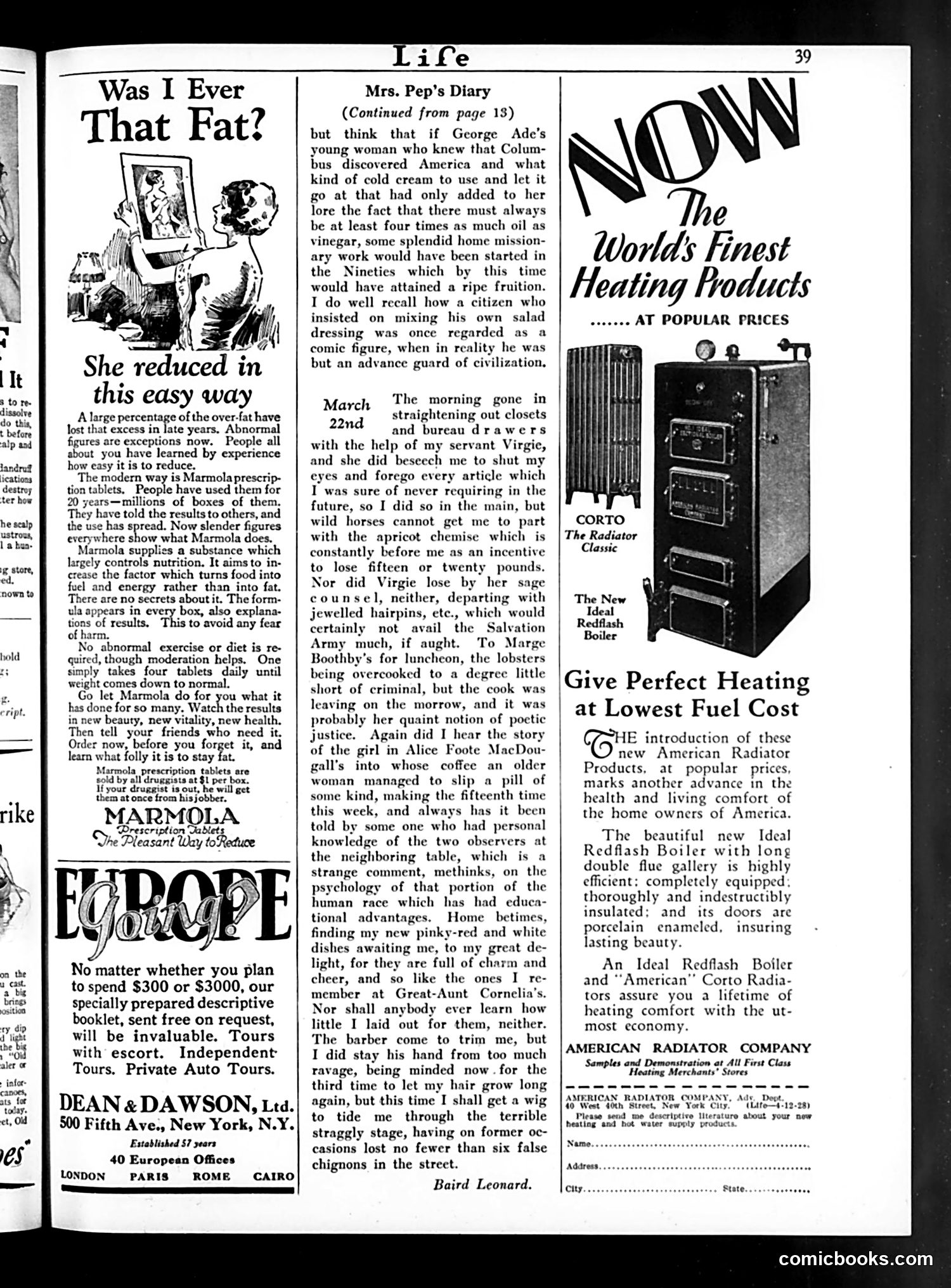
This page contains two main elements: **"Was I Ever That Fat?" (Left):** A Marmola diet-pill advertisement disguised as a testimonial. The cartoon shows a woman looking at her former fat self in a mirror. The satire targets the diet-pill industry's false promises—Marmola claimed to work without "abnormal exercise or diet," merely by controlling nutrition through prescription tablets. The ad's pseudo-scientific language ("increases the factor which turns food into fuel") masked what was essentially an unregulated weight-loss product. The cartoon's ironic title suggests skepticism about such easy solutions. **"Mrs. Pep's Diary" (Center-Right):** A society gossip column continuing from page 18, written by Baird Leonard. It chronicles upper-class domestic trivialities—organizing closets, attending luncheons with overcooked lobster. The tone gently mocks the shallow preoccupations of wealthy women. **Right Side:** Advertisements for heating products (Corto radiators, Redflash boilers) and travel services (Dean & Dawson tours). The page primarily advertises consumer products to affluent readers during the early 20th century.
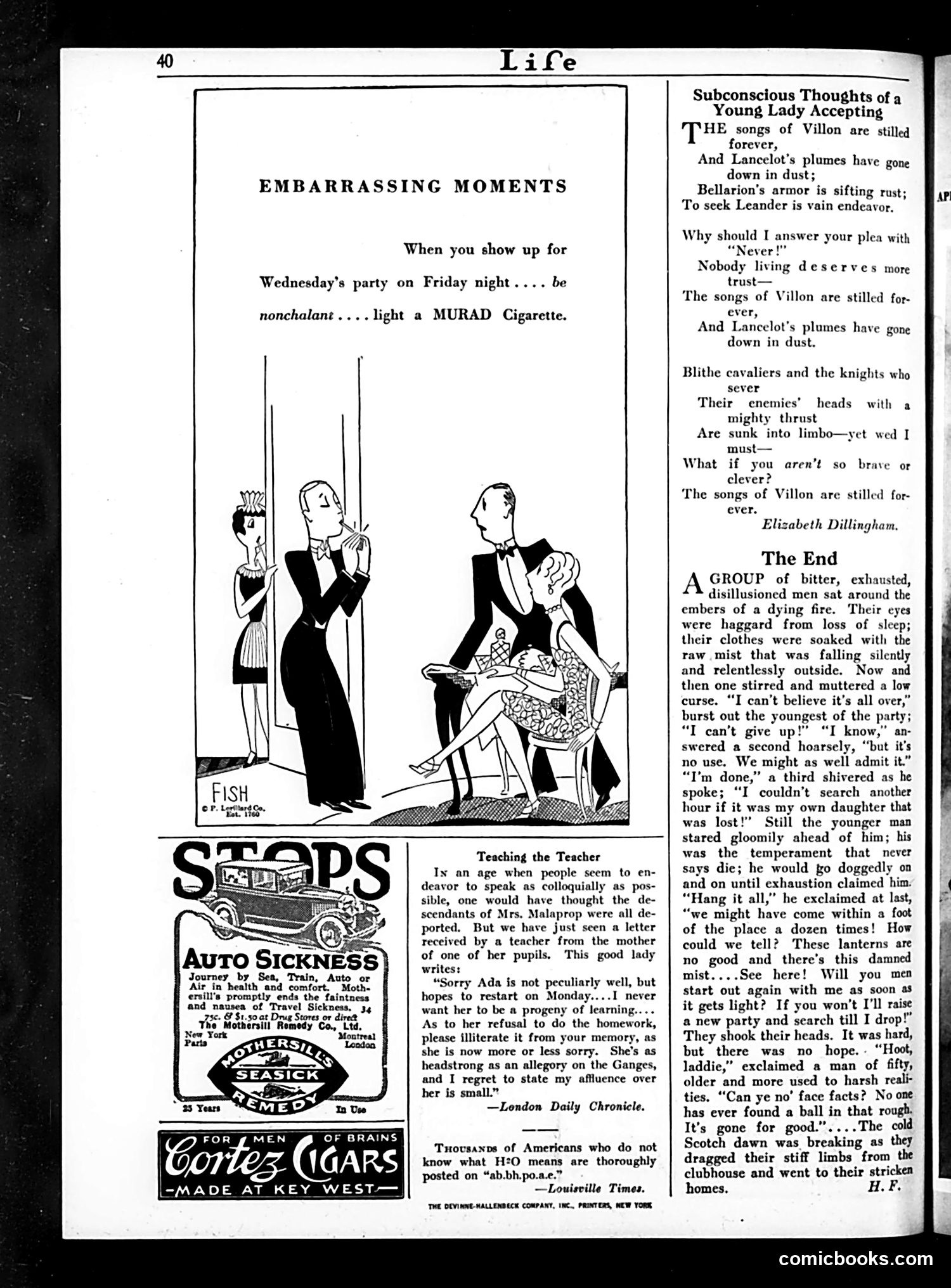
**"Embarrassing Moments"** cartoon shows a social etiquette tip: if you arrive late to a party, act casual and light a cigarette to seem unbothered. The humor targets early 20th-century social anxiety about appearing composed in awkward situations. **"Teaching the Teacher"** satirizes malapropisms—the comical misuse of words. A pupil's mother writes to a teacher using absurdly wrong words ("illiterate" instead of "obliterate," "progeny of learning" instead of learning outcome, "allegory on the Ganges" instead of an actual comparison). The joke mocks both poor education and pretentious attempts at formal language. **"The End"** is a serious short story about golfers searching unsuccessfully for a lost ball in fog and darkness. It's a somber tale emphasizing futility and resignation—darkly ironic given the trivial subject matter (a golf ball) contrasted with the exhausted, desperate tone. The page is primarily **advertising** (Murad cigarettes, Mothersill's travel remedy, Cortez cigars).