
Life, 1928-04-12 · page 30 of 42
Life — April 12, 1928 — page 30: what you’re looking at
What you’re looking at
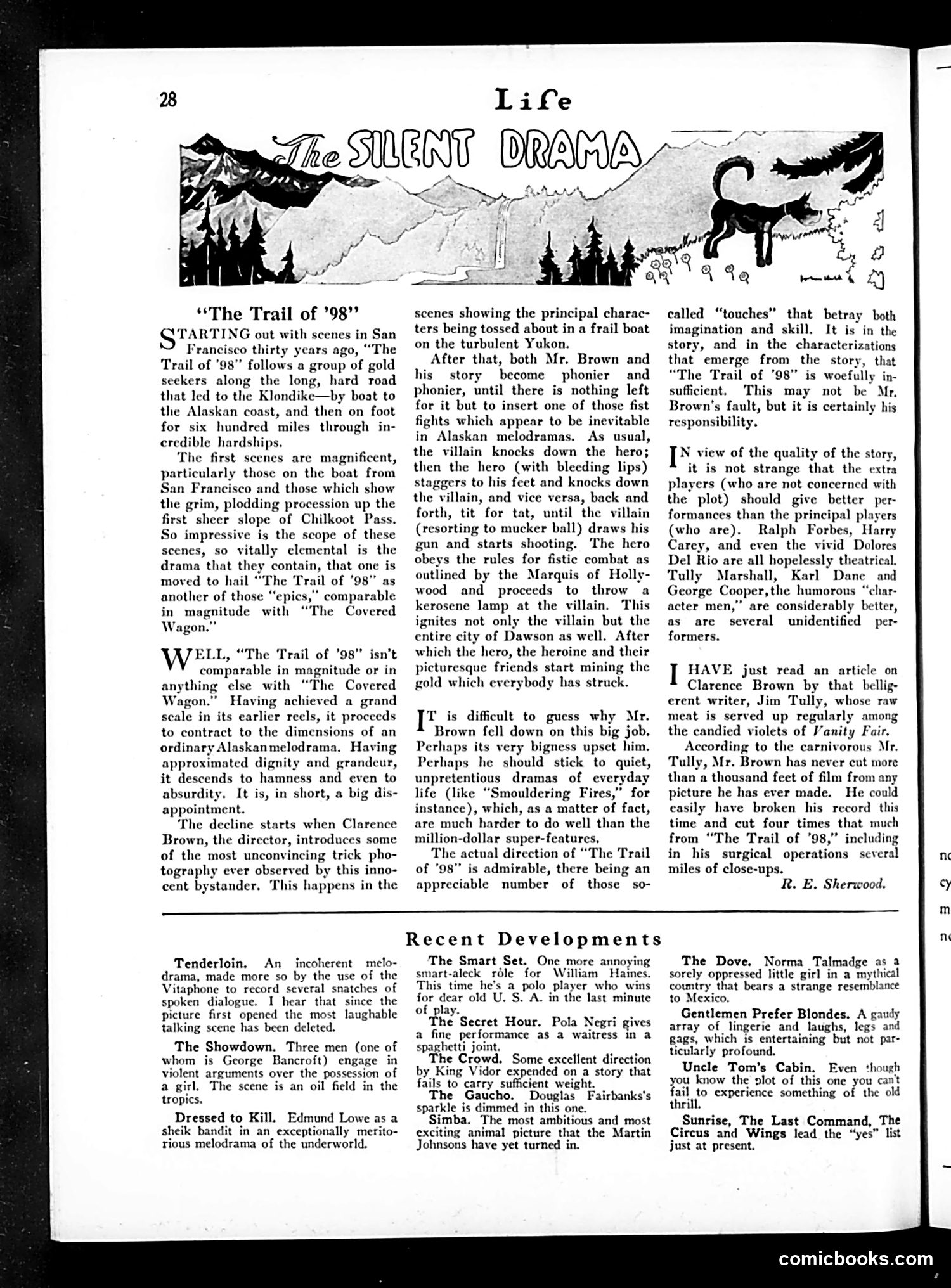
This page reviews **"The Trail of '98,"** a silent film about 1890s Klondike gold seekers directed by Clarence Brown. The critic praises the film's opening scenes—the San Francisco departure and Chilkoot Pass sequence—comparing them favorably to "The Covered Wagon" (a celebrated epic). However, the review condemns the film's second half as a descent into cheap melodrama. Once the story shifts to the Yukon settlement, it devolves into predictable clichés: unconvincing trick photography, a tired love triangle, and a climactic fistfight that literally sets the town of Dawson on fire. The critic suggests Brown lost control of an ambitious project, advising he stick to quieter dramas where his talent is evident. The page also briefly reviews other current releases (Tenderloin, The Crowd, The Gaucho), continuing Life magazine's role as a cultural arbiter of popular entertainment.
📄 Transcribed text from this page (OCR, searchable)
Machine-transcribed from the original scan — historical spelling and the odd misread are preserved.
“The Trail of ’98” STARTING out with scenes in San Francisco thirty years ago, “The Trail of '98" follows a group of gold seekers along the long, hard road that led to the Klondike—by boat to the Alaskan coast, and then on foot for six hundred miles through in- credible hardships. The first scenes are magnificent, particularly those on the boat from San Francisco and those which show the grim, plodding procession up the first sheer slope of Chilkoot Pass. So impressive is the scope of these scenes, so vitally elemental is the drama that they contain, that one is moved to hail “The Trail of ’98” as another of those “epi comparable in magnitude with “The Covered Wagon.” ELL, “The Trail of ’98” isn’t comparable in magnitude or in anything else with “The Covered Wagon.” Having achieved a grand scale in its earlier reels, it proceeds to contract to the dimensions of an ordinary Alaskanmelodrama, Having approximated dignity and grandeur, it descends to hamness and even to absurdity. It is, in short, a big dis- appointment. The decline starts when Clarence Brown, the director, introduces some of the most unconvincing trick pho- tography ever observed by this inno- cent bystander. This happens in the Tenderloin. An incoherent melo- drama, made more so by the use of the Vitaphone to record several snatches of spoken dialogue. I hear that since the Picture first opened the most laughable talking scene has been deleted. The Showdown. Three men (one of whom is George Bancroft) engage in violent arguments over the possession of a girl. The scene is an oil field in the tropics. Dressed to Kill. Edmund Lowe as a sheik bandit in an exceptionally merito- rious melodrama of the underworld. Life DRA tLe ry, ae scenes showing the principal charac- ters being tossed about in a frail boat on the turbulent Yukon. After that, both Mr. Brown and his story become phonier and phonier, until there is nothing left for it but to insert one of those fist fights which appear to be inevitable in Alaskan melodramas. As usual, the villain knocks down the hero; then the hero (with bleeding lips) staggers to his feet and knocks down the villain, and vice versa, back and forth, tit for tat, until the villain (resorting to mucker ball) draws his gun and starts shooting. The hero obeys the rules for fistic combat as outlined by the Marquis of Holly- wood and proceeds to throw a kerosene lamp at the villain. This ignites not only the villain but the entire city of Dawson as well. After which the hero, the heroine and their picturesque friends start mining the gold which everybody has struck. I" is difficult to guess why Mr. Brown fell down on this big job. Perhaps its very bigness upset him. Perhaps he should stick to quiet, unpretentious dramas of everyday life (like “Smouldering Fires,” for instance), which, as a matter of fact, are much harder to do well than the million-dollar super-features. The actual direction of “The Trail of '98” is admirable, there being an appreciable number of those so- Recent Developments The Smart Set. One more annoying smart-aleck réle for William Haines. This time he's a_polo player who wins for dear old U. S. A. in the last minute of play. The Secret Hour. Pola Negri gives a fine performance as a waitress in a spaghetti joint. The Crowd. Some excellent direction by King Vidor expended on a story that fails to carry sufficient weight. The Gaucho. Douglas Fairbanks's sparkle is dimmed in this one. Simba. The most ambitious and most exciting animal picture that the Martin Johnsons have yet turned in. zy %4 ae called “touches” that betray both imagination and skill. It is in the story, and in the characterizations that emerge from the story, that “The Trail of ’98” is woefully in- sufficient. This may not be Mr, Brown's fault, but it is certainly his responsibility. IX view of the quality of the story, it is not strange that the extra players (who are not concerned with the plot) should give better per- formances than the principal players (who are). Ralph Forbes, Harry Carey, and even the vivid Dolores Del Rio are all hopelessly theatrical. Tully Marshall, Karl Dane and George Cooper,the humorous “char- acter men,” are considerably better, as are several unidentified per- formers. I HAVE just read an article on Clarence Brown by that bellig- erent writer, Jim Tully, whose raw meat is served up regularly among the candied violets of Vanity Fair. According to the carnivorous Mr. Tully, Mr. Brown has never cut more than a thousand feet of film from any picture he has ever made. He could easily have broken his record this time and cut four times that much from “The Trail of ’98,” including in his surgical operations several miles of close-ups. R. E. Sherwood. The Dove. Norma Talmadge as a sorely oppressed little girl in a mythical country that bears a strange resemblance to Mexico. Gentlemen Prefer Blondes. A gaudy array of lingerie and laughs, legs and gags, which is entertaining but not par- ticularly profound. Uncle Tom’s Cabin, Even though you know the plot of this one you can't fail to experience something of the old thrill. Sunrise, The Last Command, The Circus and Wings lead the “yes” list just at present. comicbooks.com