
Life, 1928-04-12 · page 16 of 42
Life — April 12, 1928 — page 16: what you’re looking at
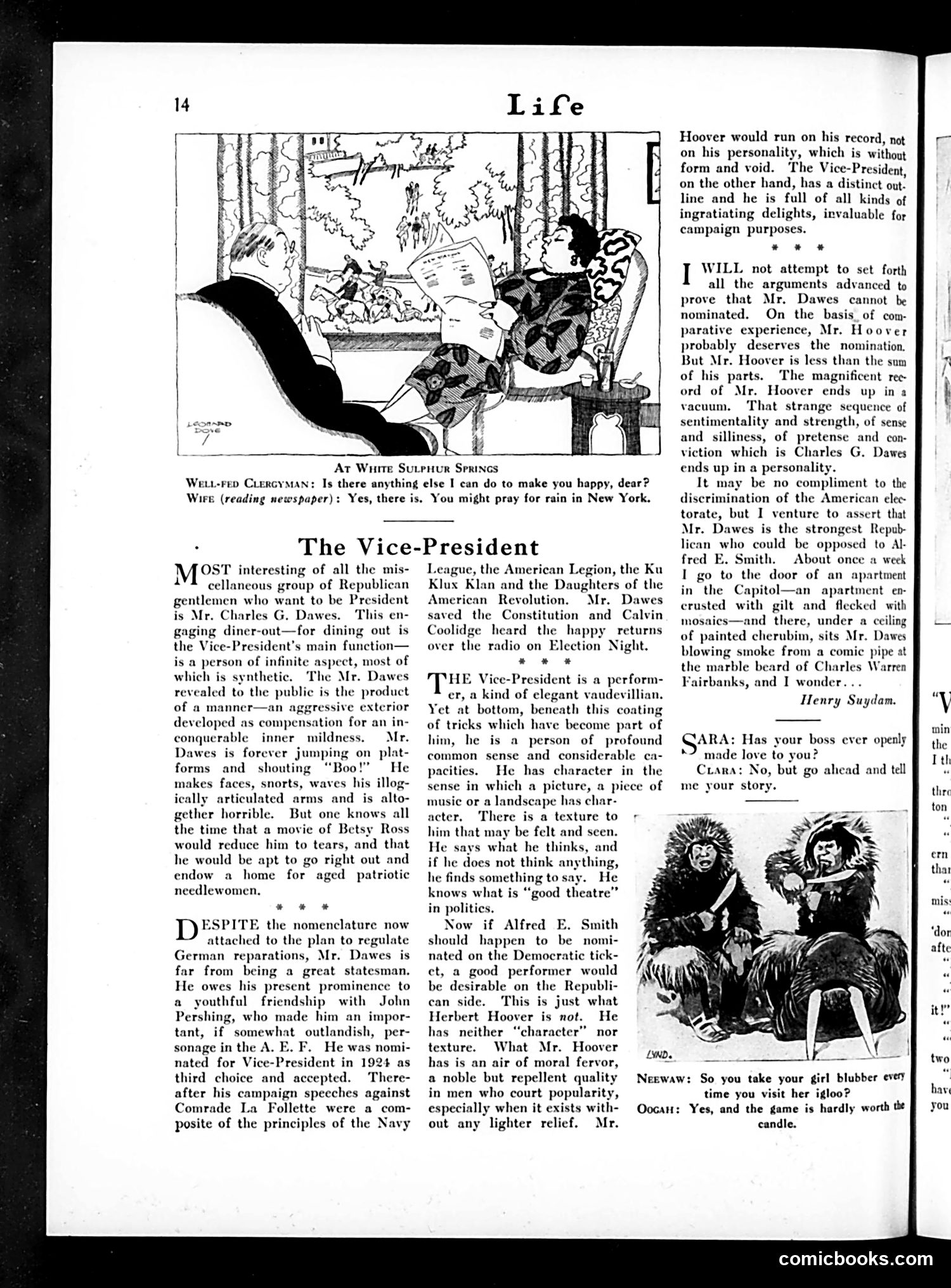
What you’re looking at
This Life magazine page satirizes the Republican Party's choice of Vice-President. The main article discusses **Charles G. Dawes**, the incumbent Vice-President, versus potential nominee **Alfred E. Smith** (the Democratic candidate). The cartoon at top depicts a clergyman and wife at White Sulphur Springs discussing whether to "pray for rain in New York"—likely alluding to Smith's association with New York and possibly his Catholic faith, which was controversial in 1928. The article praises Dawes's personality and political acumen while noting he's less conventionally "character-driven" than opponents might claim. The satirical point: Republican leadership must choose between a proven administrator (Dawes) and other candidates, with the choice carrying significant campaign implications.
📄 Transcribed text from this page (OCR, searchable)
Machine-transcribed from the original scan — historical spelling and the odd misread are preserved.
At Wurre Sutenur Sprincs -FED CLERGYMAN: Is there anything else I can do to make you happy, dear? p (reading newspaper): Yes, there is, You might pray for rain in New York. The Vice-President OST interesting of all the mis- + cellaneous group of Republican gentlemen who want to be President is Mr. Charles G. Dawes. This en- gaging diner-out—for dining out is the Vice-President’s main function— is a person of infinite aspect, most of which is synthetic. The Mr. Dawes revealed to the public is the product of a manner—an aggressive exterior developed as compensation for an in- conquerable inner mildness. Mr. Dawes is forever jumping on plat- forms and shouting “Boo!” He makes faces, snorts, waves his illog- ically articulated arms and is alto- gether horrible. But one knows all the time that a movie of Betsy Ross would reduce him to tears, and that he would be apt to go right out and endow a home for aged patriotic needlewomen, **# # DESPITE the nomenclature now attached to the plan to regulate German reparations, Mr. Dawes is far from being a great statesman. He owes his present prominence to a youthful friendship with John Pershing, who made him an impor- tant, if somewhat outlandish, per- sonage in the A. E. F, He was nomi- nated for Vice-President in 1924 as third choice and accepted. There- after his campaign speeches against Comrade La Follette were a com- posite of the principles of the Navy League, the American Legion, the Ku Klux Klan and the Daughters of the American Revolution. Mr. Dawes saved the Constitution and Calvin Coolidge heard the happy returns over the radio on Election Night. se # HE Vice-President is a perform- er, a kind of elegant vaudevillian. Yet at bottom, beneath this coating of tricks which have become part of him, he is a person of profound common sense and considerable ca- pacities. He has character in the sense in which a picture, a piece of music or a landscape has char- acter, There is a texture to him that may be felt and seen. He says what he thinks, and if he does not think anything, he finds something to say. He knows what is “good theatre” in politics, Now if Alfred E, Smith should happen to be nomi- nated on the Democratic tick- et, a good performer would be desirable on the Republi- can side. TI just what Herbert Hoover is not. He has neither “character” nor texture. What Mr. Hoover has is an air of moral fervor, a noble but repellent quality in men who court popularity, especially when it exists with- out any lighter relief. Mr. Oocan: Yes, and the game is hardly worth te Hoover would run on his record, not on his personality, which is without form and void. The Vice-President, on the other hand, has a distinct out. line and he is full of all kinds of ingratiating delights, invaluable for campaign purposes. ** © WILL not attempt to set forth all the arguments advanced to prove that Mr. Dawes cannot be nominated. On the basis. of com- parative experience, Mr. Hoover probably deserves the nomination. But Mr. Hoover is less than the sum of his parts. The magnificent ree- ord of Mr. Hoover ends up in a vacuum. That strange sequence of sentimentality and strength, of sense and silliness, of pretense and con- viction which is Charles G. Dawes ends up in a personality. It may be no compliment to the discrimination of the American elec torate, but I venture to assert that Mr. Dawes is the strongest Repub- lican who could be opposed to Al- fred E, Smith. About once a week I go to the door of an apartment in the Capitol—an apartment en- crusted with gilt and flecked with mosaics—and there, under a ceiling of painted cherubim, sits Mr. Dawes blowing smoke from a comic pipe at the marble beard of Charles Warren Fairbanks, and I wonder. .. Henry Suydam. SARA: Has your boss ever openly ‘J made love to you? Ciara: No, but go ahead and tell me your story. Neewaw: So you take your girl blubber every time you visit her igloo? candle. comicbooks.com hav you