
Life, 1928-04-12 · page 34 of 42
Life — April 12, 1928 — page 34: what you’re looking at
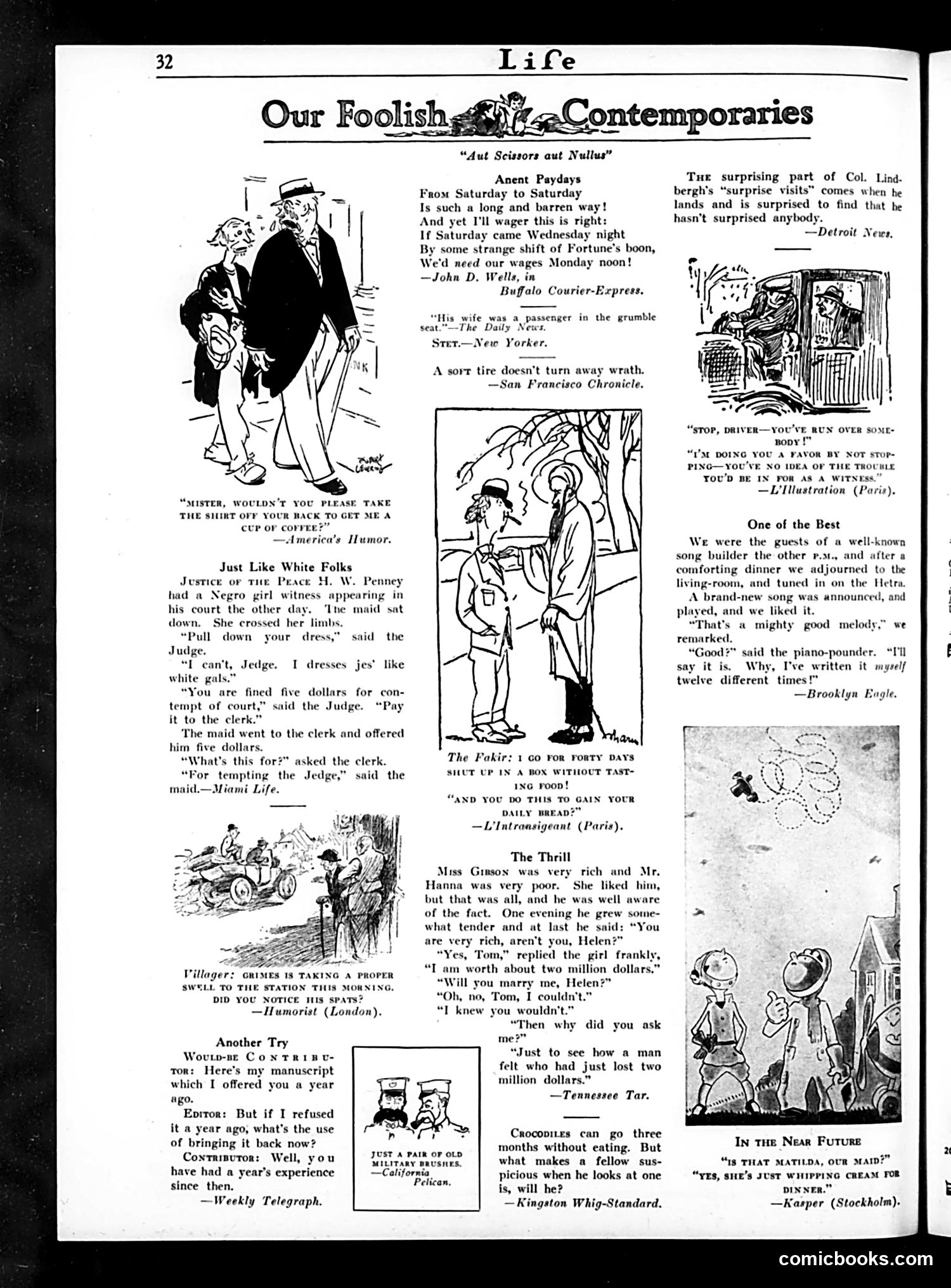
What you’re looking at
This page from *Life* magazine collects brief humorous anecdotes and cartoon jokes about contemporary social issues circa the 1920s. **Key themes:** - **Economic anxiety**: "Anent Paydays" jokes about workers waiting desperately for payday; "The Thrill" satirizes wealth disparity through a poor man's reaction to losing a hypothetical fortune. - **Racial attitudes**: "Just Like White Folks" depicts a Black witness misunderstanding a judge's instruction, playing on racist stereotypes about dialect and intelligence. - **Colonel Lindbergh reference**: A dig at Lindbergh's famous surprise visits—mocking that he's no longer actually surprising anyone. - **Class humor**: British and continental European jokes about servants, military brushes, and domestic staff. - **Reject persistence**: "Another Try" jokes about a writer repeatedly submitting rejected manuscripts. The cartoons use exaggerated illustration styles typical of 1920s satirical magazines. Most humor depends on period-specific class consciousness, gender roles, and casual racial stereotyping now considered offensive.
📄 Transcribed text from this page (OCR, searchable)
Machine-transcribed from the original scan — historical spelling and the odd misread are preserved.
Our Foolish “Aut ontemporaries Scissors aut Nullus” Anent Paydays From Saturday to Saturday Is such a long and barren way! And yet I'll If Saturday wager this is right: came Wednesday night Tue surprising part of Col. Lind. bergh’s “surprise visits” comes when he lands and is surprised to find that be hasn't surprised anybody. —Detroit News, “MISTER, WOULDN'T YOU PLEA: THE SHIRT OFF YOUR BACK TO GE’ cUP oF corr —America’s Humor. Just Like White Folks Jestice or THe Peace H. W. Penney had a Negro girl witness appe his court the other day, down, “Pull Jud) “LT can't, Jedge. white gals.” “You are fined five dollars for con- tempt of court,” said the Judge. “Pay it to the clerk.” The maid went to the clerk and offered him five dollars. “What's this for?” asked the clerk. “For tempting the Jedge,” said the maid.—Miami Life. ring in ‘Tne maid sat She crossed her limbs. down your the dress,” said I dresses jes’ like Villager: anistrs 18 TAKING A PROPER SWELL TO TILE STATION THIS MORNING. DID YOU NOTICE HIS SPATS? —Humorist (London). Another Try Wovtp-ng Con trip c- ron: Here's my manuscript which I offered you a year ago. Epitor: But if I refused it a year ago, what's the use of bringing it back now? Contrisutor: Well, you have had a year’s experience since then. —Weekly Telegraph. cr) roens JUST A PAIR OF OLD MILITARY BRUSHES. —California Pelican, By some strange shift of Fortune's boon, We'd need our wages Monday noon! —John D. Wells, in Buffalo Courier-Express. is wife was a passenger in the grumble seat."—The Daily News. Stet.—New Yorker. A sort tire doesn’t turn away wrath. —San Francisco Chronicle. “STOP, DRIVER—YOU'VE RUN OVER somE- nopy “1’M DOING YOU A FAVOR BY NoT stop- FOR AS A WITNESS.” —L'Illustration (Paris). One of the Best We were the guests of a well-known song builder the other p.st., and after a comforting dinner we adjourned to the living-room, and tuned in on the Hetra. A brand-new song was announced, and played, and we liked it. “That's a mighty good melody,” we remarked. “Good?” said the piano-pounder. “I'll say it Why, I've written it myself twelve different times! —Brooklyn Eagle. = ray The Fakir: 1 Go vor rorty DAYS SHUT UP IN A BOX WITHOUT TAST- ING Foop! “AND YOU DO THIS TO DAILY BREAD? =L'Intransigeant (Paris). IN YOUR The Thrill Miss Ginson was very rich and Mr. Hanna was very poor. She liked him, but that was all, and he was well aware of the fact. One evening he grew some- what tender and at last he said: “You are very rich, aren't you, Helen? “Yes, Tom,” replied the girl frankly, “TI am worth about two million dollars.” “Will you marry me, Helen?” “Oh, no, Tom, I couldn't.” “I knew you wouldn't.” hen why did you ask m “Just to see how a man felt who had just lost two million dollars.” —Tennessee Tar. hi = Crocopites can go three months without eating. But what makes a fellow sus- picious when he looks at one is, will he? — Kingston Whig-Standard. In THE Near Future “18 THAT MATILDA, OUR MAID? “YES, SHE'S JUST WHIPPING CREAM FOR DINNER.” —Kasper (Stockholm). comicbooks.com