
Life, 1928-04-12 · page 25 of 42
Life — April 12, 1928 — page 25: what you’re looking at
What you’re looking at
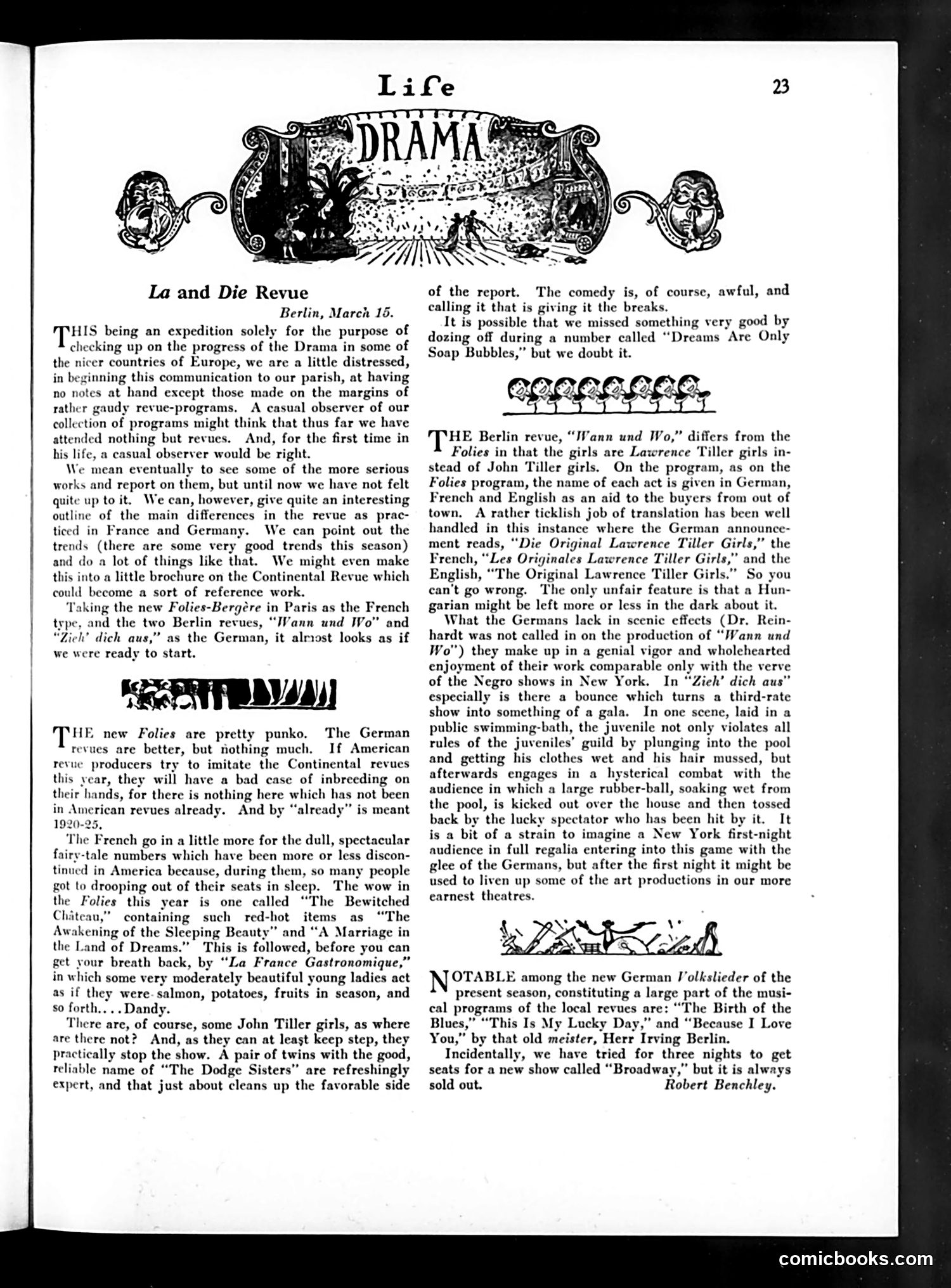
This is a theater review column, not a political cartoon. The author—identified at column's end as Robert Benchley—reports on Continental revue productions in Paris and Berlin (dated March 15-16, likely 1920s). The piece compares French spectacle-heavy revues (the Folies-Bergère) with German ones ("Wann und Wo," "Zieh' dich aus"), noting American producers shouldn't imitate Continental style since nothing here is original to Europe. Benchley mocks the French revue's elaborate but sleep-inducing fairy-tale numbers while crediting the Germans' enthusiastic vigor—though he notes their staging lacks the scenic effects of Dr. Reinhardt's productions. He praises the Tiller Girls (professional chorus lines) and "The Dodge Sisters" as actual talent amid otherwise "awful" comedy. The column's tone is wry, insider-gossip theater criticism typical of *Life* magazine's satirical approach to high culture.
📄 Transcribed text from this page (OCR, searchable)
Machine-transcribed from the original scan — historical spelling and the odd misread are preserved.
La and Die Revue Berlin, March 16. THs being an expedition solely for the purpose of iecking up on the progress of the Drama in some of the nicer countries of Europe, we are a little distressed, in beginning this communication to our parish, at having no notes at hand except those made on the margins of rather gaudy revue-programs. A casual observer of our collection of programs might think that thus far we have attended nothing but revues. And, for the first time in his life, a casual observer would be right. We mean eventually to see some of the more serious works and report on them, but until now we have not felt quite up to it. We can, however, give quite an interesting outline of the main differences in the revue as prac- ticed in France and Germany. We can point out the trends (there are some very good trends this season) and do a lot of things like that. We might even make this into a little brochure on the Continental Revue which could become a sort of reference work. Taking the new Folies-Bergére in Paris as the French and the two Berlin revues, “JVann und Wo" and jh’ dich aus,” as the German, it almost looks as if we were ready to start. 2 new Folies are pretty punko. evues are better, but nothing much. The German If American T! r revue producers try to imitate the Continental revues this year, they will have a bad case of inbreeding on nds, for there is nothing here which has not been can revues already. And by “already” is meant rench go in a little more for the dull, spectacular fairy-tale numbers which have been more or less discon- tinued in America because, during them, so many people got to drooping out of their seats in sleep. The wow in the Folies this year is one called “The Bewitched Chateau,” containing such red-hot items as “The Awakening of the Sleeping Beauty” and “A Marriage in the Land of Dreams.” This is followed, before you can get your breath back, by “La France Gastronomique,” in which some very moderately beautiful young ladies act as if they were-salmon, potatoes, fruits in season, and so forth... Dandy. There are, of course, some John Tiller girls, as where are there not? And, as they can at least keep step, they practically stop the show. A pair of twins with the good, reliable name of “The Dodge Sisters” are refreshingly expert, and that just about cleans up the favorable side of the report. The comedy is, of course, awful, and calling it that is giving it the breaks. It is possible that we missed something very good by dozing off during a number called “Dreams Are Only Soap Bubbles,” but we doubt it. CL. THE Berlin revue, “Wann und Wo,” differs from the Folies in that the girls are Lawrence Tiller girls in- stead of John Tiller girls. On the program, as on the Folies program, the name of each act is given in German, French and English as an aid to the buyers from out of town. A rather ticklish job of translation has been well handled in this instance where the German announce- ment reads, “Die Original Lawrence Tiller Girls,” the French, “Les Originales Lawrence Tiller Girls, English, “The Original Lawrence Tiller Girls. can’t go wrong. The only unfair feature is that a Hun- garian might be left more or less in the dark about it. What the Germans lack in scenic effects (Dr. Rein- hardt was not called in on the production of “Wann und Wo") they make up in a genial vigor and wholehearted enjoyment of their work comparable only with the verve of the Negro shows in New York. In “Zieh’ dich aus” especially is there a bounce which turns a third-rate show into something of a gala. In one scene, laid in a public swimming-bath, the juvenile not only violates all rules of the juveniles’ guild by plunging into the pool and getting his clothes wet and his hair mussed, but afterwards engages in a hysterical combat with the audience in which a large rubber-ball, soaking wet from the pool, is kicked out over the house and then tossed back by the lucky spectator who has been hit by it. It is a bit of a strain to imagine a New York first-night audience in full regalia entering into this game with the glee of the Germans, but after the first night it might be used to liven up some of the art productions in our more earnest theatres. ye OTABLE among the new German J'olkslieder of the present season, constituting a large part of the musi- cal programs of the local revues are: “The Birth of the Blues,” “This Is My Lucky Day,” and ‘Because I Love You,” by that old meister, Herr Irving Berlin. Incidentally, we have tried for three nights to get seats for a new show called “Broadway,” but it is always sold out. Robert Benchley. comicbooks.com