
Life, 1928-04-12 · page 20 of 42
Life — April 12, 1928 — page 20: what you’re looking at
What you’re looking at
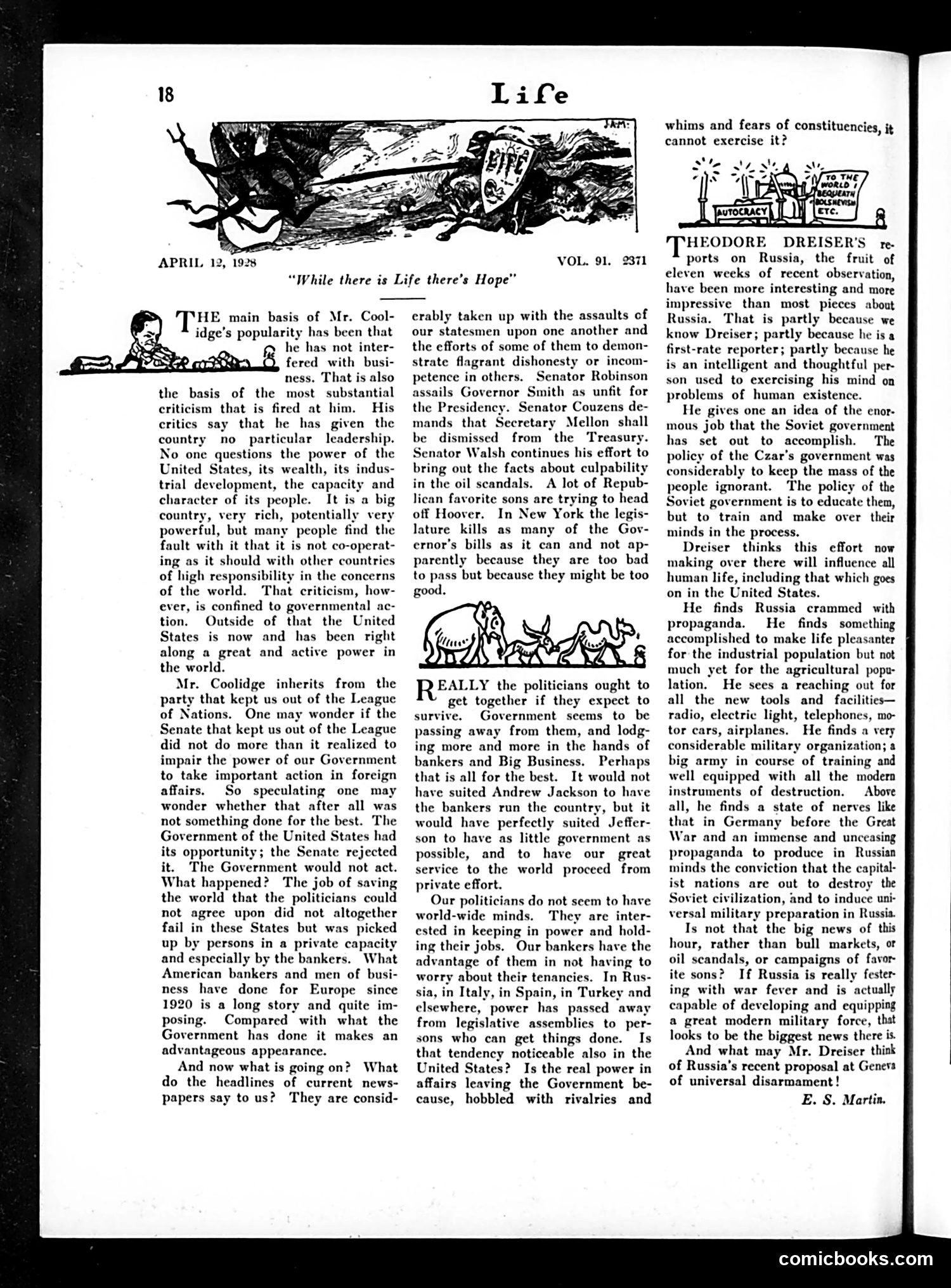
This Life magazine page (April 13, 1928) contains editorial commentary critiquing President Calvin Coolidge's passive leadership style and the broader decline of governmental power in America. The text argues that while Coolidge's non-interference with business initially boosted his popularity, it represents a failure of national leadership. The author notes that private bankers and businessmen have effectively filled the vacuum left by government inaction—particularly regarding post-WWI European recovery. The piece criticizes contemporary politicians for petty infighting (mentioning Senator Robinson attacking Governor Smith, Senator Couzens demanding Secretary Mellon's dismissal, and Senator Walsh investigating oil scandals) while real power shifts toward bankers and business interests. The author observes this pattern globally: in Russia, Italy, Spain, and Turkey, legislative bodies have lost power to decisive executive figures. The question posed is whether America is following this authoritarian trend, with governmental dysfunction ceding authority to unelected business leadership. The accompanying cartoons (though details are unclear) appear to reinforce themes of political weakness and institutional decline.
📄 Transcribed text from this page (OCR, searchable)
Machine-transcribed from the original scan — historical spelling and the odd misread are preserved.
VOL. 91, 2371 “While there is Life there’s Hope” HE main basis of Mr. Cool- idge’s popularity has been that fQ he has not inter- 2, fered with busi- ness. That is also the basis of the most substantial criticism that is fired at him. His critics say that he has given the country no particular leadership. No one questions the power of the United States, its wealth, its indus- trial development, the capacity and character of its people. It is a big country, very rich, potentially very powerful, but many people find the fault with it that it is not co-operat- ing as it should with other countries of high responsibility in the concerns of the world. That criticism, how- ever, is confined to governmental ac- tion. Outside of that the United States is now and has been right along a great and active power in the world. Mr. Coolidge inherits from the party that kept us out of the League of Nations. One may wonder if the Senate that kept us out of the League did not do more than it realized to impair the power of our Government to take important action in foreign affairs. So speculating one may wonder whether that after all was not something done for the best. The Government of the United States had its opportunity; the Senate rejected it. The Government would not act. What happened? The job of saving the world that the politicians could not agree upon did not altogether fail in these States but was picked up by persons in a private capacity and especially by the bankers. What American bankers and men of busi- ness have done for Europe since 1920 is a long story and quite im- posing. Compared with what the Government has done it makes an advantageous appearance. And now what is going on? What do the headlines of current news- papers say to us? They are consid- erably taken up with the assaults of our statesmen upon one another and the efforts of some of them to demon- strate flagrant dishonesty or incom- petence in others. Senator Robinson assails Governor Smith as unfit for the Presidency. Senator Couzens de- mands that Secretary Mellon shall be dismissed from the Treasury. Senator Walsh continues his effort to bring out the facts about culpability in the oil scandals. A lot of Repub- lican favorite sons are trying to head off Hoover. In New York the legis- lature kills as many of the Gov- ernor’s bills as it can and not ap- parently because they are too bad to pass but because they might be too good. ane h ?: AA ROA REALLY the politicians ought to get together if they expect to survive. Government seems to be passing away from them, and lodg- ing more and more in the hands of bankers and Big Business. Perhaps that is all for the best. It would not have suited Andrew Jackson to have the bankers run the country, but it would have perfectly suited Jeffer- son to have as little government as possible, and to have our great service to the world proceed from private effort. Our politicians do not seem to have world-wide minds. They are inter- ested in keeping in power and hold- ing their jobs. Our bankers have the advantage of them in not having to worry about their tenancies. In Rus- sia, in Italy, in Spain, in Turkey and elsewhere, power has passed away from legislative assemblies to per- sons who can get things done. Is that tendency noticeable also in the United States? Is the real power in affairs leaving the Government be- cause, hobbled with rivalries and whims and fears of constituencies, it cannot exercise it? HEODORE DREISER'S re. ports on Russia, the fruit of eleven weeks of recent observation, have been more interesting and more impressive than most pieces about Russia. That is partly because we know Dreiser; partly because he is a first-rate reporter; partly because he is an intelligent and thoughtful per- son used to exercising his mind on problems of human existence. He gives one an idea of the enor- mous job that the Soviet government has set out to accomplish. The policy of the Czar’s government was considerably to keep the mass of the people ignorant. The policy of the Soviet government is to educate them, but to train and make over their minds in the process. Dreiser thinks this effort now making over there will influence all human life, including that which goes on in the United States. He finds Russia crammed with propaganda. He finds something accomplished to make life pleasanter for the industrial population but not much yet for the agricultural popu- lation. He sees a reaching out for all the new tools and_ facilitie— radio, electric light, telephones, mo- tor cars, airplanes. He finds a very considerable military organization; a big army in course of training and Il equipped with all the modern instruments of destruction. Above all, he finds a state of nerves like that in Germany before the Great War and an immense and unceasing propaganda to produce in Russian minds the conviction that the capital- ist nations are out to destroy the Soviet civilization, and to induce uni- versal military preparation in Russia. Is not that the big news of this hour, rather than bull markets, or oil scandals, or campaigns of favor ite sons? If Russia is really fester ing with war fever and is actually capable of developing and equipping a great modern military force, that looks to be the biggest news there is. And what may Mr. Dreiser think of Russia’s recent proposal at Genevs of universal disarmament! E. S. Martin. comicbooks.com