
A complete issue · 36 pages · 1922
Life — November 9, 1922
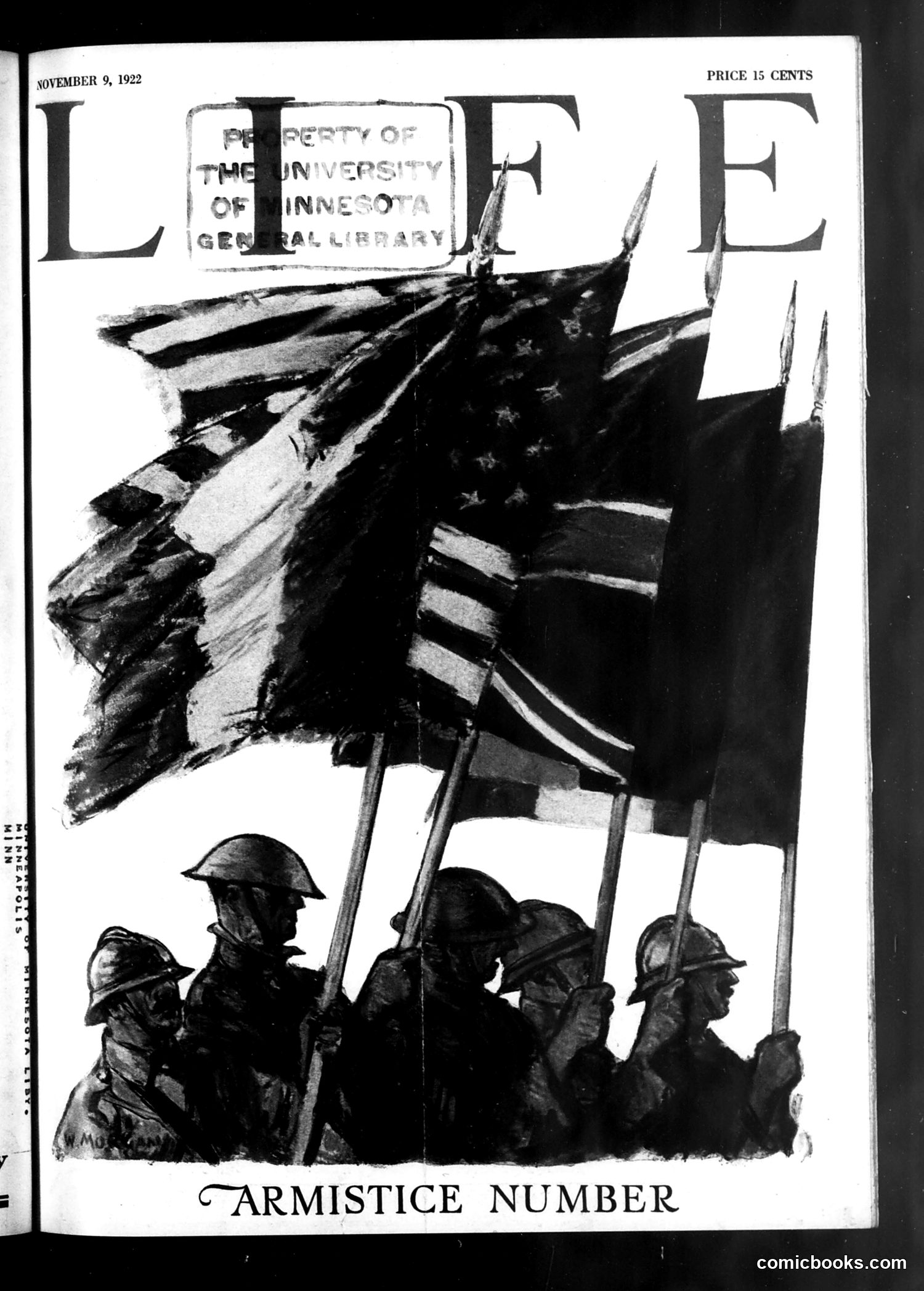
This is an **Armistice Day commemorative cover** marking the fourth anniversary of the November 11, 1918 armistice ending World War I. The image shows five soldiers in military helmets carrying a large coffin or casket aloft on their shoulders, with rifles and bayonets held upright beside it. Above floats what appears to be a tattered flag or banner. The visual metaphor is clear: this is a funeral procession honoring the war dead. The soldiers represent those who survived; the coffin symbolizes the massive casualties of the Great War. The composition treats Armistice Day as a solemn memorial rather than celebration—reflecting how 1920s America grappled with the war's devastating human cost and loss. The image conveys grief and remembrance as the primary emotional response to the conflict.
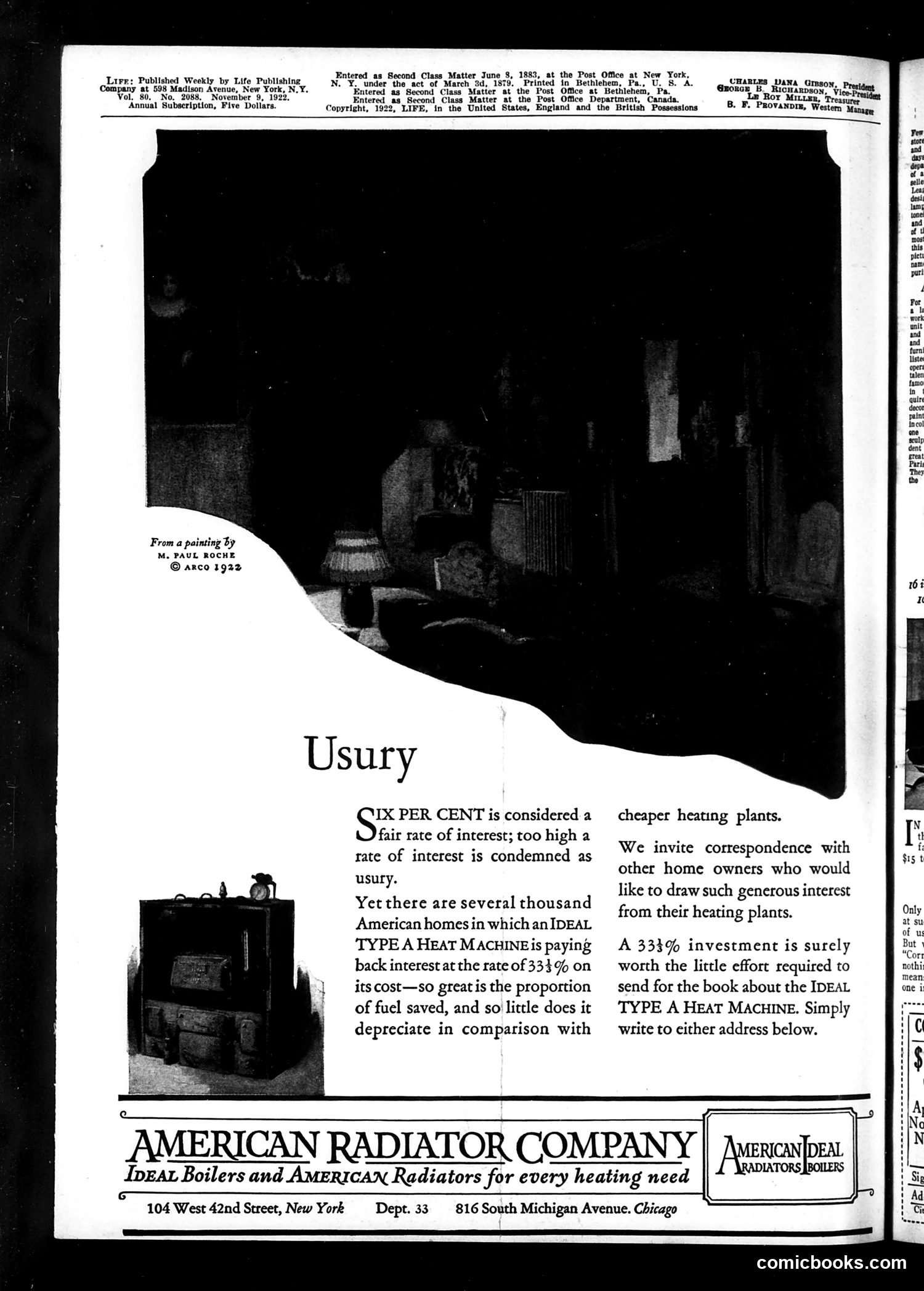
This page is primarily **advertising**, not satire or editorial content. It features a full-page advertisement for the American Radiator Company promoting their "Ideal Type A Heat Machine." The ad uses the word "Usury" as a headline, arguing that charging 6% interest on loans is considered usurious (exploitative), yet American homeowners pay 33⅓% returns on heating system costs through fuel savings—making the investment worthwhile. The painting by M. Paul Roche (dated 1935) depicts an interior with a heating unit. The copy invites homeowners to request information about their heating systems, emphasizing fuel efficiency as a major selling point during the Depression era when cost-savings mattered greatly to consumers. No political figures or satire are present; this is straightforward commercial messaging using economic reasoning to promote a product.
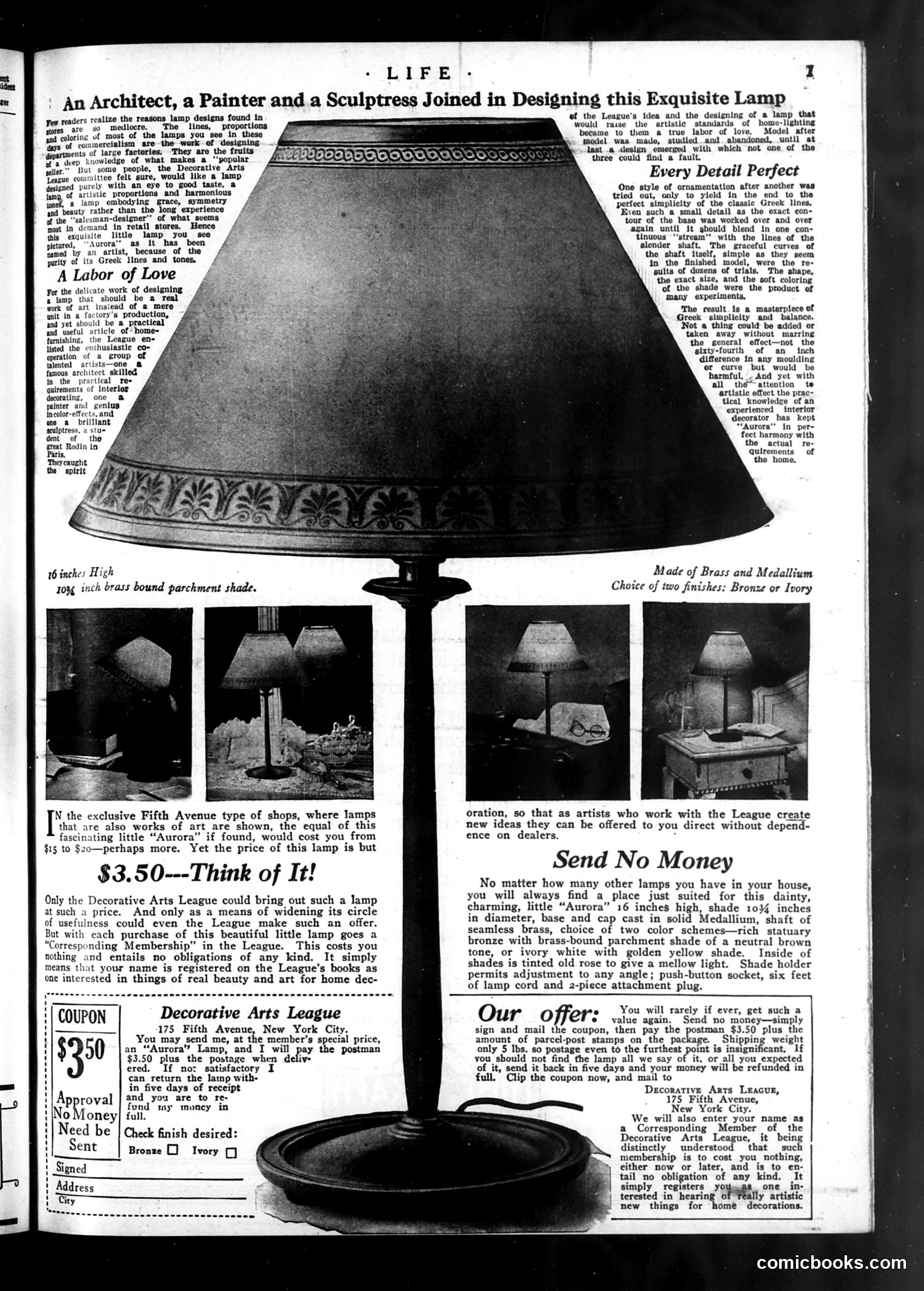
This page is **primarily an advertisement**, not political satire. It promotes the "Aurora" table lamp, designed collaboratively by an architect, painter, and sculptress for the Decorative Arts League. The ad emphasizes the lamp's artistic merit and classical design (Greek-inspired ornamentation), positioning it as affordable luxury at $3.50. Multiple product photographs show the lamp in home settings. A coupon at bottom allows mail-order purchase with a "no approval needed" policy—a significant selling point during this era, suggesting the advertiser's confidence in the product and appeal to budget-conscious buyers. The text emphasizes the League's membership benefits and the lamp's artistic legitimacy, essentially marketing mass-produced design as fine art accessible to ordinary Americans.
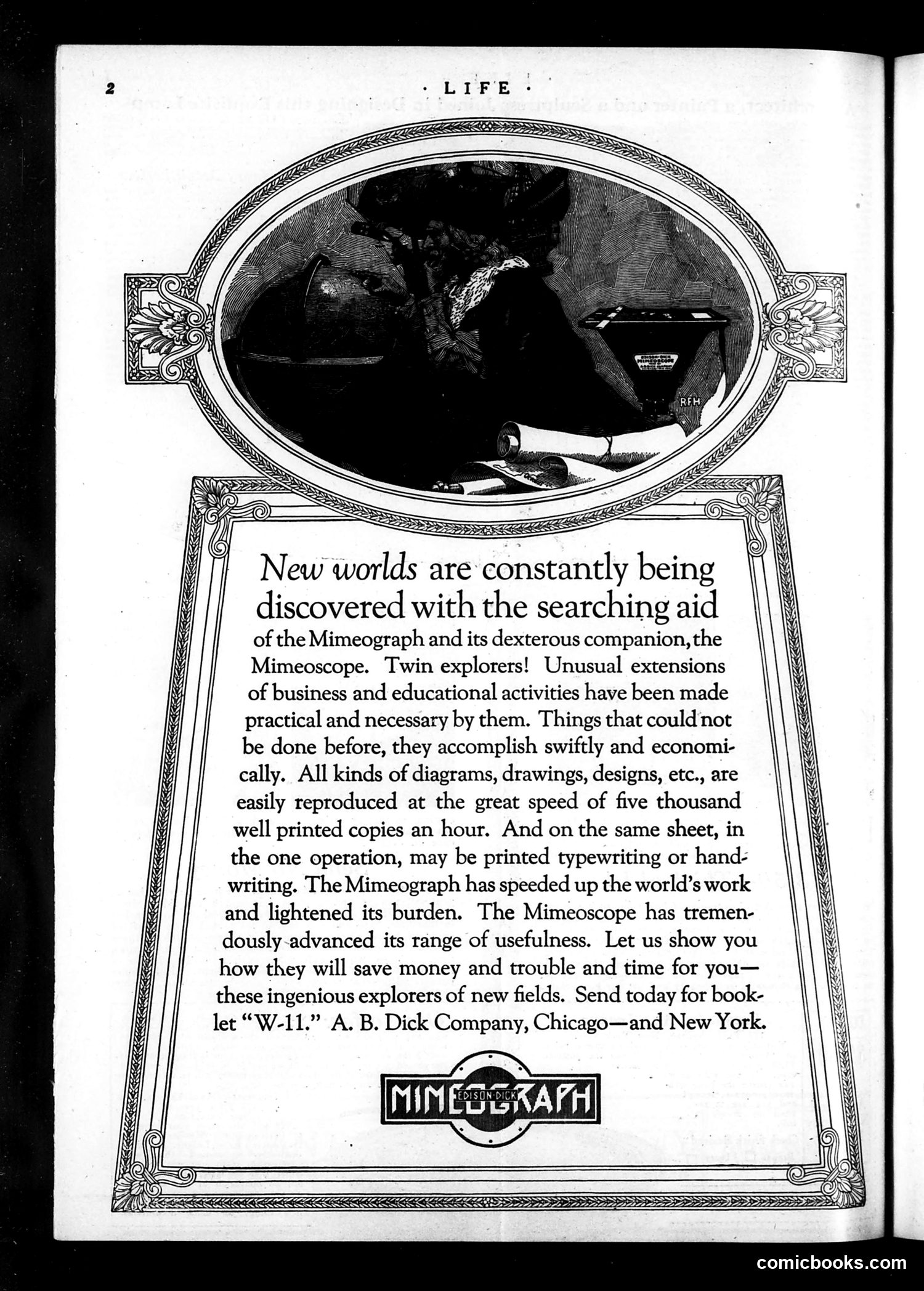
This page is **entirely an advertisement**, not satire or political commentary. It promotes the Mimeograph and Mimeoscope—office copying and reproduction machines made by A.B. Dick Company of Chicago and New York. The ad uses metaphorical language ("new worlds," "explorers") to describe business applications. It claims these machines enable rapid reproduction of documents (5,000 copies hourly), reduce labor costs, and allow simultaneous printing of typewritten or handwritten content on single sheets. The oval photograph at top appears to show the machinery itself, though details are unclear in this reproduction. This represents early 20th-century office technology marketing—positioning copying machines as revolutionary business tools that would modernize and accelerate workplace productivity.
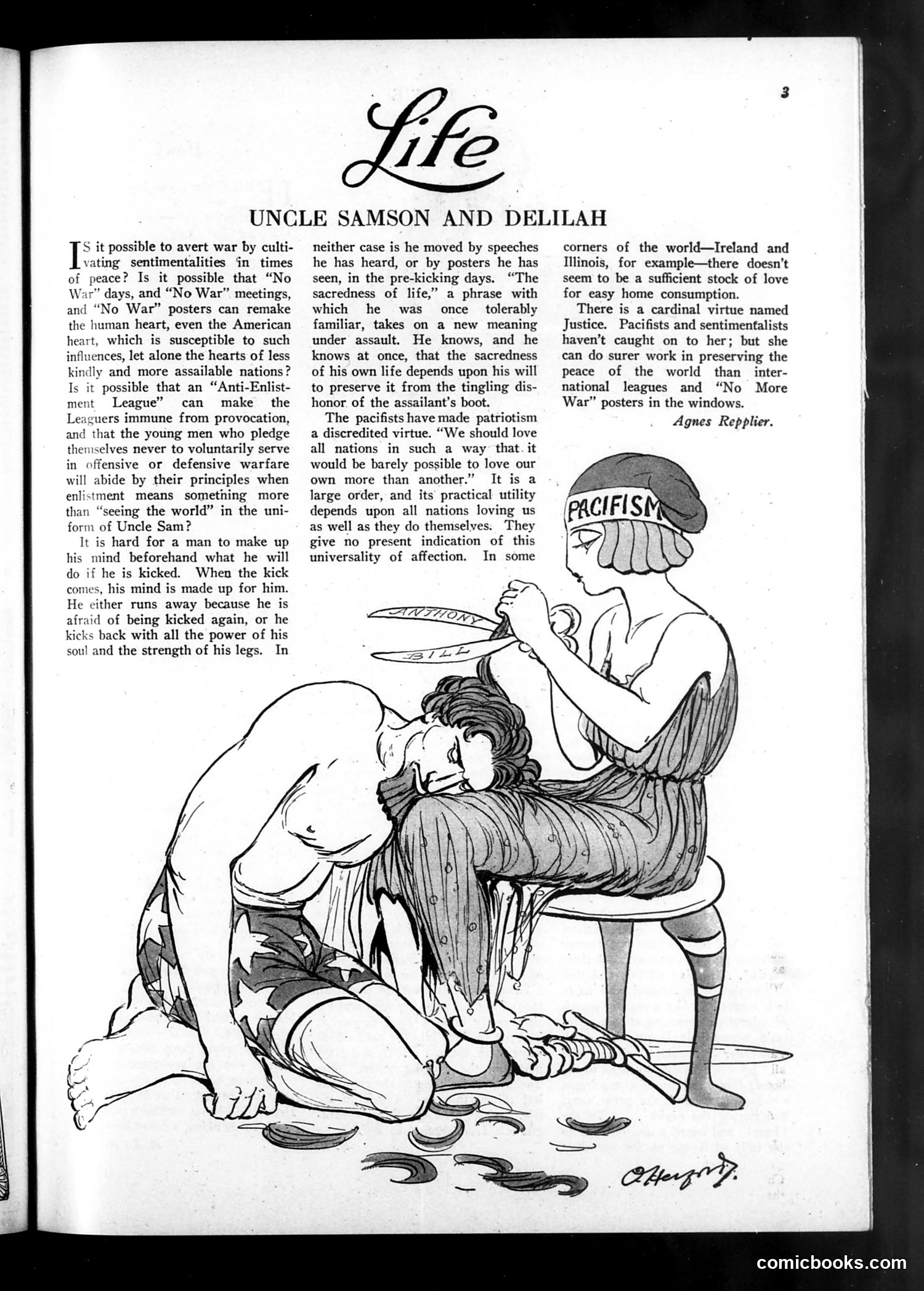
This satirical cartoon depicts **Uncle Sam** (the bearded male figure, representing America) being weakened by **Delilah** (the winged female figure labeled "Pacifism"). The biblical reference is deliberate: just as Delilah betrayed Samson by cutting his hair and sapping his strength, the cartoon warns that pacifism will weaken America's military resolve. The text above argues against "No War" messaging and pacifist sentiments, claiming such ideology makes nations vulnerable. The author (Agnes Repplier) contends that pacifism, while presented as virtue, actually serves enemy interests by undermining national defense. The cartoon satirizes peace advocates as naive or dangerous, equating their message with literal emasculation of American power—a common anti-pacifist argument during the WWI era.
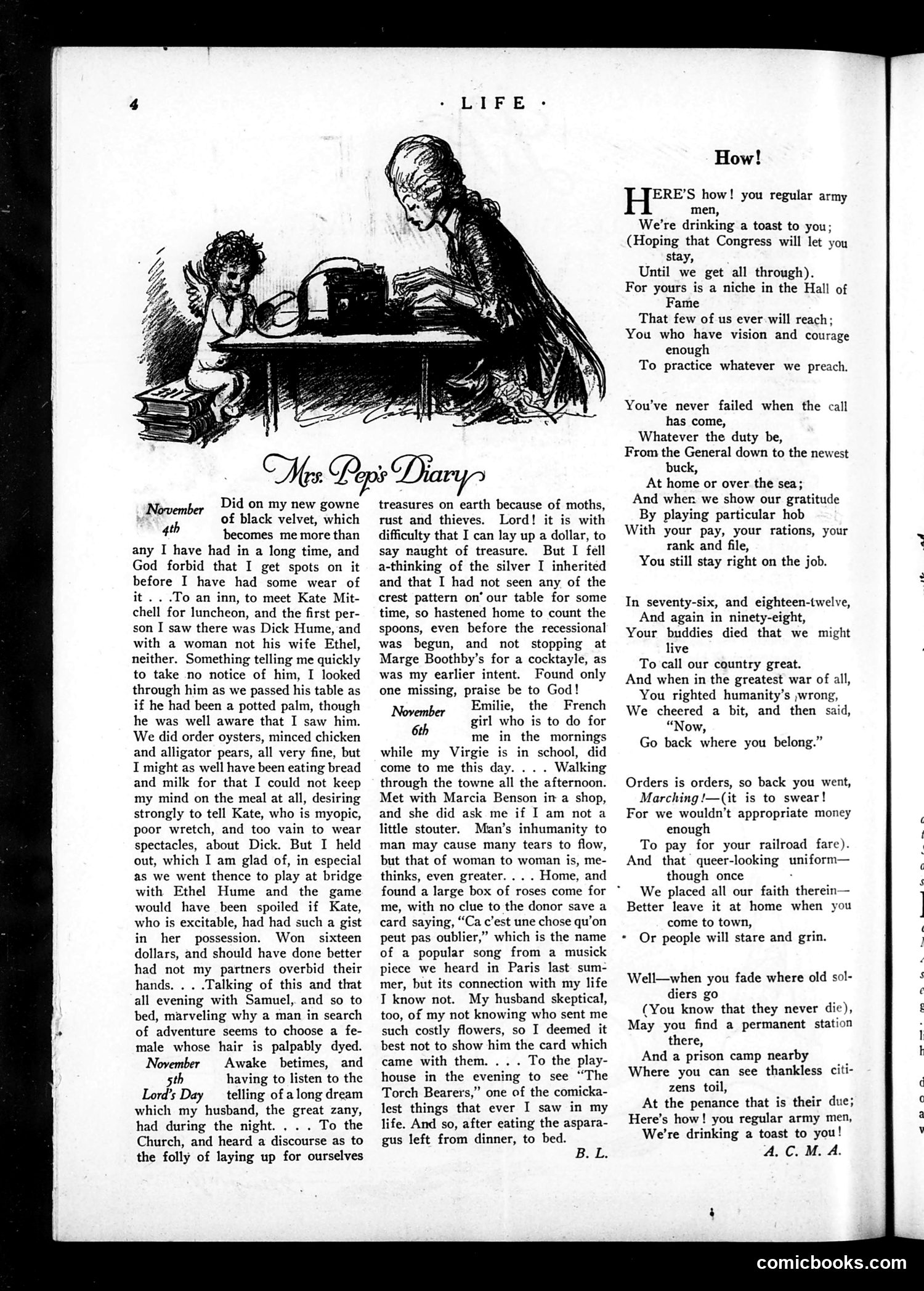
This page presents two distinct pieces from Life magazine: **"Mrs. Peps's Diary"** (left) is a humorous domestic diary entry satirizing middle-class financial anxiety. Mrs. Peps frets over a new gown's cost and inherited silver, describing petty domestic economies and social embarrassments—typical concerns of genteel but financially-constrained households. **"How!"** (right) is a patriotic poem addressing soldiers during wartime (context suggests WWI era, given references to "greatest war of all" and overseas service). It celebrates military service as honorable duty, using elevated language to honor enlisted men and officers alike, encouraging them to accept hardship patriotically. Together, these pieces reflect Life's dual focus: satirizing civilian domestic life while earnestly celebrating national sacrifice during wartime.
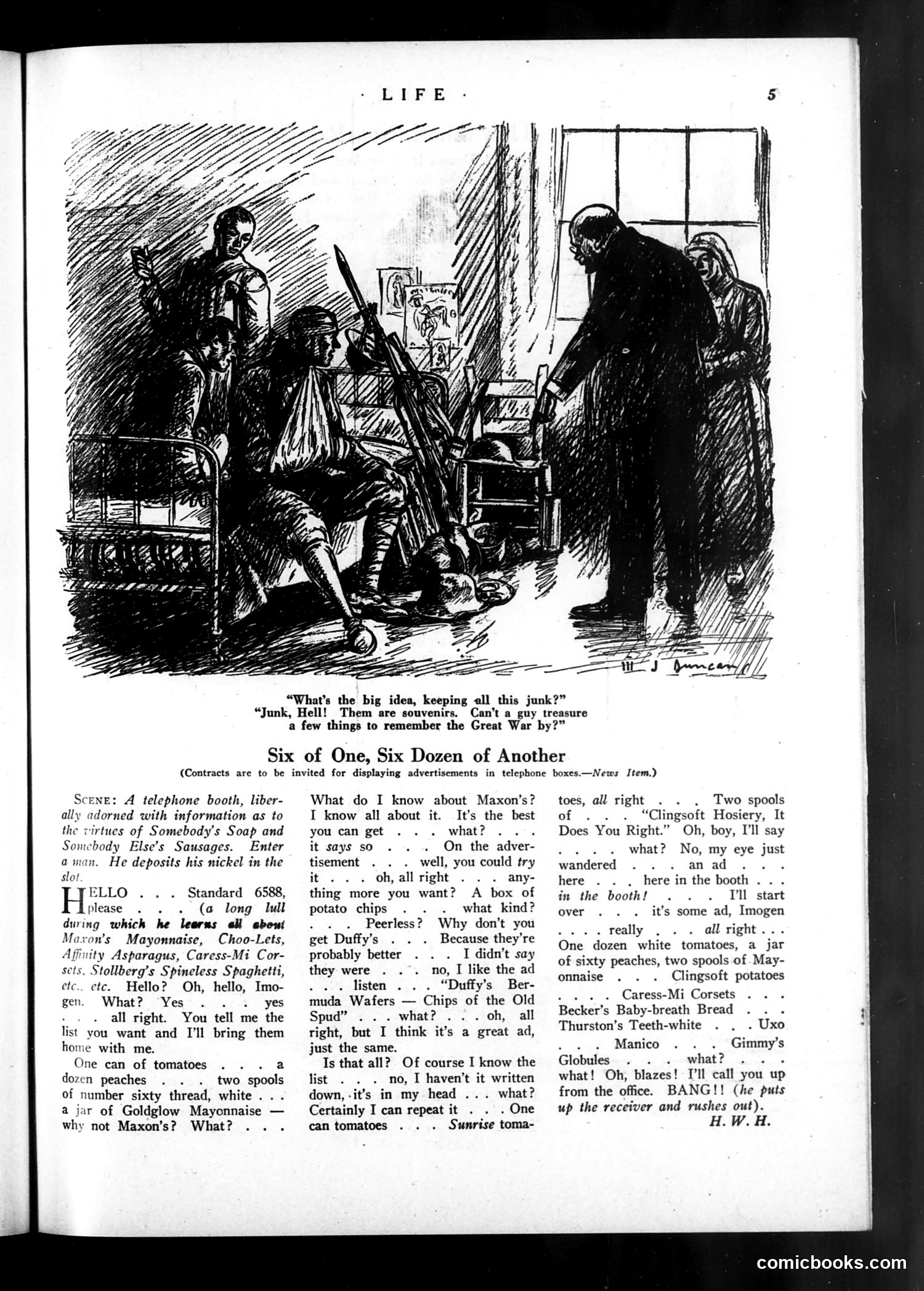
This page from *Life* magazine contains a satirical cartoon and a comedic dialogue piece titled "Six of One, Six Dozen of Another." The cartoon depicts a soldier in what appears to be a military office or barracks, with the caption: "What's the big idea, keeping all this junk? 'Junk, Hell! Them are souvenirs. Can't a guy treasure a few things to remember the Great War by?'" **Context:** This satirizes post-WWI soldiers hoarding military memorabilia and junk, claiming sentimental value from their war experience. The humor lies in the contrast between the officer's dismissal of the items as worthless and the soldier's insistence on their emotional significance. The adjacent text piece appears to be a humorous telephone conversation advertisement parody, mocking trivial product advertisements and consumer culture through exaggerated phone exchanges about various mundane goods (hosiery, bread, tomatoes, etc.).
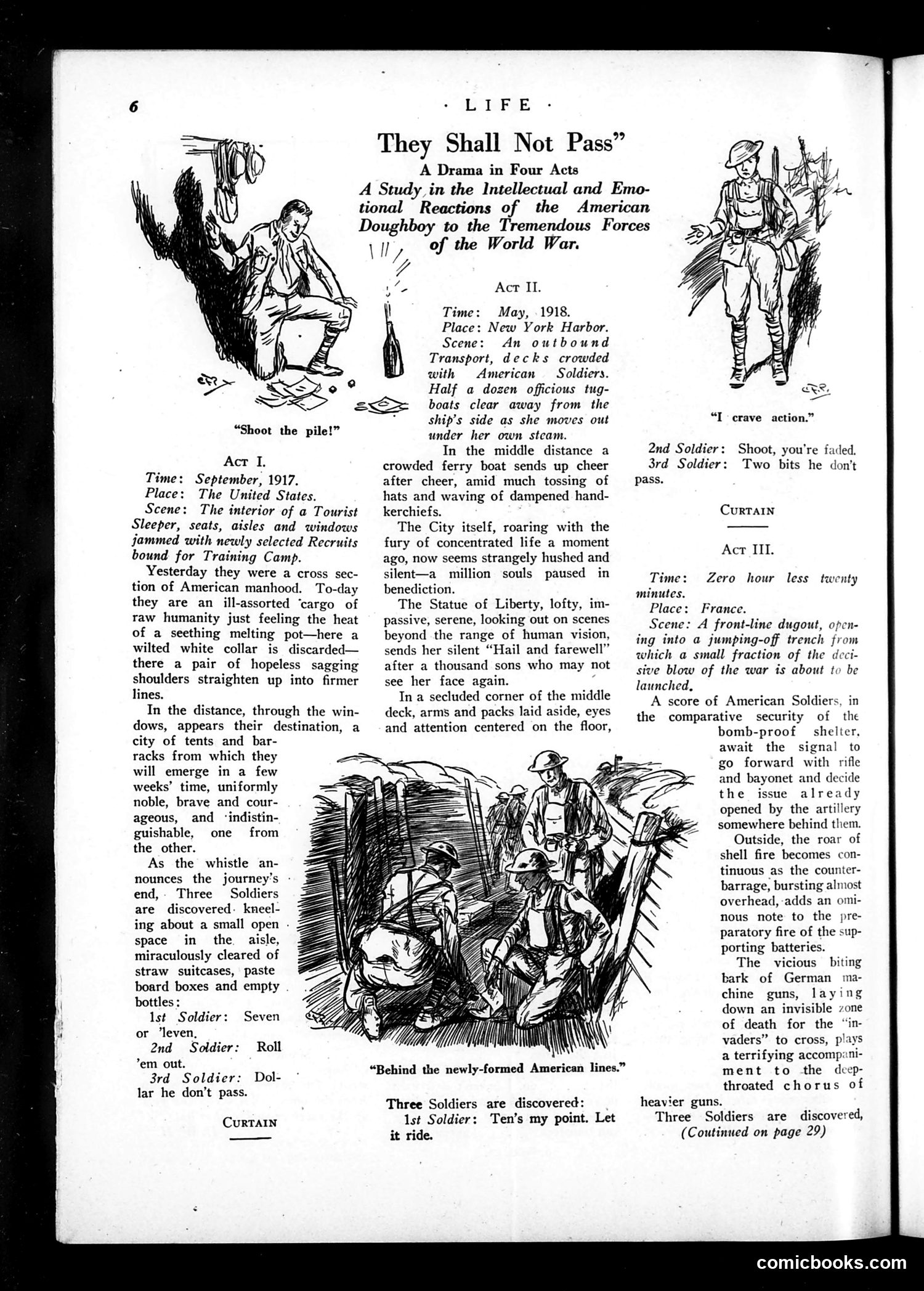
This page presents Act I-III of a four-act play about American soldiers' reactions to World War I. The drama follows recruits from September 1917 through a May 1918 departure from New York Harbor, culminating in a front-line dugout in France. The satirical illustrations depict soldiers in various states—discovering they've been assigned to camps, celebrating departure, and finally in combat. The title references the famous WWI slogan "They shall not pass," meaning Allied determination to stop German advancement. The play appears designed to show American doughboys' emotional journey from naive recruits to combat-hardened troops, likely reflecting contemporary anxieties about American involvement in the war and soldiers' capabilities. The sketches use humor to address serious themes of transformation and sacrifice.
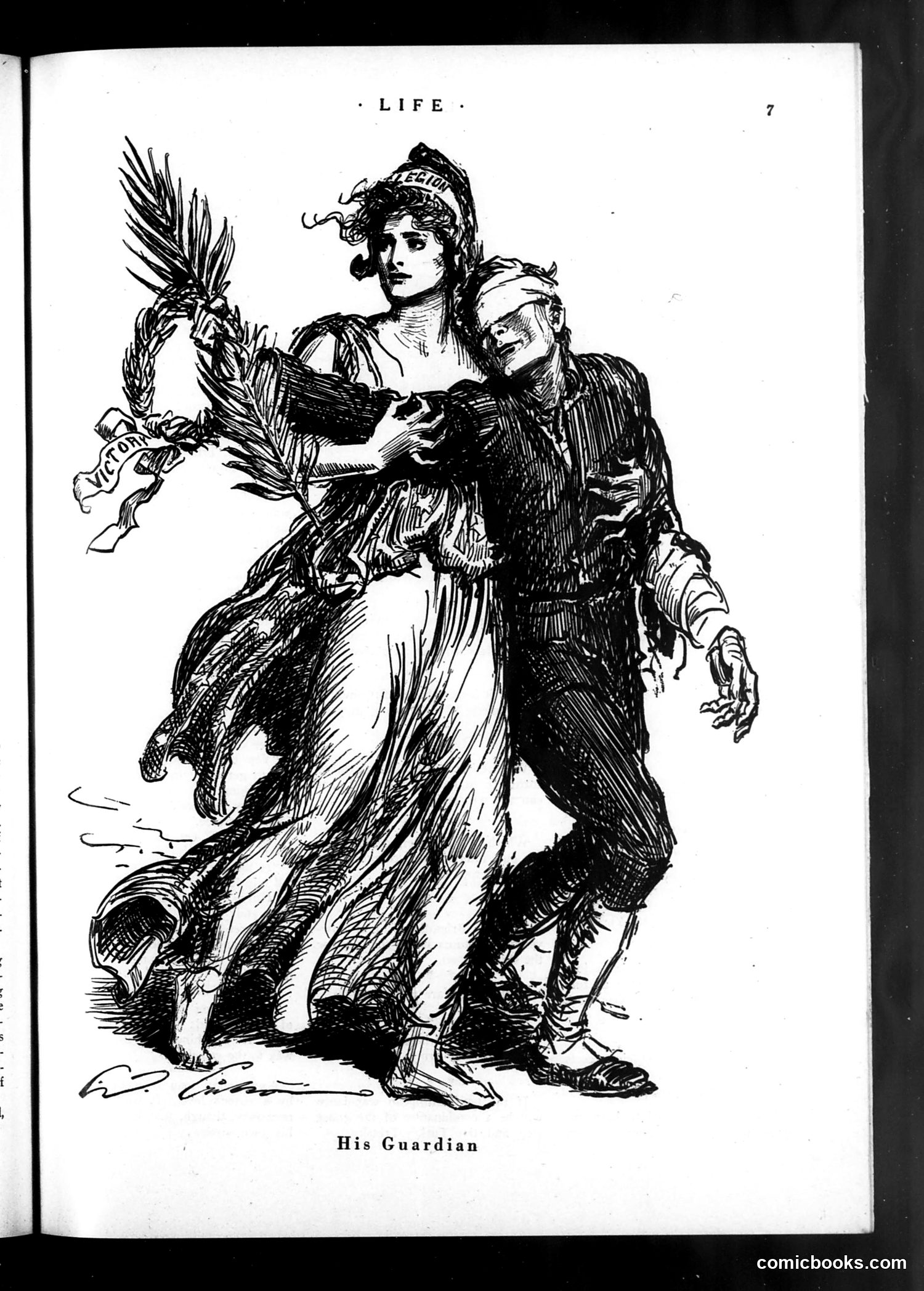
This allegorical illustration depicts a classical female figure (likely representing Liberty, Justice, or American ideals) being supported or guided by a smaller, bandaged figure on her right. The woman holds laurel branches and wears a Phrygian cap, traditional symbols of liberty and republicanism. The smaller figure appears injured or weakened, suggested by the bandaging visible on his body and head. The cartoon's title "His Guardian" creates ironic tension—typically, a guardian protects the vulnerable, but here the roles seem reversed or compromised. The image likely critiques how American institutions or leadership were inadequately protecting or supporting foundational democratic values during the period this *Life* magazine was published, though the specific historical context remains unclear without dating information.
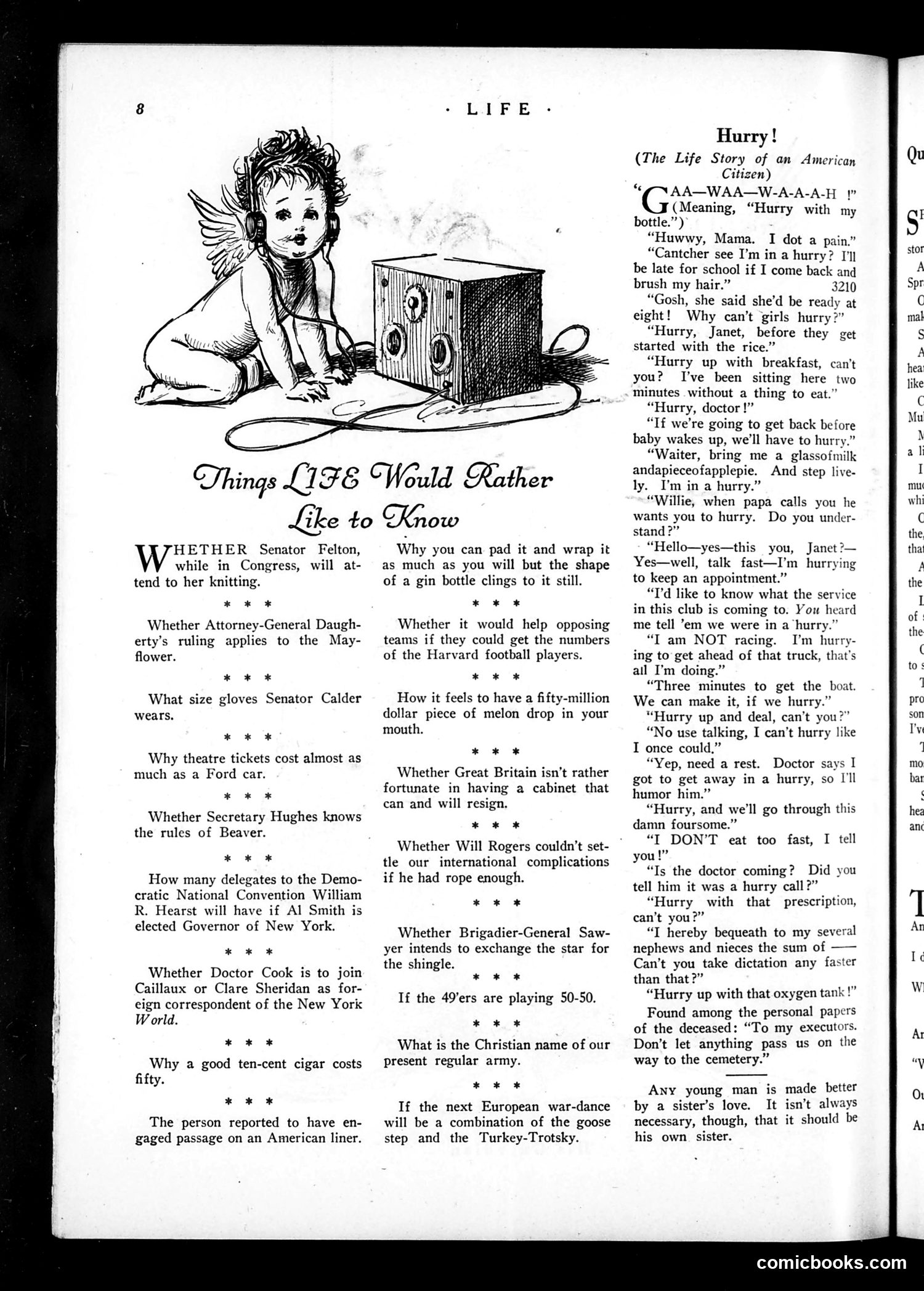
This page features satirical commentary on contemporary issues. The left column lists absurd questions reflecting 1920s political and social concerns: whether Attorney-General Daugherty's rulings apply to the Mayflower, Senator Calder's glove size, theater ticket costs, Secretary Hughes' knowledge of Beaver rules, William Randolph Hearst's gubernatorial ambitions, and Doctor Cook's journalism prospects. The right section, titled "Hurry! (The Life Story of an American Citizen)," is a humorous monologue about American obsession with rushing—a satire on frenetic modern life. A cherub illustration accompanies the text, emphasizing the absurdist tone. Together, these represent Life magazine's characteristic satirical approach: mocking both political figures and widespread cultural behaviors through pointed, witty commentary.
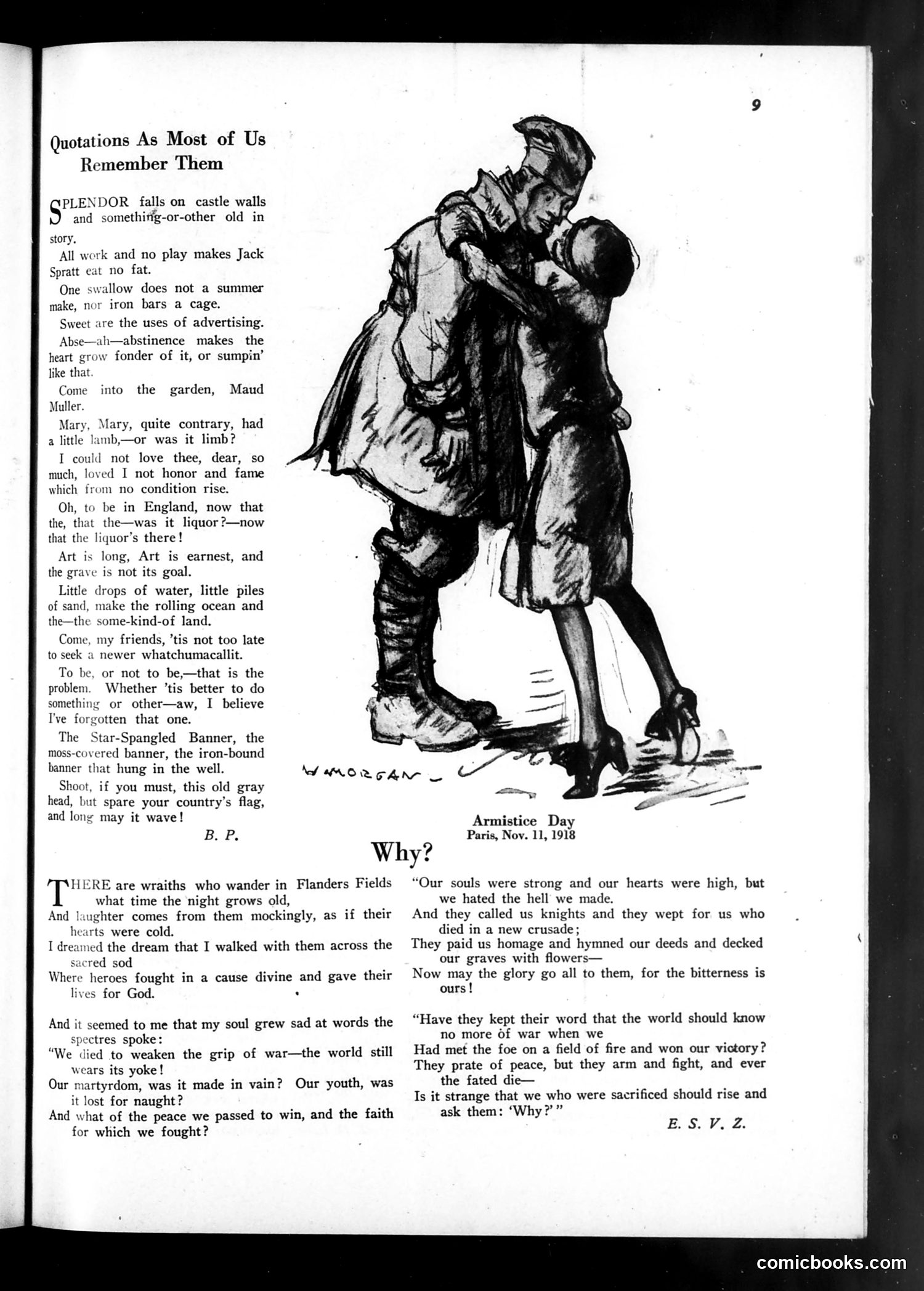
This page commemorates Armistice Day (November 11, 1918), marking the end of World War I. The central illustration depicts a soldier embracing a woman, likely representing the joy and relief of soldiers returning home after the war's conclusion. The poems above and below address the war's human cost and disillusionment. The upper section contains various quotations about life's uncertainties. The lower poem, titled "Why?", expresses the bitterness of fallen soldiers and questions whether the peace achieved justified their sacrifice. It sarcastically references broken promises of peace while leaders continue to "arm and fight." The page reflects post-war ambivalence—celebrating the armistice while mourning losses and questioning whether the victory was worth the cost.
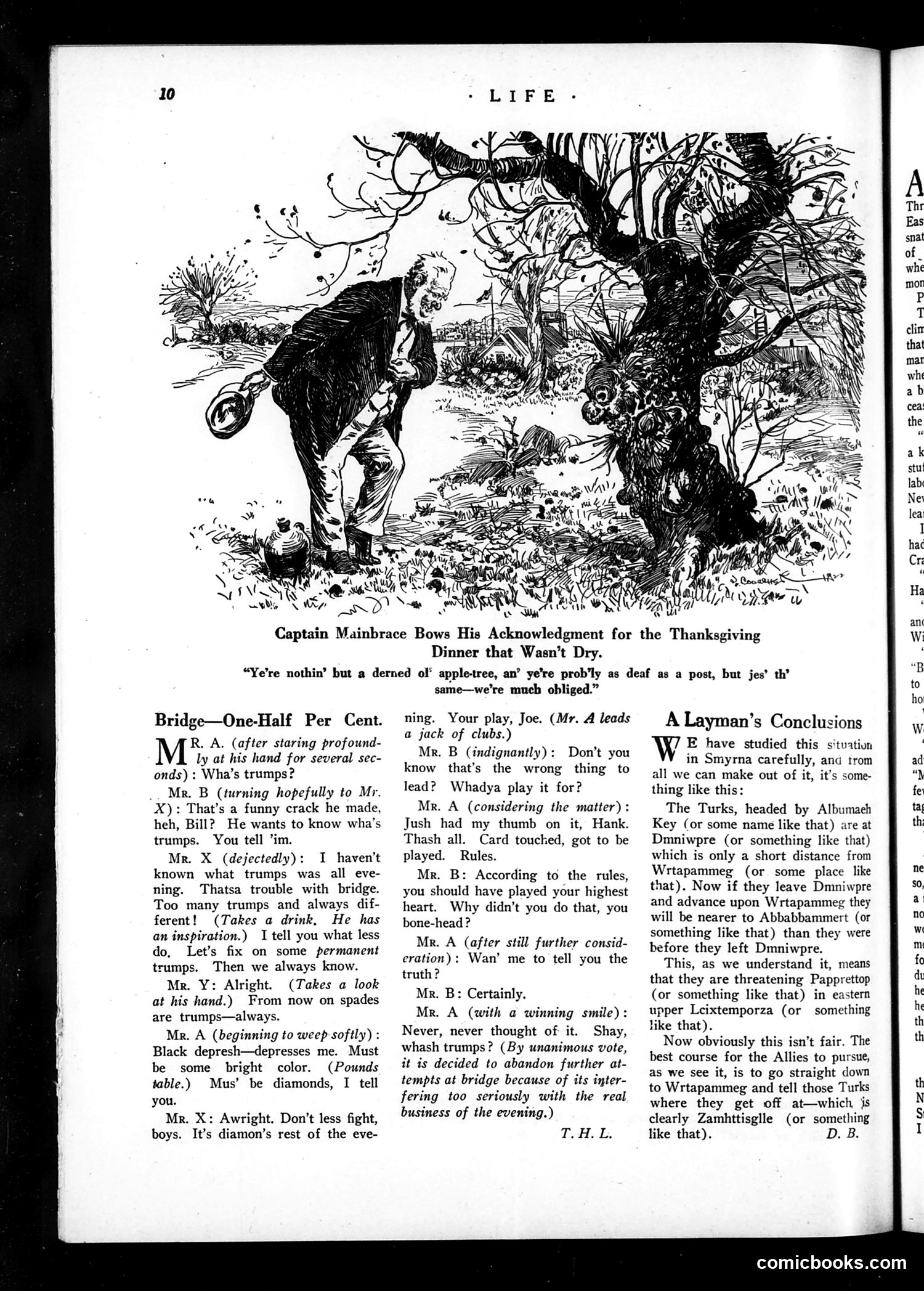
**Main Cartoon:** The illustration shows a man in formal dress bowing to a gnarled tree, with the caption "Captain Mainbrace Bows His Acknowledgment for the Thanksgiving Dinner that Wasn't Dry." The quote beneath suggests the man is sarcastically thanking the tree (representing apple cider or alcohol) for making the meal palatable—implying the food itself was poor quality. **Context:** This appears to be Prohibition-era humor. "Captain Mainbrace" is a traditional sailor's toast. The satire mocks either poor Thanksgiving meals or the challenges of dining during alcohol restrictions, with the implication that liquor was needed to make the experience tolerable. **Secondary Content:** "Bridge—One-Half Per Cent" is a humorous dialogue about card-playing rules, appearing unrelated to the main cartoon.
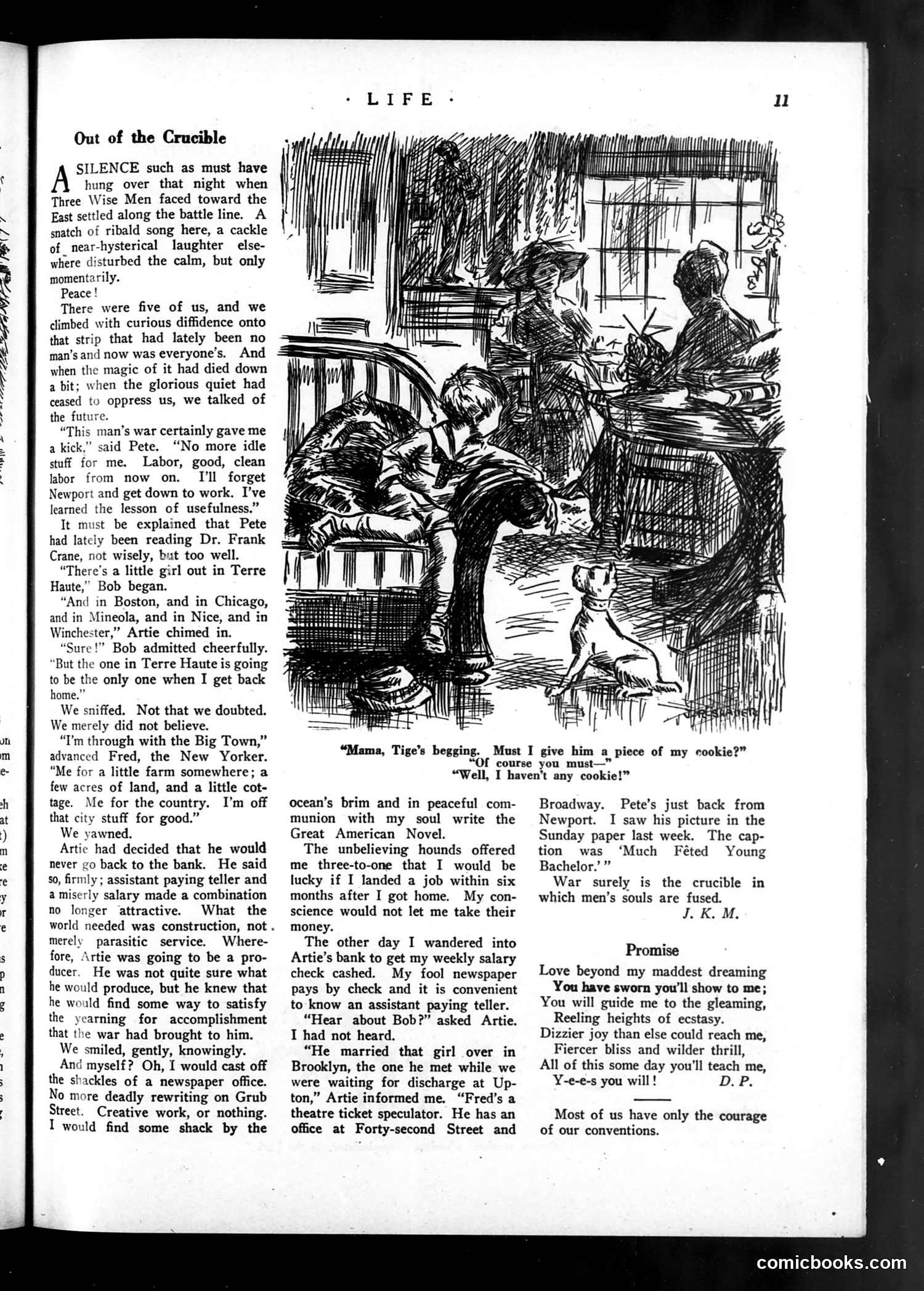
This page contains a short story titled "Out of the Crucible" alongside an illustration showing a domestic scene with a mother, child, and dog. The narrative discusses five young men who climbed onto a New York City rooftop after WWI, reflecting on how the war's hardships changed their perspectives on ambition and labor. The story references Dr. Frank Crane (a real contemporary advice columnist) and mentions specific locations: Boston, Chicago, Mineola, Nice, and Winchester. One character named Pete has returned from Newport, appearing in the Sunday paper as a "Much Fêted Young Bachelor." The illustration depicts a humble home scene, contrasting with the text's themes of post-war disillusionment and working-class aspiration. The page concludes with a poem titled "Promise." This appears to be serious literary content rather than satire.
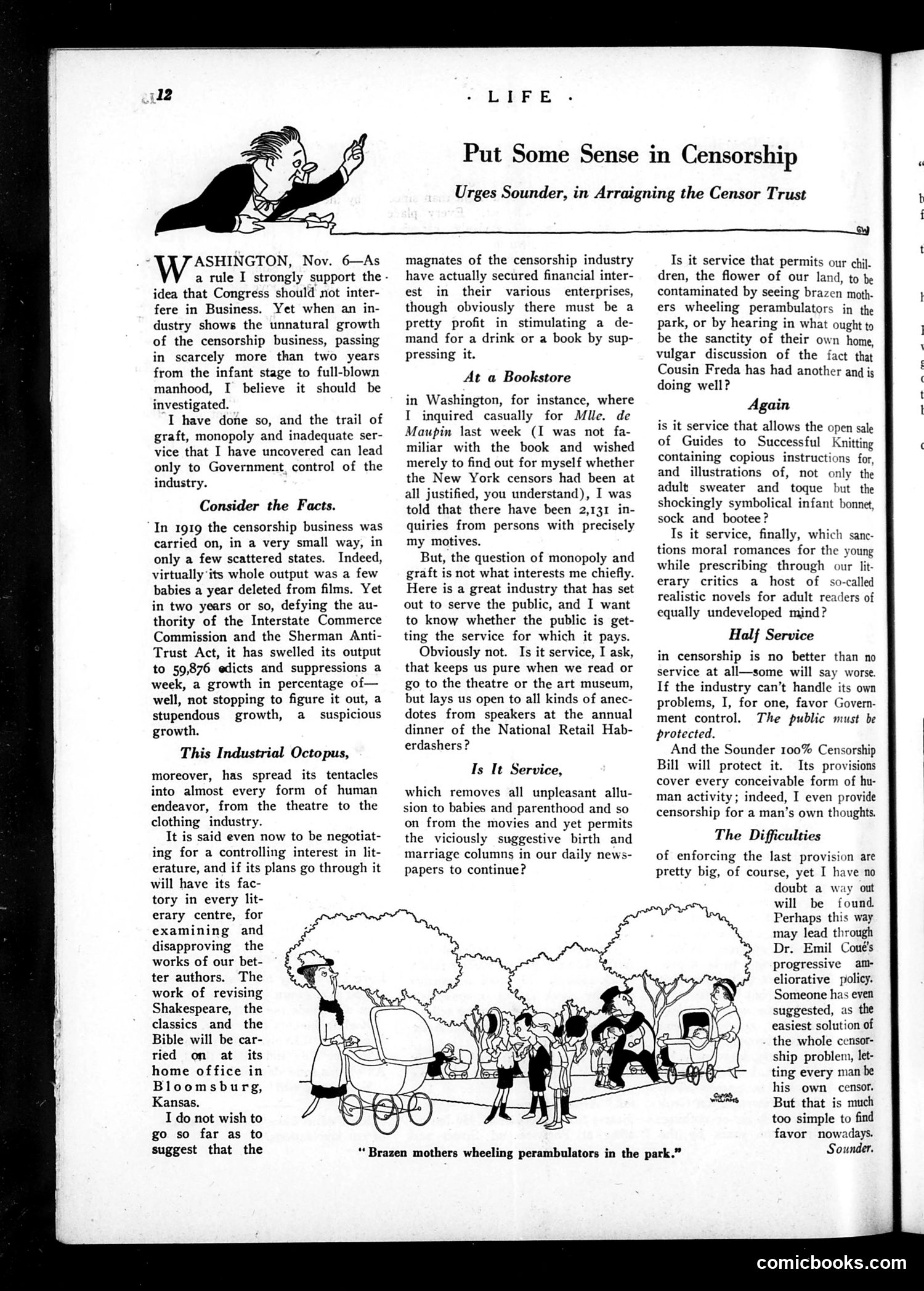
This article by someone named Sounder criticizes the censorship industry's rapid, uncontrolled growth. The author supports Congressional investigation while arguing censorship has expanded from few scattered states to affecting nearly all industries—theater, literature, clothing. The cartoon captioned "Brazen mothers wheeling perambulators in the park" satirizes absurd censorship by showing ordinary mothers with babies being deemed scandalous content requiring removal. This illustrates the author's point: censorship has become ridiculous, extending to innocent public activities. Sounder advocates "Government control" of censorship itself as paradoxically preferable to unregulated private censorship boards. The irony is stark—he proposes government oversight to prevent worse private monopolistic control, suggesting the censorship industry had become an unaccountable trust requiring intervention.
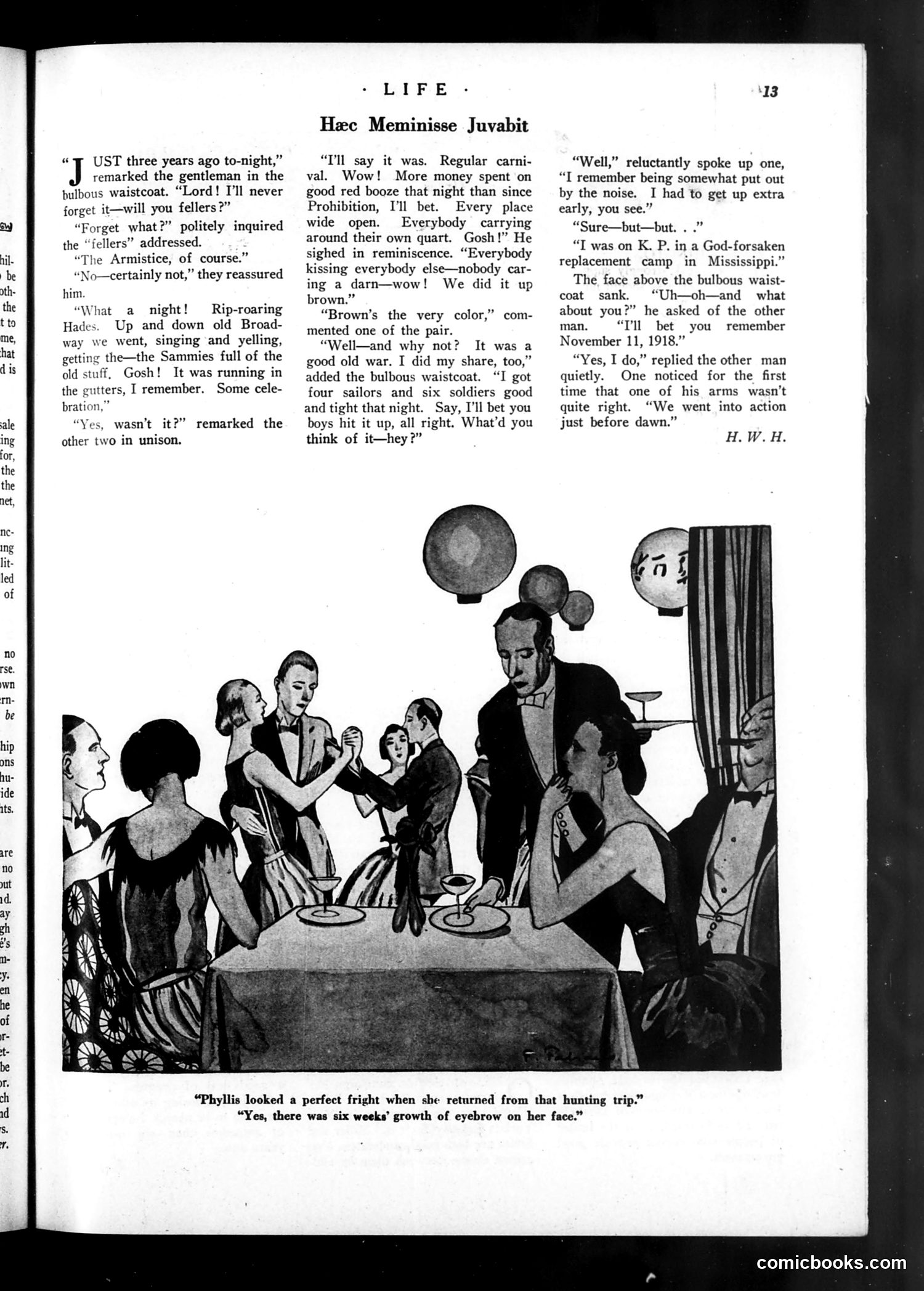
This page satirizes post-Prohibition revelry. The story describes a gentleman recounting a three-year-old carnival celebration during Prohibition's enforcement, featuring open speakeasies, illegal alcohol consumption, and soldiers partaking in festivities. The illustration depicts a 1920s party scene with well-dressed guests around a table with cocktails. The Latin title translates to "It will be pleasant to remember these things"—ironic given the illegal nature of the depicted activity. The satire targets Prohibition-era hypocrisy: despite the law's intent, speakeasies operated openly with military and civilian participation. The nostalgic framing mocks how Americans would fondly remember lawbreaking once Prohibition ended. The date reference (November 11, 1918) marks Armistice Day, emphasizing soldiers' role in underground drinking culture.
This November 9, 1922 *Life* page discusses British Prime Minister Lloyd George's political struggles following World War I. The text critiques George's inconsistent foreign policy, particularly regarding Turkey and Greece, suggesting he backed the wrong side in their conflict. The article argues George lacks a "definite following" among allied nations and questions his effectiveness as a leader. It also comments on the American election campaign, dismissing both Miller and Smith as candidates while noting that voters cannot meaningfully distinguish between them. The decorative header illustration appears to show classical or allegorical imagery relating to hope and civilization, though specific figures remain unclear.
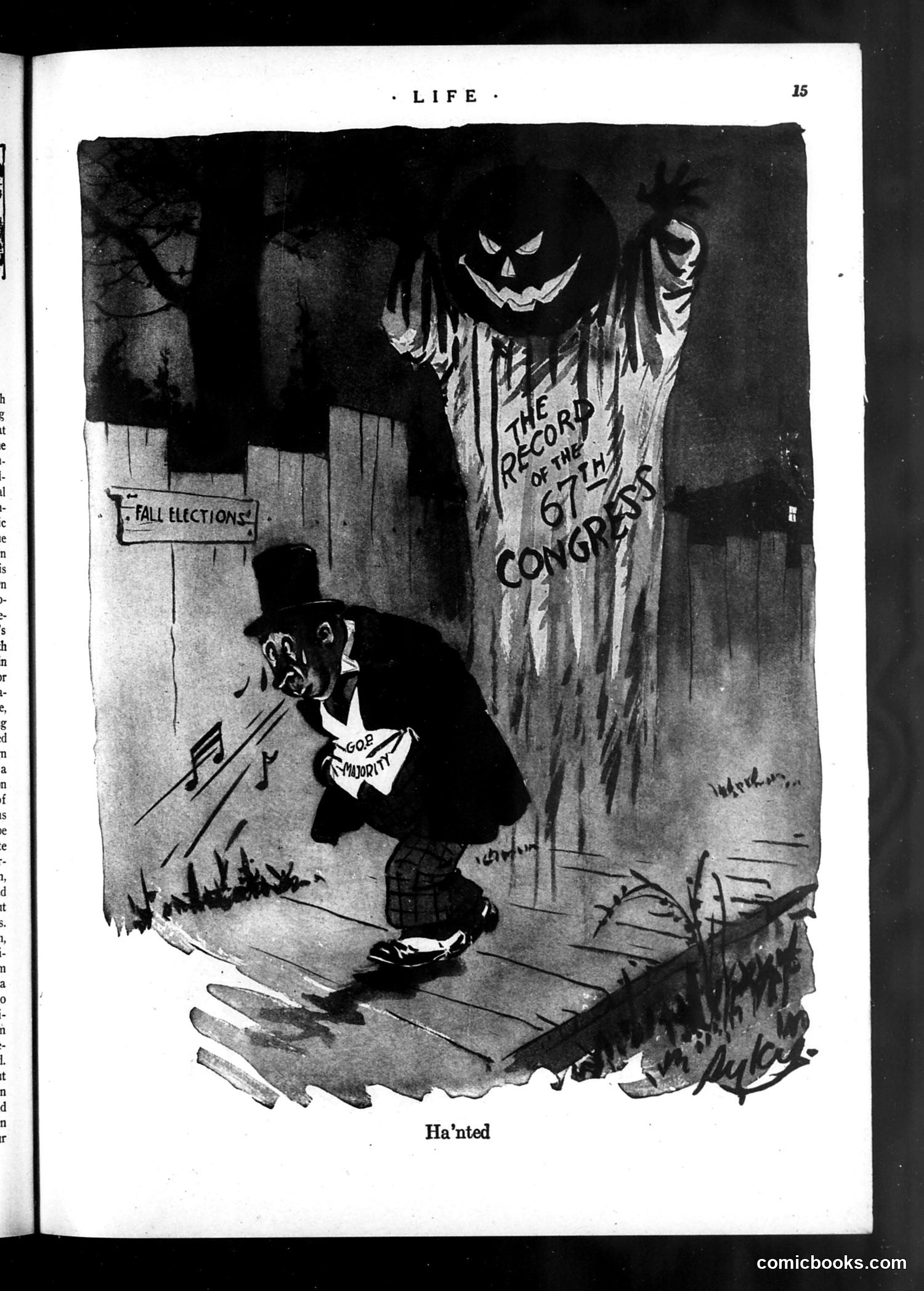
This cartoon from *Life* magazine satirizes the 1918 midterm elections through a Halloween-themed image. A frightened figure labeled "GOP" (Republican Party) cowers before a ghostly specter labeled "The Record of the 61st Congress" while a sign marks "Fall Elections." The satire suggests Republicans feared voter backlash over the legislative record of the 61st Congress. The ghost imagery implies this record would "haunt" them during the election campaign. The cartoonist uses the specter as a visual metaphor for past political failures or unpopular policies that would materialize as electoral consequences. The joking title "Ha'nted" plays on both "haunted" and the abbreviated "Ha" sound of Halloween mockery, emphasizing the Republicans' anxiety about their political legacy.
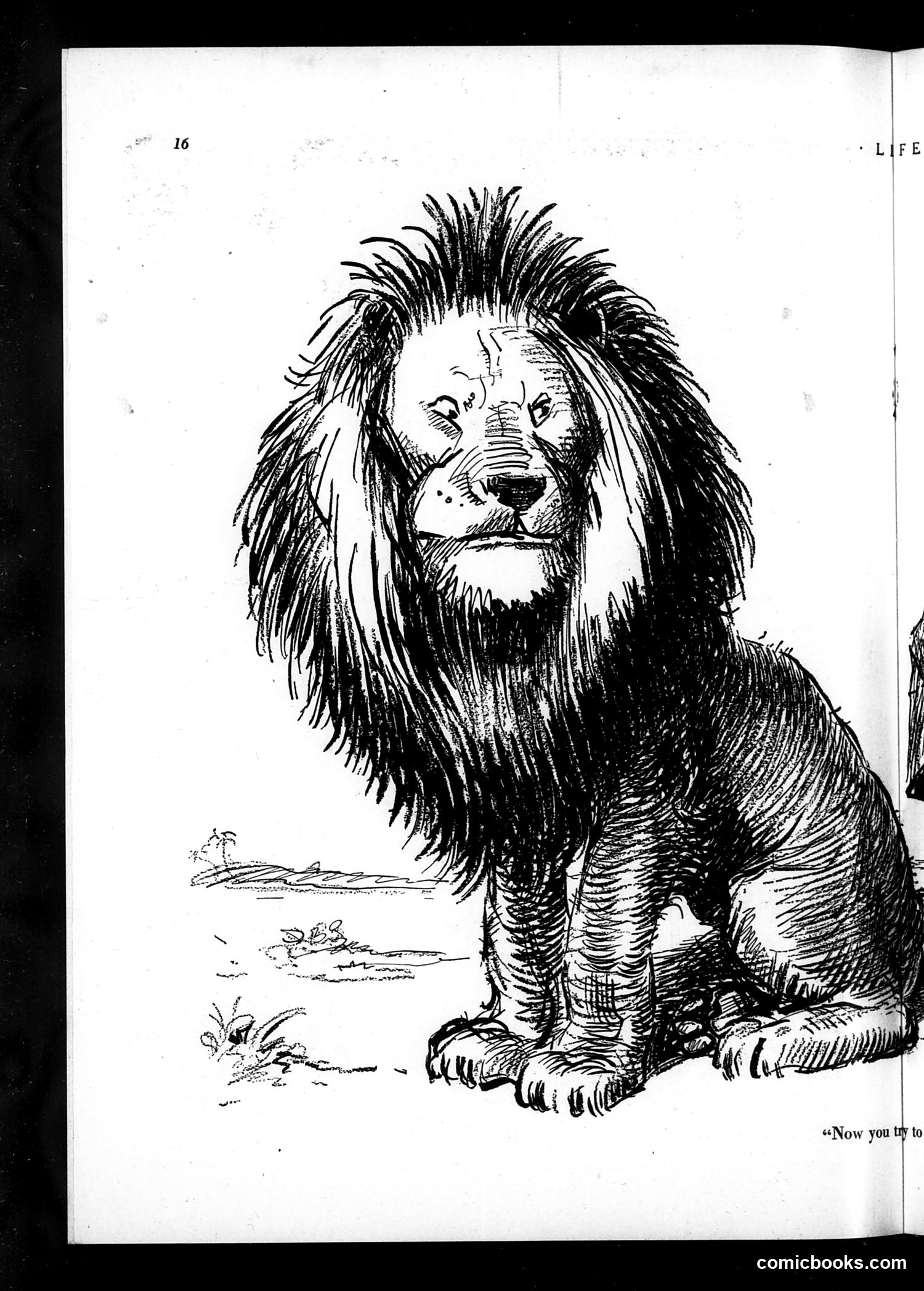
This page from *Life* magazine shows a detailed ink drawing of a lion sitting upright in an anthropomorphic pose. The lion has a full mane and beard, muscular body, and prominent claws. Small creatures (appearing to be insects or small animals) are visible in the lower left. The incomplete caption reads "Now you try to," suggesting this is part of a larger cartoon or instructional piece. Without the complete text or additional context, the specific satirical meaning is unclear. The image could be a humorous take on animal behavior, strength/power symbolism, or potentially a caricature using leonine features—though the target of any satire cannot be determined from the visible portion alone. The artistic style is consistent with early-to-mid 20th century magazine illustration.
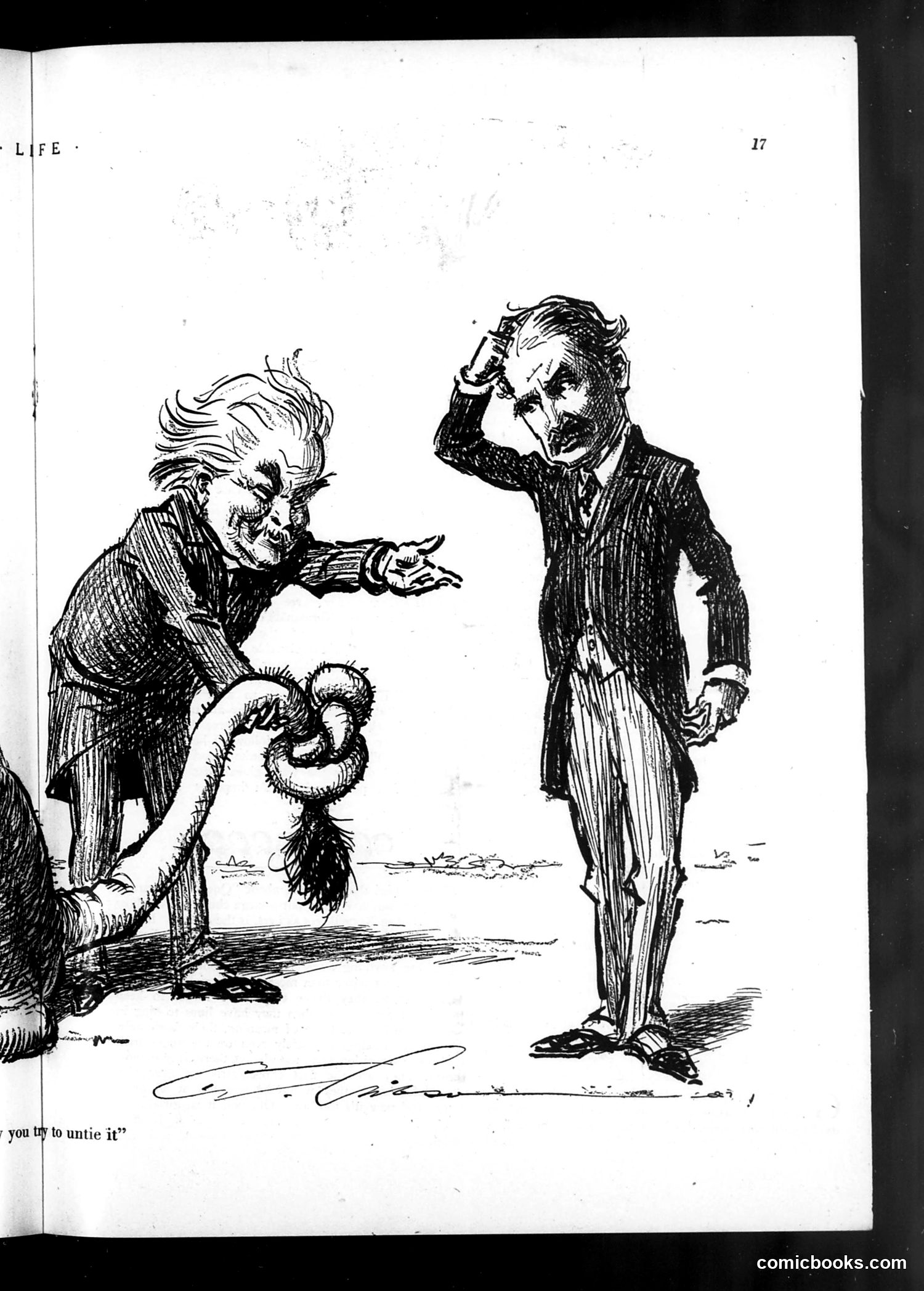
This appears to be a satirical cartoon from Life magazine depicting two well-dressed gentlemen in formal Victorian-era attire engaged in what seems to be a heated debate or confrontation. The figure on the left is gesturing dramatically while holding what appears to be a knotted rope or knot, while the figure on the right clutches his head in apparent distress or frustration. The partial caption visible ("you try to untie it") suggests the cartoon satirizes a complex, intractable political or social problem—likely one where two opposing figures or parties are deadlocked, unable to resolve a tangled situation. However, without complete context, caption, and publication date, I cannot definitively identify the specific figures or the exact historical event being referenced.
This LIFE magazine drama section reviews three theatrical productions: **"The Fool"**: A play adapting a novel about a young minister-philanthropist who behaves as Christ would in modern situations. The critic praises the concept but mocks the overwrought execution—comparing it to a "Passion Play adapted for stock in Woonsocket, R.I." The satire targets melodramatic excess: false whiskers, grease-paint, and cornball dialogue ("I...wonder"). The reviewer notes audiences find the hero's Christ-like behavior uncomfortably eccentric, suggesting modern American "red-blooded" men find such virtue ridiculous. **"To Love"**: Grace George's translation of a French play about infidelity. The critic notes it's verbose—the lover delivers a four-minute argument *for* adultery rather than simple declarations of love. The three-character cast talks excessively. **"Queen o' Hearts"**: Praised for its chorus line and spectacle, though the young chorus girls are noted more for appearance than talent. Throughout, the page satirizes theatrical pretension and overwrought sentimentality popular in early 20th-century drama.
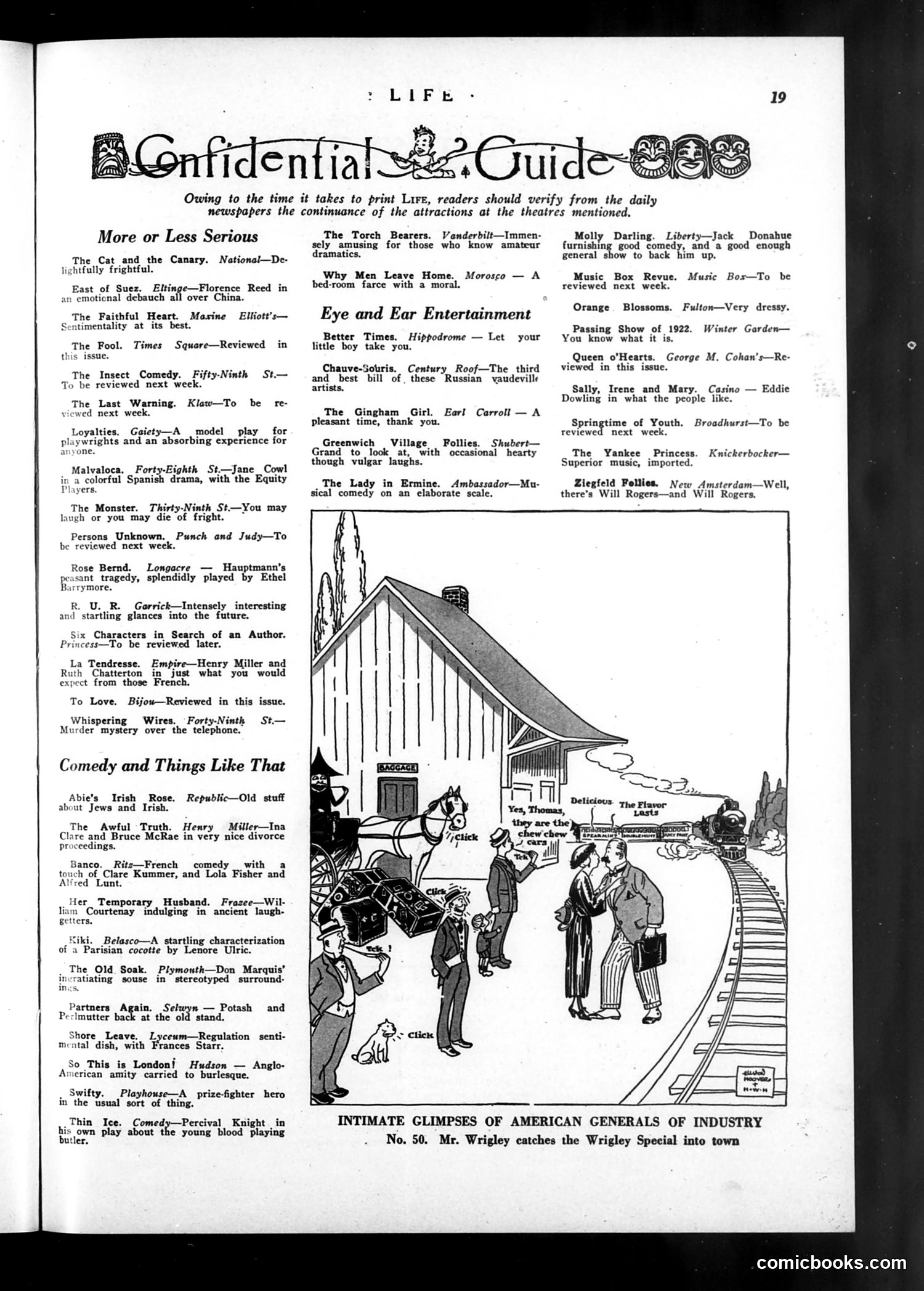
This page comprises theatre reviews and a single cartoon satirizing American industrial magnates. **The Reviews**: The left columns list Broadway shows with brief, often sarcastic critiques—typical of Life's theatre section from the early 1920s. Titles range from serious drama (*R.U.R.*, *Rose Bernd*) to comedies and musicals (*Abie's Irish Rose*, *Ziegfeld Follies*). **The Cartoon**: Titled "Intimate Glimpses of American Generals of Industry," it depicts Mr. Wrigley (the chewing gum magnate) boarding a train labeled the "Wrigley Special." The satire mocks industrial titans' self-aggrandizing behavior—Wrigley apparently owns a private train bearing his name. The cartoon ridicules the ego and extravagance of wealthy businessmen who name everything after themselves, presenting this as absurdly comical rather than impressive.
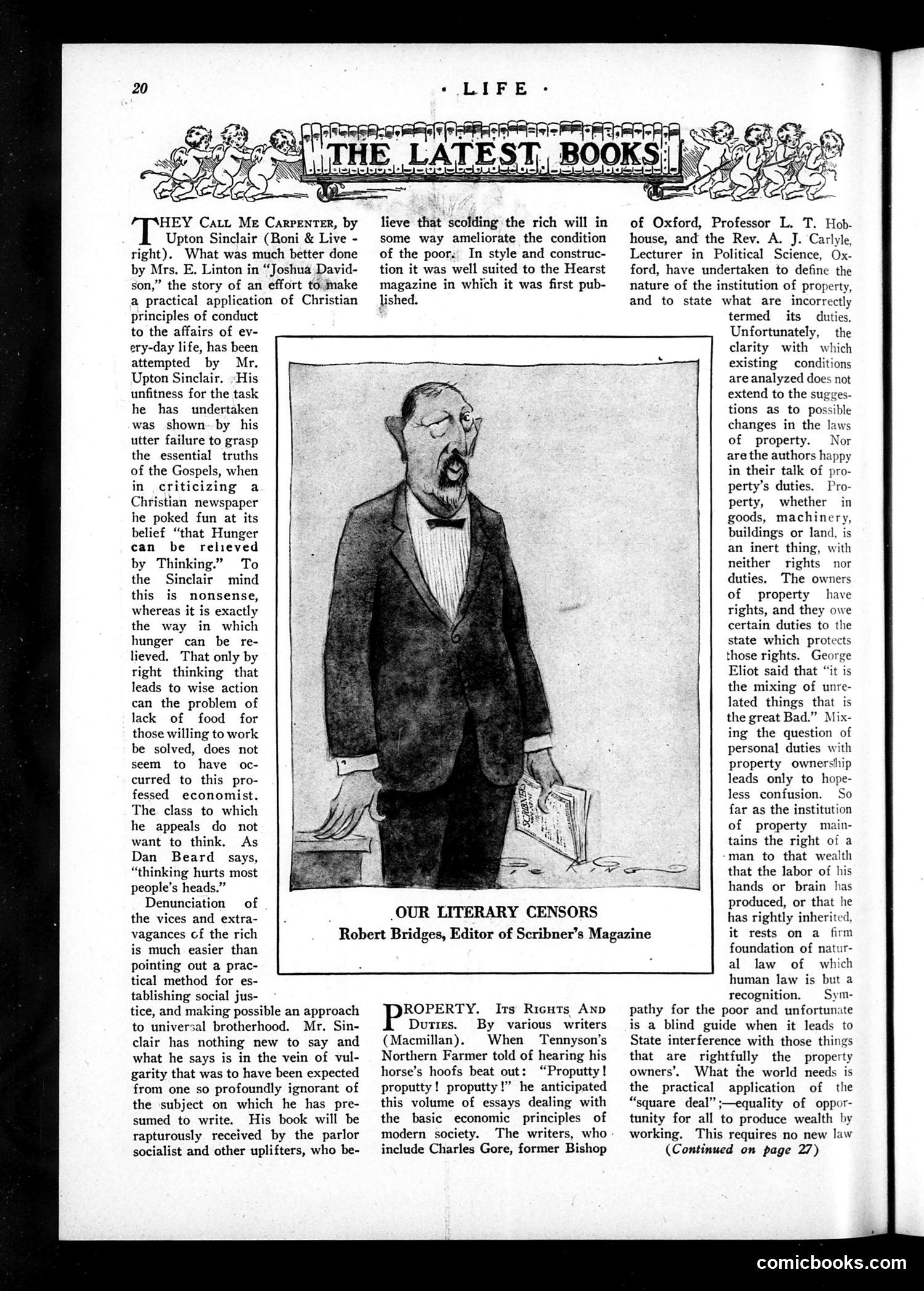
This page from *Life* magazine features a caricatured portrait labeled "Robert Bridges, Editor of Scribner's Magazine" under the heading "OUR LITERARY CENSORS." The cartoon depicts Bridges as a stern-faced censor figure, suggesting the satirical point that magazine editors function as gatekeepers controlling public discourse. The page reviews two books. The text harshly critiques Upton Sinclair's *They Call Me Carpenter*, dismissing the socialist author as ignorant and vulgar, claiming his work lacks practical solutions—merely "scolding the rich" rather than addressing poverty constructively. A separate review of *Property: Its Rights and Duties* (essays by various Oxford scholars) praises their analysis but criticizes their conflation of personal duties with property ownership, advocating instead for equal opportunity and natural law principles. The satire suggests how literary editors wielded considerable power to shape public opinion and dismiss certain ideological viewpoints.
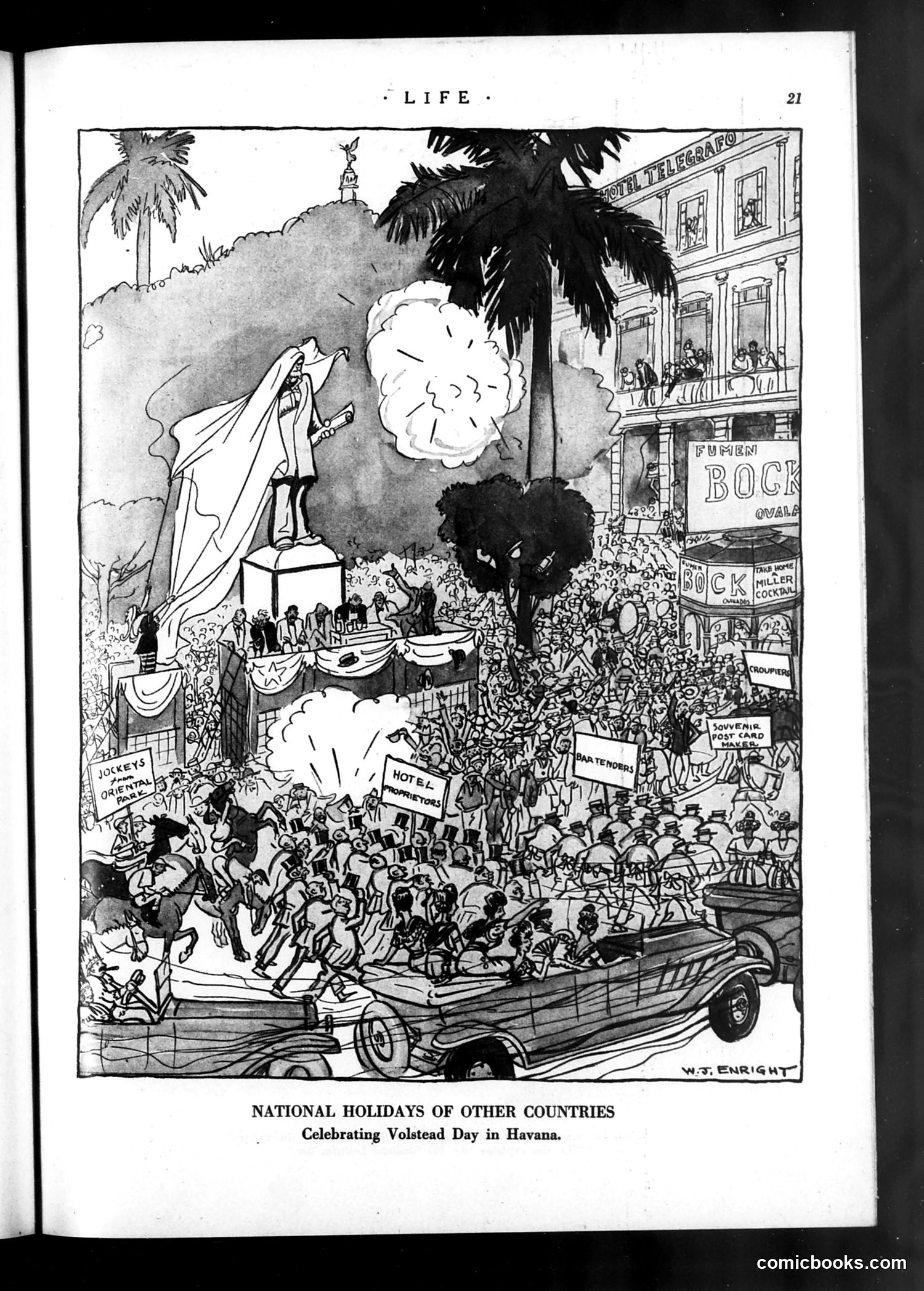
This satirical cartoon depicts a chaotic street celebration in Havana, Cuba, labeled "Volstead Day." The Volstead Act (1920-1933) enforced Prohibition in the United States, making alcohol illegal. The joke appears to be that while Americans couldn't legally drink at home, Cuba—just offshore—became a haven for alcohol consumption and tourism. The cartoon shows a massive, boisterous crowd in a tropical setting with palm trees, a grand building, and commercial establishments (visible "ROCK" signs suggest bars/clubs). The anarchic celebration satirizes how Cubans could openly drink while Americans faced Prohibition. The title mockingly suggests celebrating American law by violating it abroad—capturing contemporary frustration with Prohibition and the ironic appeal of Cuban destinations to American drinkers seeking legal access to alcohol during this period.
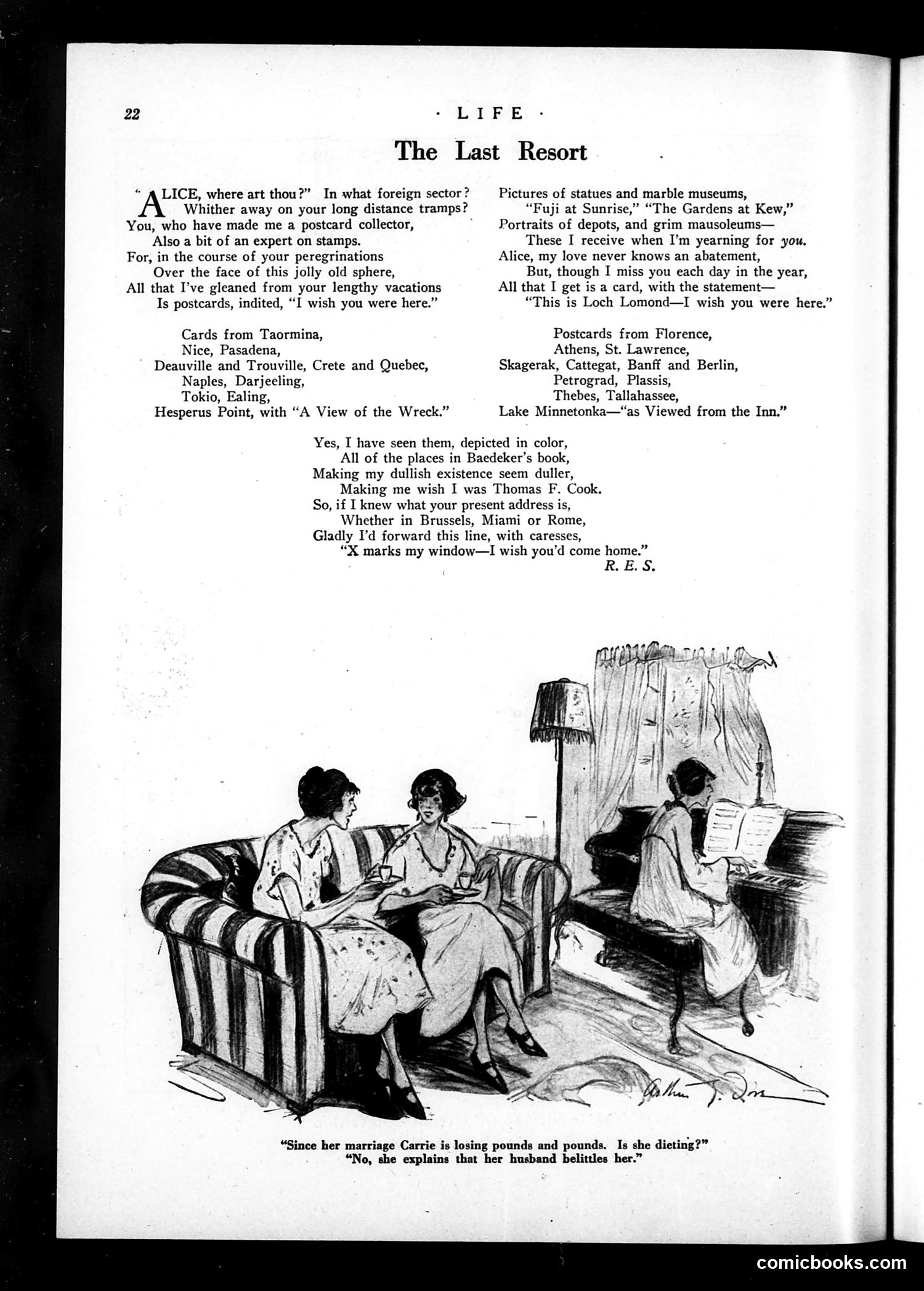
This page contains two distinct pieces of social satire: **The Poem (upper section):** A romantic complaint where a man laments his absent girlfriend Alice, who travels constantly and sends only postcards from exotic locations worldwide (Florence, Berlin, Tokyo, etc.). He's become an unwilling "postcard collector" and expert on stamps, reduced to receiving only generic messages saying "I wish you were here." The satire mocks both the tedium of receiving tourist postcards and the dismissiveness of someone too busy traveling to write genuine letters. The reference to "Thomas F. Cook" (likely Thomas Cook, the famous travel company founder) reinforces the theme—he wishes he could travel rather than stay home waiting. **The Cartoon (lower section):** A domestic scene where two women discuss a third, Carrie, who is losing weight. One assumes she's dieting; the other reveals her husband "belittles her"—a dark joke suggesting emotional abuse is causing her weight loss, not deliberate dieting. Both pieces satirize relationship dissatisfaction in early 20th-century courtship and marriage conventions.
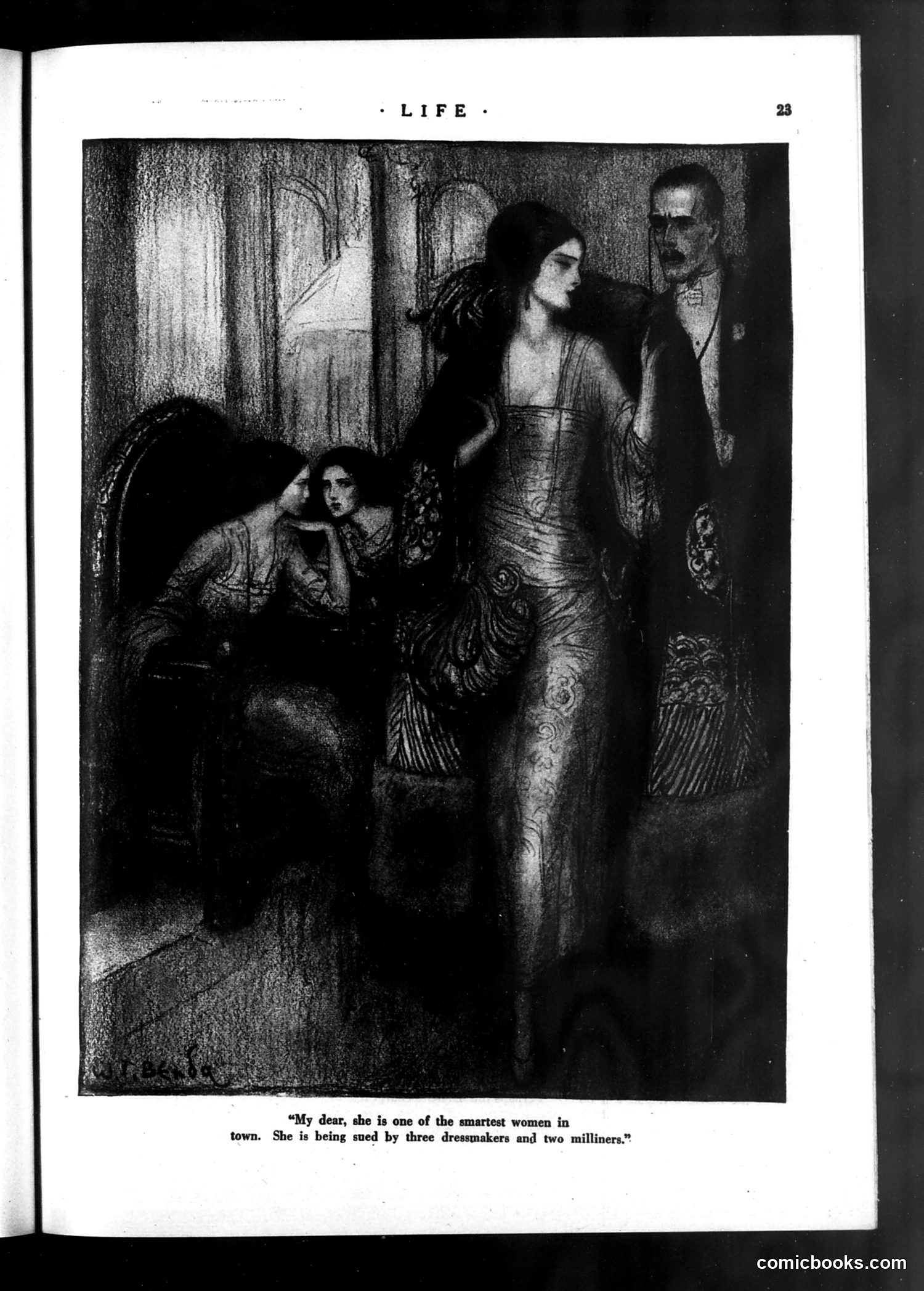
This satirical illustration mocks the vanity and financial irresponsibility of wealthy women. The caption presents a paradox: a woman is praised as "one of the smartest women in town," yet the proof of her intelligence is that she owes money to multiple tradespeople—three dressmakers and two milliners (hat makers). The joke critiques the social pretension of the era: being "smart" or fashionable required constantly purchasing expensive clothing and accessories, often on credit. The cartoon satirizes both the women who accumulate such debts and the society that equates fashion consumption with intelligence or status. The dramatic, shadowed illustration style emphasizes the potentially scandalous nature of unpaid bills among the social elite.
This page contains film criticism from Life magazine's silent film review column. The critic discusses four movies: **"Trifling Women"** (Rex Ingram): Praised as excellent but commercially doomed because it lacks the lowbrow appeal needed for box-office success. The critic notes it's the type of film Will H. Hays (head of Hollywood's moral censorship board) wants to eliminate—suggesting it contains morally questionable content. **"Rags to Riches"**: Presented as the moral alternative, endorsed by Hays's censorship committee. **"Clarence"** and **"Lorna Doone"**: Standard reviews of adaptations, praising directorial skill and performances. The underlying satire: Life mocks the tension between artistic quality and moral censorship. The reviewer celebrates sophisticated filmmaking while noting the Hays Committee suppresses such work in favor of "clean" entertainment—implying censorship damages cinema as an art form.
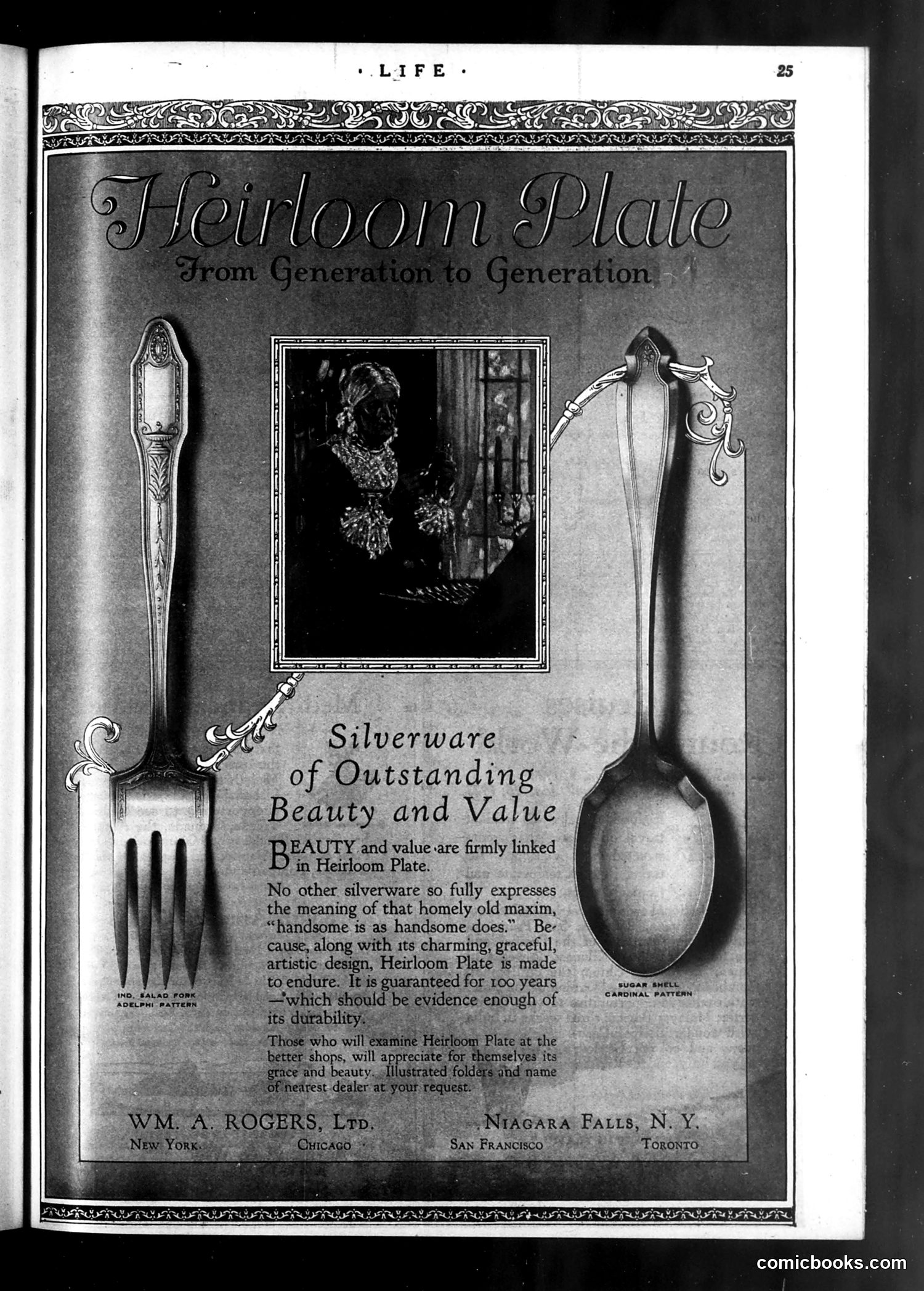
This is an advertisement rather than political satire or cartoon content. It promotes "Heirloom Plate," a silverware product by WM. A. Rogers, Ltd., with locations in New York, Chicago, Niagara Falls, and Toronto. The ad features decorative spoon and fork images flanking a historical portrait photograph (depicting what appears to be a wealthy or notable figure in period dress). The text emphasizes that beauty and value are linked in their silverware, guarantees durability for 100 years, and invokes the maxim "handsome is as handsome does." This is a straightforward commercial appeal to customers seeking elegant, durable dinnerware rather than satirical content.
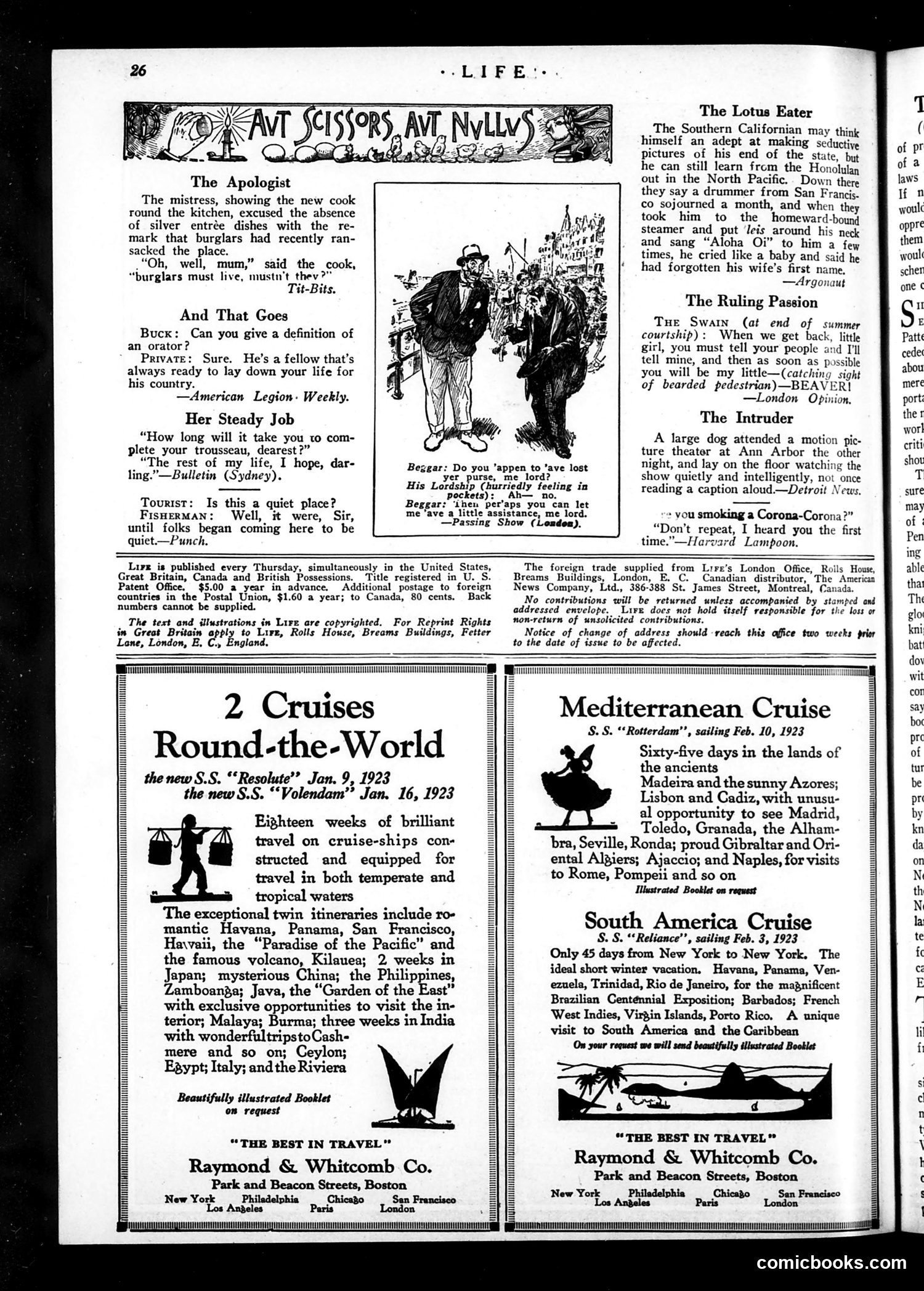
This page contains **short humorous anecdotes** rather than political cartoons. The jokes satirize British and American social conventions: **"The Apologist"**: A cook's pragmatic acceptance that burglars "must live"—gentle satire on working-class fatalism. **"And That Goes"**: Mocks patriotic rhetoric by defining an orator as someone ready to sacrifice *others'* lives for country—anti-war humor common post-WWI. **"Her Steady Job"**: Jokes about women's endless wedding preparations, reflecting period attitudes toward female consumption and marriage obsession. **"The Ruling Passion"**: A swan courting a female gets distracted by a bearded man—satirizing male attention spans and shallow romantic commitment. **"The Intruder"**: Humorous reversal: a dog watches a movie intelligently without reading captions aloud, implying human moviegoers are annoying and less civilized. The page also features cruise ship advertisements. The overall tone is light, class-conscious British humor typical of *Life*'s satirical style in the 1920s.
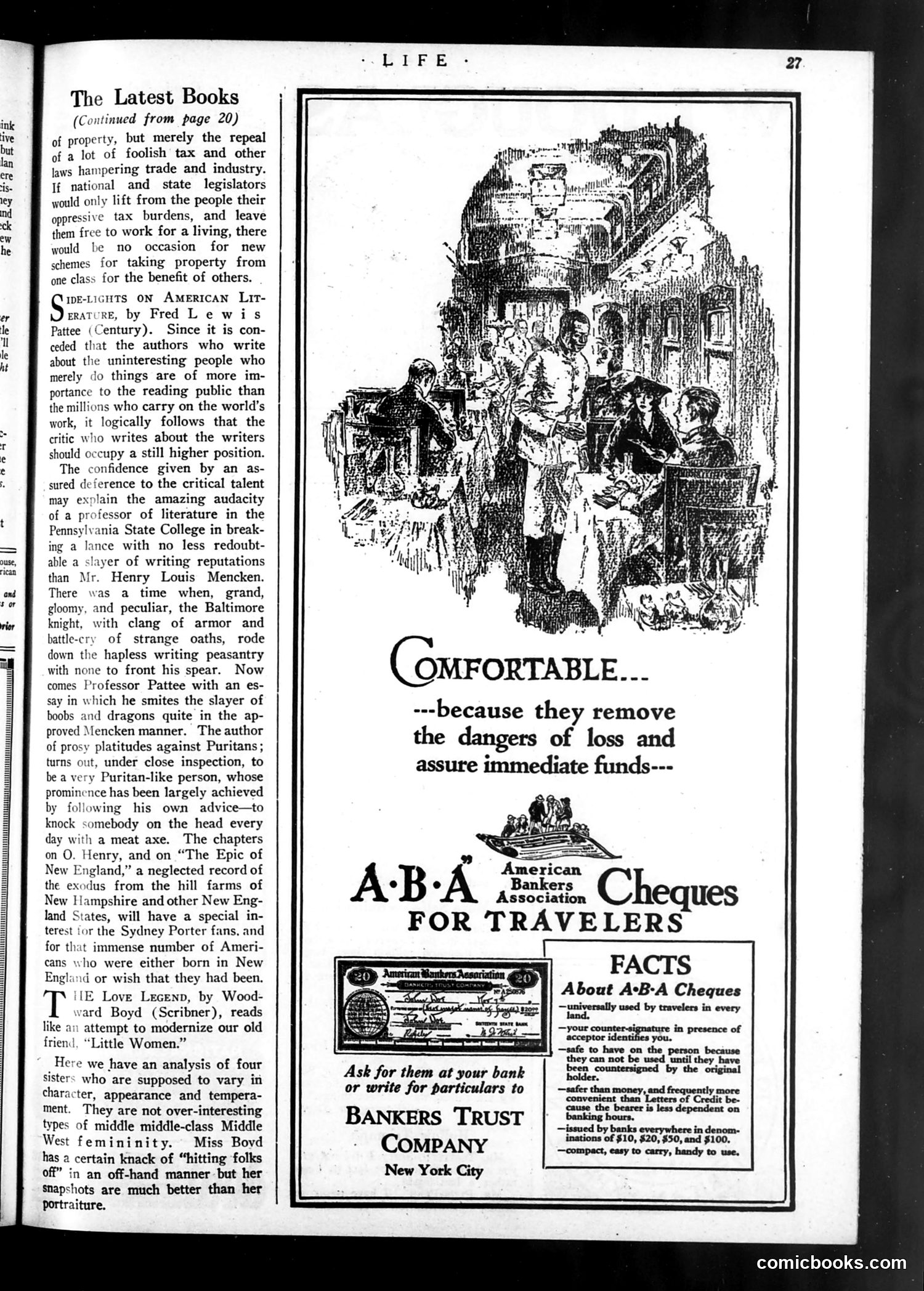
This page is primarily a **book review section** with an **advertisement**, not a political cartoon. The text reviews three books: Fred Lewis Pattee's critique of American literature (notably attacking critic H.L. Mencken as a hypocritical Puritan); O. Henry and New England regional fiction; and a modern retelling of "Little Women" by Woodward Boyd. The reviewer uses colorful language—describing Mencken as a "Baltimore knight" attacking "writing peasantry"—to critique literary criticism itself. The large illustration shows a domestic interior scene (likely Victorian-era) but serves as generic decoration for an **ABA Traveler's Cheques advertisement** below it. The ad promotes these checks as safe, convenient alternatives to carrying cash while traveling—emphasizing they "remove dangers of loss and assure immediate funds." The page reflects 1920s-era concerns: literary debates about American writers, gendered domestic fiction, and the emerging financial service of traveler's cheques for the affluent traveling public.
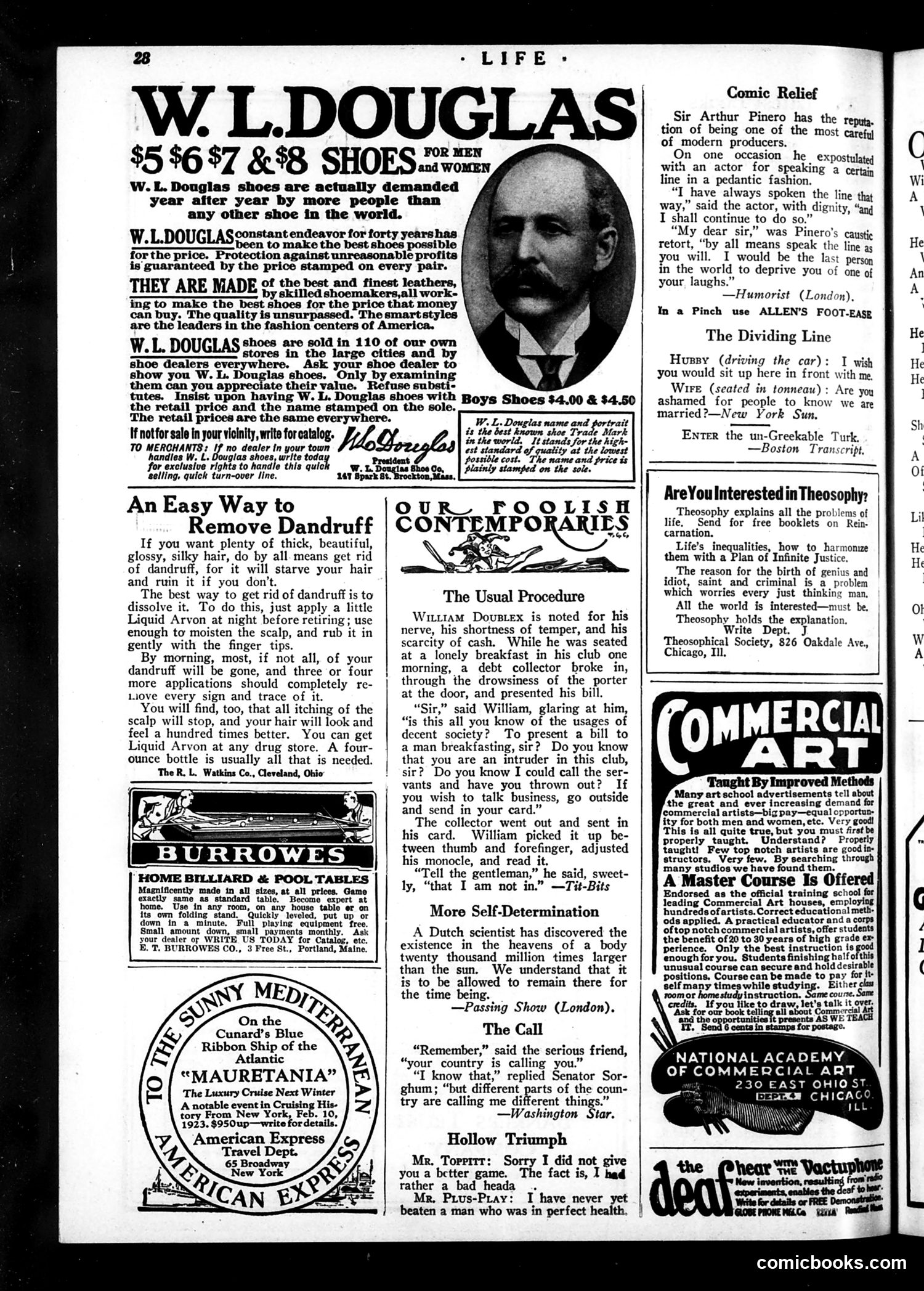
This page is primarily **advertising**, featuring prominent shoe and product ads (W.L. Douglas shoes, Burrowes billiard tables, American Express cruises). The satirical content appears in the middle section titled **"Our Foolish Contemporaries,"** reprinting a brief humorous story called "The Usual Procedure." It mocks the pretensions of a man named William Doubleday who, when confronted by a debt collector during breakfast at his club, uses etiquette as a defense—lecturing the collector about "decent society" rules forbidding business discussions at mealtimes. The joke satirizes how the wealthy weaponize social conventions to avoid accountability for debts. The remaining text includes miscellaneous humor pieces ("The Dividing Line," "Hollow Triumph") and advertisements for theosophical services and commercial art schools. This appears to be a typical 1920s Life page: **mostly commercial with light satirical interludes** poking fun at social affectation and financial evasion.
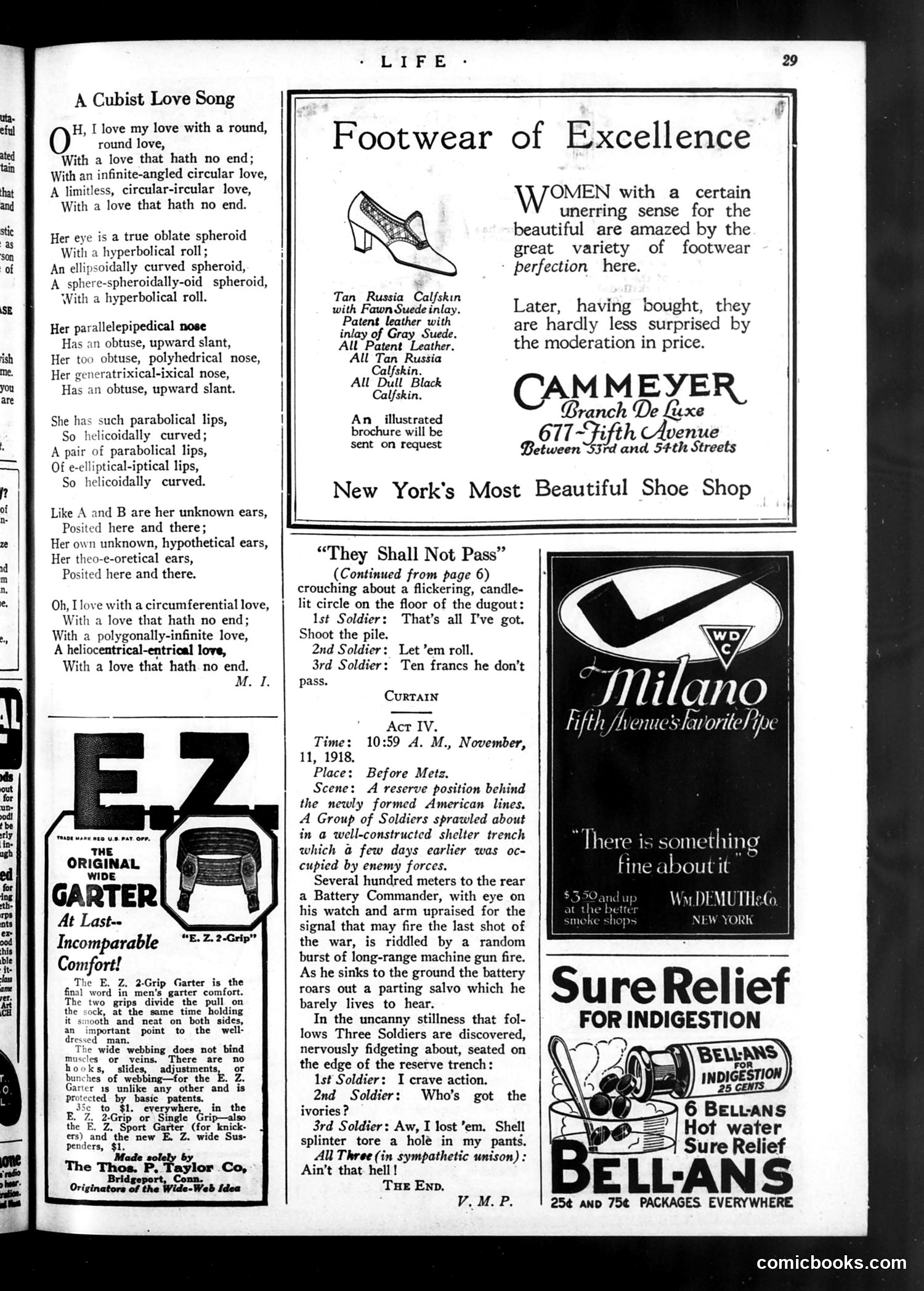
This page contains mostly **advertisements and literary content**, not political cartoons. The main items are: 1. **"A Cubist Love Song"** — a satirical poem mocking Cubist art movement's geometric abstraction by describing a woman's features using mathematical/geometric terminology ("oblate spheroid," "parallelepipedical nose," etc.). The satire targets modernist art's obscure jargon and disconnect from reality. 2. **Multiple advertisements** for shoes (Cammeyer), garters (E.Z. Garter), cigarettes (Milano), and indigestion relief (Bellans) — typical 1918 product marketing. 3. **"They Shall Not Pass"** — appears to be a one-act play set during WWI's final day (November 11, 1918), depicting soldiers in a trench awaiting the armistice. The title references the famous WWI battle cry. The page is primarily a **magazine layout mixing editorial content with advertising**, not political commentary or cartooning.
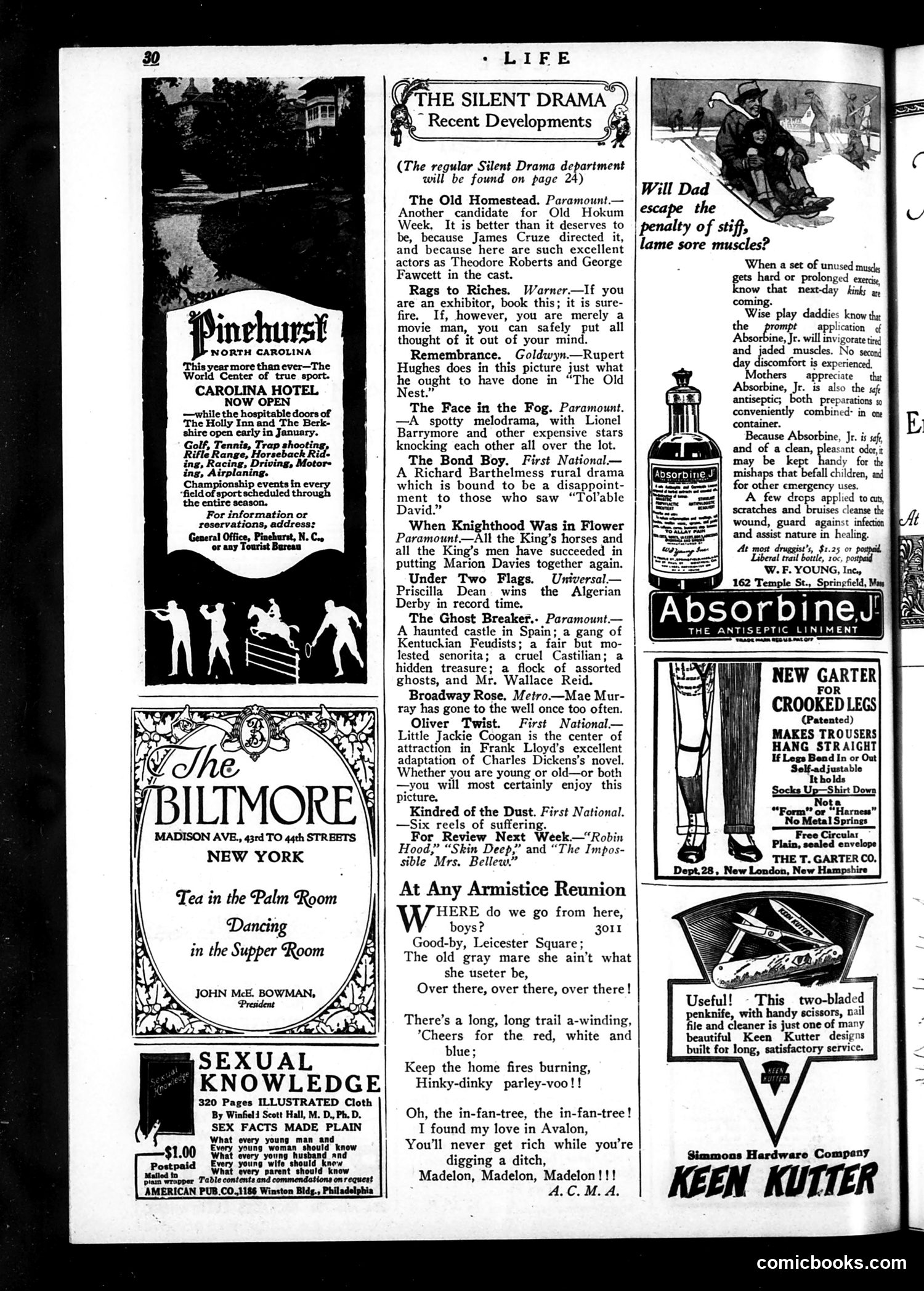
This is primarily a **film review section** ("The Silent Drama") from Life magazine, listing recent movie releases with brief critical assessments. The films referenced (like *Oliver Twist* with child star Jackie Coogan, Marion Davies vehicles, and Richard Barthelmess dramas) are from the early 1920s silent film era. The page includes advertising and a poem titled **"At Any Armistice Reunion"** by A.C.M.A., which nostalgically lists popular World War I-era songs (*"Over There,"* *"Keep the Home Fires Burning,"* *"Madelon"*). This appears to be commemorative content reflecting on WWI's end, evoking soldiers' memories through the musical hits of that period. The remaining content consists of hotel, product, and book advertisements typical of the era—nothing satirical or particularly political beyond the war nostalgia theme.
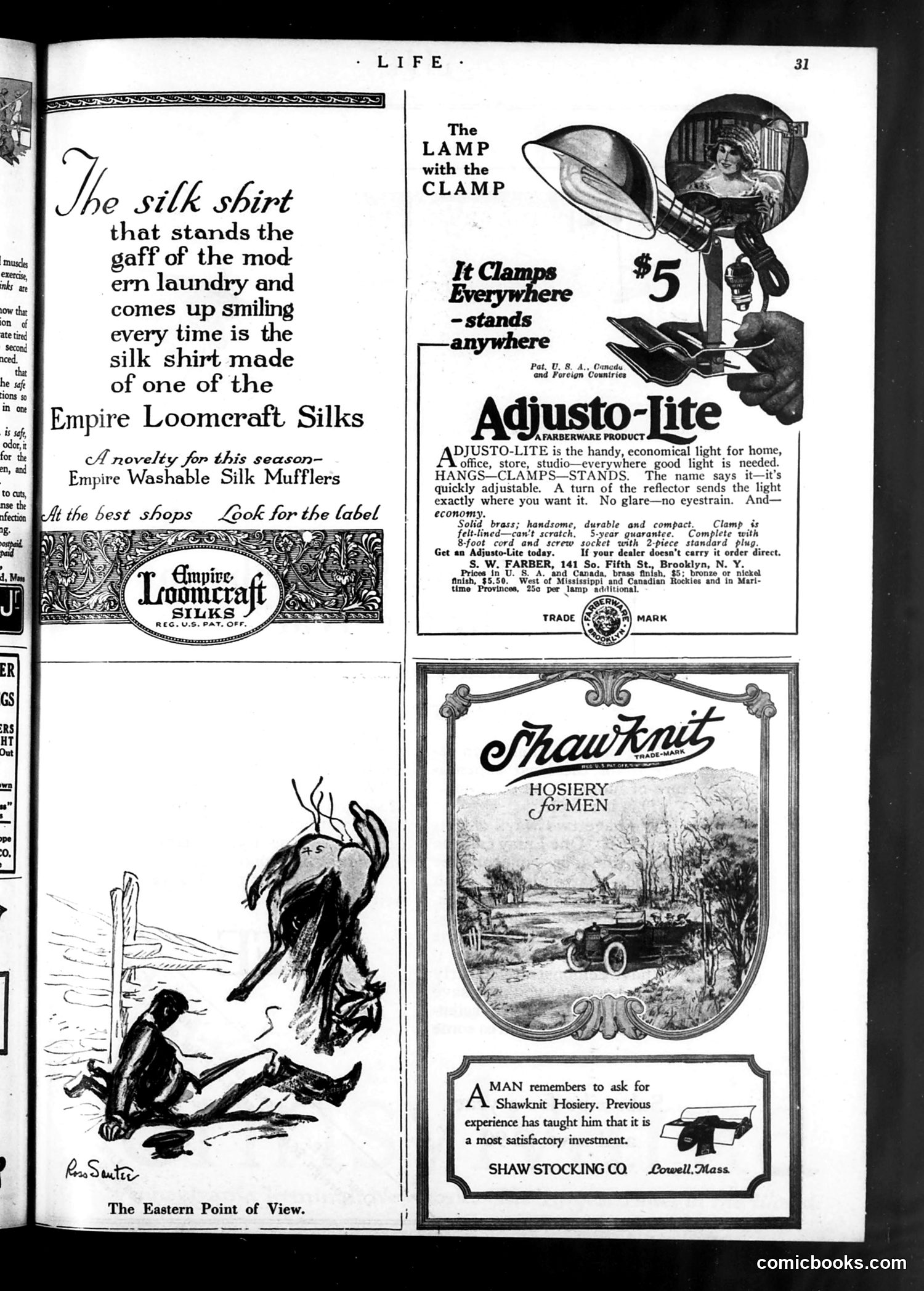
This page is primarily **advertising**, with one small political cartoon. The cartoon titled "The Eastern Point of View" (by B.E. Sutter, visible signature) depicts a comedic scene of apparent conflict—a figure appears to be thrown or falling backward while another figure below reacts with alarm. Without additional context, the specific political or social reference is **unclear from the image alone**; the title suggests it comments on East Coast perspectives, but the exact satire cannot be definitively identified. The rest of the page contains four product advertisements: Empire Loomcraft Silks (washable silk shirts), Adjusto-Lite lamps ($5), Shawknit Hosiery, and a Shaw Stocking Company ad featuring a vintage automobile. These represent typical 1920s-era consumer goods marketed to middle-class readers.
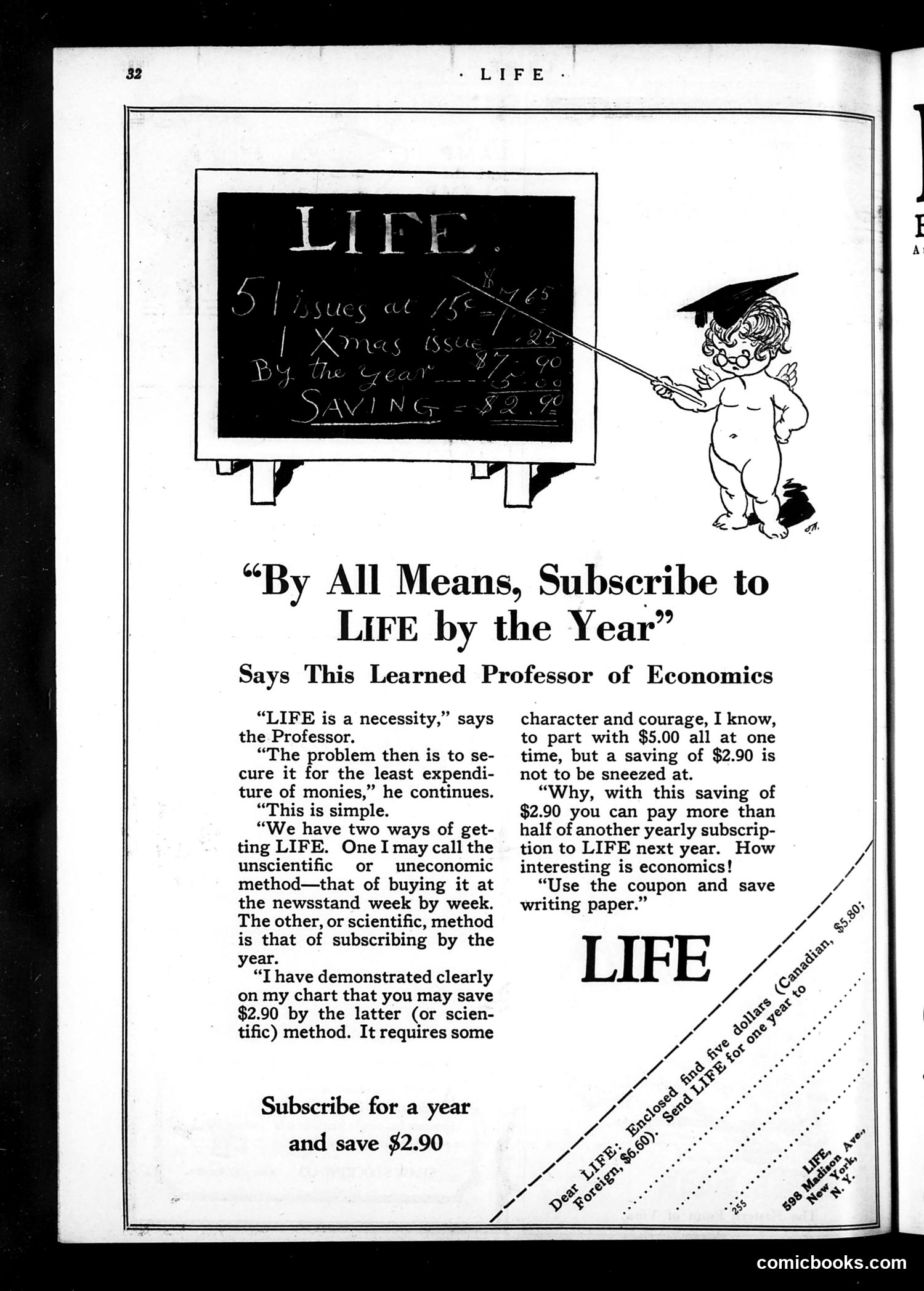
This is a **Life magazine advertisement** for yearly subscriptions, not a political cartoon. It features a Cupid figure pointing at a blackboard showing subscription math. The satire targets academic economics and the professor's overwrought logic. He presents the simple choice between weekly newsstand purchases versus annual subscription as a grand economic principle worthy of charts and demonstrations. The joke is that he's using inflated professorial language and economic theory to justify what's obvious: buying annually saves money. The humor lies in the absurdity—describing a $2.90 savings with the gravitas of serious economic scholarship, and suggesting that modest saving could fund "more than half" another subscription. It's gentle mockery of how academics can complicate straightforward truths, while simultaneously pitching LIFE's subscription offer to readers who appreciate both wit and value.
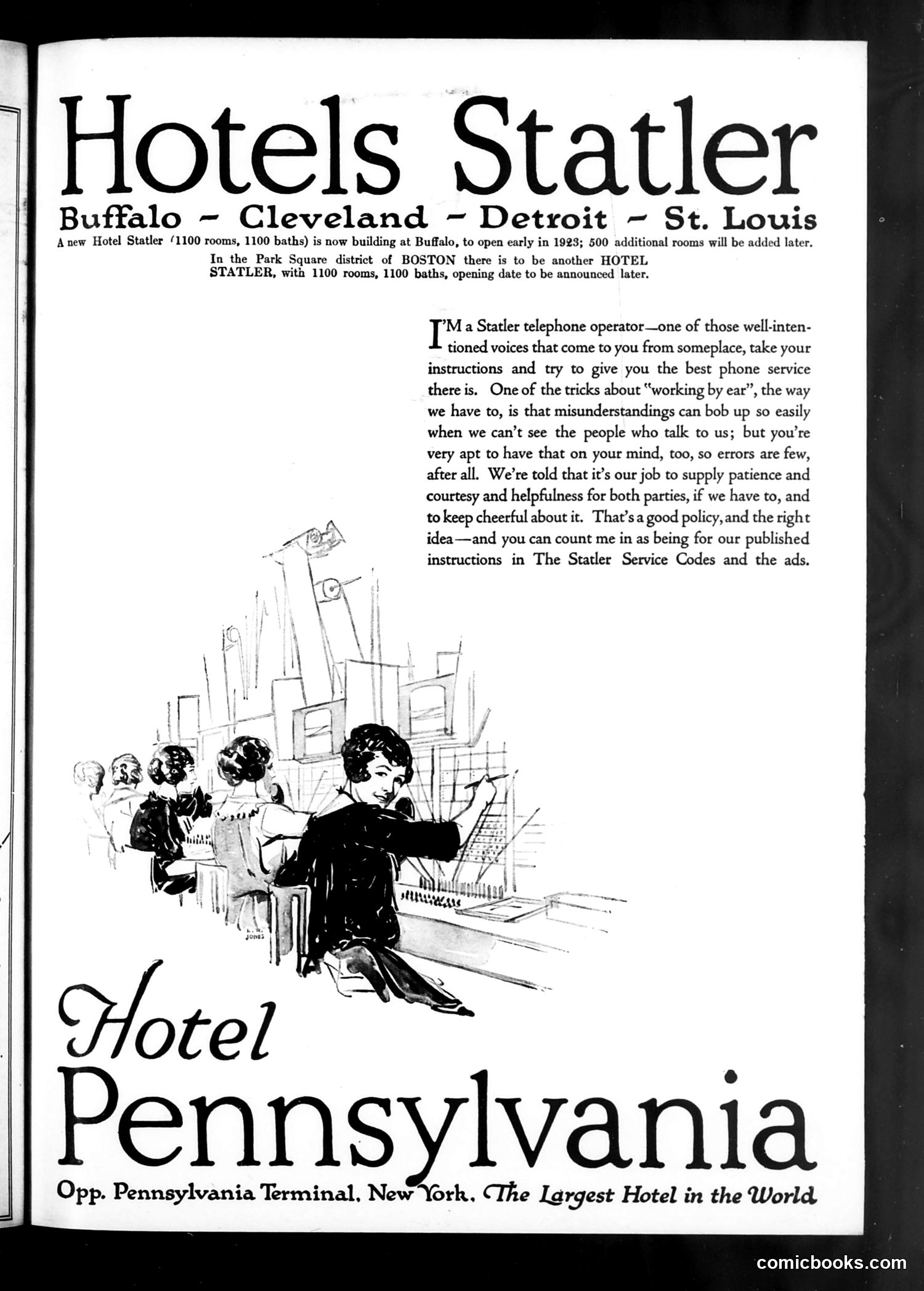
This is primarily **a corporate advertisement**, not political satire. The Statler hotel chain is promoting its expansion and brand philosophy across multiple cities (Buffalo, Cleveland, Detroit, St. Louis, Boston, and New York). The illustration shows a telephone operator—a common female profession of the era—speaking directly to readers. The accompanying text is a first-person testimonial from this operator, explaining the Statler company's service philosophy: patience, courtesy, and helpfulness despite communication challenges when working "by ear" without seeing customers. The advertisement's rhetorical strategy is to personify corporate values through an individual worker's voice, positioning Statler hotels as places where professional service standards are maintained. The "largest hotel in the world" claim and emphasis on standardized service codes reflect early 20th-century corporate modernization and systematization. This is brand messaging dressed as human connection, typical of advertising from this period.
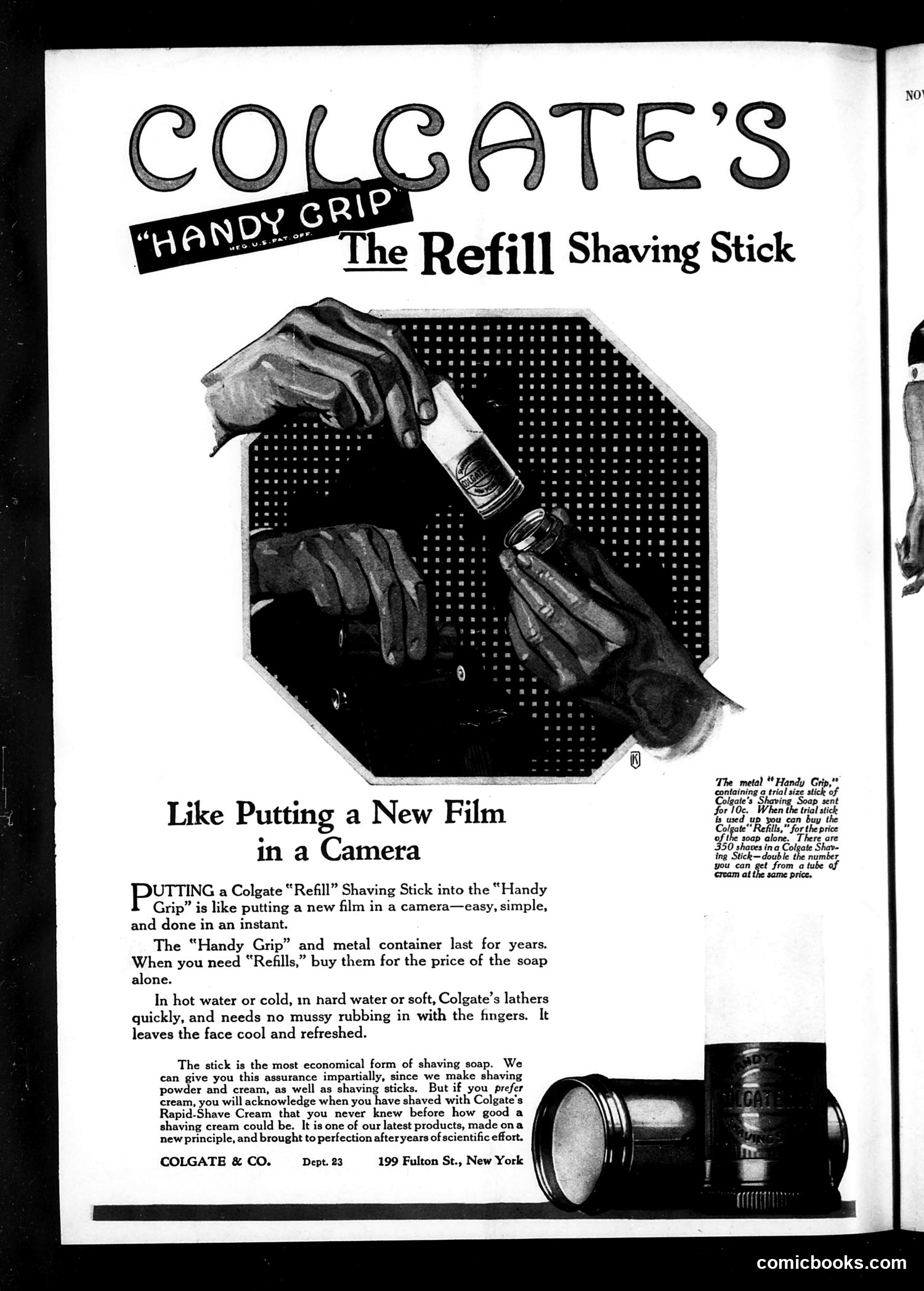
This is a **Colgate advertisement**, not political satire. The page promotes Colgate's "Handy Grip" refillable shaving stick system. The central image shows hands inserting a shaving stick into a metal container, illustrating the product's key selling point: easy refill replacement. The headline compares this to "putting a new film in a camera"—a relatable analogy for early-20th-century readers familiar with camera film cartridges. The copy emphasizes **economic value**: the reusable metal grip lasts years; refills cost only the price of soap (no container markup); and the stick format provides 350 shaves versus fewer from competing cream tubes at equal price. This represents **early consumer product marketing** emphasizing convenience, durability, and value—positioning the innovation as modern and efficient technology. There is no political message or satire present.