
Life, 1922-11-09 · page 13 of 36
Life — November 9, 1922 — page 13: what you’re looking at
What you’re looking at
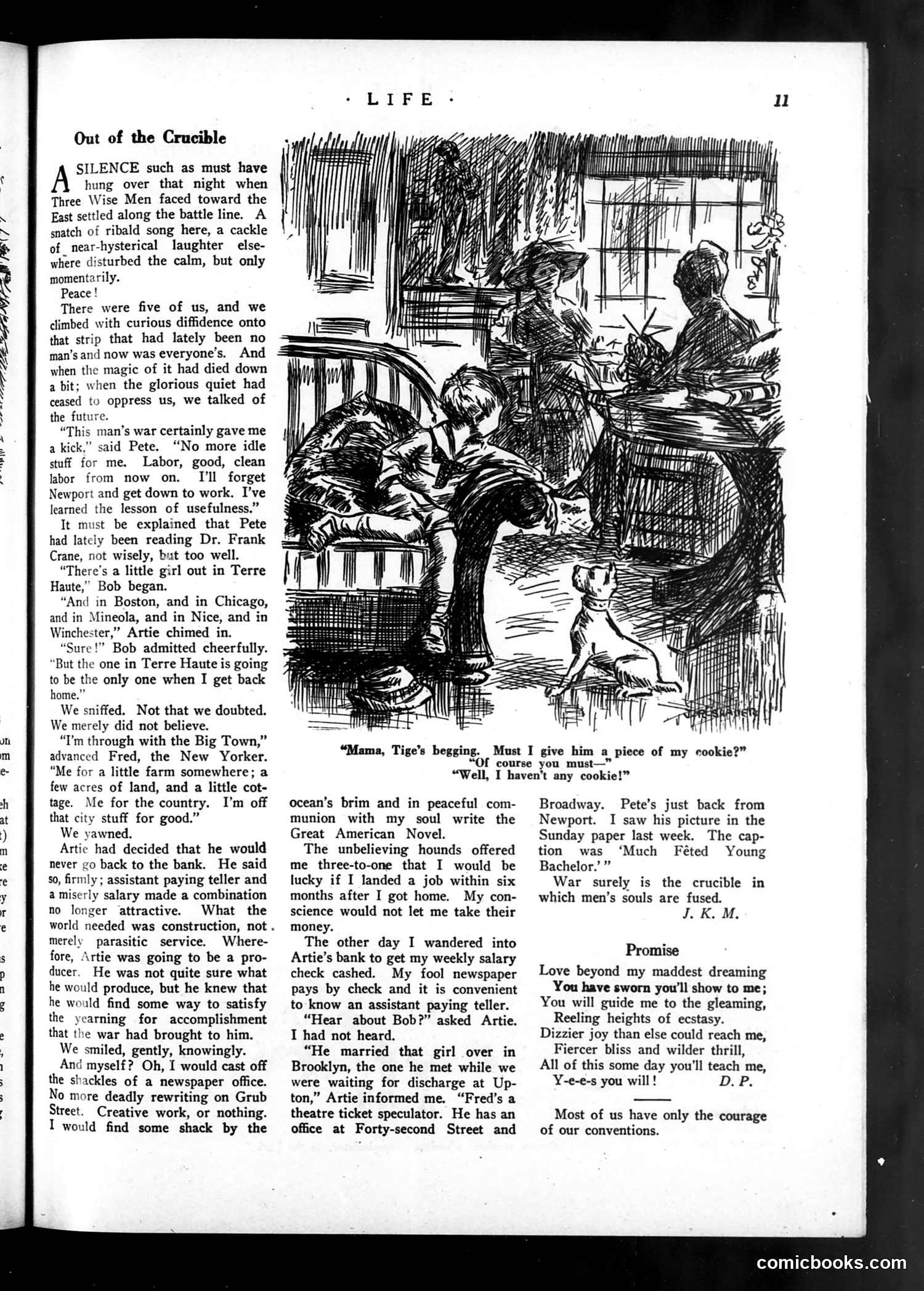
This page contains a short story titled "Out of the Crucible" alongside an illustration showing a domestic scene with a mother, child, and dog. The narrative discusses five young men who climbed onto a New York City rooftop after WWI, reflecting on how the war's hardships changed their perspectives on ambition and labor. The story references Dr. Frank Crane (a real contemporary advice columnist) and mentions specific locations: Boston, Chicago, Mineola, Nice, and Winchester. One character named Pete has returned from Newport, appearing in the Sunday paper as a "Much Fêted Young Bachelor." The illustration depicts a humble home scene, contrasting with the text's themes of post-war disillusionment and working-class aspiration. The page concludes with a poem titled "Promise." This appears to be serious literary content rather than satire.
📄 Transcribed text from this page (OCR, searchable)
Machine-transcribed from the original scan — historical spelling and the odd misread are preserved.
SS. DONG, TENG O) Out of the Crucible SILENCE such as must have hung over that night when Three Wise Men faced toward the East settled along the battle line. A snatch of ribald song here, a cackle of near-hysterical laughter else- where disturbed the calm, but only momentarily. Peace! There were five of us, and we climbed with curious diffidence onto that strip that had lately been no man’s and now was everyone's. And when the magic of it had died down a bit; when the glorious quiet had ceased to oppress us, we talked of the future. “This man’s war certainly gave me akick,” said Pete. “No more idle stuff for me. Labor, good, clean labor from now on. I'll forget Newport and get down to work. I’ve learned the lesson of usefulness.” It must be explained that Pete had lately been reading Dr. Frank Crane, not wisely, but too well. “There's a little girl out in Terre Haute,” Bob began. “And in Boston, and in Chicago, and in Mineola, and in Nice, and in Winchester,” Artie chimed in. “Sure!” Bob admitted cheerfully. “But the one in Terre Haute is going to be the only one when I get back home.” We sniffed. Not that we doubted. We merely did not believe. “T'm through with the Big Town,” advanced Fred, the New Yorker. “Me for a little farm somewhere; a few acres of land, and a little cot- tage. Me for the country. I’m off that city stuff for good.” We yawned. Artie had decided that he would never go back to the bank. He said 80, firmly ; assistant paying teller and a miserly salary made a combination no longer attractive. What the world needed was construction, not . merely parasitic service. Where- fore, Artie was going to be a pro- ducer. He was not quite sure what he would produce, but he knew that he would find some way to satisfy the yearning for accomplishment that the war had brought to him. We smiled, gently, knowingly. And myself? Oh, I would cast off the shackles of a newspaper office. No more deadly rewriting on Grub Street. Creative work, or nothing. I would find some shack by the “Mama, Tige’s begging. Must I give him a piece of my cookie?” “Of course you must—” “Well, I haven’t any cookie!” ocean’s brim and in peaceful com- munion with my soul write the Great American Novel. The unbelieving hounds offered me three-to-one that I would be lucky if I landed a job within six months after I got home. My con- science would not let me take their money. The other day I wandered into Artie’s bank to get my weekly salary check cashed. My fool newspaper pays by check and it is convenient to know an assistant paying teller. “Hear about Bob?” asked Artie. I had not heard. “He married that girl over in Brooklyn, the one he met while we were waiting for discharge at Up- ton,” Artie informed me. “Fred’s a theatre ticket speculator. He has an office at Forty-second Street and Broadway. Pete’s just back from Newport. I saw his picture in the Sunday paper last week. The cap- tion was ‘Much Féted Young Bachelor.’” War surely is the crucible in which men’s souls are fused. J.K.M. Promise Love beyond my maddest dreaming You have sworn you'll show to me; You will guide me to the gleaming, Reeling heights of ecstasy. Dizzier joy than else could reach me, Fiercer bliss and wilder thrill, All of this some day you'll teach me, Y-e-e-s you will! D.P. Most of us have only the courage of our conventions. comicbooks.com