
Life, 1922-11-09 · page 20 of 36
Life — November 9, 1922 — page 20: what you’re looking at
What you’re looking at
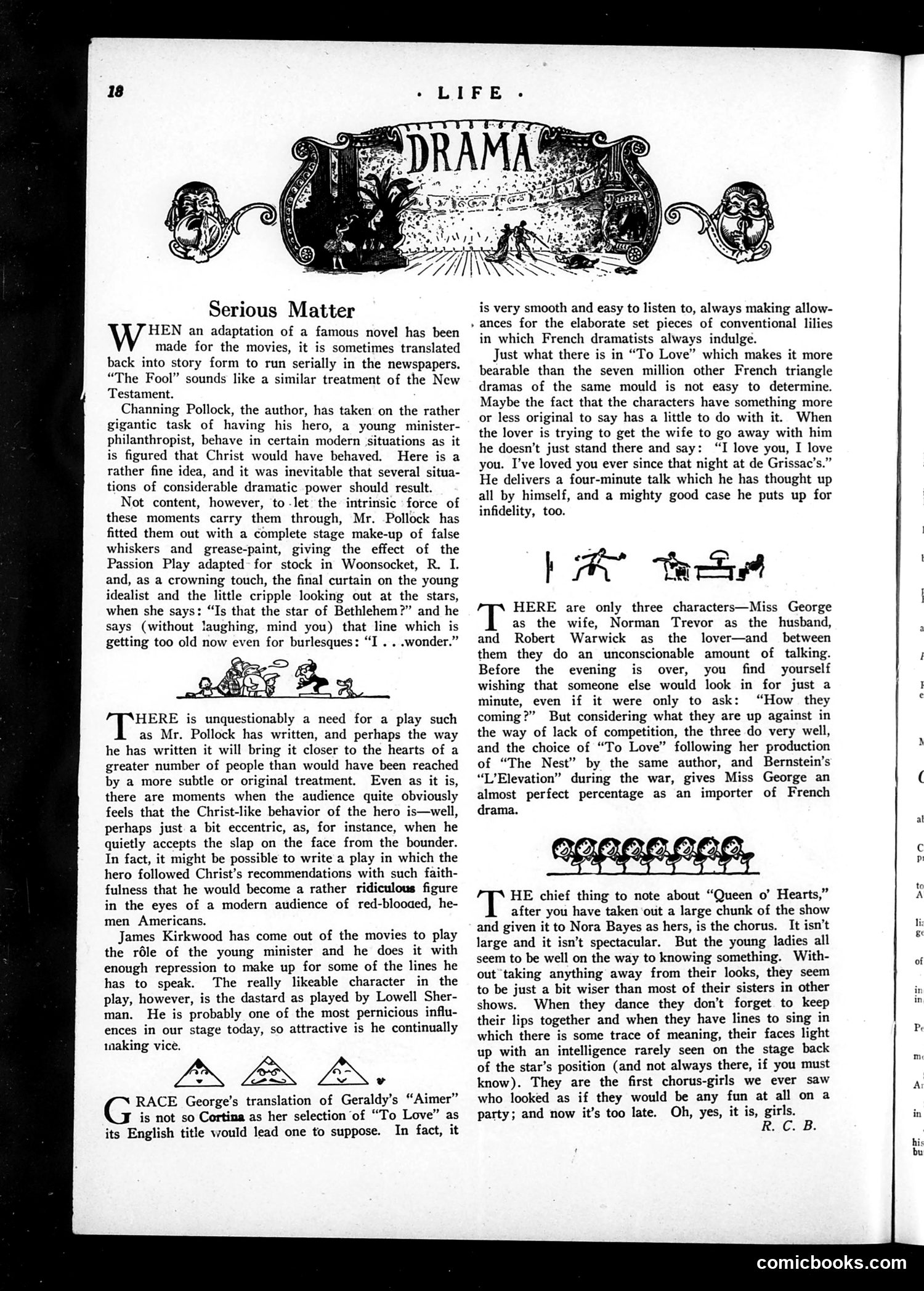
This LIFE magazine drama section reviews three theatrical productions: **"The Fool"**: A play adapting a novel about a young minister-philanthropist who behaves as Christ would in modern situations. The critic praises the concept but mocks the overwrought execution—comparing it to a "Passion Play adapted for stock in Woonsocket, R.I." The satire targets melodramatic excess: false whiskers, grease-paint, and cornball dialogue ("I...wonder"). The reviewer notes audiences find the hero's Christ-like behavior uncomfortably eccentric, suggesting modern American "red-blooded" men find such virtue ridiculous. **"To Love"**: Grace George's translation of a French play about infidelity. The critic notes it's verbose—the lover delivers a four-minute argument *for* adultery rather than simple declarations of love. The three-character cast talks excessively. **"Queen o' Hearts"**: Praised for its chorus line and spectacle, though the young chorus girls are noted more for appearance than talent. Throughout, the page satirizes theatrical pretension and overwrought sentimentality popular in early 20th-century drama.
📄 Transcribed text from this page (OCR, searchable)
Machine-transcribed from the original scan — historical spelling and the odd misread are preserved.
Serious Matter HEN an adaptation of a famous novel has been made for the movies, it is sometimes translated back into story form to run serially in the newspapers. “The Fool” sounds like a similar treatment of the New Testament. Channing Pollock, the author, has taken on the rather gigantic task of having his hero, a young minister- philanthropist, behave in certain modern situations as it is figured that Christ would have behaved. Here is a rather fine idea, and it was inevitable that several situa- tions of considerable dramatic power should result. Not content, however, to-let the intrinsic force of these moments carry them through, Mr. Pollock has fitted them out with a complete stage make-up of false whiskers and grease-paint, giving the effect of the Passion Play adapted for stock in Woonsocket, R. I. and, as a crowning touch, the final curtain on the young idealist and the little cripple looking out at the stars, when she says: “Is that the star of Bethlehem?” and he says (without laughing, mind you) that line which is getting too old now even for burlesques: “I . . .wonder.” HERE is unquestionably a need for a play such as Mr. Pollock has written, and perhaps the way he has written it will bring it closer to the hearts of a greater number of people than would have been reached by a more subtle or original treatment. Even as it is, there are moments when the audience quite obviously feels that the Christ-like behavior of the hero is—well, perhaps just a bit eccentric, as, for instance, when he quietly accepts the slap on the face from the bounder. In fact, it might be possible to write a play in which the hero followed Christ’s recommendations with such faith- fulness that he would become a rather ridiculous figure in the eyes of a modern audience of red-blooaed, he- men Americans. James Kirkwood has come out of the movies to play the réle of the young minister and he does it with enough repression to make up for some of the lines he has to speak. The really likeable character in the play, however, is the dastard as played by Lowell Sher- man. He is probably one of the most pernicious influ- ences in our stage today, so attractive is he continually inaking vice. BUTE LX RACE George's translation of Geraldy’s “Aimer” is not so Cortina as her selection of “To Love” as its English title would lead one to suppose. In fact, it is very smooth and easy to listen to, always making allow- » ances for the elaborate set pieces of conventional lilies in which French dramatists always indulge. Just what there is in “To Love” which makes it more bearable than the seven million other French triangle dramas of the same mould is not easy to determine. Maybe the fact that the characters have something more or less original to say has a little to do with it. When the lover is trying to get the wife to go away with him he doesn’t just stand there and say: “I love you, I love you. I’ve loved you ever since that night at de Grissac’s.” He delivers a four-minute talk which he has thought up all by himself, and a mighty good case he puts up for infidelity, too. | eee HERE are only three characters—Miss George T as the wife, Norman Trevor as the husband, and Robert Warwick as the lover—and between them they do an unconscionable amount of talking. Before the evening is over, you find yourself wishing that someone else would look in for just a minute, even if it were only to ask: “How they coming?” But considering what they are up against in the way of lack of competition, the three do very well, and the choice of “To Love” following her production of “The Nest” by the same author, and Bernstein’s “L’Elevation” during the war, gives Miss George an almost perfect percentage as an importer of French drama. HE chief thing to note about “Queen o’ Hearts,” after you have taken ‘out a large chunk of the show and given it to Nora Bayes as hers, is the chorus. It isn’t large and it isn’t spectacular. But the young ladies all seem to be well on the way to knowing something. With- out taking anything away from their looks, they seem to be just a bit wiser than most of their sisters in other shows. When they dance they don’t forget to keep their lips together and when they have lines to sing in which there is some trace of meaning, their faces light up with an intelligence rarely seen on the stage back of the star’s position (and not always there, if you must know). They are the first chorus-girls we ever saw who looked as if they would be any fun at all on a party; and now it’s too late. Oh, yes, it is, girls. RC. B: comicbooks.com in in