
Life, 1922-11-09 · page 6 of 36
Life — November 9, 1922 — page 6: what you’re looking at
What you’re looking at
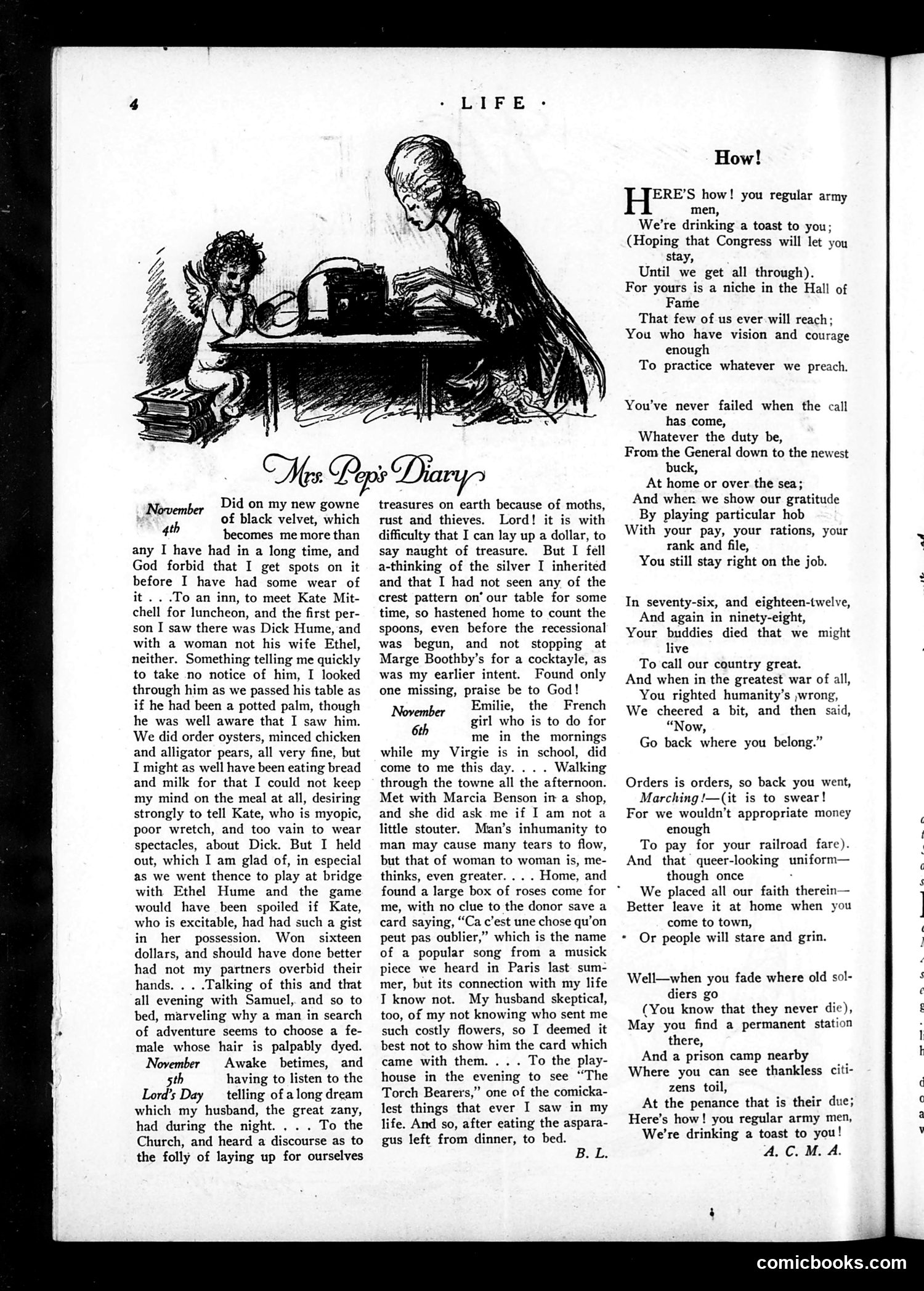
This page presents two distinct pieces from Life magazine: **"Mrs. Peps's Diary"** (left) is a humorous domestic diary entry satirizing middle-class financial anxiety. Mrs. Peps frets over a new gown's cost and inherited silver, describing petty domestic economies and social embarrassments—typical concerns of genteel but financially-constrained households. **"How!"** (right) is a patriotic poem addressing soldiers during wartime (context suggests WWI era, given references to "greatest war of all" and overseas service). It celebrates military service as honorable duty, using elevated language to honor enlisted men and officers alike, encouraging them to accept hardship patriotically. Together, these pieces reflect Life's dual focus: satirizing civilian domestic life while earnestly celebrating national sacrifice during wartime.
📄 Transcribed text from this page (OCR, searchable)
Machine-transcribed from the original scan — historical spelling and the odd misread are preserved.
Did on my new gowne of black velvet, which becomes me more than November gth any I have had in a long time, and God forbid that I get spots on it before I have had some wear of it . . .To an inn, to meet Kate Mit- chell for luncheon, and the first per- son I saw there was Dick Hume, and with a woman not his wife Ethel, neither. Something telling me quickly to take no notice of him, I looked through him as we passed his table as if he had been a potted palm, though he was well aware that I saw him. We did order oysters, minced chicken and alligator pears, all very fine, but I might as well have been eating bread and milk for that I could not keep my mind on the meal at all, desiring strongly to tell Kate, who is myopic, poor wretch, and too vain to wear spectacles, about Dick. But I held out, which I am glad of, in especial as we went thence to play at bridge with Ethel Hume and the game would have been spoiled if Kate, who is excitable, had had such a gist in her possession. Won _ sixteen dollars, and should have done better had not my partners overbid their hands. . . .Talking of this and that all evening with Samuel, and so to bed, marveling why a man in search of adventure seems to choose a fe- male whose hair is palpably dyed. November Awake betimes, and 5th having to listen to the Lord’s Day telling of along dream which my husband, the great zany, had during the night. . . . To the Church, and heard a discourse as to the folly of laying up for ourselves treasures on earth because of moths, rust and thieves. Lord! it is with difficulty that I can lay up a dollar, to say naught of treasure. But I fell a-thinking of the silver I inherited and that I had not seen any of the crest pattern on’ our table for some time, so hastened home to count the spoons, even before the recessional was begun, and not stopping at Marge Boothby’s for a cocktayle, as was my earlier intent. Found only one missing, praise be to God! Noweuher Emilie, the French h girl who is to do for 6t me in the mornings while my Virgie is in school, did come to me this day. . . . Walking through the towne all the afternoon. Met with Marcia Benson ir a shop, and she did ask me if I am not a little stouter. Mian’s inhumanity to man may cause many tears to flow, but that of woman to woman is, me- thinks, even greater... . Home, and found a large box of roses come for ~ me, with no clue to the donor save a card saying, “Ca c’est une chose qu’on peut pas oublier,” which is the name of a popular song from a musick piece we heard in Paris last sum- mer, but its connection with my life T know not. My husband skeptical, too, of my not knowing who sent me such costly flowers, so I deemed it best not to show him the card which came with them. .. . To the play- house in the evening to see “The Torch Bearers,” one of the comicka- lest things that ever I saw in my life. And so, after eating the aspara- gus left from dinner, to bed. B. L. How! ERE’S how! you regular army men, We're drinking a toast to you; (Hoping that Congress will let you stay, Until we get all through). For yours is a niche in the Hall of Fame That few of us ever will reach; You who have vision and courage enough To practice whatever we preach. You’ve never failed when the call has come, Whatever the duty be, From the General down to the newest buck, At home or over the sea; And wher. we show our gratitude By playing particular hob With your pay, your rations, your rank and file, You still stay right on the job. In seventy-six, and eighteen-twelve, And again in ninety-eight, Your buddies died that we might live To call our country great. And when in the greatest war of all, You righted humanity’s ,wrong, We cheered a bit, and then said, “Now, Go back where you belong.” Orders is orders, so back you went, Marching !—(it is to swear! For we wouldn’t appropriate money enough To pay for your railroad fare). And that queer-looking uniform— though once We placed all our faith therein— Better leave it at home when you come to town, + Or people will stare and grin. Well—when you fade where old sol- diers go (You know that they never die), May you find a permanent station there, And a prison camp nearby Where you can see thankless citi- zens toil, At the penance that is their due; Here’s how! you regular army men, We're drinking a toast to you! A, C. M. A. comicbooks.com dese PA 7S ey