
Life, 1922-11-09 · page 22 of 36
Life — November 9, 1922 — page 22: what you’re looking at
What you’re looking at
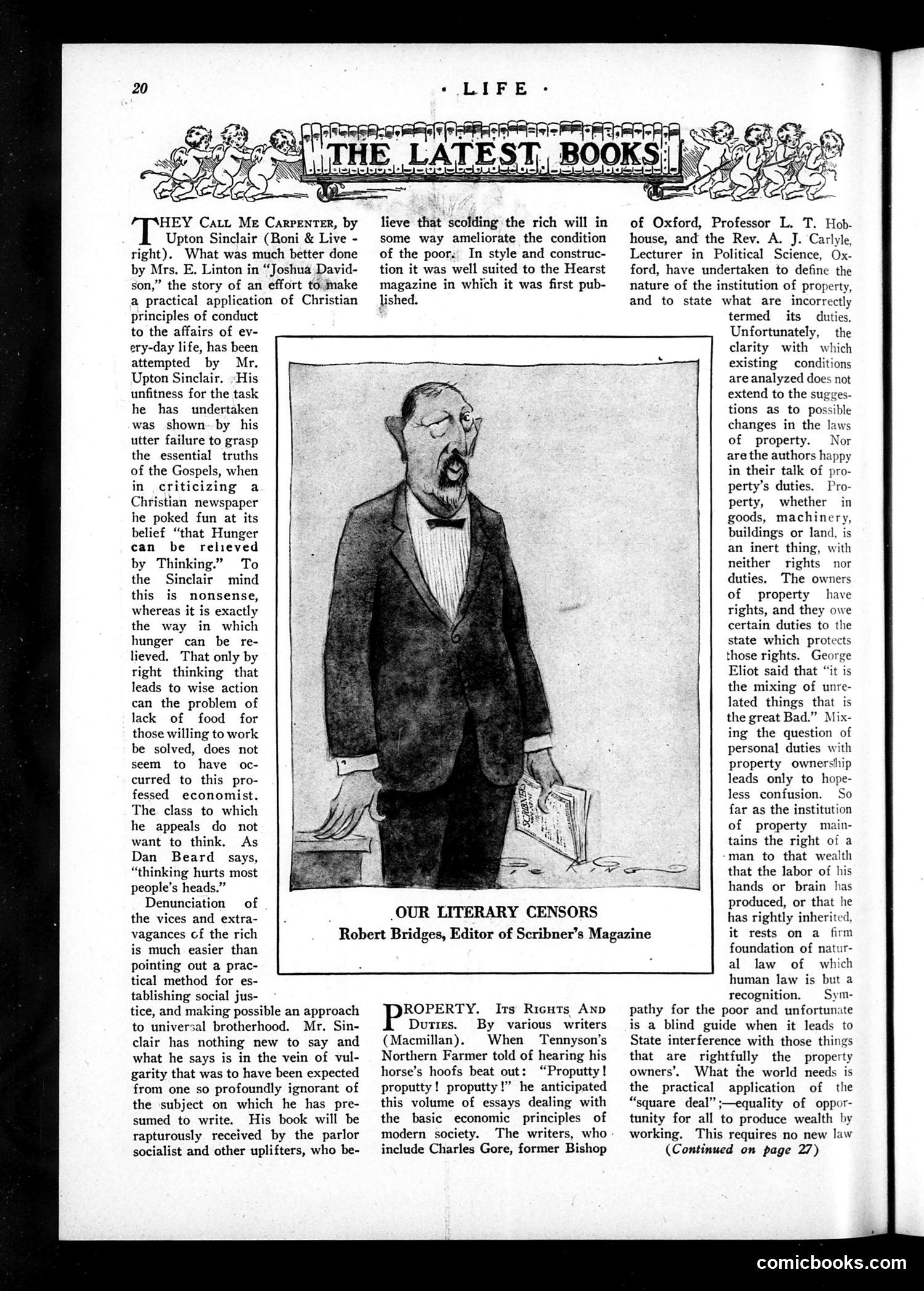
This page from *Life* magazine features a caricatured portrait labeled "Robert Bridges, Editor of Scribner's Magazine" under the heading "OUR LITERARY CENSORS." The cartoon depicts Bridges as a stern-faced censor figure, suggesting the satirical point that magazine editors function as gatekeepers controlling public discourse. The page reviews two books. The text harshly critiques Upton Sinclair's *They Call Me Carpenter*, dismissing the socialist author as ignorant and vulgar, claiming his work lacks practical solutions—merely "scolding the rich" rather than addressing poverty constructively. A separate review of *Property: Its Rights and Duties* (essays by various Oxford scholars) praises their analysis but criticizes their conflation of personal duties with property ownership, advocating instead for equal opportunity and natural law principles. The satire suggests how literary editors wielded considerable power to shape public opinion and dismiss certain ideological viewpoints.
📄 Transcribed text from this page (OCR, searchable)
Machine-transcribed from the original scan — historical spelling and the odd misread are preserved.
HEY Catt Me Carpenter, by Upton Sinclair (Boni & Live - right). What was much better done by Mrs. E. Linton in “Joshua David- son,” the story of an effort to make a practical application of Christian principles of conduct to the affairs of ev- ery-day life, has been attempted by Mr, Upton Sinclair. His unfitness for the task he has undertaken was shown. by his utter failure to grasp the essential truths of the Gospels, when in criticizing a Christian newspaper he poked fun at its belief “that Hunger can be relieved by Thinking.” To the Sinclair mind this is nonsense, whereas it is exactly the way in which hunger can be re- lieved. That only by right thinking that leads to wise action can the problem of lack of food for those willing to work be solved, does not seem to have oc- curred to this pro- fessed economist. The class to which he appeals do not want to think. As Dan Beard says, “thinking hurts most people’s heads.” Denunciation of the vices and extra- vagances cf the rich is much easier than pointing out a prac- tical method for es- tablishing social jus- tice, and making possible an approach to universal brotherhood. Mr. Sin- clair has nothing new to say and what he says is in the vein of vul- garity that was to have been expected from one so profoundly ignorant of the subject on which he has pre- sumed to write. His book will be rapturously received by the parlor socialist and other uplifters, who be- lieve that scolding the rich will in some way ameliorate the condition of the poor. In style and construc- tion it was well suited to the Hearst magazine in which it was first pub- lished. .OUR LITERARY CENSORS Robert Bridges, Editor of Scribner’s Magazine ROPERTY. Its Ricuts Anp Duties. By various writers (Macmillan). When Tennyson's Northern Farmer told of hearing his horse’s hoofs beat out: “Proputty! proputty! proputty!” he anticipated this volume of essays dealing with the basic economic principles of modern society. The writers, who include Charles Gore, former Bishop of Oxford, Professor L. T. Hob- house, and the Rev. A. J. Carlyle, Lecturer in Political Science, Ox- ford, have undertaken to define the nature of the institution of property, and to state what are incorrectly termed its duties. Unfortunately, the clarity with which existing conditions are analyzed does not extend to the sugges- tions as to possible changes in the laws of property. Nor are the authors happy in their talk of pro- perty’s duties. Pro- perty, whether in goods, machinery, buildings or land, is an inert thing, with neither rights nor duties. The owners of property have rights, and they owe certain duties to the state which protects those rights. George Eliot said that “it is the mixing of unre- lated things that is the great Bad.” Mix- ing the question of personal duties with property ownership leads only to hope- less confusion. So far as the institution of property § main- tains the right of a man to that wealth that the labor of his hands or brain has produced, or that he has rightly inherited, it rests on a firm foundation of natur- al law of which human law is but a recognition. Sym- pathy for the poor and unfortunate is a blind guide when it leads to State interference with those things that are rightfully the property owners’, What the world needs is the practical application of the “square deal” ;—equality of oppor- tunity for all to produce wealth by working. This requires no new law (Continued on page 27) comicbooks.com