
Life, 1922-11-09 · page 11 of 36
Life — November 9, 1922 — page 11: what you’re looking at
What you’re looking at
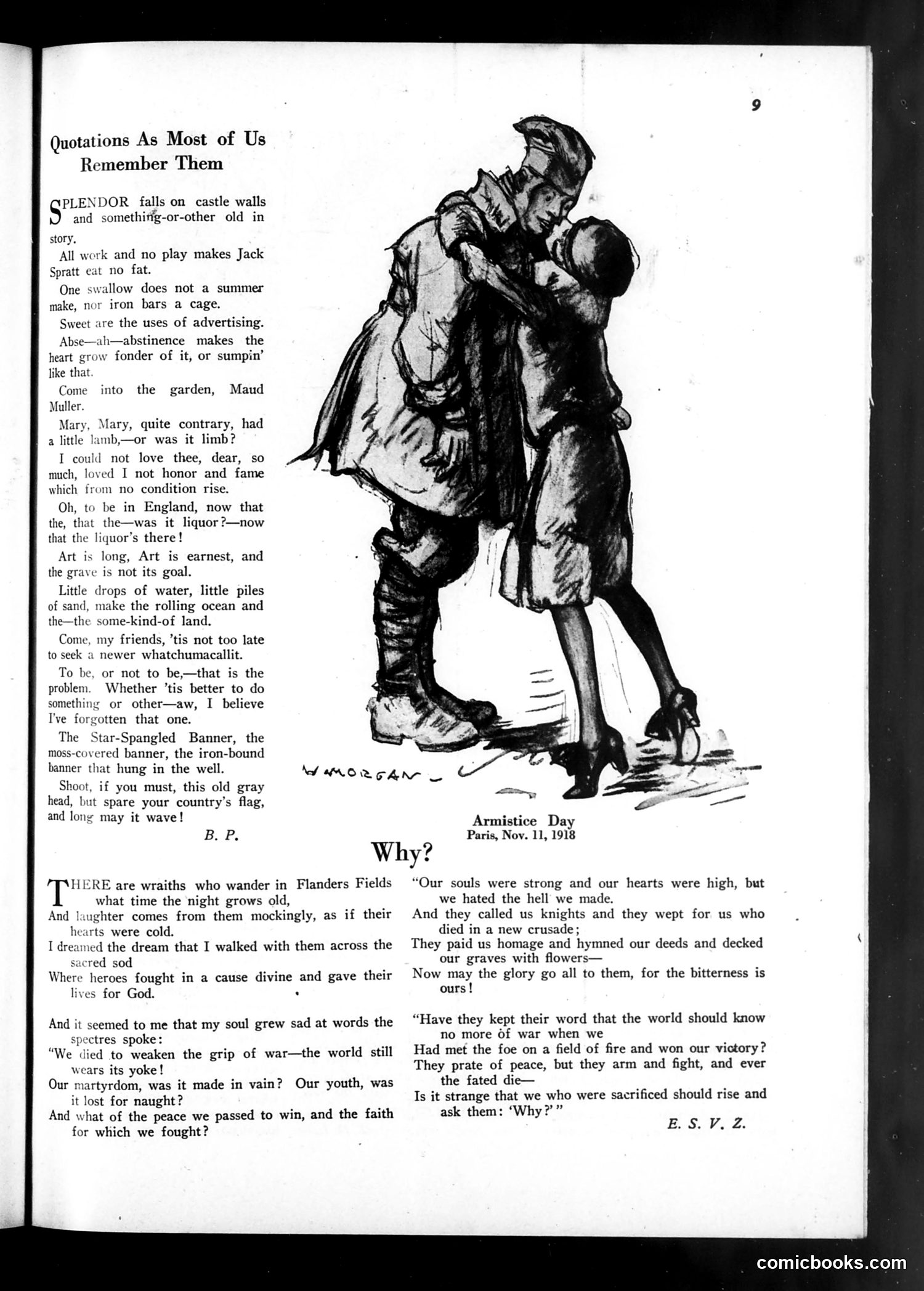
This page commemorates Armistice Day (November 11, 1918), marking the end of World War I. The central illustration depicts a soldier embracing a woman, likely representing the joy and relief of soldiers returning home after the war's conclusion. The poems above and below address the war's human cost and disillusionment. The upper section contains various quotations about life's uncertainties. The lower poem, titled "Why?", expresses the bitterness of fallen soldiers and questions whether the peace achieved justified their sacrifice. It sarcastically references broken promises of peace while leaders continue to "arm and fight." The page reflects post-war ambivalence—celebrating the armistice while mourning losses and questioning whether the victory was worth the cost.
📄 Transcribed text from this page (OCR, searchable)
Machine-transcribed from the original scan — historical spelling and the odd misread are preserved.
Quotations As Most of Us Remember Them PLENDOR falls on castle walls and somethirig-or-other old in story, All work and no play makes Jack Spratt eat no fat. One swallow does not a summer make, nor iron bars a cage. Sweet are the uses of advertising. Abse—ah—abstinence makes the heart grow fonder of it, or sumpin’ like that Come Muller. Mary, Mary, quite contrary, had a little lamb,—or was it limb? I could not love thee, dear, so much, loved I not honor and fame which from no condition rise. Oh, to be in England, now that the, that the—was it liquor ?—now that the liquor’s there! Art is long, Art is earnest, and the grave is not its goal. Little drops of water, little piles of sand, make the rolling ocean and the—the some-kind-of land. Come, my friends, ’tis not too late to seek a newer whatchumacallit. To be, or not to be,—that is the problem. Whether ’tis better to do something or other—aw, I believe I've forgotten that one. The Star-Spangled Banner, the moss-covered banner, the iron-bound banner that hung in the well. Shoot, if you must, this old gray head, but spare your country’s flag, and long may it wave! into the garden, Maud B. P. Armistice Day Paris, Nov. 11, 1918 Why? HERE are wraiths who wander in Flanders Fields what time the night grows old, And laughter comes from them mockingly, as if their hearts were cold. ed the dream that I walked with them across the cred sod heroes fought in a cause divine and gave their lives for God. . I dr Whe And it seemed to me that my soul grew sad at words the spectres spoke: “We died to weaken the grip of war—the world still wears its yoke! Our martyrdom, was it made in vain? Our youth, was it lost for naught? And what of the peace we passed to win, and the faith for which we fought? “Our souls were strong and our hearts were high, but we hated the hell we made. And they called us knights and they wept for us who died in a new crusade; They paid us homage and hymned our deeds and decked our graves with flowers— Now may the glory go all to them, for the bitterness is ours ! “Have they kept their word that the world should know no more of war when we Had met the foe on a field of fire and won our victory? They prate of peace, but they arm and fight, and ever the fated die— Is it strange that we who were sacrificed should rise and ask them: ‘Why?” E.S. V, 2. comicbooks.com