
Life, 1922-11-09 · page 8 of 36
Life — November 9, 1922 — page 8: what you’re looking at
What you’re looking at
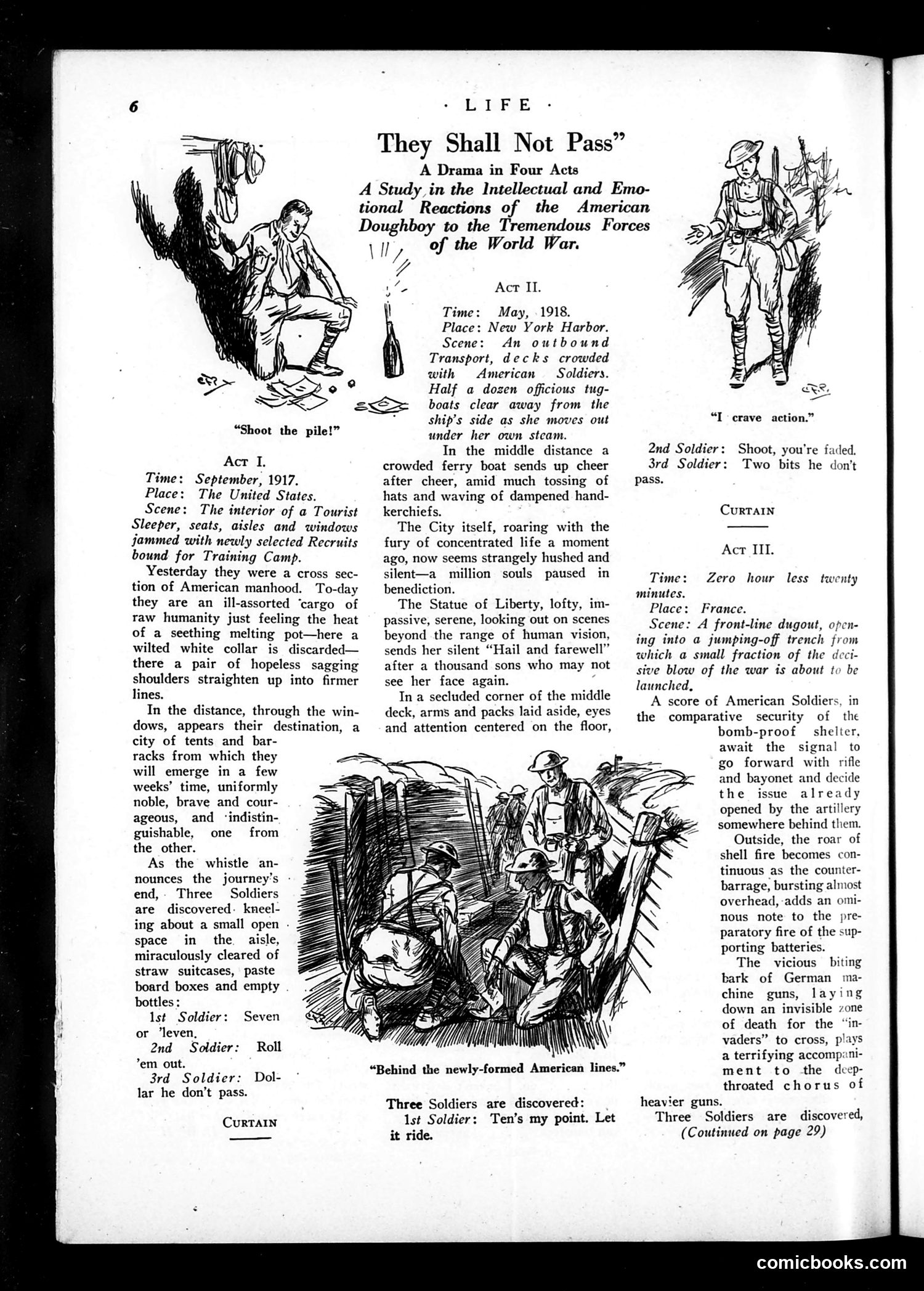
This page presents Act I-III of a four-act play about American soldiers' reactions to World War I. The drama follows recruits from September 1917 through a May 1918 departure from New York Harbor, culminating in a front-line dugout in France. The satirical illustrations depict soldiers in various states—discovering they've been assigned to camps, celebrating departure, and finally in combat. The title references the famous WWI slogan "They shall not pass," meaning Allied determination to stop German advancement. The play appears designed to show American doughboys' emotional journey from naive recruits to combat-hardened troops, likely reflecting contemporary anxieties about American involvement in the war and soldiers' capabilities. The sketches use humor to address serious themes of transformation and sacrifice.
📄 Transcribed text from this page (OCR, searchable)
Machine-transcribed from the original scan — historical spelling and the odd misread are preserved.
LIFE They Shall Not Pass” A Drama in Four Acts A Study, in the Intellectual and Emo- tional Reactions of the American Doughboy to the Tremendous Forces “Shoot the pile!” Acr I, Time: September, 1917. Place: The United States. Scene: The interior of a Tourist Sleeper, seats, aisles and windows jammed with newly selected Recruits bound for Training Camp. Yesterday they were a cross sec- tion of American manhood. To-day they are an ill-assorted ‘cargo of raw humanity just feeling the heat of a seething melting pot—here a wilted white collar is discarded— there a pair of hopeless sagging shoulders straighten up into firmer lines. In the distance, through the win- dows, appears their destination, a city of tents and bar- racks from which they will emerge in a few weeks’ time, uniformly noble, brave and cour- ageous, and ‘indistin- guishable, one from the other. As the whistle an- nounces the journey’s - end,- Three Soldiers are discovered. kneel- ing about a small open - space in the. aisle, miraculously cleared of straw suitcases, paste board boxes and empty bottles : 1st Soldier: or ‘leven, 2nd Soldier: ’em out. 3rd Soldier: lar he don’t pass. Seven Roll Dol- Curtain I of the World War. Y Act II. Time: May, 1918. Place: New York Harbor. Scene: An outbound Transport, decks crowded with American Soldiers. Half a dozen officious tug- boats clear away from the ship’s side as she moves out under her own steam. In the middle distance a crowded ferry boat sends up cheer after cheer, amid much tossing of hats and waving of dampened hand- kerchiefs. The City itself, roaring with the fury of concentrated life a moment ago, now seems strangely hushed and silent—a million souls paused in benediction. The Statue of Liberty, lofty, im- passive, serene, looking out on scenes beyond the range of human vision, sends her silent “Hail and farewell” after a thousand sons who may not see her face again. “ Ina secluded corner of the middle deck, arms and packs laid aside, eyes and attention centered on the floor, “Behind the newly-formed American lines.” Three Soldiers are discovered: lst Soldier: Ten’s my point. Let it ride. “I crave action.” 2nd Soldier: 3rd Soldier: pass. Shoot, you're faded, Two bits he don't Curtain Acr III. Time: minutes. Place: France. Scene: A front-line dugout, open- ing into a jumping-off trench from which a small fraction of the deci- sive blow of the war is about to be launched, A score of American Soldiers, in the comparative security of the bomb-proof shelter. await the signal to go forward with rifle and bayonet and decide the issue already opened by the artillery somewhere behind them. Outside, the roar of shell fire becomes con- tinuous as the counter- barrage, bursting almost overhead, ‘adds an omi- nous note to the pre- paratory fire of the sup- porting batteries. The vicious _ biting bark of German ma- chine guns, laying down an invisible zone of death for the “in- vaders” to cross, plays a terrifying accomp: ment to the deep- throated chorus of heavier guns. Three Soldiers are discovered, (Coutinued on page 29) Zero hour less twenty comicbooks.com