
Life, 1922-11-09 · page 26 of 36
Life — November 9, 1922 — page 26: what you’re looking at
What you’re looking at
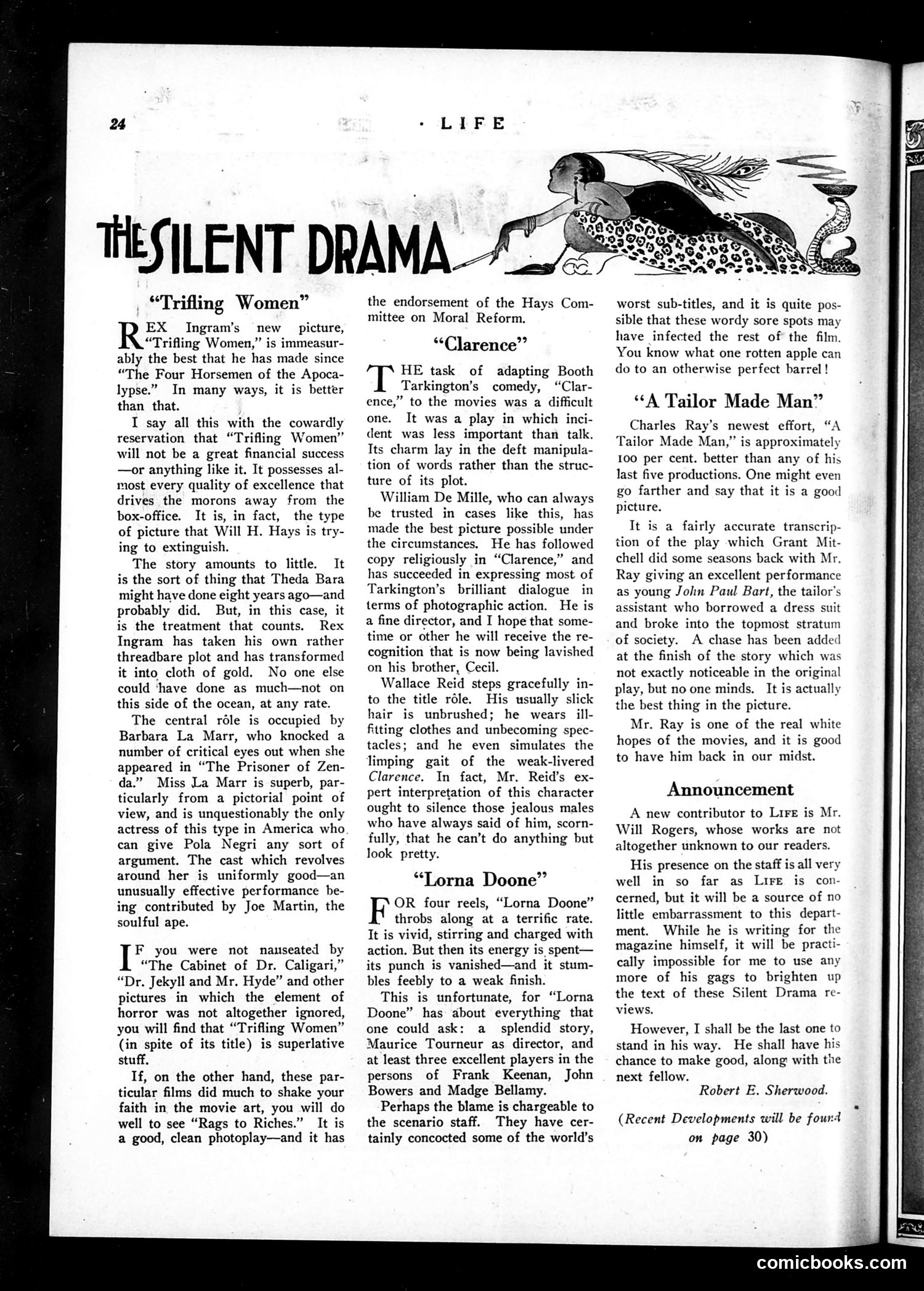
This page contains film criticism from Life magazine's silent film review column. The critic discusses four movies: **"Trifling Women"** (Rex Ingram): Praised as excellent but commercially doomed because it lacks the lowbrow appeal needed for box-office success. The critic notes it's the type of film Will H. Hays (head of Hollywood's moral censorship board) wants to eliminate—suggesting it contains morally questionable content. **"Rags to Riches"**: Presented as the moral alternative, endorsed by Hays's censorship committee. **"Clarence"** and **"Lorna Doone"**: Standard reviews of adaptations, praising directorial skill and performances. The underlying satire: Life mocks the tension between artistic quality and moral censorship. The reviewer celebrates sophisticated filmmaking while noting the Hays Committee suppresses such work in favor of "clean" entertainment—implying censorship damages cinema as an art form.
📄 Transcribed text from this page (OCR, searchable)
Machine-transcribed from the original scan — historical spelling and the odd misread are preserved.
“Trifling Women” EX Ingram’s new picture, “Trifling Women,” is immeasur- ably the best that he has made since “The Four Horsemen of the Apoca- lypse.” In many ways, it is better than that. I say all this with the cowardly reservation that “Trifling Women” will not be a great financial success —or anything like it. It possesses al- most every quality of excellence that drives the morons away from the box-office. It is, in fact, the type of picture that Will H. Hays is try- ing to extinguish. The story amounts to little. It is the sort of thing that Theda Bara might have done eight years ago—and probably did. But, in this case, it is the treatment that counts. Rex Ingram has taken his own rather threadbare plot and has transformed it into cloth of gold. No one else could ‘have done as much—not on this side of the ocean, at any rate. The central réle is occupied by Barbara La Marr, who knocked a number of critical eyes out when she appeared in “The Prisoner of Zen- da.” Miss La Marr is superb, par- ticularly from a pictorial point of view, and is unquestionably the only actress of this type in America who can give Pola Negri any sort of argument. The cast which revolves around her is uniformly good—an unusually effective performance be- ing contributed by Joe Martin, the soulful ape. F you were not nauseated by “The Cabinet of Dr. Caligari,” “Dr. Jekyll and Mr. Hyde” and other pictures in which the element of horror was not altogether ignored, you will find that “Trifling Women” (in spite of its title) is superlative stuff. If, on the other hand, these par- ticular films did much to shake your faith in the movie art, you will do well to see “Rags to Riches.” It is a good, clean photoplay—and it has the endorsement of the Hays Com- mittee on Moral Reform. “Clarence” HE task of adapting Booth Tarkington’s comedy, “Clar- ence,” to the movies was a difficult one. It was a play in which inci- dent was less important than talk. Its charm lay in the deft manipula- tion of words rather than the struc- ture of its plot. William De Mille, who can always be trusted in cases like this, has made the best picture possible under the circumstances. He has followed copy religiously in “Clarence,” and has succeeded in expressing most of Tarkington’s brilliant dialogue in terms of photographic action. He is a fine director, and I hope that some- time or other he will receive the re- cognition that is now being lavished on his brother, Cecil. Wallace Reid steps gracefully in- to the title rdle. His usually slick hair is unbrushed; he wears ill- fitting clothes and unbecoming spec- tacles; and he even simulates the limping gait of the weak-livered Clarence. In fact, Mr. Reid’s ex- pert interpretation of this character ought to silence those jealous males who have always said of him, scorn- fully, that he can’t do anything but look pretty. “Lorna Doone” OR four reels, “Lorna Doone” ." throbs along at a terrific rate. It is vivid, stirring and charged with action. But then its energy is spent— its punch is vanished—and it stum- bles feebly to a weak finish. This is unfortunate, for “Lorna Doone” has about everything that one could ask: a_ splendid story, Maurice Tourneur as director, and at least three excellent players in the persons of Frank Keenan, John Bowers and Madge Bellamy. Perhaps the blame is chargeable to the scenario staff. They have cer- tainly concocted some of the world’s worst sub-titles, and it is quite pos- sible that these wordy sore spots may have infected the rest of the film. You know what one rotten apple can do to an otherwise perfect barrel! “A Tailor Made Man” Charles Ray’s newest effort, “A Tailor Made Man,” is approximately 100 per cent. better than any of his last five productions. One might even go farther and say that it is a good picture, It is a fairly accurate transcrip- tion of the play which Grant Mit- chell did some seasons back with Mr. Ray giving an excellent performance as young John Paul Bart, the tailor’s assistant who borrowed a dress suit and broke into the topmost stratum of society. A chase has been added at the finish of the story which was not exactly noticeable in the original play, but no one minds. It is actually the best thing in the picture. Mr. Ray is one of the real white hopes of the movies, and it is good to have him back in our midst. Announcement A new contributor to Lire is Mr. Will Rogers, whose works are not altogether unknown to our readers. His presence on the staff is all very well in so far as Lire is con- cerned, but it will be a source of no little embarrassment to this depart- ment. While he is writing for the magazine himself, it will be practi- cally impossible for me to use any more of his gags to brighten up the text of these Silent Drama re- views. However, I shall be the last one to stand in his way. He shall have his chance to make good, along with the next fellow. Robert E. Sherwood. (Recent Developments will be fourd on page 30) comicbooks.com