
Life, 1922-11-09 · page 14 of 36
Life — November 9, 1922 — page 14: what you’re looking at
What you’re looking at
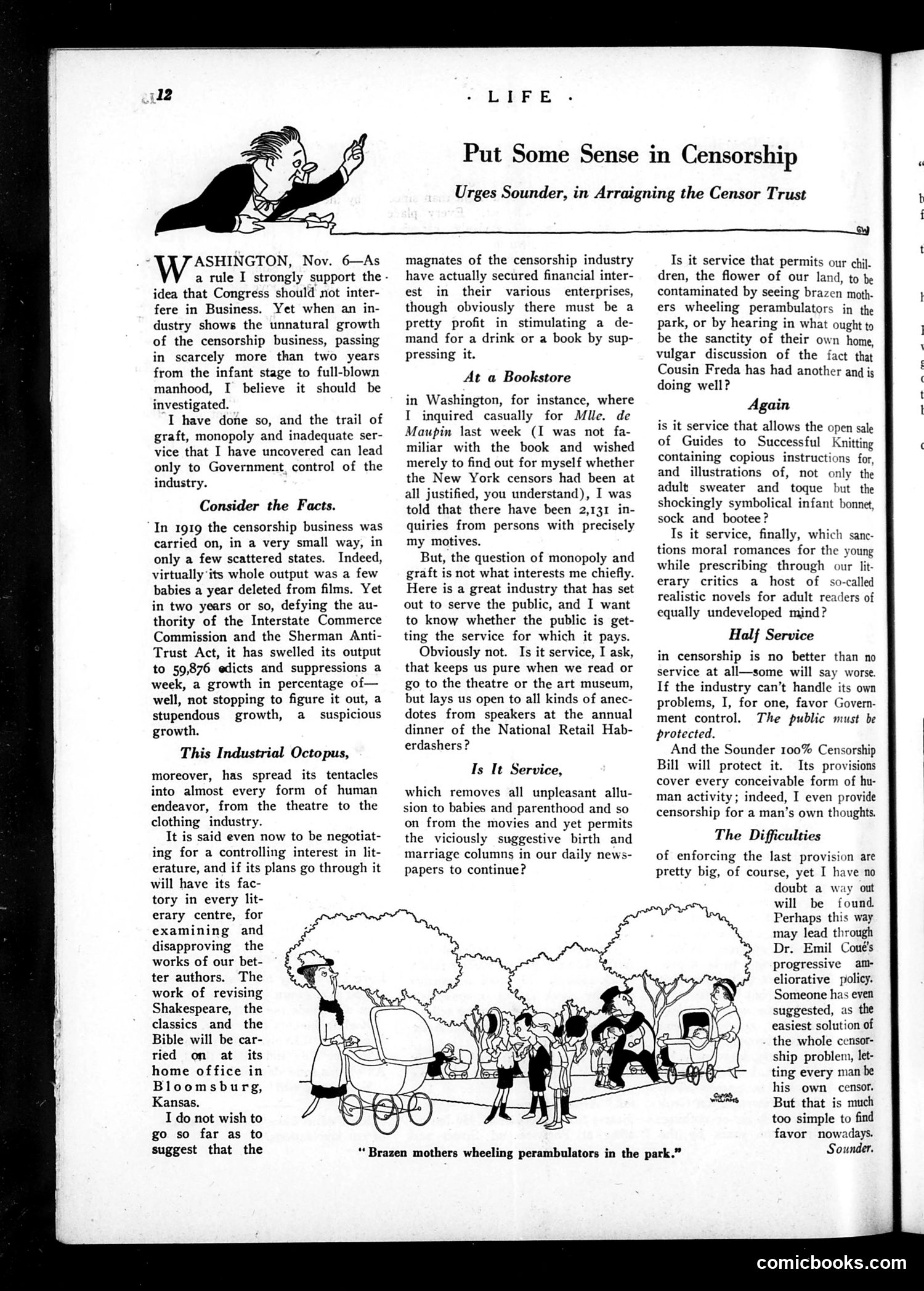
This article by someone named Sounder criticizes the censorship industry's rapid, uncontrolled growth. The author supports Congressional investigation while arguing censorship has expanded from few scattered states to affecting nearly all industries—theater, literature, clothing. The cartoon captioned "Brazen mothers wheeling perambulators in the park" satirizes absurd censorship by showing ordinary mothers with babies being deemed scandalous content requiring removal. This illustrates the author's point: censorship has become ridiculous, extending to innocent public activities. Sounder advocates "Government control" of censorship itself as paradoxically preferable to unregulated private censorship boards. The irony is stark—he proposes government oversight to prevent worse private monopolistic control, suggesting the censorship industry had become an unaccountable trust requiring intervention.
📄 Transcribed text from this page (OCR, searchable)
Machine-transcribed from the original scan — historical spelling and the odd misread are preserved.
ASHINGTON, Nov. 6—As a rule I strongly support the - idea that Congress should not inter- fere in Business. Yet when an in- dustry shows the unnatural growth of the censorship business, passing in scarcely more than two years from the infant stage to full-blown manhood, I believe it should be investigated. I have done so, and the trail of graft, monopoly and inadequate ser- vice that I have uncovered can lead only to Government, control of the industry. Consider the Facts. In 1919 the censorship business was carried on, in a very small way, in only a few scattered states. Indeed, virtually its whole output was a few babies a year deleted from films. Yet in two years or so, defying the au- thority of the Interstate Commerce Commission and the Sherman Anti- Trust Act, it has swelled its output to 59,876 edicts and suppressions a week, a growth in percentage of— well, not stopping to figure it out, a stupendous growth, a _ suspicious growth. This Industrial Octopus, moreover, has spread its tentacles into almost every form of human endeavor, from the theatre to the clothing industry. It is said even now to be negotiat- ing for a controlling interest in lit- erature, and if its plans go through it will have its fac- tory in every lit- erary centre, for examining and disapproving the works of our bet- ter authors. The work of revising Shakespeare, the classics and the Bible will be car- tied on at its home office in Bloomsburg, Kansas. I do not wish to go so far as to suggest that the - LIFE Put Some Sense in Censorship Urges Sounder, in Arraigning the Censor Trust magnates of the censorship industry have actually secured financial inter- est in their various enterprises, though obviously there must be a pretty profit in stimulating a de- mand for a drink or a book by sup- pressing it. At a Bookstore in Washington, for instance, where I inquired casually for Mlle. de Maupin last week (I was not fa- miliar with the book and wished merely to find out for myself whether the New York censors had been at all justified, you understand), I was told that there have been 2,131 in- quiries from persons with precisely my motives. But, the question of monopoly and graft is not what interests me chiefly. Here is a great industry that has set out to serve the public, and I want to know whether the public is get- ting the service for which it pays. Obviously not. Is it service, I ask, that keeps us pure when we read or go to the theatre or the art museum, but lays us open to all kinds of anec- dotes from speakers at the annual dinner of the National Retail Hab- erdashers? Is It Service, which removes all unpleasant allu- sion to babies and parenthood and so on from the movies and yet permits the viciously suggestive birth and marriage columns in our daily news- papers to continue? “Brazen mothers wheeling perambulators in the park.” Is it service that permits our chil. dren, the flower of our land, to be contaminated by seeing brazen moth- ers wheeling perambulators in the park, or by hearing in what ought to be the sanctity of their own home, vulgar discussion of the fact that Cousin Freda has had another and is doing well? Again is it service that allows the open sale of Guides to Successful Knitting containing copious instructions for, and illustrations of, not only the adult sweater and toque but the shockingly symbolical infant bonnet, sock and bootee? Is it service, finally, which sane- tions moral romances for the young while prescribing through our lit- erary critics a host of so-called realistic novels for adult readers of equally undeveloped mind? Half Service in censorship is no better than no service at all—some will say worse. If the industry can’t handle its own problems, I, for one, favor Govern- ment control. The public must be protected. And the Sounder 100% Censorship Bill will protect it. Its provisions cover every conceivable form of hu- man activity; indeed, I even provide censorship for a man’s own thoughts. The Difficulties of enforcing the last provision are pretty big, of course, yet I have no doubt a way out will be found Perhaps this way may lead through Dr. Emil Coué's progressive am eliorative policy. Someone has even suggested, as the easiest solution of the whole censor- ship problem, let- ting every man be his own censor. But that is much too simple to find favor nowadays. Sounder. comicbooks.com