
Life, 1922-11-09 · page 16 of 36
Life — November 9, 1922 — page 16: what you’re looking at
What you’re looking at
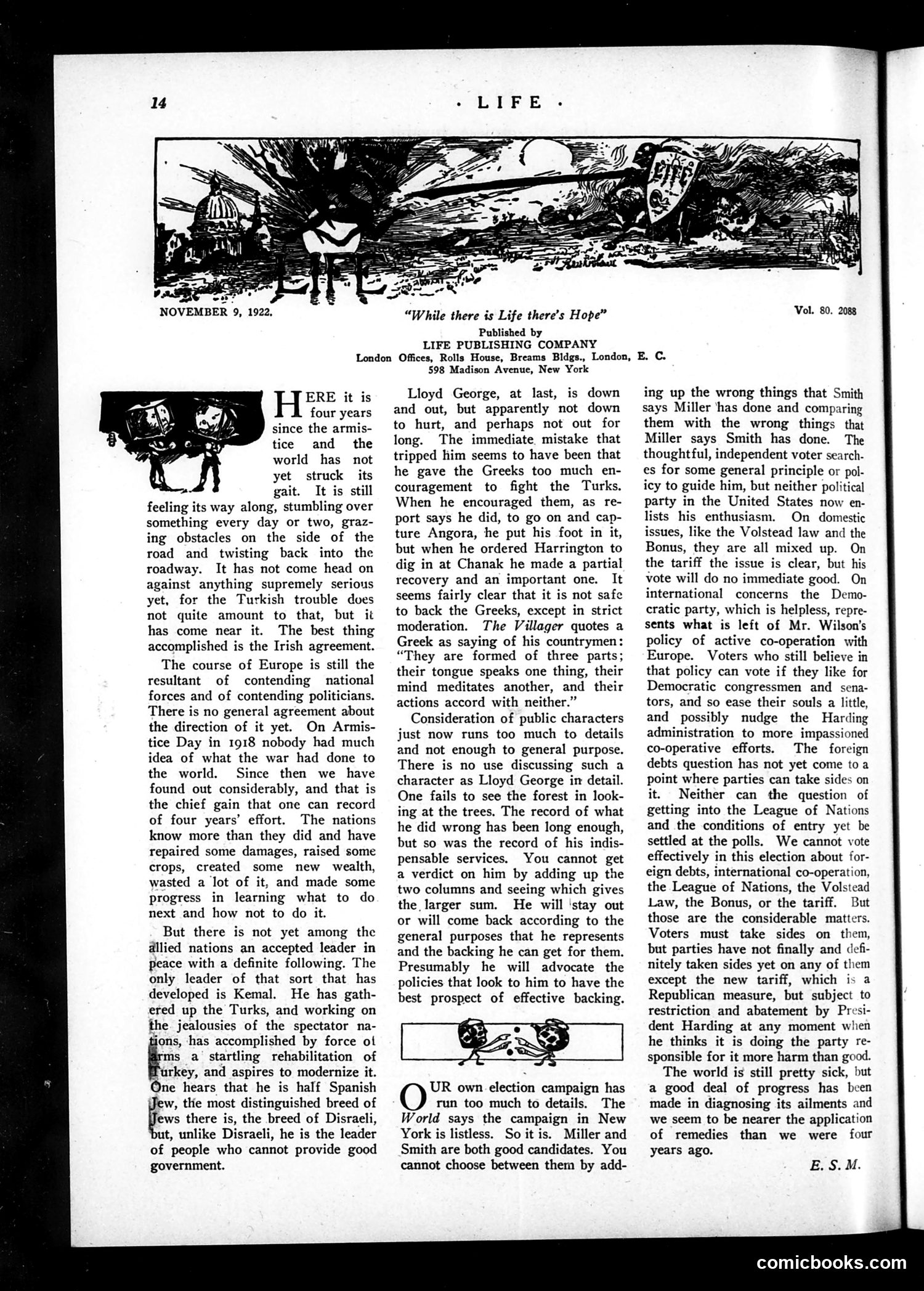
This November 9, 1922 *Life* page discusses British Prime Minister Lloyd George's political struggles following World War I. The text critiques George's inconsistent foreign policy, particularly regarding Turkey and Greece, suggesting he backed the wrong side in their conflict. The article argues George lacks a "definite following" among allied nations and questions his effectiveness as a leader. It also comments on the American election campaign, dismissing both Miller and Smith as candidates while noting that voters cannot meaningfully distinguish between them. The decorative header illustration appears to show classical or allegorical imagery relating to hope and civilization, though specific figures remain unclear.
📄 Transcribed text from this page (OCR, searchable)
Machine-transcribed from the original scan — historical spelling and the odd misread are preserved.
NOVEMBER 9, 1922, “While there is Life there’s Hope” Published by LIFE PUBLISHING COMPANY ‘Vol. 80. 2088 London Offices, Rolls House, Breams Bldgs., London, E. C. ERE it is four years since the armis- tice and the world has not yet struck its gait. It is still feeling its way along, stumbling over something every day or two, graz- ing obstacles on the side of the road and twisting back into the roadway. It has not come head on against anything supremely serious yet, for the Turkish trouble does not quite amount to that, but it has come near it. The best thing accomplished is the Irish agreement. The course of Europe is still the resultant of contending national forces and of contending politicians. There is no general agreement about the direction of it yet. On Armis- tice Day in 1918 nobody had much idea of what the war had done to the world. Since then we have found out considerably, and that is the chief gain that one can record of four years’ effort. The nations know more than they did and have repaired some damages, raised some crops, created some new wealth, wasted a lot of it, and made some progress in learning what to do next and how not to do it. But there is not yet among the allied nations an accepted leader in peace with a definite following. The only leader of that sort that has developed is Kemal. He has gath- ered up the Turks, and working on the jealousies of the spectator na- jons, ‘has accomplished by force of ms a startling rehabilitation of furkey, and aspires to modernize it. One hears that he is half Spanish Jew, the most distinguished breed of lews there is, the breed of Disraeli, ut, unlike Disraeli, he is the leader of people who cannot provide good government. 598 Madison Avenue, New York Lloyd George, at last, is down and out, but apparently not down to hurt, and perhaps not out for long. The immediate. mistake that tripped him seems to have been that he gave the Greeks too much en- couragement to fight the Turks. When he encouraged them, as re- port says he did, to go on and cap- ture Angora, he put his foot in it, but when he ordered Harrington to dig in at Chanak he made a partial recovery and an important one. It seems fairly clear that it is not safe to back the Greeks, except in strict moderation. The Villager quotes a Greek as saying of his countrymen: “They are formed of three parts; their tongue speaks one thing, their mind meditates another, and their actions accord with neither.” Consideration of public characters just now runs too much to details and not enough to general purpose. There is no use discussing such a character as Lloyd George in detail. One fails to see the forest in look- ing at the trees. The record of what he did wrong has been long enough, but so was the record of his indis- pensable services. You cannot get a verdict on him by adding up the two columns and seeing which gives the larger sum. He will ‘stay out or will come back according to the general purposes that he represents and the backing he can get for them. Presumably he will advocate the policies that look to him to have the best prospect of effective backing. UR own election campaign has run too much to details. The World says the campaign in New York is listless. So it is. Miller and Smith are both good candidates. You cannot choose between them by add- ing up the wrong things that Smith says Miller ‘has done and comparing them with the wrong things that Miller says Smith has done. The thoughtful, independent voter search- es for some general principle or pol- icy to guide him, but neither political party in the United States now en- lists his enthusiasm. On domestic issues, like the Volstead law and the Bonus, they are all mixed up. On the tariff the issue is clear, but his vote will do no immediate good. On international concerns the Demo- cratic party, which is helpless, repre- sents what is left of Mr. Wilson's policy of active co-operation with Europe. Voters who still believe in that policy can vote if they like for Democratic congressmen and sena- tors, and so ease their souls a little, and possibly nudge the Harding administration to more impassioned co-operative efforts. The foreign debts question has not yet come toa point where parties can take sides on it. Neither can the question of getting into the League of Nations and the conditions of entry yet be settled at the polls. We cannot vote effectively in this election about for- eign debts, international co-operation, the League of Nations, the Volstead Law, the Bonus, or the tariff. But those are the considerable matters. Voters must take sides on them, but parties have not finally and defi- nitely taken sides yet on any of them except the new tariff, which is a Republican measure, but subject to restriction and abatement by Presi- dent Harding at any moment when he thinks it is doing the party re- sponsible for it more harm than good. The world is still pretty sick, but a good deal of progress has been made in diagnosing its ailments and we seem to be nearer the application of remedies than we were four years ago. E. S.M. comicbooks.com