
A complete issue · 60 pages · 1919
Life — April 3, 1919
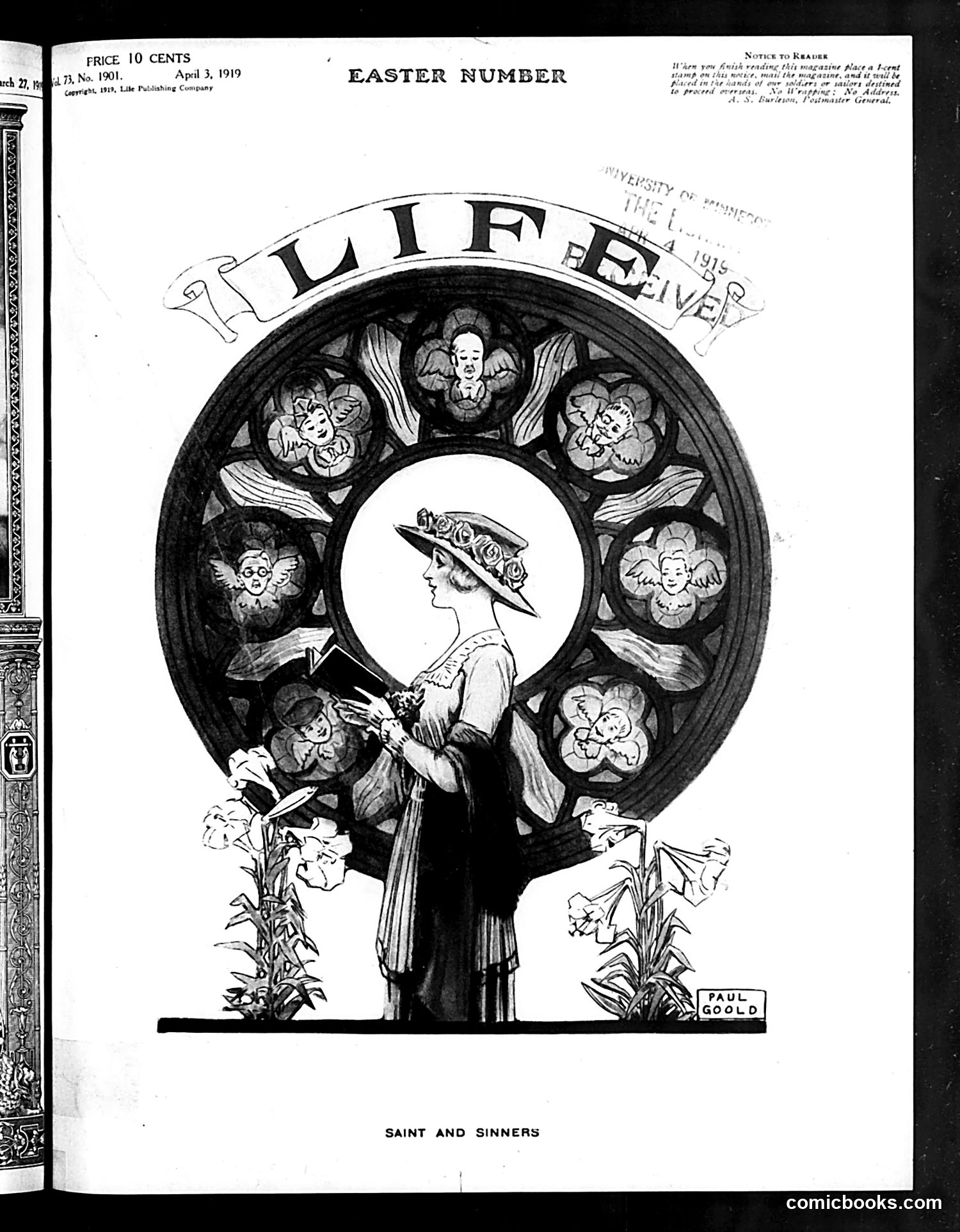
This Paul Gould illustration depicts a woman in an Easter bonnet surrounded by cherub faces arranged in a circular halo formation. The title "Saint and Sinners" suggests a commentary on Easter hypocrisy—the contrast between religious observance and actual moral behavior. The cherubs likely represent innocence or virtue, while the woman's fashionable Easter attire (the elaborate hat was a symbol of Easter display) may satirize shallow materialism masquerading as piety. The composition invokes religious iconography (halos, angels) while depicting worldly vanity, suggesting post-World War I society's disconnect between professed Christian values and the pursuit of fashionable appearances and social status during Easter celebrations.
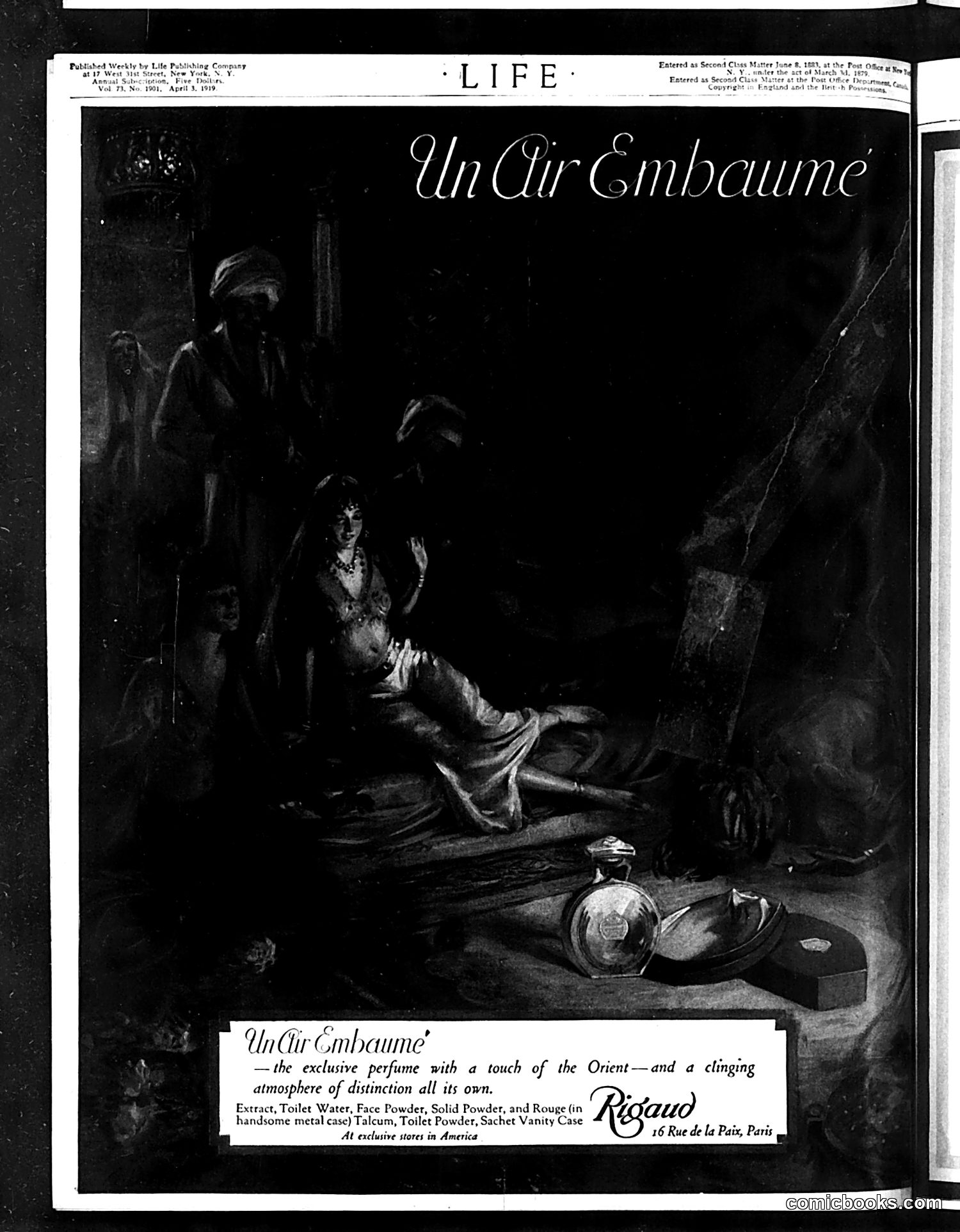
This page is **primarily an advertisement**, not political satire. It's a full-page ad for "Un Cir Embaume," a perfume by Rigaud (16 Rue de la Paix, Paris). The ad uses an Orientalist fantasy scene to market the product—showing a seated woman surrounded by shadowy figures in what appears to be an exotic, mysterious setting. A perfume bottle and vanity case are displayed in the foreground. The copy emphasizes the perfume's "touch of the Orient" and "clinging atmosphere of distinction." This reflects early 20th-century Western consumer culture's fascination with romanticized "Eastern" imagery to sell luxury goods to affluent women. There is **no political cartoon or satire** on this page—it's commercial marketing using period aesthetic conventions.
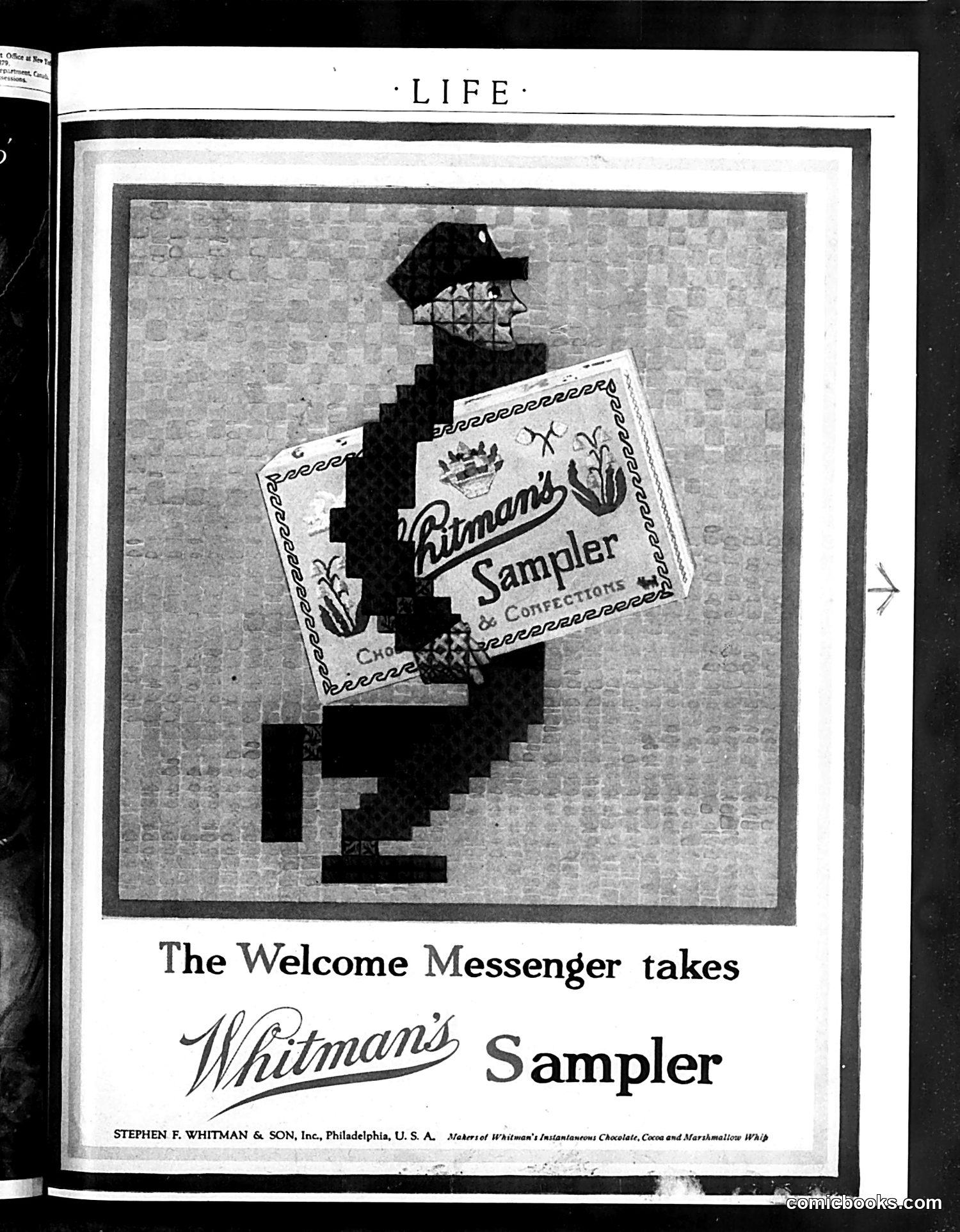
This page is primarily a **product advertisement** for Whitman's Sampler chocolates, not political satire. The image depicts a stylized figure in formal attire (top hat, coat) carrying a box of Whitman's Sampler confections. The tagline "The Welcome Messenger takes Whitman's Sampler" frames the candy box as a gift-giving messenger—likely playing on the tradition of presenting chocolates as a courteous or romantic gesture. The "Welcome Messenger" concept suggests the product arrives as a pleasant, socially appropriate present. The ad was placed in *Life* magazine to reach its affluent readership. The ornate decorative border on the chocolate box and formal presentation reflect early 20th-century marketing aesthetics emphasizing refinement and quality.
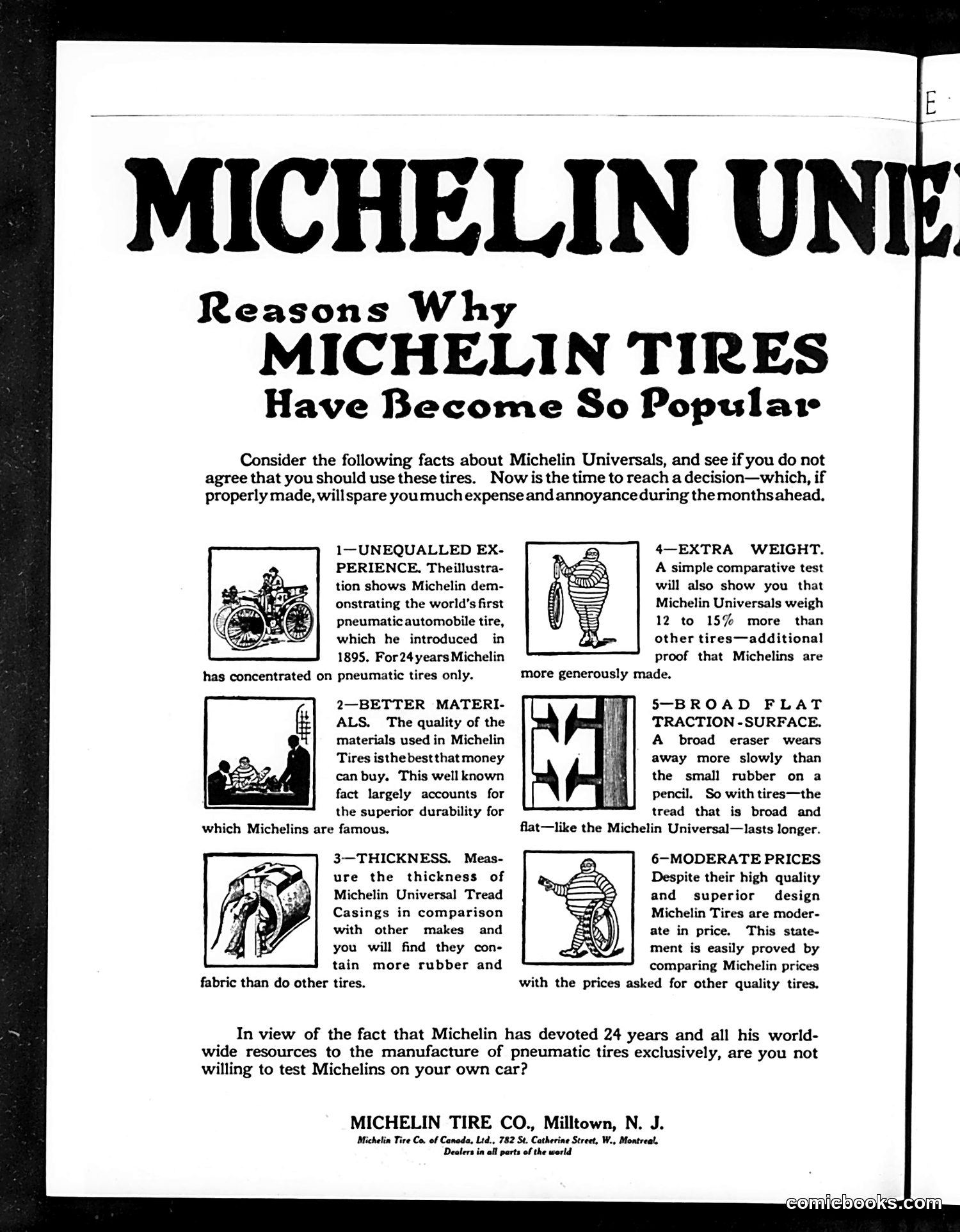
This is **not a satirical cartoon page** — it's a straightforward **advertisement for Michelin Tires** from an early 20th-century publication. The page presents six numbered reasons explaining Michelin's market popularity: unequaled experience (citing their 1895 pneumatic tire invention), superior materials, tire thickness, extra weight, broad tread surface, and moderate pricing. Each point includes a small illustration: early automobiles, factory workers, tire cross-sections, and the Michelin Man mascot (the anthropomorphic tire figure). The ad concludes with a sales pitch challenging readers to test Michelin tires themselves, given the company's 24-year specialization in pneumatic tires. This is corporate marketing, not satire or editorial cartooning.
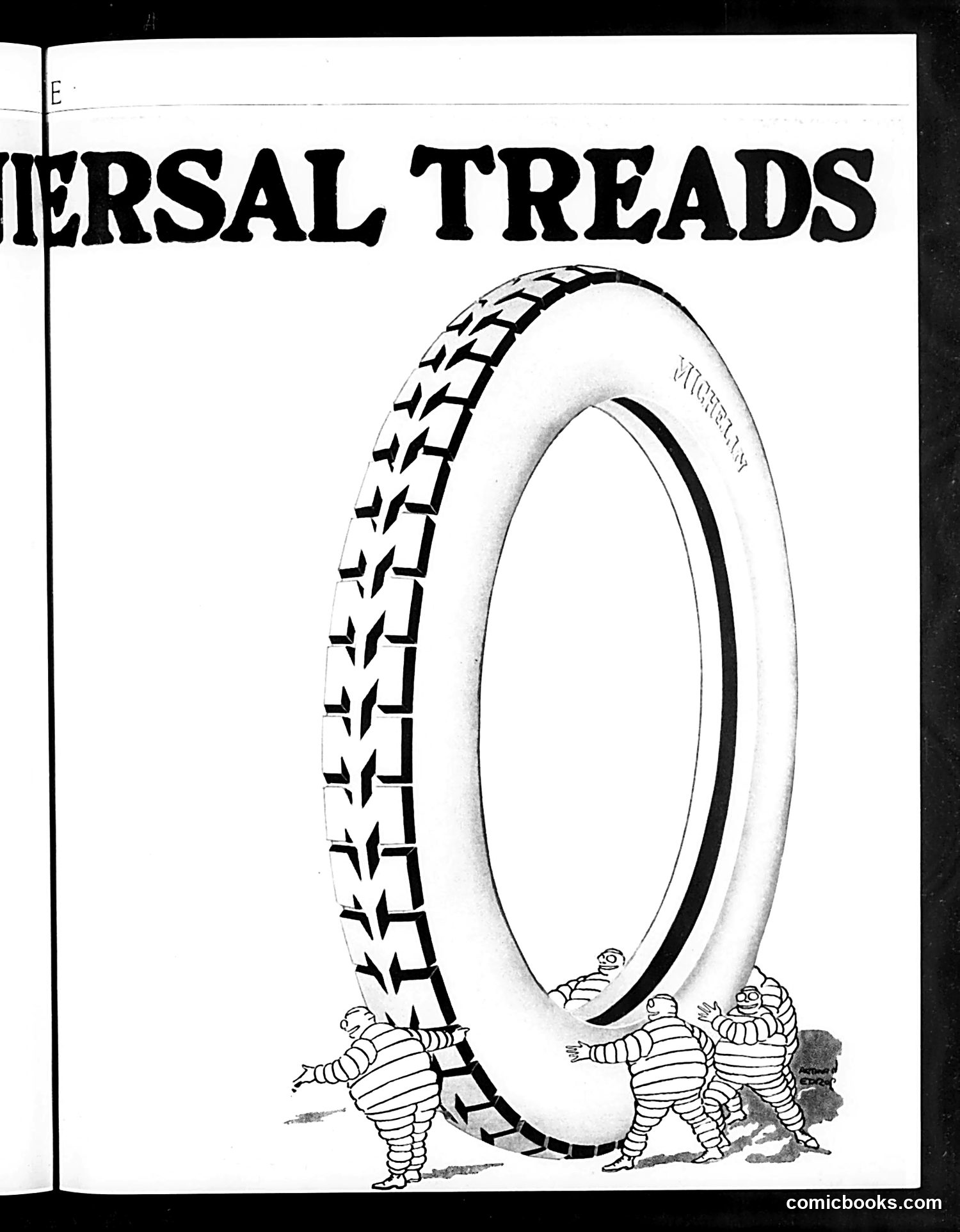
This appears to be a vintage advertisement for Universal Treads tires, likely from the early 20th century. The image shows a large tire with distinctive tread patterns being held up by three cartoon figures styled as the Michelin Man (the puffy, anthropomorphic mascot made of tire rings). The satire likely mocks or parodies the famous Michelin brand's iconic mascot and marketing dominance in the tire industry. By depicting multiple "Michelin men" struggling to support a competitor's product, the ad humorously suggests Universal Treads' superiority and weight/importance compared to rival brands. The visual joke plays on the recognizable mascot character as shorthand for tire advertising of this era.
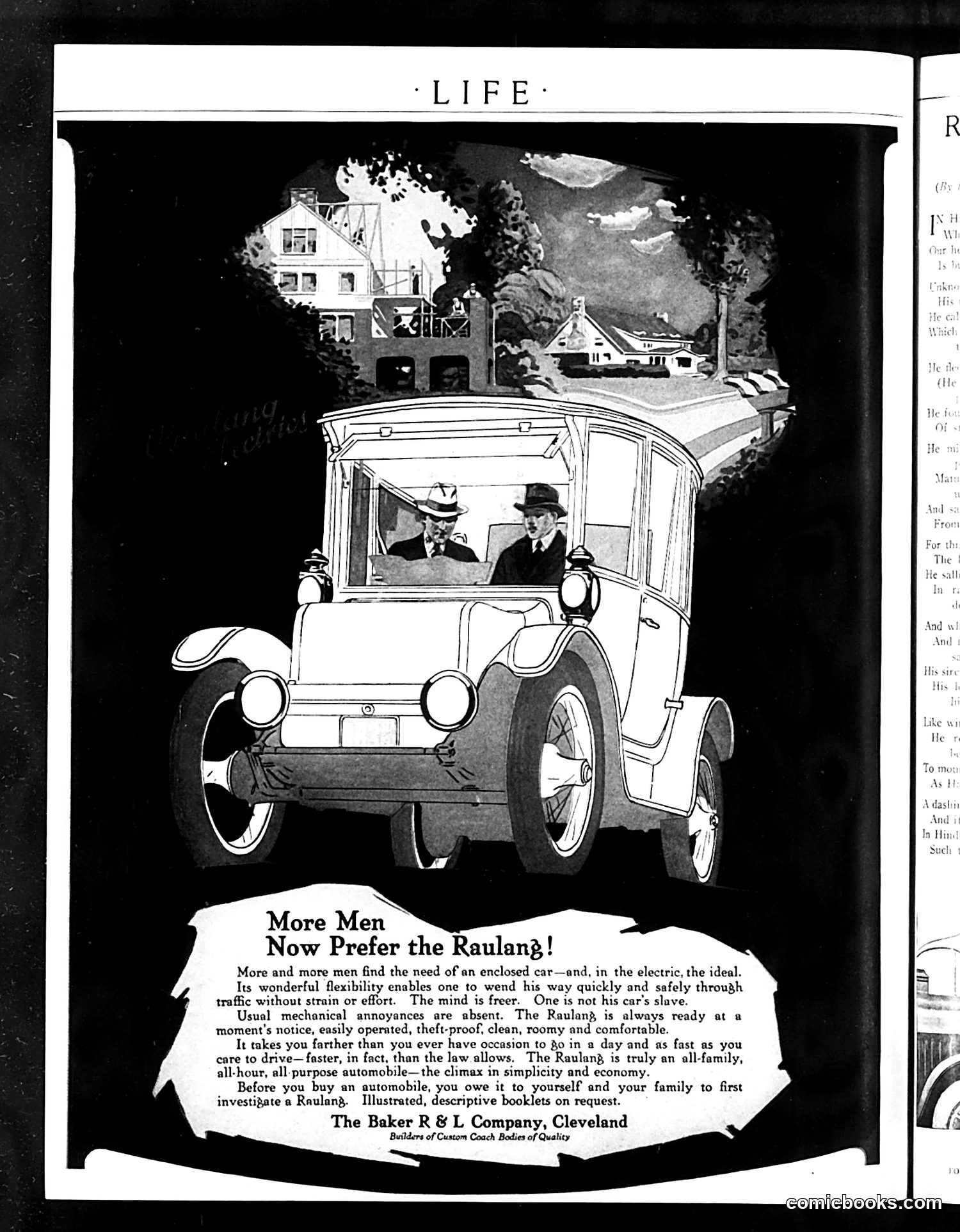
This is primarily a **Raulang automobile advertisement**, not political satire. The Baker R & L Company of Cleveland is marketing their "Raulang" electric car to male drivers. The ad's appeal targets practical concerns of the era: electric cars offered reliability, ease of operation, and freedom from mechanical annoyances plaguing gasoline vehicles. The tagline "More Men Now Prefer the Raulang!" suggests electric automobiles were gaining acceptance among skeptical male consumers who traditionally favored gas-powered cars. The illustration shows two well-dressed men in an open-air Raulang, with pastoral scenery visible through the windshield, emphasizing comfort and leisurely driving. The copy emphasizes the car's flexibility, cleanliness, and all-purpose utility for modern family life—positioning electric vehicles as the sophisticated choice for discerning drivers.
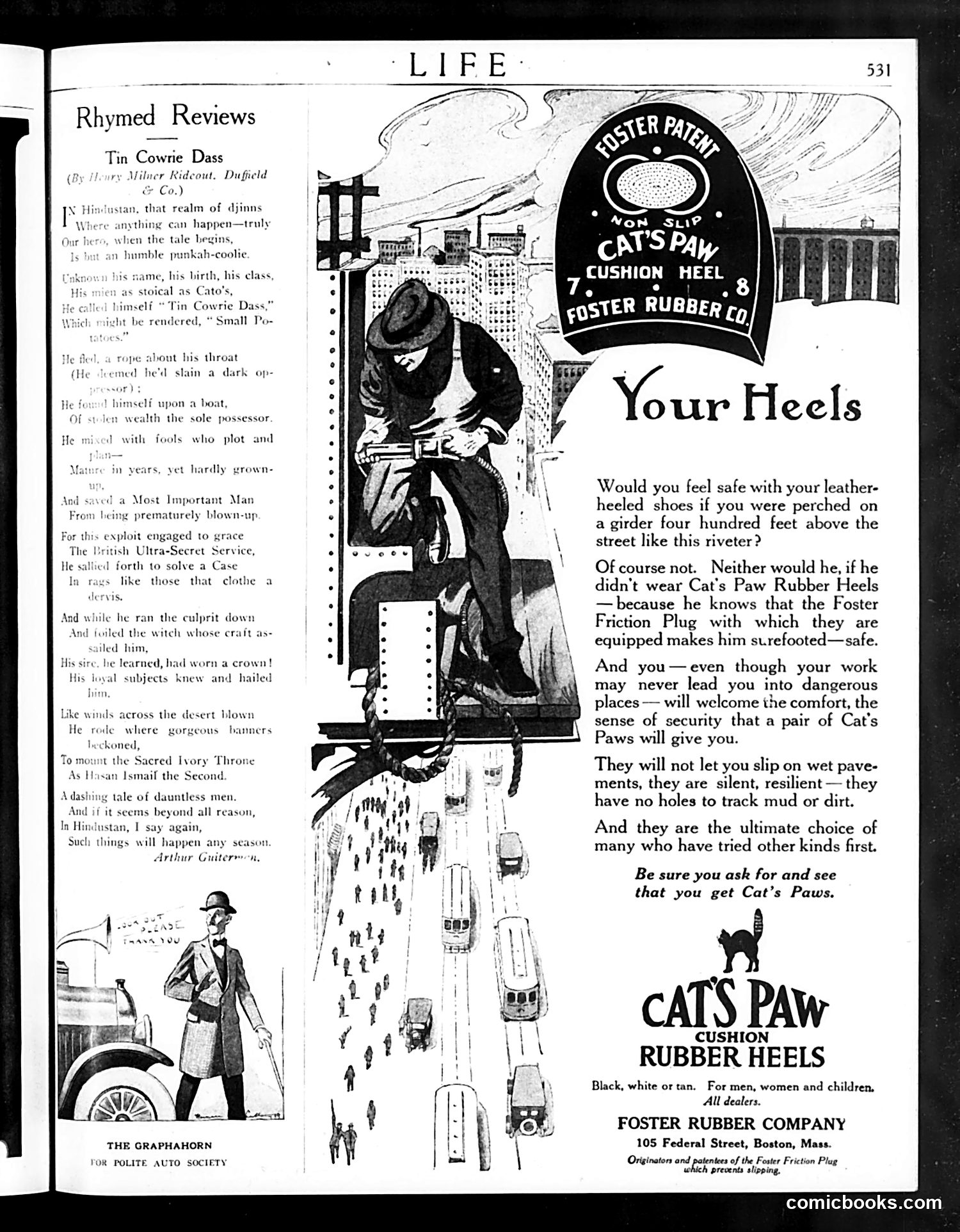
This page contains a poetry section ("Rhymed Reviews") on the left featuring "Tin Cowrie Dass" by Henry Milner Rideout, a satirical verse about a character who acquires wealth through dubious means and is eventually caught and executed by authorities. The poem's protagonist is described as someone who "stole with tools who plot and plan" and ultimately faces a "crown"—likely gallows. The right side is a full-page advertisement for Cat's Paw Cushion Rubber Heels by Foster Rubber Company. The ad features an illustration of a man on a rooftop above a city street and uses safety messaging: rubber heels prevent slipping on wet pavements and offer security. The ad targets "men, women and children" and emphasizes this product as the superior choice among rubber heel options.
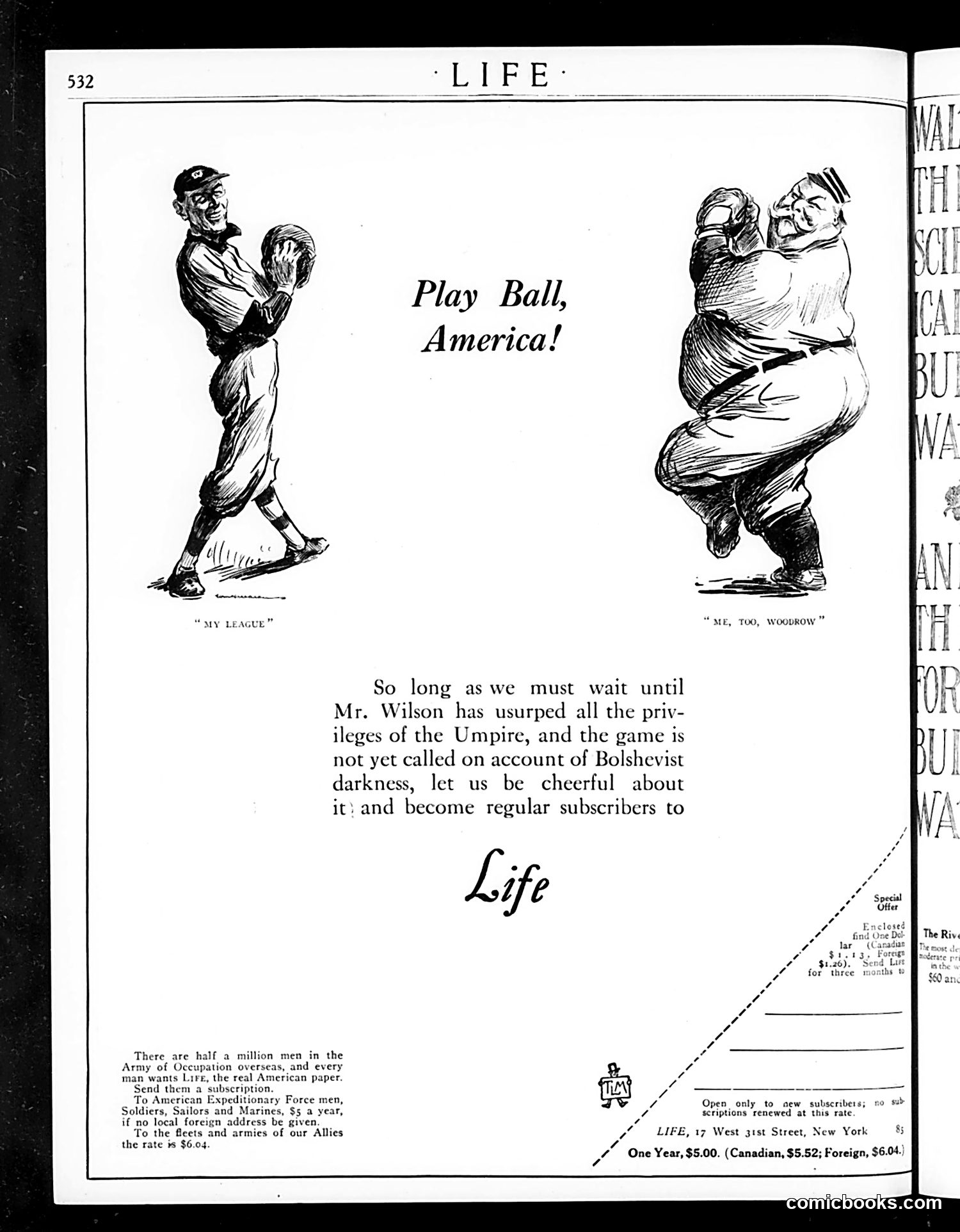
This Life magazine page satirizes baseball during WWI using two illustrations labeled "MY LEAGUE" and "ME, TOO, WOODROW." The left figure represents professional baseball; the right caricature is labeled to reference President Woodrow Wilson. The accompanying text criticizes Wilson for "usurping all the privileges of the Umpire"—a metaphor for excessive executive power—and jokes that the game cannot proceed due to "Bolshevik darkness" (likely referring to the Russian Revolution and post-war communist fears). The satire suggests Wilson has taken over baseball's authority like an autocratic umpire, preventing normal play. The piece ironically urges readers to "Play Ball, America!" and subscribe to Life magazine despite these wartime disruptions, while noting half a million soldiers overseas want access to the publication.
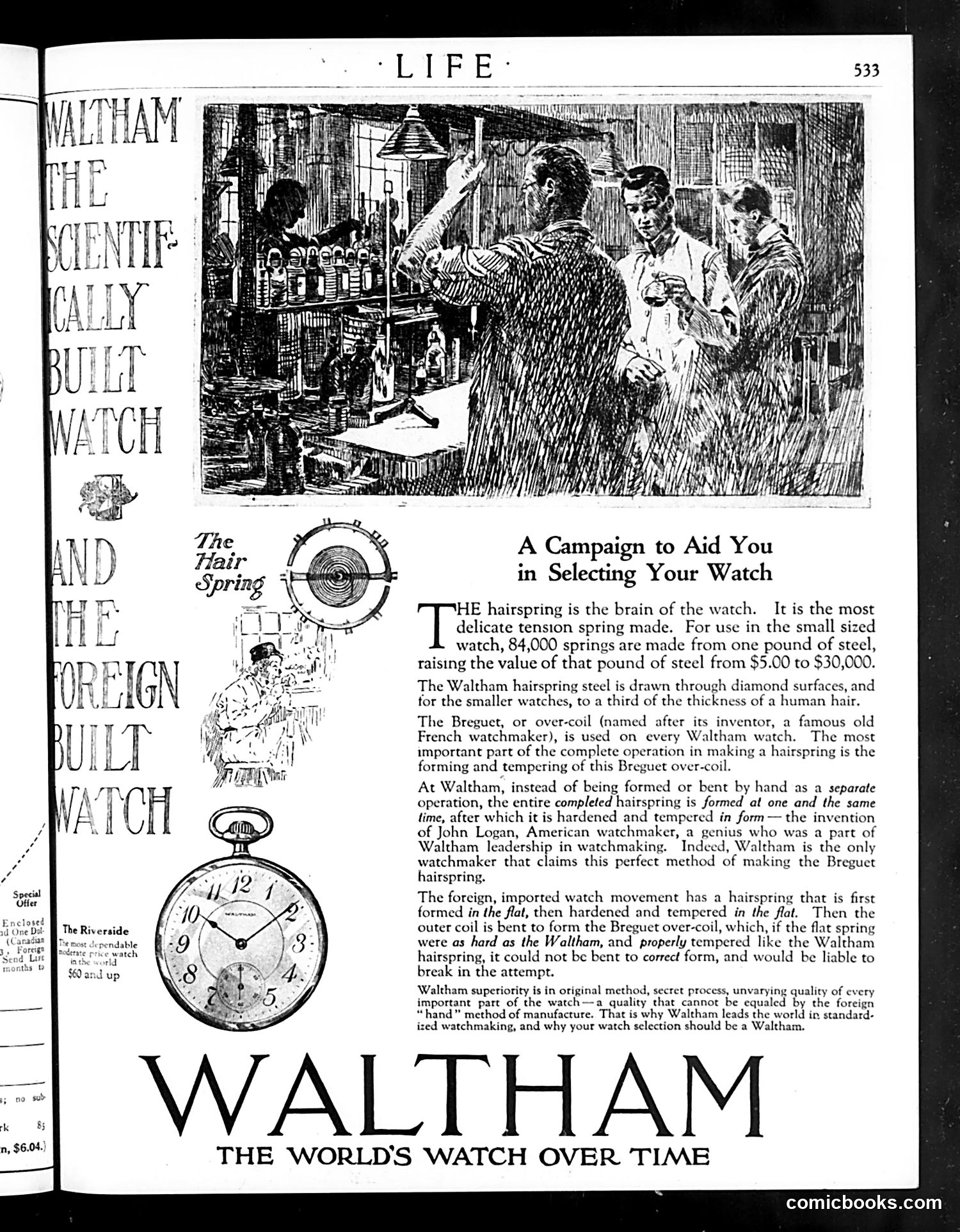
This is primarily a **Waltham Watch advertisement**, not a political cartoon. The page features a technical explanation of the hairspring mechanism that makes precision watchmaking possible. The illustrated scene at top shows men in a laboratory or factory examining watches—depicting Waltham's manufacturing process as scientifically rigorous. The text emphasizes that Waltham, unlike foreign competitors, forms the hairspring through an innovative single continuous process rather than hand-bending, making their watches more reliable. The "campaign to aid you in selecting your watch" is marketing rhetoric: the ad argues Waltham's superior manufacturing method justifies choosing their brand. The Breguet over-coil design is presented as exclusive to Waltham among American makers. This reflects early 20th-century industrial advertising that positioned American mass-production methods as technically superior to traditional European craftsmanship.
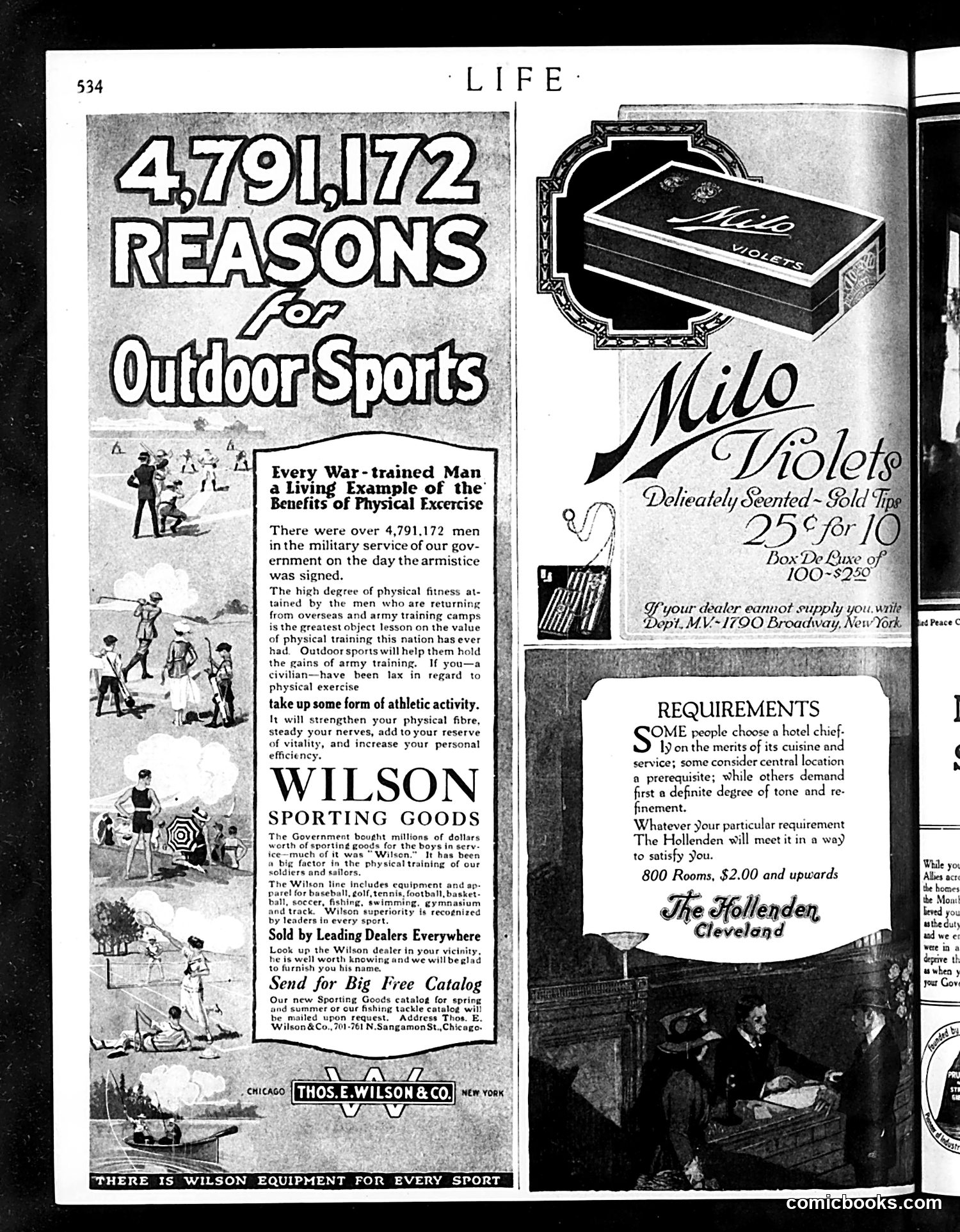
This page is primarily **advertising, not editorial content or satire**. The left side features a Wilson Sporting Goods advertisement with the headline "4,791,172 REASONS for Outdoor Sports," referencing the number of men in military service during World War I. The copy argues that physical fitness from sports prepared soldiers for combat and suggests civilians should also exercise. The right side contains two separate advertisements: one for Milo Violet perfume and another for The Hollenden hotel in Cleveland. There are no political cartoons or satirical commentary on this page. The "reasons" framing is straightforward marketing copy capitalizing on patriotic sentiment and wartime consciousness rather than satire.
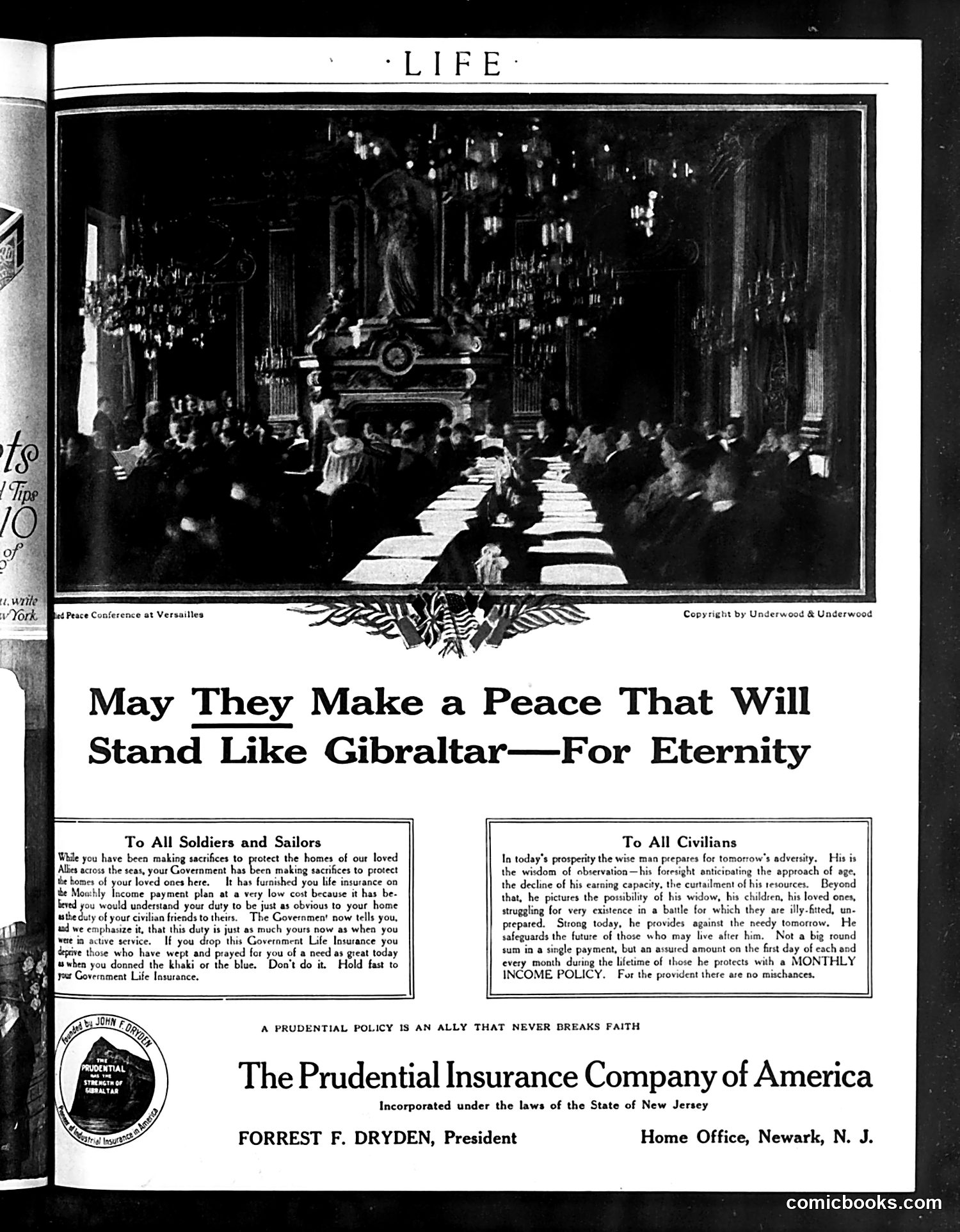
This page is primarily a **Prudential Insurance advertisement** rather than political satire. The image shows what appears to be the Paris Peace Conference at Versailles (noted in the caption), depicting delegates in a grand hall beneath a statue. The ad uses the post-WWI peace negotiations as an aspirational backdrop, appealing to soldiers, sailors, and civilians with messaging about life insurance as financial protection for families. The headline promises a lasting peace "like Gibraltar—For Eternity," connecting international stability with personal financial security. Two text boxes address different audiences: soldiers/sailors are urged to secure government life insurance, while civilians are encouraged to purchase Prudential's "Monthly Income Policy" for long-term family protection. The advertisement emphasizes reliability and duty during uncertain times.
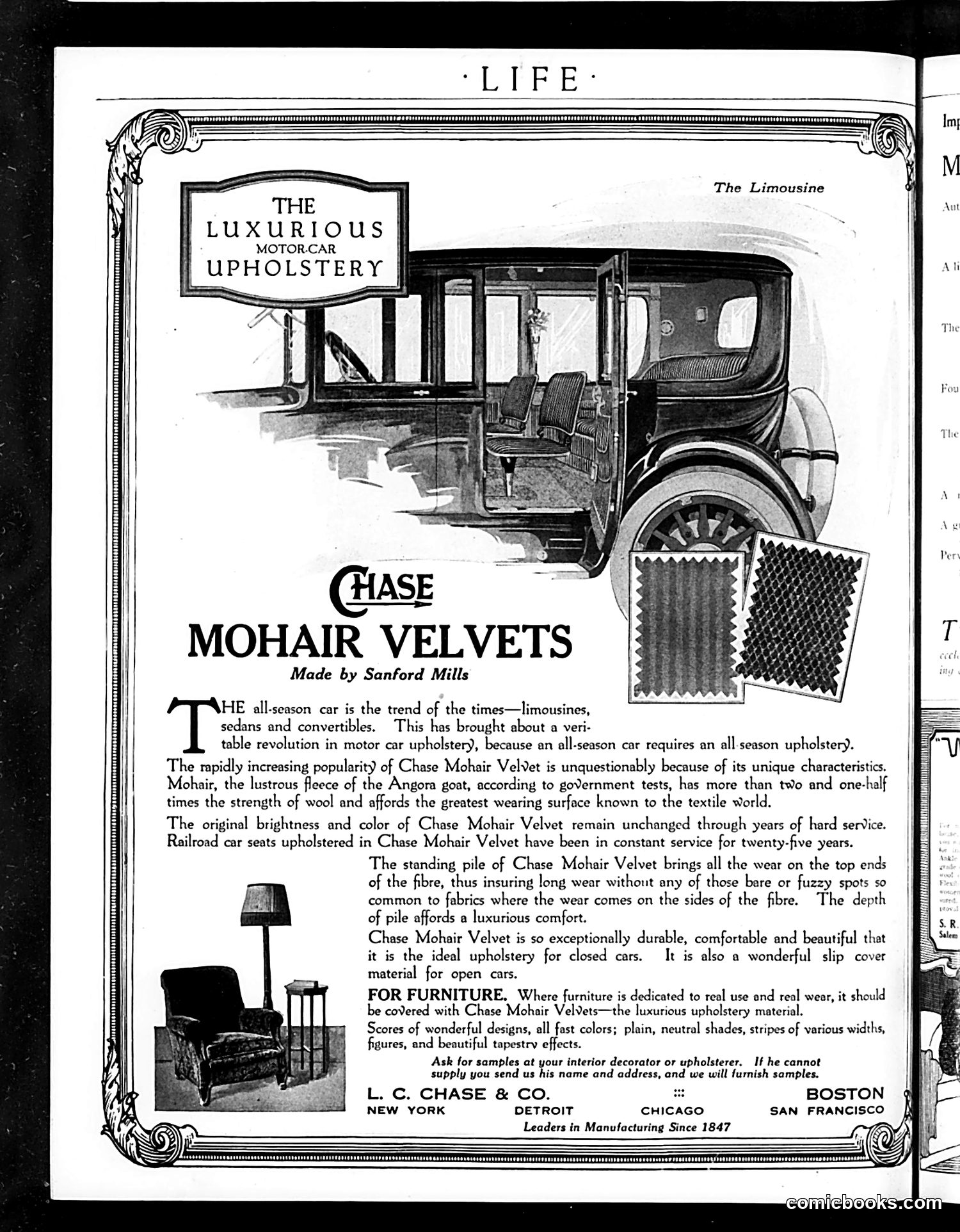
This page is **primarily an advertisement**, not satirical content. It's a full-page ad for Chase Mohair Velvets, a luxurious upholstery fabric made by Sanford Mills and sold by L.C. Chase & Co. The ad targets affluent consumers by emphasizing the fabric's use in high-end automobiles (the limousine illustrated) and fine furniture. The marketing emphasizes durability, appearance retention, and comfort—key selling points for wealthy buyers investing in quality furnishings. The text highlights the fabric's superior wear resistance compared to wool, its elegant appearance in various colors and patterns (shown in fabric swatches), and its suitability for both car interiors and home furniture. This reflects early 20th-century consumer culture where luxury automotive upholstery was a status symbol.
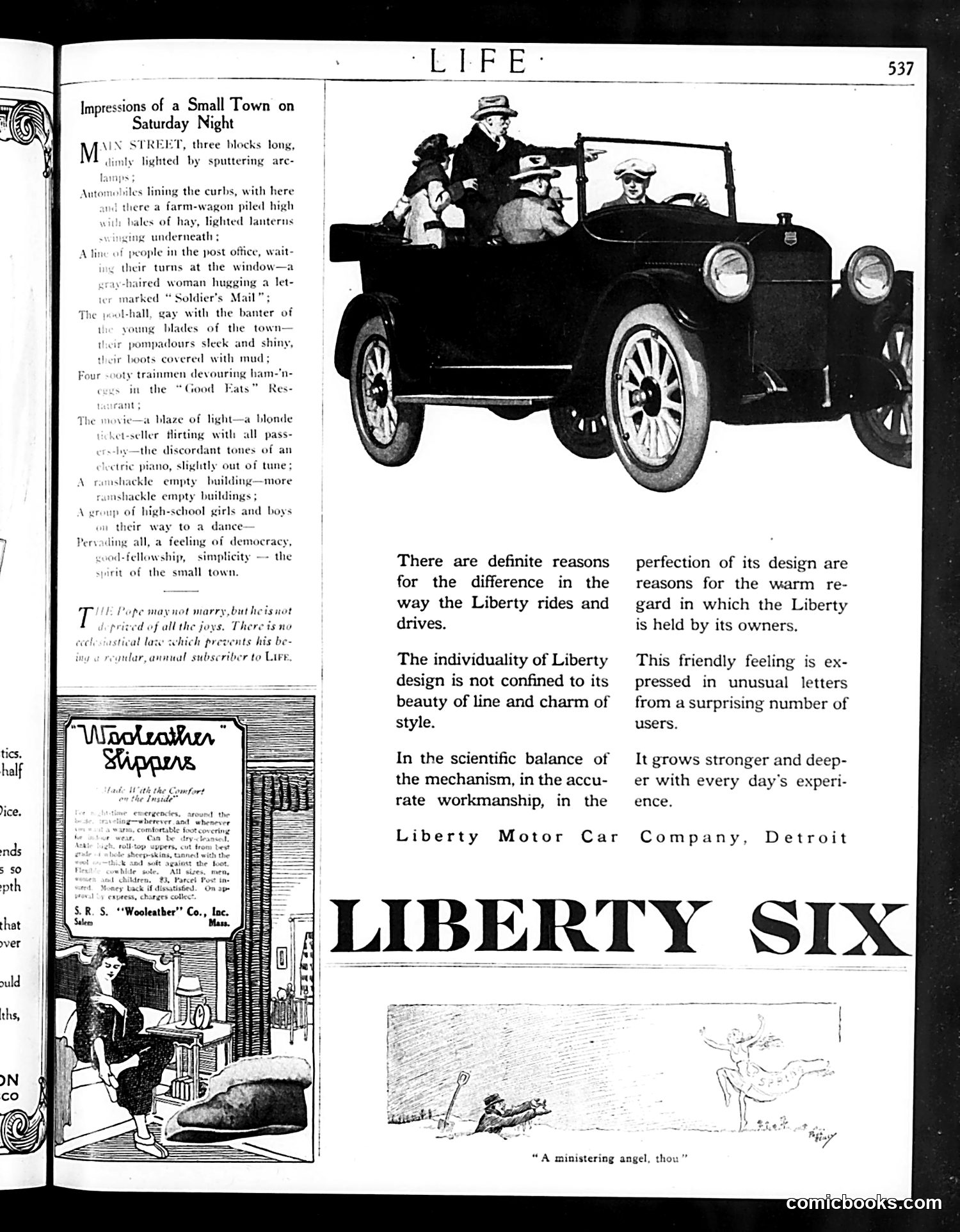
This page is primarily a **Liberty automobile advertisement** (Liberty Motor Car Company, Detroit), not political satire. The main image shows a Liberty Six car overflowing with passengers in a humorous scene—people are piled on seats, the roof, and hanging off the sides. The accompanying article, "Impressions of a Small Town on Saturday Night," describes typical rural American weekend activities: Main Street lit by sputtering lamps, automobiles and farm wagons, post office crowds, the pool hall, music hall, and high schoolers heading to dances. The ad's humor plays on the car's apparent spaciousness and appeal, while the article provides nostalgic Americana context celebrating small-town life and the role automobiles play in it. The overall tone is warmly humorous rather than satirical.
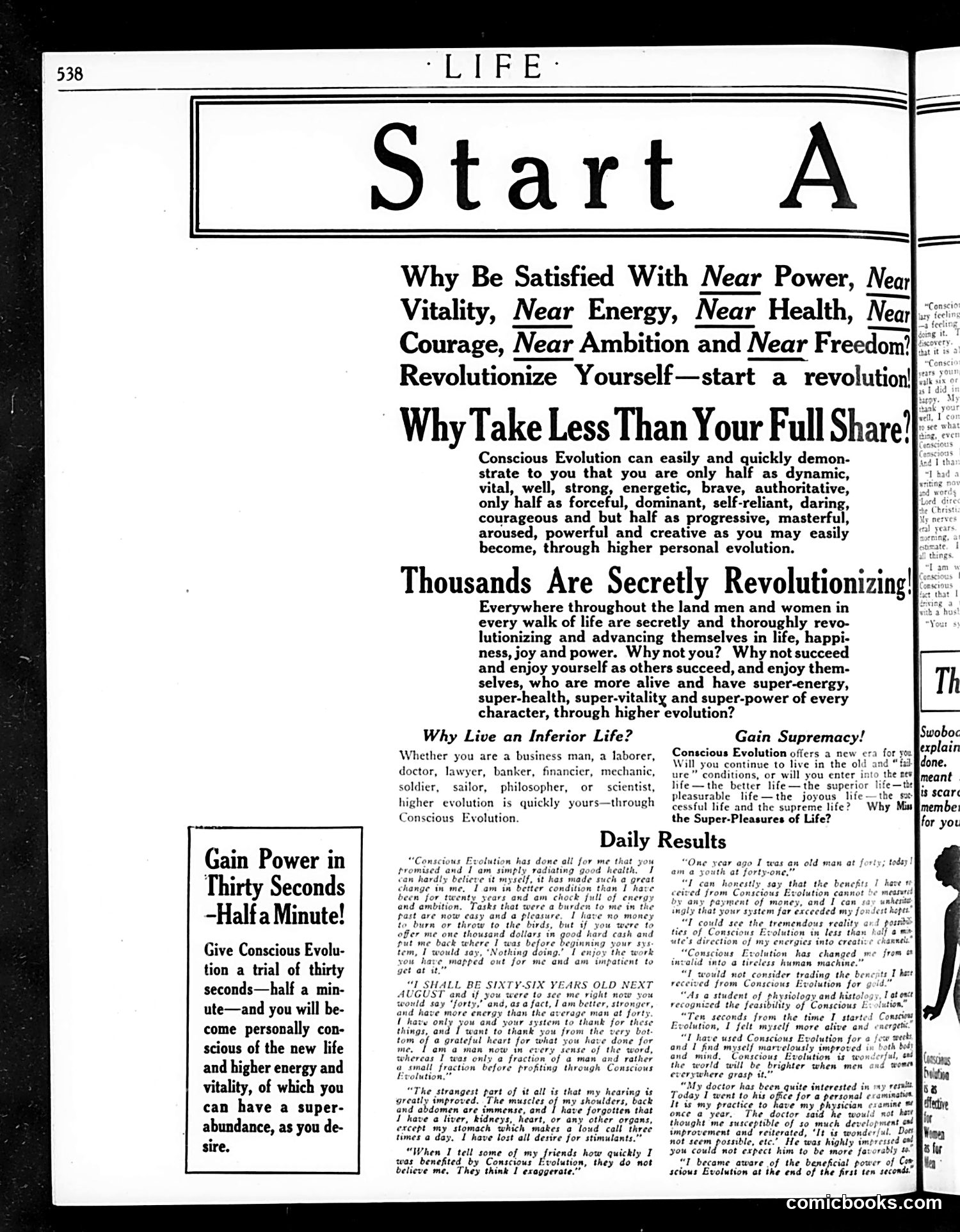
This is an advertisement rather than a cartoon or satirical piece. It promotes "Conscious Evolution," a self-improvement philosophy or movement popular in early 20th-century America. The ad targets people unsatisfied with their current lives, promising that through "Conscious Evolution" they can gain "power," "energy," "health," "courage," and "freedom" — essentially a complete personal transformation. It claims "thousands are secretly revolutionizing" themselves through this method. The repeated emphasis on gaining superiority ("supreme," "super-energy," "super-health," "super-power") reflects era-specific anxieties about personal inadequacy and competitive self-advancement. The testimonials in the right column appear to offer "proof" of the method's effectiveness. This represents typical progressive-era pseudoscience marketing, blending evolutionary theory with quasi-mystical self-help rhetoric.
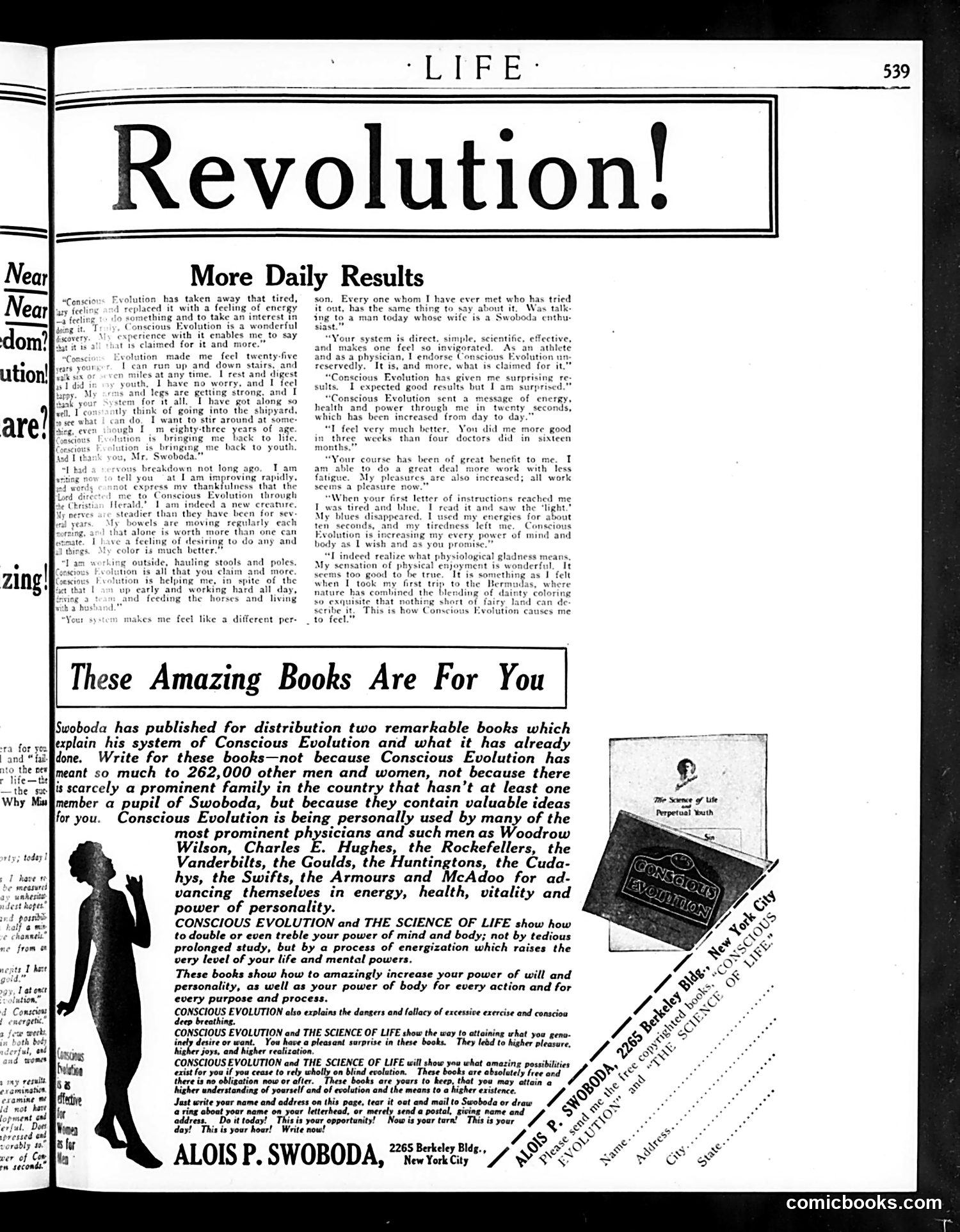
This page is primarily **advertising, not satire or political commentary**. The large headline "Revolution!" and section "More Daily Results" present testimonials from purported users of "Conscious Evolution"—a self-help system marketed by Alois P. Swoboda (advertiser address shown at bottom). The testimonials claim the system produces physical and mental improvements: increased energy, better work capacity, reduced fatigue, and enhanced "powers of mind and body." The lower half promotes two books on Conscious Evolution, claiming endorsement by wealthy families (Rockefellers, Vanderbilts, etc.) and prominent men (Woodrow Wilson, Charles E. Hughes mentioned). This is a **health/self-improvement advertisement typical of early 20th-century American magazines**, exploiting aspirational claims and celebrity association rather than political satire.
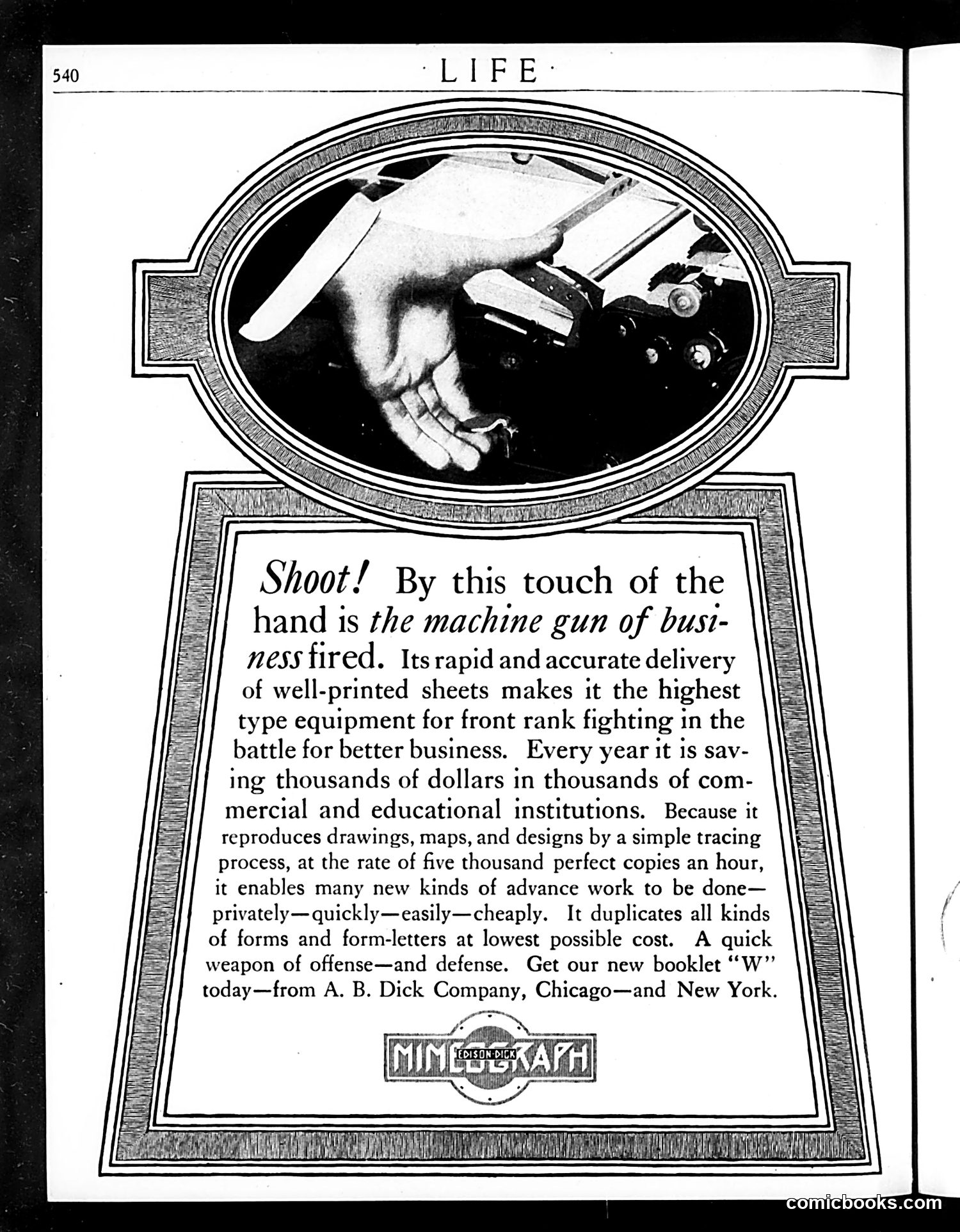
This is an **advertisement**, not satire or political commentary. It appears on page 540 of *Life* magazine and promotes the "Mimeograph" machine by A.B. Dick Company. The ad uses militaristic language to market a copying device: describing it as a "machine gun of business" and a "weapon of offense—and defense" in the "battle for better business." This reflects early-20th-century advertising's tendency to use war metaphors for commercial competition. The image shows a hand operating the mimeograph's trigger mechanism. The ad emphasizes the machine's practical benefits: rapid reproduction of documents (5,000 copies/hour), cost savings, and ability to duplicate drawings and forms. For modern readers, the aggressive "warfare" framing of business competition—and the casual weaponization metaphor—is notably dated marketing rhetoric.
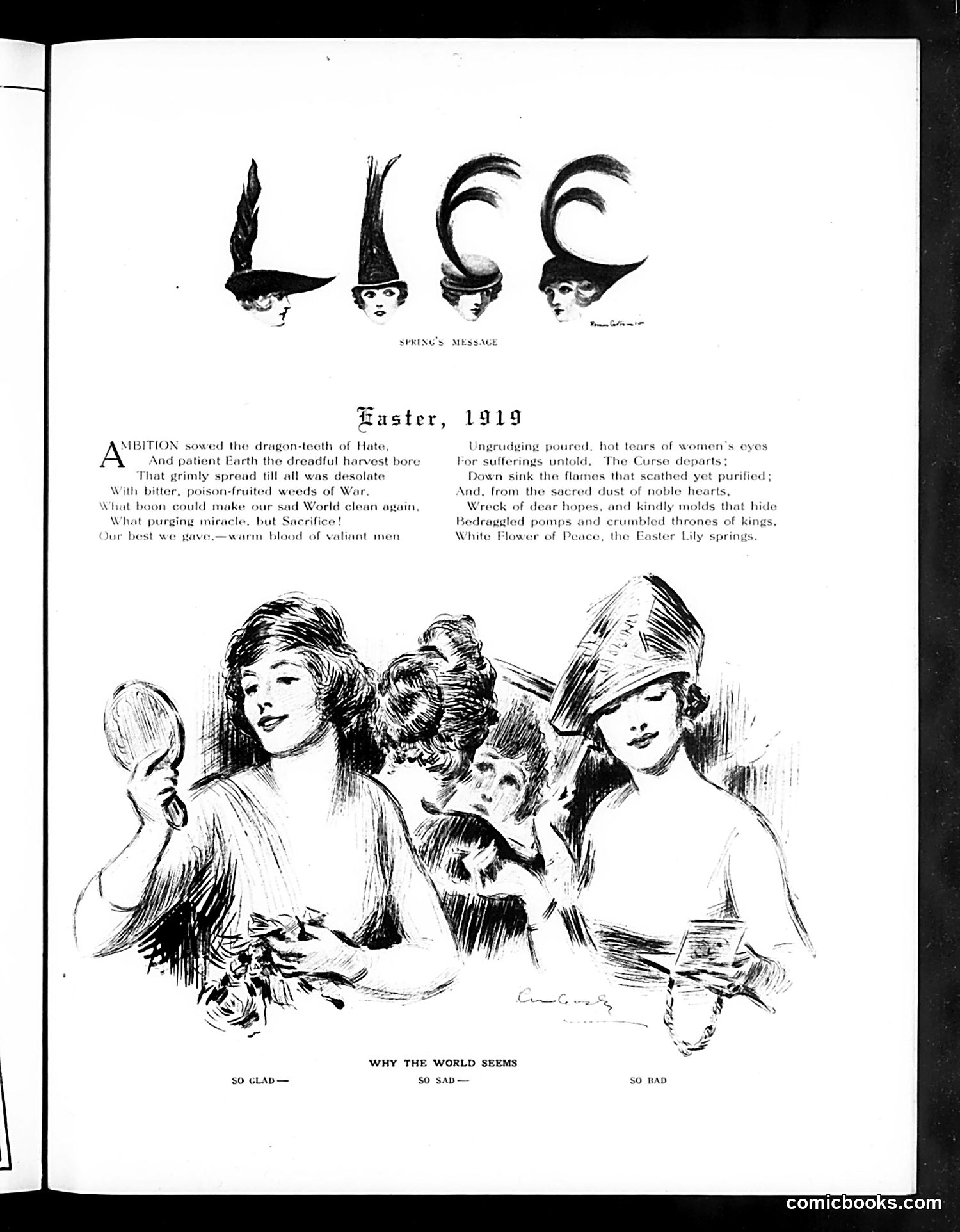
This page uses Easter symbolism to reflect on World War I's aftermath. The top shows four stylized female heads spelling "LICE" (likely "LIFE," the magazine's title), with "Spring's Message" referencing renewal. The poem frames WWI as humanity's self-inflicted curse—"dragon-teeth of Hate" sown by ambition, requiring blood sacrifice to purify the world. The Easter lily represents hoped-for peace and resurrection. The lower illustration, captioned "Why the World Seems So Sad—So Bad," depicts fashionable women enjoying luxuries (mirror, flowers, jewelry) while appearing oblivious or indifferent. The satire suggests a disconnect: despite the war's enormous human cost and destruction, society's privileged classes continue their frivolous pleasures rather than grappling with the devastation or meaningfully embracing the peace that sacrifice supposedly purchased. This critiques wartime profiteering and the failure of post-war society to match noble wartime rhetoric with genuine transformation.
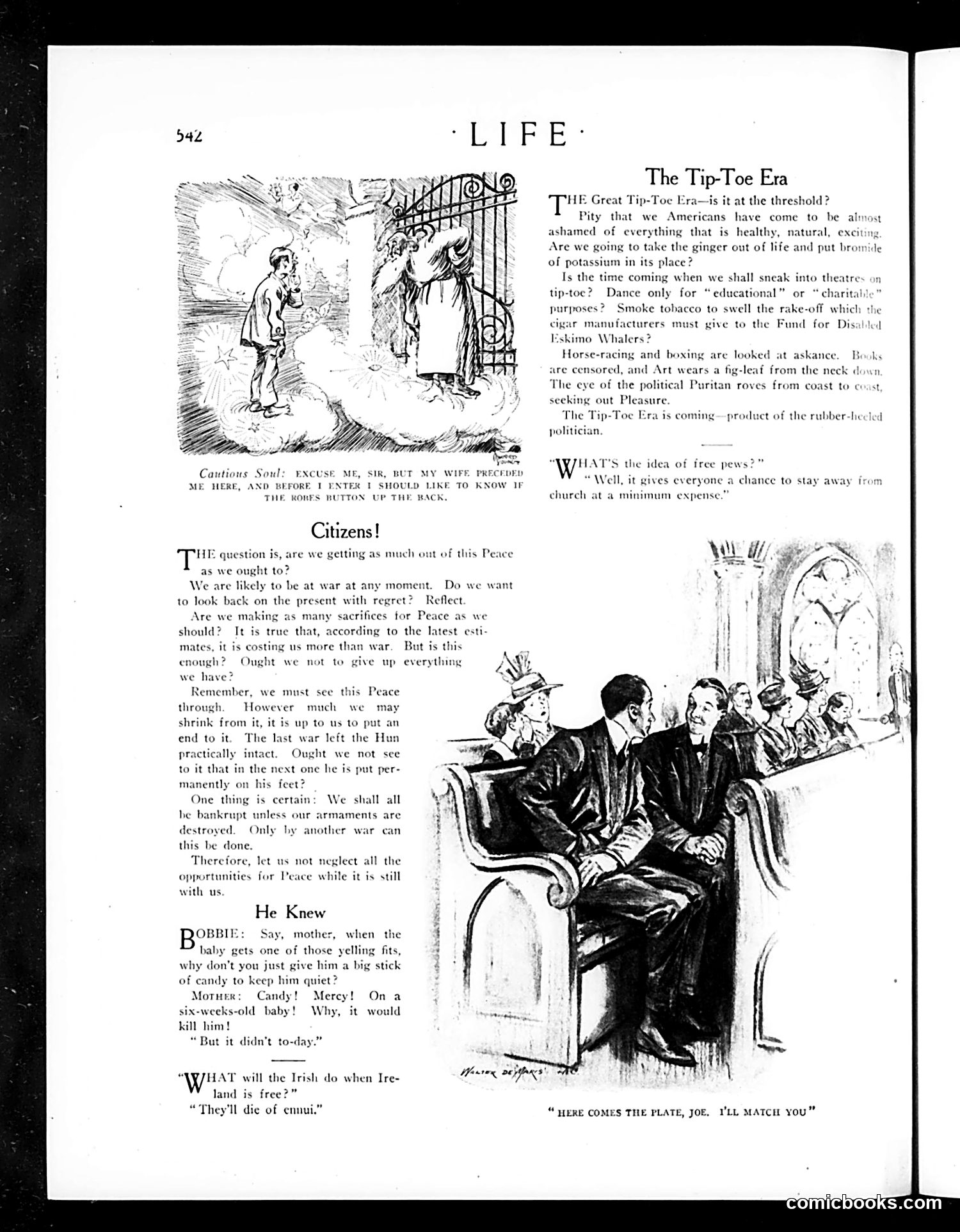
This page satirizes American puritanism and post-WWI anxiety circa the early 1920s. **"The Tip-Toe Era"** warns against creeping censorship and moral policing. It mocks the "rubber-heeled politician" and reformers who increasingly restrict entertainment (boxing, horse-racing), censor art and literature, and impose prohibition-era morality. The title suggests people must tiptoe around newfound restrictions on what was once "healthy, natural, exciting" life. **"Citizens!"** sarcastically argues for continued military spending under the guise of peace-building, suggesting post-war anxiety about Germany and disarmament debates. **The cartoon vignettes** mock social hypocrisy: the "Cautious Soul" worries about women's clothing modesty; "He Knew" jokes about giving candy to infants (dark humor); the Irish independence quip plays on stereotypes; the church "free pews" cartoon shows people gambling during services—satirizing churchgoers' actual behavior versus preached morality. The overall tone: Americans are becoming prudish busybodies while simultaneously engaging in vice they publicly condemn.
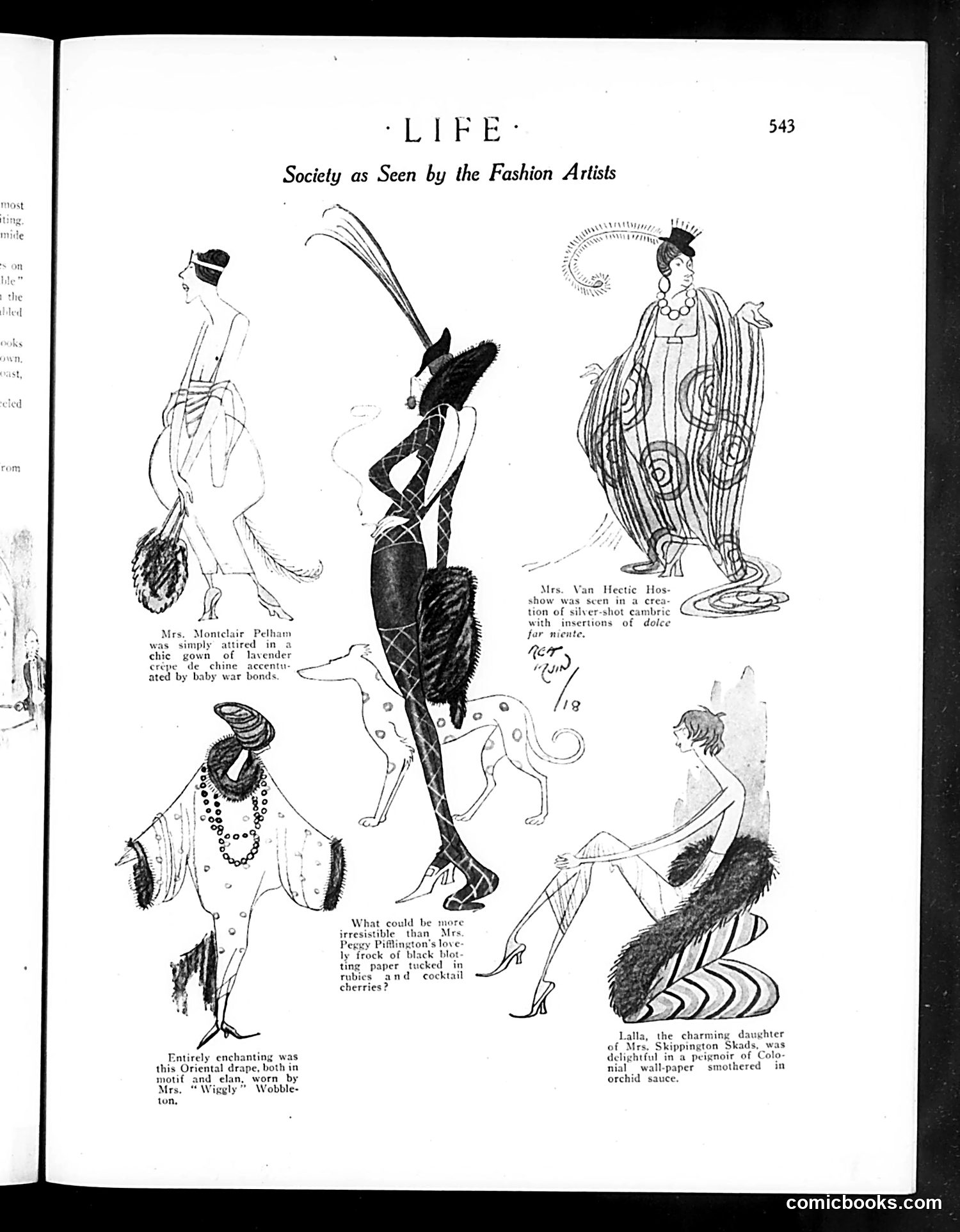
This is a satirical fashion commentary mocking wealthy society women and their absurd clothing choices. Each illustration caricatures a named socialite wearing ridiculously impractical or nonsensical garments: - Mrs. Montclair Pelham wears a lavender gown "accented by baby war bonds" — likely mocking both frivolous fashion and superficial patriotism during wartime - Mrs. Van Hectic Hoshow's outfit features "dolce far niente" (sweet idleness), satirizing pretentious Italian phrases - Peggy Duffington's dress uses "blotting paper" with "rubies and cocktail cherries" — absurdly combining office supplies with luxury - Mrs. Skippington Skads wears "colonial wall-paper smothered in orchid sauce" The humor targets the pretentious, name-dropping world of high society fashion, where wealthy women adopt elaborate, impractical, and occasionally nonsensical styles as status symbols. The exaggerated illustrations and ridiculous material descriptions expose the gap between fashion's claimed sophistication and its actual absurdity.
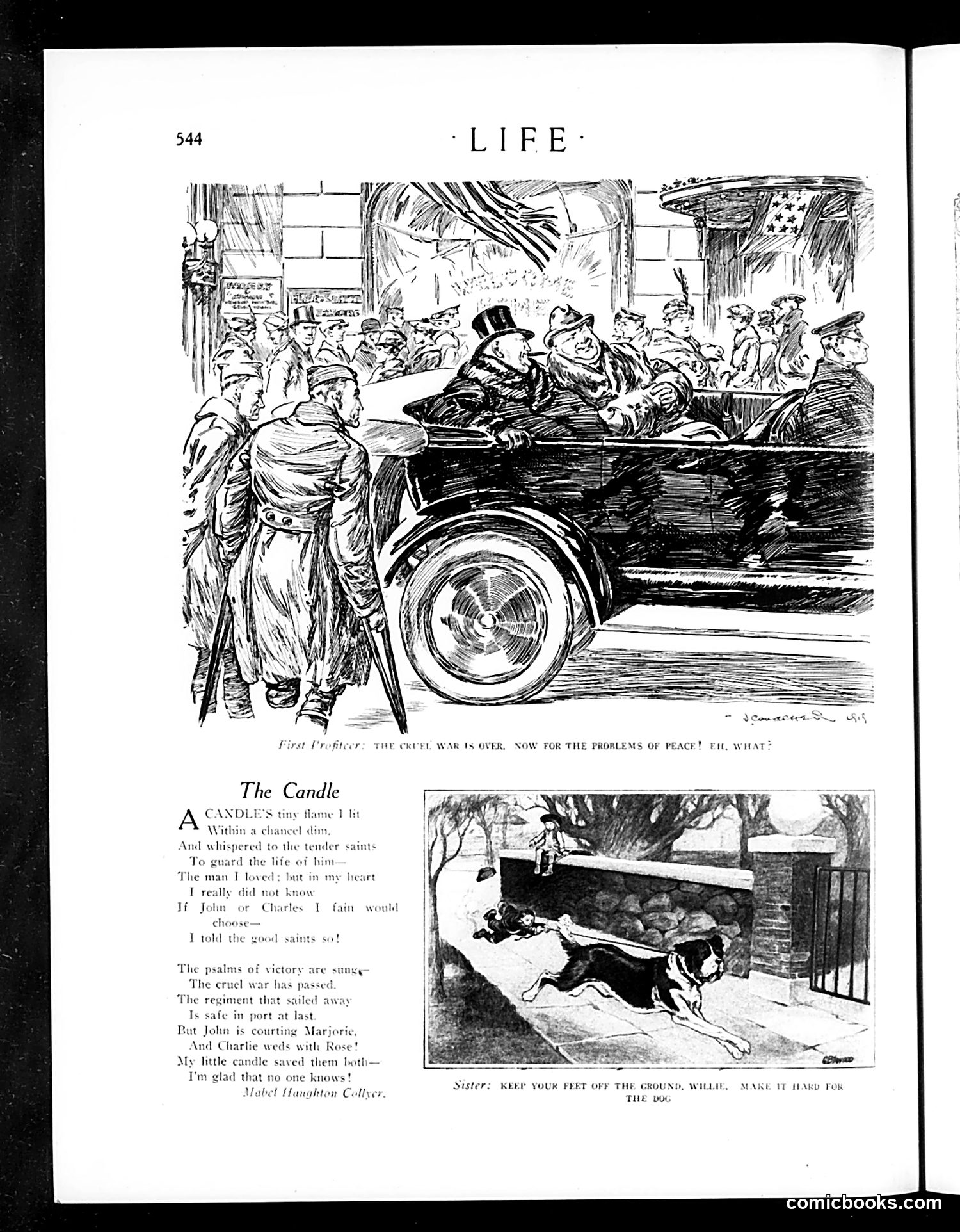
**Top Cartoon ("First Profiteers"):** This depicts soldiers and officials surrounding an automobile, with the caption "The great war is over. Now for the problems of peace! Eh, what?" The satire targets post-WWI profiteering—suggesting that those who made money from the war are now shifting to peacetime opportunities. The car and well-dressed figures imply wealthy businessmen ready to exploit new economic conditions. **"The Candle" Poem:** This sentimental verse by Mabel Haughton Collyer celebrates a small candle that helped save soldiers' lives during wartime, contrasting with the cynical profiteering above it. **Bottom Cartoon:** A domestic scene showing a dog near a fireplace with the caption about keeping feet off the ground, seemingly unrelated to war themes—possibly providing comic relief or serving as an advertisement. The page juxtaposes wartime sacrifice with peacetime greed, a common post-1918 satirical theme in American magazines.
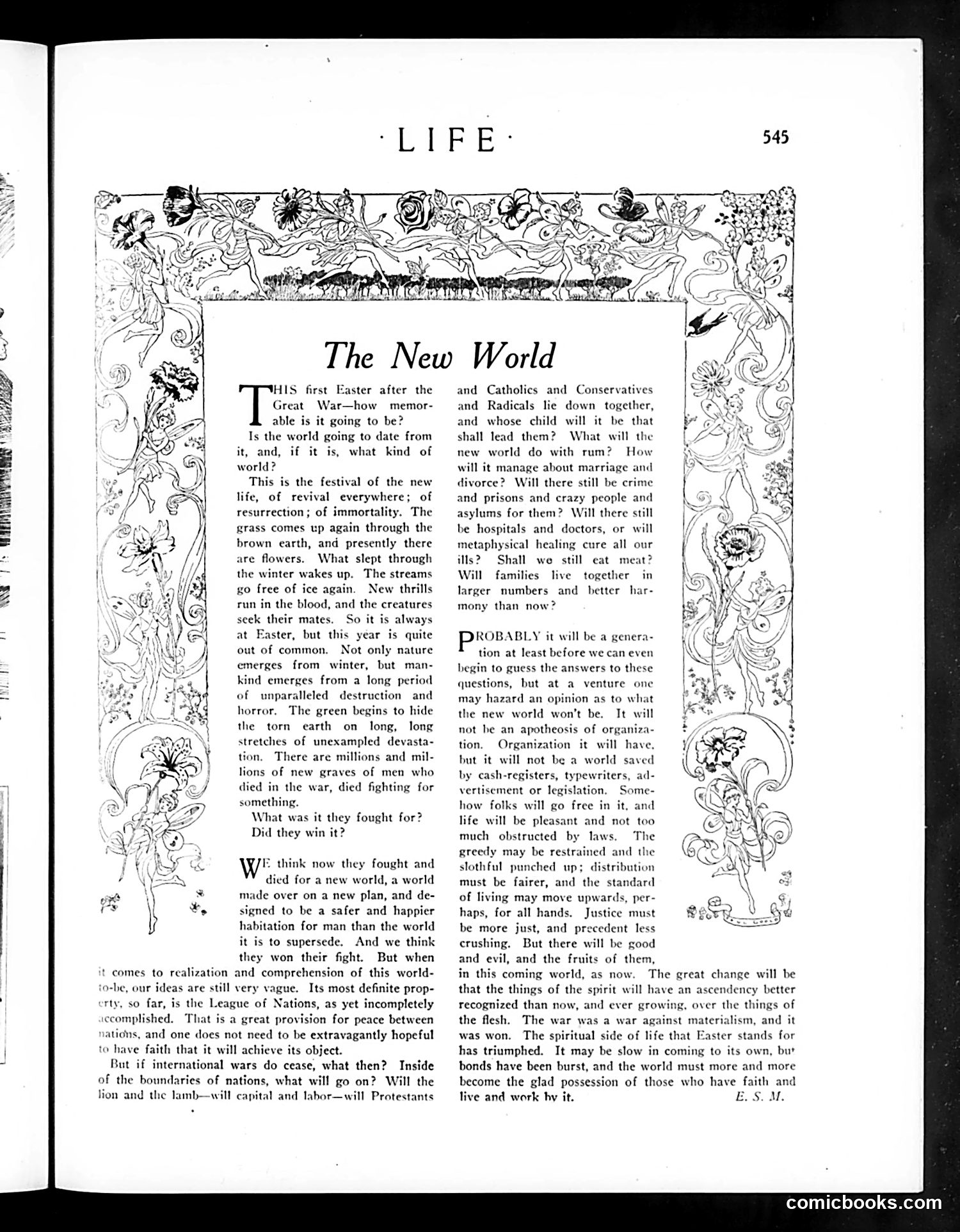
This is an editorial essay (not a cartoon), published shortly after World War I ended, reflecting on Easter and humanity's post-war future. The author contemplates what kind of society will emerge from the war's devastation. The piece addresses fundamental social questions: Will the new world solve problems like crime, divorce, alcoholism, and economic inequality? The author expresses skepticism about purely mechanized solutions (cash registers, typewriters, legislation), arguing instead that spiritual values—not materialism—must guide reconstruction. The essay takes an optimistic but cautious tone: a generation must pass before answers emerge. Key tensions highlighted include labor-capital relations and religious divisions (Protestant-Catholic). The author suggests the war was fundamentally a spiritual victory against materialism, with Easter symbolizing humanity's resurrection toward better values. This reflects post-WWI idealism mixed with anxiety about whether hard-won sacrifices would actually produce meaningful social change.
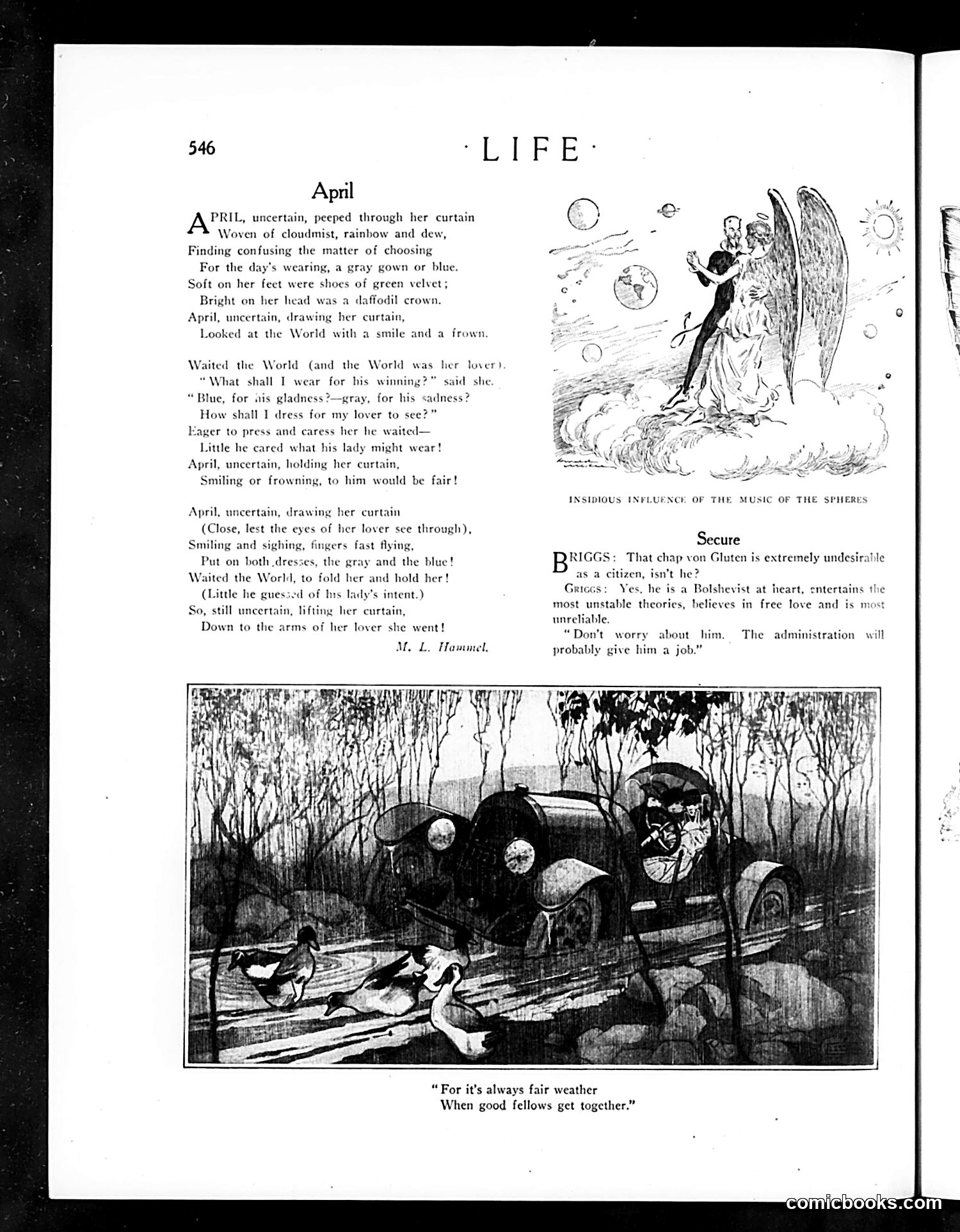
**The Poetry ("April"):** M.L. Hamuiel's romantic verse personifies April as an indecisive woman choosing between gray and blue dresses for her lover (the World). The metaphor celebrates spring's unpredictable beauty—whether sad or joyful, April charms regardless. This is straightforward romantic literature without political content. **The Cartoon ("Secure"):** This is sharp political satire about government hiring practices during the Red Scare era. Briggs and Gaices discuss "von Gluten," clearly a German-sounding name, whom they identify as a dangerous Bolshevik with radical views including free love advocacy. The punchline—that the administration will simply "give him a job"—mocks government incompetence or hypocrisy: despite identifying him as an ideological threat, bureaucratic indifference ensures his employment anyway. This reflects 1920s anxiety about communist infiltration and government ineffectiveness.
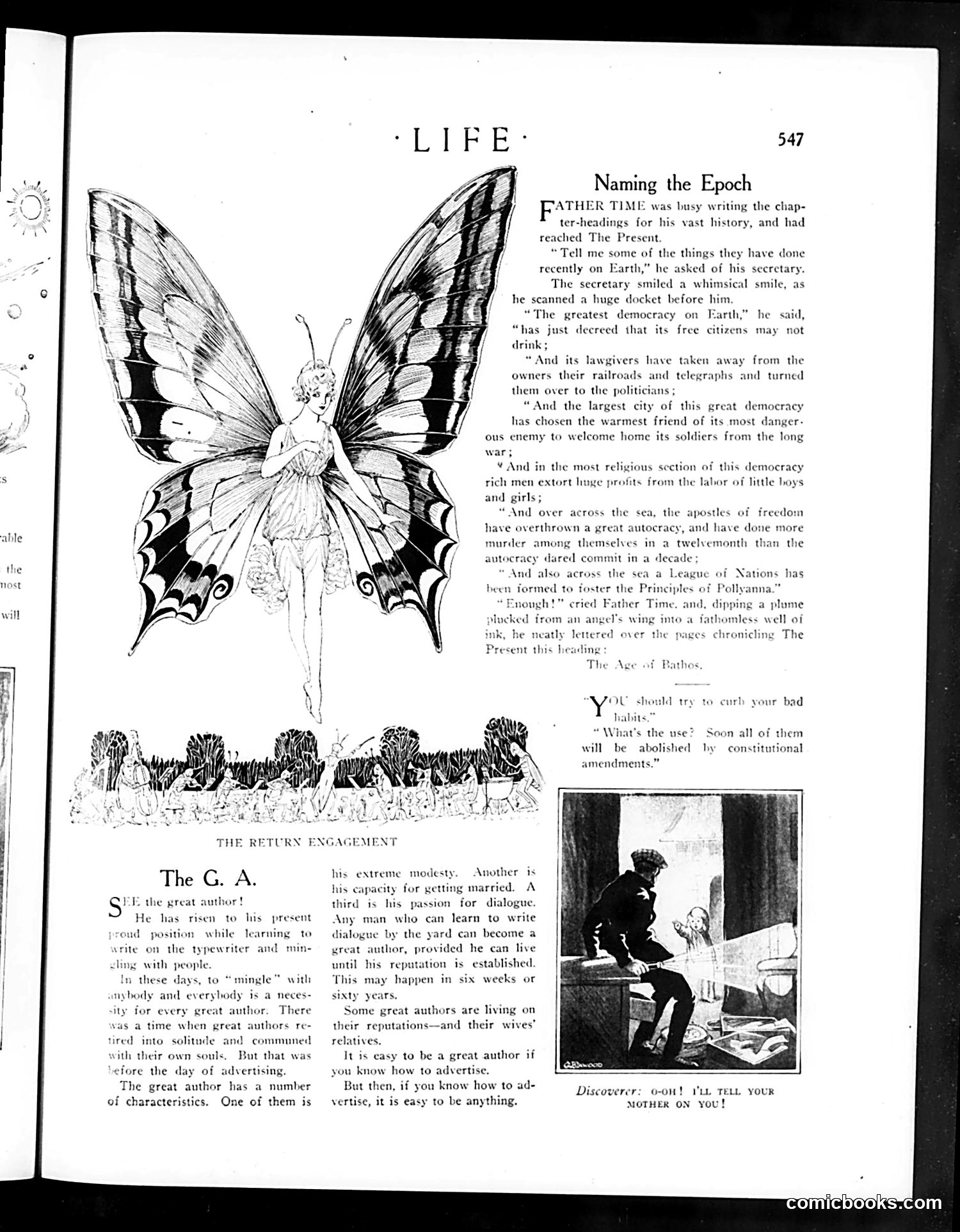
This piece mocks the contradictions of 1920s American democracy through Father Time reviewing current events for his historical record. The secretary catalogs recent U.S. achievements ironically: Prohibition (banning alcohol), government seizure of railroads, welcoming home war soldiers, wealth inequality amid "democracy," and the newly formed League of Nations—all presented as noble but undercut by their actual failures. The satire's bite: these are presented as embarrassing contradictions unworthy of recording as "progress." The joke culminates when the secretary dismisses them all as temporary—soon abolished by constitutional amendments anyway—leading Father Time to title the era "The Age of Pathos." The accompanying illustration and text about "The G.A." (great author) appears to be separate satirical content mocking literary pretension and the commercialization of authorship through advertising rather than genuine talent.
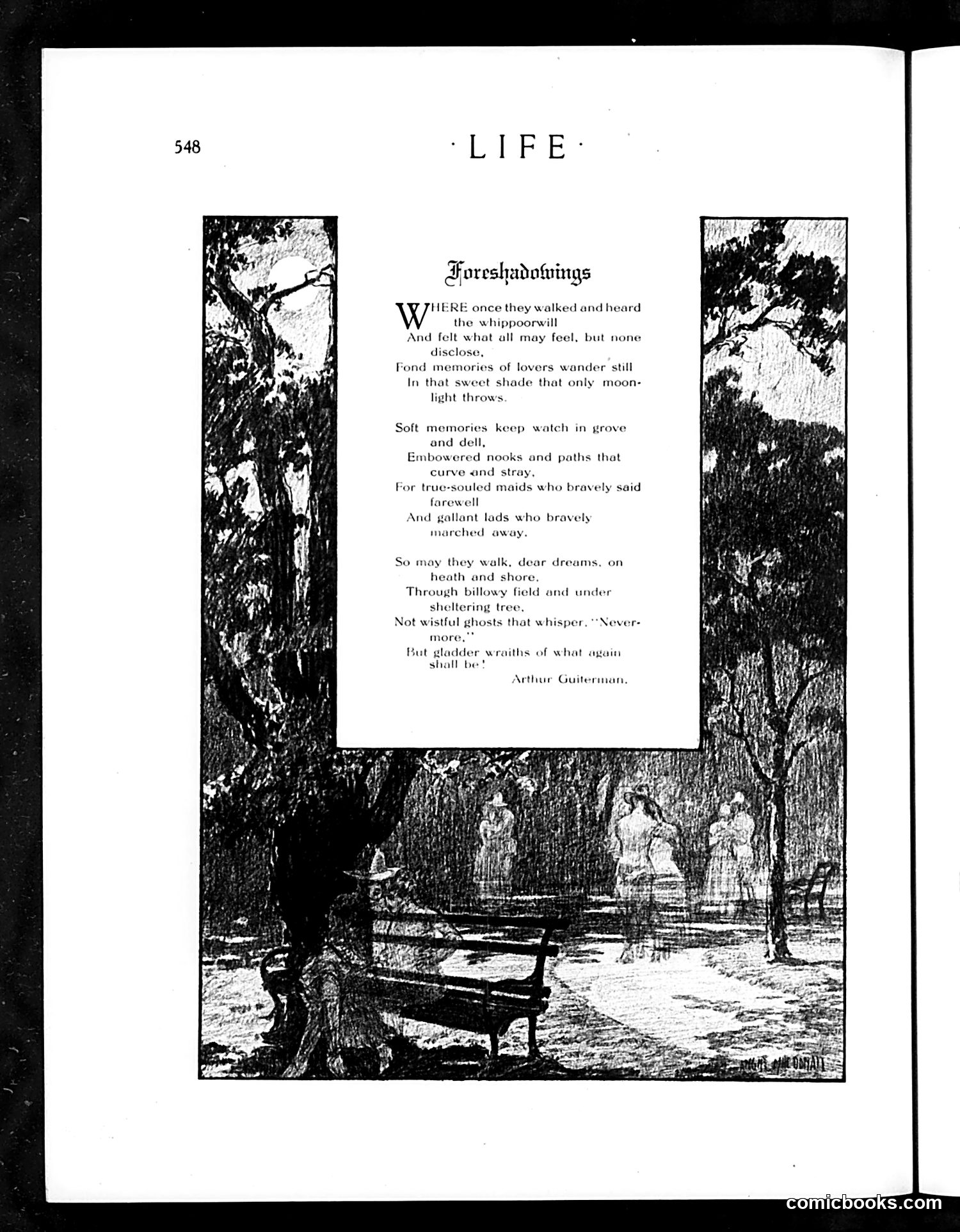
This is a sentimental poem with accompanying illustration, not satire or political commentary. The piece appears to commemorate soldiers and their sweethearts during wartime (likely WWI, given the era). The text celebrates memories of lovers meeting in natural settings before young men "bravely marched away" to war. The illustration shows a forest scene with benches and figures, evoking pastoral romance. The poem's message is hopeful: rather than becoming "wistful ghosts" lamenting loss, these memories should inspire faith that soldiers will return ("what again shall be"). This is nostalgic, patriotic sentiment rather than satire—typical of *Life* magazine's wartime content honoring sacrifice and conjugal devotion.
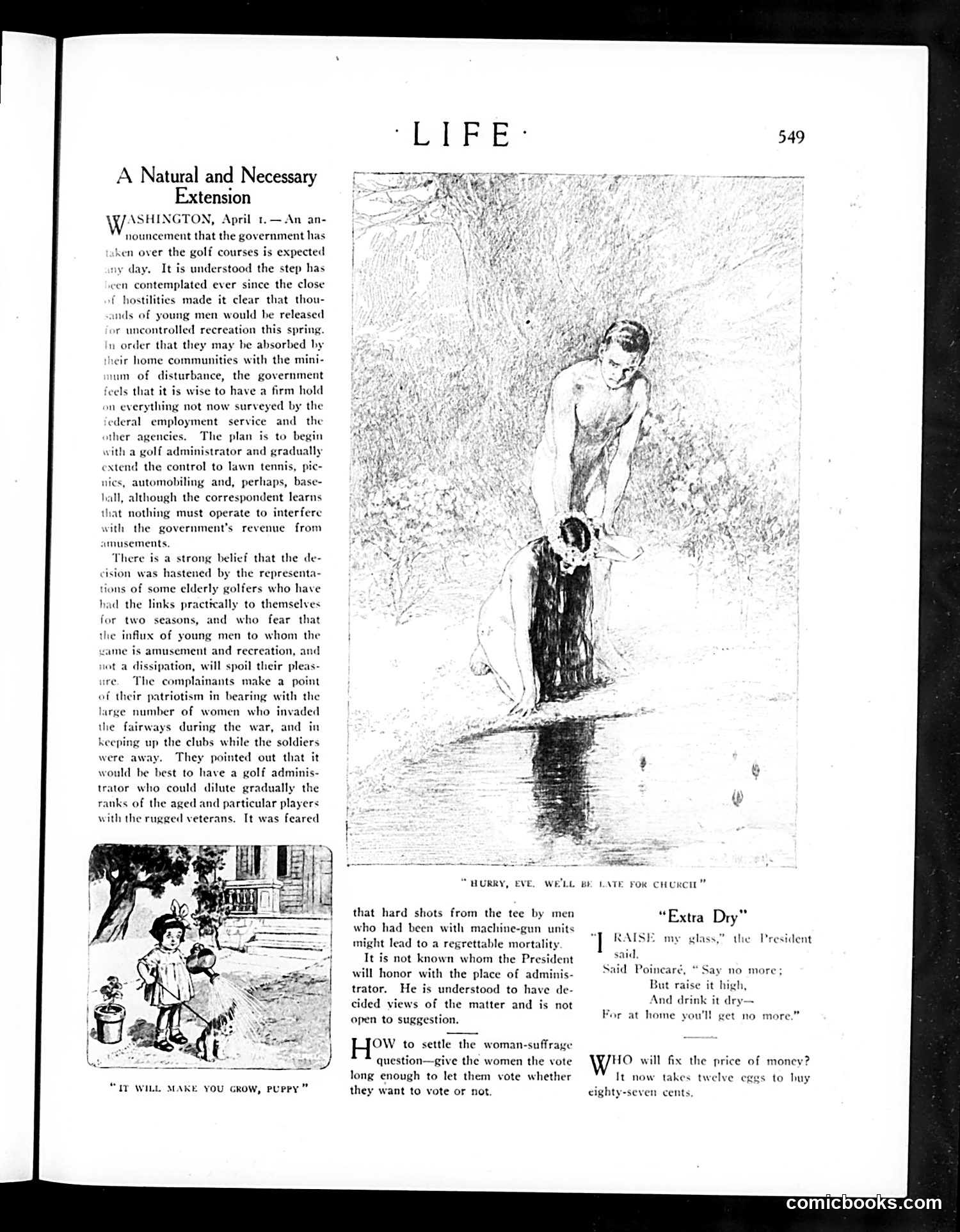
This page satirizes government overreach following World War I's end. The main article mockingly proposes the government should take over golf courses to manage the sudden influx of young returning soldiers seeking recreation. The satire targets both post-war bureaucratic expansion and elderly, exclusive golfers who monopolized clubs during wartime and now fear young veterans will disrupt their leisure. The cartoon "Hurry, Eve. We'll Be Late for Church" appears to mock marital dynamics or social pretension. The smaller illustration "It Will Make You Grow, Puppy" uses a child-to-pet comparison, likely satirizing some contemporary claim or parenting philosophy. The section "Extra Dry" presents witty observations on Prohibition (the "raise it high, drink it dry" reference suggests hidden alcohol consumption) and inflation's absurdity (eggs versus currency value), reflecting post-war economic chaos. The woman-suffrage quip sarcastically proposes giving women the vote temporarily to determine if they want permanent voting rights—mocking both the suffrage debate and bureaucratic circular logic.
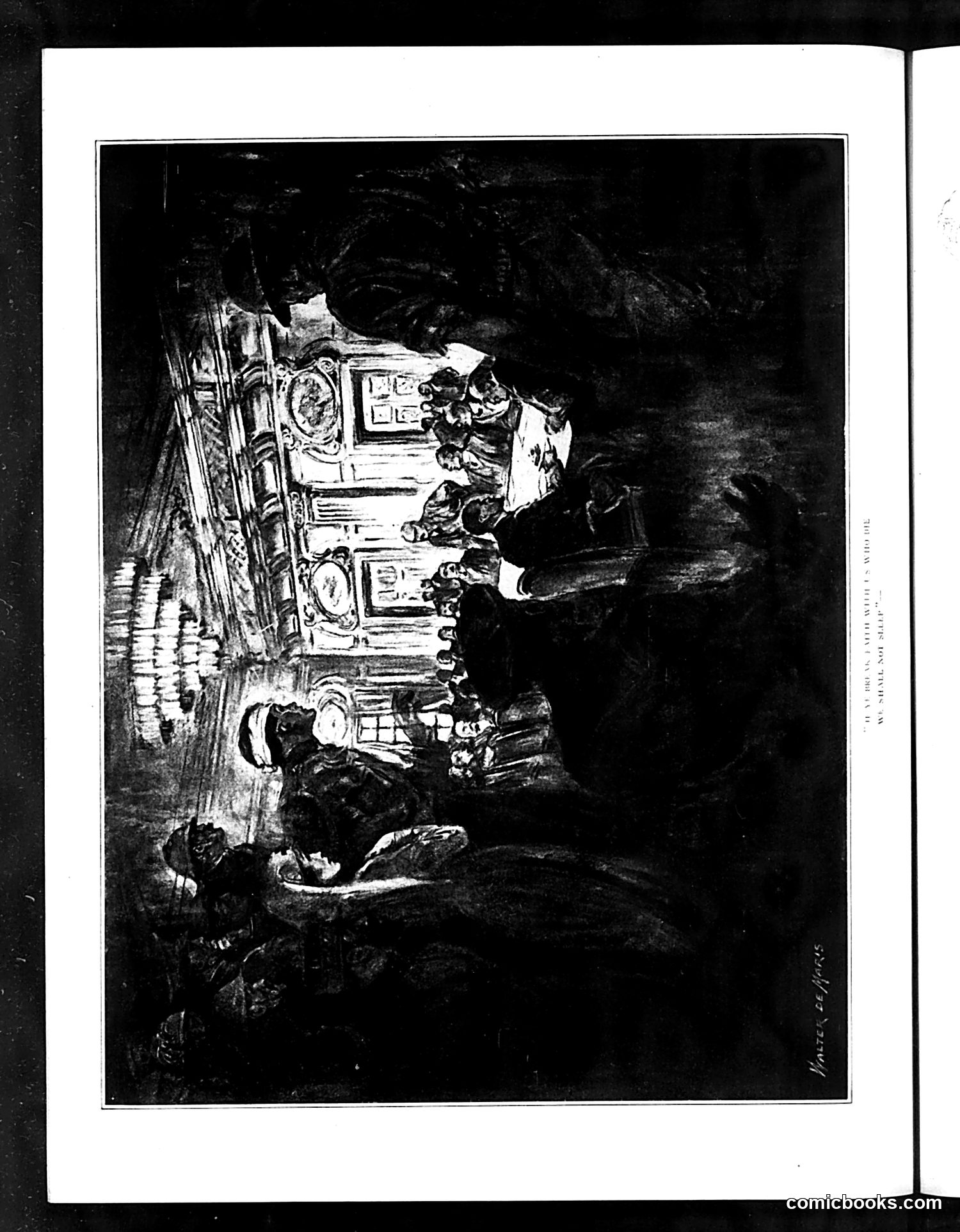
This appears to be a satirical illustration, likely from early 20th-century Life magazine, but the image is rotated and heavily shadowed, making precise identification difficult. The scene depicts what looks like an ornate interior space—possibly a government building or wealthy establishment—with multiple figures in formal dress engaged in some kind of transaction or social interaction. The architectural details and period clothing suggest political or social commentary typical of Life's satire. However, without clearer visibility of the figures' faces, text labels, or caption, I cannot confidently identify specific individuals or pinpoint the exact political event or scandal being referenced. The composition suggests critique of corruption, wealth disparity, or institutional misbehavior, but I cannot assert specifics with certainty.
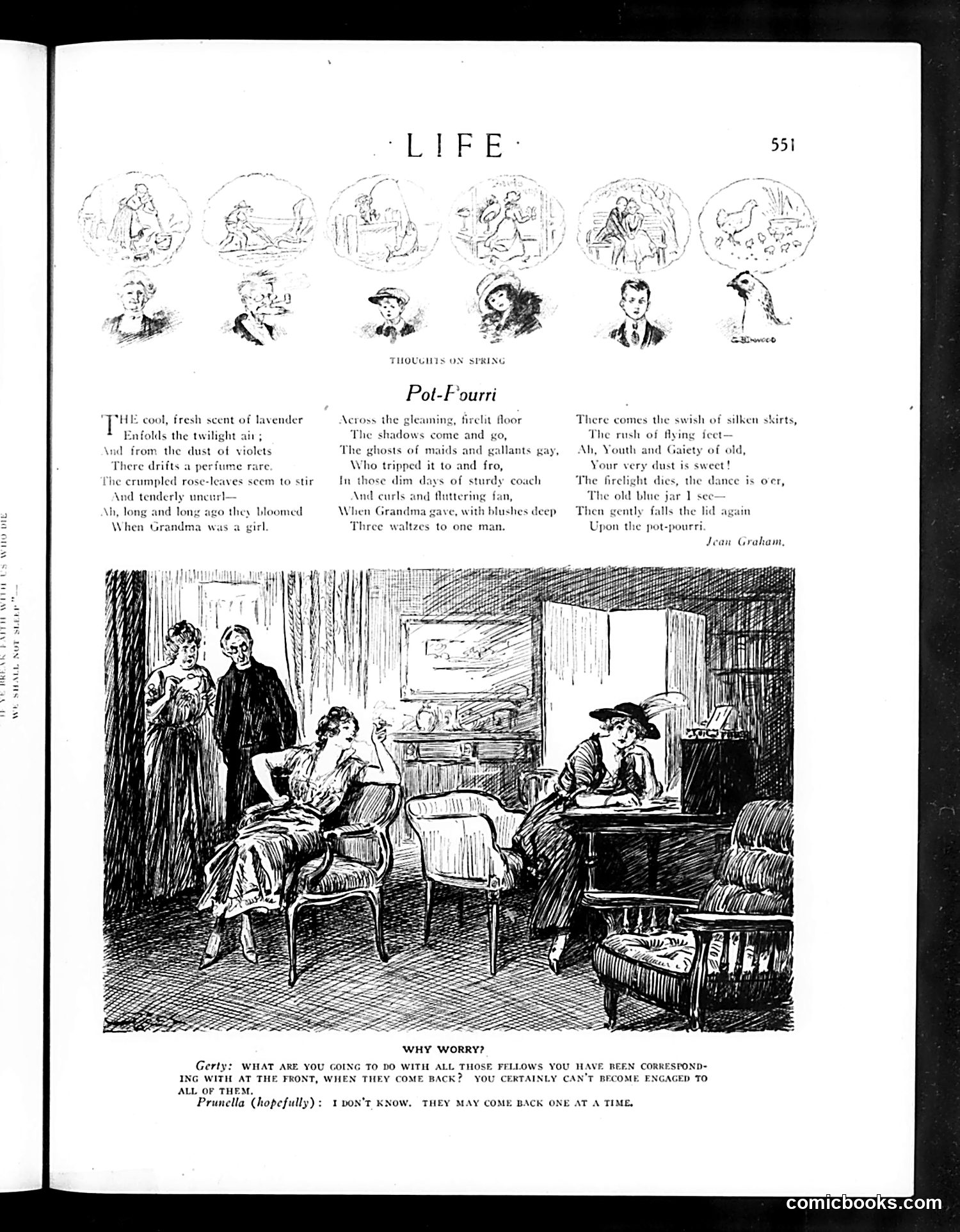
**Top Section:** "Pot-Pourri" is a nostalgic poem by Jean Graham about spring flowers and memories of youth, illustrated with small vignettes of romance and dancing. It's sentimental Victorian verse celebrating "Grandma was a girl" — typical early 20th-century magazine filler celebrating the past. **Bottom Cartoon ("Why Worry?"):** A young woman named Prunella admits she's been corresponding with multiple soldiers at the front (World War I, likely). When her friend Gerty asks what she'll do when they all return wanting engagements, Prunella hopes they'll arrive home "one at a time" — implying she can then decide which to actually marry, or avoid commitments altogether. The satire gently mocks female opportunism during wartime: young women entertaining multiple soldier suitors for attention and letters, with no serious romantic intent. It's light social commentary on romantic fickleness rather than sharp political satire.
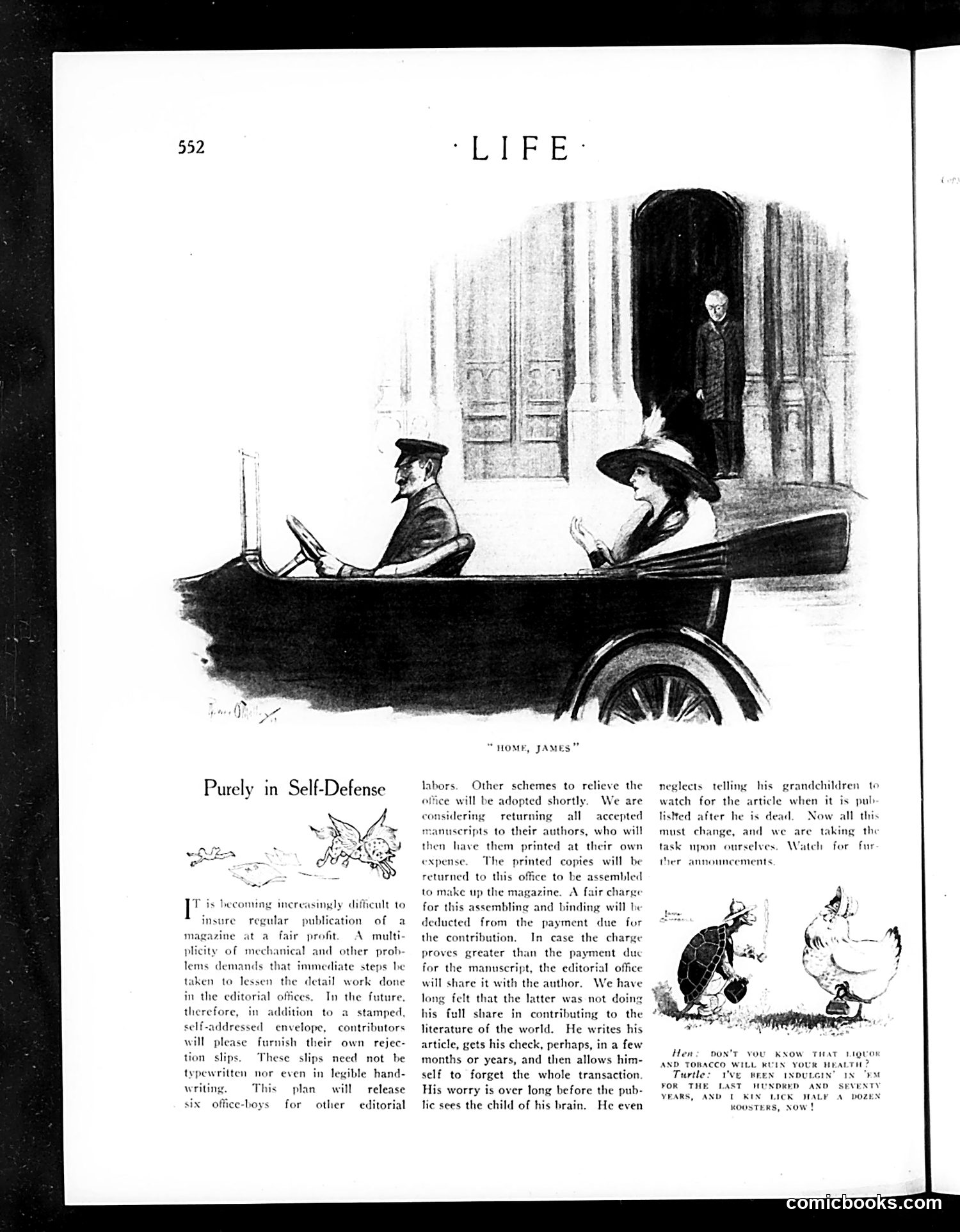
This page satirizes *Life* magazine's editorial struggles during what appears to be the early 20th century. The main cartoon shows a chauffeur driving passengers past a stern-faced figure in a doorway, captioned "Home, James"—likely depicting an editor or publisher. The accompanying article mockingly proposes cost-cutting "solutions" to keep the magazine profitable: contributors must supply their own rejection slips and pay for printing their accepted manuscripts, which the magazine will then assemble and charge them for. The satire targets both the magazine's financial desperation and authors' perceived lack of commitment to their published work. The bottom cartoon about a hen and turtle debating longevity is unrelated humor. The joke is that *Life* is so financially desperate it's shifting all production burdens and costs onto unpaid contributors—presented as absurdist "self-defense" against insolvency.
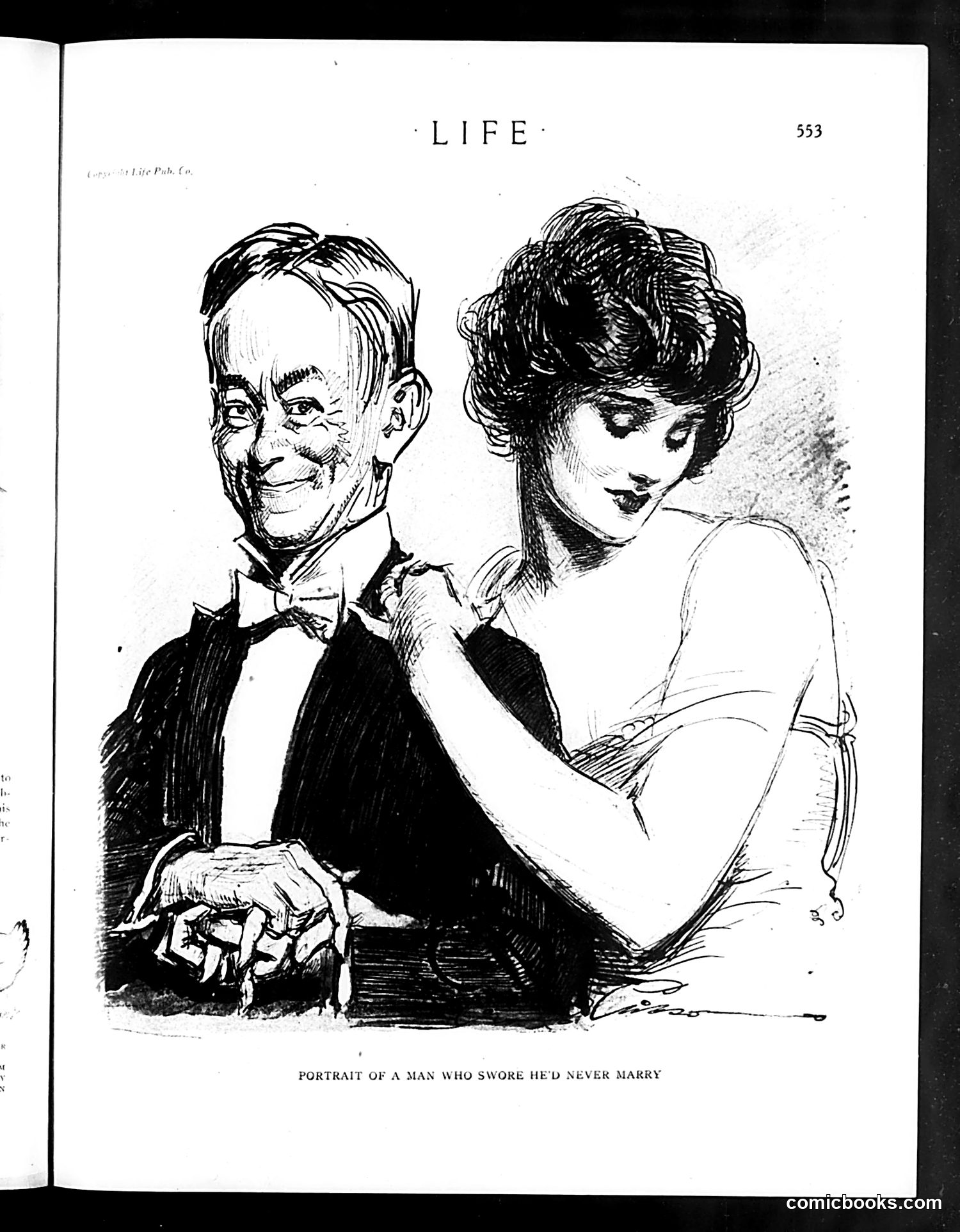
This satirical drawing depicts a man in formal attire (tuxedo and bow tie) paired with an elegantly dressed woman, illustrating the ironic caption about a man who "swore he'd never marry." The humor targets the common male experience of swearing bachelorhood while ultimately succumbing to matrimony. The man's somewhat bemused expression—looking back toward the viewer while physically linked to the woman—suggests his resignation or surprise at his own fate. The woman's confident pose and direct gaze emphasize her role in this romantic "conquest." This reflects early 20th-century *Life* magazine's satirical approach to gender dynamics and courtship, gently mocking masculine resistance to marriage as ultimately futile against feminine determination and charm.
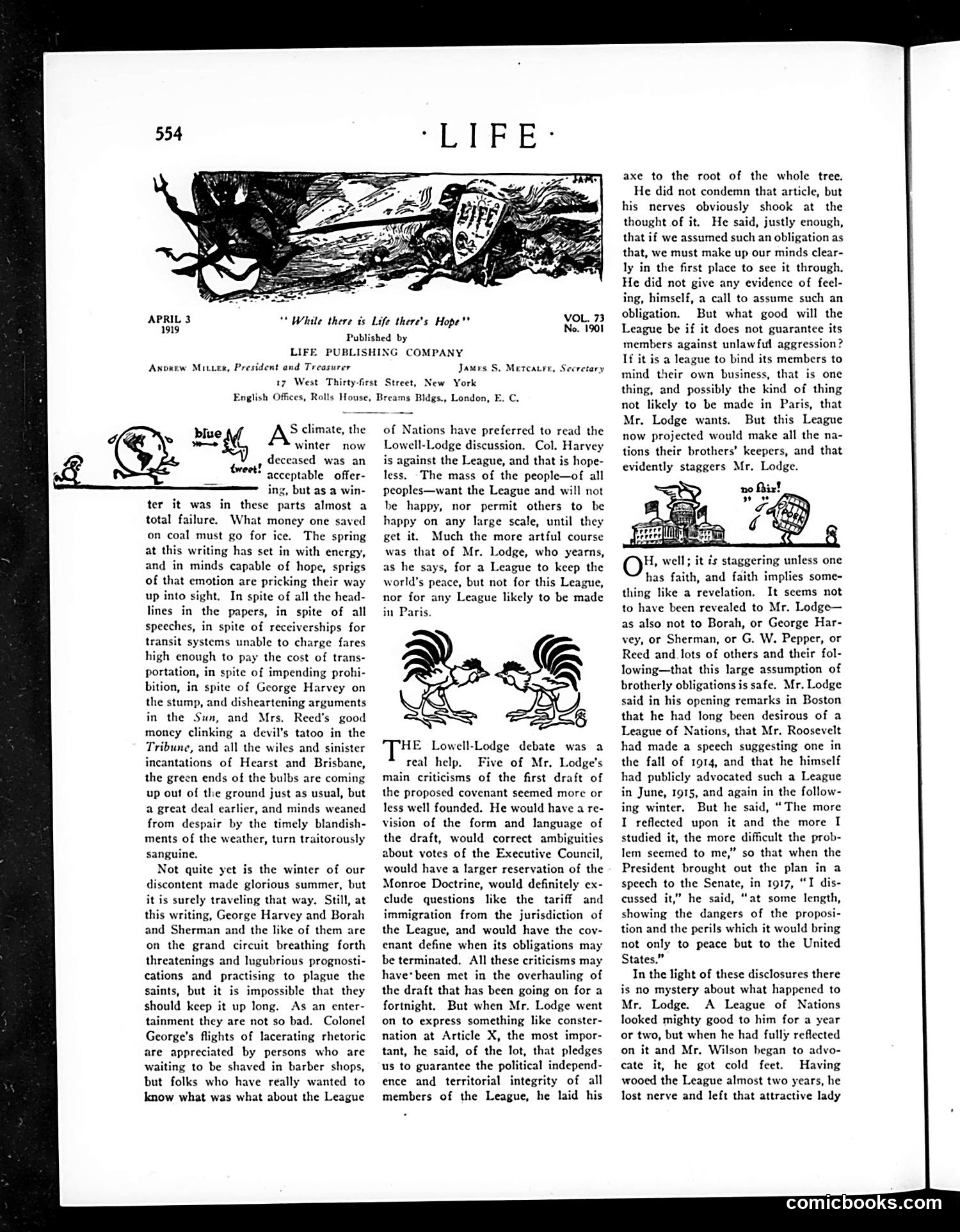
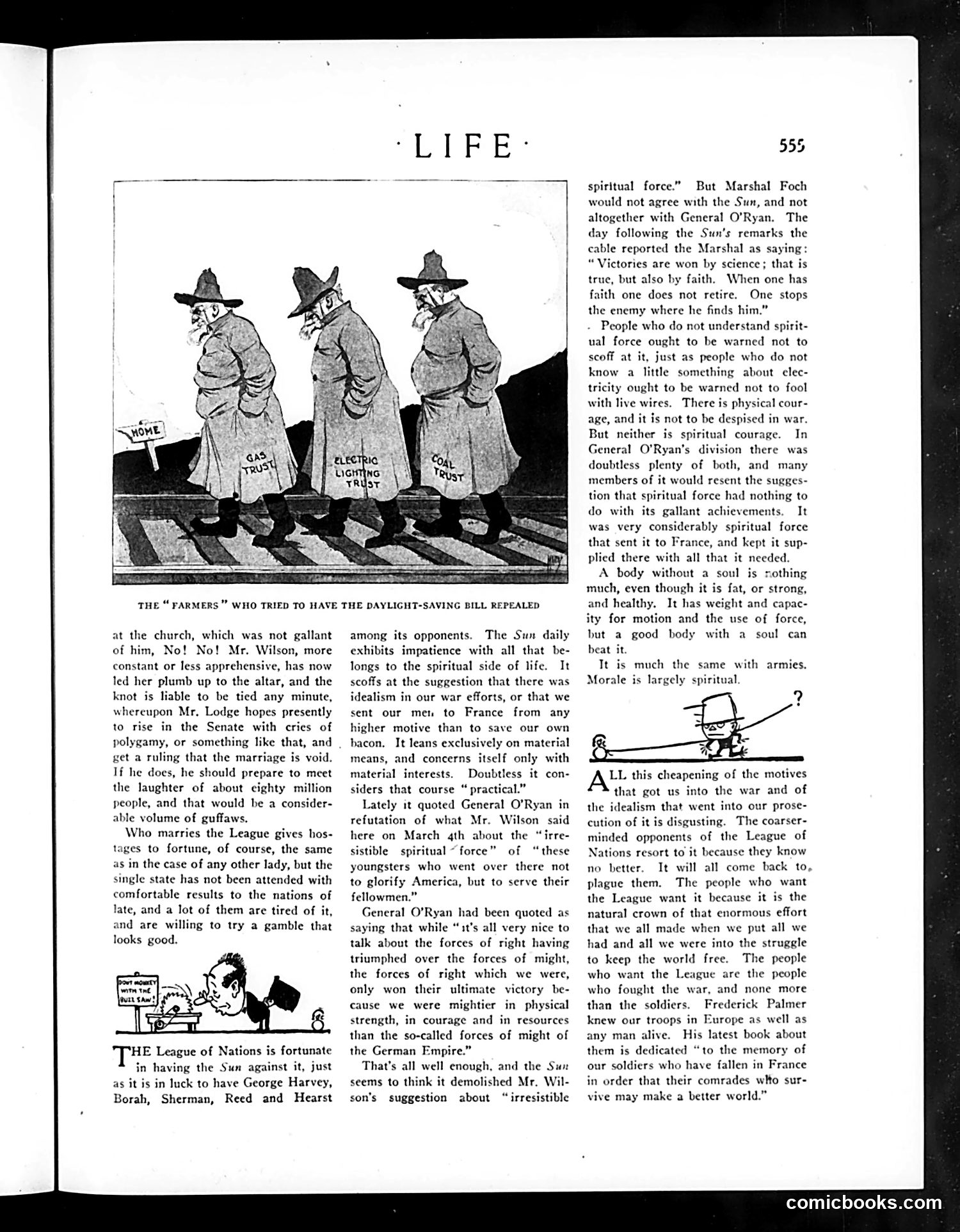
## The Cartoon The illustration shows three figures labeled "HOME," "GAS TRUST," "ELECTRIC LIGHTING TRUST," and "COAL TRUST" dressed as farmers attempting to repeal the daylight-saving bill at church—a reference to agricultural and utility interests opposing daylight saving time. ## The Main Article's Political Context The piece defends the League of Nations against critics (naming Henry Cabot Lodge, William Randolph Hearst, and others). It argues that opponents like the *New York Sun* newspaper emphasize only material/physical factors in America's WWI victory while dismissing the "spiritual force" or idealism behind the war effort. The author disputes this cynicism by citing Marshal Foch, who claimed victory required both science *and* faith. The broader point: those attacking the League's idealistic mission lack understanding of morale's importance to military and national success. ## For Modern Readers This reflects post-WWI debates about whether America fought for ideals or self-interest, and whether international cooperation (the League) was naive idealism or practical necessity.
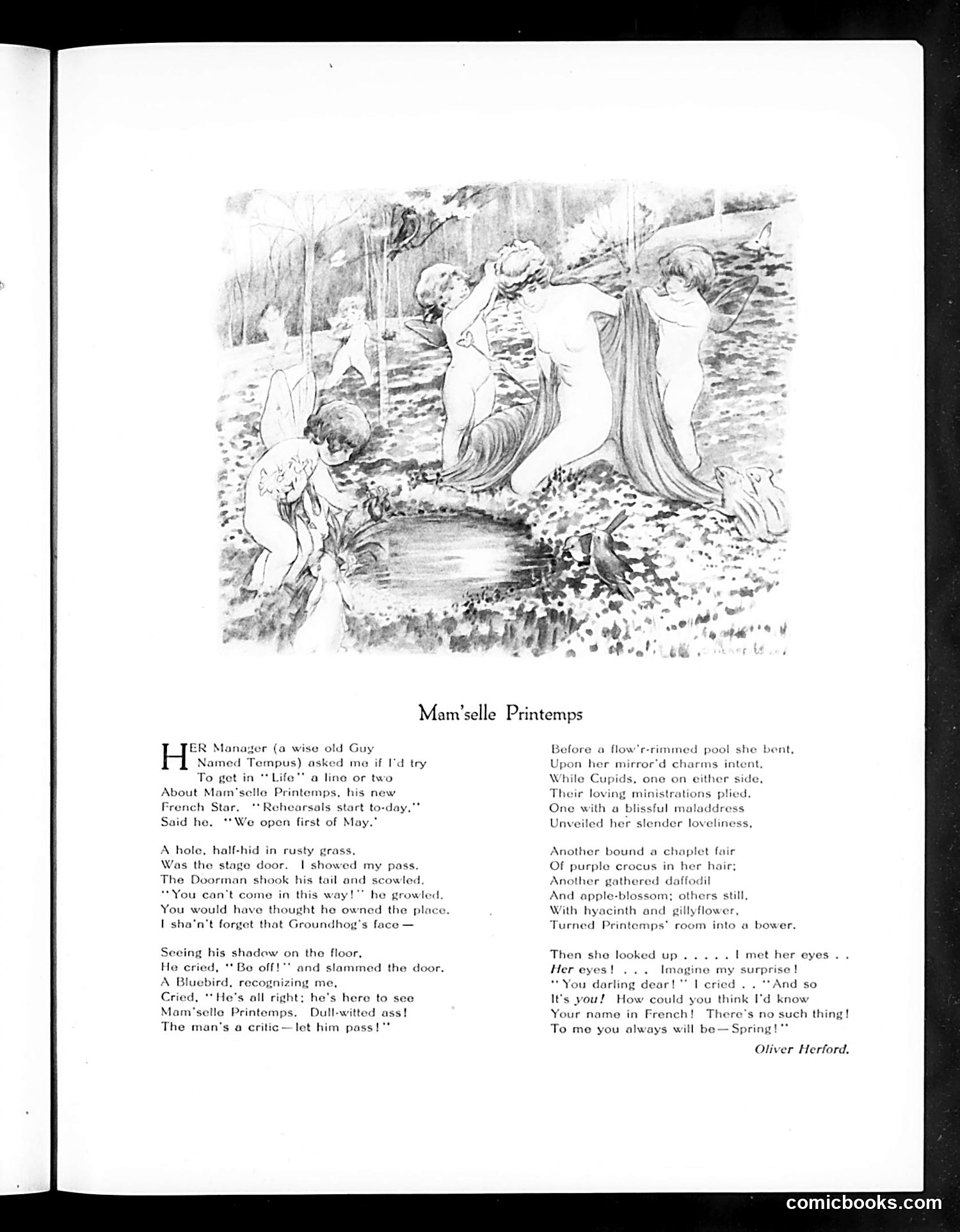
This is a whimsical illustrated poem by Oliver Herford about meeting a French theatrical actress nicknamed "Mam'selle Printemps" (French for "Miss Spring"). The satire works on multiple levels: **The Setup:** A theater manager named Tempus (Latin for "time") asks the narrator to write about a new French star. The joke plays on springtime—"Printemps" means spring in French, and the character is literally Spring personified. **The Humor:** The narrator sneaks past a grumpy groundhog doorman to find the actress primping by a pool, surrounded by Cupids arranging flowers in her hair. When she looks up and their eyes meet, the narrator realizes "she" is not actually a woman named Printemps, but Spring itself—the season. **The Satire:** This gently mocks the pretentiousness of French theatrical imports and the breathless romance surrounding them, while celebrating American nature and seasonal imagery instead. The elaborate French name means nothing; she's simply Spring. The accompanying sketch shows idealized nude or semi-draped figures in a natural woodland setting, reinforcing the allegorical theme.
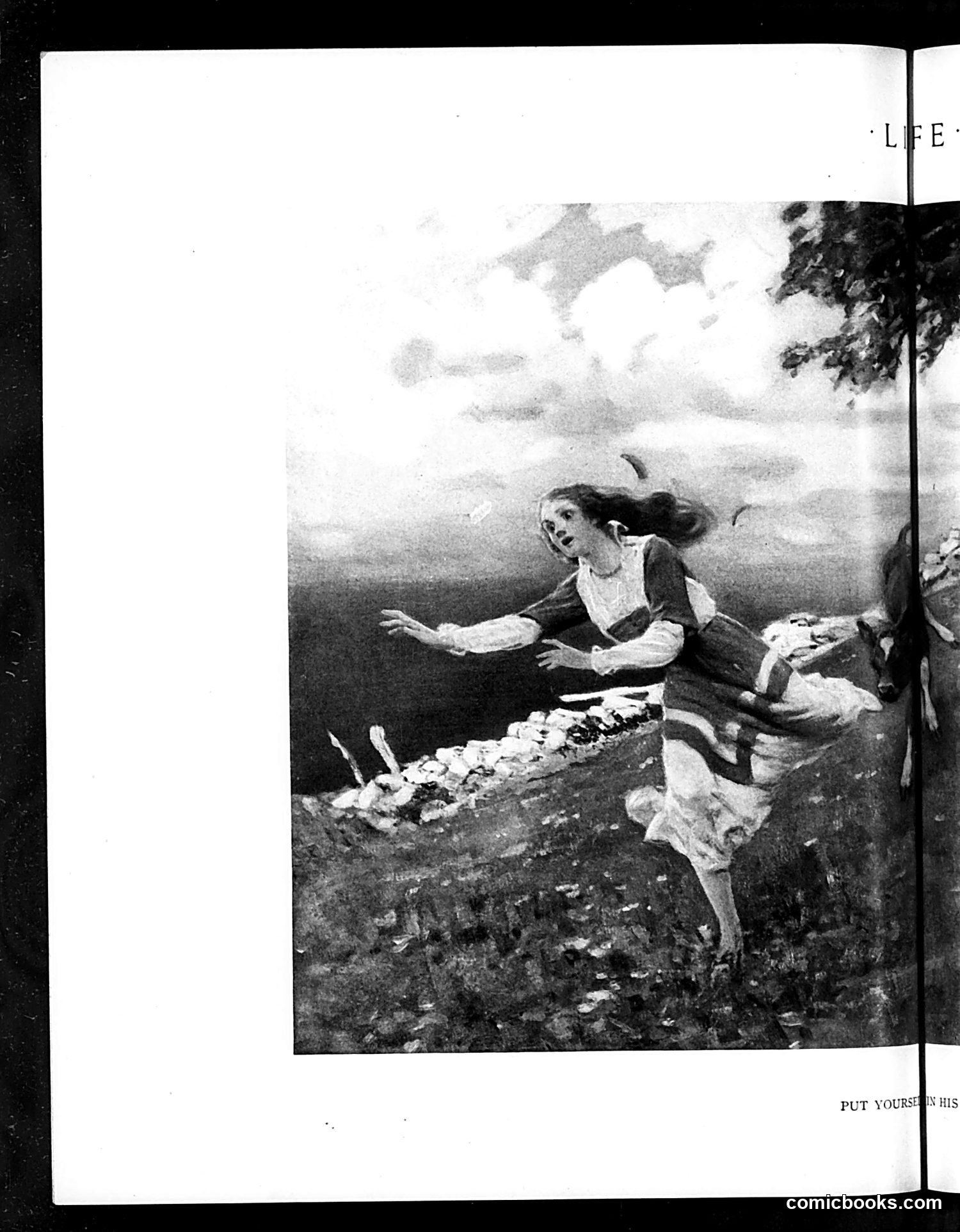
This appears to be a page from *Life* magazine featuring a photograph rather than a cartoon. The image shows a woman in early-20th-century dress (white blouse, dark skirt) posed dramatically on a rocky cliff or hillside, with her arms outstretched as if about to leap or fall. The incomplete caption reads "PUT YOURSEL[F] IN HIS[?]," suggesting this is likely part of a humorous advertisement or feature encouraging readers to imagine themselves in a romantic or dramatic scenario. Without the complete caption or additional context, the specific reference remains unclear. However, the theatrical pose and magazine format suggest this may be promoting a film, novel, or theatrical production popular at the time. The woman's animated expression and precarious positioning create comedic melodrama typical of *Life*'s satirical approach to popular entertainment.
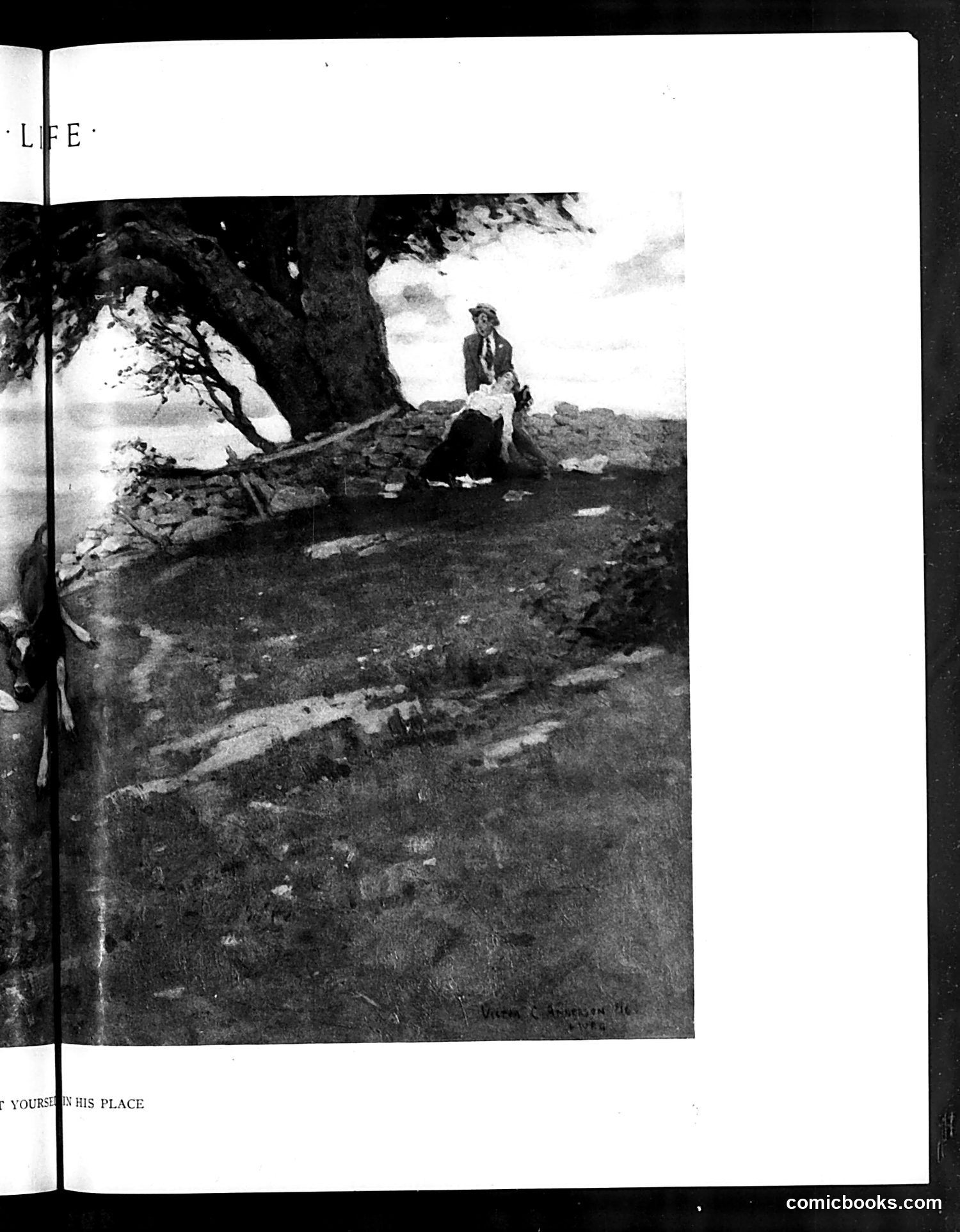
This page from *Life* magazine features a black and white photograph rather than a cartoon. The image shows a man in formal attire (coat and hat) sitting beneath a large, gnarled tree in what appears to be a rural or countryside setting. The composition suggests a contemplative or melancholic mood. The partial text visible reads "SEEN HIS PLACE" (likely "HAVE YOU SEEN HIS PLACE"), suggesting this is captioned commentary. However, without the complete caption or additional context, the specific satirical point and identity of the figure remain unclear. The photograph's artistic quality and the formal dress suggest this may be commentary on a notable public figure or social situation, but I cannot definitively identify who or what is being referenced here.
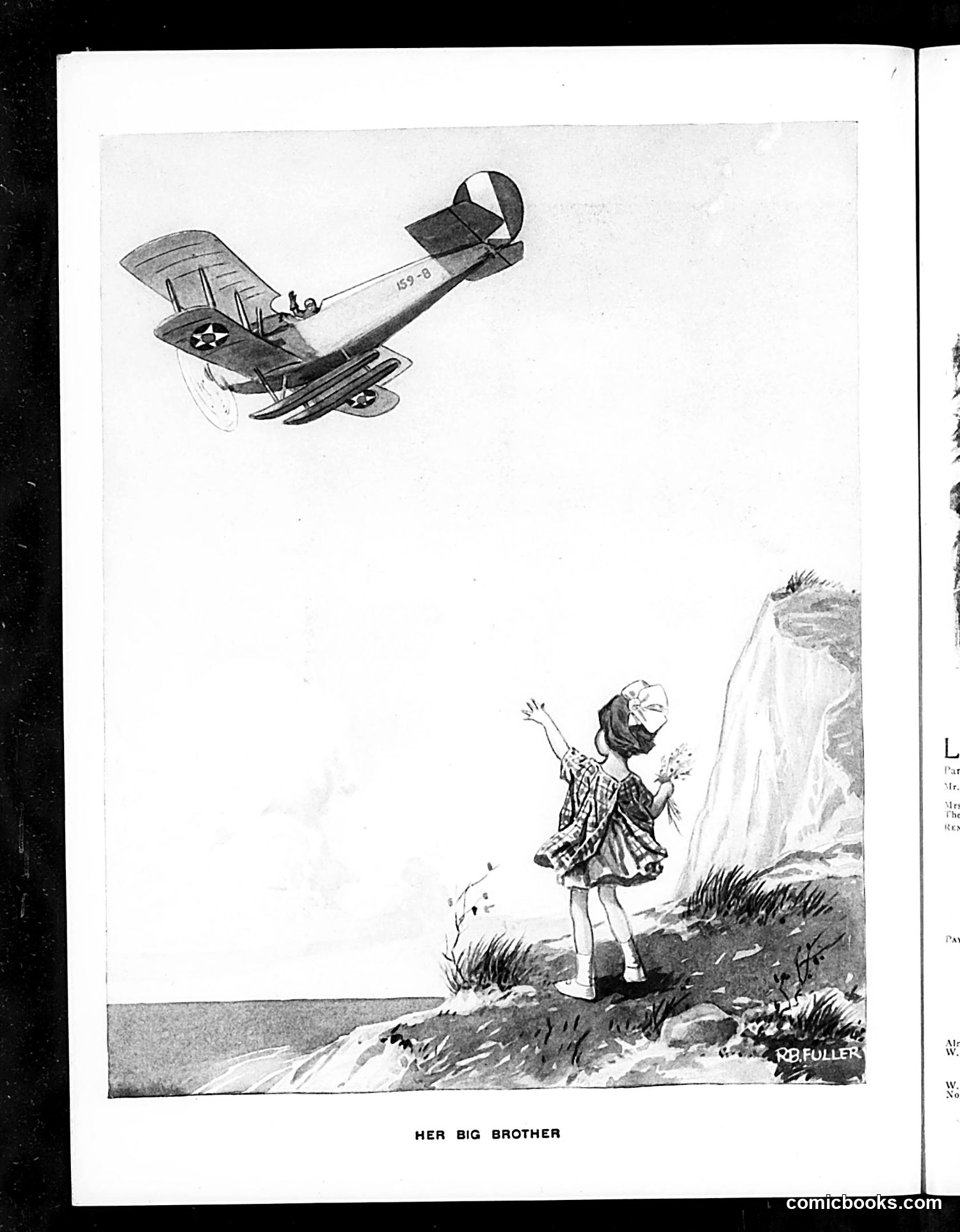
This cartoon depicts a young girl on a cliff watching an early military aircraft (marked "159-9") flying overhead. The plane appears to be a WWI-era design, and the girl waves up at it with evident pride and affection. The title "Her Big Brother" suggests the aircraft represents her sibling serving in military aviation. This is sentimental wartime imagery celebrating familial sacrifice—a common theme in American propaganda and popular culture during World War I. The drawing romanticizes military service and aviation specifically, positioning the pilot-brother as a heroic figure. The cartoon appeals to emotional patriotism, depicting the home front's connection to fighting forces. It reflects contemporary anxieties about loved ones in combat while promoting pride in military service.
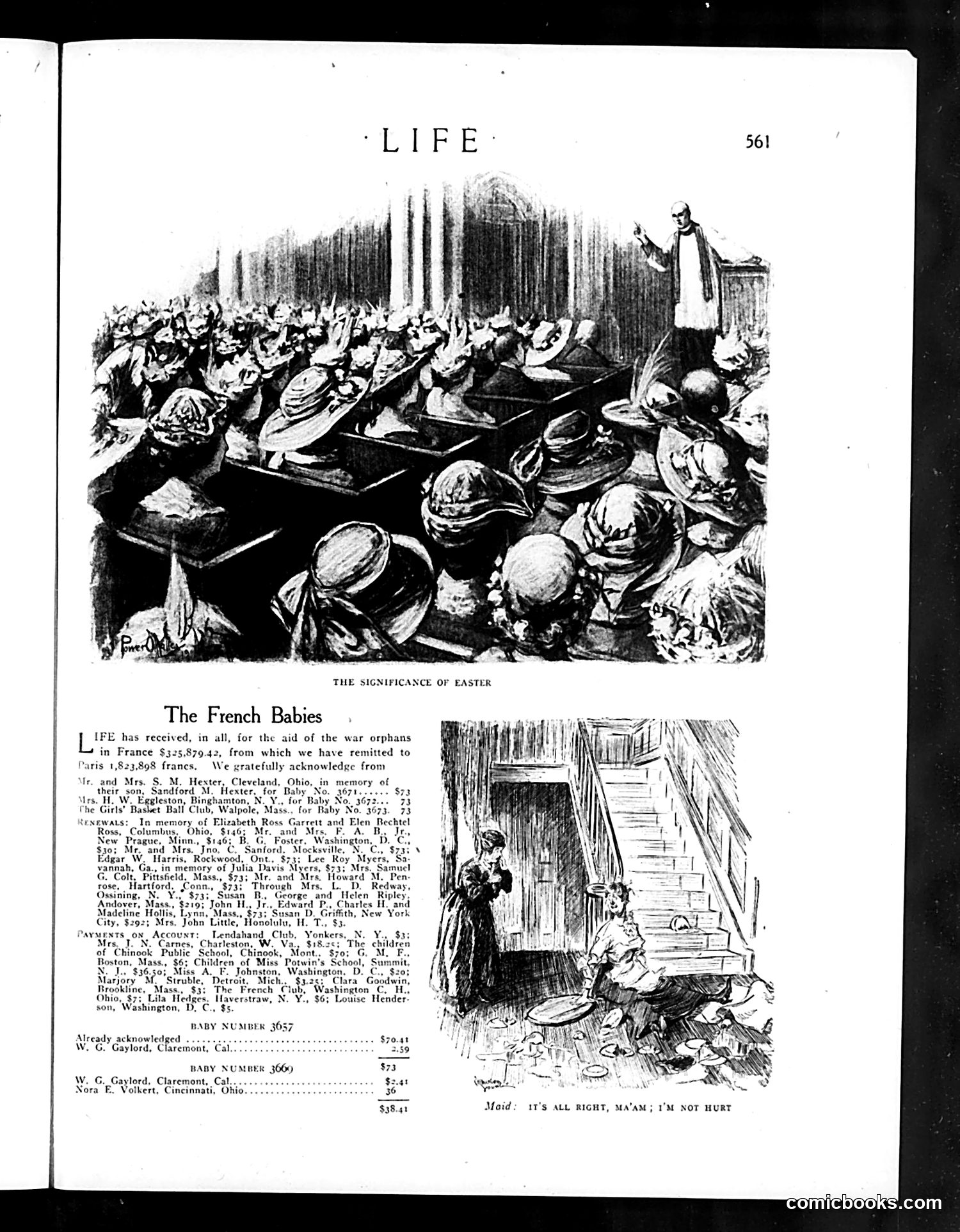
This page documents Life magazine's fundraising campaign for French war orphans during or after World War I. The top illustration shows a religious service (likely Easter, given the caption "The Significance of Easter") with a priest addressing a large congregation—presumably soliciting donations for the cause. The bulk of the page lists donors and their contributions, organized by "Baby Numbers" (individual orphans sponsored through the program). Donations range from $5 to over $700, with donors from across America. The bottom illustration shows a maid comforting an injured child with the caption "It's all right, Ma'am; I'm not hurt"—depicting the plight of French children affected by the war. This represents American charitable response to European war casualties, framing orphan aid as both a moral and religious duty. Life used its platform to publicize donors and encourage continued contributions to this cause.
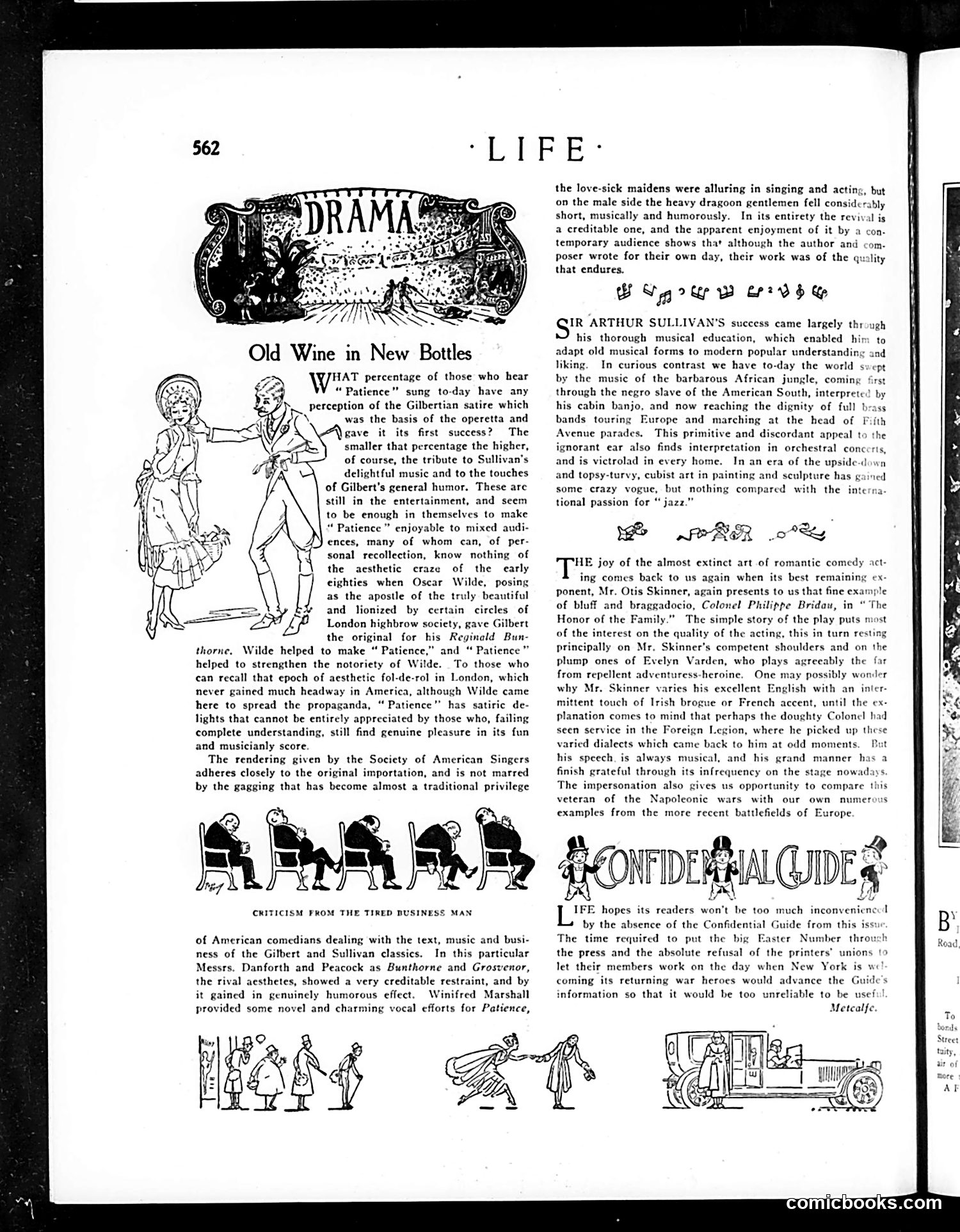
This page reviews recent theatrical productions, primarily discussing a revival of Gilbert and Sullivan's *Patience*. The main article explains that modern audiences likely miss the operetta's original satirical target: **Oscar Wilde and the 1880s aesthetic movement**. The text notes Wilde's pose as an apostle of beauty and his lionization by London society inspired Gilbert's character Reginald Bunthorne. The reviewer credits Sullivan's music for the work's enduring appeal despite audiences no longer understanding its specific cultural reference. The page also critiques contemporary popular music, contrasting Sullivan's refined classical approach with "barbarous African jungle" music and "jazz"—reflecting period attitudes toward jazz as primitive. A secondary review praises actor Otis Skinner's performance in *The Honor of the Family*, noting the rarity of romantic comedy acting talent. The cartoons appear decorative rather than satirical, illustrating the theatrical content discussed.
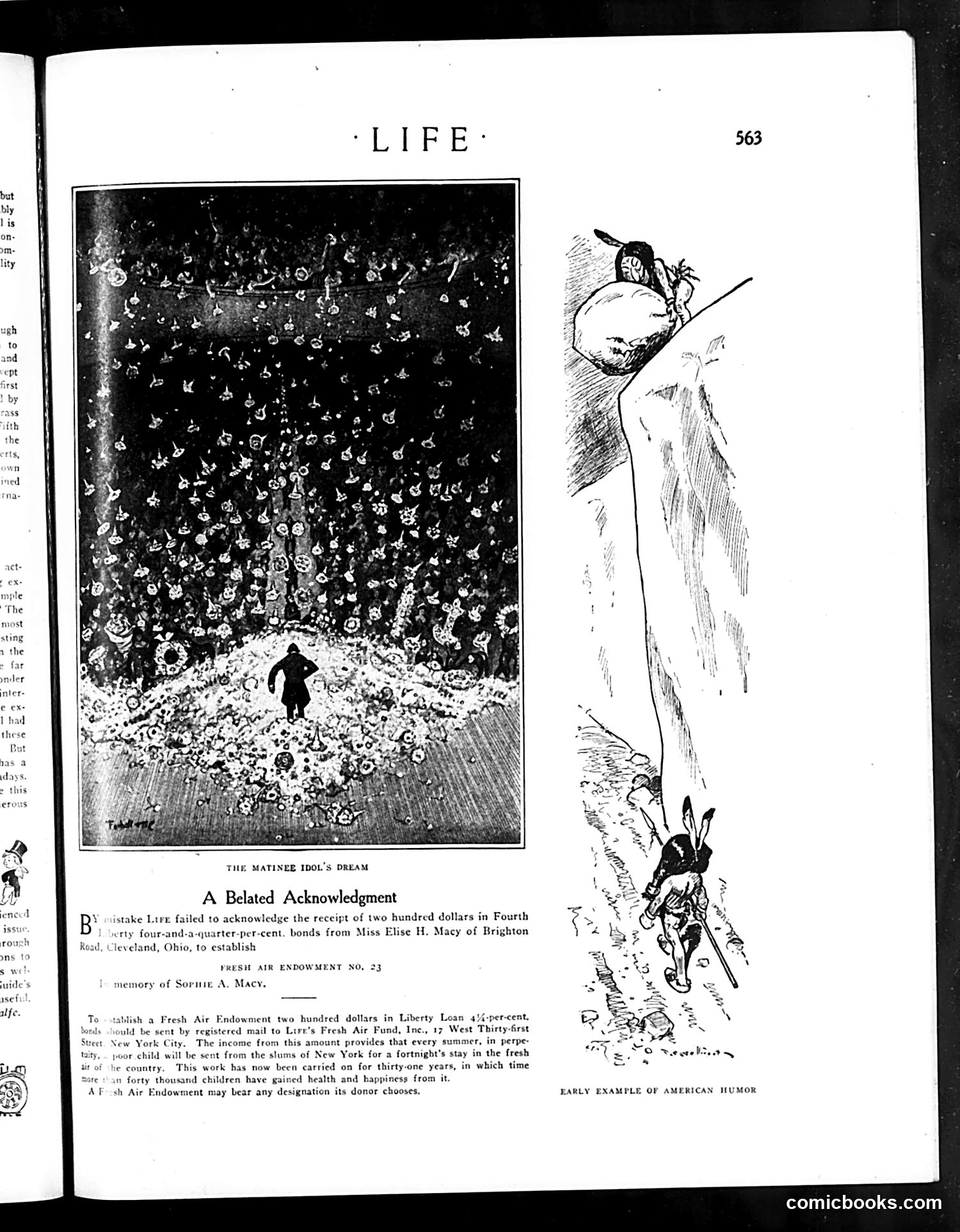
**Left image ("The Matinee Idol's Dream"):** A surreal scene showing a small figure standing amid a massive pile of skulls and bones, with countless skull-faces filling the dark sky above. This appears to be a dark, nightmarish vision—likely satirizing the anxieties or guilt of a theatrical celebrity, though the specific reference is unclear without additional context. **Right image ("Early Example of American Humor"):** A figure climbing a steep cliff or slope using what appears to be a fishing rod as a makeshift tool, with a small animal (possibly a rabbit or cat) at the base. This is captioned as historical American humor, suggesting it represents an older comedic tradition being referenced or celebrated. **Text content:** Acknowledges donations to a "Fresh Air Endowment"—a charitable fund sending poor children from New York City slums to the countryside for two-week stays. The fund had operated for 31 years at this time, benefiting 40,000 children. The page combines dark social commentary with lighter humor and charitable messaging.
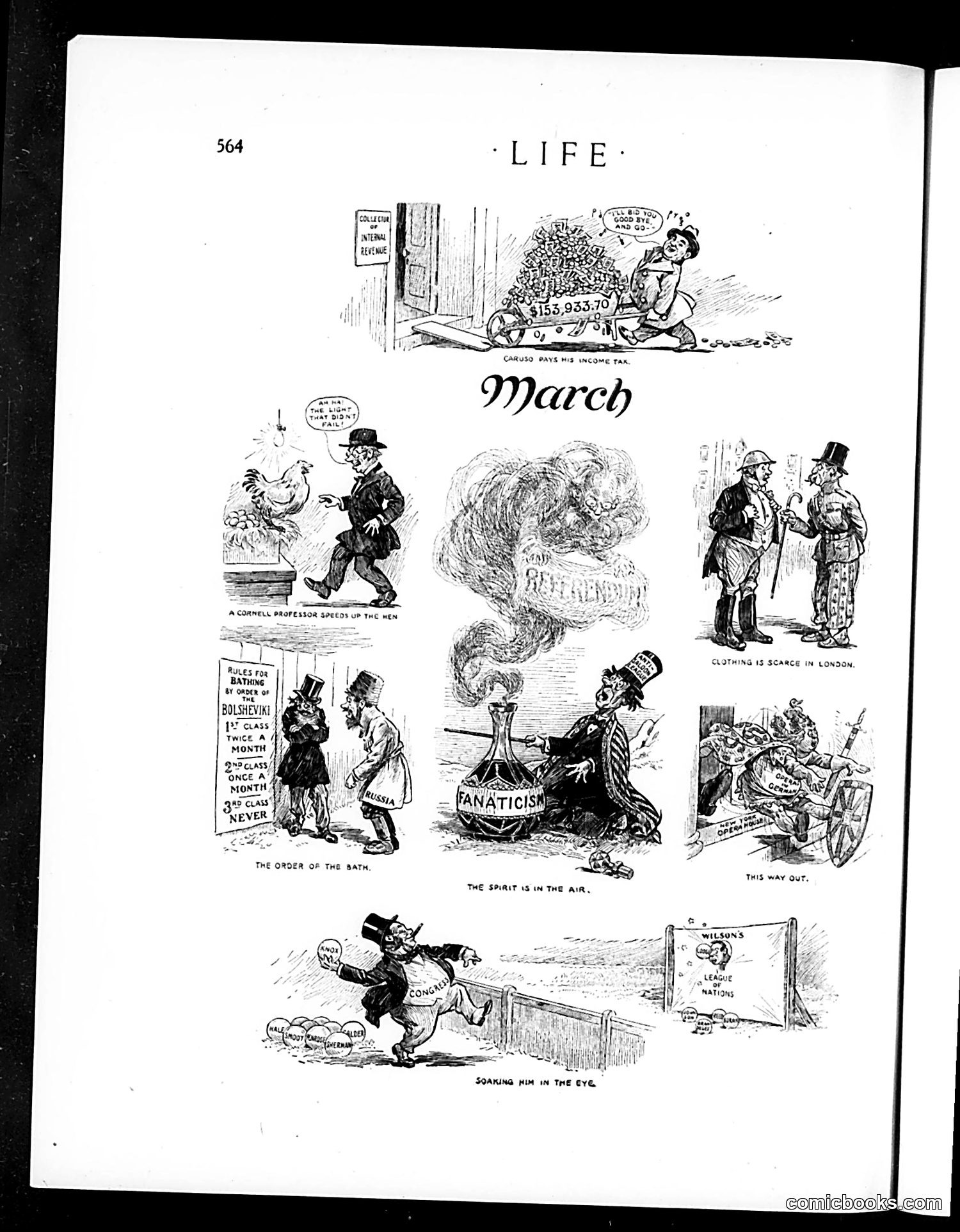
This page satirizes post-WWI anxieties about Bolshevism and social upheaval in early 1920s America. Key cartoons include: **"The Spirit is in the Air"**: Fanaticism (depicted as a demon/spirit) spreads chaos, referencing Red Scare fears of communist ideology infiltrating society. **"The Order of the Bath"**: Mocks Bolshevik bathing rules as absurdly restrictive—class-based bathing schedules ridiculing Soviet egalitarian policies as impractical. **"Soaking him in the Eye"**: Shows Wilson (likely) being attacked by various labeled spheres (appears to reference domestic and international criticisms), suggesting the president under assault from multiple directions. The cartoons express American middle-class concerns about revolutionary socialism, class conflict, and perceived threats to traditional order during the turbulent post-war period.
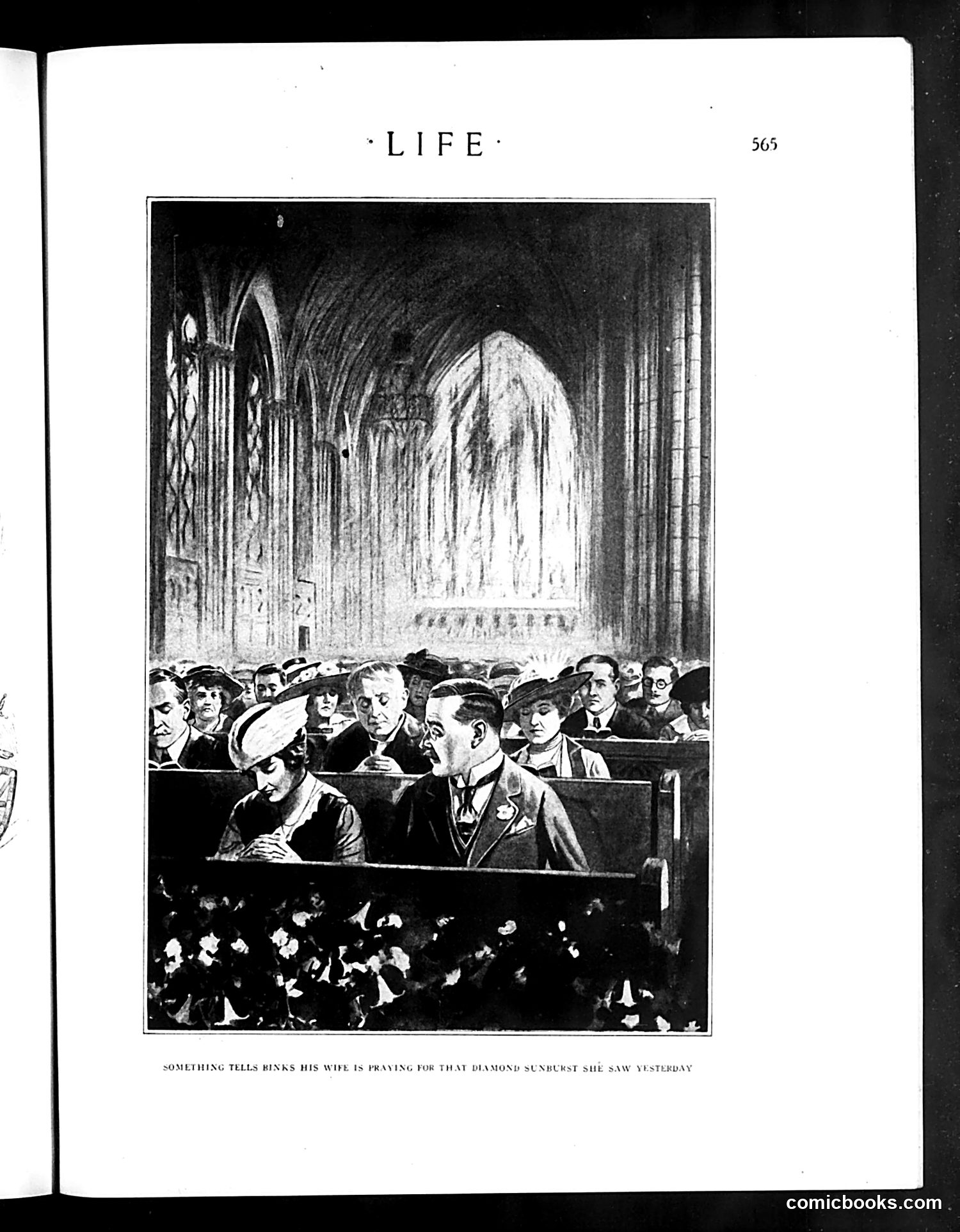
This is a satirical cartoon from *Life* magazine depicting a church interior scene. A man (identified as "Binks" in the caption) sits in a pew with his wife during what appears to be a religious service. The caption suggests Binks suspects his wife is praying not for spiritual matters, but rather for a diamond—implying she's using prayer for material gain. The satire targets two things: wealthy husbands' anxieties about wives' materialism, and the era's stereotype of women as primarily motivated by jewelry and luxury goods. The humor derives from the ironic situation of a woman feigning religious devotion while actually focused on acquiring expensive gifts. This reflects early 20th-century gender attitudes and middle-to-upper-class social dynamics regarding consumption and marriage.
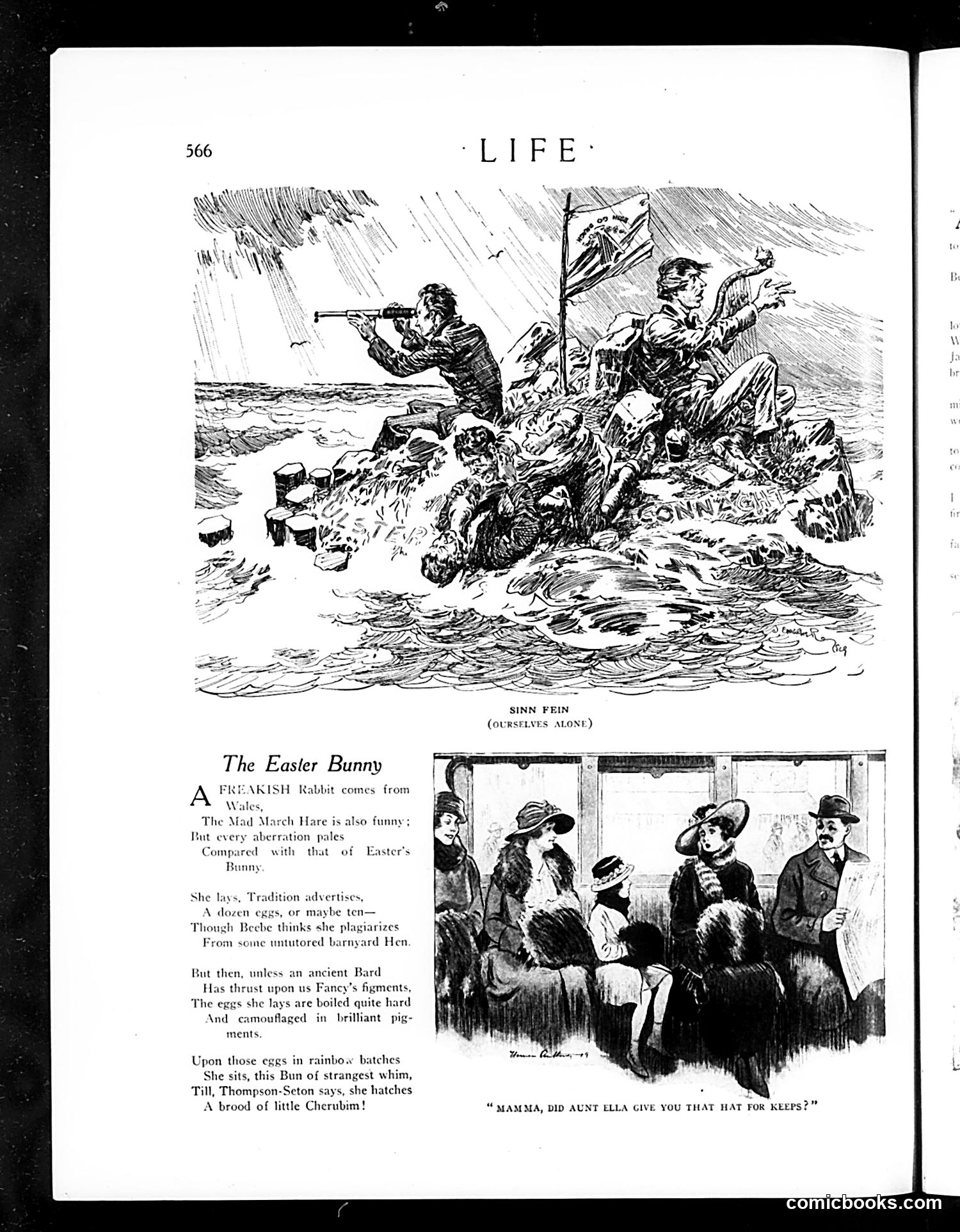
This page satirizes the Easter Bunny myth through two contrasting pieces: **Upper cartoon ("Sinn Féin")**: A political allegory depicting Irish independence fighters using maritime/military imagery. The title suggests commentary on Irish nationalism during the independence struggle. **Lower poem and illustration**: A humorous debunking of Easter Bunny folklore. The text mocks the fantastical tradition—that a rabbit lays decorated eggs and supposedly hatches them into "little Cherubim" (babies). It references naturalist Ernest Thompson Seton and ornithologist William Beebe as authorities, sarcastically suggesting the Easter Bunny might plagiarize from actual barnyard hens. The accompanying illustration shows adults and children in a domestic setting, with a caption ("Mamma, did Aunt Ella give you that hat for keeps?") suggesting confusion about gift-giving customs—perhaps implying the Easter Bunny tradition creates similar confusion about where gifts actually come from. The satire targets both literal belief in the Easter Bunny and broader gullibility about inherited traditions.
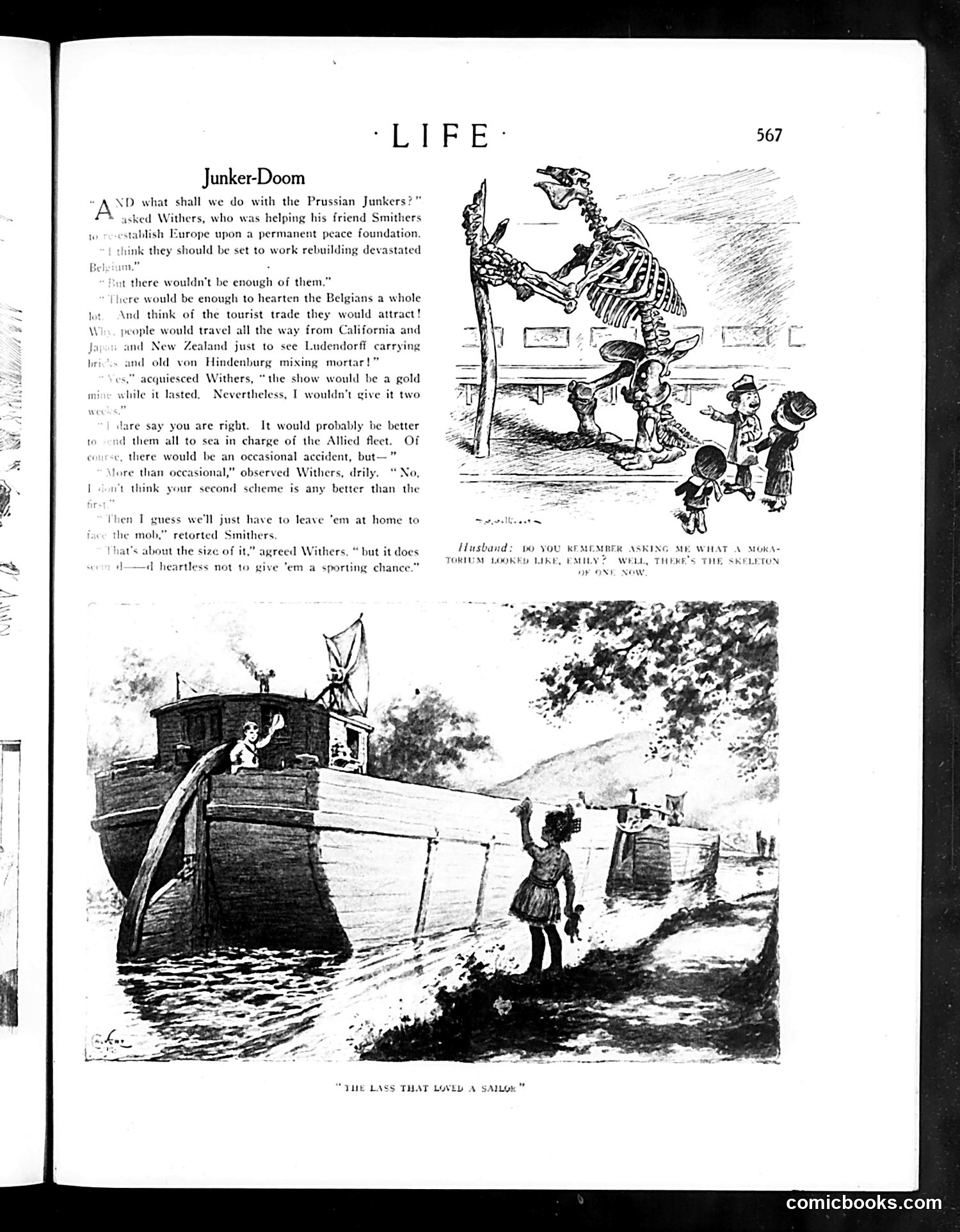
This page satirizes post-World War I discussions about punishing German military leadership. The dialogue between Withers and Smithers debates what to do with Prussian "Junkers"—the German military aristocracy, particularly figures like Ludendorff and von Hindenburg (explicitly named). The satire progresses through increasingly harsh proposals: using them for reconstruction labor in devastated Belgium, putting them on display as tourist attractions, drowning them at sea. Each suggestion is darkly comic, culminating in Smithers's resigned acceptance that they'll simply "stay home to face the mob"—implying public justice or lynching. The cartoon criticizes both the vindictive peace sentiment and the difficulty of actually implementing punishment against defeated enemies. The top illustration depicts a skeleton (representing a "moratorium"—likely referencing post-war economic discussions) being shown to tourists, reinforcing themes of German humiliation as spectacle. The satire reflects 1918-1920s debates about war crimes tribunals and reparations that ultimately shaped the controversial Treaty of Versailles.
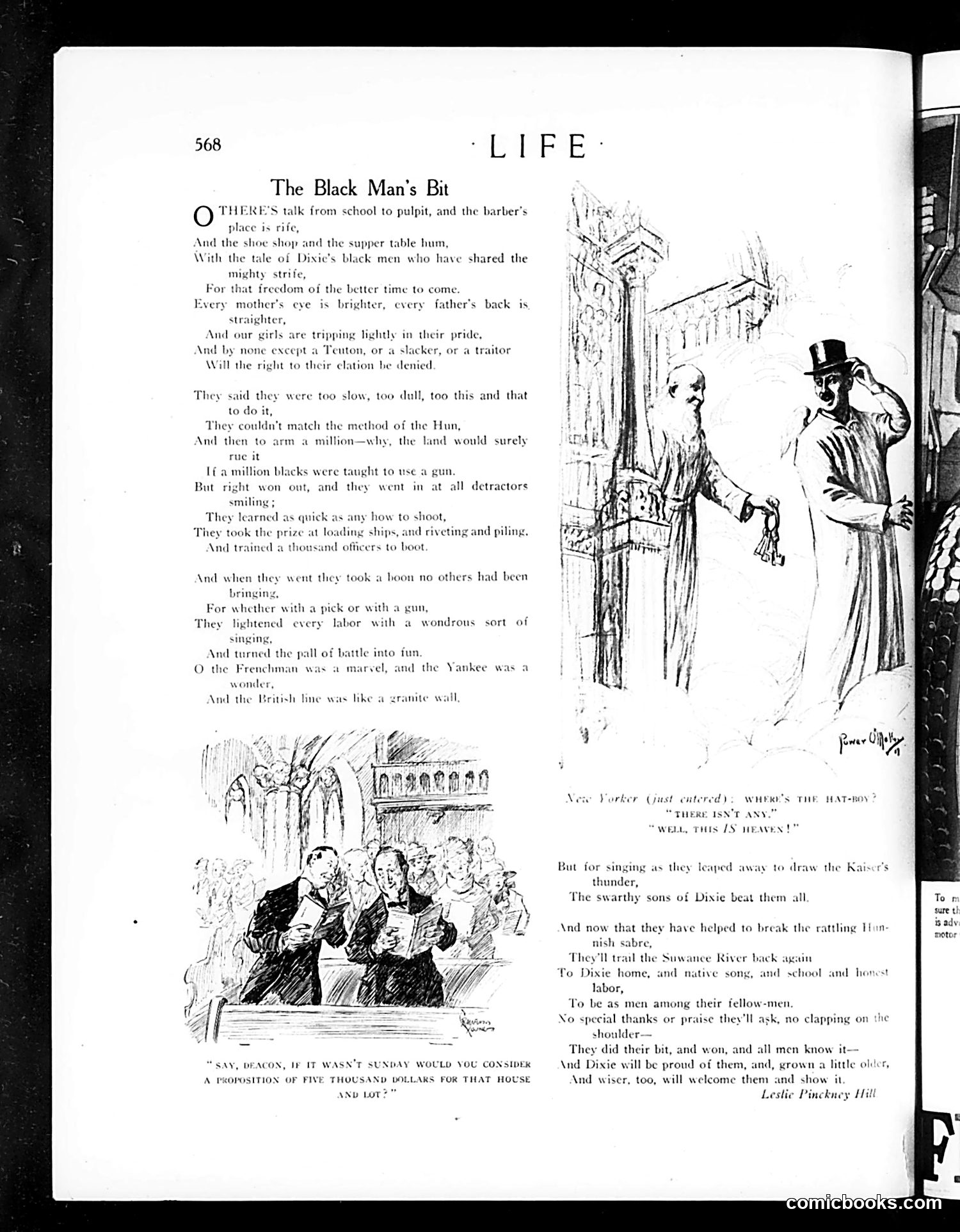
This WWI-era poem by Leslie Pinckney Hill celebrates African American soldiers' contributions to the war effort. The page includes two cartoons with period humor. **Main content:** The poem argues that Black soldiers—long stereotyped as "too slow, too dull"—proved themselves capable fighters and laborers. It emphasizes their singing, morale-boosting, and skilled contributions (loading ships, riveting, training officers). Hill suggests they earned respect and should return home as equals ("as men among their fellow-men"), expecting no special praise but deserving integration into society. **Cartoons:** - Top: A New Yorker entering heaven asks where the hat-boy is; told there isn't one—a joke about American class distinctions disappearing in the afterlife. - Bottom: A deacon proposes buying a house for $5,000—period financial humor about property values. The page reflects 1918 optimism that wartime service would improve race relations, though history shows this hope was largely unfulfilled.
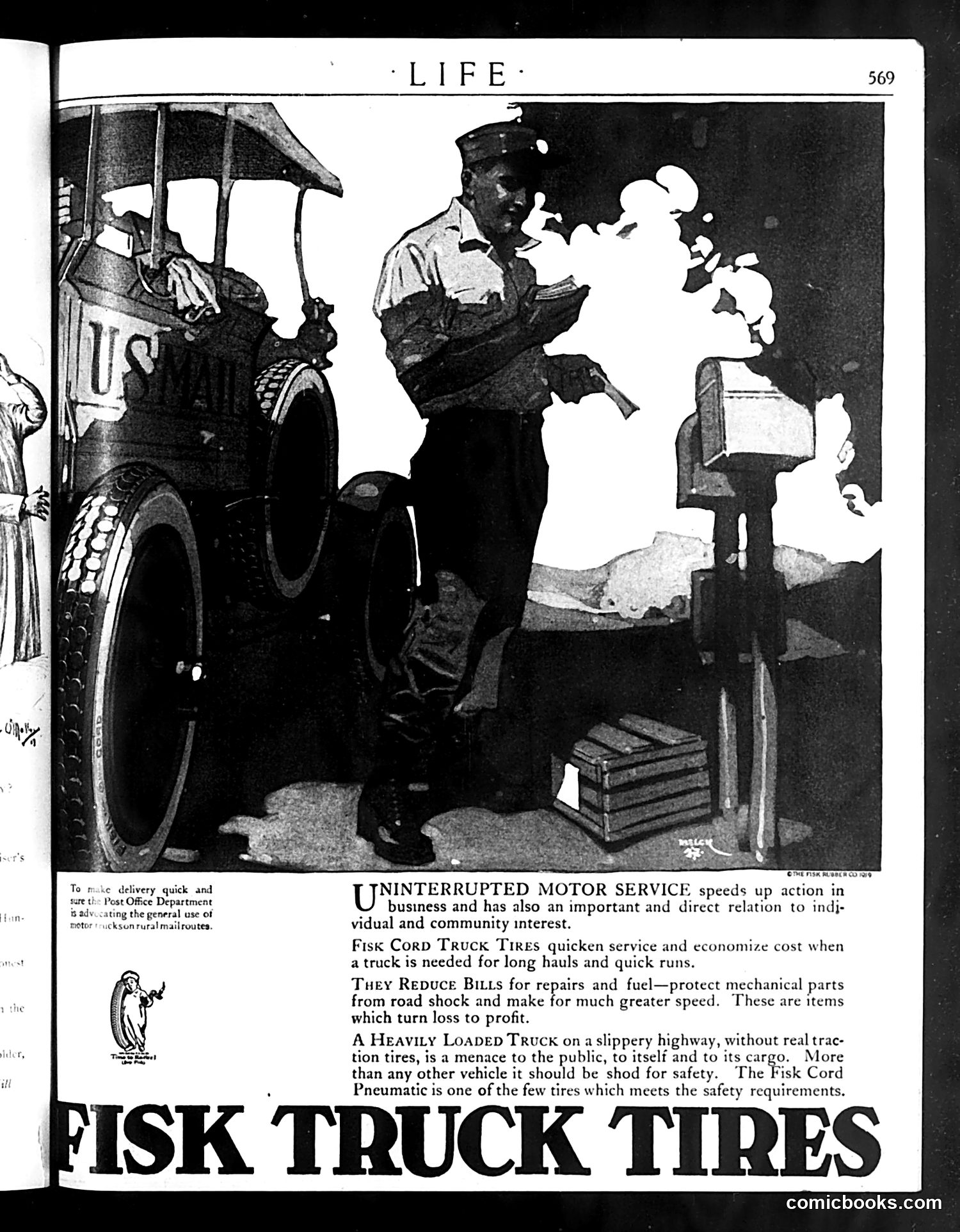
This is a **product advertisement**, not political satire. The illustration shows a delivery truck driver making a postal delivery, with text promoting Fisk Corporation truck tires. The ad's argument is straightforward: reliable tires improve business efficiency and safety. It emphasizes that Fisk tires enable faster service, reduce repair costs, and—crucially—provide traction on slippery roads, making heavily loaded trucks safer for public use. The referenced context includes Post Office and rural mail delivery routes, suggesting this ad targeted commercial trucking and government fleet operators in an era when motorized delivery was still relatively new and tire reliability directly affected business operations and public safety. This reflects early 20th-century advertising that connected consumer products to broader social benefits like efficient mail service.
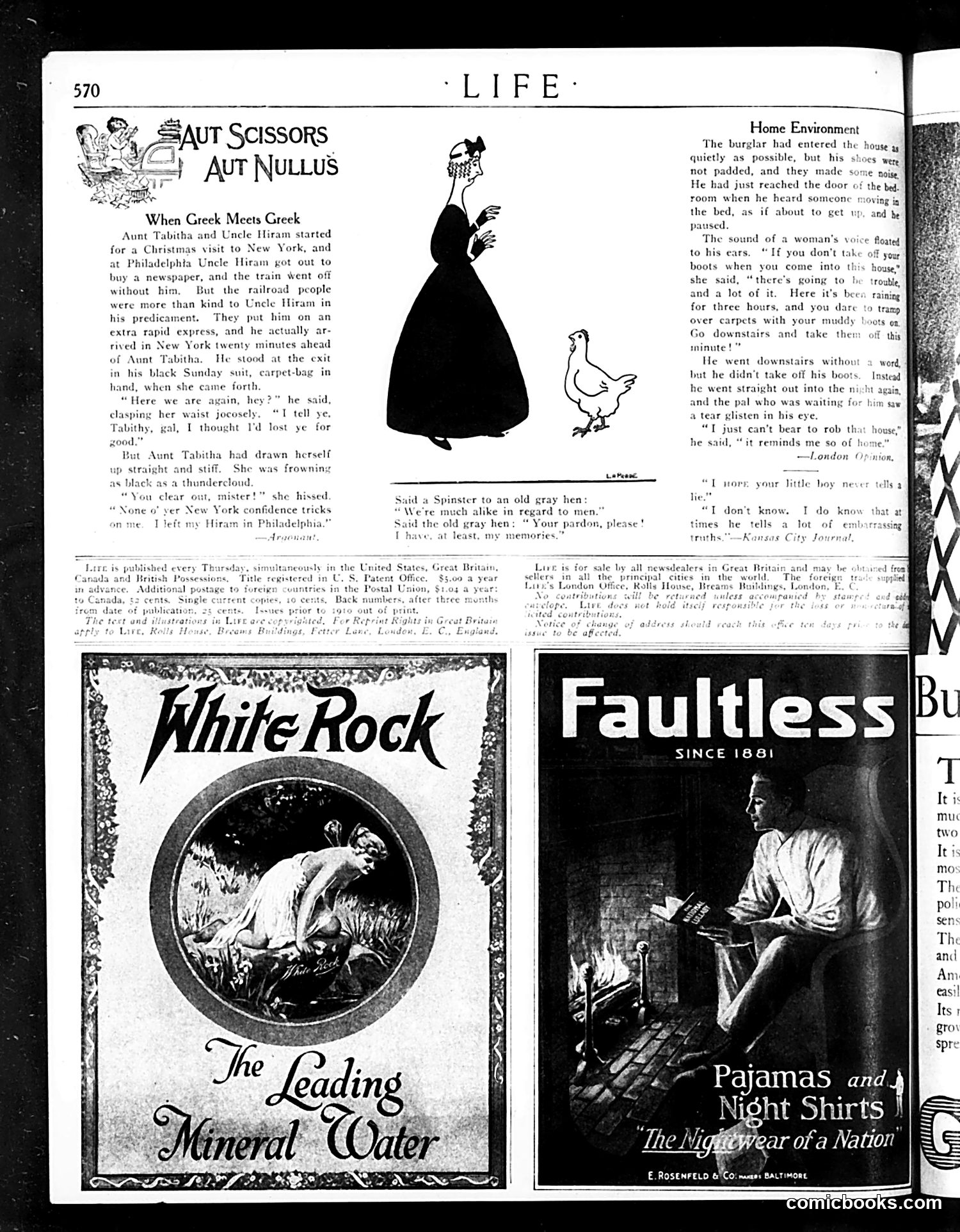
This page contains two satirical pieces from Life magazine: **"When Greek Meets Greek"** (top left): A humorous story about Uncle Hiram and Aunt Tabitha reuniting at a train station in New York. Uncle Hiram, accidentally left behind in Philadelphia, arrives early via express train. When Aunt Tabitha appears, he greets her cheerfully, but she's drawn herself up coldly and accuses him of using "New York confidence tricks." The satire mocks marital dynamics and the battle of wills between spouses—her suspicion and coldness toward his innocent mishap. **"Home Environment"** (top right): A darkly comic anecdote about a burglar who enters a house and hears a woman's voice scolding someone (apparently her husband) about tracking mud on carpets. The burglar is so reminded of domestic nagging that he abandons the robbery, emotionally unable to steal from a home that mirrors his own domestic torments. The joke satirizes how even criminals recognize—and are deterred by—the universal complaint of wives about household cleanliness. Both pieces use humor to comment on marriage and domestic life.
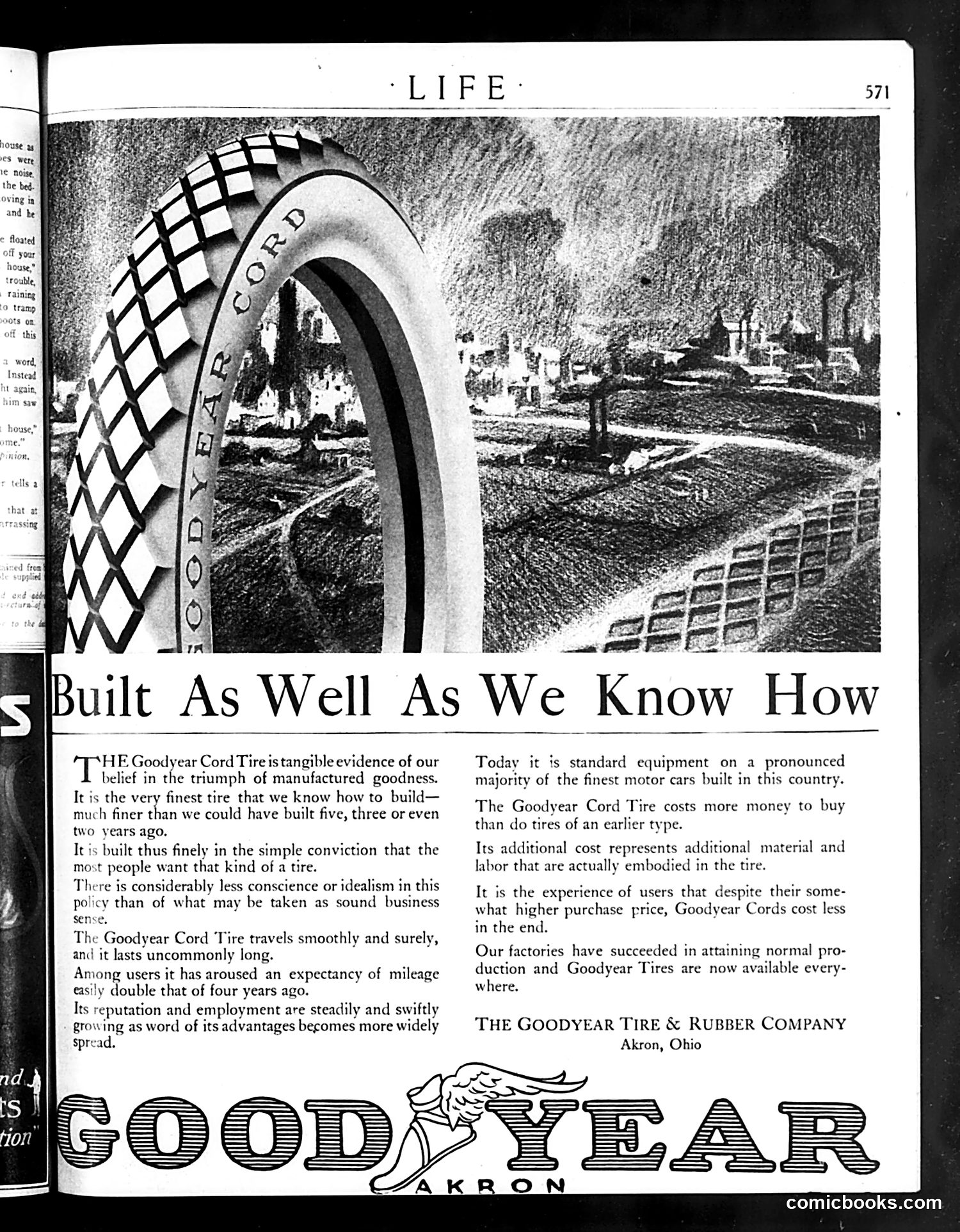
This is **not a cartoon or satire**—it's a straightforward commercial advertisement for Goodyear Cord Tires from the Goodyear Tire & Rubber Company in Akron, Ohio. The ad features a large photograph of a Goodyear tire with visible tread pattern, positioned to showcase the product. The accompanying text argues that Goodyear Cords represent superior manufacturing quality and justify their higher price through durability and longevity. The ad emphasizes that these tires are now "standard equipment on a pronounced majority of the finest motor cars" and claims users experience doubled mileage compared to earlier tire types. The headline, "Built As Well As We Know How," reflects early-20th-century advertising rhetoric emphasizing craftsmanship and consumer trust in manufactured goods. This appears designed to reassure readers during what may have been post-production shortage ("factories have succeeded in attaining normal production").
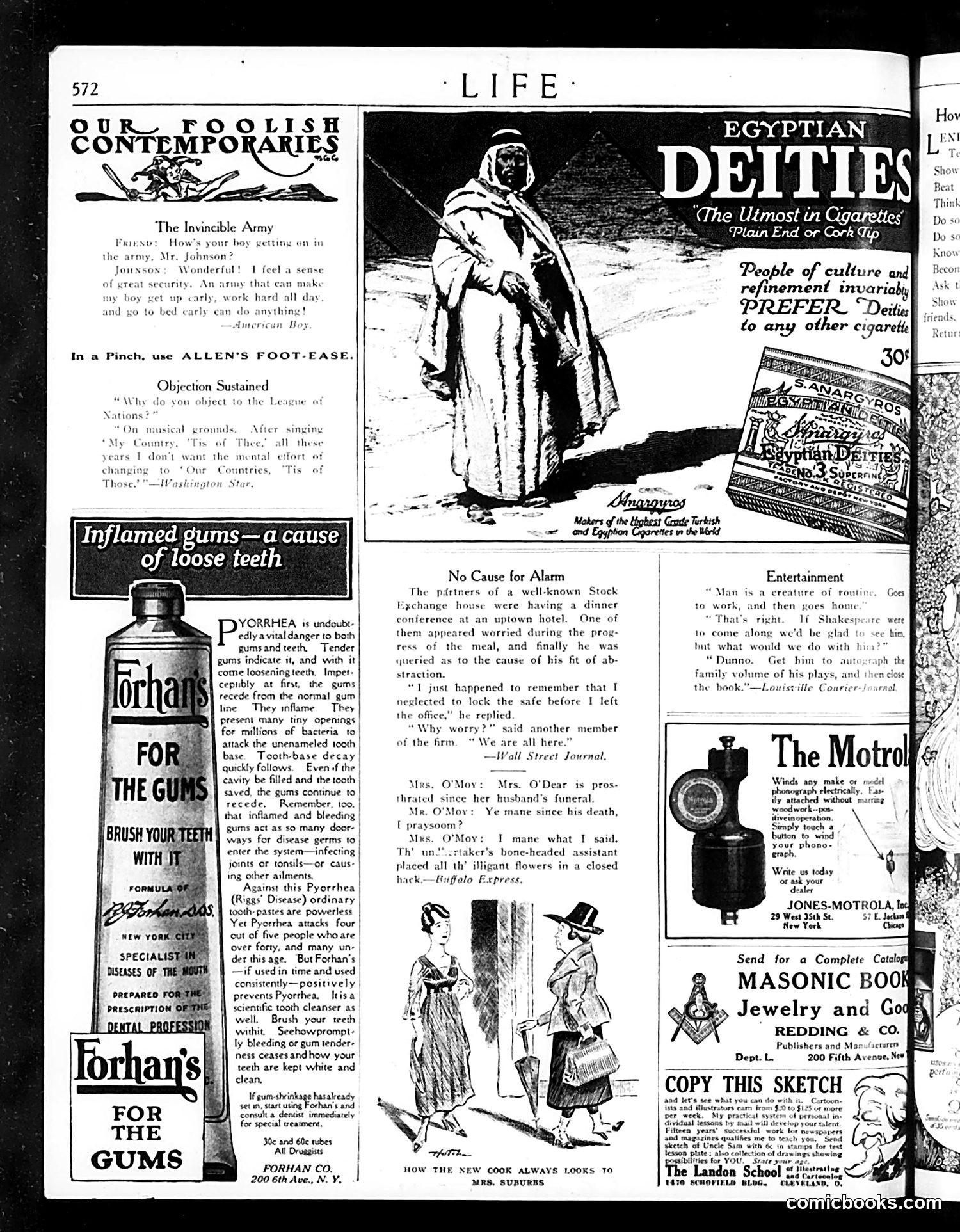
This page from *Life* magazine is primarily **advertising**, with several small humor items interspersed. The main content includes: **Cartoons/Humor:** - "The Invincible Army": A joke about military discipline making boys obedient - "Objection Sustained": A satirical jab at opponents of the League of Nations, mocking their musical objections to international cooperation - Several short anecdotes about absent-mindedness and miscommunication **Central Image:** An Egyptian figure in traditional robes—part of an advertisement for "Egyptian Deities" cigarettes, playing on exotic/colonial imagery popular in the 1920s. **Context for Modern Readers:** The League of Nations reference dates this to the post-WWI period when American isolationists opposed U.S. membership. The page reflects 1920s consumer culture and advertising aesthetics, with no sophisticated political satire—mostly light domestic humor and product promotions.
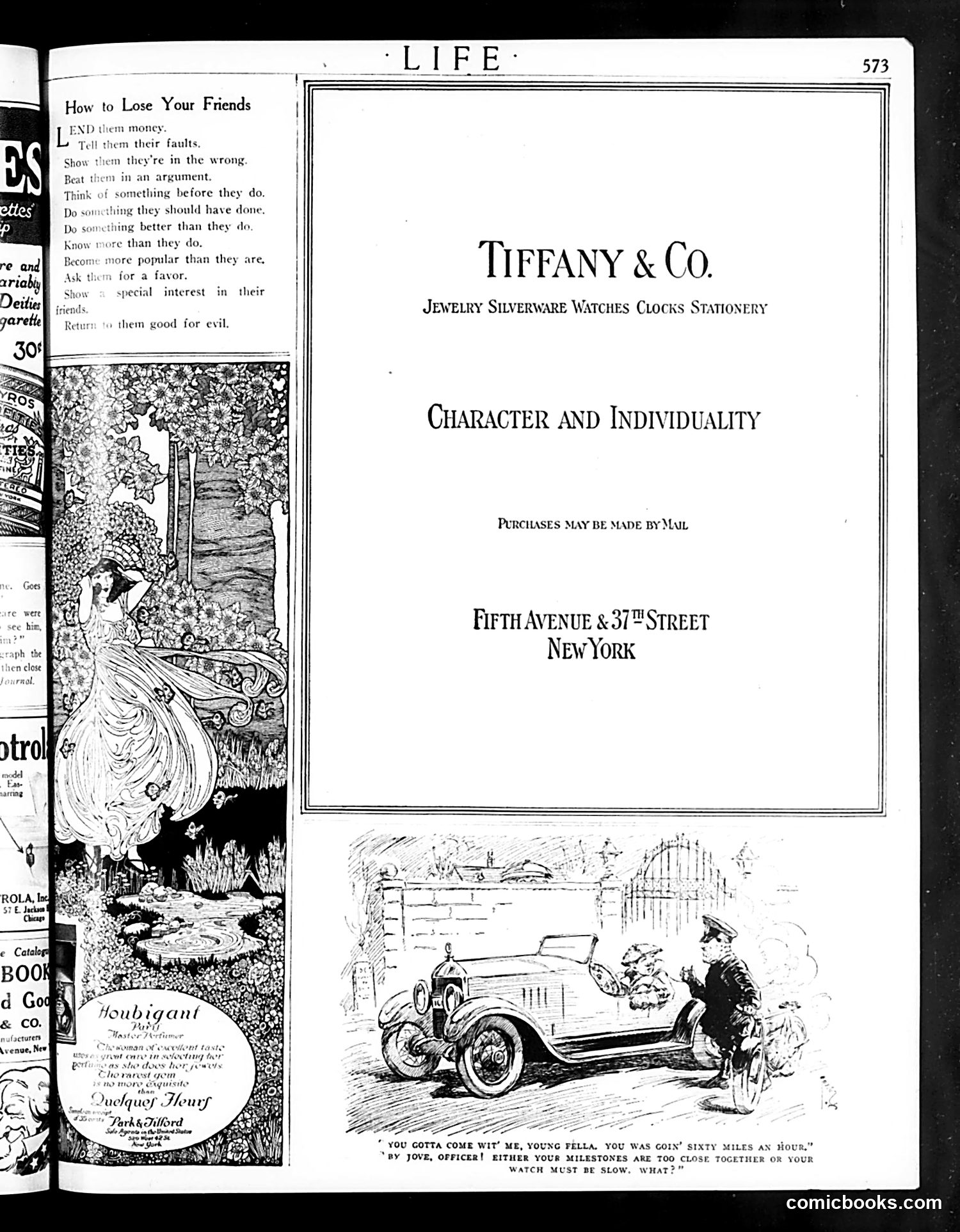
This is primarily a **title/advertising page** rather than editorial content. The right side features a Tiffany & Co. luxury goods advertisement emphasizing "Character and Individuality." The left sidebar contains a humorous list titled **"How to Lose Your Friends"**—satirical advice on friendship-damaging behaviors (lending money, criticizing, one-upping others, etc.). This is mild social satire about interpersonal vanity. The bottom cartoon depicts a **speeding violation encounter**: a wealthy, well-dressed motorist caught by a traffic officer claims the officer's speed measurement must be faulty—his milestones are "too close together" or the officer's watch is "slow." The humor lies in the motorist's absurd deflection rather than admitting guilt, combined with his affected British accent ("By Jove"). This satirizes upper-class entitlement and the audacity of wealthy drivers dismissing traffic laws as measurement errors rather than accepting accountability.
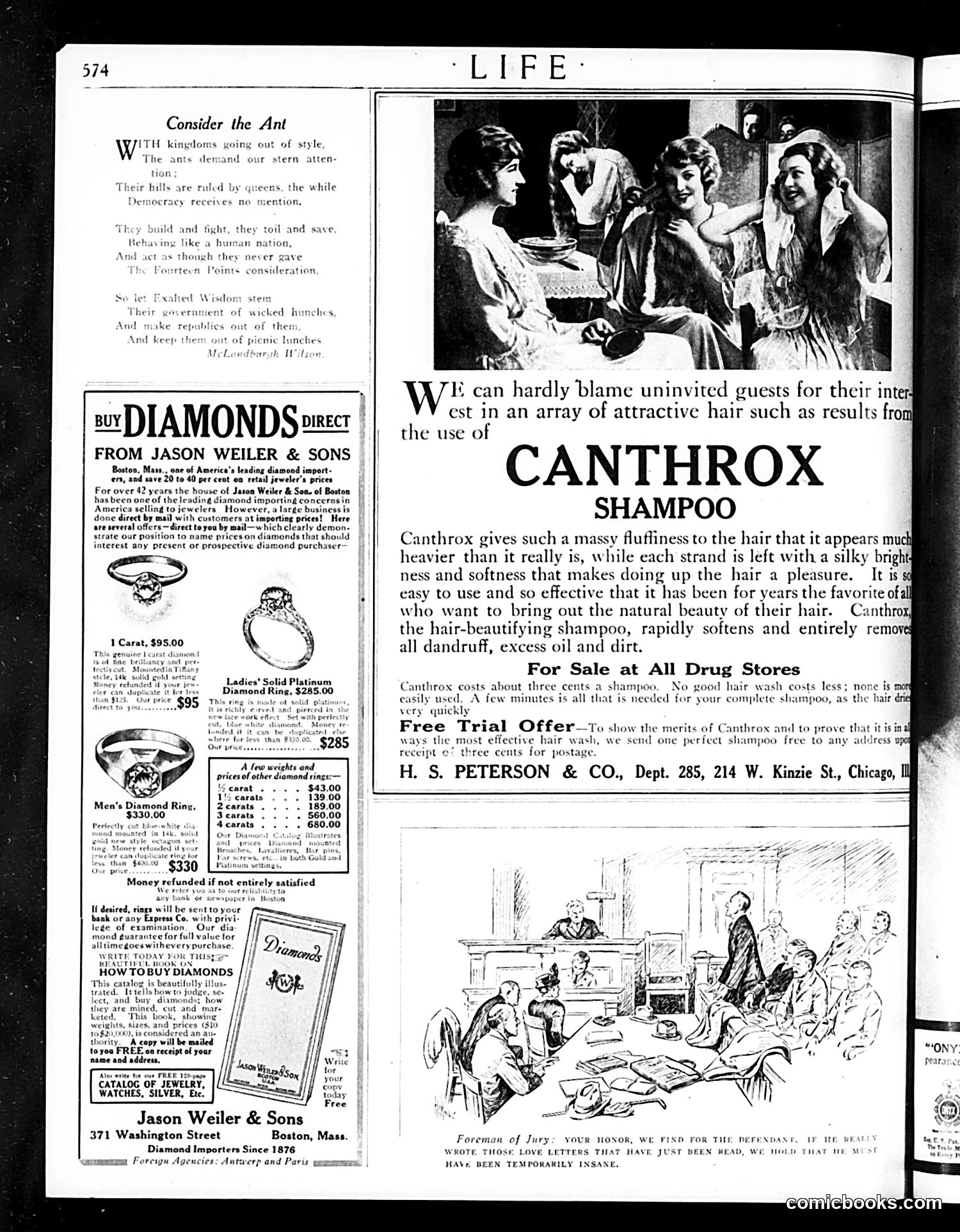
This page contains primarily **advertisements** rather than political satire. The main content includes: **"Consider the Ant"** poem (top left): A brief verse comparing ant colonies—ruled by queens with no democracy—to human governance, attributed to "McCondorach Wilson." It appears to be light social commentary about hierarchical organization. **Advertisements dominate the page:** - Jason Weiler & Sons (diamonds/jewelry) - Canthrox Shampoo (hair product) **Bottom cartoon**: A courtroom scene showing a jury foreman announcing a verdict. The joke is that if the defendant wrote the love letters introduced as evidence, he must be "temporarily insane"—implying the letters were so poorly written or ridiculous that no sane person could have composed them. This is a crude humor joke about male incompetence in romantic expression, not political satire. The page is primarily a commercial vehicle for period advertising with minimal satirical content.
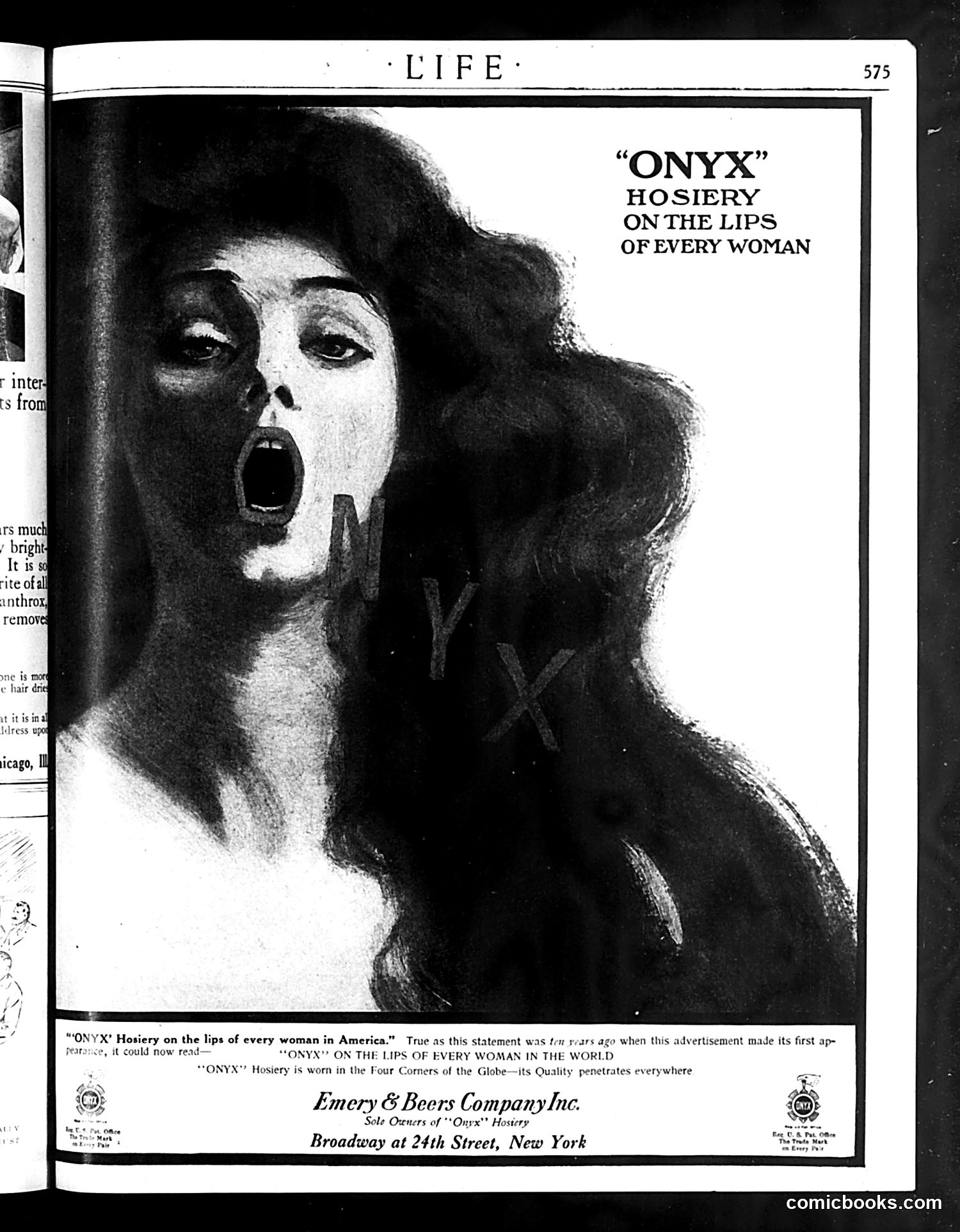
This is a **product advertisement**, not a political cartoon. It promotes "Onyx" brand hosiery (stockings) by Emery & Beers Company. The ad features a dramatic black-and-white photograph of a woman's face with an exaggerated, surprised expression—mouth wide open—to convey excitement or enthusiasm about the product. The tagline claims "Onyx Hosiery on the lips of every woman in America," playing on the double meaning of "on the lips" (people talking about it) rather than literal lips. The text notes the slogan was accurate "ten years ago" and claims Onyx hosiery is now worn "in the Four Corners of the Globe," emphasizing the product's global success and quality. For modern readers, the theatrical presentation and hyperbolic marketing language is typical of early 20th-century advertising, which relied on dramatic imagery and exaggerated claims about product superiority and universal appeal.
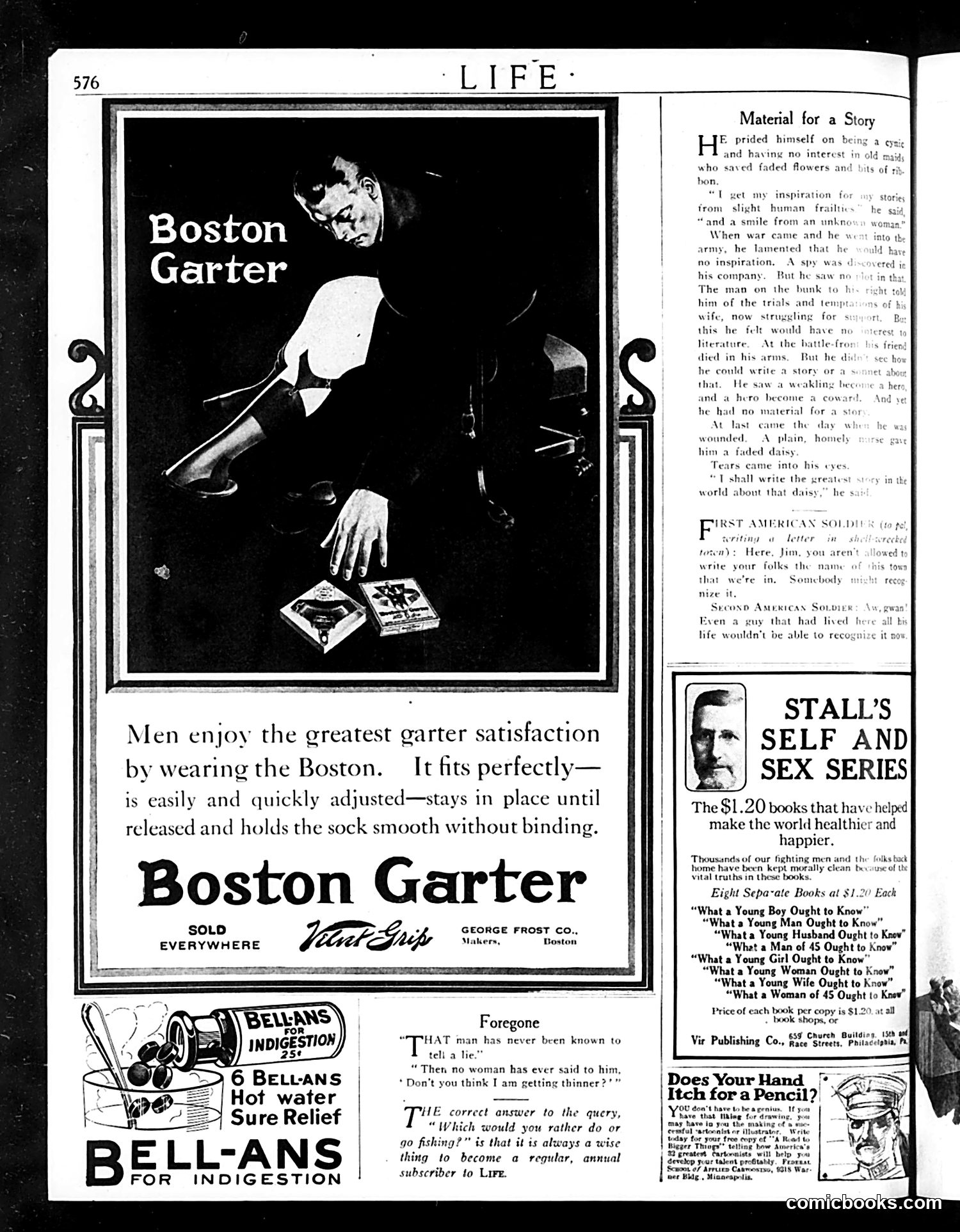
This page is primarily **advertising**, featuring several unrelated commercial products and services typical of early 20th-century magazines. **Main Advertisement:** Boston Garter (sock garters) dominates the left side with an image of a man examining playing cards, emphasizing the product's fit and functionality. **Sidebar Content:** Includes a short story titled "Material for a Story" about a writer seeking inspiration from human experience during wartime, and a brief joke about American soldiers being unable to recognize their own towns—likely WWI-era humor about soldiers from small communities. **Other Advertisements:** Bell-Ans indigestion remedy, Stall's Self and Sex Series (educational books on sexual health marketed to young people), and a pencil company ad. **The "Foregone" Section:** A short comic dialogue suggesting women always ask if they're getting thinner, and that readers should subscribe to *Life* magazine annually—typical period humor about gender stereotypes and self-promotion. The page reflects early 20th-century advertising styles and attitudes without sophisticated political satire.
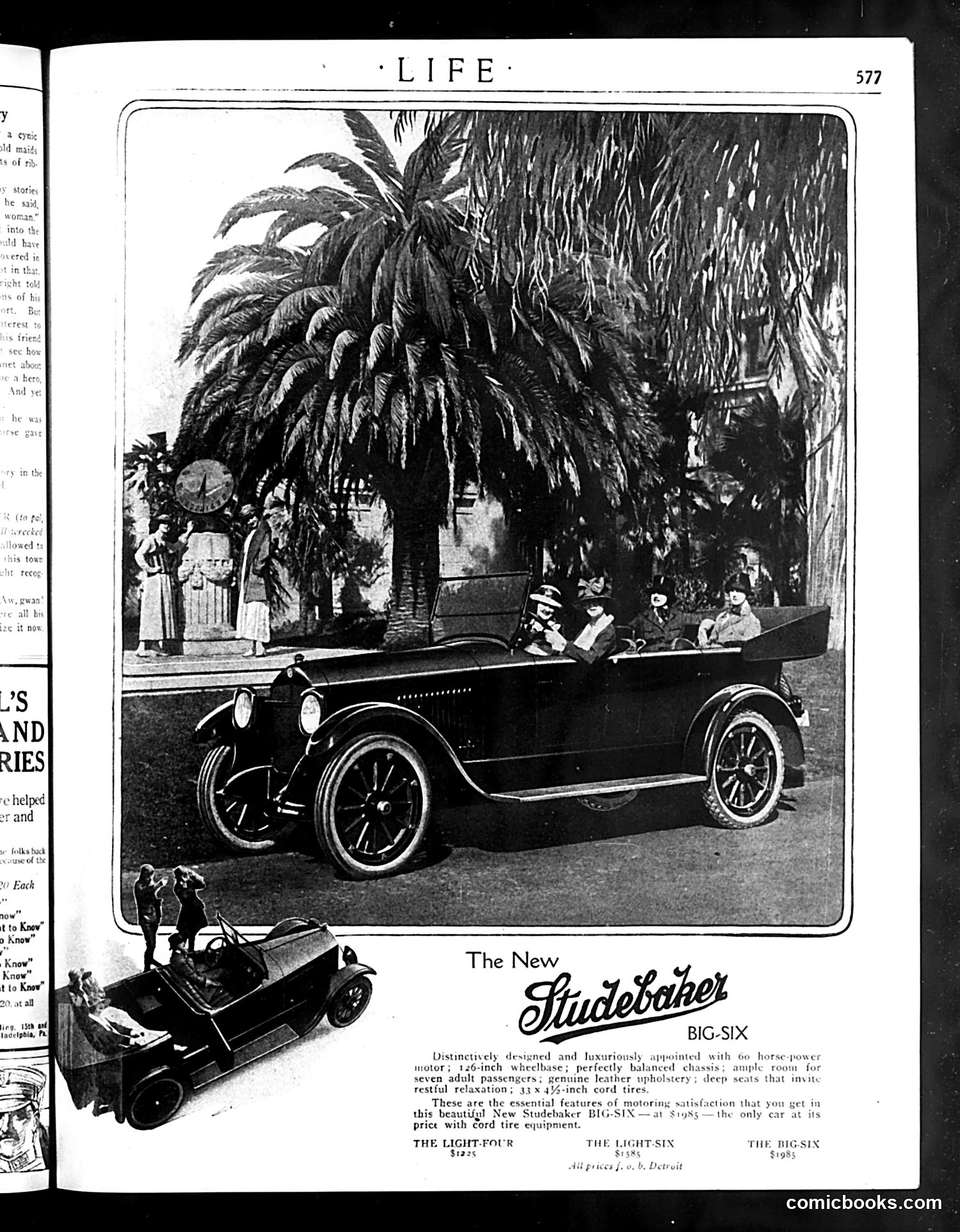
This page is primarily an **advertisement for the Studebaker Big-Six automobile**, not political satire. The large photograph shows an open-air touring car beneath a palm tree, with well-dressed passengers, emphasizing luxury and leisure travel. A smaller illustration below depicts the vehicle in action. The ad copy highlights the car's features: 60 horsepower motor, 126-inch wheelbase, balanced chassis, spacious seating for seven passengers, and genuine leather upholstery. It emphasizes "motoring satisfaction" and positions the Big-Six as an affordable luxury option compared to competitors, boasting "cord tire equipment" as a selling point. Two models are listed with prices: the Light-Four at $1,425 and the Big-Six at $1,985. This represents early 1920s automotive marketing targeting middle to upper-class consumers.
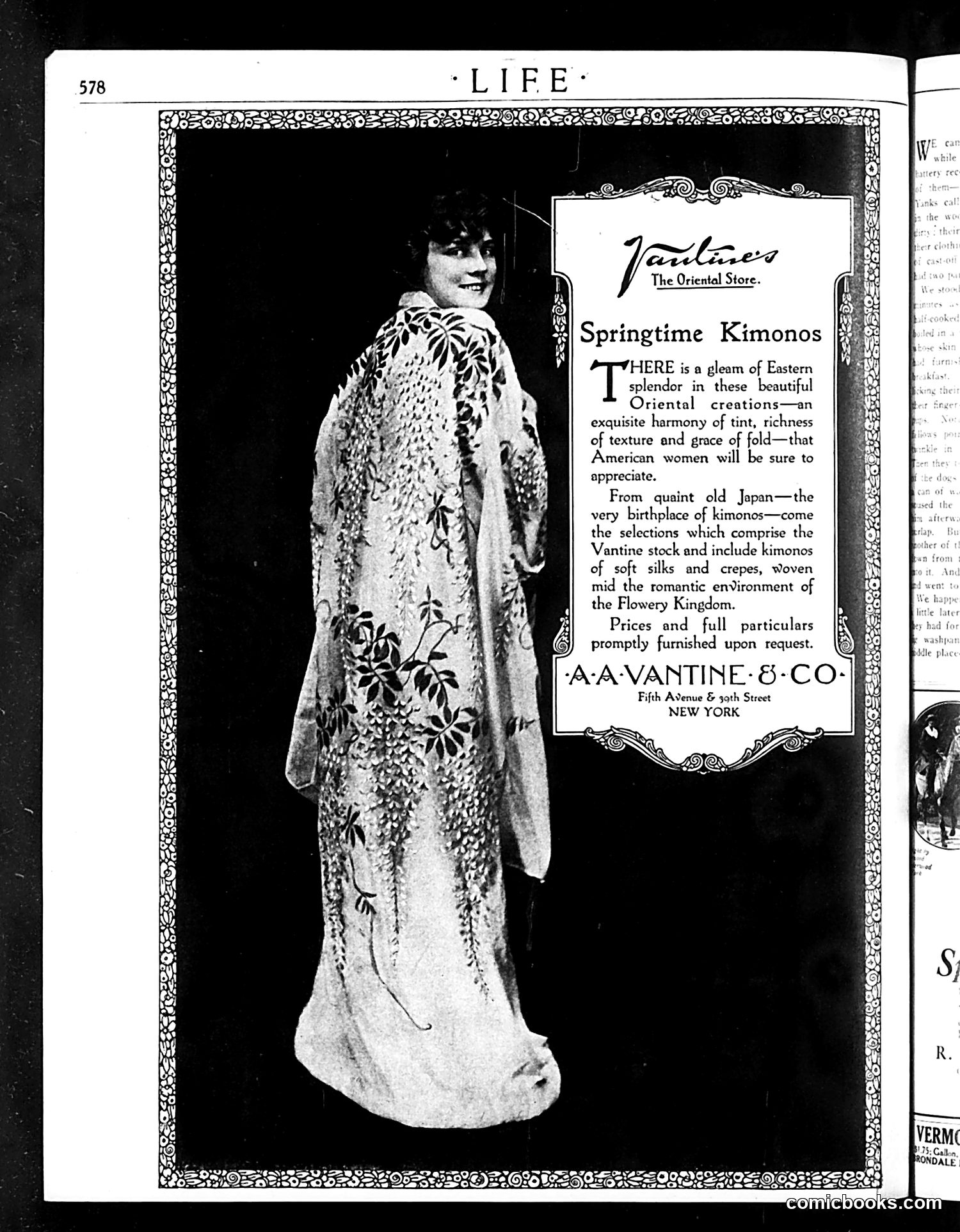
This page is primarily **advertising, not satire or political commentary**. It features a full-page advertisement for A. A. Vantine & Co., a New York retailer specializing in imported Japanese kimonos. The ad includes a photograph of a woman modeling an ornate kimono with floral patterns and flowing sleeves, shown from behind. The text emphasizes the garments' "Eastern splendor" and exotic appeal, marketing them as fashionable springtime wear for American women. This reflects **early 20th-century American Orientalism**—the romanticized fascination with Asian aesthetics among wealthy American consumers. The rhetoric about Japan as "the very birthplace of kimonos" and "Flowery Kingdom" caters to period desires for luxury imports and the exotic. There is no evident political message; this is straightforward commercial promotion targeting affluent female readers of *Life* magazine.
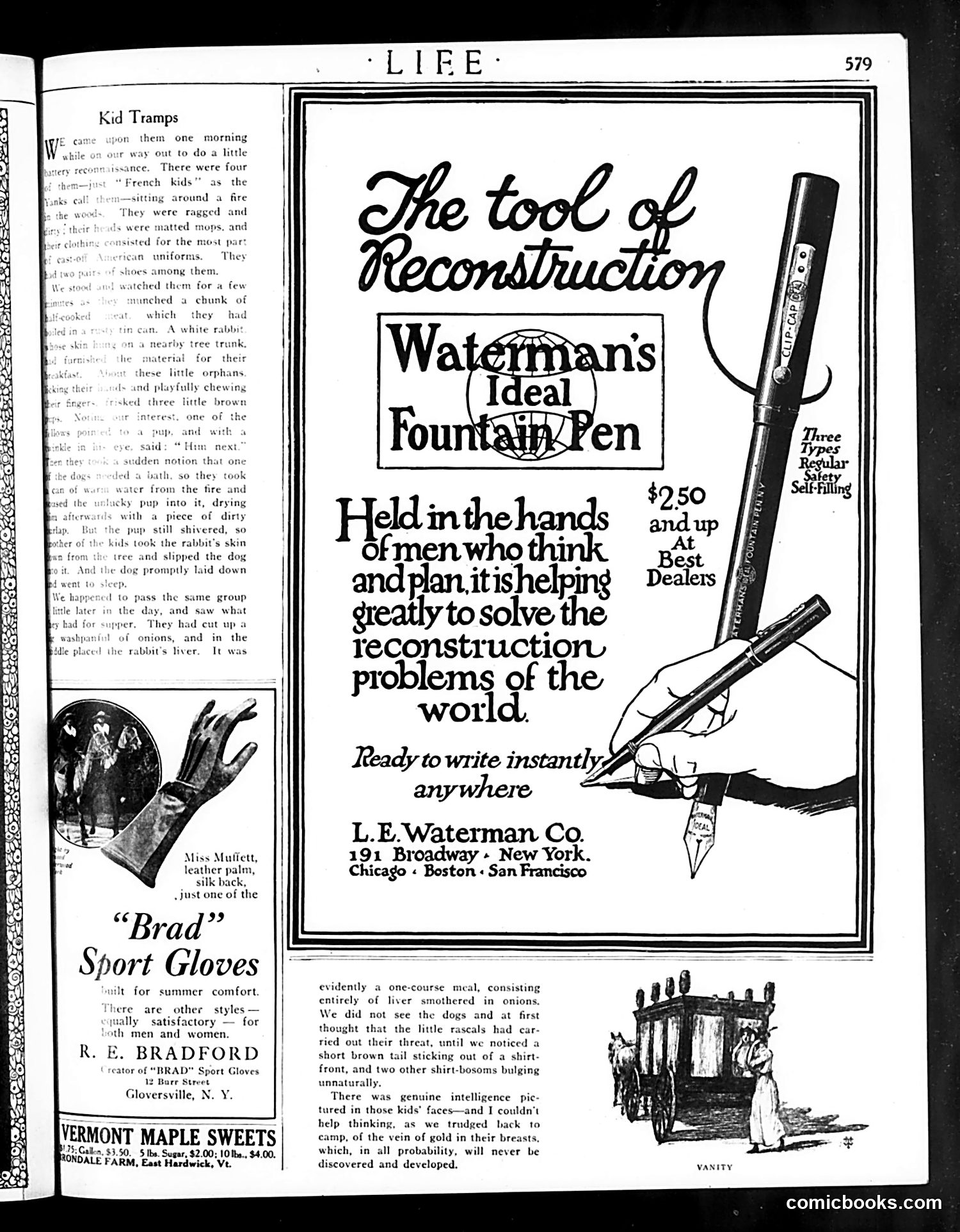
This page contains a short story titled "Kid Tramps" (left column) alongside advertisements. The narrative describes encountering four orphaned French children during what appears to be a post-WWI period (suggested by references to "American uniforms" and reconstruction). The children attempt to cook a rabbit and dog for food, demonstrating both resourcefulness and desperation. The story's moral commentary—expressed in the final passage—romanticizes the children's "genuine intelligence" and potential "vein of gold," while lamenting that their talents will likely "never be discovered and developed." This reflects early 20th-century attitudes toward poor children and lost human potential. The page's main advertisement promotes Waterman's Ideal Fountain Pen as a tool for solving "reconstruction problems of the world," positioning the pen as essential for serious post-war planning—a sales pitch linking consumer goods to global recovery efforts.
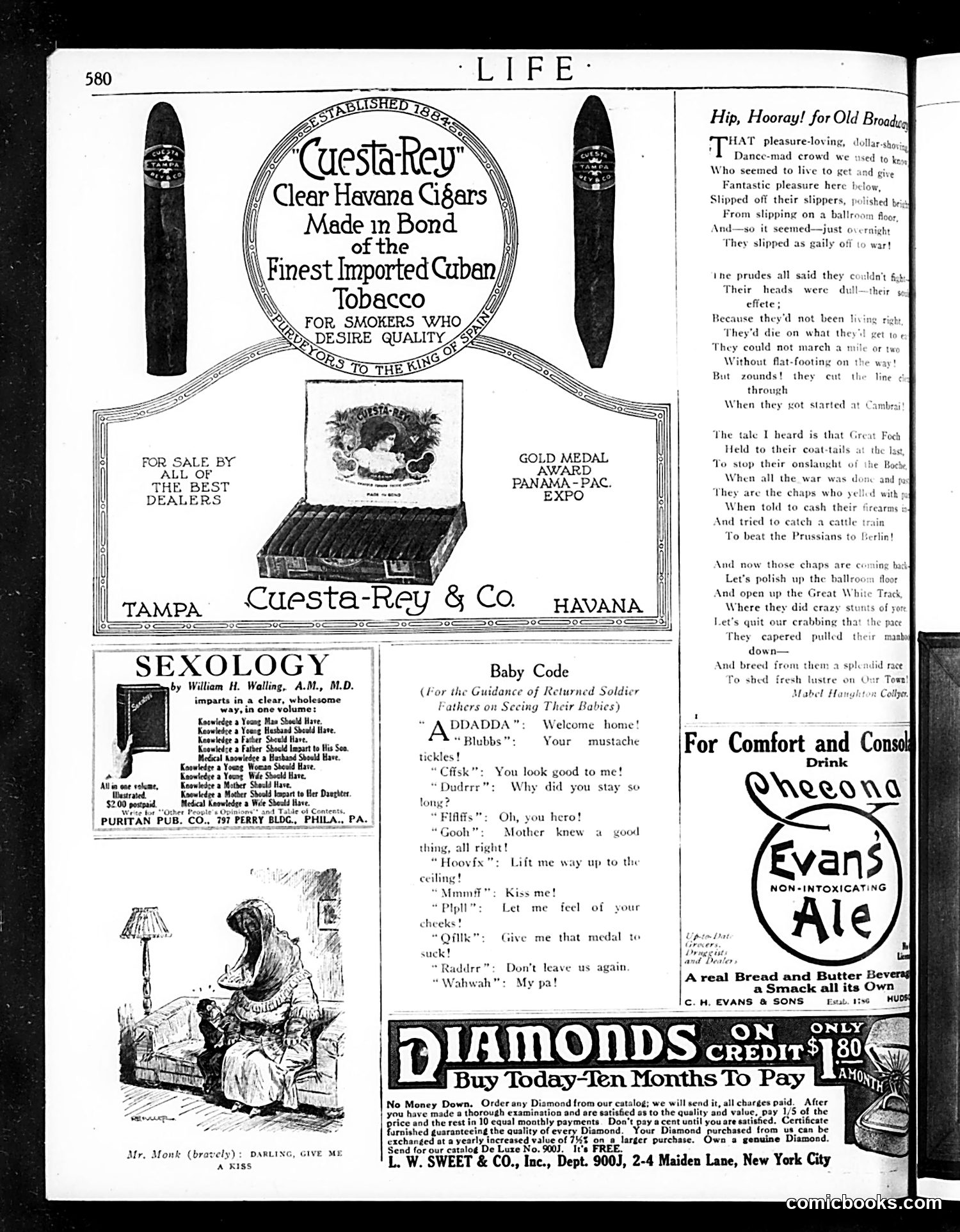
This page is primarily **advertising**, with one notable satirical poem about WWI soldiers. The main text piece, "Hip, Hooray! for Old Broad[s]," is a poem celebrating young men who were initially dismissed as frivolous ("pleasure-loving, dollar-shy / Dance-mad crowd") for their nightlife and ballroom culture. The satire's point: these same men, mocked as effete and unpatriotic before the war, proved themselves fierce soldiers at Cambrai and Berlin, outpacing even General Foch's expectations. The poem mocks pre-war snobbery by suggesting that civilian critics were wrong—the "dance-mad" generation actually made excellent soldiers. The remainder consists of era-typical ads: Cuesta-Rey cigars, a "Sexology" self-help book, Evans' non-intoxicating ale, and a diamonds-on-credit scheme. A small illustrated humor piece shows an infant's babbling interpreted as greetings to his returning soldier father. The page reflects post-WWI American culture reassessing young men's reputations in light of military service.
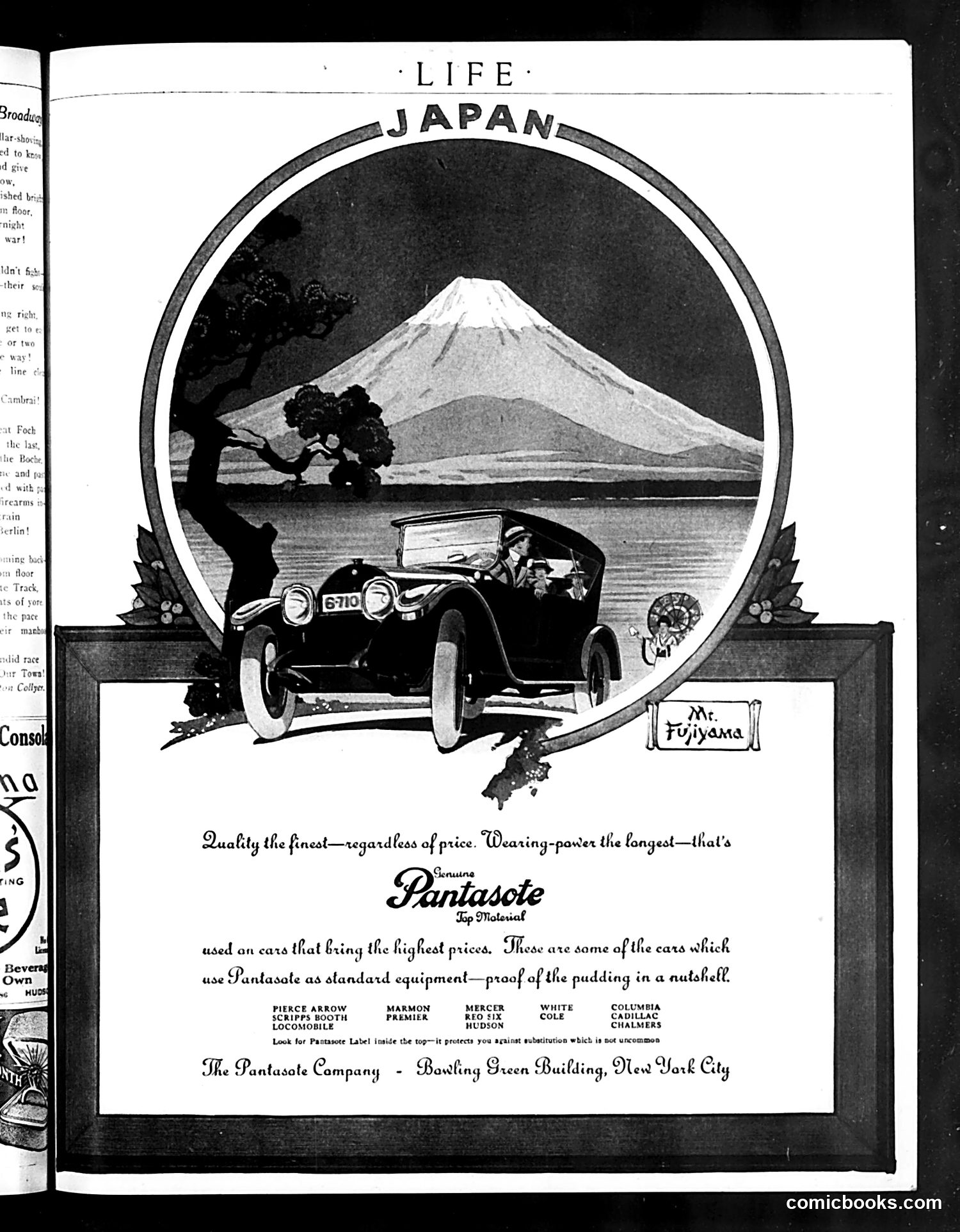
This is primarily a **product advertisement**, not political satire. It advertises Pantasote, an automotive material (likely upholstery or protective coating). The image shows a luxury automobile with a driver touring Japan, with Mount Fuji visible in the background—a romantic, aspirational scene meant to suggest quality and durability. The framing device (oval window, decorative elements) and "Mr. Fujiyama" signature suggest this is playing on exotic, prestigious imagery. The advertisement's text claims Pantasote is "standard equipment" on prestigious car brands listed below (Pierce-Arrow, Marmon, Cadillac, etc.), positioning it as a mark of quality. The phrase "proof of the pudding in a nutshell" suggests these luxury cars' use of the product proves its superiority. There is no apparent satire or political commentary—this is straightforward period advertising leveraging aspirational travel imagery and brand association to sell automotive materials.
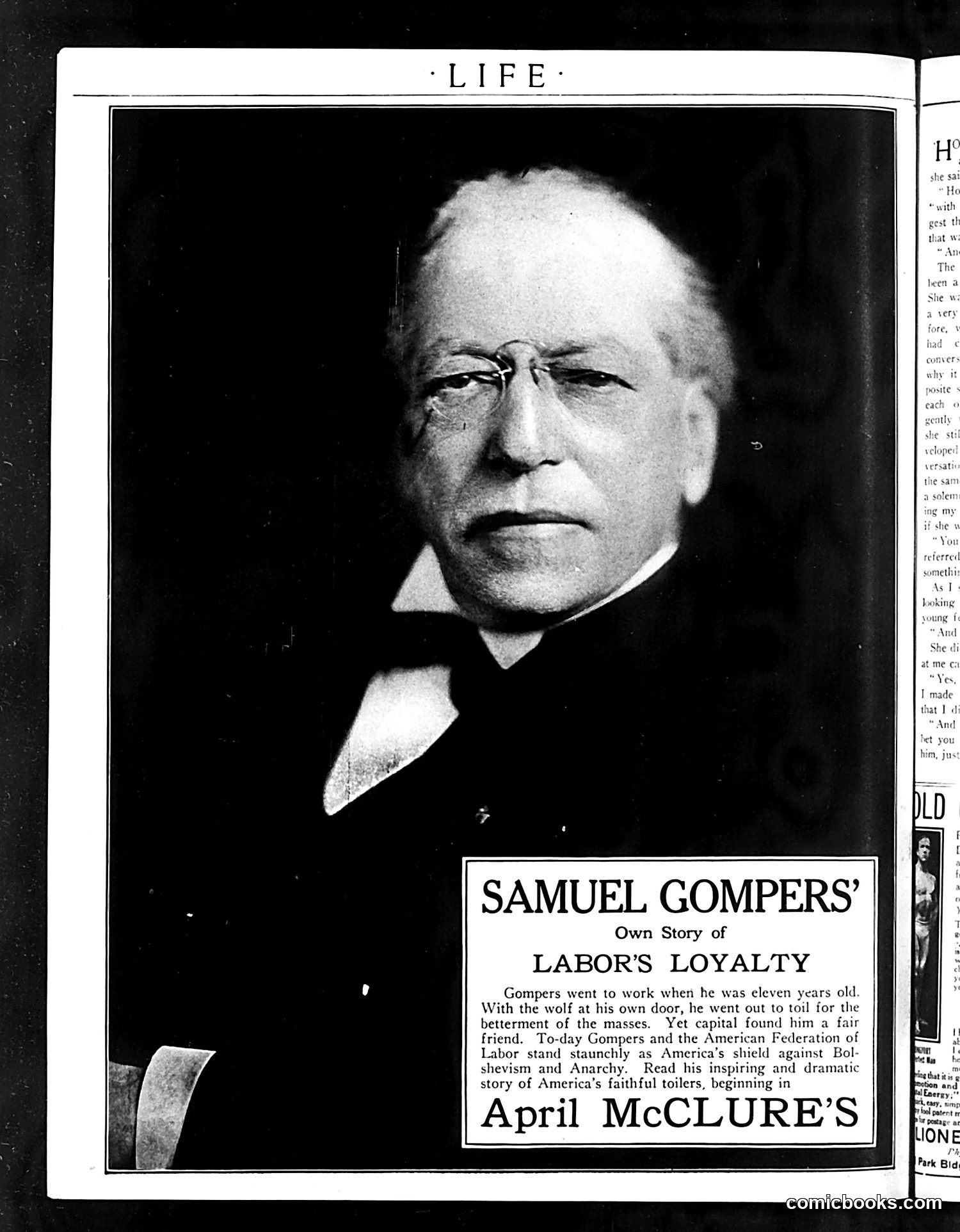
This is a **magazine advertisement** promoting serialized content about Samuel Gompers, the prominent labor union leader and founder of the American Federation of Labor (AFL). The ad presents Gompers as a heroic working-class figure—a man who started work at age eleven and dedicated himself to "the betterment of the masses." Notably, it frames labor unions as defenders of America "against Bolshevism and Anarchy," positioning Gompers as a **moderate, patriotic alternative** to radical socialism during the post-WWI Red Scare period. The "fair friend" reference to capital suggests the ad is countering criticisms that Gompers was too accommodating to business interests. Instead, it portrays him as balancing workers' interests with American stability—a pitch designed to appeal to Life's middle-class readers who feared both unchecked radicalism and labor unrest.
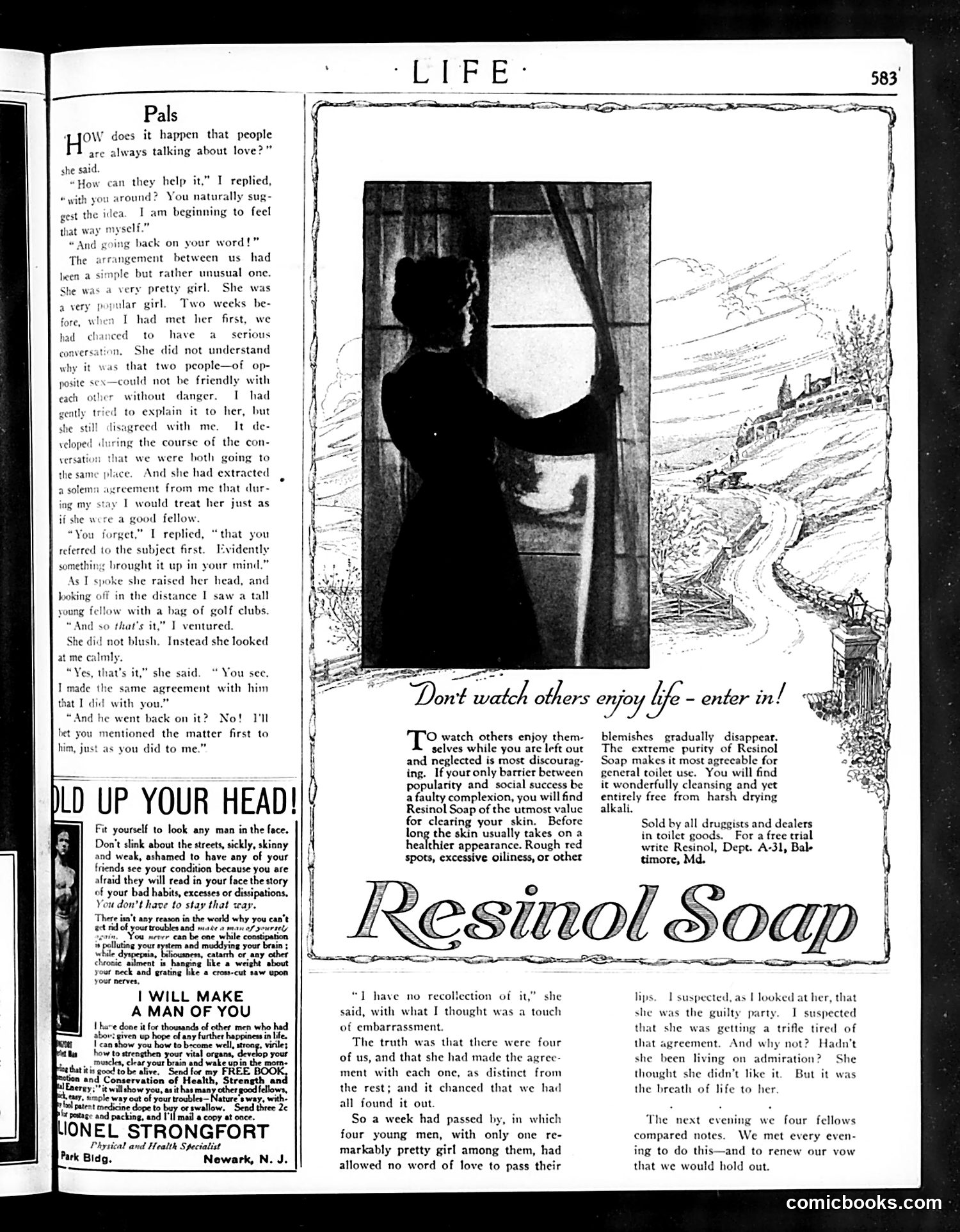
This page mixes fiction with advertising. The main story, "Pals," depicts a modern romantic complication: a young woman has made identical "friendship agreements" with multiple men—promising to treat each other platonically without romantic entanglement. She's now flirting with a golfer while maintaining the same pact with the narrator, who suspects she's grown tired of her own rules. The satire targets early 20th-century courtship anxieties and the era's attempt to create rational, contractual approaches to opposite-sex friendships—a notably progressive but ultimately impractical idea. The woman's casual infidelity to her own agreement undercuts the pretense that such arrangements can work. The advertisements ("Hold Up Your Head," Resinol Soap, Lionel Strongfort) promise self-improvement through vigor, clear skin, and physical development—reflecting period anxieties about masculinity and social acceptability tied to appearance and vitality.
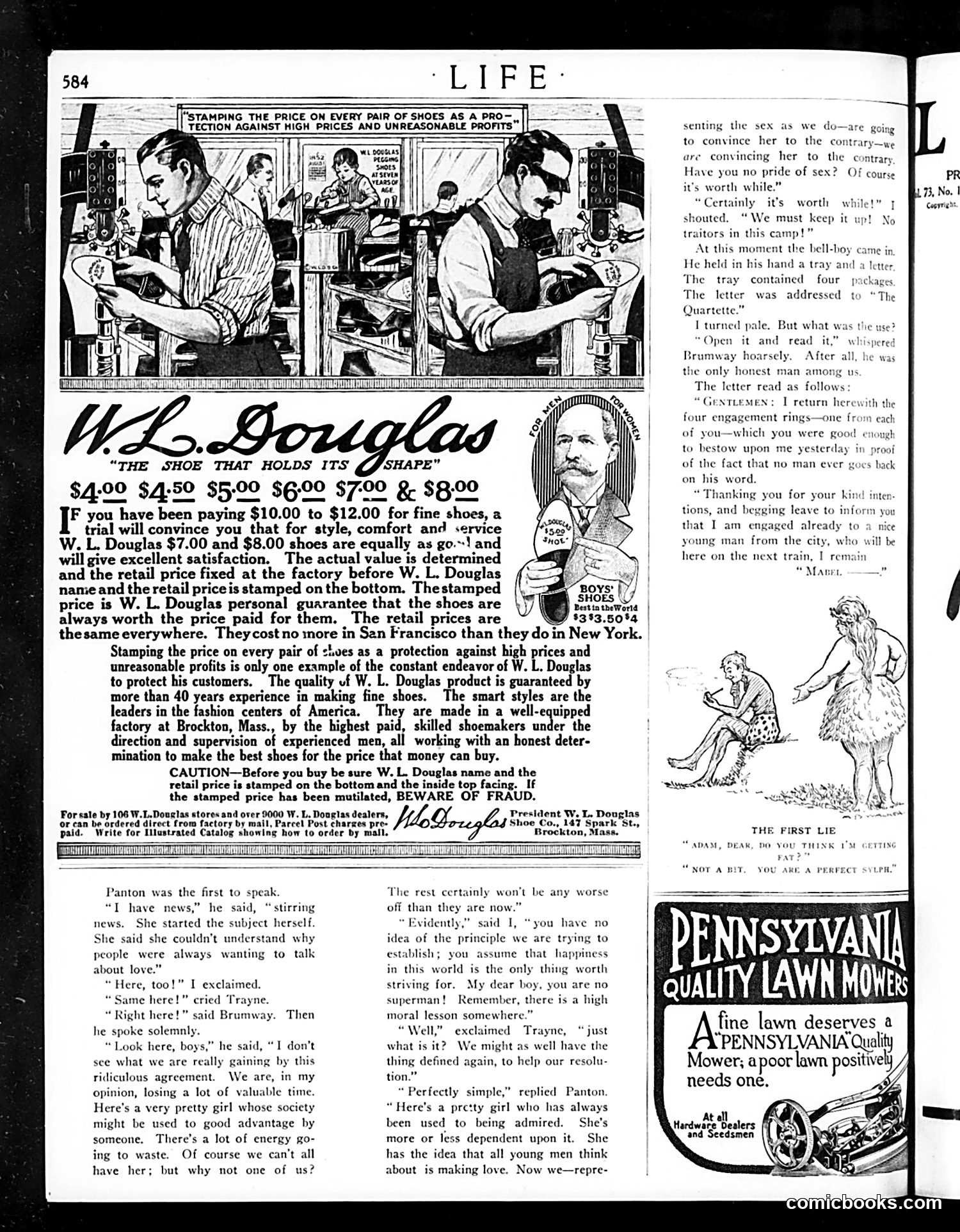
This page is primarily **advertising**, dominated by a large W.L. Douglas shoe company advertisement. The cartoon at the top depicts a shoe factory where prices are stamped on shoes "as a protection against high prices and unreasonable profits"—a Progressive Era consumer protection reform. The ad emphasizes that Douglas shoes cost $4–$8 (less than competitors' $10–$12) and claims the stamped price guarantees honest pricing, positioning the company as protecting consumers against fraud and exploitation. The right side contains fictional narrative text unrelated to the advertisement, discussing romantic entanglements among male characters. **For modern readers:** This reflects early 1900s Progressive concerns about price transparency, factory labor practices, and corporate honesty—issues that motivated consumer protection laws. The stamped-price practice was genuinely novel and presented as a radical consumer safeguard.