
Life, 1919-04-03 · page 38 of 60
Life — April 3, 1919 — page 38: what you’re looking at
What you’re looking at
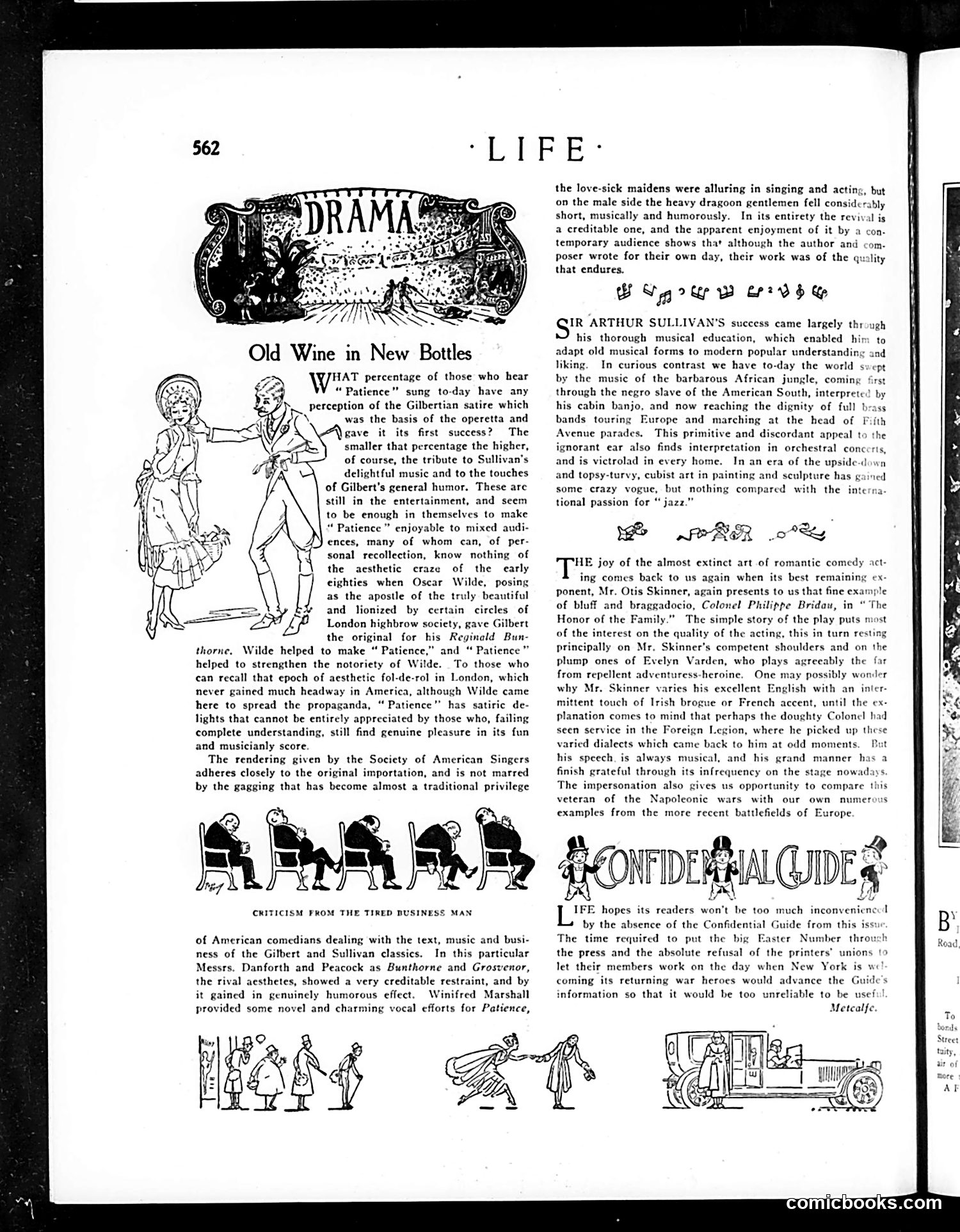
This page reviews recent theatrical productions, primarily discussing a revival of Gilbert and Sullivan's *Patience*. The main article explains that modern audiences likely miss the operetta's original satirical target: **Oscar Wilde and the 1880s aesthetic movement**. The text notes Wilde's pose as an apostle of beauty and his lionization by London society inspired Gilbert's character Reginald Bunthorne. The reviewer credits Sullivan's music for the work's enduring appeal despite audiences no longer understanding its specific cultural reference. The page also critiques contemporary popular music, contrasting Sullivan's refined classical approach with "barbarous African jungle" music and "jazz"—reflecting period attitudes toward jazz as primitive. A secondary review praises actor Otis Skinner's performance in *The Honor of the Family*, noting the rarity of romantic comedy acting talent. The cartoons appear decorative rather than satirical, illustrating the theatrical content discussed.
📄 Transcribed text from this page (OCR, searchable)
Machine-transcribed from the original scan — historical spelling and the odd misread are preserved.
“LIP SE - Old Wine in New Bottles HAT percentage of those who hear “ Patience” sung to-day have any perception of the Gilbertian satire which was the basis of the operetta and gave it its first success? The smaller that percentage the higher, of course, the tribute to Sullivan's delightful music and to the touches of Gilbert's general humor. These arc still in the entertainment, and seem to be enough in themselves to make “ Patience” enjoyable to mixed audi- ences, many of whom can, of per- sonal recollection, know nothing of the aesthetic craze of the carly eighties when Oscar Wilde, posing as the apostle of the truly beautiful and lionized by certain circles of London highbrow society, gave Gilbert the original for his Reginald Bun- thorne. Wilde helped to make “ Patience,” and “ Patience helped to strengthen the notoriety of Wilde. To those who can recall that epoch of aesthetic fol-de-rol in London, which never gained much headway in America, although Wilde came here to spread the propaganda, “ Patience” has satiric de- lights that cannot be entirely appreciated by those who, failing complete understanding, still find genuine pleasure in its fun and musicianly score. The rendering given by the Society of American Singers adheres closely to the original importation, and is not marred by the gagging that has become almost a traditional privilege CRITICISM FROM THE TIRED BUSINESS MAN of American comedians dealing with the text, music and busi- ness of the Gilbert and Sullivan classics. In this particular Messrs. Danforth and Peacock as Bunthorne and Grosvenor, the rival aesthetes, showed a very creditable restraint, and by it gained in genuinely humorous effect. Winifred Marshall provided some novel and charming vocal efforts for Patience, the love-sick maidens were alluring in singing and actin; on the male side the heavy dragoon gentlemen fell considerably short, musically and humorously. In its entirety the revival is a creditable one, and the apparent enjoyment of it by a con- temporary audience shows that although the author and com. poser wrote for their own day, their work was of the quality that endures. BVgr ew ooee IR ARTHUR SULLIVAN'S success came largely through his thorough musical education, which enabled him to adapt old musical forms to modern popular understanding and liking. In curious contrast we have to-day the world swept by the music of the barbarous African jungle, coming first through the negro slave of the American South, interpreted by his cabin banjo, and now reaching the dignity of full brass bands touring Europe and marching at the head of fF Avenue parades, This primitive and discordant appeal to th ignorant ear also finds interpretation in orchestral concerts, and is victrolad in every hom In an era of the upside-down and topsy-turvy, cubist art in painting and sculpture has gained some crazy vogue, but nothing compared with the interna tional passion for “ jazz.” > PAR 0 WY HE joy of the almost extinct art of romantic comedy act- ing comes back to us again when its best remainin: ponent, Mr. Otis Skinner, again presents to us that fine ex: of bluff and braggadocio, Colonel Philippe Bridau, in “ The Honor of the Family.” The simple story of the play puts m of the interest on the quality of the acting, this in turn res principally on Mr. Skinner's competent shoulders and on the plump ones of Evelyn Varden, who pl reeably the far from repellent adventuress-heroine. One may possibly wor why Mr. Skinner varies his excellent English with an inter- mittent touch of Irish brogue or French accent, until the x: planation comes to mind that perhaps the doughty Colonel had seen service in the Foreign Legion, where he picked up these varied dialects which came back to him at odd moments, But his speech. is always musical, and his grand manner has a finish grateful through its infrequency on the stage nowad The impersonation also gives us opportunity to compare this veteran of the Napoleonic wars with our own numerous examples from the more recent battlefields of Europe IFE hopes its readers won't be too much inconvenienc by the absence of the Confidential Guide from this iss: The time required to put the big Easter Number throuzh the press and the absolute refusal of the printers’ unions (0 let their members work on the day when New York is wi! coming its returning war heroes would advance the Gui information so that it would be too unreliable to be use Metcalfe. Ccomicbooks.com