
Life, 1919-04-03 · page 31 of 60
Life — April 3, 1919 — page 31: what you’re looking at
What you’re looking at
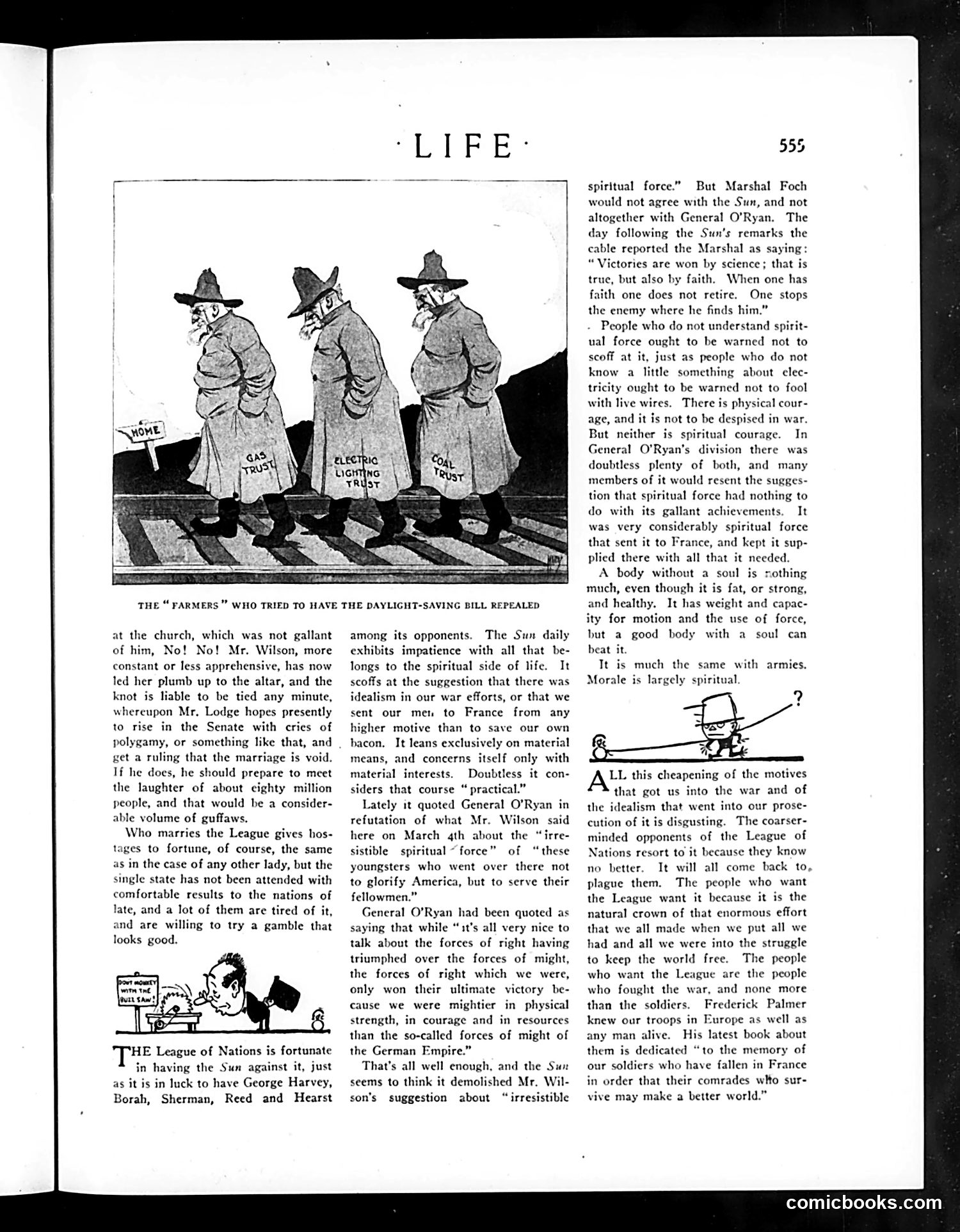
## The Cartoon The illustration shows three figures labeled "HOME," "GAS TRUST," "ELECTRIC LIGHTING TRUST," and "COAL TRUST" dressed as farmers attempting to repeal the daylight-saving bill at church—a reference to agricultural and utility interests opposing daylight saving time. ## The Main Article's Political Context The piece defends the League of Nations against critics (naming Henry Cabot Lodge, William Randolph Hearst, and others). It argues that opponents like the *New York Sun* newspaper emphasize only material/physical factors in America's WWI victory while dismissing the "spiritual force" or idealism behind the war effort. The author disputes this cynicism by citing Marshal Foch, who claimed victory required both science *and* faith. The broader point: those attacking the League's idealistic mission lack understanding of morale's importance to military and national success. ## For Modern Readers This reflects post-WWI debates about whether America fought for ideals or self-interest, and whether international cooperation (the League) was naive idealism or practical necessity.
📄 Transcribed text from this page (OCR, searchable)
Machine-transcribed from the original scan — historical spelling and the odd misread are preserved.
THE “ FARMERS WHO TRIED TO HAVE THE DAYLIGHT-SAVING BILL REPEALED at the church, which was not gallant of him, No! No! Mr. Wilson, more constant or less apprehensive, has now led her plumb up to the altar, and the knot is liable to be tied any minute, whereupon Mr, Lodge hopes presently to rise in the Senate with cries of polygamy, or something like that, and get a ruling that the marriage is void. If he does, he should prepare to meet the laughter of about cighty million people, and that would be a consider- able volume of guffaws, Who marries the League gives hos- tages to fortune, of course, the same as in the case of any other lady, but the single state has not been attended with comfortable results to the nations of late, and a lot of them are tired of it, and are willing to try a gamble that looks good. THE League of Nations is fortunate in having the Sun against it, just as it is in luck to have George Harvey, Borah, Sherman, Reed and Hearst among its opponents. The Sun daily exhibits impatience with all that be- longs to the spiritual side of life. It scoffs at the suggestion that there was idealism in our war efforts, or that we sent our met to France from any higher motive than to save our own bacon. It leans exclusively on material means, and concerns itself only with material interests. Doubtless it con- siders that course “ practical.” Lately it quoted General O’Ryan in refutation of what Mr. Wilson said here on March 4th about the “irre- sistible spiritual “force” of “these youngsters who went over there not to glorify America, but to serve their fellowmen.” General O’Ryan had been quoted as saying that while “it’s all very nice to talk about the forces of right having triumphed over the forces of might, the forces of right which we were, only won their ultimate victory be- cause we were mightier in physical strength, in courage and in resources than the so-called forces of might of the German Empire.” That's all well enough, and the Sur seems to think it demolished Mr. Wil- son’s suggestion about “irresistible 555 spiritual force.” But Marshal Foch would not agree with the Sun, and not altogether with General O’Ryan. The day following the Sun's remarks the cable reported the Marshal as saying: “Victories are won by science; that is true, but also by faith. When one has faith one does not retire. One stops the enemy where he finds him.” People who do not understand spirit- ual force ought to be warned not to scoff at it, just as people who do not know a little something about clec- tricity ought to be warned not to fool with live wires. There is physical cour- age, and it is not to be despised in war. But neither is spiritual courage. In General O'Ryan’s di doubtless plenty of both, and many members of it would resent the sugges- tion that spiritual force had nothing to do with its gallant achievements, It was very considerably spiritual force that sent it to France, and kept it sup- plied there with all that it needed. A body without a soul is nothing much, even though it is fat, or strong, and healthy, It has weight and capac- ity for motion and the use of force, but a good body with a soul can beat it It is much the same with armies. Morale is largely spiritual. sion there was LL this cheapening of the motives that got us into the war and of the idealism that went into our prose- cution of it is disgusting. The coarser- minded opponents of the League of Nations resort to it because they know no better. It will all come back to, plague them. The people who want the League want it because it is the natural crown of that enormous effort that we all made when we put all we had and all we were into the struggle to keep the world free. The people who want the League are the people who fought the war, and none more than the soldiers. Frederick Palmer knew our troops in Europe as well as any man alive. His latest book about them is dedicated “to the memory of our soldiers who have fallen in France in order that their comrades who sur- vive may make a better world.” comicbooks.com