
Life, 1919-04-03 · page 21 of 60
Life — April 3, 1919 — page 21: what you’re looking at
What you’re looking at
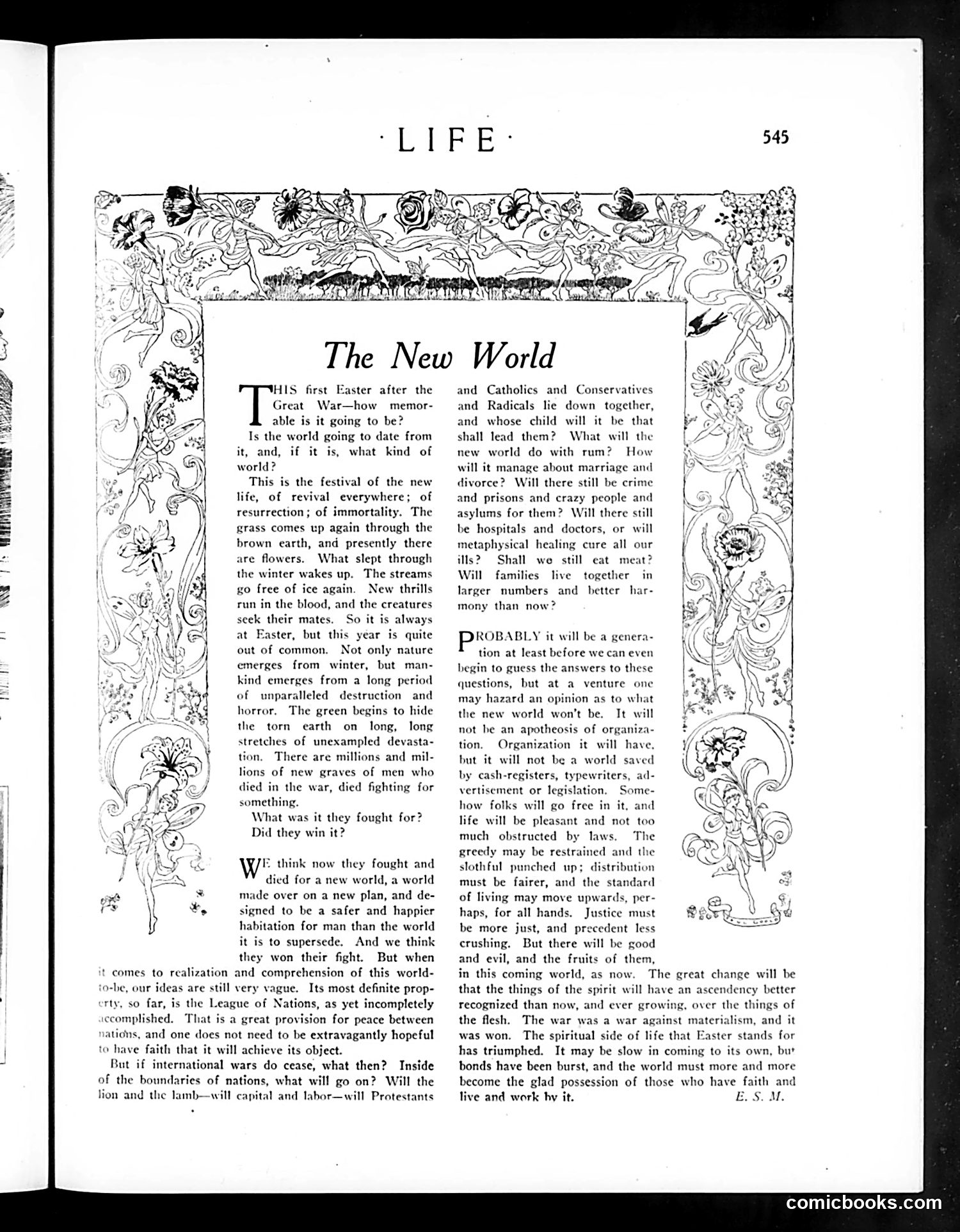
This is an editorial essay (not a cartoon), published shortly after World War I ended, reflecting on Easter and humanity's post-war future. The author contemplates what kind of society will emerge from the war's devastation. The piece addresses fundamental social questions: Will the new world solve problems like crime, divorce, alcoholism, and economic inequality? The author expresses skepticism about purely mechanized solutions (cash registers, typewriters, legislation), arguing instead that spiritual values—not materialism—must guide reconstruction. The essay takes an optimistic but cautious tone: a generation must pass before answers emerge. Key tensions highlighted include labor-capital relations and religious divisions (Protestant-Catholic). The author suggests the war was fundamentally a spiritual victory against materialism, with Easter symbolizing humanity's resurrection toward better values. This reflects post-WWI idealism mixed with anxiety about whether hard-won sacrifices would actually produce meaningful social change.
📄 Transcribed text from this page (OCR, searchable)
Machine-transcribed from the original scan — historical spelling and the odd misread are preserved.
The New World IHIS first Easter after the Great War—how memor- able is it going to be? Is the world going to date from it, and, if it is, what kind of world? This is the festival of the new life, of revival everywhere; of resurrection; of immortality. The grass comes up again through the brown earth, and presently there are flowers. What slept through the winter wakes up. The streams go free of ice again. New thrills run in the blood, and the creatures seek their mates. So it is always at ter, but this year is quite out of common. Not only nature emerges from winter, but man- kind emerges from a long period of unparalleled destruction and horror. The green begins to hide the torn earth on long, long stretches of unexampled devasta- tion, There are millions and mil- lions of new graves of men who died in the war, died fighting for something. What w t they fought for? Did they win it? W 2 think now they fought and died for a new world, a world made over on a new plan, and de- signed to be a safer and happier habitation for man than the world it is to supersede. And we think they won their fight. But when and Catholics and Conservatives and Radicals lie down together, and whose child will it be that shall lead them? What will the new world do with rum? How will it manage about marriage and divorce? Will there still be crime and prisons and crazy people and asylums for them? Will there still be hospitals and doctors, or will metaphysical healing cure all our ills? Shall we still eat | meat? Will families live together in larger numbers and better har- mony than now? ROBABLY it will be a genera- tion at least before we can even begin to guess the answers to these questions, but at a venture one may hazard an opinion as to what the new world won't be. It will not he an apotheosis of organiza tion. Organization it will have, but it will not be a world saved by cash-registers, typewriters, ad- vertisement or legislation. Some- how folks will go free in it, and life will be pleasant and not too much obstructed by laws, The greedy may be restrained and the slothful punched up; distribution must be fairer, and the standard of living may move upwards, per- haps, for all hands. Justice must be more just, and precedent less crushing. But there will be good and evil, and the fruits of them, t comes to realization and comprehension of this world- in this coming world, as now. The great change will be », our ideas are still very vague. Its most definite prop- that the things of the spirit will have an ascendency better y, so far, is the League of Nations, as yet incompletely recognized than now, and ever growing, over the things of ccomplished. That great provision for peace between the flesh. The war was a war against materialism, and it ations, and one does not need to be extravagantly hopeful was won. The spiritual side of life that Easter stands for to have faith that it will achieve its object. has triumphed. It may be slow in coming to its own, but But if international wars do cease, what then? Inside bonds have been burst, and the world must more and more of the boundaries of nations, what will go on? Will the become the glad possession of those who have faith and lion and the lamb—will capital and labor—will Protestants live and work hy it. Bs S. Ms comicbooks.com