
Life, 1919-04-03 · page 30 of 60
Life — April 3, 1919 — page 30: what you’re looking at
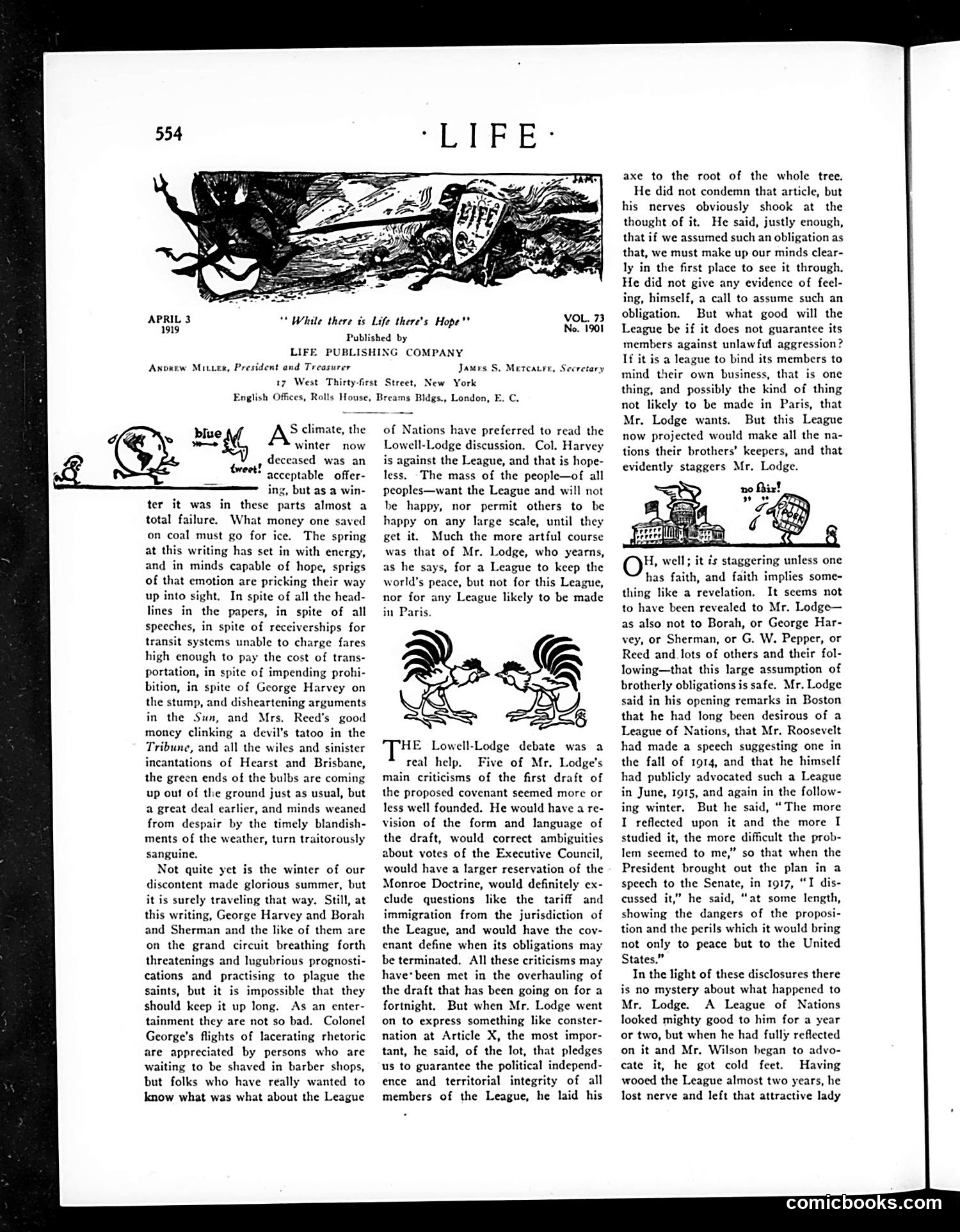
A restored page from Life, 1919-04-03. Page through the whole issue in the reader above.
📄 Transcribed text from this page (OCR, searchable)
Machine-transcribed from the original scan — historical spelling and the odd misread are preserved.
APRIL 3 “While there is Li . ” VOL. 73 fn While there is Life there's Hope No. 1901 Published by LIFE PUBLISHING COMPANY Anperw Mitter, President and Treasurer James S. Metcatre, Secretary 17 West Thirty-first Street, New York English Offices, Rolls House, Breas Bldgs., London, E. C. AS: climate, the winter now , deceased was an * acceptable offer- ing, but as a win- ter it was in these parts almost a total failure. What money one saved on coal must go for ice. The spring at this writing has set in with energy, and in minds capable of hope, sprigs of that emotion are pricking their way up into sight. In spite of all the head- lines in the papers, in spite of all specches, in spite of receiverships for transit systems unable to charge fares high enough to pay the cost of trans- portation, in spite of impending prohi- bition, in spite of George Harvey on the stump, and disheartening arguments in the Sw, and Mrs, Reed's good moncy clinking a devil's tatoo in the Tribune, and all the wiles and sinister incantations of Hearst and Brisbane, the green ends of the bulbs are coming up out of the ground just as usual, but a great deal earlier, and minds weaned from despair by the timely blandish- ments of the weather, turn traitorously sanguine. Not quite yet is the winter of our discontent made glorious summer, but it is surely traveling that way. Still, at this writing, George Harvey and Borah and Sherman and the like of them are on the grand circuit breathing forth threatenings and lugubrious prognosti- cations and practising to plague the saints, but it is impossible that they should keep it up long. As an enter- tainment they are not so bad. Colonel George's flights of lacerating rhetoric are appreciated by persons who are waiting to be shaved in barber shops, but folks who have really wanted to know what was what about the League of Nations have preferred to read the Lowell-Lodge discussion, Col. Harvey is against the League, and that is hope- less. The mass of the people—of all peoples—want the League and will not be happy, nor permit others to be happy on any large scale, until they get it. Much the more artful course was that of Mr. Lodge, who yearns, as he says, for a League to keep the world’s peace, but not for this League, nor for any League likely to be made in Paris. =N & HE Lowell-Lodge debate was a real help. Five of Mr. Lodge's main criticisms of the first draft of the proposed covenant seemed more or less well founded. He would have a re- vision of the form and language of the draft, would correct ambiguities about votes of the Executive Council, would have a larger reservation of the Monroe Doctrine, would definitely ex- clude questions like the tariff and immigration from the jurisdiction of the League, and would have the cov- enant define when its obligations may be terminated. All these criticisms may have*been met in the overhauling of the draft that has been going on for a fortnight. But when Mr. Lodge went on to express something like conster- nation at Article X, the most impor- tant, he said, of the lot, that pledges us to guarantee the political independ- ence and territorial integrity of all members of the League, he laid his axe to the root of the whole tree. He did not condemn that article, but his nerves obviously shook at the thought of it. He said, justly enough, that if we assumed such an obligation as that, we must make up our minds clear- ly in the first place to see it through, He did not give any evidence of feel- ing, himself, a call to assume such an obligation. But what good will the League be if it does not guarantee its members against unlawful aggression? If it is a league to bind its members to mind their own business, that is one thing, and possibly the kind of thing not likely to be made in Paris, that Mr. Lodge wants. But this League now projected would make all the na- tions their brothers’ keepers, and that evidently staggers Mr. Lodge. H, well; it is staggering unless one has faith, and faith implies some- thing like a revelation, It seems not to have been revealed to Mr. Lodge— as also not to Borah, or George Har- vey, or Sherman, or G. W. Pepper, or Reed and. lots of others and their fol- lowing—that this large assumption of brotherly obligations is safe. Mr. Lodge said in his opening remarks in Boston that he had long been desirous of a League of Nations, that Mr. Roosevelt had made a speech suggesting one in the fall of ror4, and that he himself had publicly advocated such a League in June, 1915, and again in the follow- ing winter. But he said, “The more I reflected upon it and the more I studied it, the more difficult the prob- lem seemed to me,” so that when the President brought out the plan in a speech to the Senate, in 1917, “I dis- cussed it,” he said, “at some length, showing the dangers of the propos tion and the perils which it would bring not only to peace but to the United States.” In the light of these disclosures there is no mystery about what happened to Mr. Lodge. A League of Nations looked mighty good to him for a year or two, but when he had fully reflected on it and Mr. Wilson began to advo- cate it, he got cold feet. Having wooed the League almost two years, he lost nerve and left that attractive lady comicbooks.com