
Life, 1919-04-03 · page 32 of 60
Life — April 3, 1919 — page 32: what you’re looking at
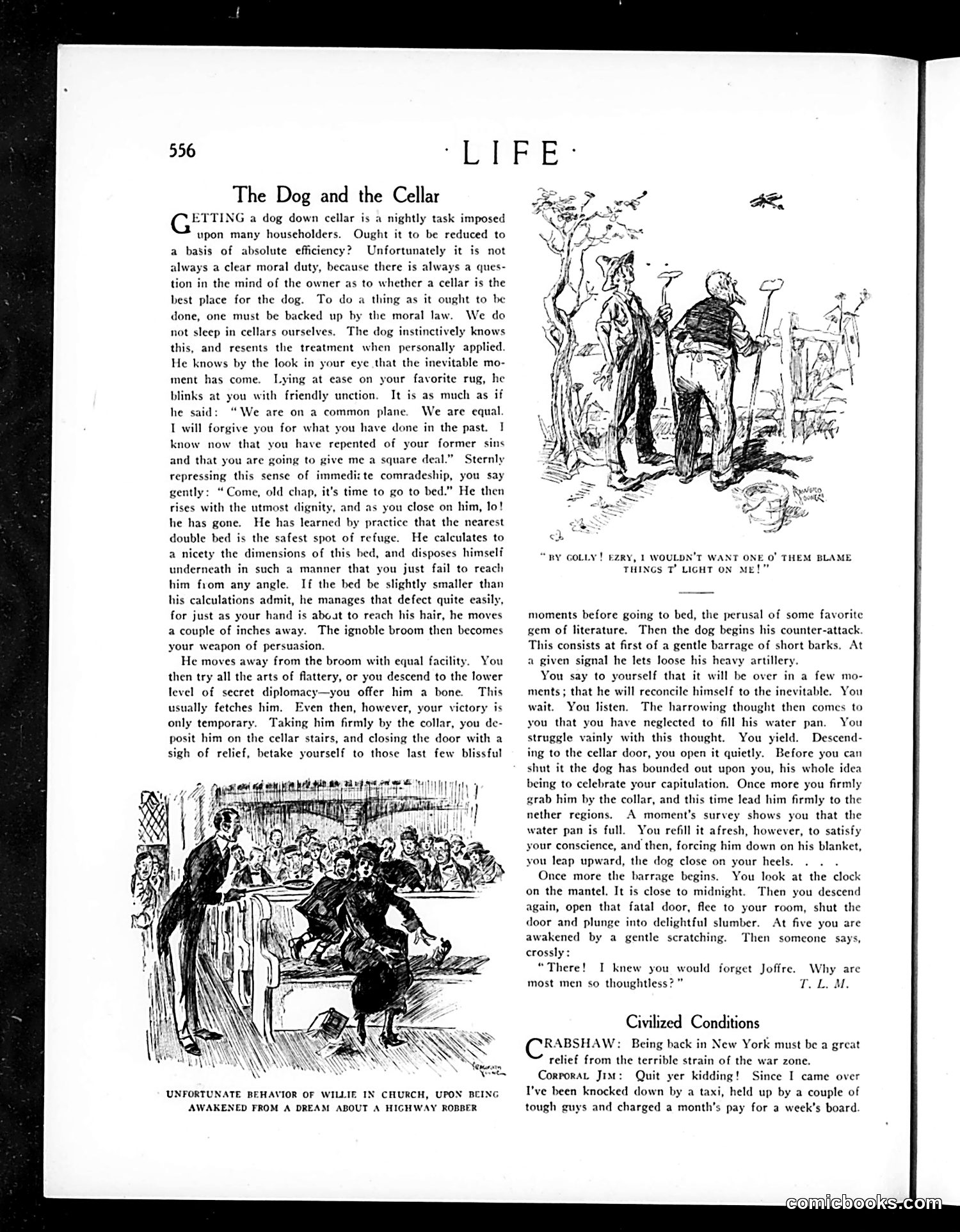
A restored page from Life, 1919-04-03. Page through the whole issue in the reader above.
📄 Transcribed text from this page (OCR, searchable)
Machine-transcribed from the original scan — historical spelling and the odd misread are preserved.
The Dog and the Cellar G TING a dog down cellar is a nightly task imposed upon many householders. Ought it to be reduced to a basis of absolute efficiency? Unfortunately it is not always a clear moral duty, because there is always a ques- tion in the mind of the owner as to whether a cellar is the best place for the dog. To do a thing as it ought to be done, one must be backed up by the moral law. We do not sleep in cellars ourselves, The dog instinctively knows this, and resents the treatment when personally applied. He knows by the look in your eye that the inevitable mo- Lying at ease on your favorite rug, he blinks at you with friendly unction. It is as much as if he said: “We are on a common plane. We are equal. I will forgive you for what you have done in the past. 1 ment has come. know now that you have repented of your former sins and that you are going to give me a square deal.” Sternly repressing this sense of immedi:te comradeship, you say gently: “Come, old chap, it’s time to go to bed.” He then rises with the utmost dignity, and as you close on him, lo! he has gone. He has learned by practice that the nearest double bed is the safest spot of refuge. He calculates to a nicety the dimensions of this bed, and disposes himself underneath in such a manner that you just fail to reach him from any angle. If the bed be slightly smaller than his calculations admit, he manages that defect quite easily, for just as your hand is about to reach his hair, he moves a couple of inches away. The ignoble broom then becomes your weapon of persuasion. He moves away from the broom with equal facility. You then try all the arts of flattery, or you descend to the lower level of secret diplomacy—you offer him a bone. This usually fetches him. Even then, however, your victory is only temporary. Taking him firmly by the collar, you de- posit him on the cellar stairs, and closing the door with a sigh of relief, betake yourself to those last few blissful UNFORTUNATE BEHAVIOR OF WILLIE IN CHURCH, UPON BLING AWAKENED FROM A DREAM ABOUT A HIGHWAY ROBBER “RY GOLLY! EZRY, 1 WOULDN'T WANT ONE 0° THEM BLAME THINGS T’ LIGHT ON ME!" moments before going to bed, the perusal of some favorite gem of literature. Then the dog begins his counter-attack. This consists at first of a gentle barrage of short barks. At a given signal he lets loose his heavy artillery. You say to yourself that it will be over in a few mo- ments; that he will reconcile himself to the inevitable. You wait. You listen. The harrowing thought then comes to you that you have neglected to fill his water pan. You struggle vainly with this thought. You yield. Descend- ing to the cellar door, you open it quietly. Before you can shut it the dog has bounded out upon you, his whole idea being to celebrate your capitulation. Once more you firmly grab him by the collar, and this time lead him firmly to the nether regions. A moment's survey shows you that the water pan is full. You refill it afresh, however, to satisfy your conscience, and then, forcing him down on his blanket, you leap upward, the dog close on your heels. . . Once more the barrage begins. You look at the clock on the mantel. It is close to midnight. Then you descend again, open that fatal door, flee to your room, shut the door and plunge into delightful slumber. At five you are awakened by a gentle scratching. Then someone says, crossly: “There! I knew you would forget Joffre. Why are most men so thoughtless?" y AA Oe Civilized Conditions RABSHAW: Being back in New York must be a great relief from the terrible strain of the zone, Corporat Jr Quit yer kidding! Since I came over I've been knocked down by a taxi, held up by a couple of tough guys and charged a month’s pay for a week's board.