
A complete issue · 38 pages · 1917
Life — March 22, 1917
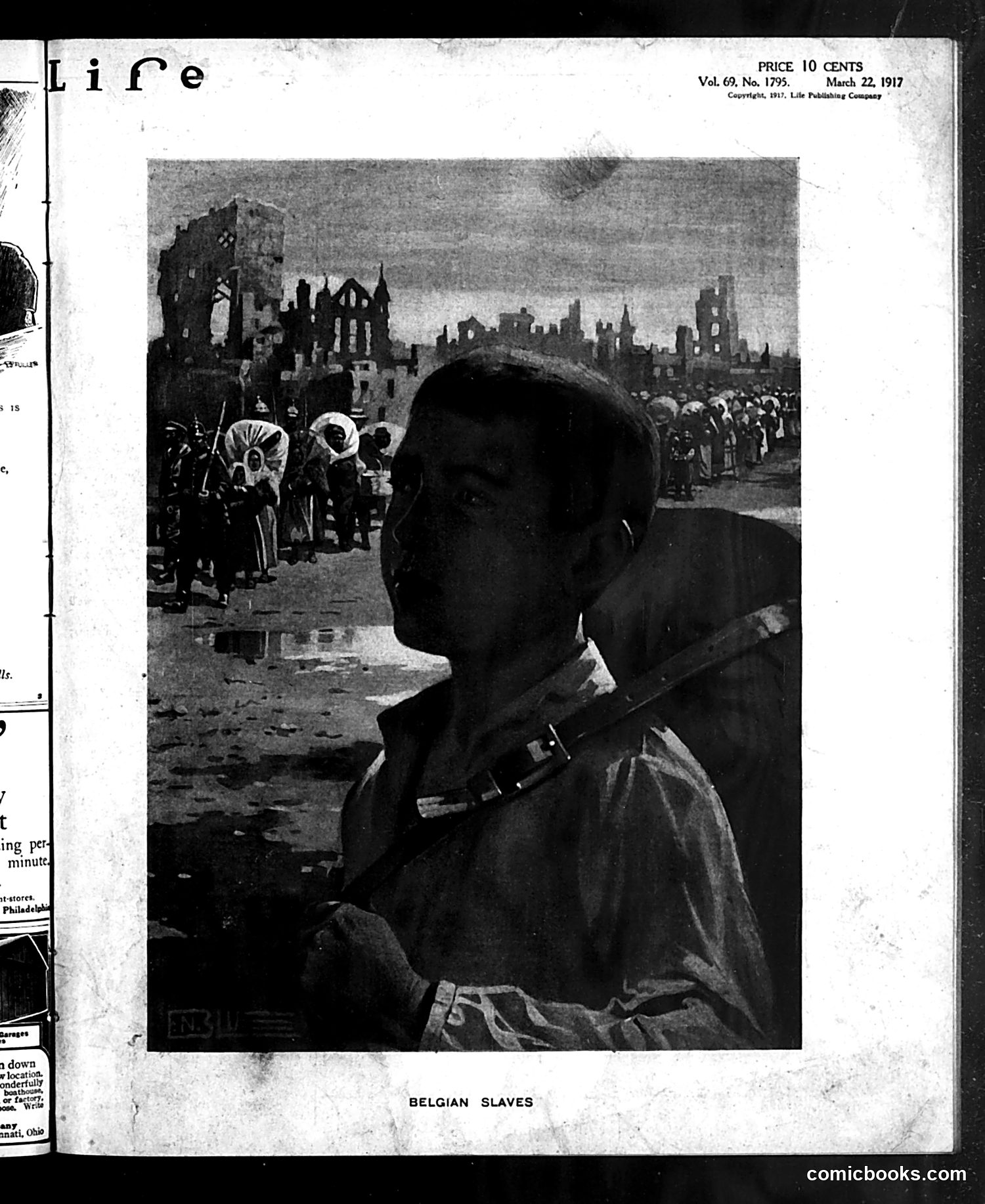
This photograph from Life magazine documents German occupation of Belgium during World War I. The image shows a Belgian civilian in the foreground with ruined architecture and crowds in the background, illustrating the human cost of the German invasion and occupation that began in 1914. The caption "Belgian Slaves" reflects American perspective on the conflict: Germany's treatment of Belgian civilians became a major propaganda point for the Allies, emphasizing German brutality. Reports of forced labor, executions, and deportations of Belgian civilians circulated widely in American media, helping build support for U.S. entry into WWI (which occurred in April 1917, weeks after this publication). The photograph serves as documentary evidence of civilian suffering under occupation.
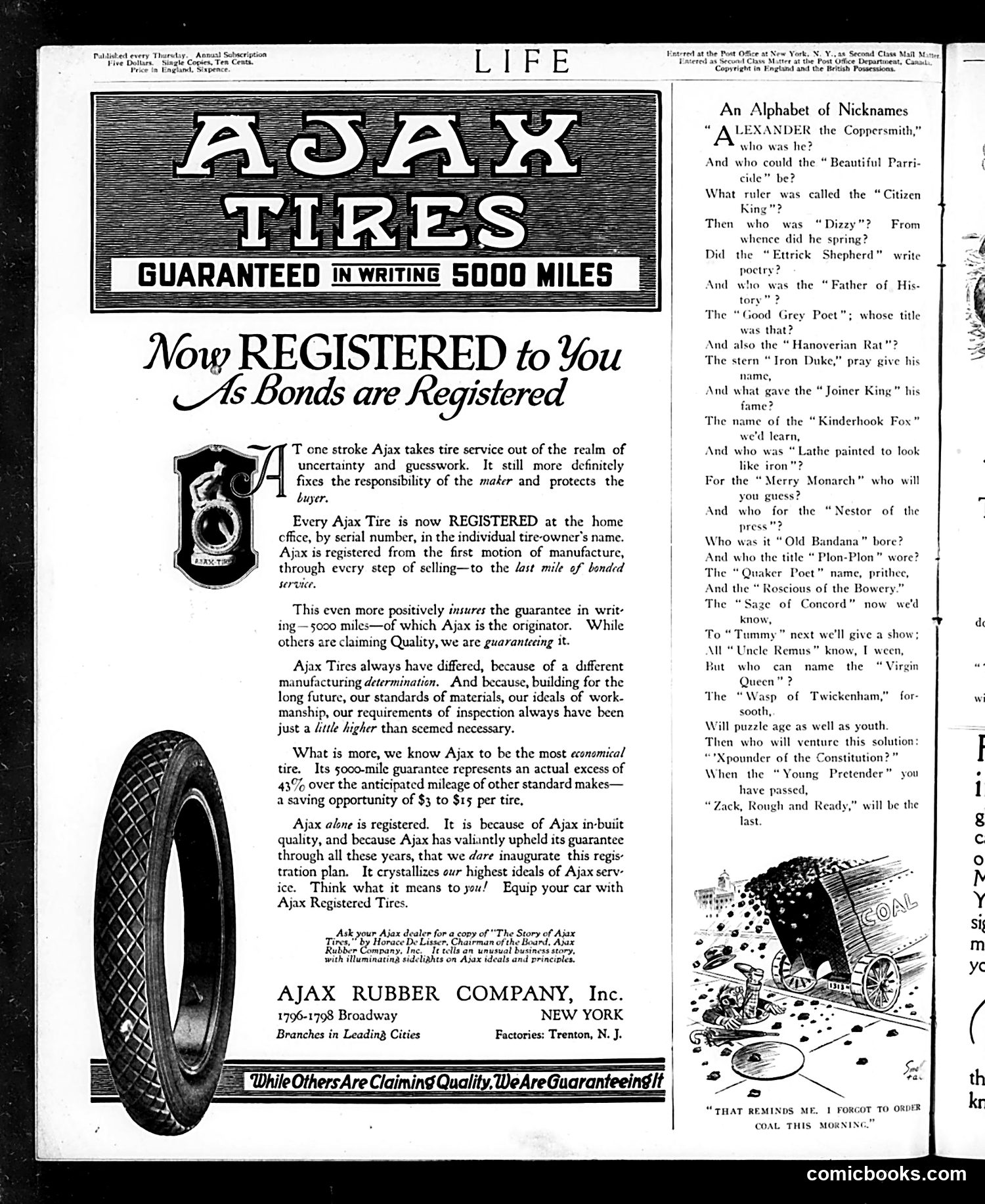
This page is **primarily advertising** for Ajax Tires, occupying the left two-thirds. The ad emphasizes Ajax's "registered" tire guarantee of 5,000 miles—a competitive selling point—and claims superior manufacturing standards and economy compared to competitors. The right side contains **"An Alphabet of Nicknames,"** a humorous quiz asking readers to identify historical and literary figures by their epithets ("Alexander the Coppersmith," "Dizzy," "The Good Grey Poet," etc.). This appears to be a regular Life magazine feature testing readers' knowledge of famous people's nicknames and alternate titles. The small cartoon at bottom right shows a coal truck, with a caption about forgetting to order coal—a relatable domestic joke for the era.
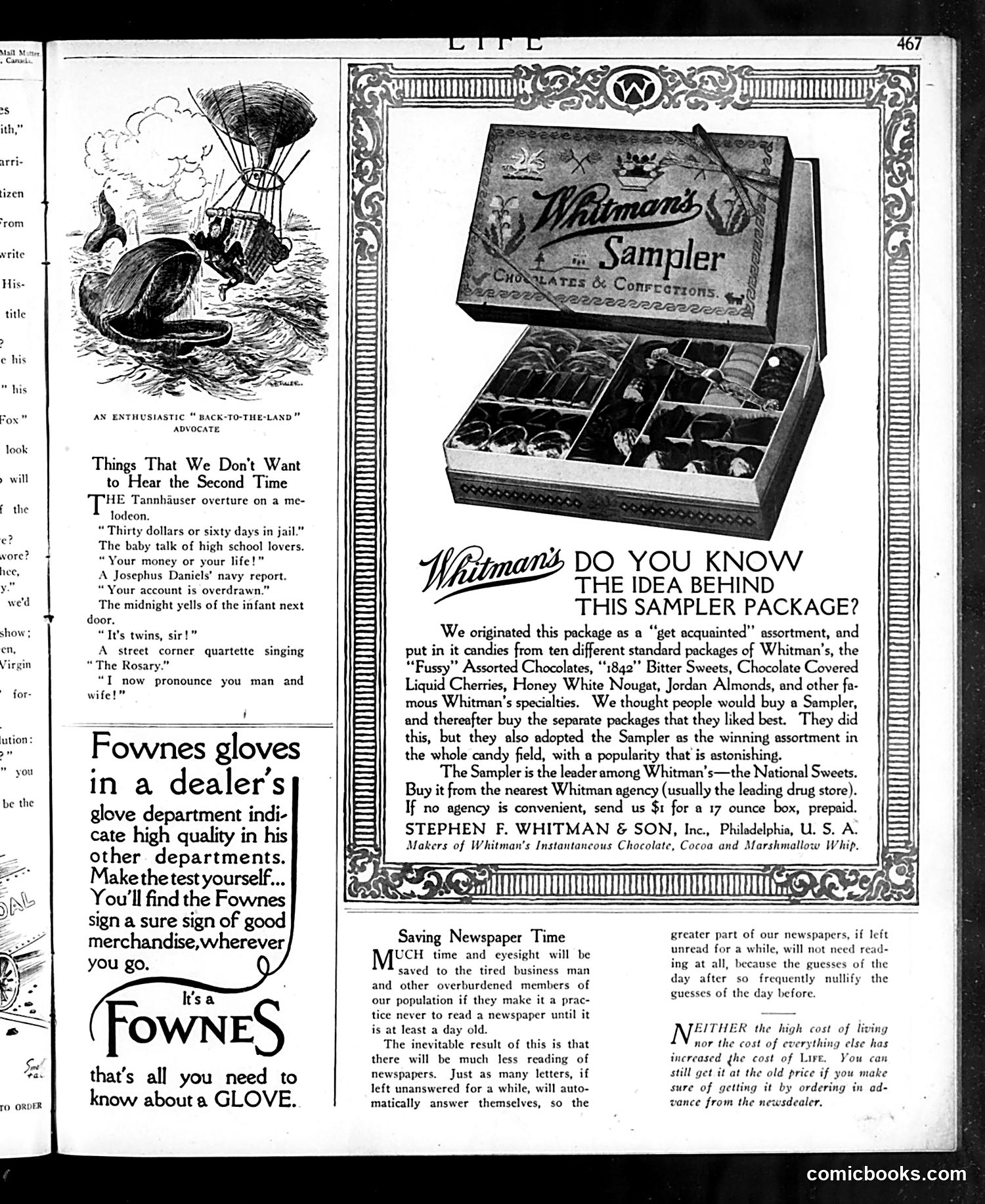
This page consists primarily of **advertisements** rather than satirical content. The main visual is a Whitman's Sampler candy box advertisement, which explains the product's appeal as a "get acquainted" assortment. The upper left cartoon, titled "An Enthusiastic 'Back-to-the-Land' Advocate," appears to be **light social satire** mocking someone promoting rural living—shown with a hot air balloon mishap, suggesting impracticality. Below that, "Things That We Don't Want to Hear the Second Time" lists **humorous clichés**—overused phrases like "thirty dollars or sixty days in jail" and "Your money or your life!" The remaining content includes a **Fownes gloves advertisement** and an article on "Saving Newspaper Time," discussing reading habits. This is primarily a **commercial page** with minimal political or social satire.
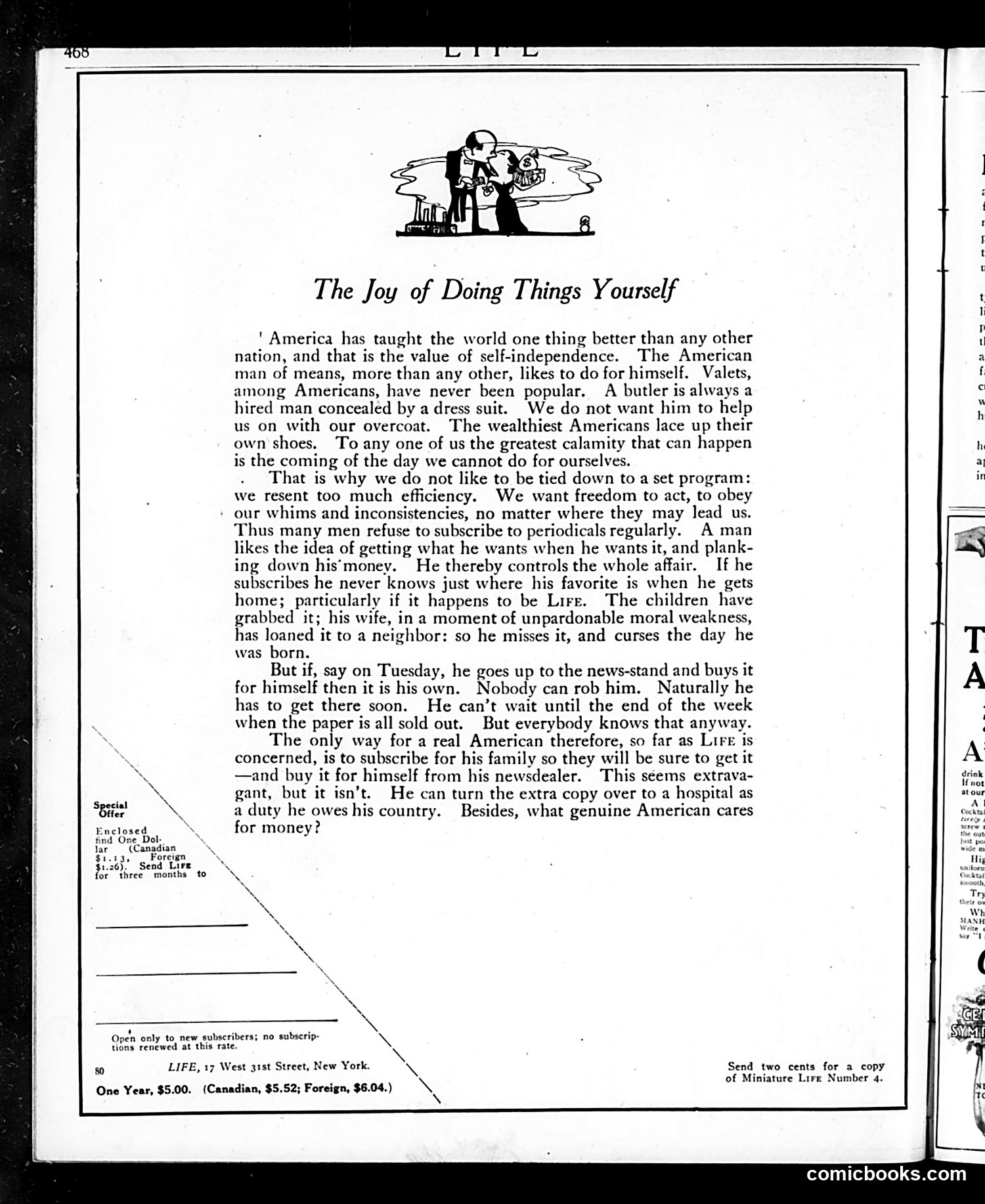
This satirical article celebrates American self-reliance while mocking its absurdities. The text argues that Americans pride themselves on independence—refusing servants, doing personal tasks themselves—yet contradicts this by emphasizing wealth and freedom from constraints. The satire peaks in the subscription example: an American man insists on buying his own newspaper daily rather than subscribing, claiming control and spontaneity matter more than efficiency. The article suggests this attitude is quintessentially American but ultimately illogical—he wastes money and time out of stubborn independence. The piece critiques American individualism as performative and inefficient, presenting self-reliance as an ideology that ironically prevents practical living. The tone is gently mocking toward American exceptionalism and its contradictions.
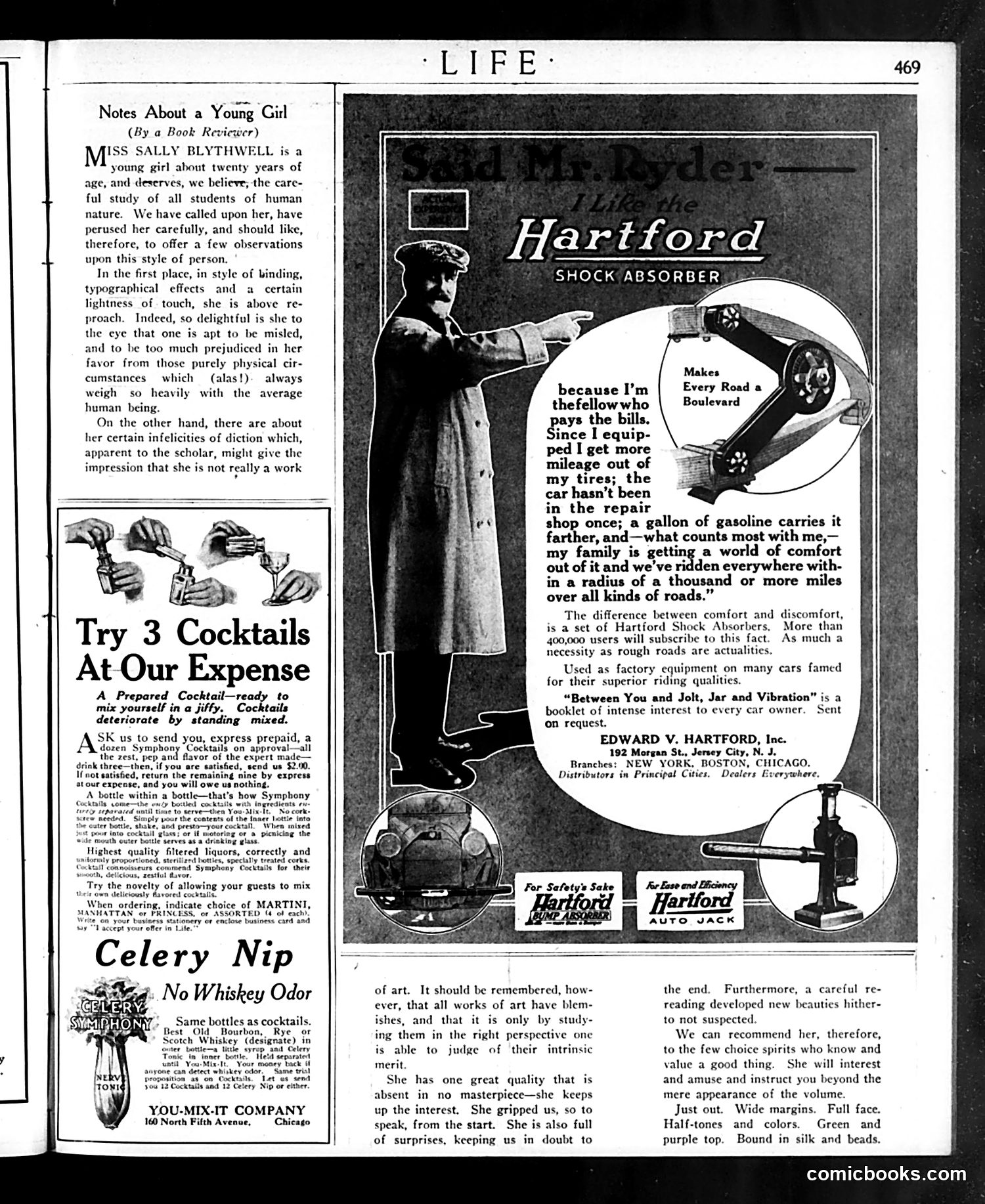
This page is primarily **advertising**, not political satire. The left side contains a book review of Sally Blythwell titled "Notes About a Young Girl," discussing her writing style and certain limitations. Below are advertisements for cocktail mixes ("Try 3 Cocktails At Our Expense") and "Celery Nip" whiskey. The dominant right side features a **Hartford Shock Absorber advertisement**. A man points to a car, explaining that Hartford shock absorbers improve gas mileage and ride comfort on rough roads. The ad includes product images and mentions Hartford's branches in New York, Boston, and Chicago, along with their auto jack product. The Hartford ad represents typical early-20th-century automobile marketing emphasizing mechanical innovation and consumer benefits—nothing satirical. This is a standard commercial magazine page mixing editorial content with paid advertising.
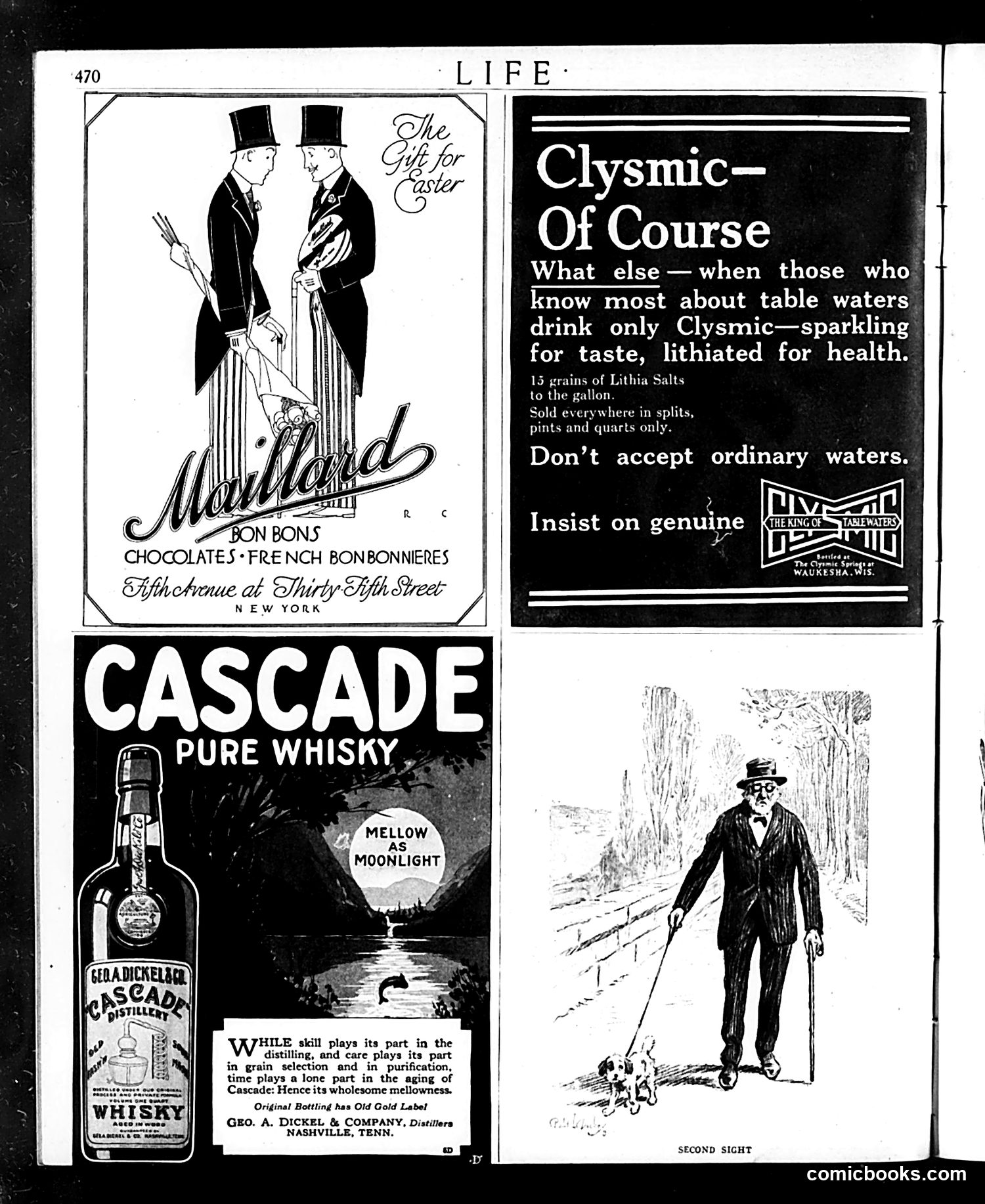
This page is primarily **advertising**, not satirical content. It contains four advertisements from approximately the 1920s-1930s: 1. **Maillard chocolates** - Easter gift ad showing two formally dressed men with top hats 2. **Clysmic water** - Mineral water marketed as a health drink containing lithium salts 3. **Cascade Pure Whisky** - Liquor advertisement emphasizing smoothness ("Mellow by Moonlight") 4. **Illustration labeled "Second Sight"** - A sketch of a man with a cane and small dog, context unclear The ads reflect period attitudes: mineral waters were marketed with medical claims, whisky was openly advertised despite Prohibition era concerns, and Easter gifts targeted wealthy consumers. The page reflects early 20th-century commercial culture and advertising practices rather than political satire.
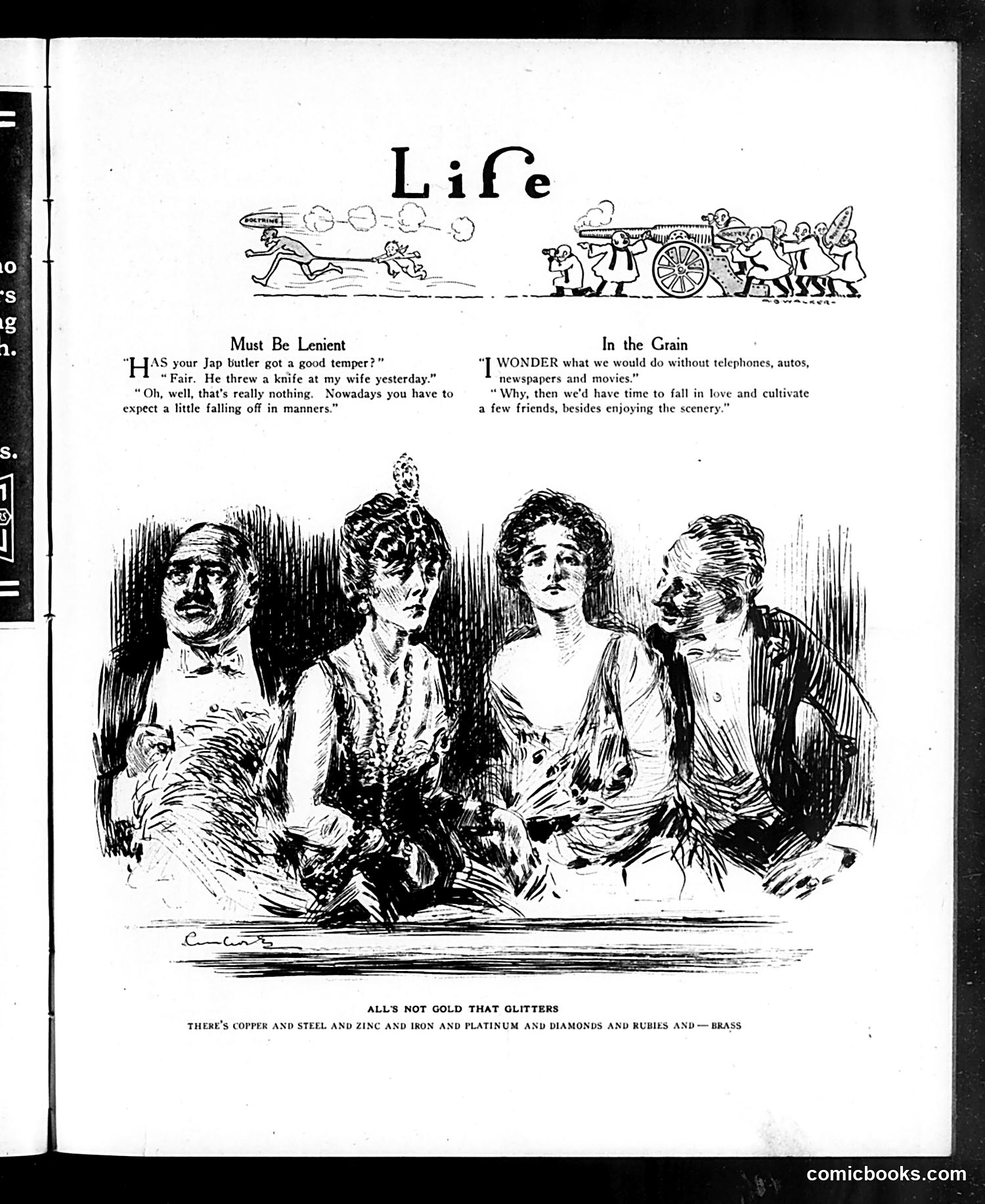
This page contains three satirical pieces about modern life's pace and values. **"Must Be Lenient"** depicts a domestic dispute where a Japanese butler threw a knife at his employer—a servant behavioral transgression the employer dismisses as merely a minor lapse in manners. The satire mocks upper-class tolerance of serious misconduct when it involves servants, suggesting class-based double standards. **"In the Grain"** presents a conversation questioning whether life without modern conveniences (telephones, automobiles, newspapers, movies) might actually be preferable, allowing time for romance and appreciating nature. The satire critiques modern society's assumption that technological progress necessarily improves life. **"All's Not Gold That Glitters"** (bottom illustration) appears to comment on materialism and false values, suggesting that not all that appears valuable truly is. The overall theme criticizes modern society's priorities and social hypocrisies.
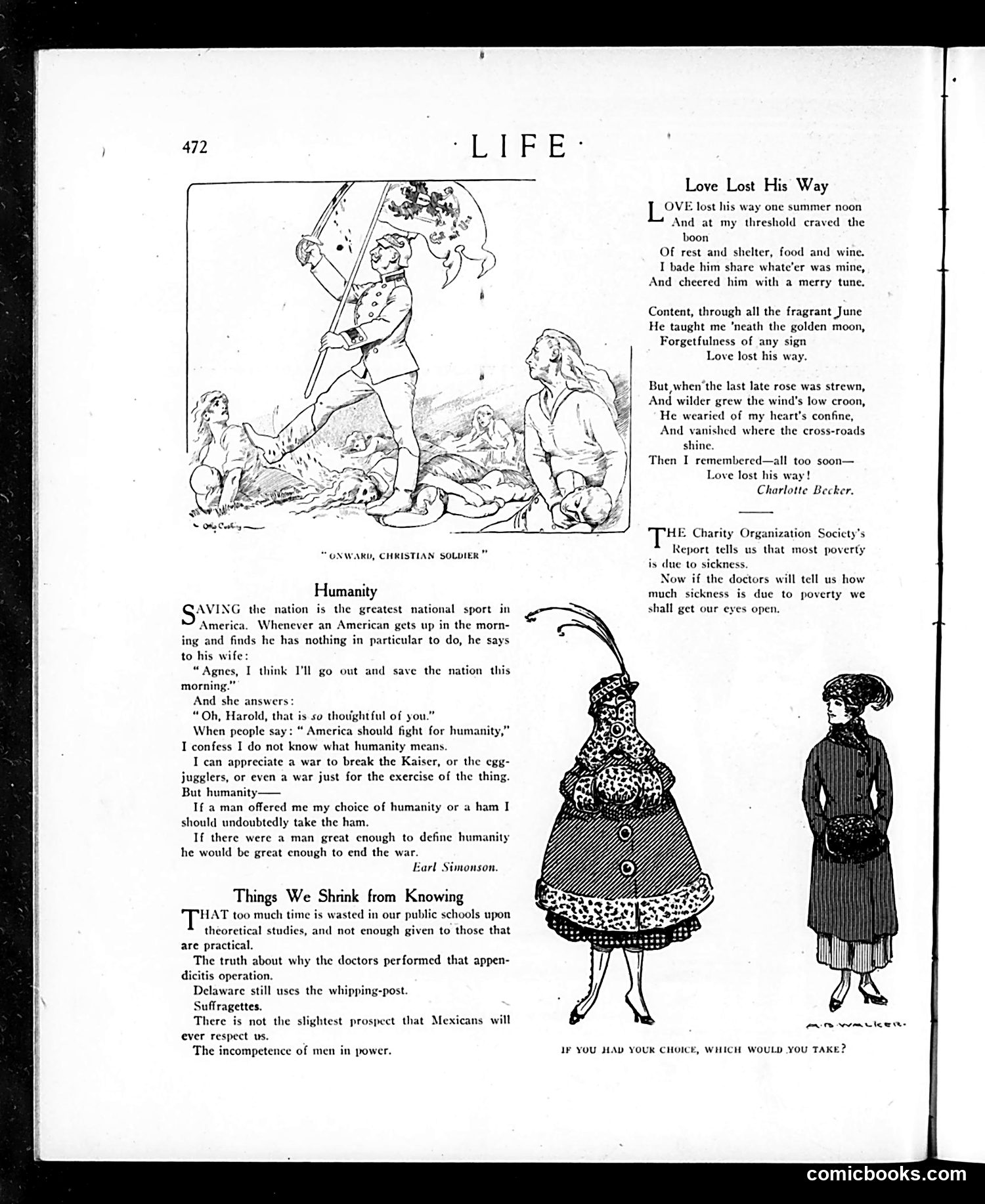
This page contains three distinct pieces: 1. **"Onward, Christian Soldier"** (top illustration): Shows a figure climbing a ladder while others below celebrate. The caption's religious military reference appears satirical about American patriotism and national service. 2. **"Humanity"** (middle): Earl Simonson's essay-poem critiques vague calls for "saving the nation" through humanitarian action, arguing that abstract idealism is meaningless without concrete definition. He suggests choosing practical good (a ham) over undefined noble causes. 3. **"Things We Shrink from Knowing"** (left column): Lists uncomfortable social truths—Delaware's whipping-post, suffragette treatment, Mexican disrespect, and governmental incompetence—suggesting Americans avoid acknowledging these uncomfortable realities. 4. **Fashion illustration** (right): Two women's clothing styles captioned "If You Had Your Choice, Which Would You Take?" - likely satirizing women's fashion choices or constraints. The page reflects progressive-era social criticism typical of Life magazine.
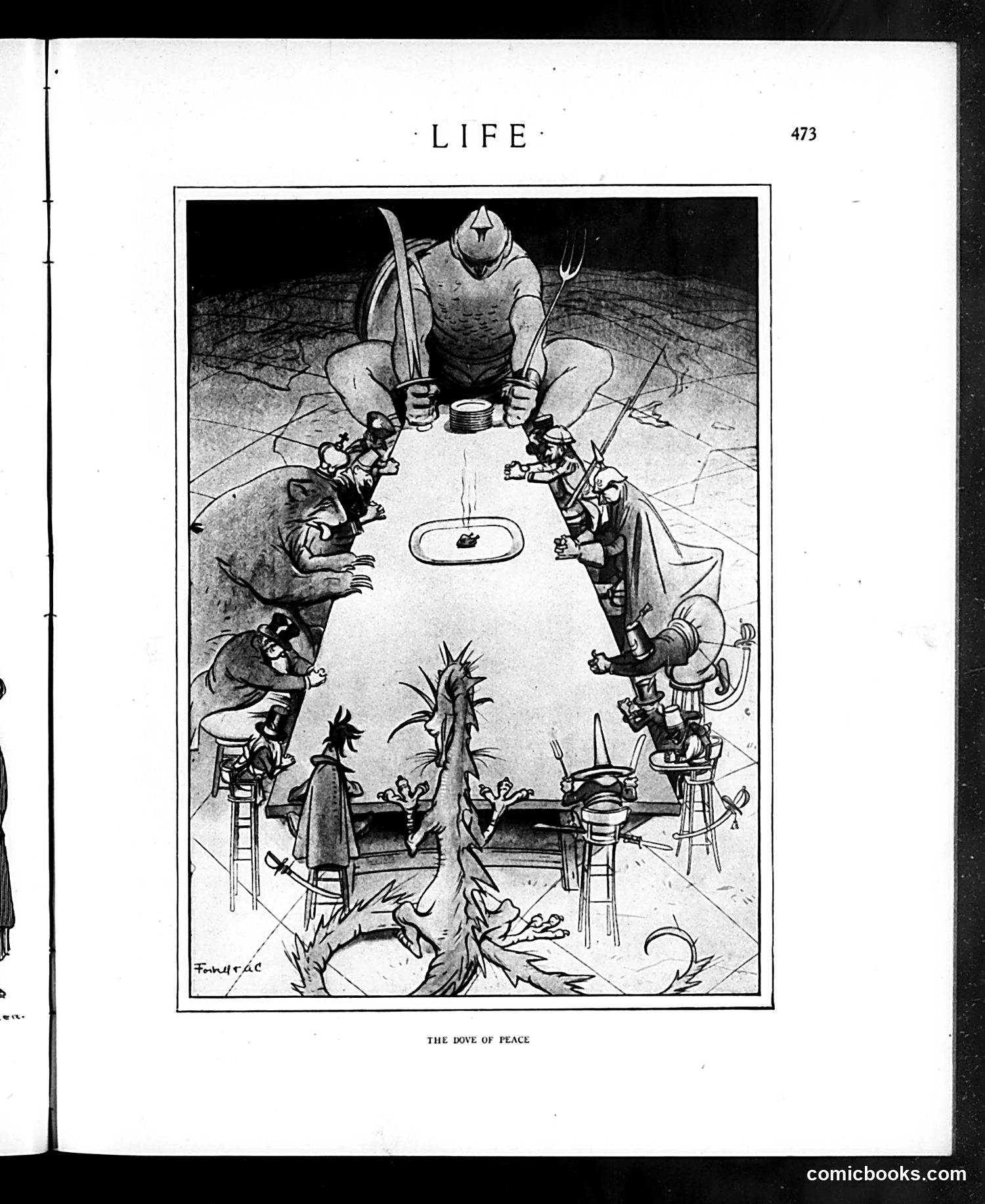
This political cartoon depicts a large, menacing figure wielding weapons (a sword and trident) looming over a dining table. Around the table sit smaller figures appearing to negotiate or dine together, with what seems to be a dove or peace symbol on the table itself. The satire appears to critique post-war peace negotiations, suggesting that despite diplomatic efforts and peaceful rhetoric (the "dove of peace"), military power and aggression (the large armed figure) actually dominate proceedings. The contrast between the small, civilized figures attempting peaceful discourse and the towering threat overhead implies that true peace remains illusory when military force overshadows negotiations. This likely comments on early 20th-century diplomatic failures or the fragility of peace agreements.
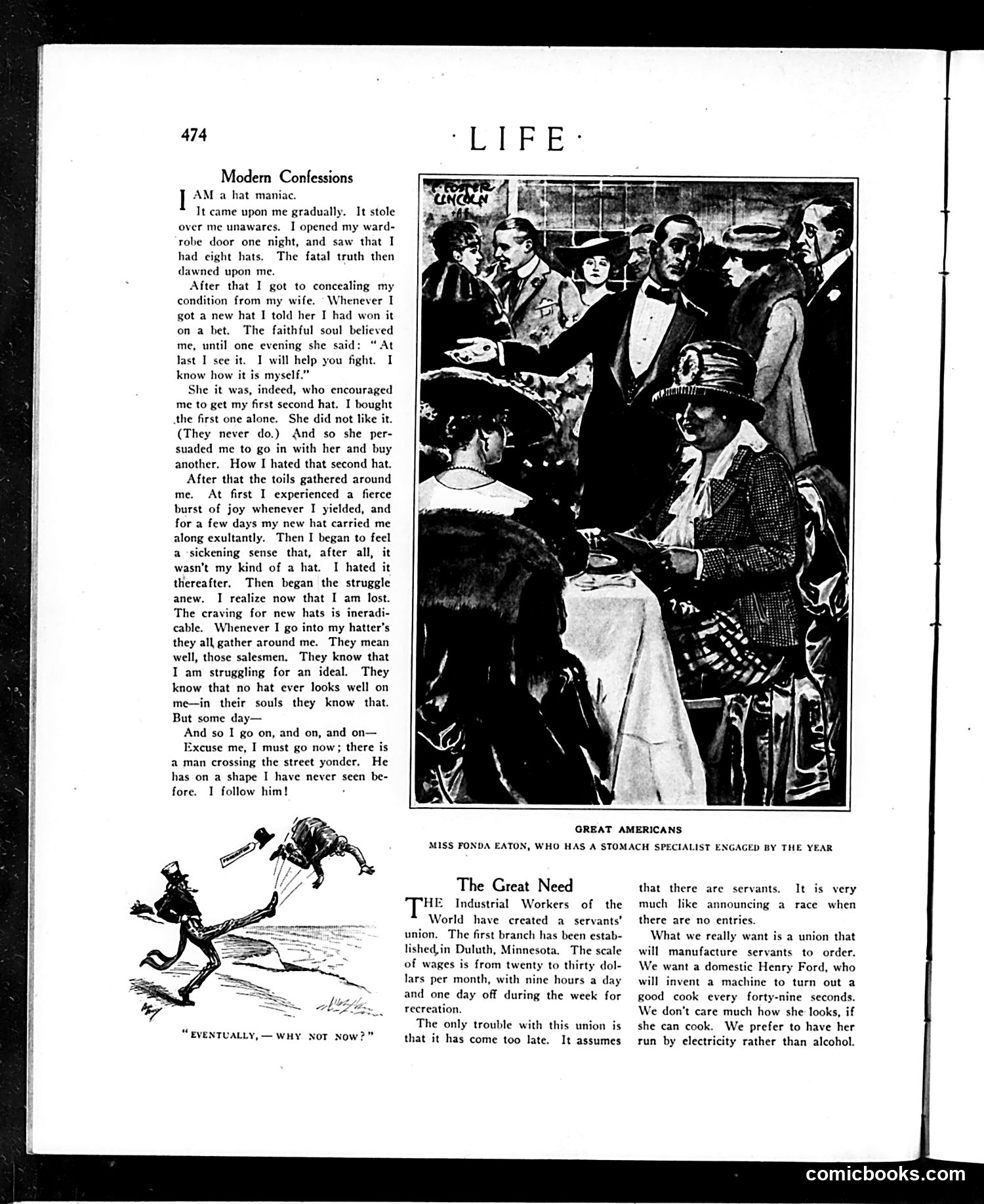
This page contains two distinct pieces: **"Modern Confessions" (left):** A first-person narrative from a man obsessed with hats. He owns eight hats, hides this from his wife, and becomes increasingly anxious about acquiring more. The piece satirizes male consumerism and obsessive collecting, portraying the hat-buyer as psychologically troubled—unable to stop despite knowing it's irrational. It mocks both the compulsion and the secrecy men employ around purchases. **"The Great Need" (right):** Commentary on a new Industrial Workers of the World (IWW) union branch in Duluth, Minnesota. The satire criticizes unions as arriving "too late" and sarcastically proposes manufacturing standardized "servants" via machine—a Henry Ford-style assembly line for domestic help. It mocks both unions and the wealthy's desire for perfectly efficient, obedient servants, questioning whether such automation is progress or absurdity. Both pieces satirize modern American consumption and labor anxieties.
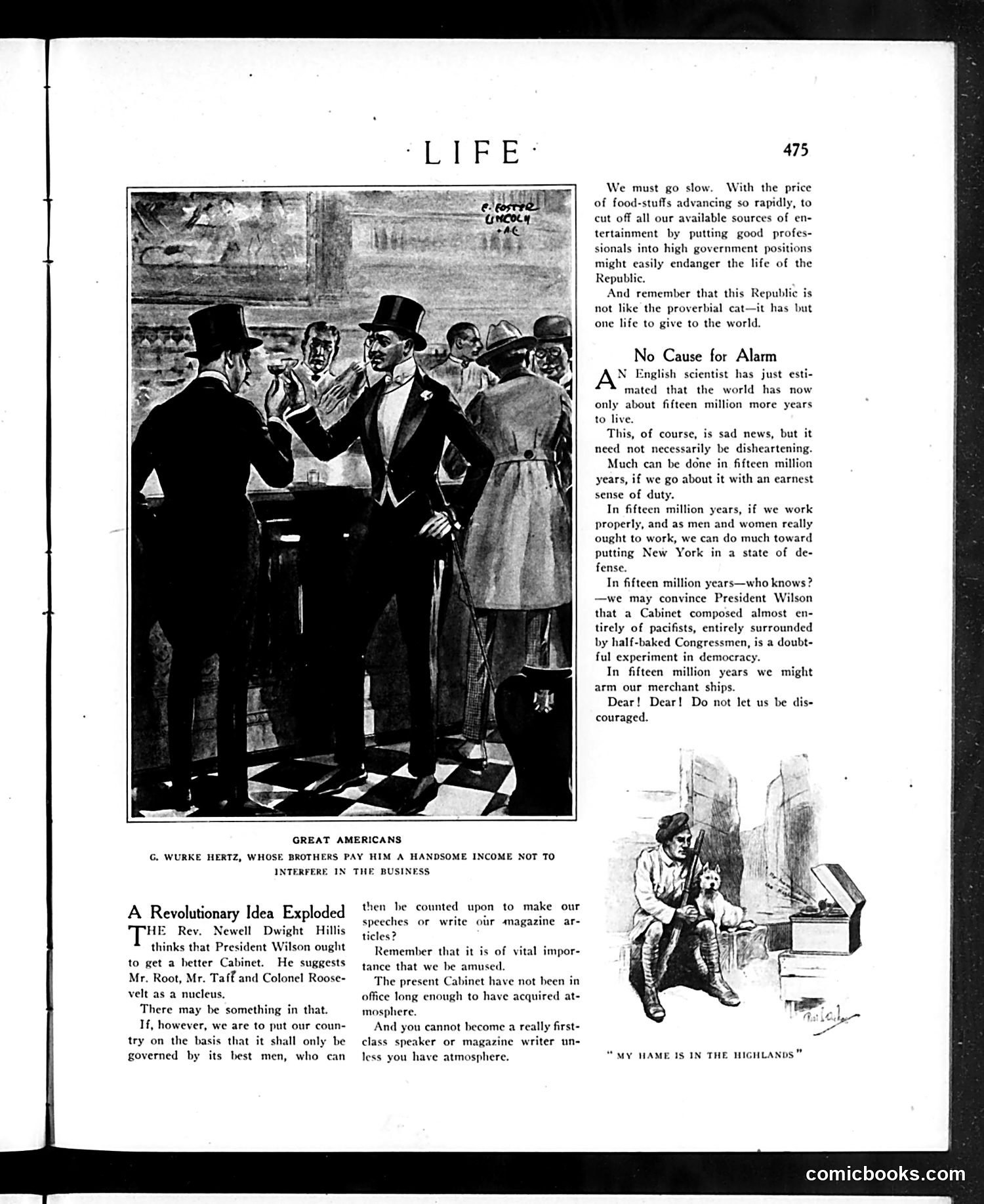
The main illustration depicts "Great Americans" and specifically identifies **G. Wurke Hertz, whose brothers pay him a handsome income not to interfere in the business**—a satirical jab at a wealthy man kept out of family affairs for money. The accompanying text discusses **President Wilson's Cabinet**, with Rev. Newell Dwight Hillis suggesting Wilson should recruit better advisors (mentioning Root, Taft, and Roosevelt). The article critiques current cabinet members as lacking "atmosphere." A secondary section titled "No Cause for Alarm" discusses an English scientist's estimate that the world has fifteen million more years to live, using this absurdist premise to comment on American politics, defense, and governance with dark humor. The small illustration shows a figure with a rifle captioned "My Home Is in the Highlands."
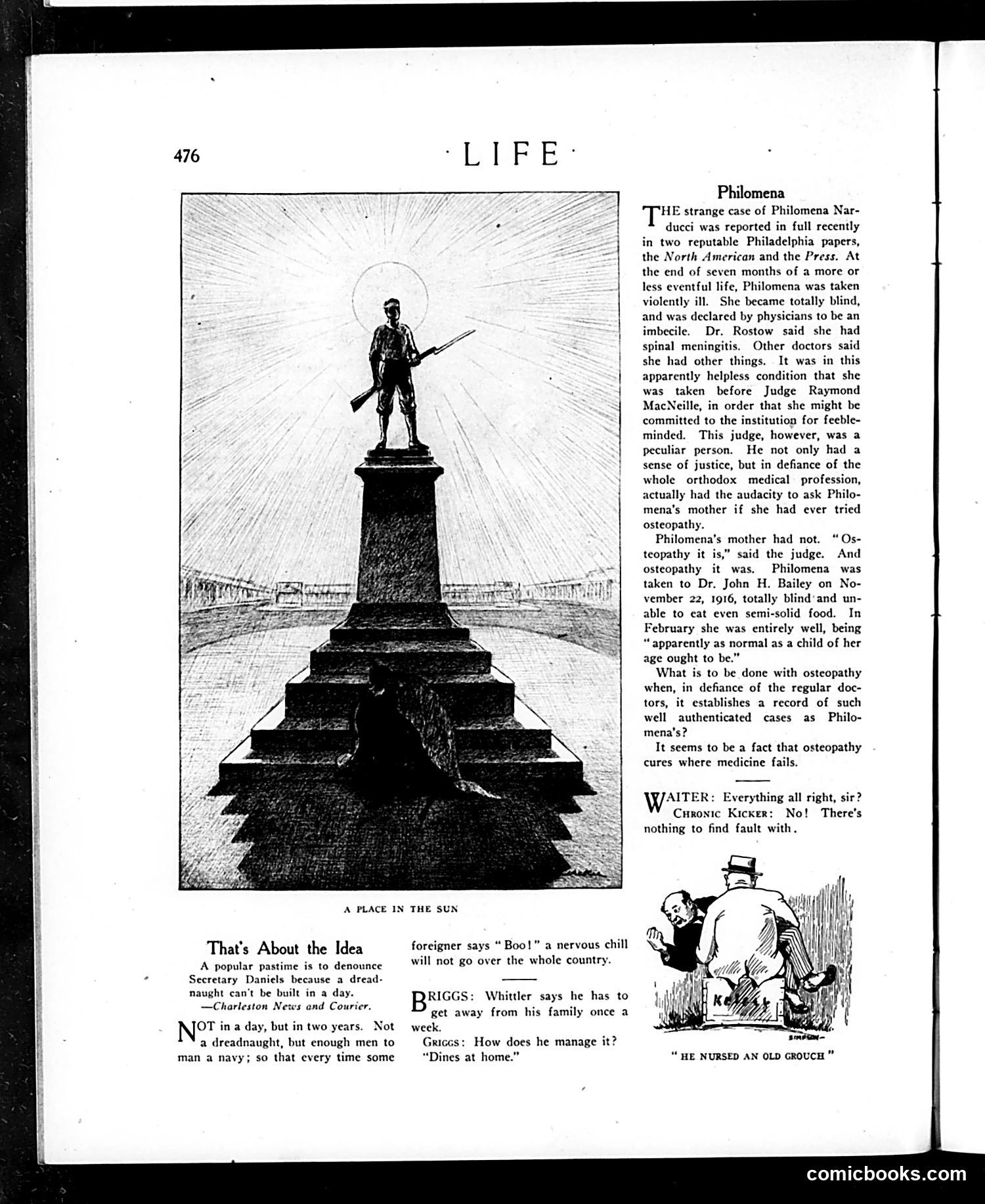
The page contains two separate items: 1. **"Philomena" article**: A serious account of a medical case involving a young woman who became blind and was diagnosed with spinal meningitis by conventional doctors. Judge Raymond MacNeille questioned whether she had tried osteopathy instead. The patient recovered fully under osteopathic treatment in 1916, establishing what the author suggests is a case where osteopathy succeeded where medicine failed. 2. **"That's About the Idea" cartoon**: A satirical dialogue mocking Secretary Daniels's naval policy. The joke critiques his claim that building a dreadnought will deter foreign aggression—suggesting this logic is absurdly backwards, like a man thinking he needs a navy to avoid hiring sailors. The page juxtaposes earnest medical advocacy with political satire.
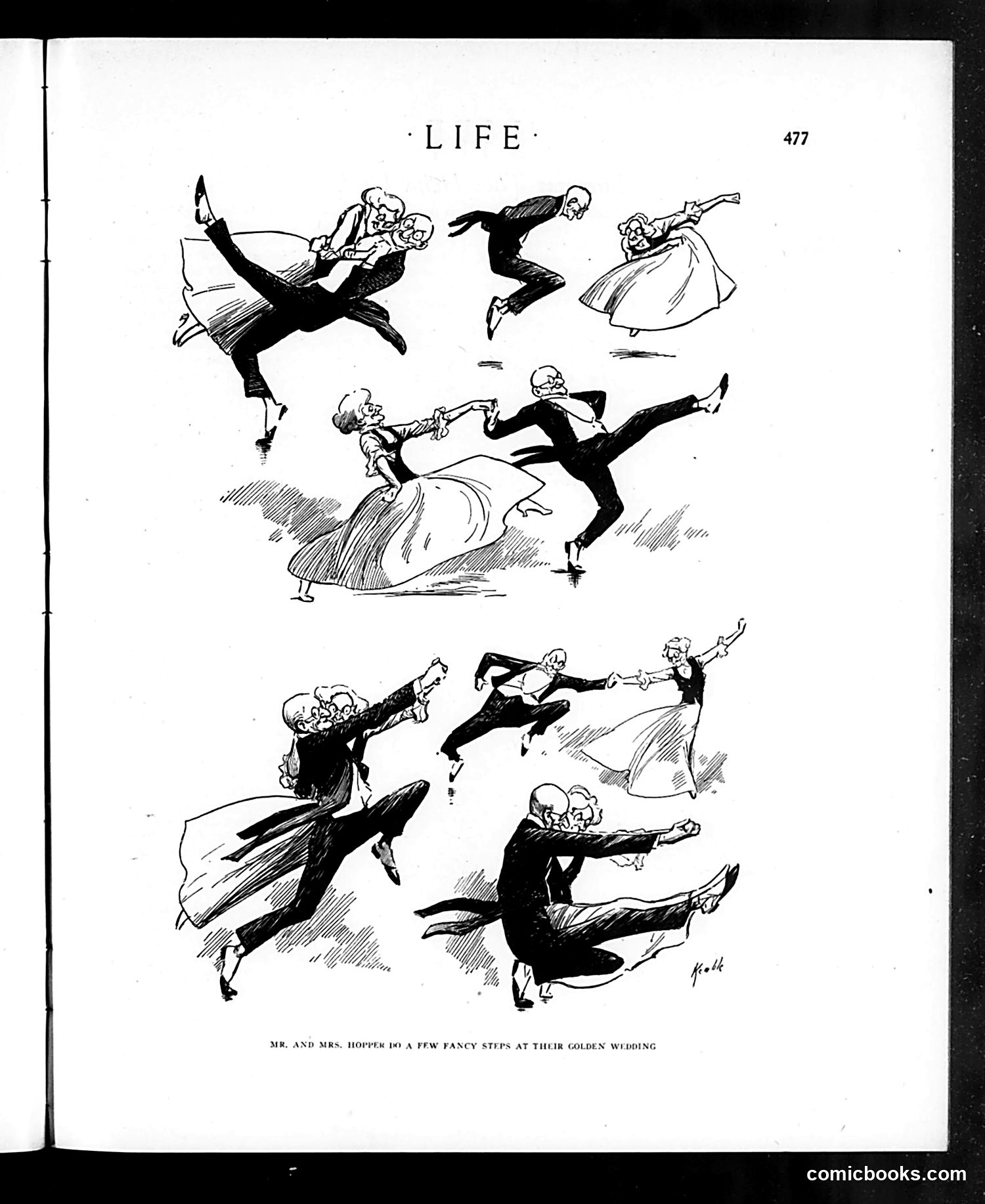
This is a humorous illustration captioned "MR. AND MRS. HOPPER DO A FEW FANCY STEPS AT THEIR GOLDEN WEDDING." The cartoon depicts an elderly couple enthusiastically performing exuberant dance moves and kicks, shown in multiple dynamic poses across the page. The wife wears a dress while the husband is in formal attire. The satire plays on the contrast between their advanced age (indicated by "golden wedding," meaning 50 years of marriage) and their energetic, youthful dancing—likely poking fun at elderly people attempting to act young, or celebrating their unexpected vitality. The multiple sequential poses emphasize their vigorous, almost acrobatic movements, creating comic exaggeration. This appears to be general social humor rather than political commentary.
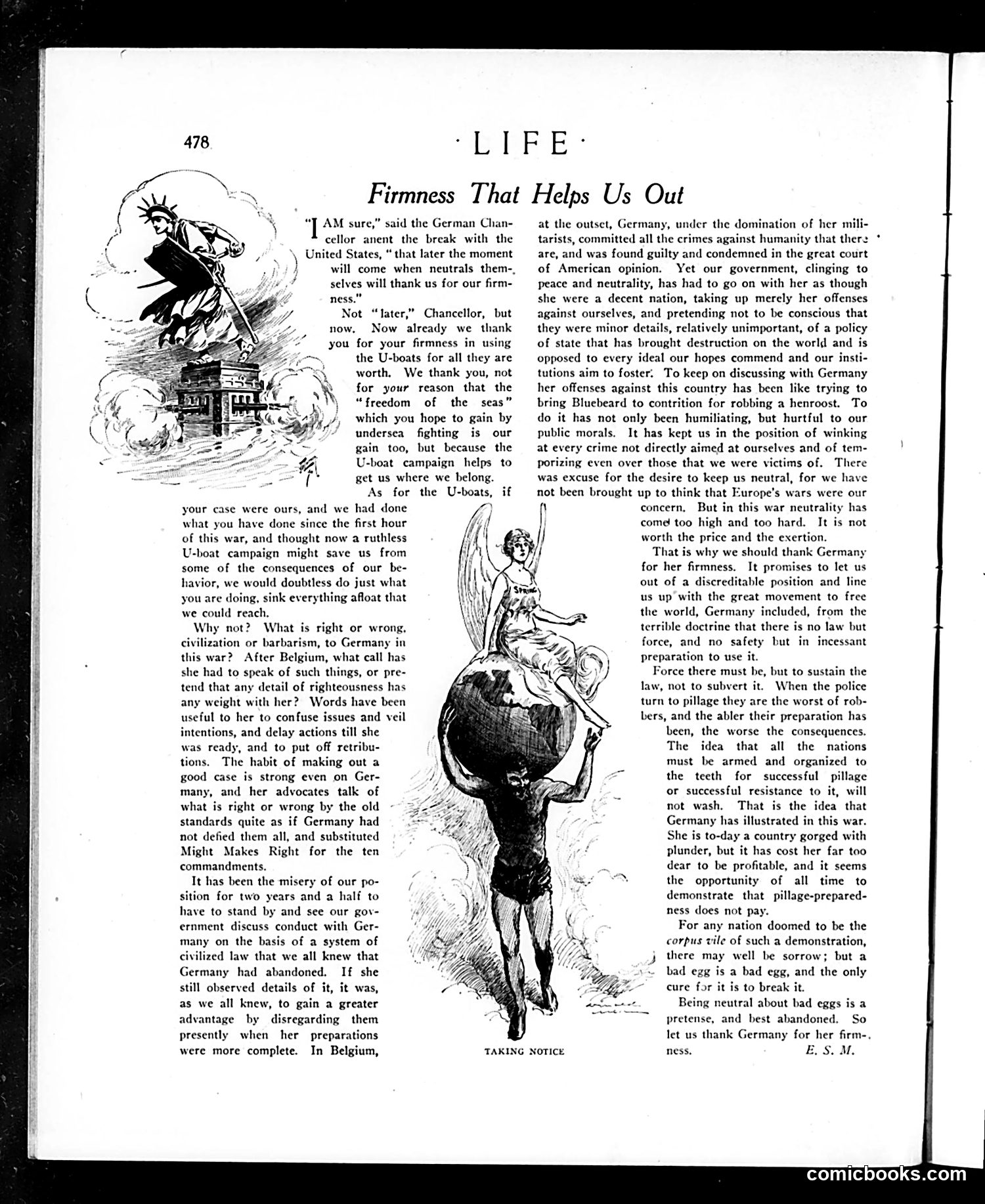
This page from *Life* magazine features anti-German World War I propaganda. The left cartoon shows a U-boat (German submarine) attacking a ship, criticizing Germany's submarine warfare campaign. The right illustration depicts a winged female figure (likely Liberty or Justice) "taking notice" of German aggression. The accompanying article, titled "Firmness That Helps Us Out," quotes a German Chancellor thanking the U.S. for neutrality while paradoxically arguing Germany's U-boat campaign actually serves American interests by preventing British naval dominance. The satire lies in this absurd logic—the author counters that Germany's ruthless tactics demonstrate why military preparedness and abandoning neutrality are necessary. The piece advocates U.S. entry against Germany, framing it as a moral imperative rather than mere realpolitik.
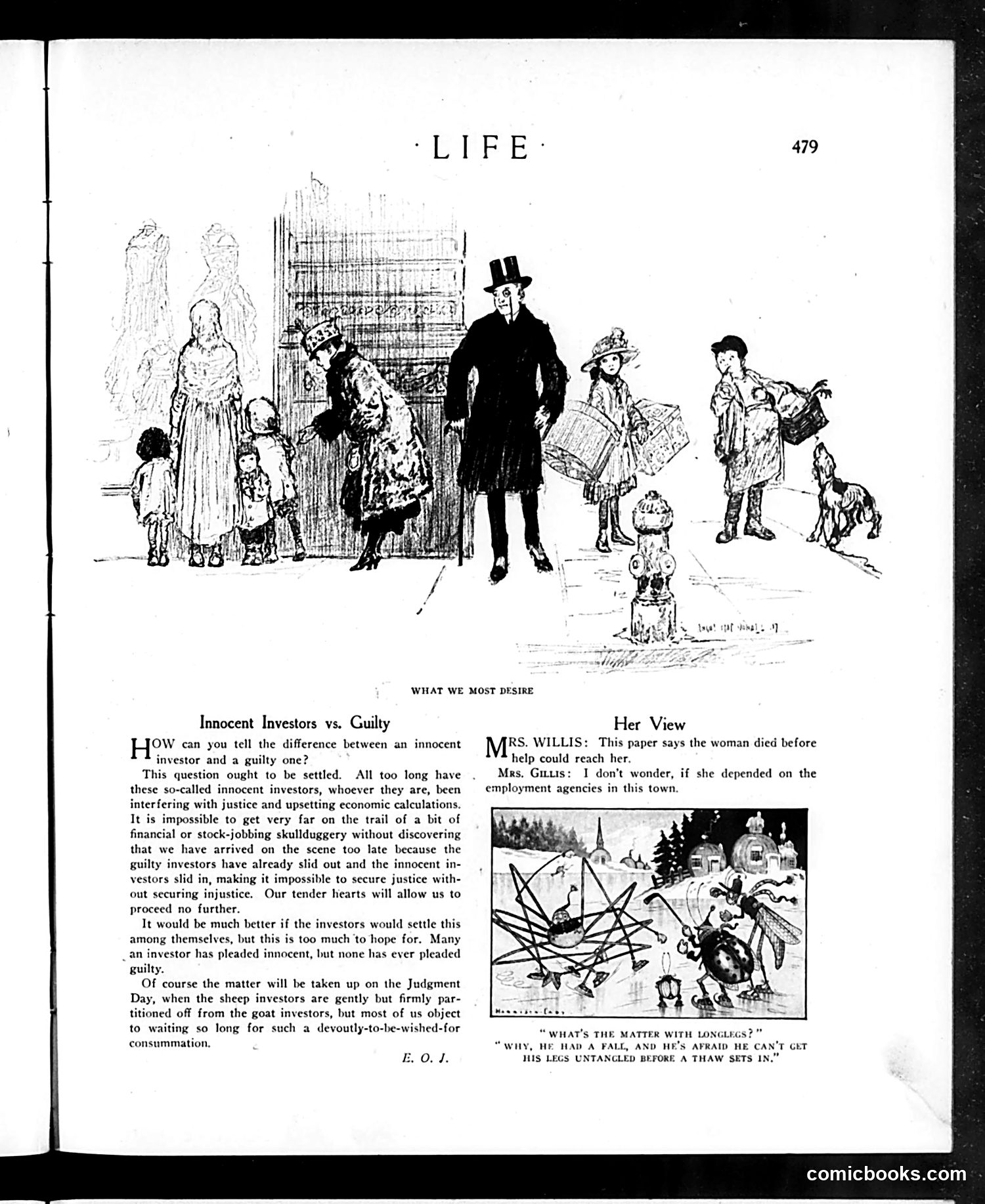
**Top Illustration**: A street scene showing a well-dressed man in a top hat (appearing to be a wealthy or official figure) surrounded by various people in shabby clothing—children, elderly persons, and those carrying bundles. This depicts class disparity and social inequality. **Main Article "Innocent Investors vs. Guilty"**: Critiques financial fraud schemes where wealthy "innocent investors" claim naivety after losing money in stock-jobbing scams. The satire suggests these investors are complicit—they benefited from fraudulent schemes but escape justice while ordinary people suffer. **"Her View" Sidebar**: Shows Mrs. Willis and Mrs. Gillis discussing a woman's death, with the latter questioning whether employment agencies could have helped. This addresses poverty and lack of social services. **Bottom Cartoon**: Depicts winter hardship, with text suggesting a man fears exposure before spring thaw. Overall: Social critique of economic inequality and fraud.
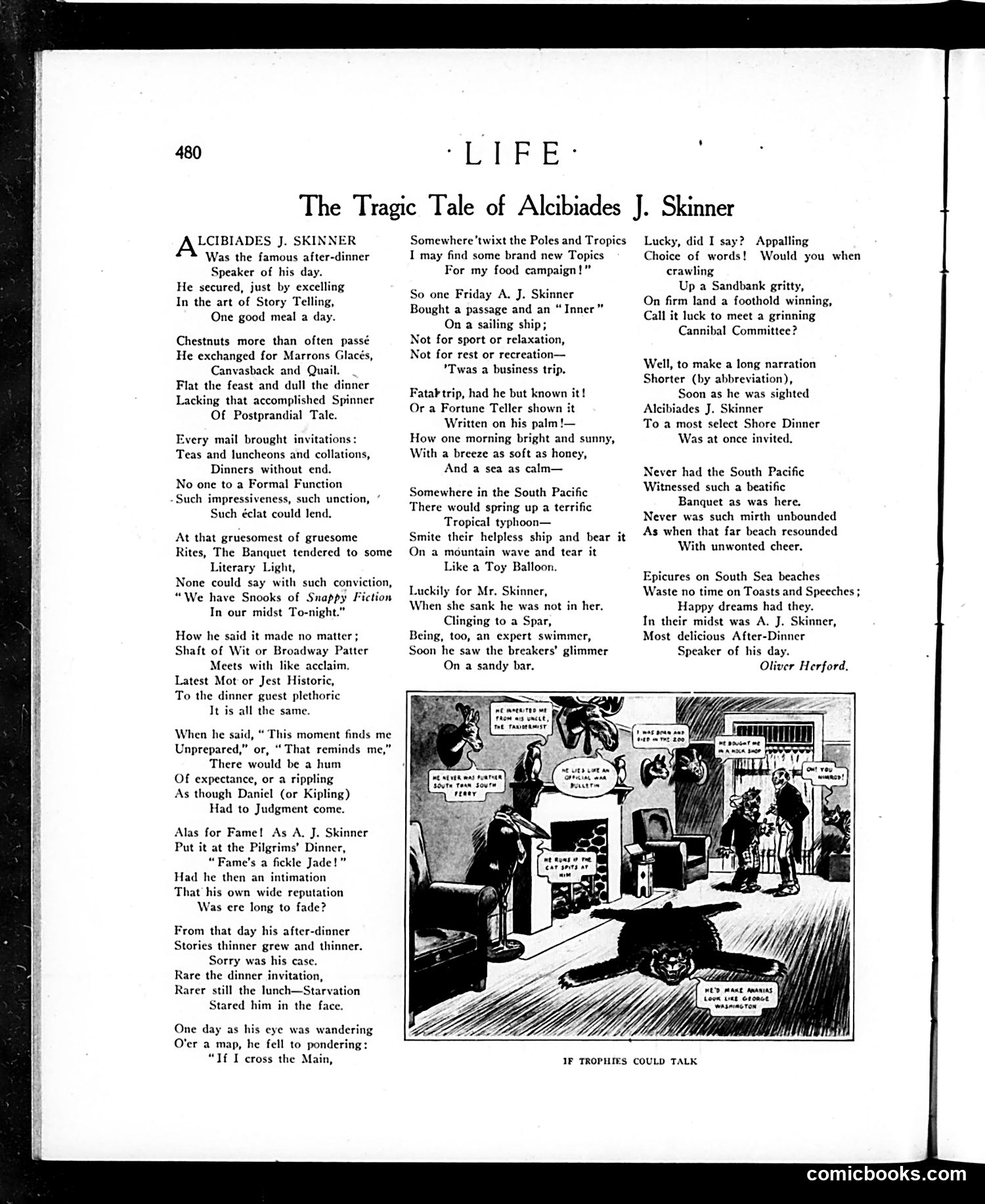
This is a satirical poem by Oliver Herford about a famous after-dinner speaker whose career depends entirely on entertaining wealthy diners with witty stories. Skinner trades his talent for meals—an arrangement that works until his reputation fades and invitations dry up. Desperate, he travels to the South Pacific seeking "new Topics" for his act. A typhoon shipwrecks him on a cannibal island, where he's captured. The satire's punchline: cannibals devour him at their "Shore Dinner," making him finally—and literally—the "Most delicious After-Dinner Speaker of his day." The accompanying cartoon shows the dinner party scene. The satire mocks both Skinner's parasitic dependence on wealthy patrons and the shallow world of high society dining where mere entertainment style matters more than substance. His grim fate is darkly comedic justice.
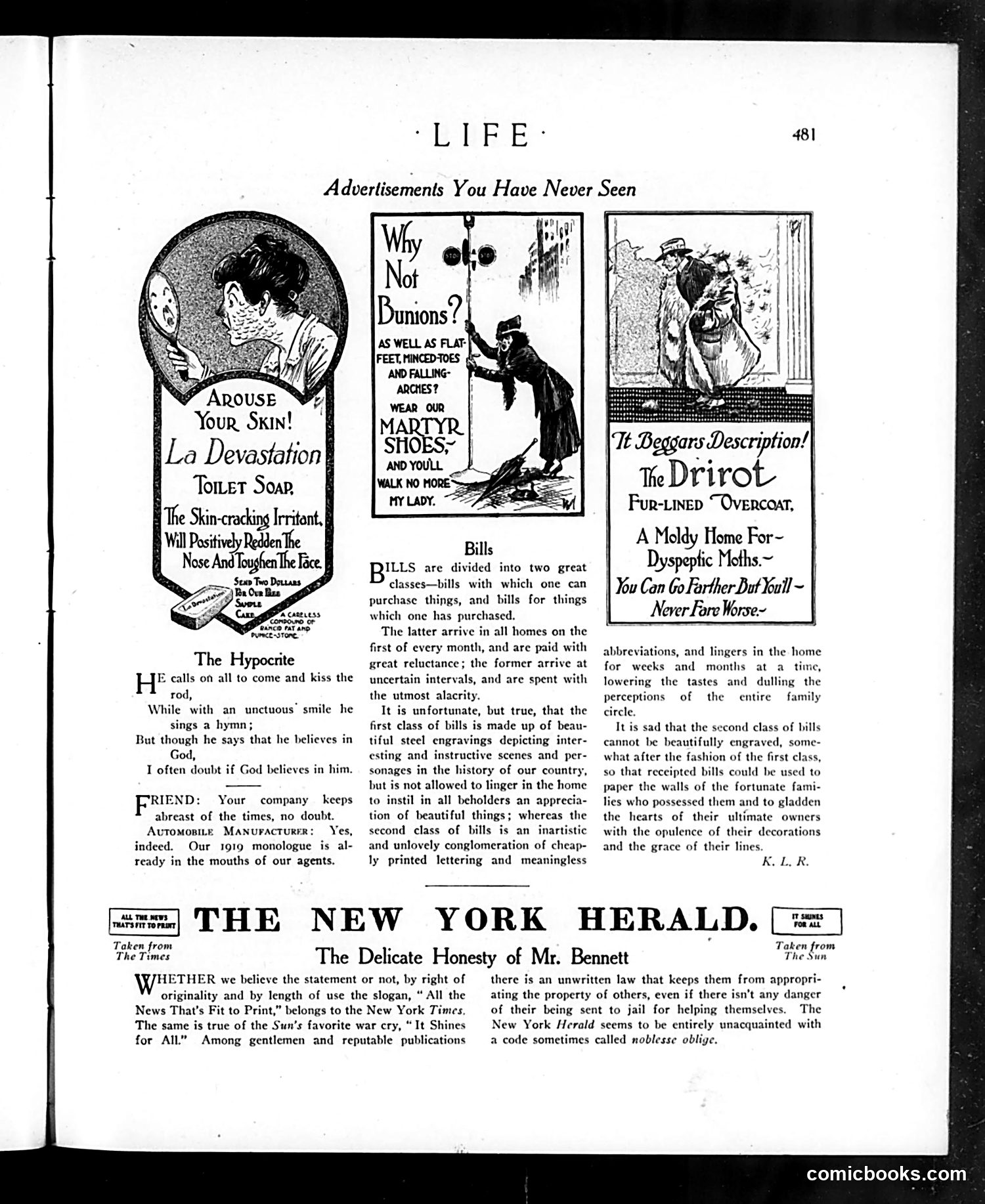
This page contains vintage satirical commentary rather than political cartoons. The main content includes: **"The Hypocrite"** — A short poem mocking religious hypocrisy, depicting someone who publicly professes faith while the author doubts God reciprocates belief in him. **"Bills" section** — Satirizes the contrast between beautiful currency/bills (which must circulate quickly) versus ugly bill statements (which linger in homes, depressing families). The joke suggests bills should be engraved like currency so people would want to display paid receipts as decoration. **Bottom section** critiques the *New York Herald* for appropriating slogans from competitors (*New York Times*' "All the News That's Fit to Print" and the *Sun*'s "It Shines for All") without attribution, suggesting the Herald lacks *noblesse oblige*—the unwritten code of honor among gentlemen and reputable publications. The page is primarily satirical commentary on everyday annoyances and media ethics, not political cartooning.
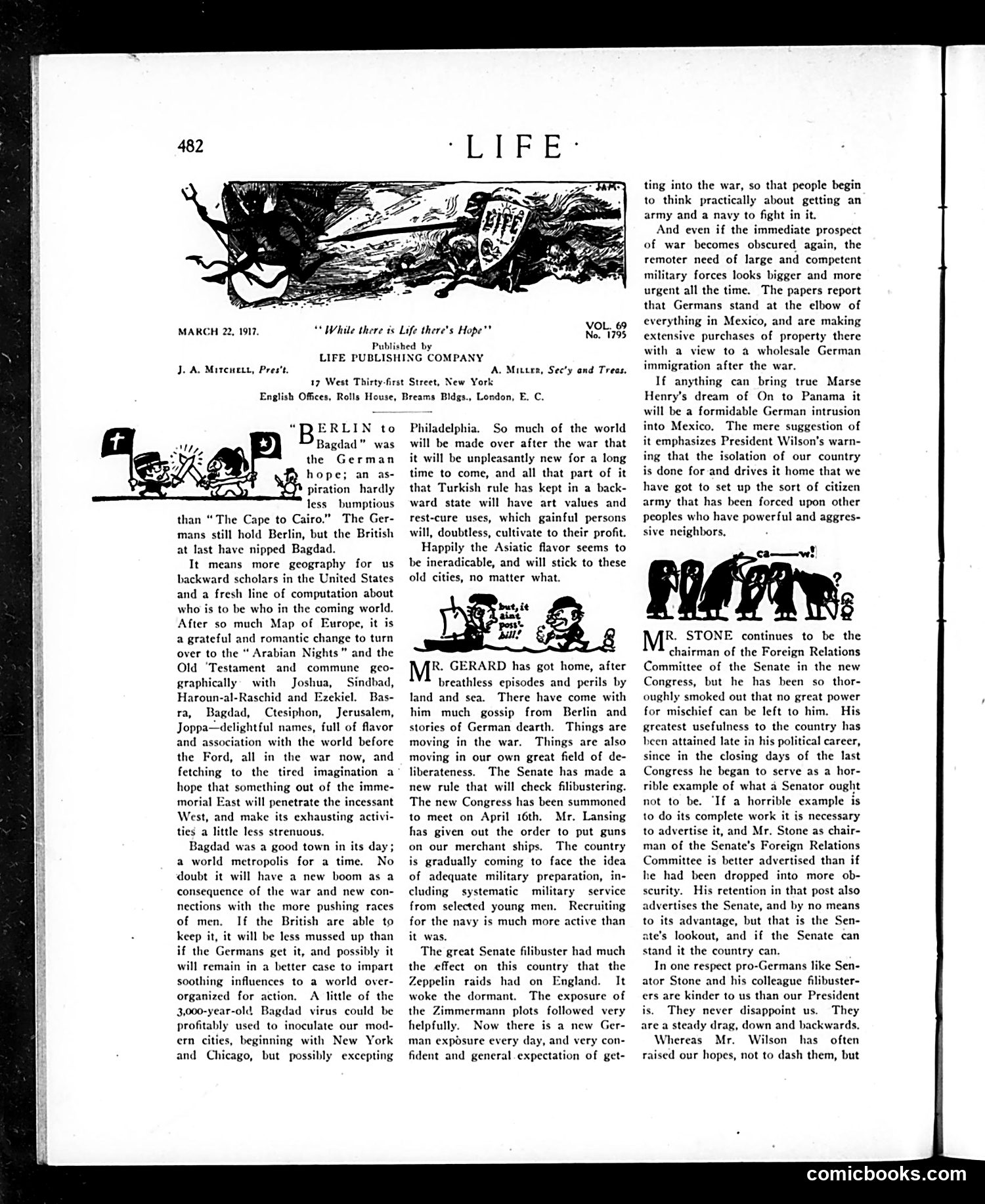
This page contains editorial commentary on World War I developments as America moved toward entry (which occurred in April 1917). **Main cartoon**: The top illustration appears satirical but the specific figures are unclear from this image quality. **Editorial content**: The text discusses Britain's capture of Baghdad from Ottoman forces, noting the romantic historical significance. It then shifts to domestic American politics: Senate filibuster rules, the Zimmermann Telegram (German plot to ally with Mexico against the U.S.), and growing American military preparation. **Key satirical points**: The author mocks how Baghdad's ancient prestige contrasts with modern industrial war, suggesting "old Bagdad virus" might benefit exhausted American cities. More directly, the piece implies German activities in Mexico (property purchases, potential immigration) represent a genuine threat justifying American military mobilization. The commentary reflects pre-war American anxiety about German ambitions in the Western Hemisphere and the gradual shift toward accepting military involvement.
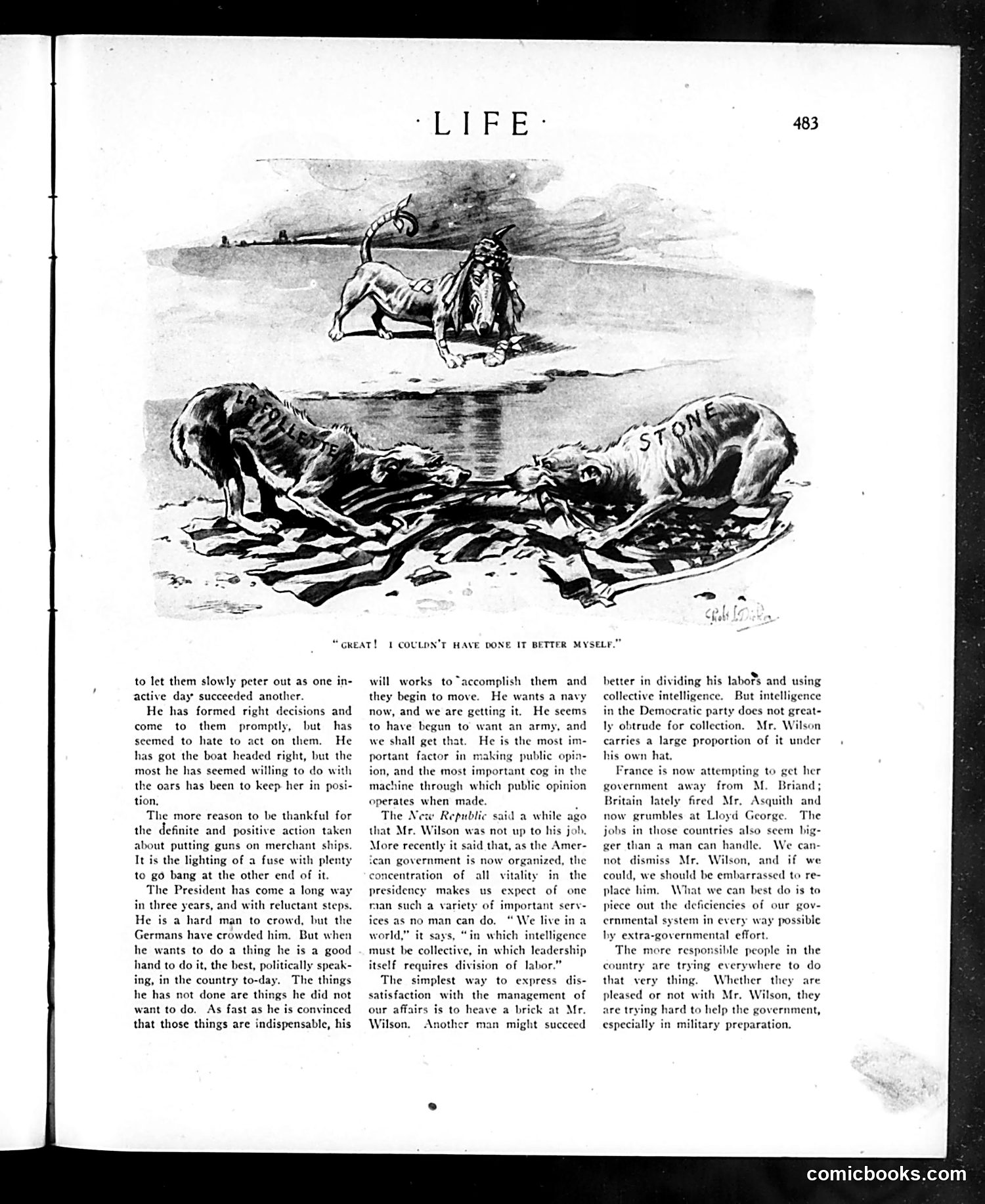
This cartoon critiques President Wilson's wartime leadership during World War I. The image shows two dogs examining a skeletal corpse labeled "STONE"—likely representing Wilson's slow, reluctant approach to military preparedness and war entry. The caption "Great! I couldn't have done it better myself" is ironic: one dog praises Wilson's inaction, suggesting even a dog could manage the government's affairs as poorly. The accompanying text defends Wilson against critics (particularly *The New Republic*), acknowledging his hesitation but arguing he eventually acts decisively once convinced of necessity. The piece notes Wilson now supports building a navy and army, and defends him as the best available leader compared to dismissed European counterparts (Asquith, Briand). The satire targets not just Wilson's reluctance, but broader frustration with slow governmental response to preparedness needs before full American entry into the war.
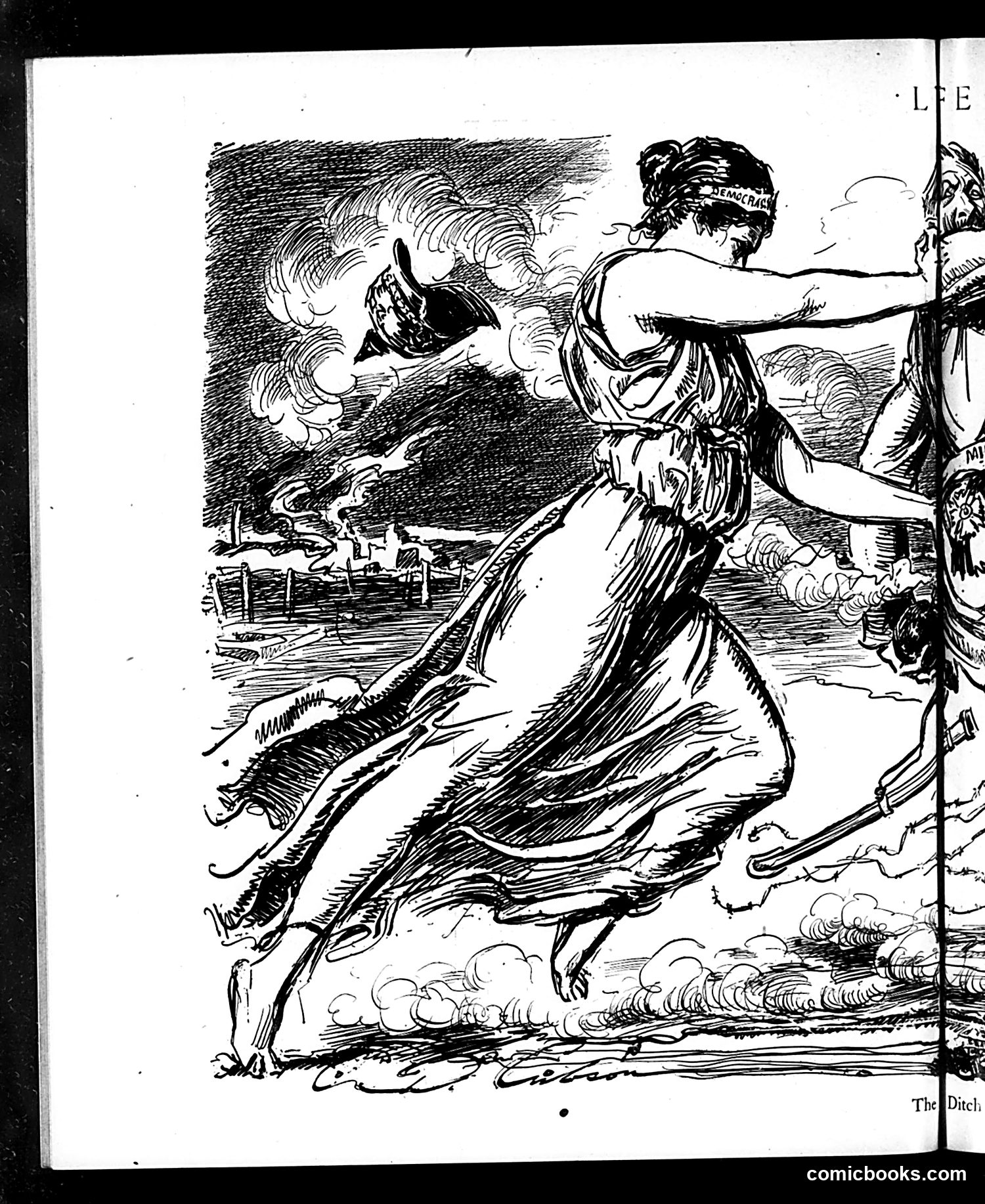
This is a classical allegorical engraving showing a female figure (likely representing Liberty or Justice, based on her classical dress and headband) in dynamic motion. She appears to be wielding a torch or similar object while gesturing forcefully toward figures on the right side of the composition. The scene includes clouds, a landscape with what appears to be a fortification or structure in the background, and other partially visible figures. The artistic style—detailed cross-hatching and classical subject matter—suggests this is from Life magazine's satirical tradition of using classical imagery to comment on contemporary political or social issues. However, without visible text identifying the specific figures, event, or political context being referenced, I cannot definitively explain what particular satire or social commentary this cartoon conveys to modern readers.
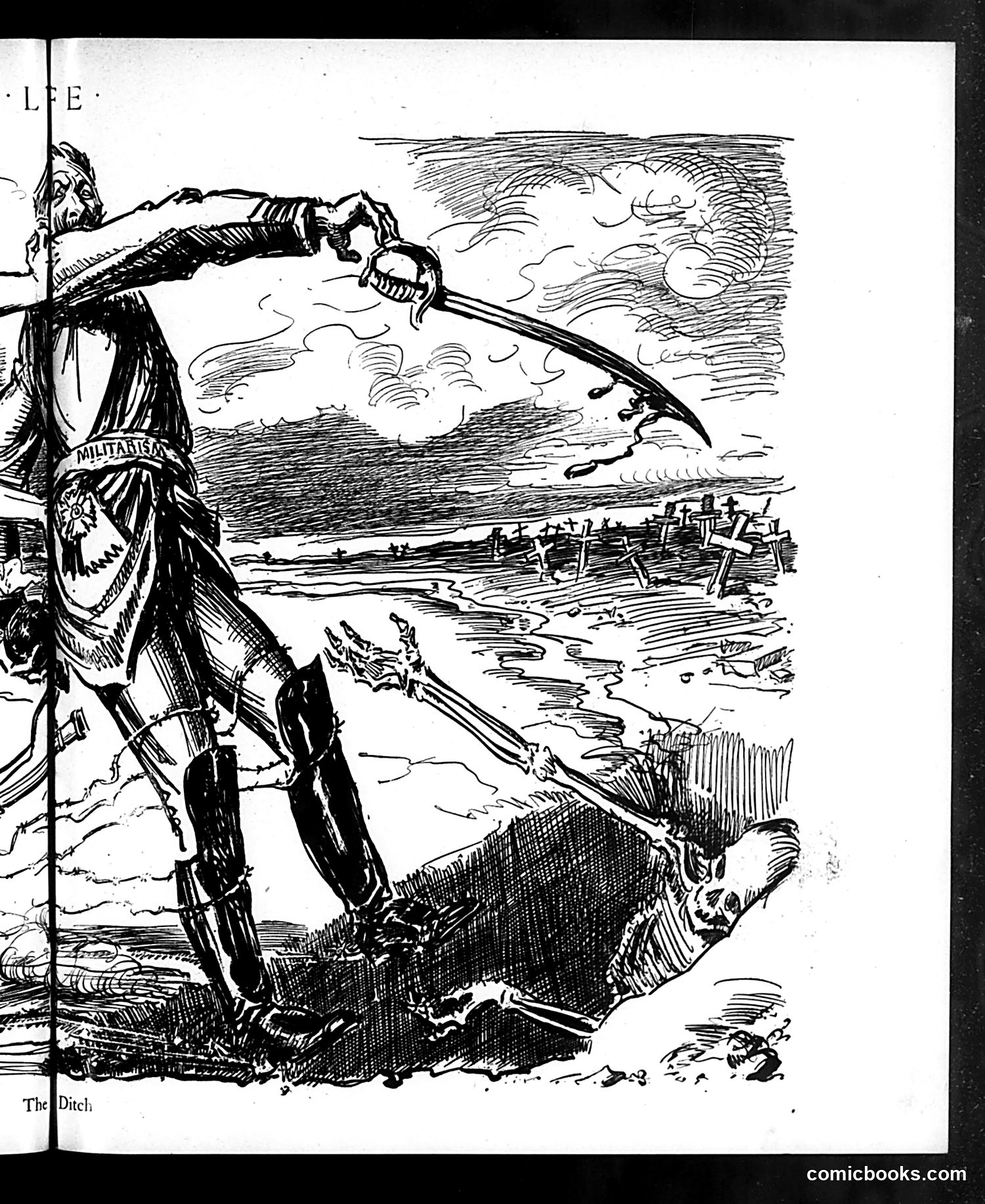
This Life magazine cartoon depicts a skeletal, militaristic figure labeled "MILITARISM" standing over a mass grave or ditch filled with crosses (representing dead soldiers). The figure wields a scythe, depicted as the Grim Reaper of war. The satire criticizes militarism as inherently deadly—a force that harvests human lives. The crosses suggest battlefield casualties, while the dark clouds and desolate landscape emphasize death and destruction. Without the publication date visible, the specific historical context is unclear, though the artistic style suggests early-to-mid 20th century. This could reference World War I, interwar militarism, or another period of conflict. The message warns readers that embracing militaristic ideology leads inevitably to mass death.
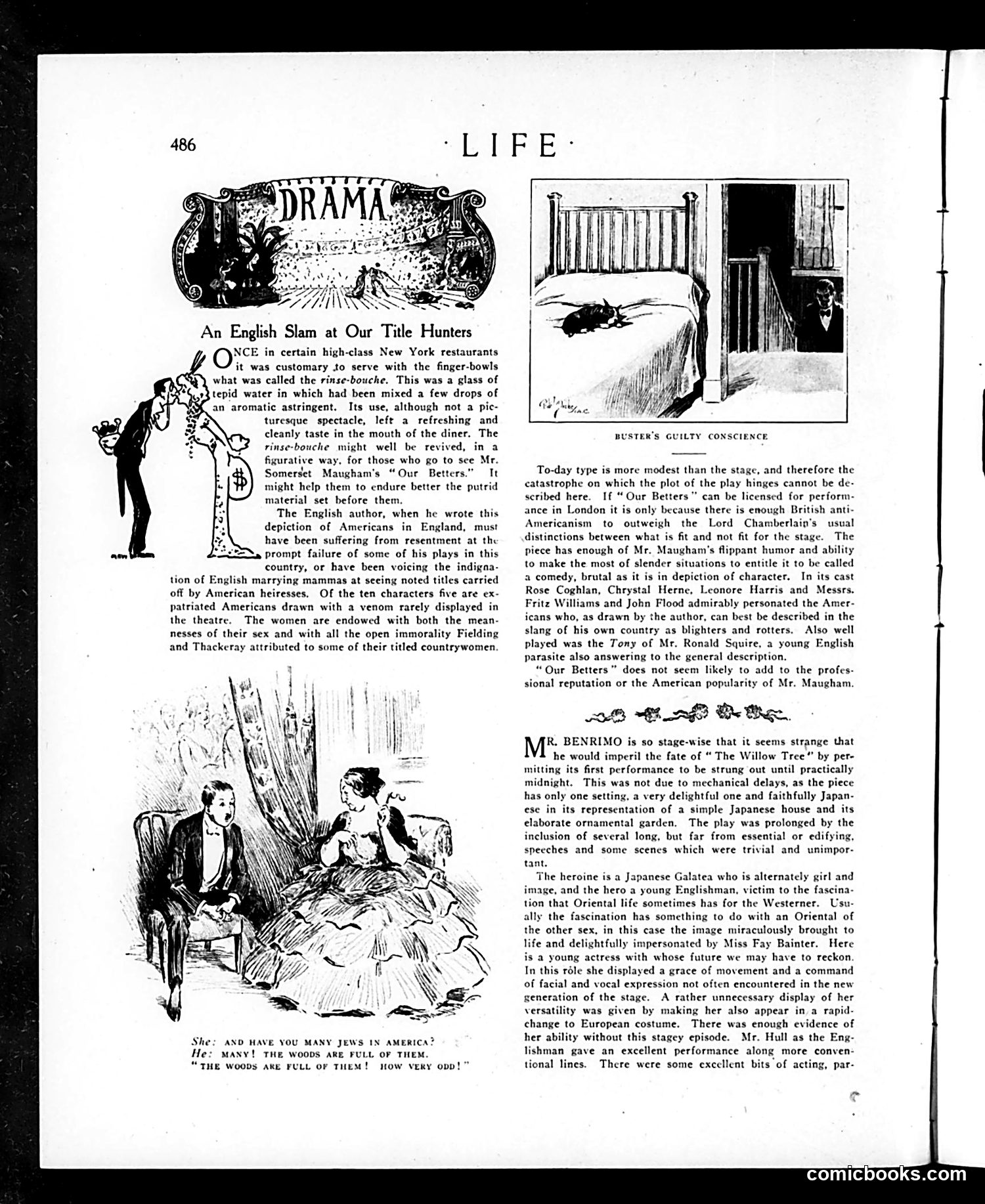
This page reviews two theatrical productions, both critiquing plays by English authors about Americans and Orientalism. **"An English Slam at Our Title Hunters"** reviews Somerset Maugham's *Our Betters*, a play satirizing wealthy Americans in England. The Life critic argues Maugham wrote it from resentment—either over failed plays in America or anger at American heiresses marrying English nobles. The review is hostile, calling the portrayal of five expatriate American characters vicious and immoral. A cartoon shows a woman asking a man about Jews in America; he responds "the woods are full of them"—likely satirizing both American antisemitism and the crude stereotyping Maugham employs. **"Buster's Guilty Conscience"** (right panel) shows a man discovering a woman in his bed—presumably illustrating the "putrid material" the play contains that offends Victorian sensibilities. The second review covers *The Willow Tree*, praising lead actress Fay Bainter's performance as a Japanese woman brought to life, while criticizing the play's excessive length and unnecessary speeches.
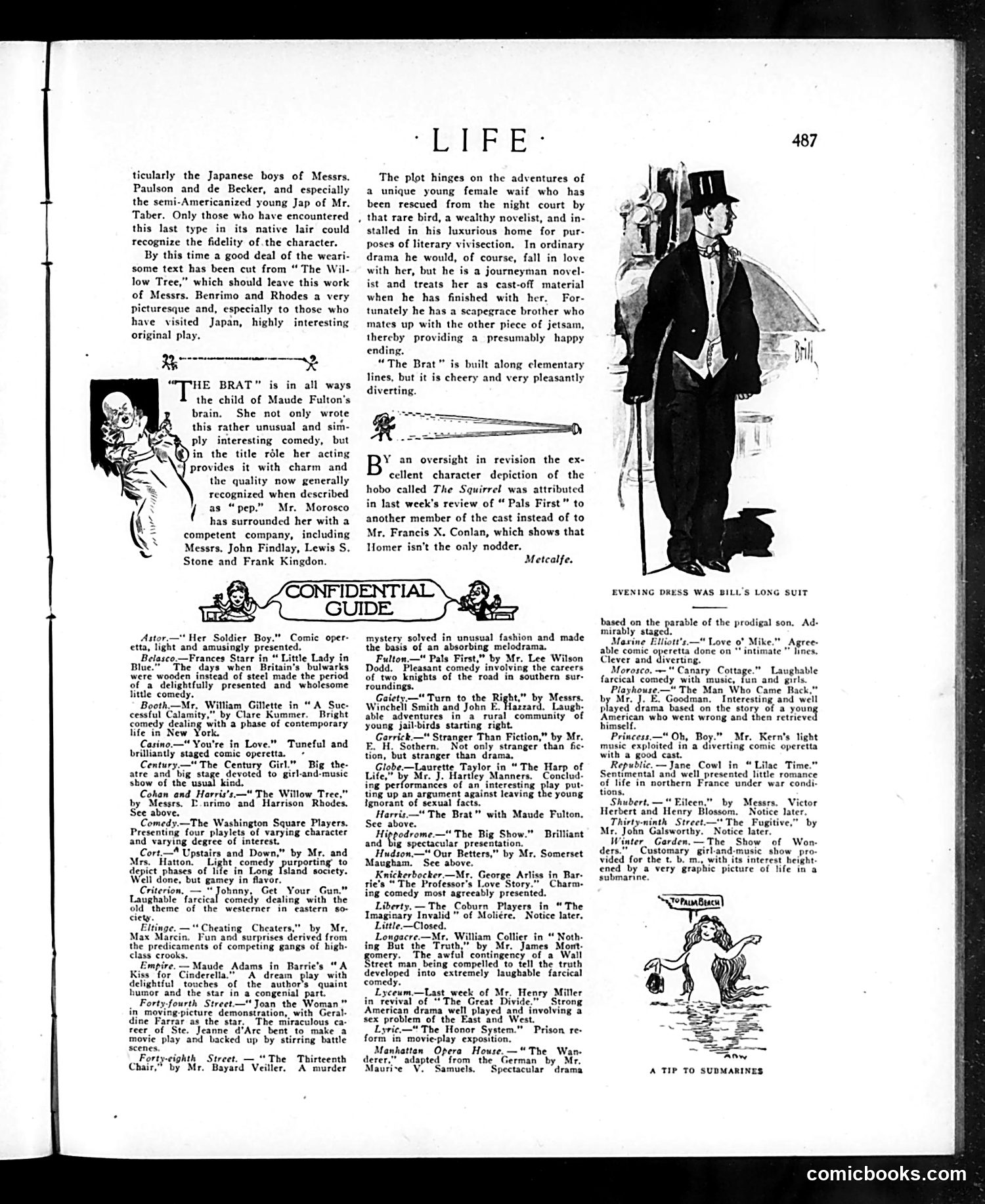
This page contains theater reviews from Life magazine's drama section. The main content discusses Broadway productions, including detailed reviews of plays like "The Brat" (starring Maude Fulton) and "The Willow Tree." The illustrations show typical theatrical scenes—a woman in evening dress with a man in formal attire, and what appears to be a submarine-related cartoon labeled "A Tip to Submarines" (likely a wartime reference, given the WWI-era context). The reviews are written in the magazine's characteristic witty, condensed style, offering brief assessments of comedies, operettas, and dramatic productions. One note corrects a previous attribution error regarding an actor named Francis X. Conlan in "Pals First," demonstrating the magazine's editorial self-correction. The tone is sophisticated and assumes readers are familiar with current theatrical productions and performers of the period.
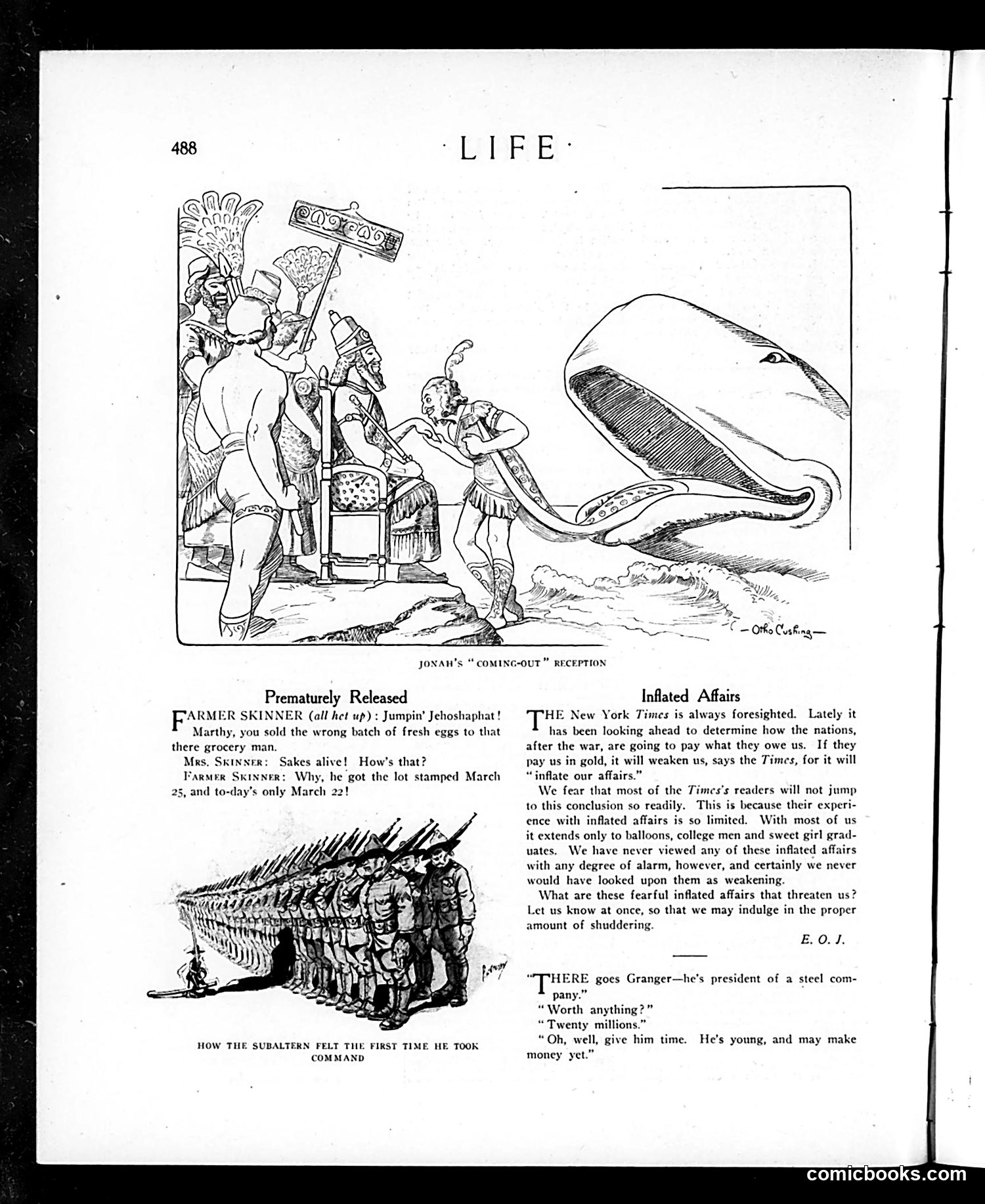
This page contains three satirical pieces from an early 20th-century American humor magazine: **Top cartoon** ("Jonah's Coming-Out Reception"): A biblical allusion—the massive whale resembles Jonah's whale. Figures in period dress appear to be celebrating or reacting to its appearance, likely satirizing some contemporary event or person's dramatic entrance into public life. **Middle cartoon** ("How the Subaltern Felt the First Time He Took Command"): A military joke showing a young officer overwhelmed by commanding troops, depicting the anxiety of inexperience in leadership. **"Inflated Affairs" article**: Satirizes *New York Times* economic predictions about post-WWI debt repayment. The piece mocks the Times's suggestion that receiving gold from debtor nations would "weaken" America through inflation—a concept the writer finds absurd, noting readers only know "inflated affairs" through balloons and college graduates. **Final joke**: Humorous commentary on wealth and potential, suggesting even a $20-million steel company president has room to "make money yet." The page demonstrates Life's focus on political and social satire through both visual and textual humor.
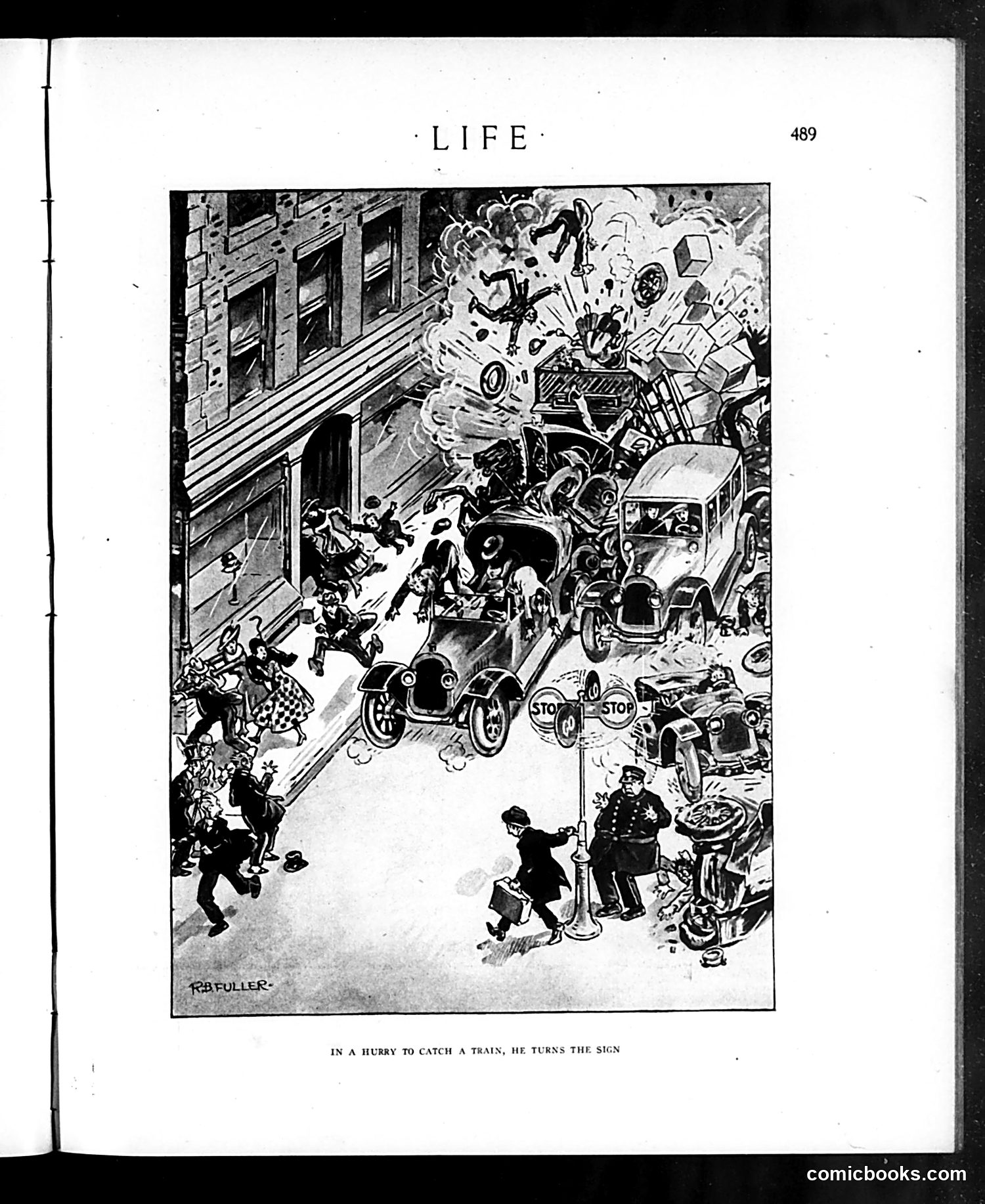
This is a humorous illustration by R. B. Fuller depicting urban chaos caused by someone in a rush to catch a train who has turned a STOP sign. The scene shows complete traffic pandemonium: vehicles colliding, pedestrians scattering, and general disorder on a city street. The satire critiques how a single person's thoughtless action—rotating the traffic sign—creates dangerous consequences for the entire community. It's a commentary on individual irresponsibility and its ripple effects on public safety and order. The crowded, chaotic composition emphasizes how one careless moment cascades into widespread disruption. The joke reflects early-20th-century anxieties about automobile safety, urban congestion, and the tension between personal urgency and civic responsibility.
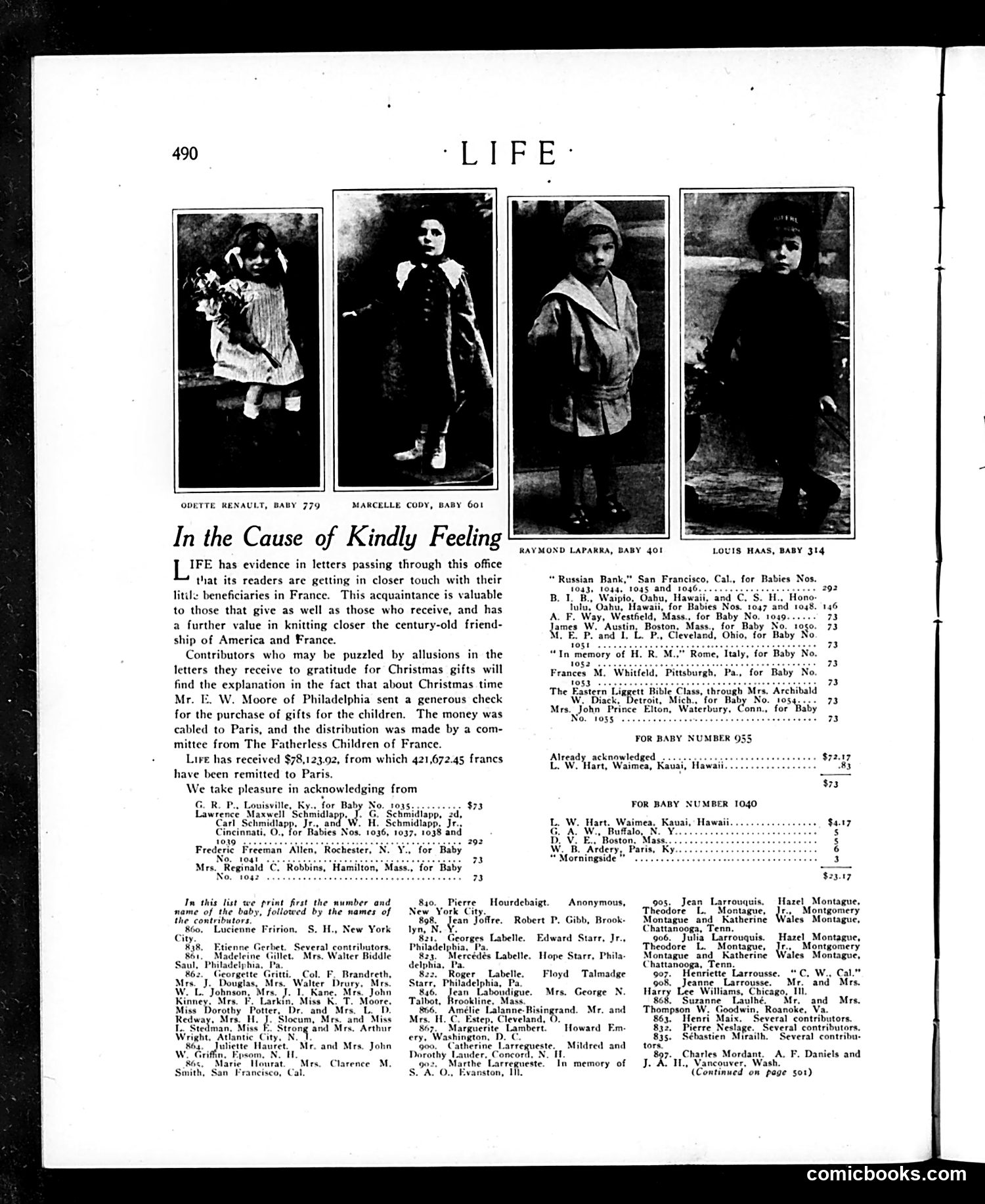
This page documents **Life magazine's charitable fundraising campaign for French war orphans**—specifically "The Fatherless Children of France." The four photographs show French children (identified by name and number) who are beneficiaries of American donors' contributions. The article explains that **E. W. Moore of Philadelphia donated money around Christmas**, which was cabled to Paris for distribution to these children. The extensive lists below acknowledge American contributors—individuals and families who funded gifts or support. This reflects post-World War I American philanthropic efforts toward France, a wartime ally. The "kindly feeling" referenced in the title emphasizes how these donations strengthen Franco-American friendship. The personal connection between American donors and named French children was intentionally highlighted to encourage further contributions. The page is primarily administrative—acknowledging donors rather than political satire—though the charitable impulse itself represents the era's sentiment toward postwar European relief.
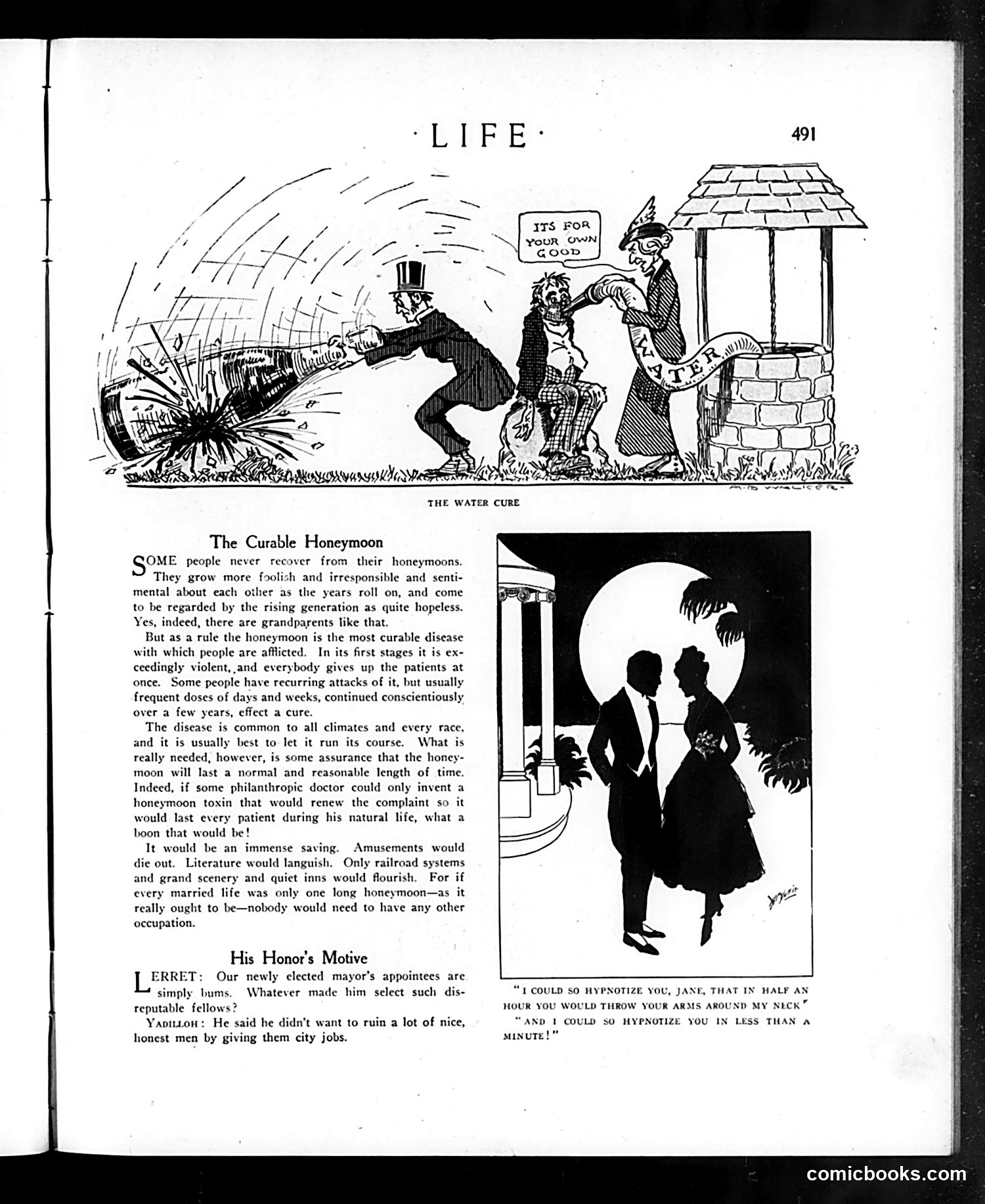
**"The Water Cure" Cartoon (top):** A satirical visual joke about honeymoon behavior. A man sprays his new wife with a fire hose labeled "WATER CURE" while another couple watches from a well. The caption suggests the "honeymoon disease"—excessive sentimentality and foolishness between newlyweds—requires drastic treatment to cure. The exaggerated violence is the joke. **"The Curable Honeymoon" Essay:** Tongue-in-cheek commentary treating honeymoon infatuation as a temporary illness. The author humorously argues it's self-limiting but suggests (facetiously) that if it lasted forever, society would collapse since married couples would abandon all other occupations and pursuits. **"His Honor's Motive":** A brief political joke about a newly elected mayor appointing disreputable people to city jobs. The punchline: he chose "bums" to avoid corrupting respectable men—implying city jobs are inherently corrupting. **"Hypnotism" Illustration (bottom right):** A flirtation scene where a man claims he could hypnotize a woman into embracing him; she replies she could hypnotize him into compliance faster—a witty reversal suggesting female agency in romantic encounters.
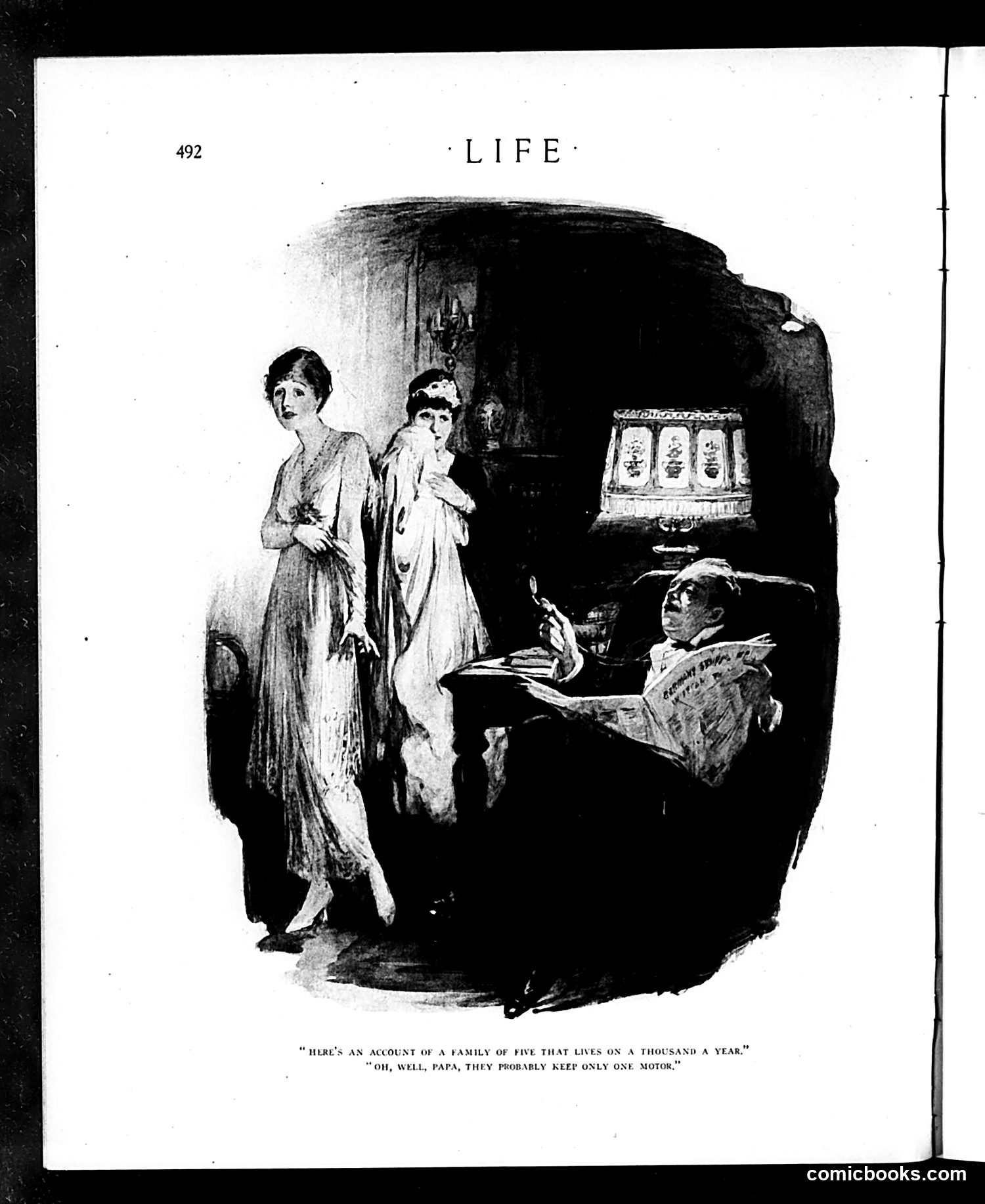
This cartoon satirizes early 20th-century American wealth and consumption habits. A father reads aloud about a family surviving on $1,000 annually—apparently a modest income. His daughter dismissively responds that such a poor family "probably keep only one motor" (automobile). The satire targets upper-class obliviousness: the daughter cannot fathom extreme poverty because her own reference point is multiple automobiles as a baseline necessity. The joke exposes how disconnected wealthy Americans were from working-class economic reality. The automobile, still a luxury item in this era, represents conspicuous consumption and the vast wealth gap between social classes. The cartoon criticizes both class insensitivity and the automobile-obsessed materialism of the period.
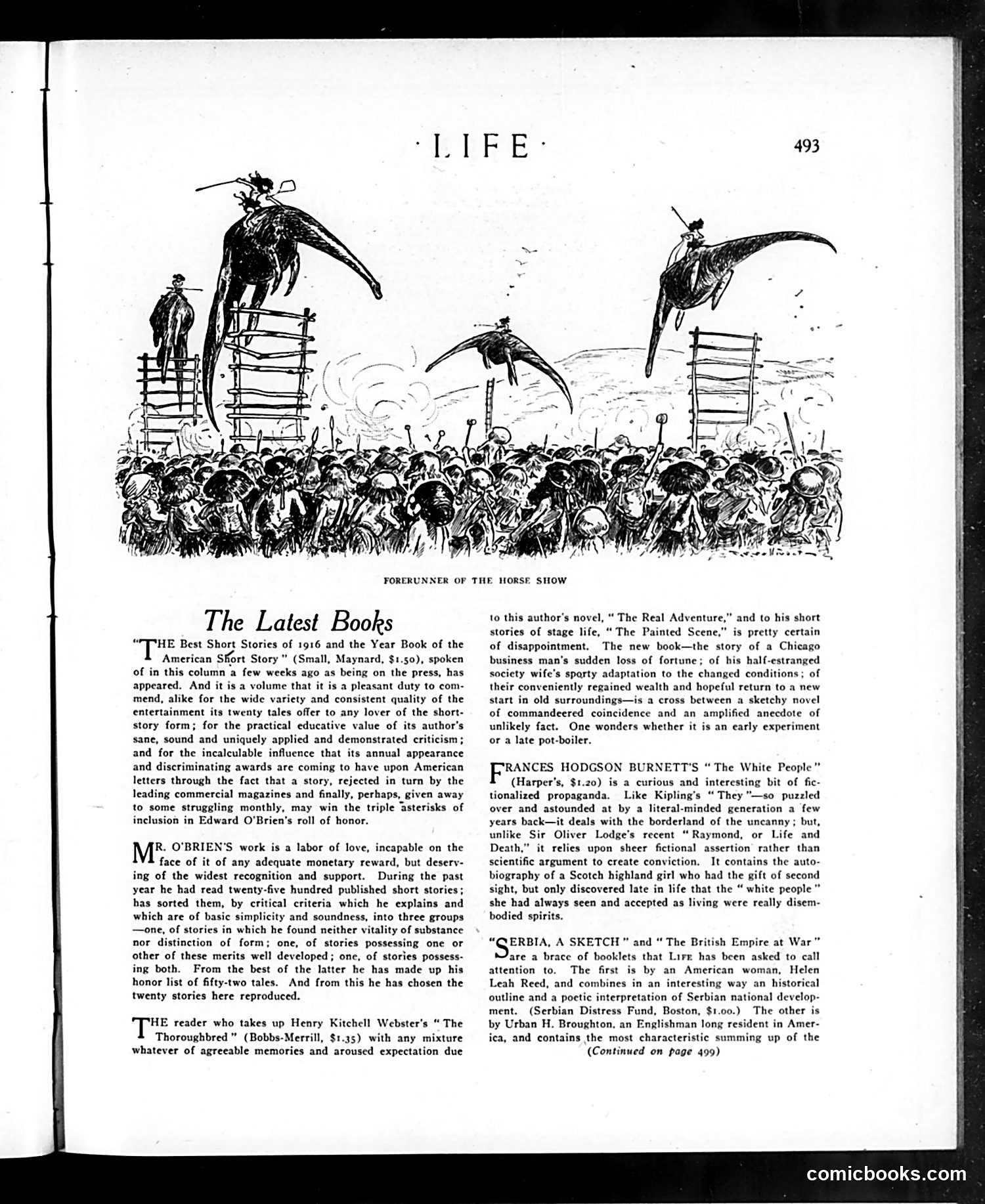
The cartoon depicts three elongated, spindly-legged figures (appearing to be insects or grasshoppers with human riders) leaping over a dense crowd of spectators. The title "Forerunner of the Horse Show" suggests this is satirizing the fashionable horse-show circuit popular among wealthy Americans. The joke likely contrasts the absurd, exaggerated athleticism of these bizarre creatures with the refined sporting pretensions of high-society horse shows. The massive crowd of onlookers emphasizes the public spectacle aspect. The cartoon mocks either the artificial nature of such elite sporting events or possibly ridicules attendees for their gullible enthusiasm for whatever entertainment is presented to them, no matter how ridiculous. The page itself is primarily a book review section, with the cartoon serving as a visual interlude.
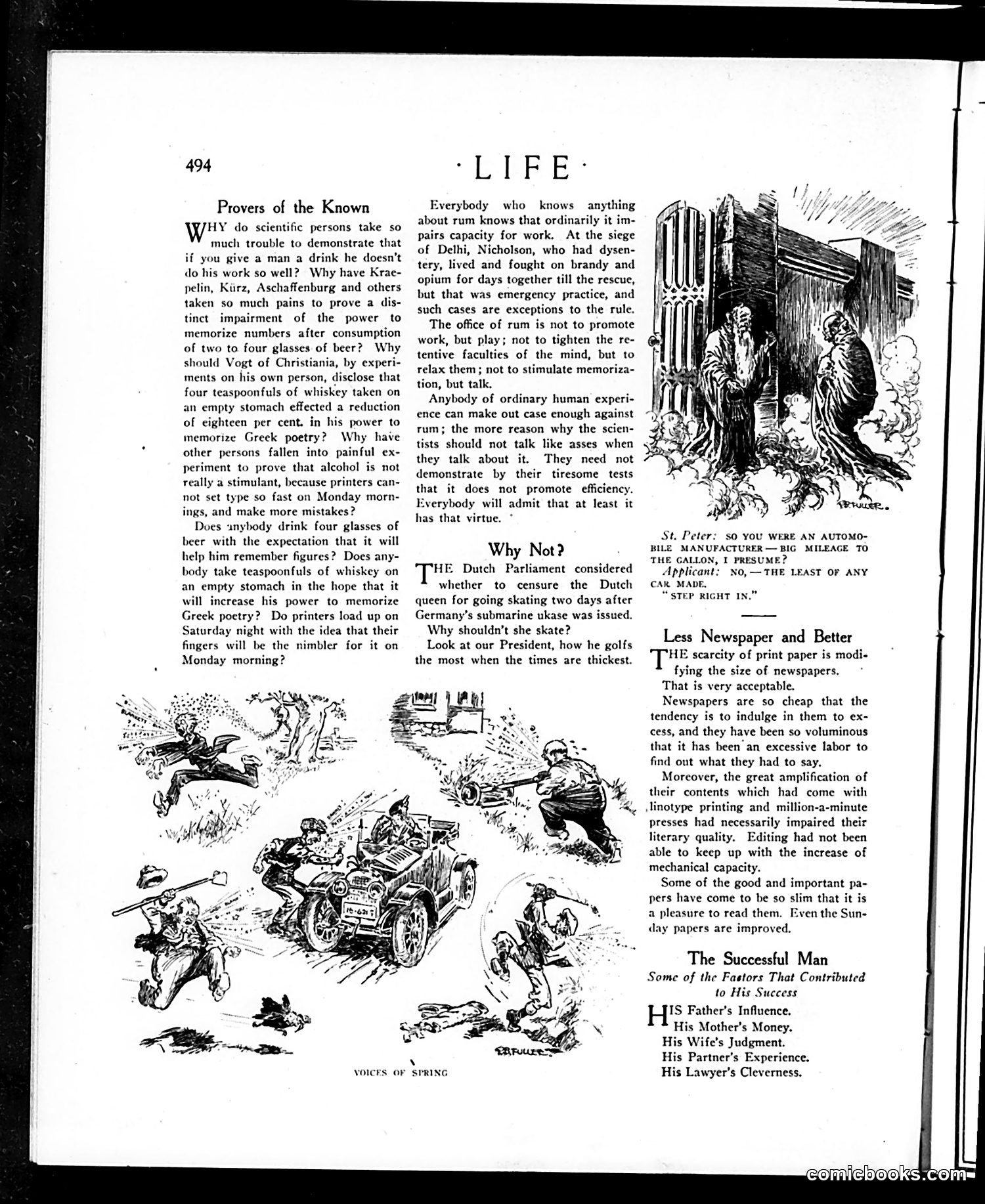
This page contains three satirical pieces mocking scientific pretension and social hypocrisy: **"Provers of the Known"** ridicules German and Scandinavian researchers (Kraepelin, Kurz, Aschaffenburg, Vogt) who laboriously "proved" that alcohol impairs work performance—something everyone already knows. The author sarcastically asks: who drinks hoping to memorize better or work faster? The satire is that scientists waste effort demonstrating the obvious while ignoring alcohol's actual social purpose: relaxation and play. **"Why Not?"** defends the Dutch queen's skating during wartime (Germany's submarine threat) by comparing her to the American President golfing during crises. Both leaders relax when times are toughest—so why criticize her? **The automobile manufacturer cartoon** depicts a car manufacturer arriving at heaven's gates. St. Peter assumes "big mileage," but the manufacturer ironically claims the opposite—his cars had poor mileage/longevity, suggesting shoddy manufacturing for profit. The remaining sections discuss newspaper size improvements and list tongue-in-cheek factors for success (money, connections, lawyers).
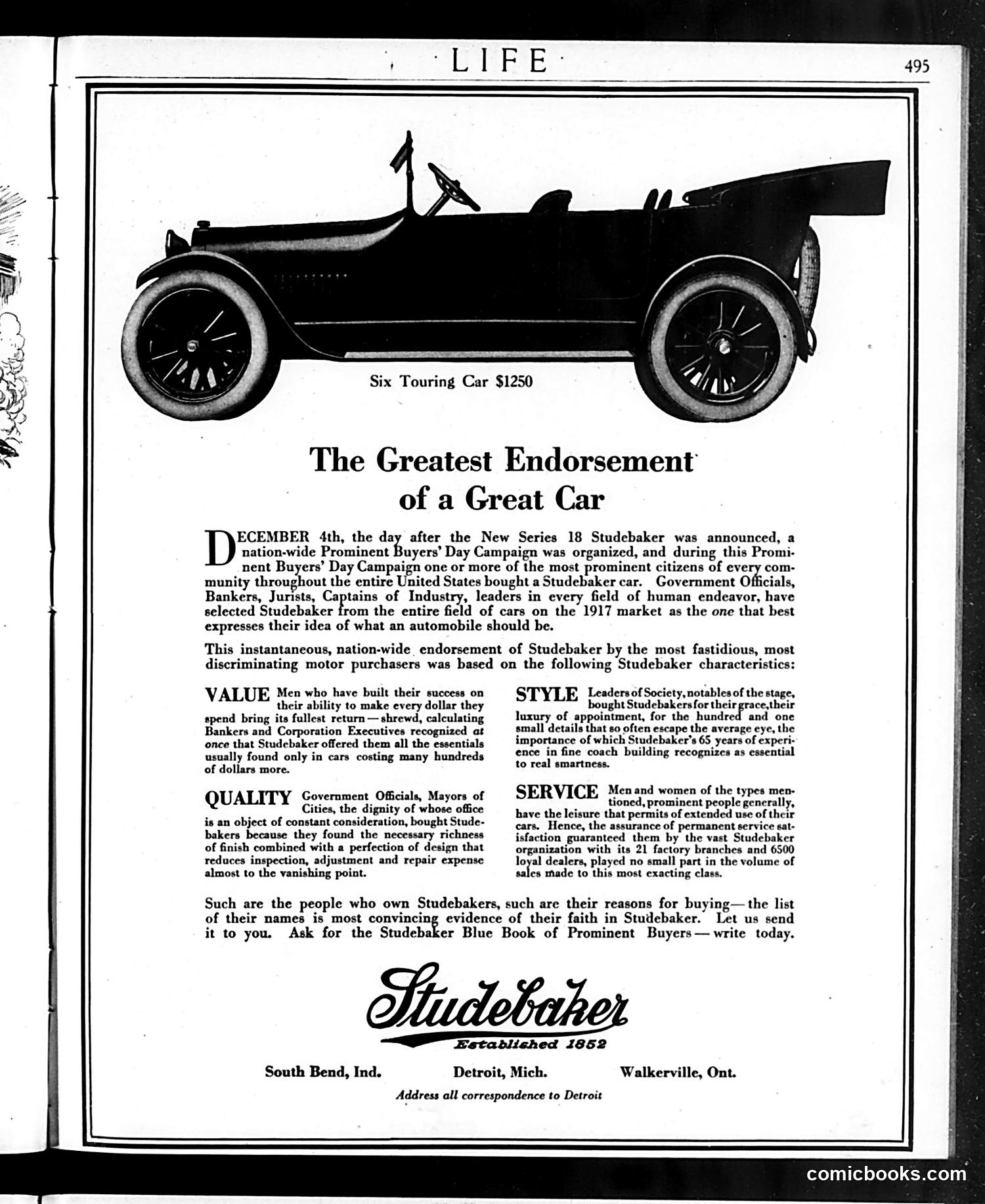
This is **not a cartoon or satire**—it's a straightforward automobile advertisement from *Life* magazine (page 495), likely from 1917 based on the text reference to "1917 market." The ad promotes the Studebaker Six Touring Car ($1,250) by claiming it received endorsements from prominent Americans across all social classes: government officials, bankers, judges, society leaders, and industrialists. The marketing strategy emphasizes four virtues—**Value, Quality, Style, and Service**—positioning Studebaker as the car chosen by the nation's most discriminating buyers. The appeal is fundamentally about **aspirational status**: by purchasing a Studebaker, ordinary buyers could align themselves with the taste and judgment of elites. The company offers a "Blue Book of Prominent Buyers" as proof of this widespread high-society approval. This reflects early 20th-century advertising that used social proof and class associations rather than technical specifications to sell products.
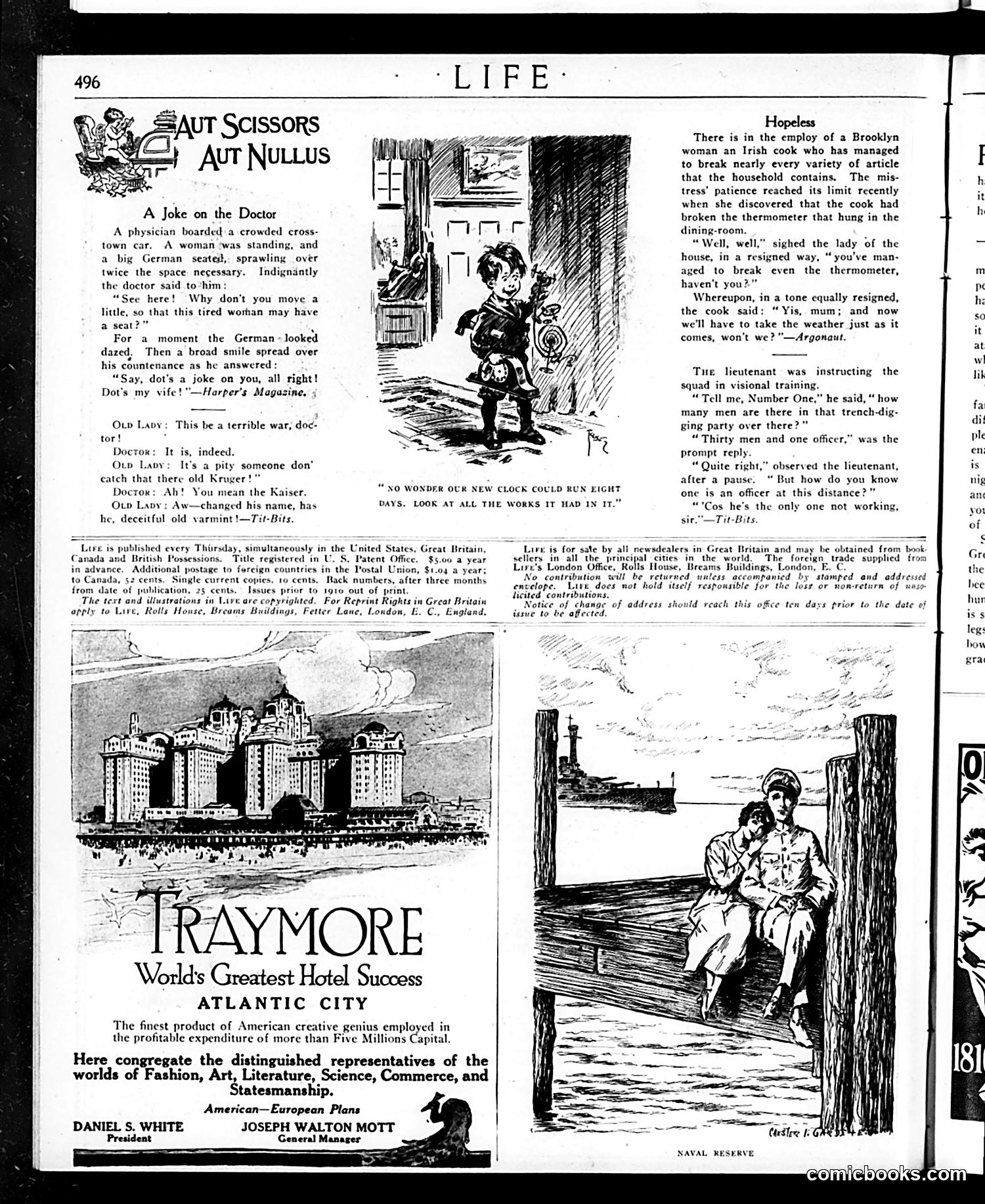
This page contains several brief humorous anecdotes typical of early 20th-century satirical magazines: **"A Joke on the Doctor"** mocks ethnic stereotypes through a German immigrant's broken English ("dot's my vife"). The humor relies on the audience finding the character's dialect and situation amusing. **"Old Lady" joke** references the Boer War era (mentions "Kruger," the Boer leader), with an elderly woman confusing the Kaiser with Kruger—likely satirizing wartime confusion or anti-German sentiment. **"Hopeless"** and **"Naval Reserve"** anecdotes use class-based humor: an Irish servant's resignation to poverty, and a joke about officers not working. The page is primarily **advertising** for Traymore Hotel in Atlantic City and includes publication information for *Life* magazine. The cartoons and jokes reflect early 1900s attitudes toward immigrants, class hierarchies, and military life—humor that depended on ethnic caricature and social stereotyping now considered offensive.
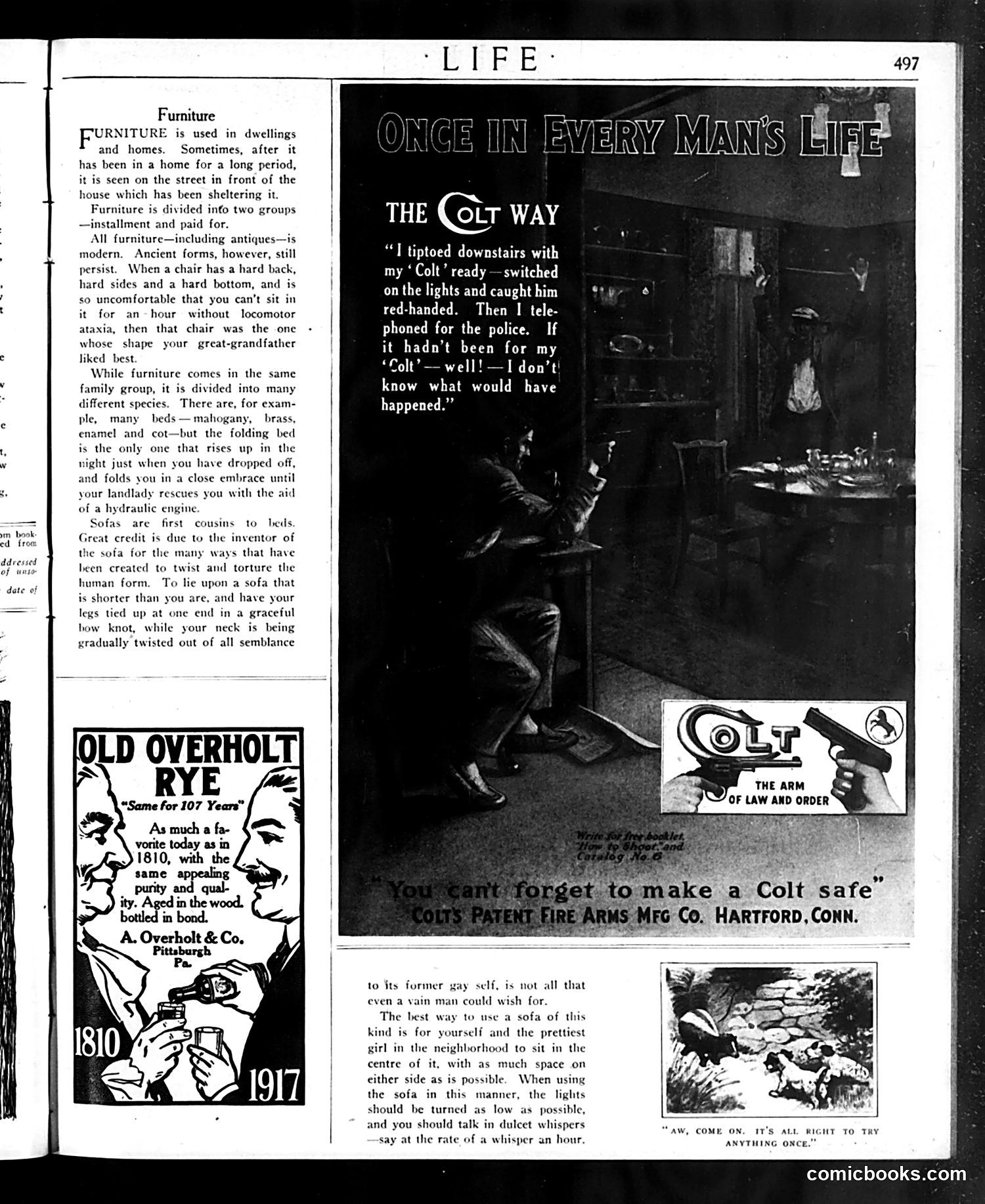
This page combines furniture commentary with **Colt firearms advertising**, reflecting early 20th-century American consumer culture. The left column humorously describes furniture types—particularly uncomfortable chairs and sofas—with satirical observations about domestic life and installment purchasing (buying on credit). The final paragraphs hint at courtship etiquette: using a dim-lit sofa as a romantic setting with a young woman. The dominant **Colt advertisement** ("The Colt Way") depicts a home-invasion scenario where the narrator catches a burglar red-handed, attributing his safety to owning a Colt pistol. This is classic firearms marketing: positioning the gun as essential household protection and masculine duty. The juxtaposition is notable—furniture advice adjacent to armed self-defense messaging—reflecting anxieties about urban crime and home security in the 1910s-20s. The Colt tagline "The Arm of Law and Order" conflates civilian gun ownership with legitimate authority. An Old Overholt Rye whiskey ad appears below, part of Life's typical advertiser mix.
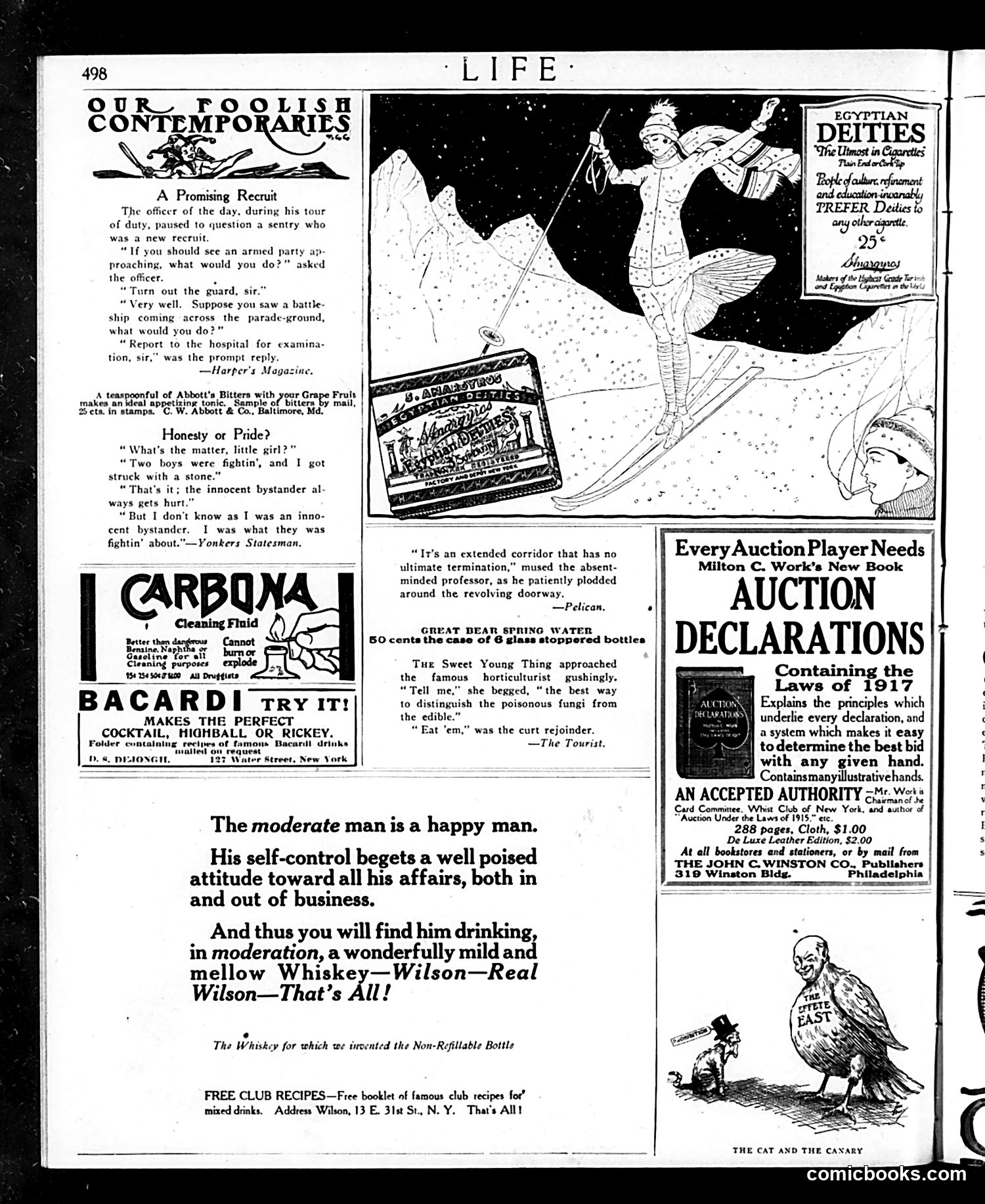
This page from *Life* magazine contains several short humorous anecdotes under "Our Foolish Contemporaries"—satirizing common human absurdities. **"A Promising Recruit"** mocks military incompetence: a new soldier, asked what he'd do if a battleship crossed the parade ground, replies he'd report to the hospital for examination—suggesting either stupidity or cowardice. **"Honesty or Pride?"** presents ironic commentary on a girl struck by a stone during boys' fighting. When told she's an "innocent bystander," she corrects the adult: she *was* what they were fighting about—reversing expectations about innocence and fault. **The professor anecdote** satirizes absent-minded academics: a professor describes a revolving door as "an extended corridor that has no ultimate termination," oblivious to his actual predicament. **The horticulturist joke** uses dark humor: asked how to distinguish poisonous from edible fungi, an expert bluntly replies "Eat 'em"—implying trial-and-error with potentially fatal consequences. The page primarily advertises whiskey, cleaning products, and auction bridge books alongside this satirical content.
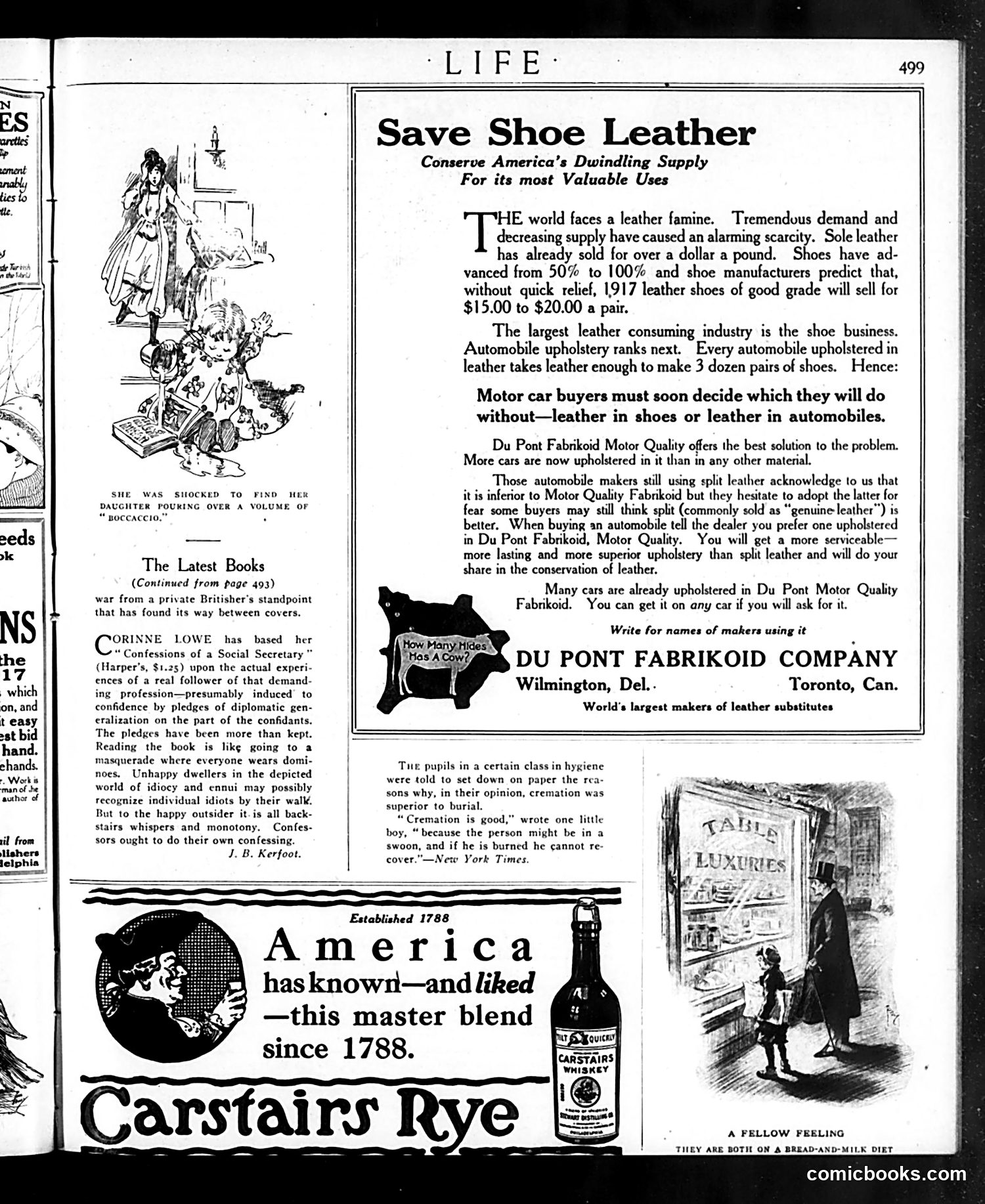
This page is primarily **wartime advertising and filler content**, not political satire. The dominant feature is a Du Pont Fabrikoid advertisement exploiting **World War I leather shortages**. The ad argues that automobile upholstery consumes leather equivalent to 3 dozen pairs of shoes per vehicle, creating competition with shoe manufacturing. It urges car buyers to choose synthetic leather substitutes instead of genuine leather, framing this as patriotic conservation for "America's Dwindling Supply." The cartoon at bottom-left (captioned "A Fellow Feeling") appears unrelated—two figures in bread-and-milk poverty, likely a social commentary on economic hardship, though the specific reference is unclear. Other page content includes book reviews and a whiskey advertisement unrelated to the leather shortage theme. The overall message reflects genuine **WWI-era material rationing** concerns, using patriotic appeals to promote commercial products.
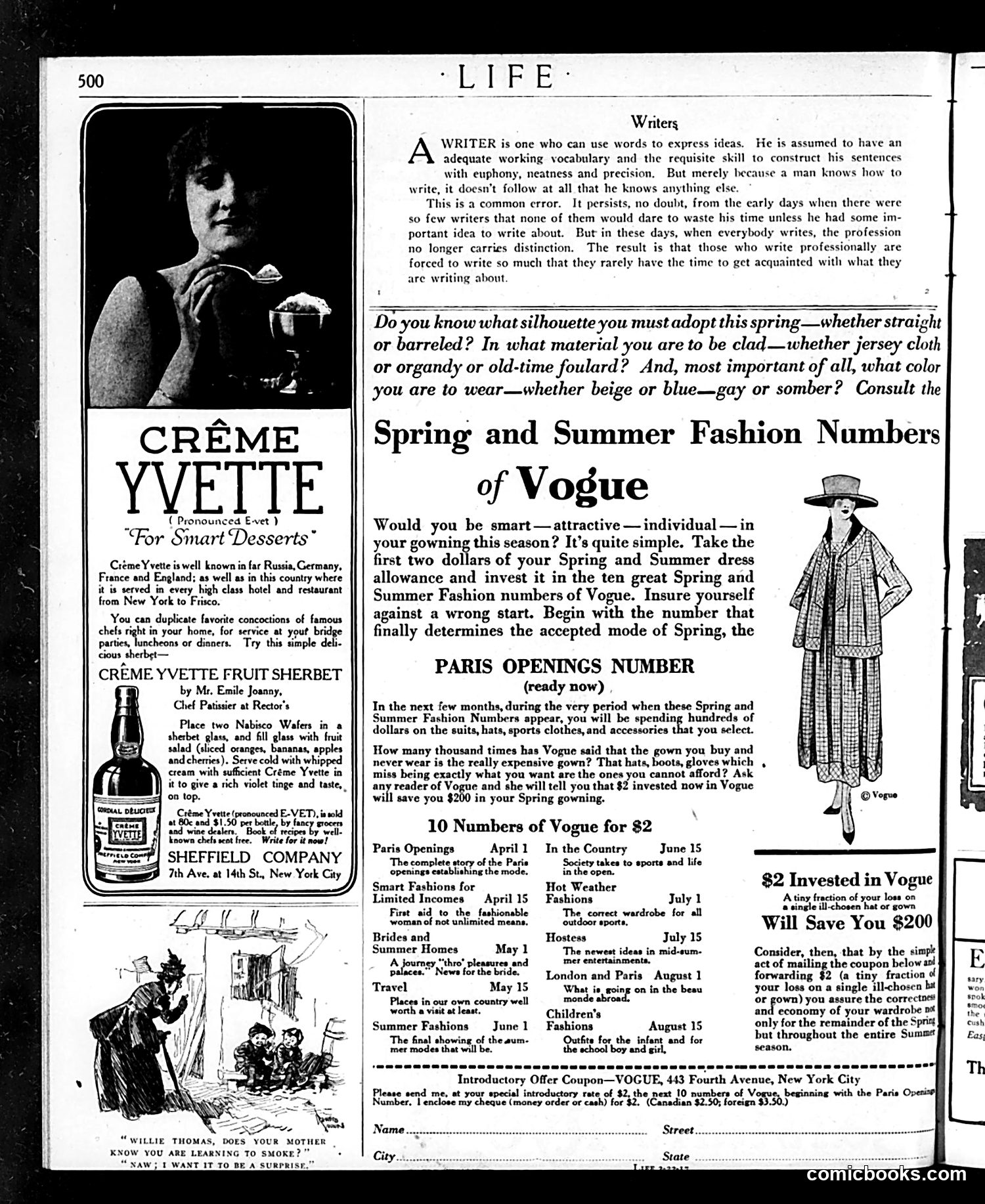
This page combines editorial content with advertising. The main article critiques professional writers—arguing that because writing is now commonplace, professional writers are forced to produce so much work that they lack time to develop actual expertise or knowledge about their subjects. It's a pointed satire on the devaluation of the writing profession due to mass literacy and increased demand for content. The bulk of the page advertises *Vogue* fashion magazines and *Crème Yvette* dessert liqueur. The *Vogue* ad exploits fashion anxiety, suggesting that spending $2 on ten fashion issues will save readers $200 by preventing poor clothing purchases. This is early 20th-century consumer marketing targeting women's insecurity about appearing fashionable and "smart." The irony is striking: the page satirizes writers who write without knowledge, while simultaneously selling magazines and products based on manufactured consumer anxiety rather than genuine need.
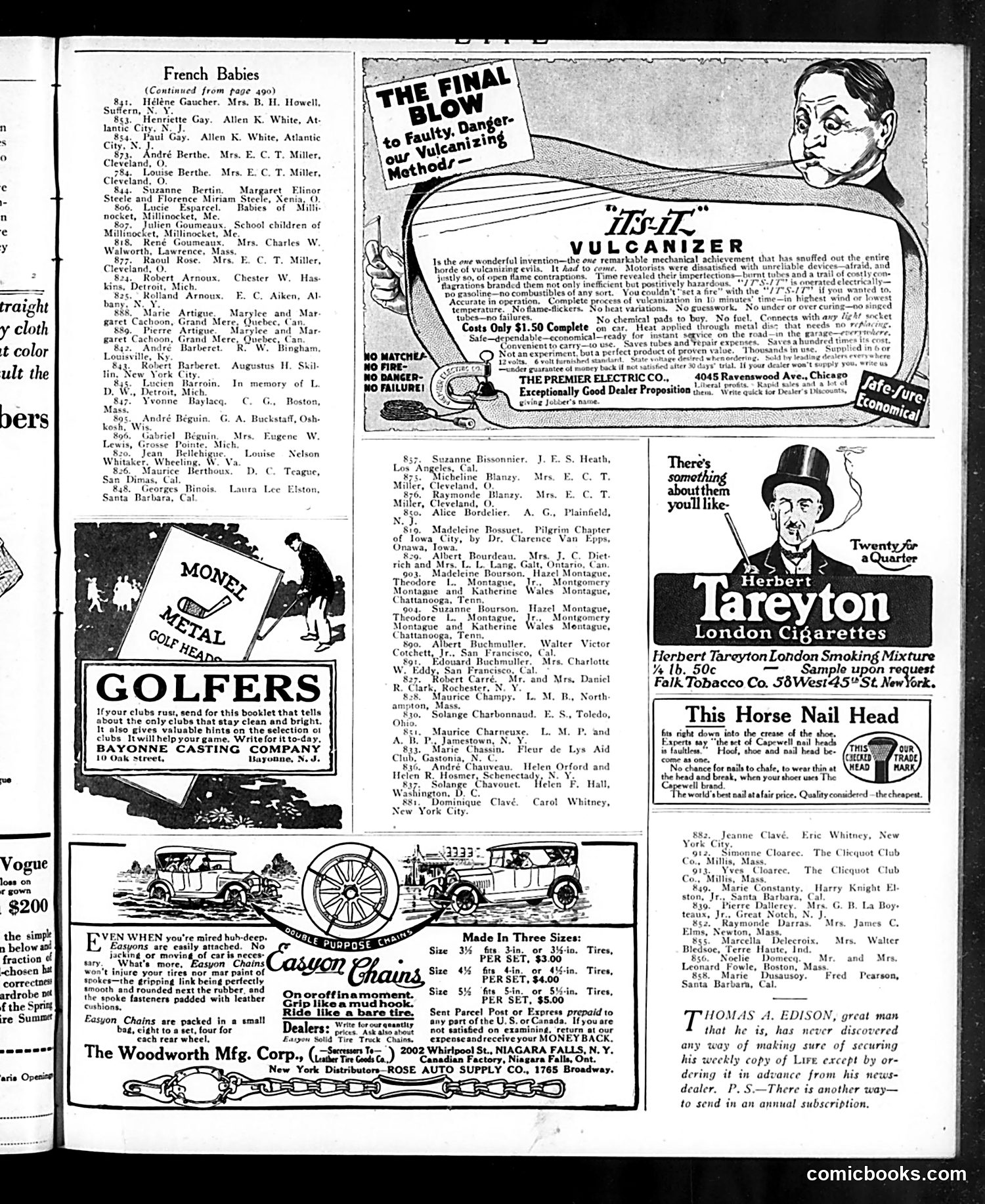
This page is primarily **advertising and classified listings** rather than political satire. The main content consists of: 1. **"French Babies" continuation** - a classified section listing names and addresses of people who submitted French baby photographs to Life magazine 2. **Product advertisements** including: - A golf club equipment ad (Bayonne Casting Company) - "Easyon" tire chains for automobiles - A "Vulcanizer" device for repairing car tires - Herbert Tareyton London cigarettes - A "Horse Nail Head" shoe accessory 3. **One small cartoon** (upper right) advertising the "Light" vulcanizer, showing a caricatured man's face with exaggerated features—standard product promotion imagery The page reflects early 20th-century consumer culture and Life's mixed editorial/advertising format. There is no significant political satire visible. The "French Babies" listings suggest Life ran photo contests, and advertisements dominate the layout—typical of period magazine design.
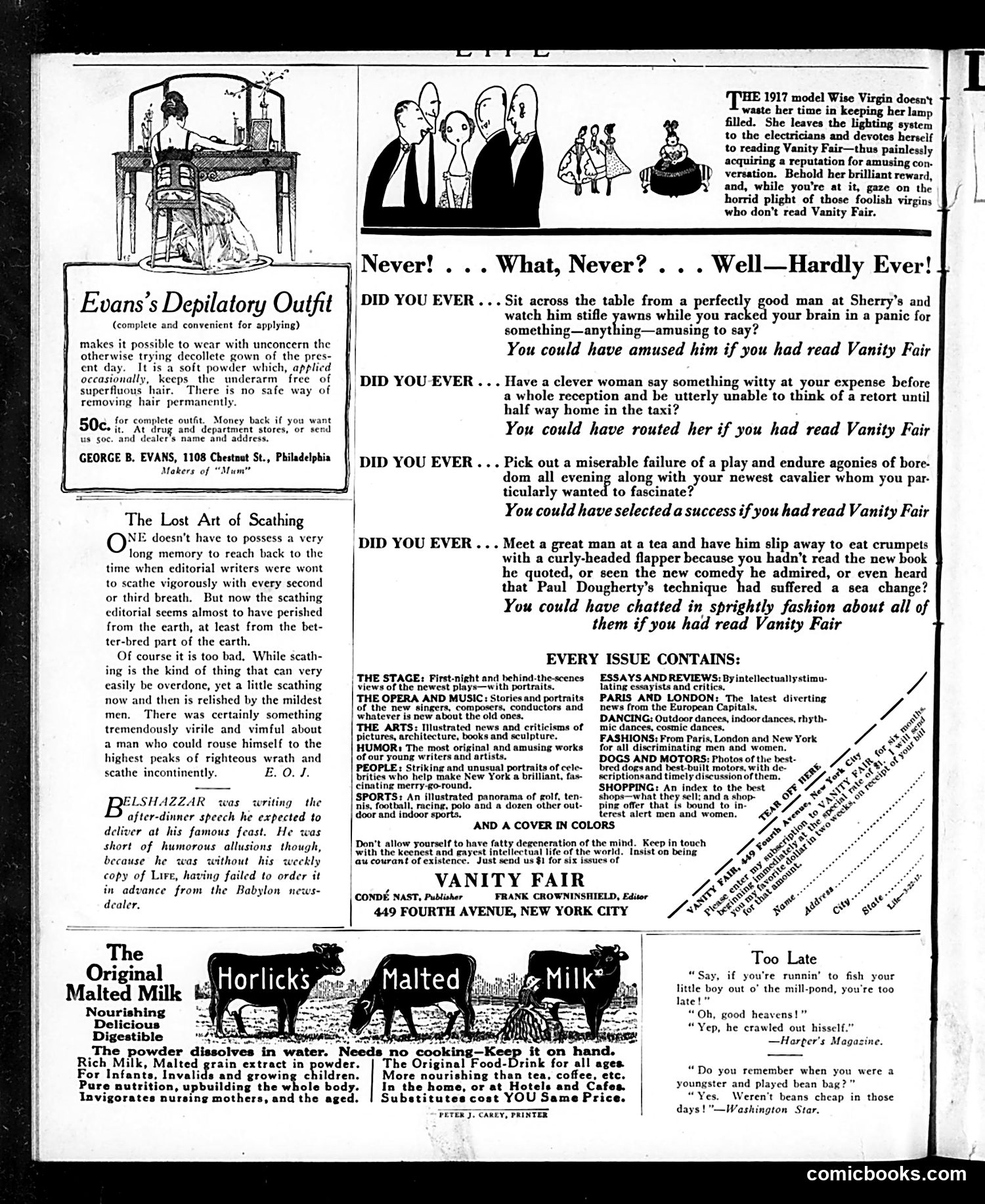
This 1917 Life page advertises **Vanity Fair magazine** through satirical scenarios targeting women. The central joke: women who don't read Vanity Fair lack conversational wit and suffer social embarrassment. The "Wise Virgin" cartoon (top) references the biblical parable of wise vs. foolish virgins, inverting it—the "wise" woman reads Vanity Fair instead of maintaining her lamp, gaining reputation through magazine-acquired knowledge rather than genuine intelligence. Accompanying vignettes mock female social anxieties: boring dinner companions, failing to deliver witty retorts, choosing bad plays, and being unable to discuss current literature or art with important men. Each ends: "You could have [succeeded] if you had read Vanity Fair." The advertisement is both genuinely promotional and satirical—mocking women's insecurity while exploiting it to sell the magazine. It reflects 1917 attitudes about women's education, social performance, and consumption. The page also includes unrelated ads (Evans's depilatory powder, Horlick's malted milk) typical of magazine layouts.