
Life, 1917-03-22 · page 29 of 38
Life — March 22, 1917 — page 29: what you’re looking at
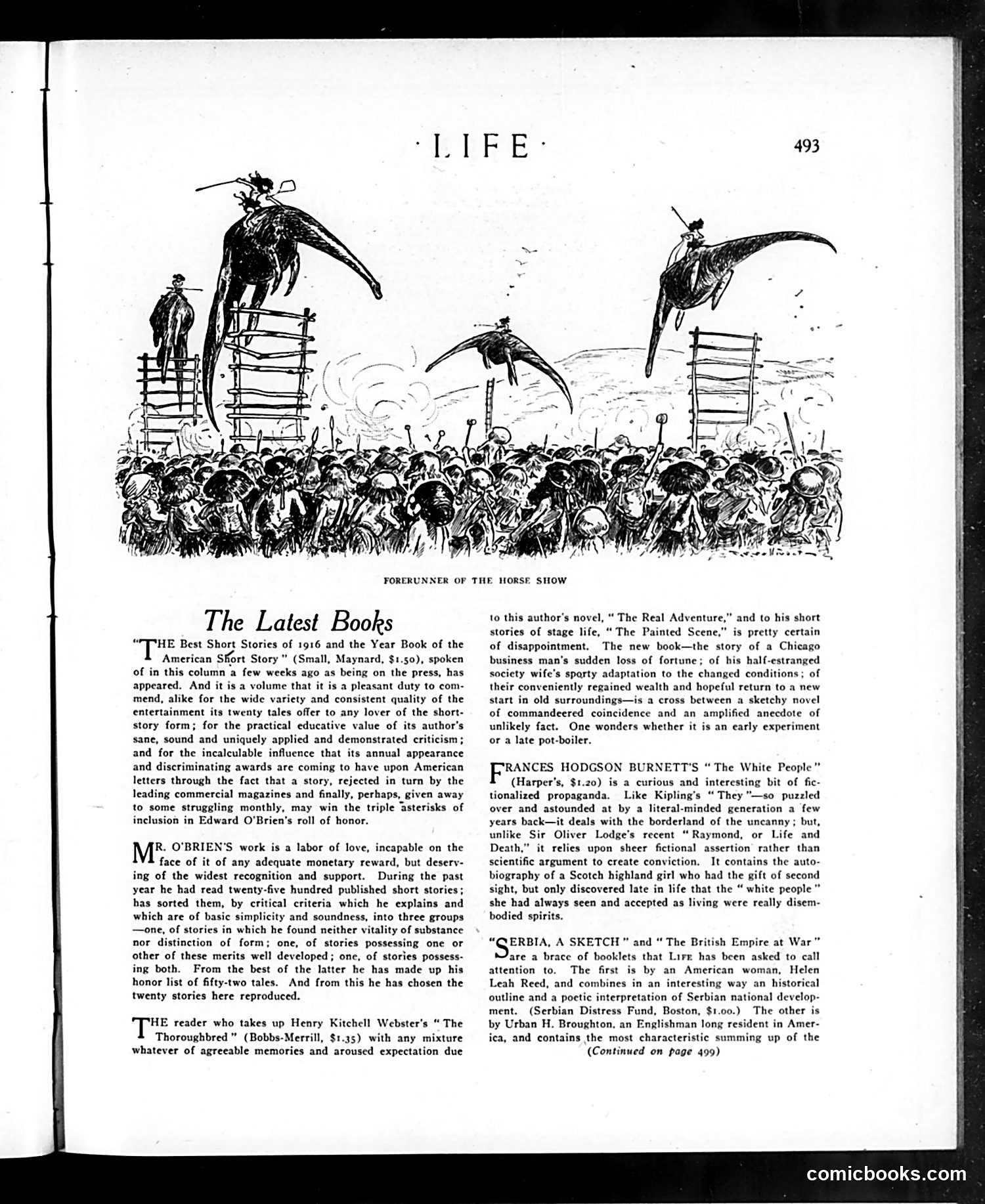
What you’re looking at
The cartoon depicts three elongated, spindly-legged figures (appearing to be insects or grasshoppers with human riders) leaping over a dense crowd of spectators. The title "Forerunner of the Horse Show" suggests this is satirizing the fashionable horse-show circuit popular among wealthy Americans. The joke likely contrasts the absurd, exaggerated athleticism of these bizarre creatures with the refined sporting pretensions of high-society horse shows. The massive crowd of onlookers emphasizes the public spectacle aspect. The cartoon mocks either the artificial nature of such elite sporting events or possibly ridicules attendees for their gullible enthusiasm for whatever entertainment is presented to them, no matter how ridiculous. The page itself is primarily a book review section, with the cartoon serving as a visual interlude.
📄 Transcribed text from this page (OCR, searchable)
Machine-transcribed from the original scan — historical spelling and the odd misread are preserved.
FORERUNNER OF THE HORSE SHOW The Latest Books od ak Best Short Stories of 1916 and the Year Book of the American Sfort Story" (Small, Maynard, $1.50), spoken of in this column a few weeks ago being on the press, has appeared. And it is a volume that it is a pleasant duty to com- mend, alike for the wide variety and consistent quality of the entertainment its twenty tales offer to any lover of the short- story form; for the practical educative value of its author's sane, sound and uniquely applied and demonstrated criticism ; and for the incalculable influence that its annual appearance and discriminating awards are coming to have upon American letters through the fact that a story, rejected in turn by the leading commercial magazines and finally, perhaps, given away to some struggling monthly, may win the triple asterisks of inclusion in Edward O'Brien's roll of honor. R. O'BRIEN’S work is a labor of love, incapable on the face of it of any adequate monetary reward, but desery- ing of the widest recognition and support. During the past year he had read twenty-five hundred published short stories; has sorted them, by critical criteria which he explains and which are of basic simplicity and soundness, into three groups —one, of stories in which he found neither vitality of substance nor distinction of form; one, of stories possessing one or other of these merits well developed; one, of stories possess- ing both. From the best of the latter he has made up his honor list of fifty-two tales. And from this he has chosen the twenty stories here reproduced. 'HE reader who takes up Henry Kitchell Webster's “ The Thoroughbred” (Bobbs-Merrill, $1.35) with any mixture whatever of agreeable memories and aroused expectation due to this author's novel, “ The Real Adventure,” and to his short stories of stage life, “The Painted Scene,” is pretty certain of disappointment. The new book—the story of a Chicago business man’s sudden loss of fortune; of his half-estranged society wife's sparty adaptation to the changed conditions; of their conveniently regained wealth and hopeful return to a new start in old surroundings—is a cross between a sketchy novel of commandeered coincidence and an amplified anecdote of unlikely fact. One wonders whether it is an early experiment or a late pot-boiler. RANCES HODGSON BURNETT'S “ The White People” (Harper's, $1.20) is a curious and interesting bit of fic- tionalized propaganda. Like Kipling’s “ They "—so puzzled over and astounded at by a literal-minded generation a few years back—it deals with the borderland of the uncanny; but, unlike Sir Oliver Lodge’s recent “Raymond, or Life and Death,” it relies upon sheer fictional assertion rather than scientific argument to create conviction, It contains the auto- biography of a Scotch highland girl who had the gift of second sight, but only discovered late in life that the “ white people” she had always seen and accepted as living were really disem- “QERBIA, A SKETCH and “ The British Empire at War” ‘are a brace of booklets that Lirr has been asked to call attention to. The first is by an American woman, Helen Leah Reed, and combines in an interesting way an historical outline and a poetic interpretation of Serbian national develop- ment. (Serbian Distress Fund, Boston, $1.00.) The other is by Urban H. Broughton, an Englishman long resident in Amer- ica, and contains the most characteristic summing up of the (Continued on page 499) comicbooks.com