
Life, 1917-03-22 · page 23 of 38
Life — March 22, 1917 — page 23: what you’re looking at
What you’re looking at
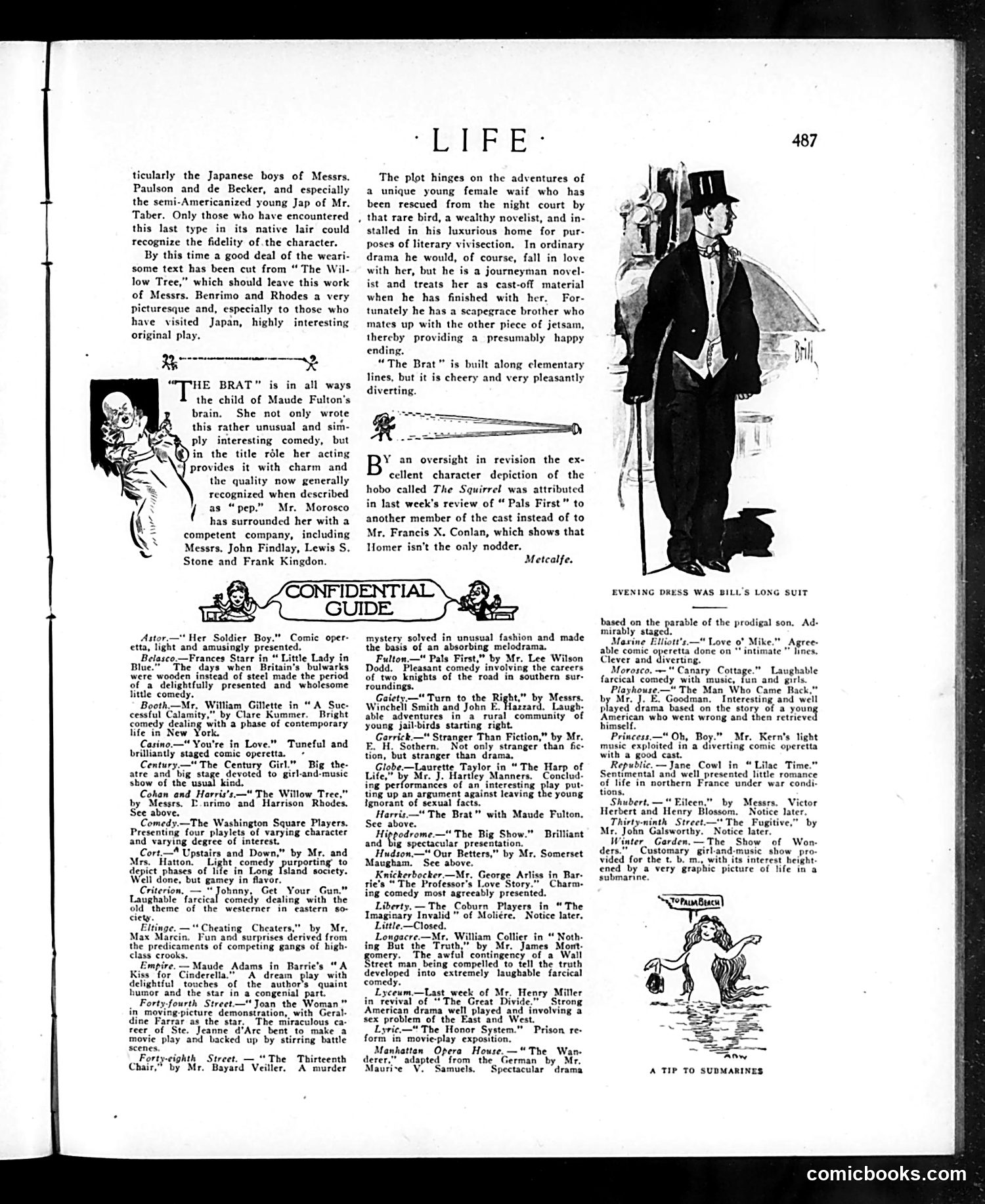
This page contains theater reviews from Life magazine's drama section. The main content discusses Broadway productions, including detailed reviews of plays like "The Brat" (starring Maude Fulton) and "The Willow Tree." The illustrations show typical theatrical scenes—a woman in evening dress with a man in formal attire, and what appears to be a submarine-related cartoon labeled "A Tip to Submarines" (likely a wartime reference, given the WWI-era context). The reviews are written in the magazine's characteristic witty, condensed style, offering brief assessments of comedies, operettas, and dramatic productions. One note corrects a previous attribution error regarding an actor named Francis X. Conlan in "Pals First," demonstrating the magazine's editorial self-correction. The tone is sophisticated and assumes readers are familiar with current theatrical productions and performers of the period.
📄 Transcribed text from this page (OCR, searchable)
Machine-transcribed from the original scan — historical spelling and the odd misread are preserved.
ticularly the Japanese boys of Messrs. Paulson and de Becker, and especially the semi-Americanized young Jap of Mr. Taber. Only those who have encountered this last type in its native lair could recognize the fidelity of.the character. By this time a good deal of the weai some text has been cut from “ The Wil- low Tree,” which should leave this work of Messrs. Benrimo and Rhodes a very picturesque and, especially to those who have visited Japan, highly interesting original play. a = “THE BRAT" is in all ways the child of Maude Fulton's brain. She not only wrote this rather unusual and sim- ply interesting comedy, but in the title réle her acting provides it with charm and the quality now generally recognized when described { 38 “pep.” Mr. Morosco has surrounded her with a competent company, including Messrs, John Findlay, Lewis S. Stone and Frank Kingdon. Comic oper- etta, light and amusingly presented. Belasco.—Frances Starr in “ Little Lady in Blue.” The days when Britain's bulwarks were wooden instead of steel made the period of a delightfully presented and wholesome little comedy. Booth.—Mr, William Gillette in “A. Suc- cessful Calamity," by Clare Kummer. Bright comedy dealing with a phase of contemporary life in New York. Casino.—" You're in Love.” Tuneful and brilliantly staged comic operetta. - Century— The Century Girl” Big. the- atre and’ big stage devoted to girl-and-music show of the usual kind, Cohan and Harris's—" The Willow Tree,” by Messrs. E.nrimo and Harrison Rhodes, See above. Comedy.—The Washington Square Players. Presenting four playlets of varying character and varying degree of interest. Cort.—* Upstairs and Down,” by Mr. and Mrs. Hatton. Light comedy purporting’ to depict phases of life in Long Island society. Well done, but gamey in flavor. Criterion. —" Johnny, Get Your Gun.” Laughable farcical comedy dealing with the old theme of the westerner in eastern s0- ciety. Eltinge. —"* Cheating Cheaters,” by Mr. Max Marcin. Fun and surprises derived from the predicaments of competing gangs of high- class crooks. _ Empire. — Maude Adams in Barrie's “A Kiss for Cinderella.” A dream play. with delightful ‘touches of the author's quaint humor and the star in a congenial part. . Forty-fourth Street—" Joan the Woman” in moying-picture demonsiration, with Geral- dine Farrar as the star, The miraculous ca- reer of Ste. Jeanne d’Are bent to make a movie play and backed up by stirring battle scenes Forty-eighth Street. — “The Thirteenth Chair,” by Mr. Bayard Veiller. A murder “a REEEY- The plot hinges on the adventures of a unique young female waif who has been rescued from the night court by that rare bird, a wealthy novelist, and in- stalled in his luxurious home for pur- poses of literary vivisection, In ordinary drama he would, of course, fall in love with her, but he is a journeyman novel- ist and treats her as cast-off material when he has finished with her. For- tunately he has a scapegrace brother who mates up with the other piece of jetsam, thereby providing a presumably happy ending. “The Brat” is built along elementary lines, but it is cheery and very pleasantly diverting. Y an oversight in revision the ex- cellent character depiction of the hobo called The Squirrel was attributed in last week's review of “ Pals First" to another member of the cast instead of to Mr. Francis X. Conlan, which shows that Homer isn't the only nodder. Metcalfe. mystery solved in unusual fashion and made the basis of an absorbing melodrama. Fulton.—" Pals First,” by Mr. Lee Wilson Dodd. Pleasant comedy involving the careers of two knights of the road in southern sur- roundings. Gaiety.—" Turn to the Right,” by Messrs. Winchell Smith and John E. Hazzard. Laugh: able adventures in’ a rural community of young jail-birds starting right. Garrick —" Stranger Than Fiction,” by Mr. E. H, Sothern, Not only stranger than fic: tion, but stranger than drama, Globe-—Laurette Taylor in “ The Harp of Life,” by Mr. J. Hartley Manners. Conclud- ing performances of an. interesting play put- ting up an argument against leaving the young Ignorant of sexual facts. Harris—" The Brat" with Maude Fulton, See above. Higgodrome—s The Big Show.” Brilliant and big spectacular presentation. Hudson.—" Our Betters,” by Mr. Somerset Maugham. See above. Knickerbocker —Mr. George Arliss in Bar- rie’s “ The Professor's Love Story.” Charm- ing comedy most agreeably presented. Liberty. —The Coburn Players in “The Imaginary Invalid” of Moliére. Notice later. Little —Closed. Longacre.—Mr, William Collier in “ Noth- ing But the Truth,” by Mr. James Mont- omery. The awful contingency of a Wall n_being compelled to tell the truth into extremely laughable farcical Lyceum.—Last_week of Mr, Henry Miller in revival of “The Great Divide.” Strong American drama well played and involving a sex problem of the East and West. Lyric.— The Honor System.” Prison re- fora in movie-play exposition. Manhatten Opera House. —“The Wan- derer,” adapted from the German by Mr. Maurive V. Samuels, Spectacular “drama EVENING DRESS WAS BILL'S LONG SUIT based on the parable of the prodigal son, Ad- mirably stages. Marine Elliott's —" Love o° Mike. able comic operetta done on “* intima Clever and diverting. Morosco. "Canary Cottage.” Laughable farcical comedy with m fun and girls. “The Man Who Came Back,” by |. E. Goodman. Interesting and well played drama based on the story of a youn American who went wrong and then retrieved himself. Princess—" Oh, Boy.” Mr. Kern's light music exploited in a diverting comic operetta with a good cast. Republic. —Jane Cowl in “ Lilac Time.” Sentimental and well presented little romance of life in northern France under war condi- tions. Shubert, —* Eileen.” by Messrs. Victor Herbert and Henry Biossom. Notice later. Thirty-ninth Street—* The Fugitive,” by Mr. John Galsworthy. Notice later. Winter, Garden.—The Show of Won- ders." Customary girl-and-music show pro- vided for the t. b. m., with its interest height. ened by a very graphic picture of life ina submarine, A TIP TO SUDMARINES. comicbooks.com cememncapiat me