
Life, 1917-03-22 · page 18 of 38
Life — March 22, 1917 — page 18: what you’re looking at
What you’re looking at
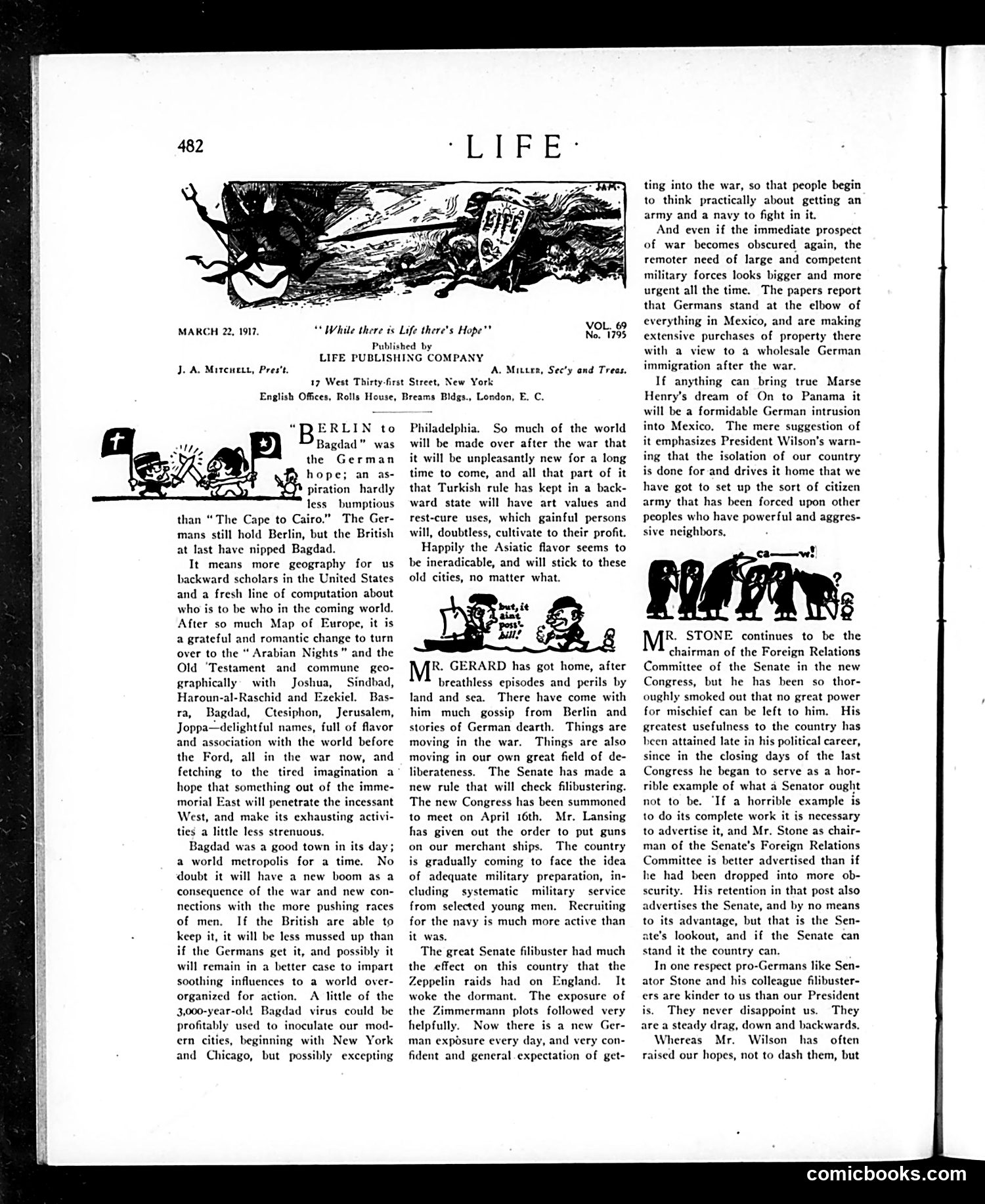
This page contains editorial commentary on World War I developments as America moved toward entry (which occurred in April 1917). **Main cartoon**: The top illustration appears satirical but the specific figures are unclear from this image quality. **Editorial content**: The text discusses Britain's capture of Baghdad from Ottoman forces, noting the romantic historical significance. It then shifts to domestic American politics: Senate filibuster rules, the Zimmermann Telegram (German plot to ally with Mexico against the U.S.), and growing American military preparation. **Key satirical points**: The author mocks how Baghdad's ancient prestige contrasts with modern industrial war, suggesting "old Bagdad virus" might benefit exhausted American cities. More directly, the piece implies German activities in Mexico (property purchases, potential immigration) represent a genuine threat justifying American military mobilization. The commentary reflects pre-war American anxiety about German ambitions in the Western Hemisphere and the gradual shift toward accepting military involvement.
📄 Transcribed text from this page (OCR, searchable)
Machine-transcribed from the original scan — historical spelling and the odd misread are preserved.
MARCH 22, 1917. ‘* While there ts Life there's Hope"* No, 1795 Published by LIFE PUBLISHING COMPANY J. A. Mitenent, Pres‘t. A. Miuure, Sec’y and Treas, 17 West Thirty-first Street, New York English Offices, Rolls House, Breams Bldgs., London, E. C. “BERLIN to Bagdad” was the German hope; an as- piration hardly less bumptious than “The Cape to Cairo.” The Ger- mans still hold Berlin, but the British at last have nipped Bagdad. It means more geography for us backward scholars in the United States and a fresh line of computation about who is to be who in the coming world. After so much Map of Europe, it is a grateful and romantic change to turn over to the “ Arabian Nights” and the Old ‘Testament and commune geo- graphically’ with Joshua, Sindbad, Haroun-al-Raschid and Ezekiel. Bas- ra, Bagdad, Ctesiphon, Jerusalem, Joppa—delightful names, full of flavor and association with the world before the Ford, all in the war now, and fetching to the tired imagination a hope that something out of the imme- morial East will penetrate the incessant West, and make its exhausting ac ties a little less strenuous. Bagdad was a good town in its day; a world metropolis for a time. No doubt it will have a new boom as a consequence of the war and new con- nections with the more pushing races of men, If the British are able to keep it, it will be less mussed up than if the Germans get and possibly it will remain in a better case to impart soothing influences to a world over- organized for action. A little of the 3,000-year-old Bagdad virus could be profitably used to inoculate our mod- ern cities, beginning with New York and Chicago, but possibly excepting Philadelp So much of the world will be made over after the war that it will be unpleasantly new for a long time to come, and all that part of it that Turkish rule has kept in a back- ward state will have art values and rest-cure uses, which gainful persons will, doubtless, cultivate to their profit. Happily the Asiatic flavor seems to be ineradicable, and will stick to these old cities, no matter what. R, GERARD has got home, after breathless episodes and perils by land and sea. There have come with him much gossip from Berlin and stories of German dearth. Things are moving in the war. Things are also moving in our own great field of de- liberateness. The Senate has made a new rule that will check filibustering. The new Congress has been summoned to meet on April 16th. Mr. Lansing has given out the order to put guns on our merchant ships. The country is gradually coming to face the idea of adequate military preparation, in- cluding systematic military service from selected young men. Recruiting for the navy is much more active than it was. The great Senate filibuster had much the effect on this country that the Zeppelin raids had on England. It woke the dormant. The exposure of the Zimmermann plots followed very helpfully. Now there is a new Ger- man exposure every day, and very con- fident and general expectation of get- ting into the war, so that people begin to think practically about getting an army and a navy to fight in it. And even if the immediate prospect of war becomes obscured again, the remoter need of large and competent military forces looks bigger and more urgent all the time. The papers report that Germans stand at the elbow of everything in Mexico, and are making extensive purchases of property there with a view to a wholesale German immigration after the war. If anything can bring true Marse Henry’s dream of On to Panama it will be a formidable German intrusion into Mexico. The mere suggestion of it emphasizes President Wilson's warn- ing that the isolation of our country is done for and drives it home that we have got to set up the sort of citizen army that has been forced upon other peoples who have powerful and aggres- sive neighbors, ca——w! R. STONE continues to be the chairman of the Foreign Relations Committee of the Senate in the new Congress, but he has been so thor- oughly smoked out that no great power for mischief can be left to him. His greatest usefulness to the country has been attained late in his political career, since in the closing days of the last Congress he began to serve as a hor- rible example of what a Senator ought not to be. ‘If a horrible example is to do its complete work it is necessary to advertise it, and Mr. Stone as chair- man of the Senate’s Foreign Relations Committee is better advertised than if he had been dropped into more ob- scurity. His retention in that post also advertises the Senate, and by no means to its advantage, but that is the Sen- ate’s lookout, and if the Senate can stand it the country can. In one respect pro-Germans like Sen- ator Stone and his colleague filibuster- ers are kinder to us than our President They never disappoint us. They are a steady drag, down and backwards. Whereas Mr. Wilson has often raised our hopes, not to dash them, but comicbooks.com