
Life, 1917-03-22 · page 30 of 38
Life — March 22, 1917 — page 30: what you’re looking at
What you’re looking at
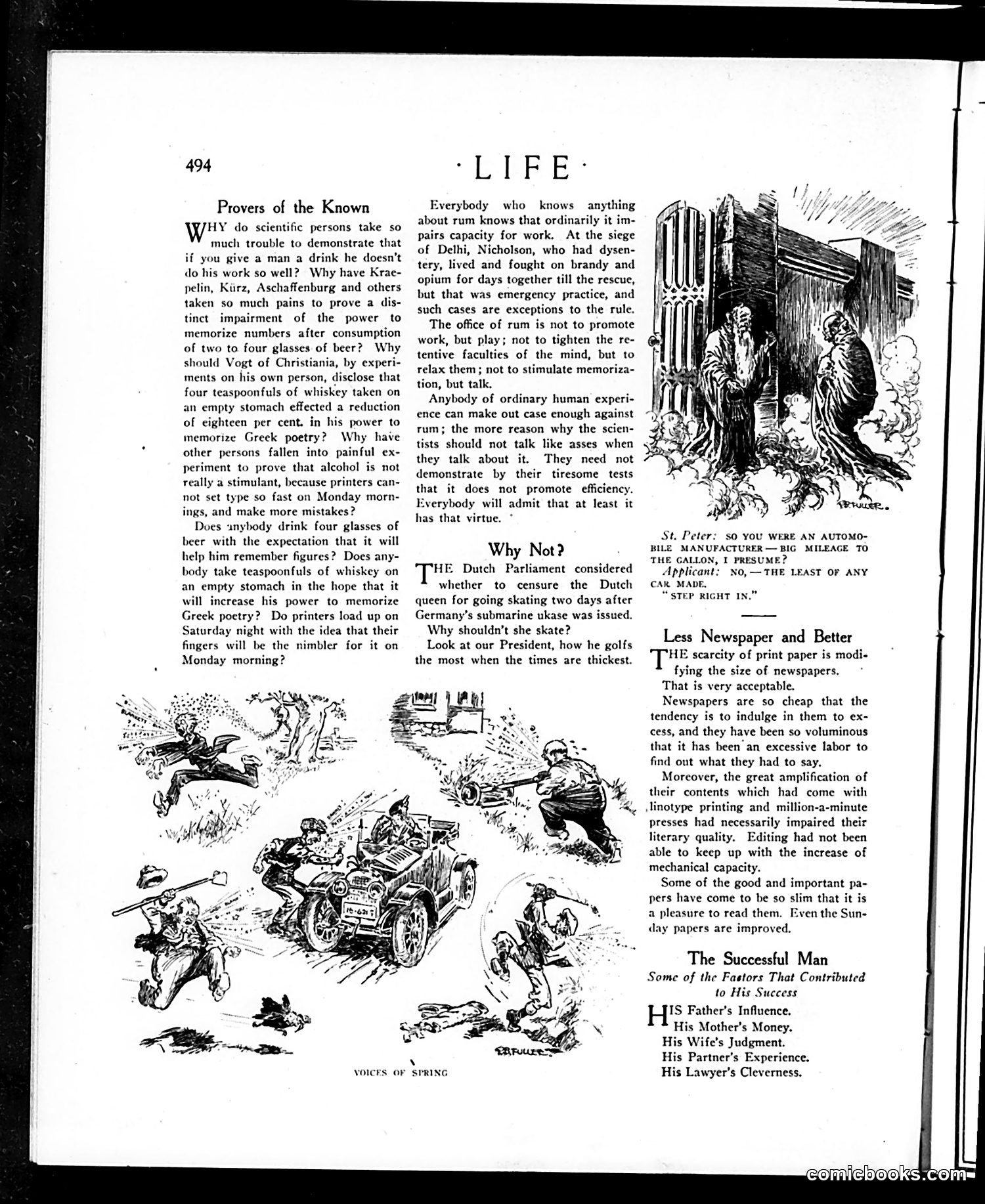
This page contains three satirical pieces mocking scientific pretension and social hypocrisy: **"Provers of the Known"** ridicules German and Scandinavian researchers (Kraepelin, Kurz, Aschaffenburg, Vogt) who laboriously "proved" that alcohol impairs work performance—something everyone already knows. The author sarcastically asks: who drinks hoping to memorize better or work faster? The satire is that scientists waste effort demonstrating the obvious while ignoring alcohol's actual social purpose: relaxation and play. **"Why Not?"** defends the Dutch queen's skating during wartime (Germany's submarine threat) by comparing her to the American President golfing during crises. Both leaders relax when times are toughest—so why criticize her? **The automobile manufacturer cartoon** depicts a car manufacturer arriving at heaven's gates. St. Peter assumes "big mileage," but the manufacturer ironically claims the opposite—his cars had poor mileage/longevity, suggesting shoddy manufacturing for profit. The remaining sections discuss newspaper size improvements and list tongue-in-cheek factors for success (money, connections, lawyers).
📄 Transcribed text from this page (OCR, searchable)
Machine-transcribed from the original scan — historical spelling and the odd misread are preserved.
494 Provers of the Known HY do scientific persons take so much trouble to demonstrate that if you give a man a drink he doesn’t do his work so well? Why have Krae- pelin, Kiirz, Aschaffenburg and others taken so much pains to prove a dis- tinct impairment of the power to memorize numbers after consumption of two to four glasses of beer? Why should Vogt of Christiania, by experi- ments on his own person, disclose that four teaspoonfuls of whiskey taken on an empty stomach effected a reduction of eighteen per cent. in his power to memorize Greek poetry? Why have other persons fallen into painful ex- periment to prove that alcohol is not really a stimulant, because printers can- not set type so fast on Monday morn- ings, and make more mistakes? Does anybody drink four glasses of beer with the expectation that it will help him remember figures? Does any- body take teaspoonfuls of whiskey on an empty stomach in the hope that it will increase his power to memorize Greek poetry? Do printers load up on Saturday night with the idea that their fingers will be the nimbler for it on Monday morning? Se ys Sy) ‘EFEE* Everybody who knows anything about rum knows that ordinarily it im- pairs capacity for work. At the siege of Delhi, Nicholson, who had dysen- tery, lived and fought on brandy and opium for days together till the rescue, but that was emergency practice, and such cases are exceptions to the rule. The office of rum is not to promote work, but play; not to tighten the re- tentive faculties of the mind, but to relax them ; not to stimulate memoriza- tion, but talk. Anybody of ordinary human experi- ence can make out case enough against rum; the more reason why the scien- tists should not talk like asses when they talk about it. They need not demonstrate by their tiresome tests that it does not promote efficiency. Everybody will admit that at least it has that virtue. * Why Not? 'HE Dutch Parliament considered whether to censure the Dutch queen for going skating two days after Germany’s submarine ukase was issued. Why shouldn’t she skate? Look at our President, how he golfs the most when the times are thickest. VOICES OF SPRING St. Peter: so YOU WERE AN AUTOMO- BILE MANUFACTURER — BIG MILEAGE TO I PRESUME? NO, —THE LEAST OF ANY “STEP RIGHT IN.” Less Newspaper and Better HE scarcity of print paper is modi- fying the size of newspapers. That is very acceptable. Newspapers are so cheap that the tendency is to indulge in them to ex- cess, and they have been so voluminous that it has been’an excessive labor to find out what they had to say. Moreover, the great amplification of their contents which had come with slinotype printing and million-a-minute presses had necessarily impaired their literary quality. iting had not been able to keep up with the increase of mechanical capacity. Some of the good and important pa- pers have come to be so slim that it is a pleasure to read them. ‘en the Sun- day papers are improved. The Successful Man Some of the Fastors That Contributed to His Success IS Father's Influence. His Mother’s Money. His Wife's Judgment. His Partner's Experience. His Lawyer’s Cleverness.