
Life, 1917-03-22 · page 8 of 38
Life — March 22, 1917 — page 8: what you’re looking at
What you’re looking at
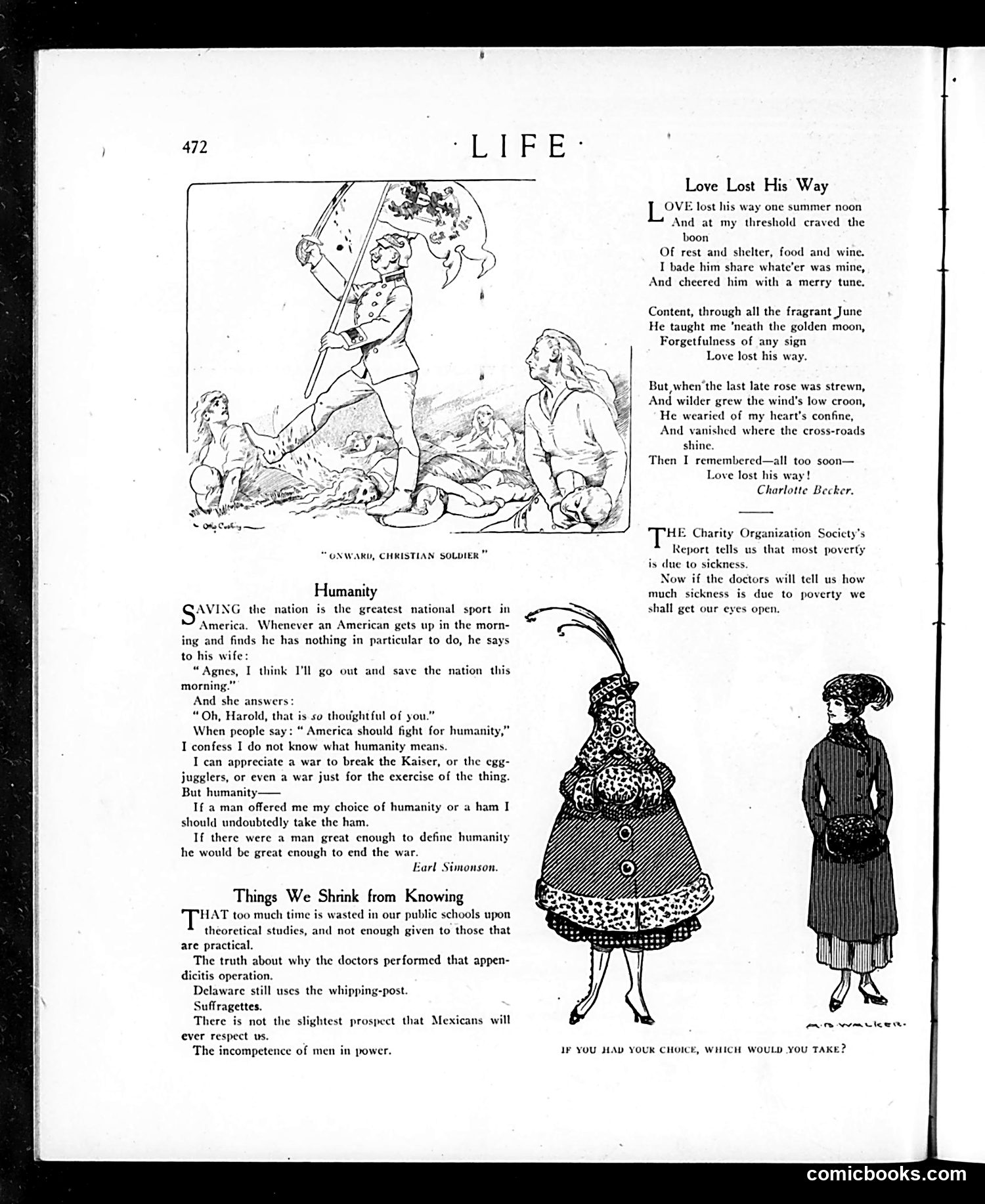
This page contains three distinct pieces: 1. **"Onward, Christian Soldier"** (top illustration): Shows a figure climbing a ladder while others below celebrate. The caption's religious military reference appears satirical about American patriotism and national service. 2. **"Humanity"** (middle): Earl Simonson's essay-poem critiques vague calls for "saving the nation" through humanitarian action, arguing that abstract idealism is meaningless without concrete definition. He suggests choosing practical good (a ham) over undefined noble causes. 3. **"Things We Shrink from Knowing"** (left column): Lists uncomfortable social truths—Delaware's whipping-post, suffragette treatment, Mexican disrespect, and governmental incompetence—suggesting Americans avoid acknowledging these uncomfortable realities. 4. **Fashion illustration** (right): Two women's clothing styles captioned "If You Had Your Choice, Which Would You Take?" - likely satirizing women's fashion choices or constraints. The page reflects progressive-era social criticism typical of Life magazine.
📄 Transcribed text from this page (OCR, searchable)
Machine-transcribed from the original scan — historical spelling and the odd misread are preserved.
“ONWARD, CHRISTIAN SOLDIER” Humanity AVING the nation is the greatest national sport in America. Whenever an American gets up in the morn- ing and finds he has nothing in particular to do, he says to his wife: “Agnes, I think I'll go out and save the nation this morning.” And she answers: “Oh, Harold, that is so thoughtful of you.” When people say: “ America should fight for humanity,” I confess I do not know what humanity means. I can appreciate a war to break the Kaiser, or the egg- jugglers, or even a war just for the exercise of the thing. But humanity — If a man offered me my choice of humanity or a ham I should undoubtedly take the ham. If there were a man great enough to define humanity he would be great cnough to end the war. Earl Simonson, Things We Shrink from Knowing HAT too much time is wasted in our public schools upon theoretical studies, and not enough given to those that are practical. The truth about why the doctors performed that appen- dicitis operation. Delaware still uses the whipping-post. Suffragettes. There is not the slightest prospect that Mexicans will ever respect us. The incompetence of men in power. ar YOU Love Lost His Way OVE lost his way one summer noon And at my threshold craved the boon Of rest and shelter, food and wine. I bade him share whate’er was mine, And cheered him with a merry tune. Content, through all the fragrant June He taught me ‘neath the golden moon, Forgetfulness of any sign Love lost his way. But when'the last late rose was strewn, And wilder grew the wind's low croon, He wearied of my heart's confine, And vanished where the cross-roads shine. Then I remembered—all too soon— Love lost his way! Charlotte Becker. HE Charity Organization Socicty’s Report tells us that most poverty is due to sickness. Now if the doctors will tell us how much sickness is due to poverty we shall get our eyes open. MAD YOUK CHOICE, WHICH WOULD YOU TAKE? comicbooks.com