
Life, 1917-03-22 · page 4 of 38
Life — March 22, 1917 — page 4: what you’re looking at
What you’re looking at
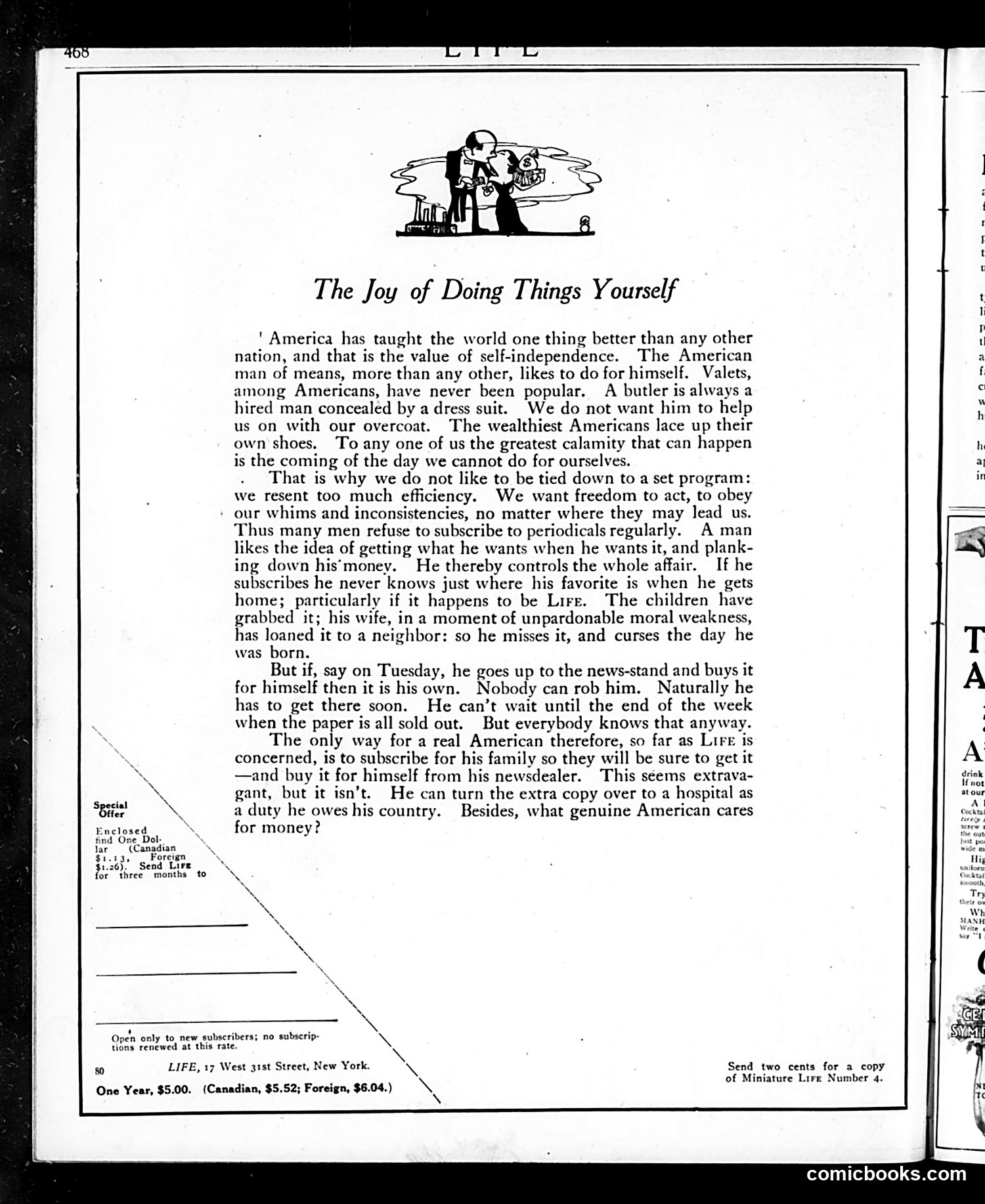
This satirical article celebrates American self-reliance while mocking its absurdities. The text argues that Americans pride themselves on independence—refusing servants, doing personal tasks themselves—yet contradicts this by emphasizing wealth and freedom from constraints. The satire peaks in the subscription example: an American man insists on buying his own newspaper daily rather than subscribing, claiming control and spontaneity matter more than efficiency. The article suggests this attitude is quintessentially American but ultimately illogical—he wastes money and time out of stubborn independence. The piece critiques American individualism as performative and inefficient, presenting self-reliance as an ideology that ironically prevents practical living. The tone is gently mocking toward American exceptionalism and its contradictions.
📄 Transcribed text from this page (OCR, searchable)
Machine-transcribed from the original scan — historical spelling and the odd misread are preserved.
Special fer Enclosed find One, Dol- lar (Canadiag $ . ‘oreign 1.36), Send Lire lor three months to The Joy of Doing Things Y ourself ' America has taught the world one thing better than any other nation, and that is the value of self-independence. The American man of means, more than any other, likes to do for himself. Valets, among Americans, have never been popular. A butler is always a hired man concealed by a dress suit. We do not want him to help us on with our overcoat. The wealthiest Americans lace up their own shoes. To any one of us the greatest calamity that can happen is the coming of the day we cannot do for ourselves. That is why we do not like to be tied down to a set program: we resent too much efficiency. We want freedom to act, to obey our whims and inconsistencies, no matter where they may lead us. Thus many men refuse to subscribe to periodicals regularly. A man likes the idea of getting what he wants when he wants it, and plank- ing down his'‘money. He thereby controls the whole affair. If he subscribes he never knows just where his favorite is when he gets home; particularly if it happens to be Lire. The children have grabbed it; his wife, ina moment of unpardonable moral weakness, has loaned it to a neighbor: so he misses it, and curses the day he was born. But if, say on Tuesday, he goes up to the news-stand and buys it for himself then it is his own. Nobody can rob him. Naturally he has to get there soon. He can’t wait until the end of the week when the paper is all sold out. But everybody knows that anyway. The only way for a real American therefore, so far as Lire is concerned, is to subscribe for his family so they will be sure to get it —and buy it for himself from his newsdealer. This séems extrava- gant, but it isn’t. He can turn the extra copy over to a hospital as a duty he owes his country. Besides, what genuine American cares for money? ‘ , ‘ Open only to new subscribers; no subscrip- tions renewed at this rate. 80 LIFE, 17 West 31st Street, New York. \ Sésia’ two Ceuta’ for a copy of Miniature Lire Number 4. One Year, $5.00. (Canadian, $5.52; Foreign, $6.04.) comicbooks.com