
Life, 1917-03-22 · page 22 of 38
Life — March 22, 1917 — page 22: what you’re looking at
What you’re looking at
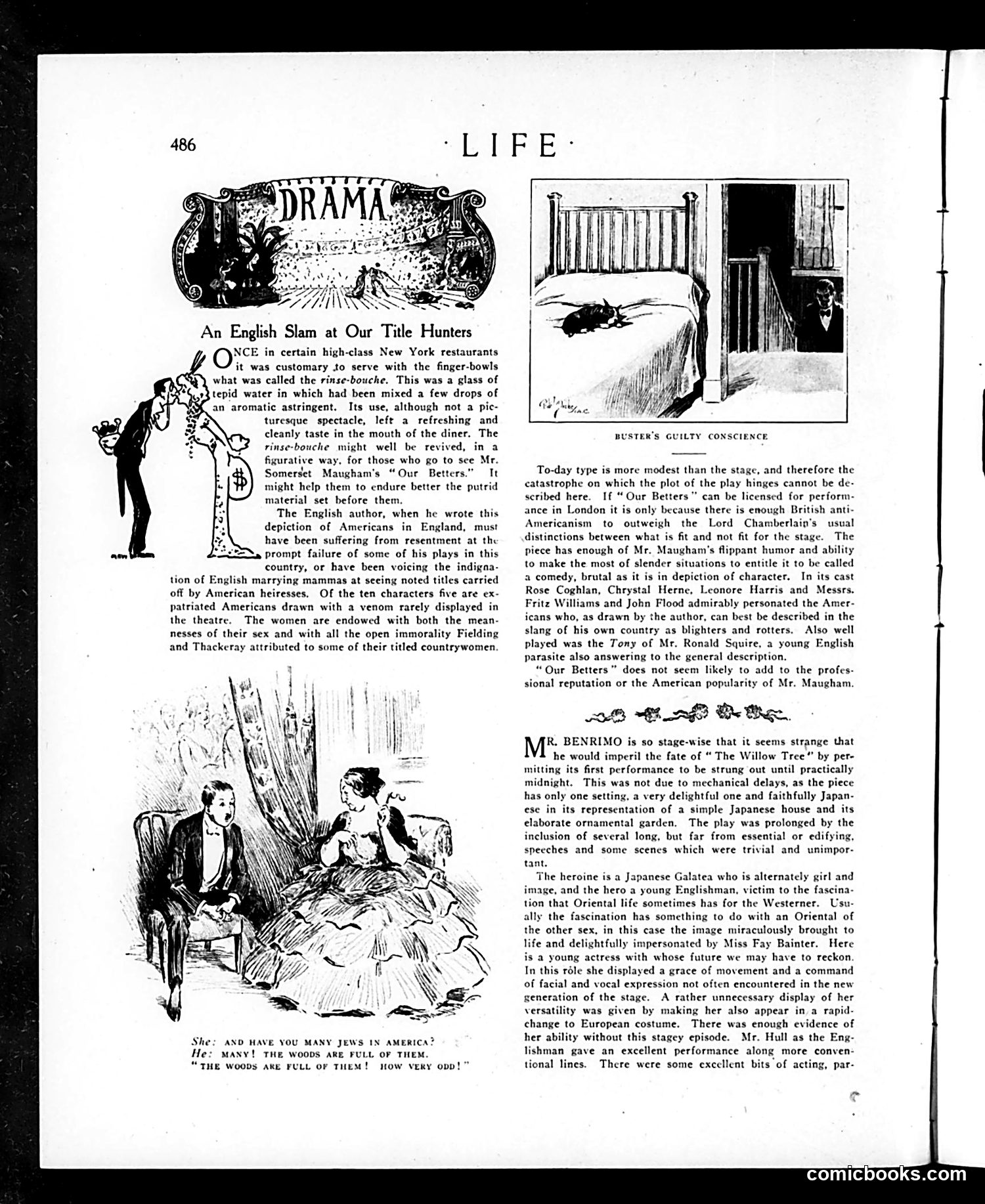
This page reviews two theatrical productions, both critiquing plays by English authors about Americans and Orientalism. **"An English Slam at Our Title Hunters"** reviews Somerset Maugham's *Our Betters*, a play satirizing wealthy Americans in England. The Life critic argues Maugham wrote it from resentment—either over failed plays in America or anger at American heiresses marrying English nobles. The review is hostile, calling the portrayal of five expatriate American characters vicious and immoral. A cartoon shows a woman asking a man about Jews in America; he responds "the woods are full of them"—likely satirizing both American antisemitism and the crude stereotyping Maugham employs. **"Buster's Guilty Conscience"** (right panel) shows a man discovering a woman in his bed—presumably illustrating the "putrid material" the play contains that offends Victorian sensibilities. The second review covers *The Willow Tree*, praising lead actress Fay Bainter's performance as a Japanese woman brought to life, while criticizing the play's excessive length and unnecessary speeches.
📄 Transcribed text from this page (OCR, searchable)
Machine-transcribed from the original scan — historical spelling and the odd misread are preserved.
An English Slam at Our Title Hunters NCE in certain high-class New York restaurants it was customary to serve with the finger-bowls what was called the rinse-bouche. This was a glass of tepid water in which had been mixed a few drops of an aromatic astringent. Its use, although not a pic- turesque spectacle, left a refreshing and cleanly taste in the mouth of the diner, The rinse-bouche might well be revived, in a figurative way, for those who go to see Mr. Somerset Maugham's “Our Betters.” It might help them to endure better the putrid material set before them. The English author, when he wrote this depiction of Americans in England, must have been suffering from resentment at the 2 eX, prompt failure of some of his plays in this country, or have been voicing the indigna- tion of English marrying mammas at seeing noted titles carried off by American heiresses, Of the ten characters five are ex- patriated Americans drawn with a venom rarely displayed in the theatre. The women are endowed with both the mean- nesses of their sex and with all the open immorality Fielding and Thackeray attributed to some of their titled countrywomen. She: AND HAVE YOU MANY JEWS IN AMERICA? He: MANY! THE WOODS ARE FULL OF THEM. “THE WOODS AKE FULL oF THEM! Mow VERY opp!” BUSTER'S GUILTY CONSCIENCE To-day type is more modest than the stage, and therefore the catastrophe on which the plot of the play hinges cannot be de- scribed here. If “ Our Betters” can be licensed for perform- ance in London it is only because there is enough British anti- Americanism to outweigh the Lord Chamberlain's usual distinctions between what is fit and not fit for the stage. The piece has enough of Mr. Maugham’s flippant humor and ability to make the most of slender situations to entitle it to be called a comedy, brutal as it is in depiction of character. In its cast Rose Coghlan, Chrystal Herne, Leonore Harris and Messrs. Fritz Williams and John Flood admirably personated the Amer- icans who, as drawn by the author, can best be described in the slang of his own country as blighters and rotters. Also well played was the Tony of Mr. Ronald Squire, a young English parasite also answering to the general description. “Our Betters” does not seem likely to add to the profes- sional reputation or the American popularity of Mr. Maugham. R. BENRIMO is so stage-wise that it seems strange that he would imperil the fate of “ The Willow Tree” by per- mitting its first performance to be strung out until practically midnight. This was not due to mechanical delays, as the piece has only one setting, a very delightful one and faithfully Japan- ese in its representation of a simple Japanese house and its elaborate ornamental garden. The play was prolonged by the inclusion of several long, but far from essential or edifying, speeches and some scenes which were trivial and unimpor- tant. The heroine is a Japanese Galatea who is alternately girl and image, and the hero a young Englishman, victim to the f. a- tion that Oriental life sometimes has for the Westerner. Usu- ally the fascination has something to do with an Oriental of the other sex, in this case the image miraculously brought to life and delightfully impersonated by Miss Fay Bainter. Here is a young actress with whose future we may have to reckon. In this réle she displayed a grace of movement and a command of facial and vocal expression not often encountered in the new generation of the stage. A rather unnecessary display of her versatility was given by making her also appear in a rapid- change to European costume. There was enough evidence of her ability without this stagey episode. Mr. Hull as the Eng- lishman gave an excellent performance along more conven- tional lines. There were some excellent bits of acting, par- comicbooks.com