
Life, 1917-03-22 · page 19 of 38
Life — March 22, 1917 — page 19: what you’re looking at
What you’re looking at
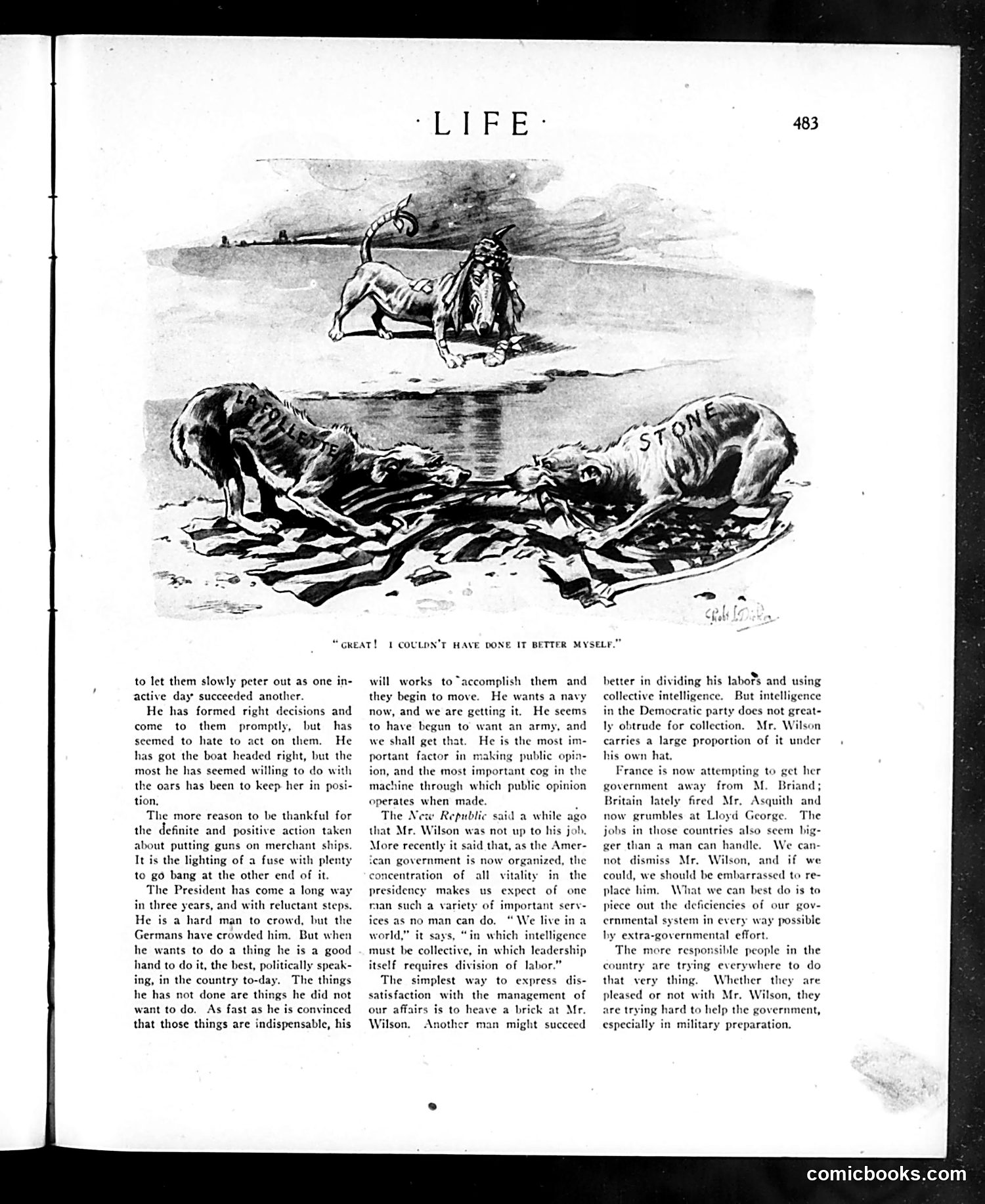
This cartoon critiques President Wilson's wartime leadership during World War I. The image shows two dogs examining a skeletal corpse labeled "STONE"—likely representing Wilson's slow, reluctant approach to military preparedness and war entry. The caption "Great! I couldn't have done it better myself" is ironic: one dog praises Wilson's inaction, suggesting even a dog could manage the government's affairs as poorly. The accompanying text defends Wilson against critics (particularly *The New Republic*), acknowledging his hesitation but arguing he eventually acts decisively once convinced of necessity. The piece notes Wilson now supports building a navy and army, and defends him as the best available leader compared to dismissed European counterparts (Asquith, Briand). The satire targets not just Wilson's reluctance, but broader frustration with slow governmental response to preparedness needs before full American entry into the war.
📄 Transcribed text from this page (OCR, searchable)
Machine-transcribed from the original scan — historical spelling and the odd misread are preserved.
to let them slowly peter out as one in- active day succeeded another. He has formed right decisions and come to them promptly, but has seemed to hate to act on them. He has got the boat headed right, but the most he has seemed willing to do with the oars has been to keep her in posi- tion, The more reason to be thankful for the definite and positive action taken about putting guns on merchant ships. It is the lighting of a fuse with plenty to go bang at the other end of it. The President has come a long way in three years, and with reluctant steps. He is a hard man to crowd, but the Germans have crowded him. But when he wants to do a thing he is a good hand to do it, the best, politically speak~ ing, in the country to-day. The things he has not done are things he did not want to do. As fast as he is convinced that those things are indispensable, his * GREAT! will works to “accomplish them and they begin to move. He wants a navy now, and we are getting it. He seems to have begun to want an army, and we shall get that. He is the most im- portant factor in king public opin- ion, and the most important cog in the machine through which public opinion operates when made. The New Republic said a while ago that Mr. Wilson was not up to his job. More recently it said that, as the Amer- ican government is now organized, the concentration of all vitality in) the presidency makes us expect of one man such a variety of important serv- ices as no man can do. “We live ina world,” it says, “in which intelligence must be collective, in which leadership itself requires division of labor.” The simplest way to express dis- satisfaction with the management of our affairs is to heave a brick at Mr. Wilson. Another man might succeed 1 COULDN'T HAVE DONE IT BETTER MYSELF.” better in dividing his labo?s and using collective intelligence. But intelligence in the Democratic party does not great- ly obtrude for collection. Mr. Wilson carries a large proportion of it under his own hat. France is now attempting to get her government away from M. Briand; Britain lately fired Mr, Asquith and now grumbles at Lloyd George. The jobs in those countries also m big ger than a man can handle. We can- not dismiss Mr. Wilson, and if we could, we should be embarrassed to re- place him. What we can best do is to piece out the deficiencies of our gov- ernmental system in every way possible hy extra-governmental effort. The more responsible people in the country are trying everywhere to do that very thing. Whether they are pleased or not with Mr. Wilson, they are trying hard to help the government, especially in military preparation. comicbooks.com