
Life, 1917-03-22 · page 14 of 38
Life — March 22, 1917 — page 14: what you’re looking at
What you’re looking at
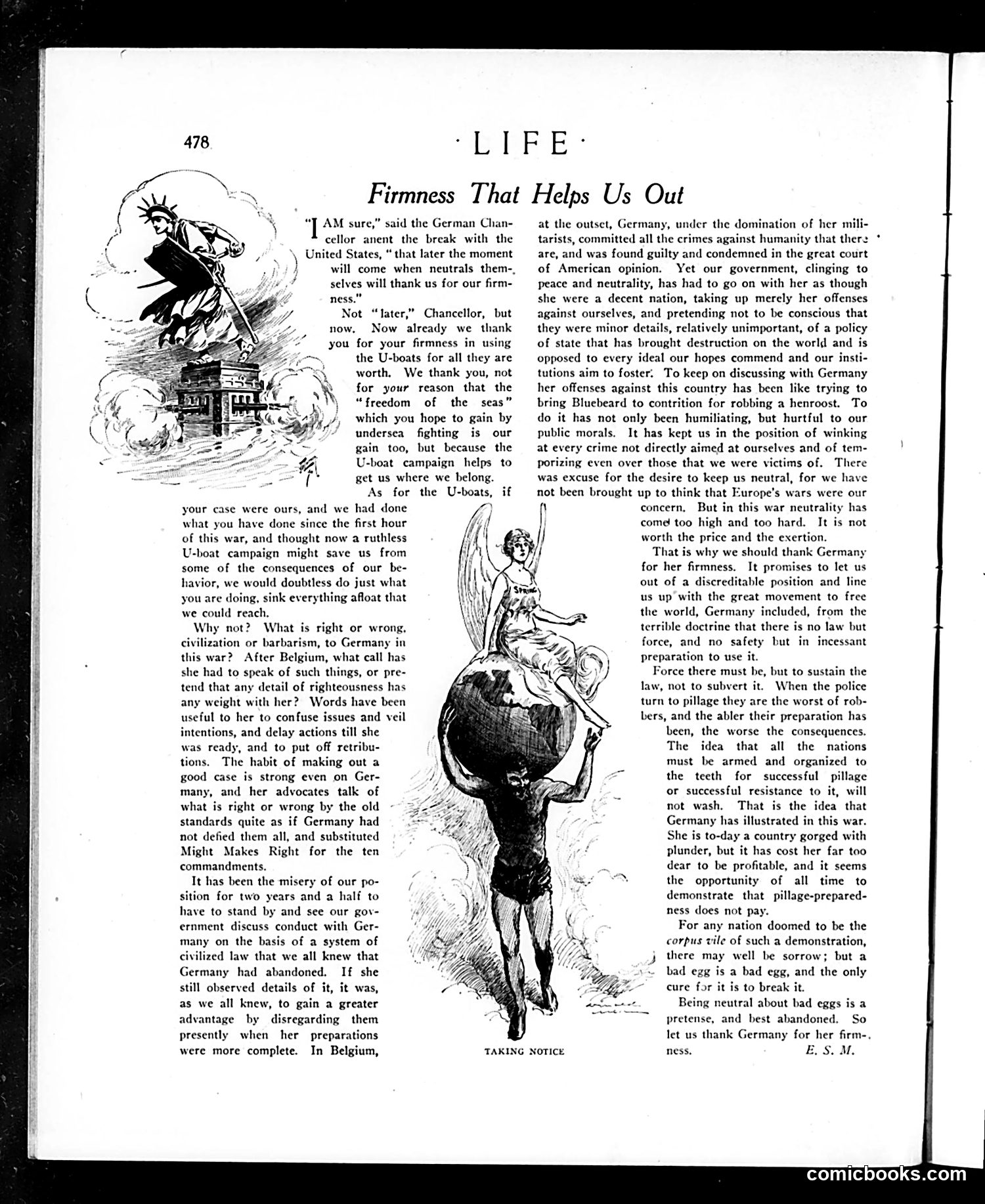
This page from *Life* magazine features anti-German World War I propaganda. The left cartoon shows a U-boat (German submarine) attacking a ship, criticizing Germany's submarine warfare campaign. The right illustration depicts a winged female figure (likely Liberty or Justice) "taking notice" of German aggression. The accompanying article, titled "Firmness That Helps Us Out," quotes a German Chancellor thanking the U.S. for neutrality while paradoxically arguing Germany's U-boat campaign actually serves American interests by preventing British naval dominance. The satire lies in this absurd logic—the author counters that Germany's ruthless tactics demonstrate why military preparedness and abandoning neutrality are necessary. The piece advocates U.S. entry against Germany, framing it as a moral imperative rather than mere realpolitik.
📄 Transcribed text from this page (OCR, searchable)
Machine-transcribed from the original scan — historical spelling and the odd misread are preserved.
I AM sure,” said the German Chan- cellor anent the break with the \ United States, “ that later the moment will come when neutrals them-, ill thank us for our firm- selves nes: Not “later,” Chancellor, but now. Now already we thank you for your firmness in using the U-boats for all they are worth, We thank you, not for your reason that the “freedom of the seas” which you hope to gain by undersea fighting is our gain too, but because the U-boat campaign helps to r get us where we belong. As for the U-boats, if your case were ours, and we had done what you have done since the first hour of this war, and thought now a ruthless U-boat campaign might save us from some of the consequences of our be- havior, we would doubtless do just what you are doing, sink everything afloat that we could reach, Why not?) What is right or wrong, civilization or barbarism, to Germany in this war? After Belgium, what call has she had to speak of such things, or pre- tend that any detail of righteousness has any weight with her? Words have been useful to her to confuse issues and veil intentions, and delay actions till she was ready, and to put off retribu- tions. The habit of making out a good case is strong even on Ger- many, and her advocates talk of what is right or wrong by the old standards quite as if Germany had not defied them all, and substituted Might Makes Right for the ten commandments. Tt has been the misery of our po- sition for two years and a half to have to stand by and see our gov- ernment discuss conduct with Ger- many on the basis of a system of civilized law that we all knew that Germany had abandoned. If she still observed details of it, it was, as we all knew, to gain a greater advantage by disregarding them presently when her preparations were more complete. “LIFE Firmness That Helps Us Out at the outset, Germany, under the domination of her mili- tarists, committed all the crimes against humanity that there are, and was found guilty and condemned in the great court of American opinion. Yet our government, clinging to peace and neutrality, has had to go on with her as though she were a decent nation, taking up merely her offenses against ourselves, and pretending not to be conscious that they were minor details, relatively unimportant, of a policy of state that has brought destruction on the world and is opposed to every ideal our hopes commend and our insti- tutions aim to foster. To keep on discussing with Germany her offenses against this country has been like trying to bring Bluebeard to contrition for robbing a henroost. To do it has not only been humiliating, but hurtful to our public morals. It has kept us in the position of winking at every crime not directly aimed at ourselves and of tem- porizing even over those that we were victims of. There was excuse for the desire to keep us neutral, for we have not been brought up to think that Europe's wars were our concern, But in this war neutrality has come too high and too hard. It is not worth the price and the exertion. That is why we should thank Germany for her firmness. It promises to let us out of a discreditable position and line us up with the great movement to free the world, Germany included, from the terrible doctrine that there is no law but force, and no safety but in incessant preparation to use it. Force there must be, but to sustain the law, not to subvert it. When the police turn to pillage they are the worst of rob- bers, and the abler their preparation has been, the worse the consequences. The idea that all the nations must be armed and organized to the teeth for successful pillage or successful resistance to it, will not wash. That is the idea that Germany has illustrated in this war. She is to-day a country gorged with plunder, but it has cost her far too dear to be profitable, and it seems the opportunity of all time to demonstrate that pillage-prepared- ness does not pay. For any nation doomed to be the corpus vile of such a demonstration, j there may well be sorrow; but a bad egg is a bad egg, and the only cure for it is to break it. Being neutral about bad eggs is a pretense, and best abandoned. So let us thank Germany for her firm-. In Belgium, TAKING NOTICE ness, ES. M. comicbooks.com