
Life, 1917-03-22 · page 17 of 38
Life — March 22, 1917 — page 17: what you’re looking at
What you’re looking at
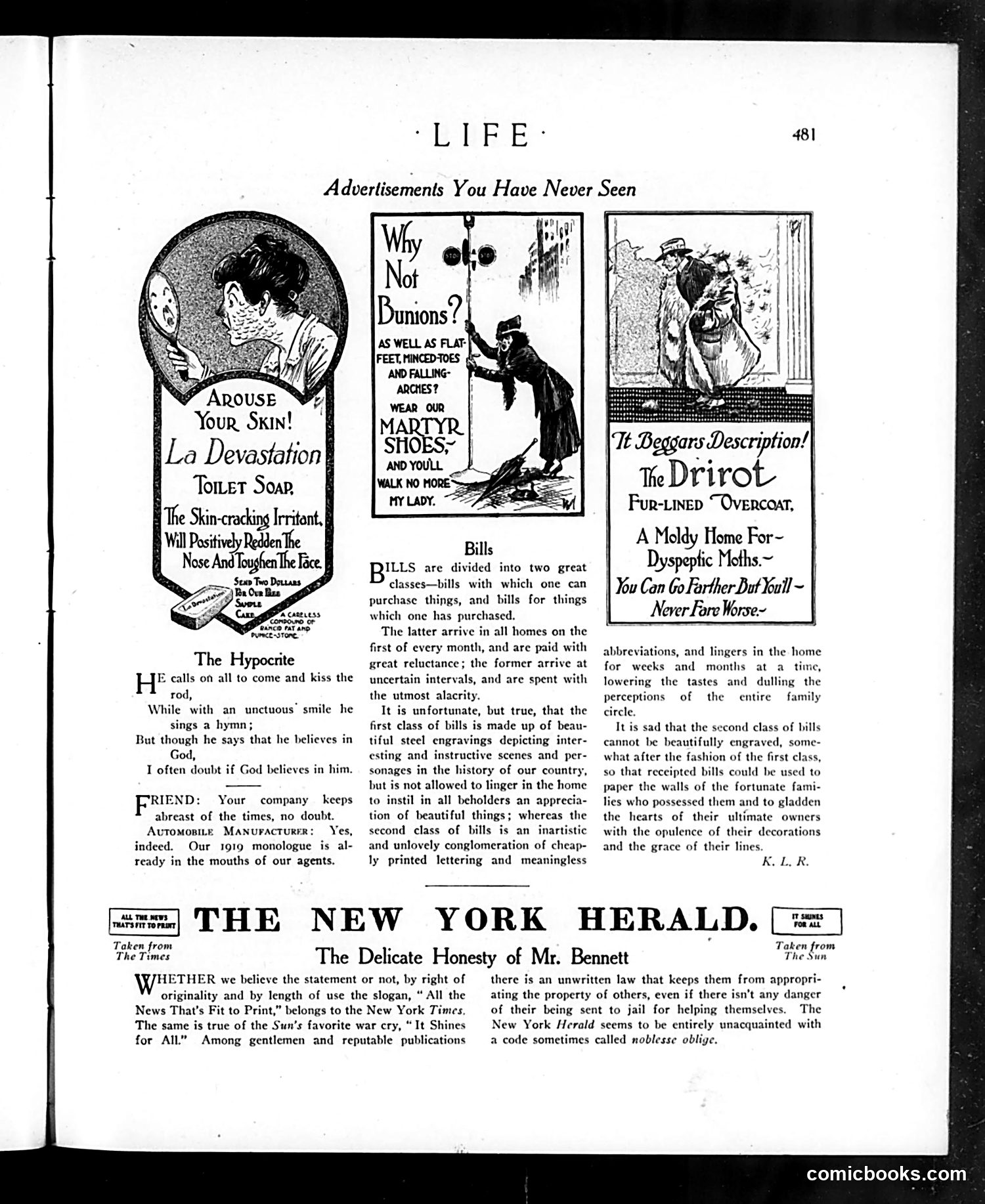
This page contains vintage satirical commentary rather than political cartoons. The main content includes: **"The Hypocrite"** — A short poem mocking religious hypocrisy, depicting someone who publicly professes faith while the author doubts God reciprocates belief in him. **"Bills" section** — Satirizes the contrast between beautiful currency/bills (which must circulate quickly) versus ugly bill statements (which linger in homes, depressing families). The joke suggests bills should be engraved like currency so people would want to display paid receipts as decoration. **Bottom section** critiques the *New York Herald* for appropriating slogans from competitors (*New York Times*' "All the News That's Fit to Print" and the *Sun*'s "It Shines for All") without attribution, suggesting the Herald lacks *noblesse oblige*—the unwritten code of honor among gentlemen and reputable publications. The page is primarily satirical commentary on everyday annoyances and media ethics, not political cartooning.
📄 Transcribed text from this page (OCR, searchable)
Machine-transcribed from the original scan — historical spelling and the odd misread are preserved.
“EB DEE * Advertisements You Have Never Seen B Your Skin! § La Devastation} Tortet Soar, E calls on all to come and kiss the rod, While with an unctuous’ smile he sings a hymn; But though he says that he believes in God, I often doubt if God believes in him. RIEND: Your company keeps abreast of the times, no doubt. AvtomosiLe Manuracturer: Yes, indeed. Our 1919 monologue is al- ready in the mouths of our agents. ILLS are divided into two great classes—bills with which one can purchase things, and bills for things which one has purchased. The latter arrive in all homes on the first of every month, and are paid with great reluctance; the former arrive at uncertain intervals, and are spent with the utmost alacrity. It is unfortunate, but true, that the first class of bills is made up of beau- tiful steel engravings depicting inter- esting and instructive scenes and per- sonages in the history of our country, but is not allowed to linger in the home to instil in all beholders an apprecia- tion of beautiful things; whereas the second class of bills is an inartistic and unlovely conglomeration of cheap- ly printed lettering and meaningless Tt Beggars Description! Te Drirot Fur-Linep “Overcoat, A Moldy Home For~ Dyspeptic Moths.~ You Can 60 Farther Dut Youll ~ Never Fore Horse-_ abbreviations, and lingers in the home for weeks and months at a_ time, lowering the tastes and dulling the perceptions of the entire family circle. It is sad that the second class of bills cannot be beautifully engraved, some- what after the fashion of the first class, so that receipted bills could be used to paper the walls of the fortunate fami- lies who possessed them and to gladden the hearts of their ultimate owners with the opulence of their decorations and the grace of their lines. KLL.R. arm] THE NEW YORK HERALD. (= ] ‘aken from The Times HETHER we believe the statement or not, by right of originality and by length of use the slogan, “ All the News That’s Fit to Print,” belongs to the New York Times, The same is true of the Sun’s favorite war cry, “It Shines The Delicate Honesty of Mr. Bennett there is an unwritten law that keeps them from appropri- ating the property of others, even if there isn’t any danger of their being sent to jail for helping themselves. New York Herald seems to be entirely unacquainted with The Sun The Taken from a code sometimes called noblesse oblige. for AIL” Among gentlemen and reputable publications comicbooks.com