
A complete issue · 46 pages · 1916
Life — November 16, 1916
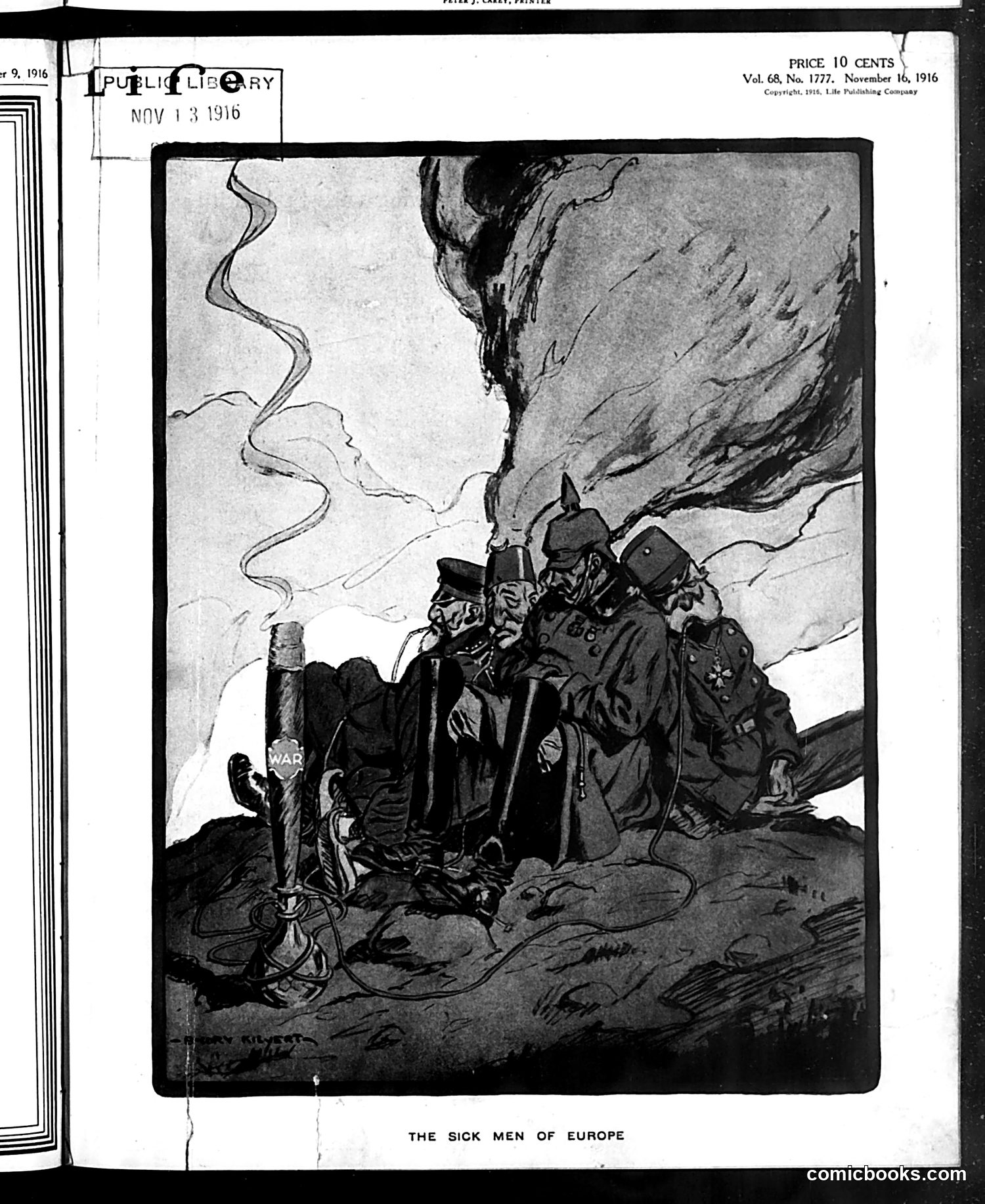
This November 1916 cartoon depicts military leaders in a trench, seemingly treating an injured soldier. The title "The Sick Men of Europe" is a historical reference to the Ottoman Empire's decline, here repurposed to comment on World War I's devastation to European powers. The cartoon shows soldiers in what appears to be a field hospital or aid station during trench warfare. The "sickness" being satirized is likely the war itself—suggesting that Europe's major powers are afflicted by the conflict, which has caused mass casualties and suffering. Published midway through WWI, this reflects American satirical commentary on the European war's destructive nature and the suffering it inflicted on the continent's militaries and populations. The dark, cramped trench setting emphasizes the grim realities of the conflict.
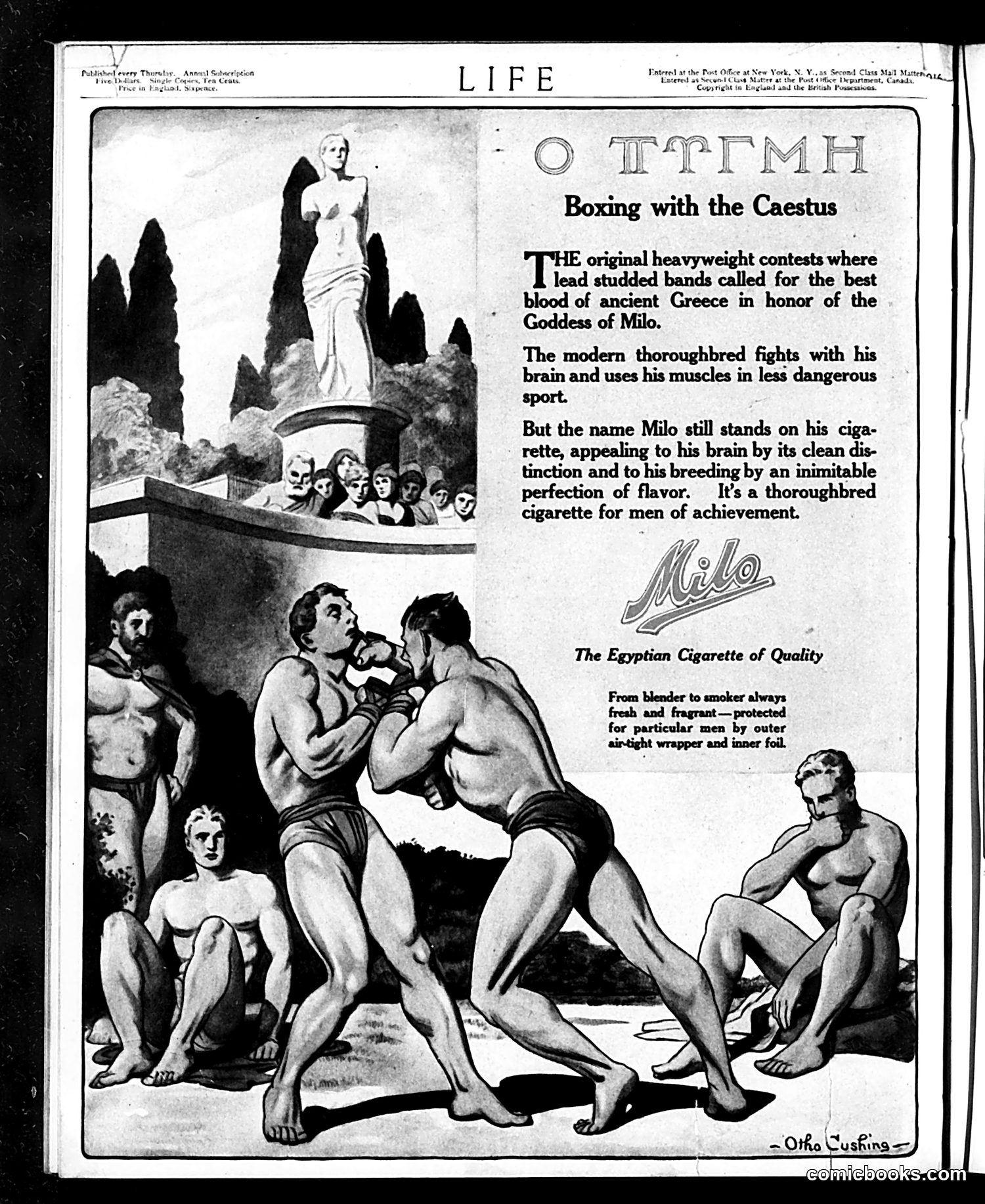
This is a Milo cigarette advertisement disguised as editorial content in Life magazine. The piece uses classical imagery—depicting ancient Greek boxing (the "Caestus," a combat sport)—to market cigarettes to men by associating smoking with athletic achievement and intellectual superiority. The ad claims Milo cigarettes appeal to "his brain" and represent "a thoroughbred cigarette for men of achievement." The classical references (Goddess of Milo, ancient Greek contests) lend sophistication and masculine authority to the product. This reflects early 20th-century advertising practices where cigarettes were openly promoted as enhancing mental and physical prowess. The satire appears unintentional—Life likely ran this as paid advertising, though modern readers recognize the absurdity of marketing tobacco as beneficial to athletes and the "accomplished."
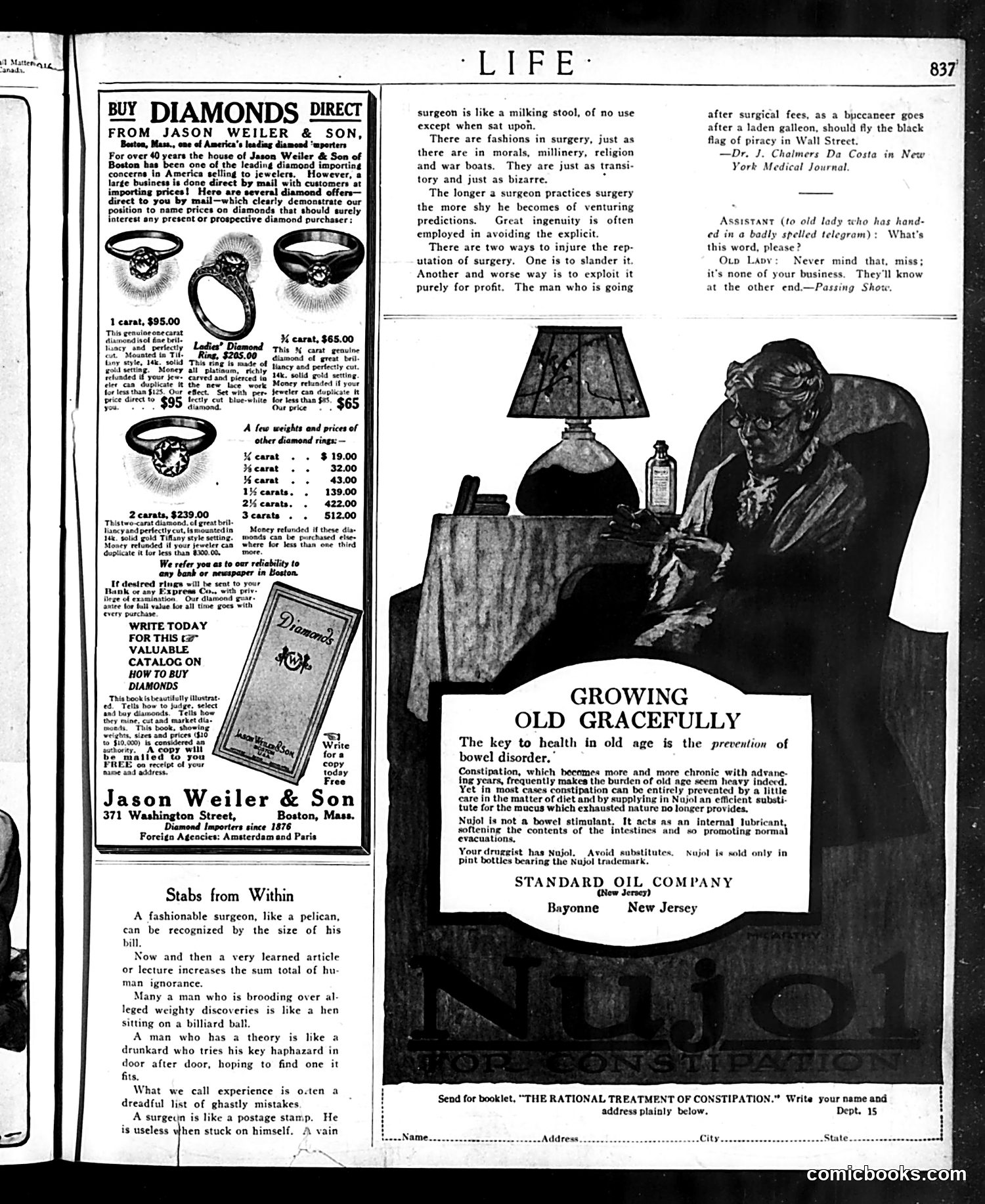
This page contains two distinct elements: **Left side:** A diamond jewelry advertisement from Jason Weiler & Son (Boston), offering direct mail-order diamonds at various carats and prices. Below it is satirical commentary titled "Stubs from Within"—brief humorous observations about human nature (surgeons compared to pelicans, theories likened to drunks, etc.). **Right side:** A Standard Oil Company advertisement for Nujol, a laxative product. The image shows an elderly person, illustrating the ad's message about preventing constipation in old age. The advertisement emphasizes that proper diet and Nujol can prevent bowel problems. The page is primarily **commercial advertising** with light satirical filler text. There are no political cartoons or identifiable caricatures of public figures. The "Growing Old Gracefully" ad reflects early 20th-century marketing about health and aging.
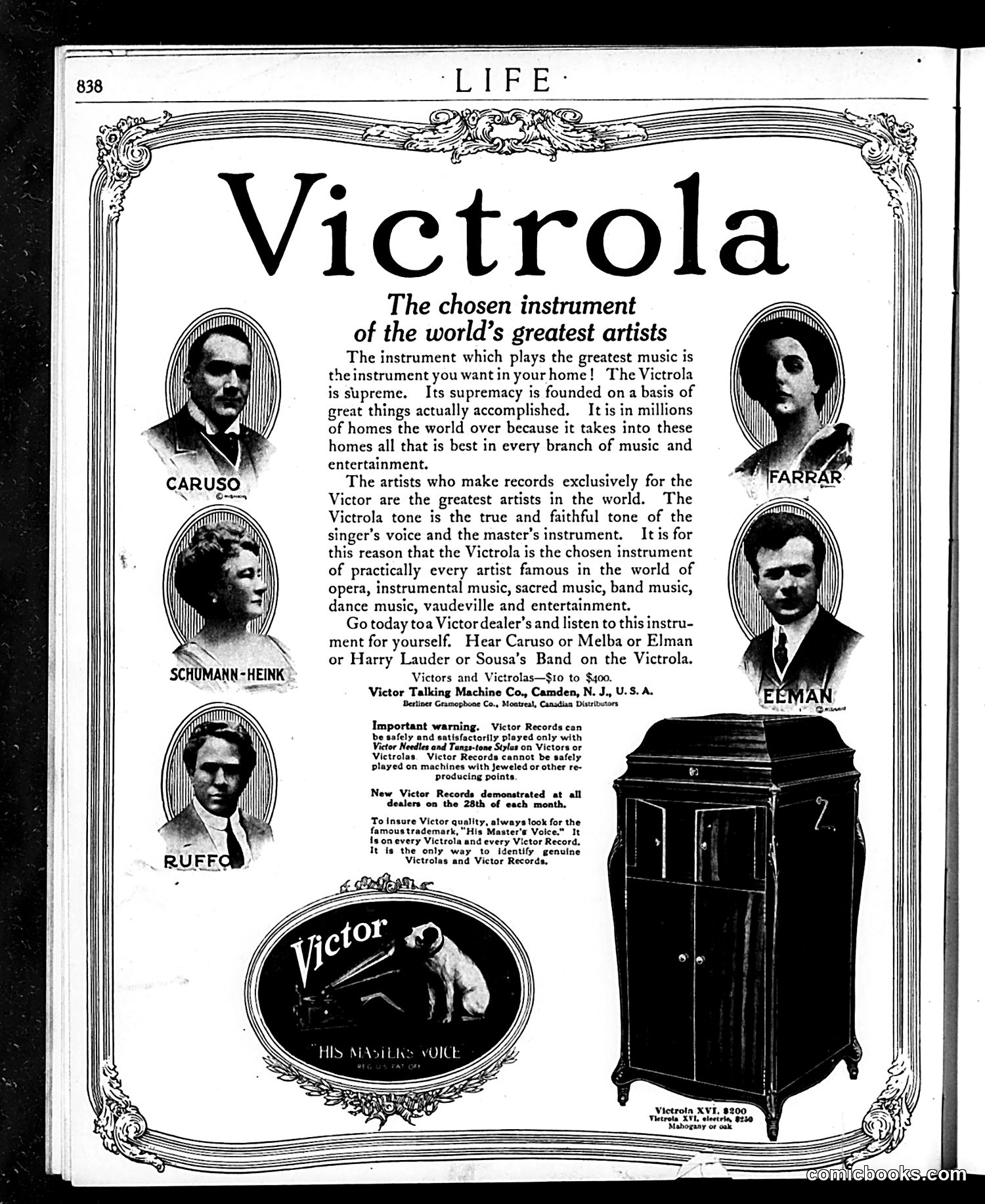
This is **not a cartoon or satire page** — it's a straightforward **product advertisement** for the Victrola, an early phonograph/record player manufactured by Victor Talking Machine Co. The page features portraits of four famous opera and classical music artists (Caruso, Farrar, Schumann-Heink, and Ruffo) who recorded exclusively for Victor Records. The advertisement's central claim is that the Victrola reproduces their performances with superior fidelity compared to competitors. The accompanying text emphasizes the instrument's popularity and endorsement by "the world's greatest artists," positioning it as essential home entertainment for music lovers. A product image shows the Victrola XVI model priced at $300. This represents early 20th-century luxury marketing leveraging celebrity endorsement and technological superiority claims — no satire intended.
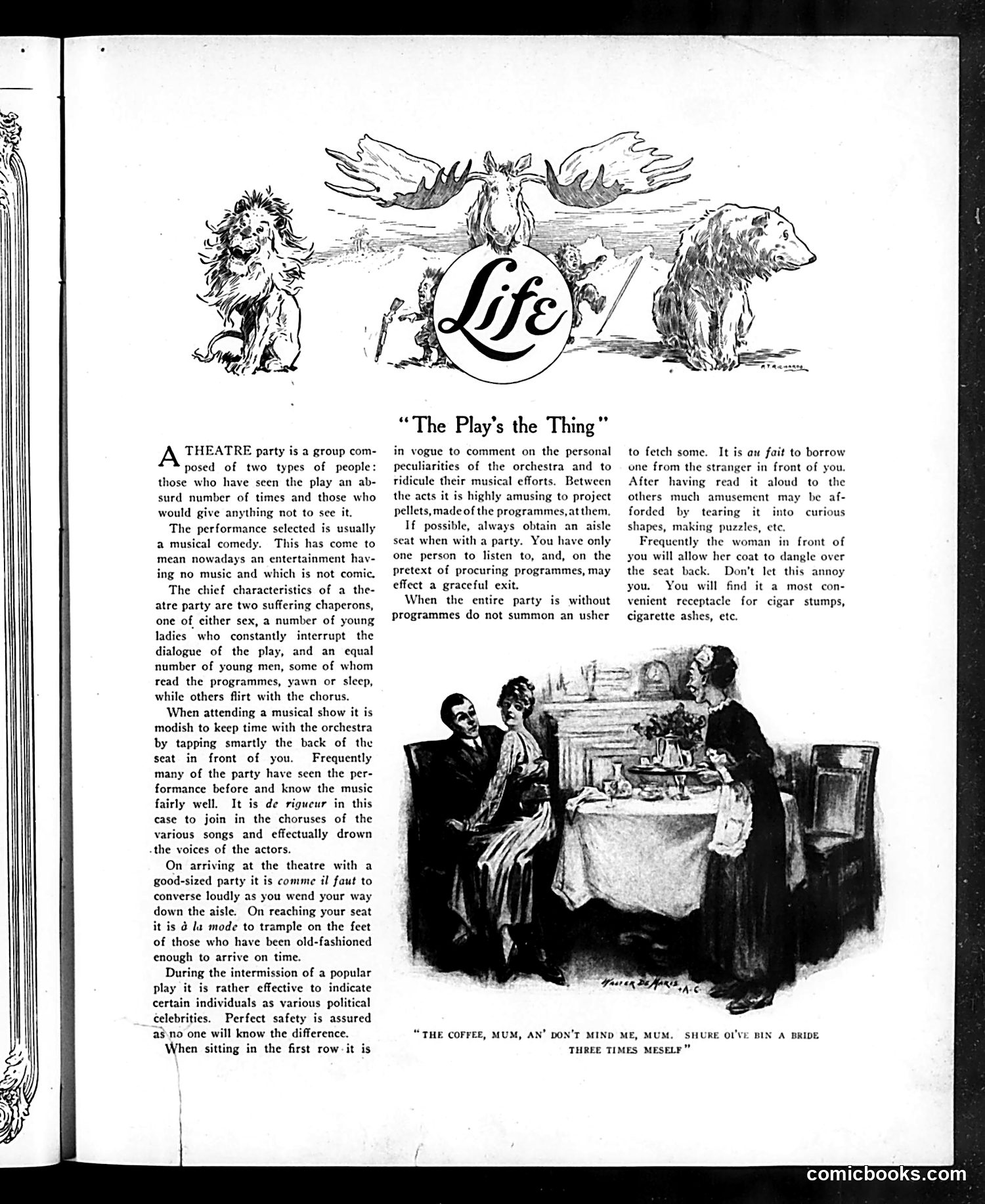
This article satirizes theater-party etiquette among the upper classes. The text mocks how wealthy patrons attend plays more for social display than genuine interest—arriving late, talking loudly, disturbing others, and leaving early. The bottom cartoon illustrates a specific annoyance: well-dressed theater-goers discussing trivial matters (coffee, marriage) during the performance, oblivious to the show. The caption—"The coffee, mum, an' don't mind me, mum. Shure give's in a bride three times mesself"—appears to capture overheard fragments of inane conversation. The satire targets the pretentious social ritual of theater-going among the wealthy, where attendance functioned as status display rather than cultural appreciation. This reflects early 20th-century criticism of upper-class behavior and priorities.
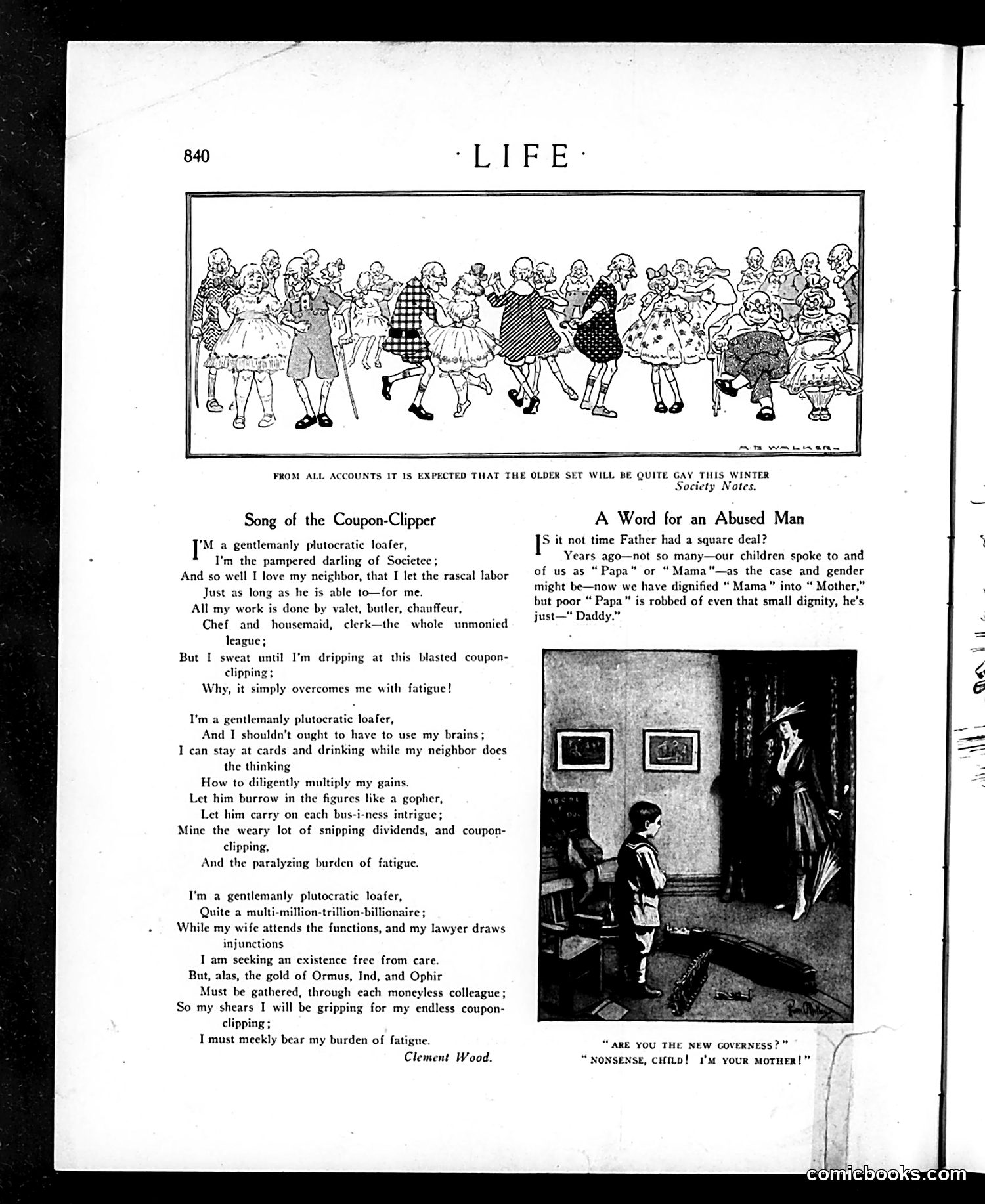
This page contains two satirical pieces from Life magazine: **"Song of the Coupon-Clipper"** (left): Clement Wood's poem mocks wealthy idle men who live off investment dividends ("coupon-clipping") rather than working. The speaker boasts of his leisured plutocratic lifestyle while his wife attends social functions and his lawyer handles business—yet he complains of exhaustion from this effortless existence. The satire targets the perceived laziness and entitlement of the leisure class. **"A Word for an Abused Man"** (right): This piece advocates for changing terms of parental address from "Papa" to "Daddy," arguing fathers deserve equal dignity with mothers (who gained "Mother" as an upgrade from "Mama"). The accompanying photo shows what appears to be a domestic scene. The satire addresses gender equality in family terminology and paternal recognition. Both pieces critique social conventions of their era.
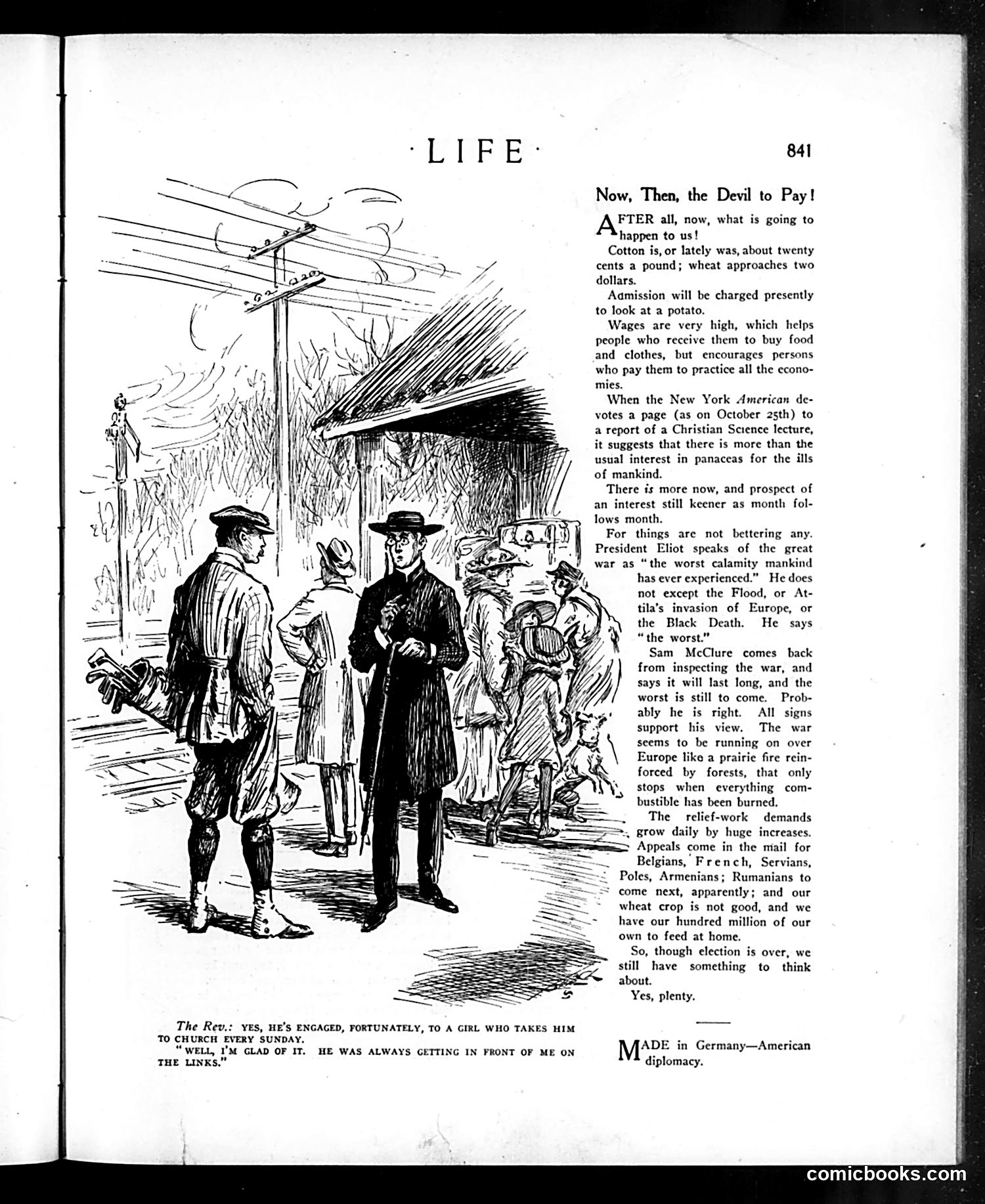
This page from *Life* magazine contains a satirical article titled "Now, Then, the Devil to Pay!" discussing post-WWI economic and social conditions. The accompanying illustration shows street figures in conversation, likely depicting everyday people confronting economic hardship. The text references President Eliot's comments on war as "the worst calamity mankind has ever experienced," and discusses ongoing relief efforts for war-affected populations (Belgians, French, Serbians, Poles, Armenians, Rumanians). It notes concerns about wheat crop failures and feeding "our own hundred million." The satire critiques post-war economic anxieties: high wages, inflation, food scarcity, and relief demands straining American resources. The caption quip about "a girl who takes him to church every Sunday" suggests domestic social commentary alongside international concerns. The cartoon depicts ordinary citizens grappling with these intersecting crises.
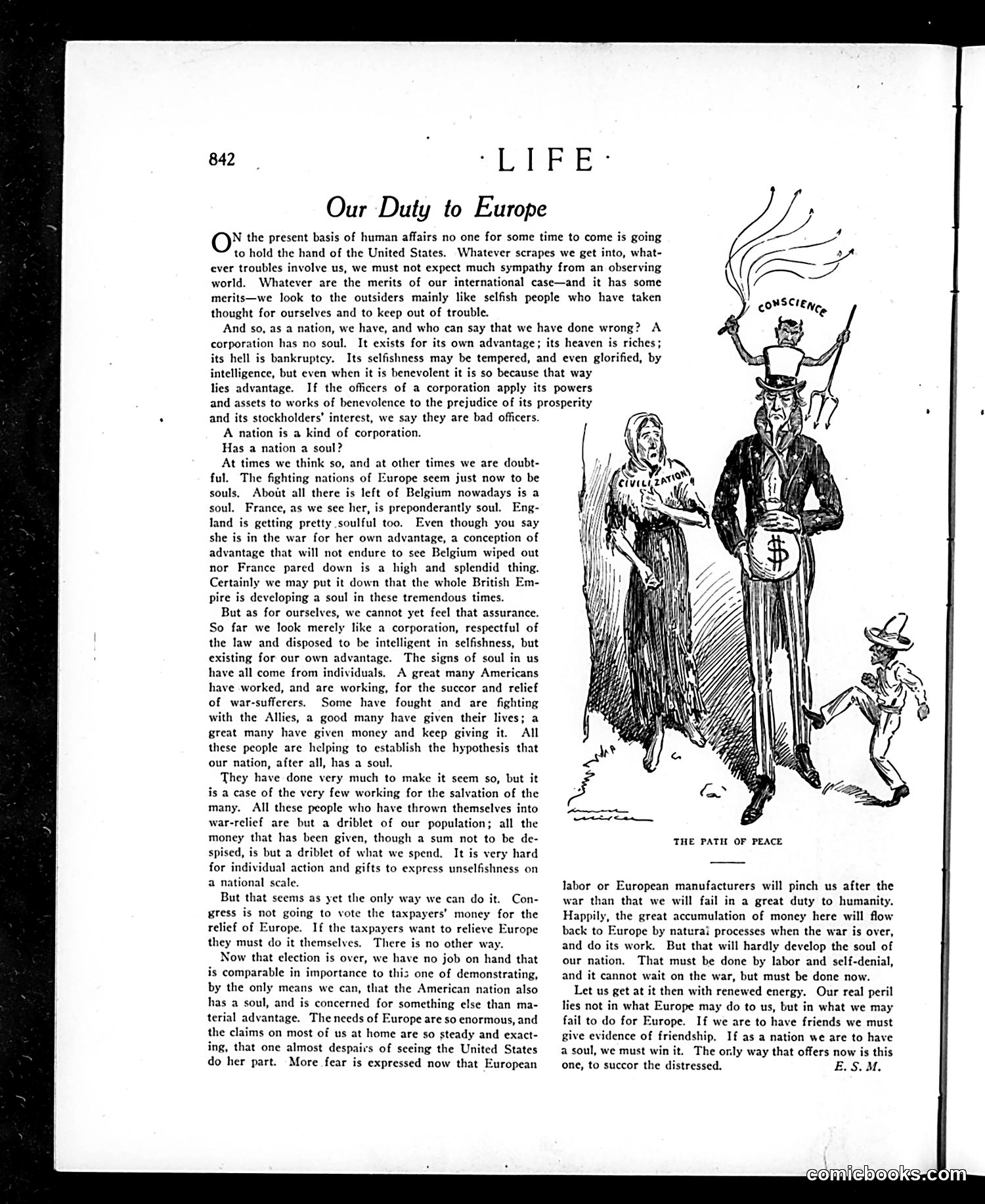
This editorial cartoon illustrates American post-WWI debate about European relief. The illustration shows three figures labeled "Civilization," "Charity," and what appears to be a soldier or wounded person, walking a difficult path while "Conscience" guides from above. The accompanying text argues that the U.S. has a moral duty to aid Europe, despite being weary from war. The author contends that Congress should fund European relief—not merely as self-interest but as evidence of national "soul." The cartoon visualizes this moral argument: civilization and charity must be supported by conscience as they navigate the dangerous "path of peace" in post-war reconstruction. Without American aid and moral leadership, the text suggests, both European recovery and American credibility will fail.
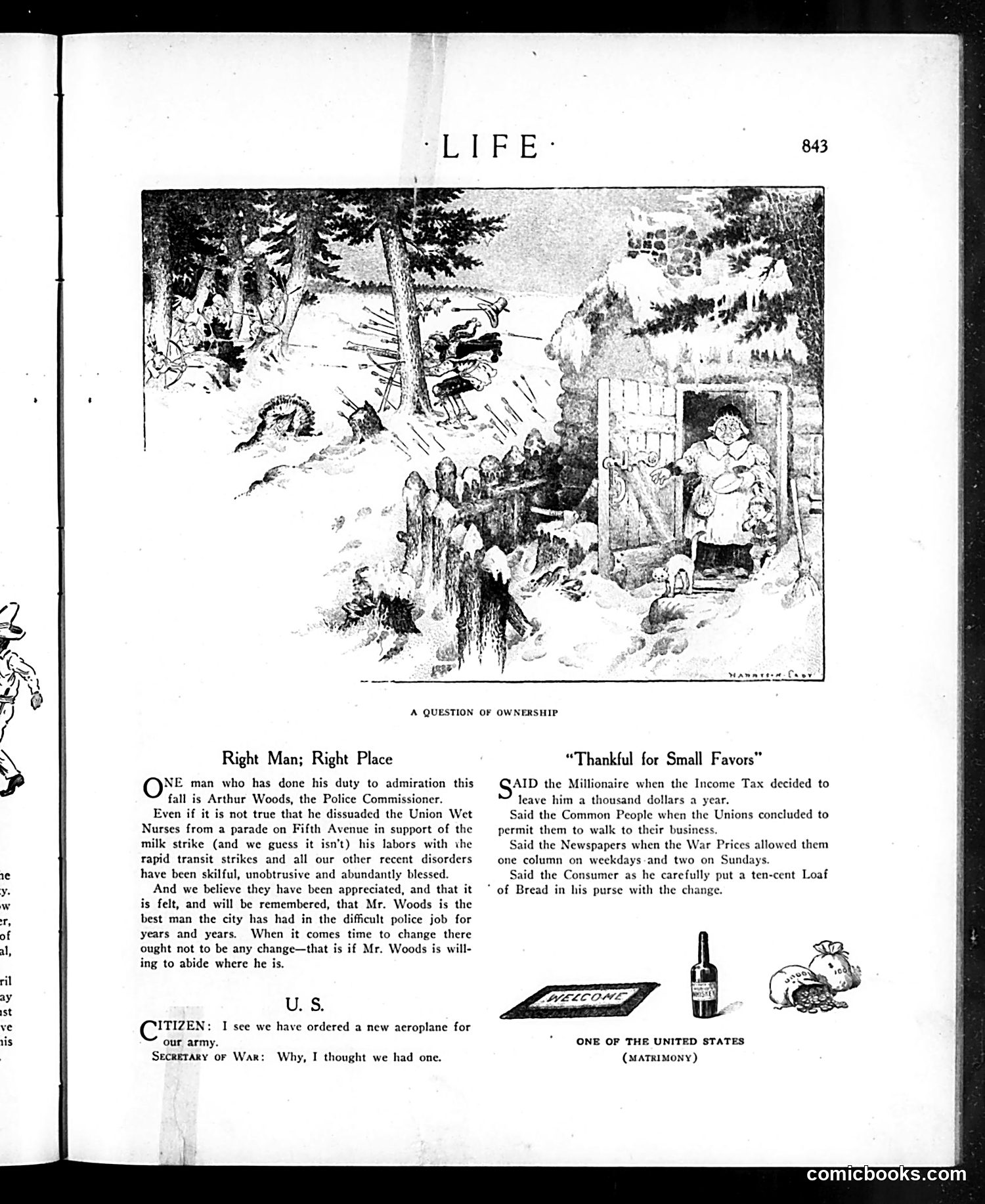
This page contains three distinct satirical pieces: **"A Question of Ownership"** (main cartoon): depicts a rural scene with tension between labor groups and property owners, likely referencing post-WWI labor disputes. **"Right Man, Right Place"**: praises Police Commissioner Mr. Woods for his management during strikes, including the "Union Wet Nurses" strike and transit strikes. The piece argues Woods handled "rapid transit strikes and all our other recent disorders" skillfully and shouldn't be replaced. **"Thankful for Small Favors"**: satirizes various groups' gratitude for minor concessions—millionaires thanking income tax policy, unions thanking permission to work, newspapers thanking war price allowances, and consumers grateful for cheap bread. **"U.S."**: A brief joke about ordering a new aeroplane despite already having one, likely commentary on military preparedness or bureaucratic redundancy.
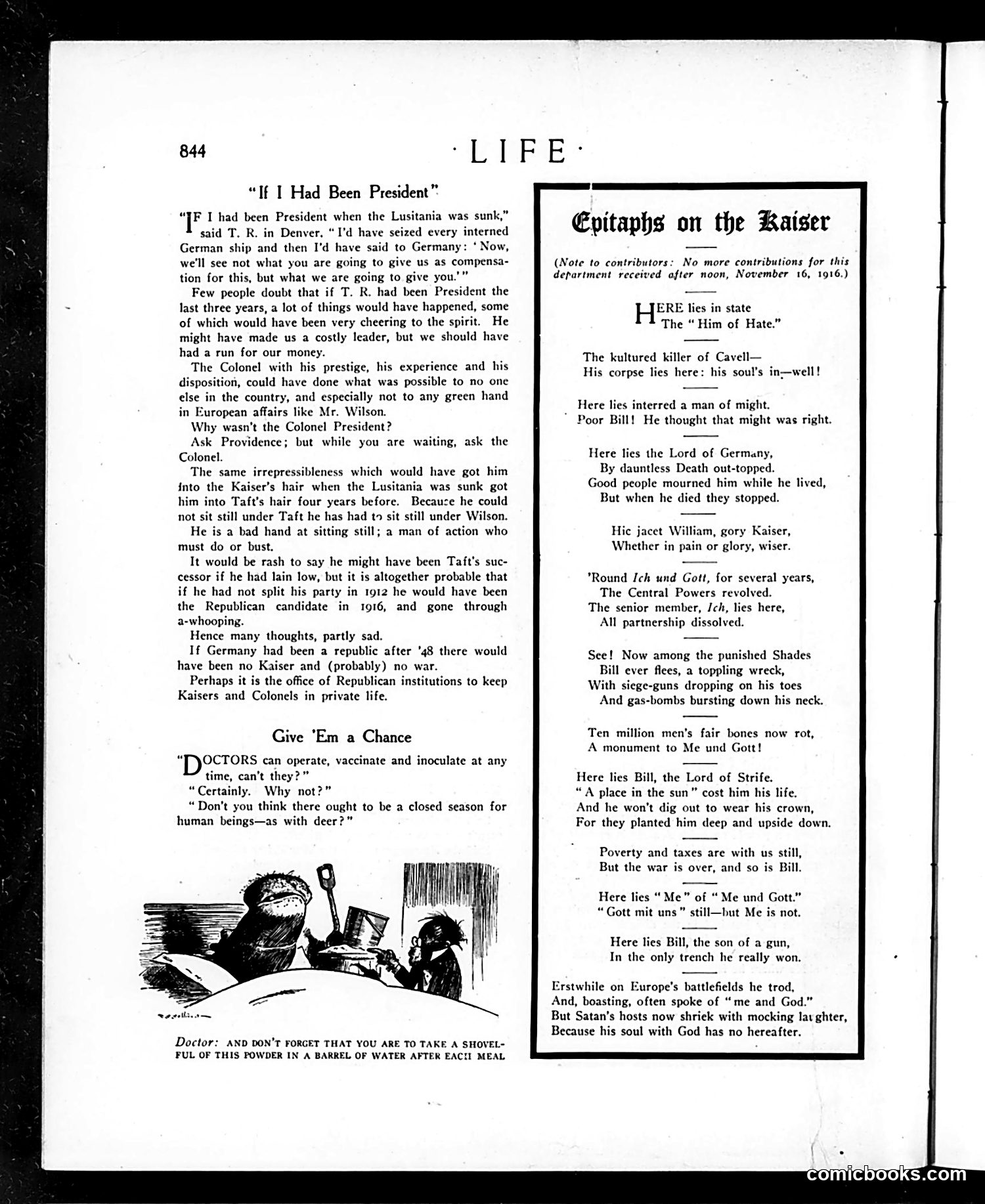
This page contains two distinct pieces of World War I-era political satire: **"If I Had Been President"** (left): T.K. from Denver argues Colonel Roosevelt would have been a superior wartime leader to President Wilson, citing his decisiveness and experience. The piece imagines Roosevelt's more aggressive approach versus Wilson's cautious strategy. **"Epitaphs on the Kaiser"** (right): A darkly satirical poem mocking Kaiser Wilhelm II and German leadership. The verses celebrate their military defeat, with crude jabs at the Kaiser's demise and those who served him ("Bill," likely referring to the Kaiser by a colloquial nickname). The tone is triumphalist, reflecting post-war American satisfaction over German defeat. Both pieces reflect American political divisions over Wilson's war leadership and post-war sentiment toward Germany.
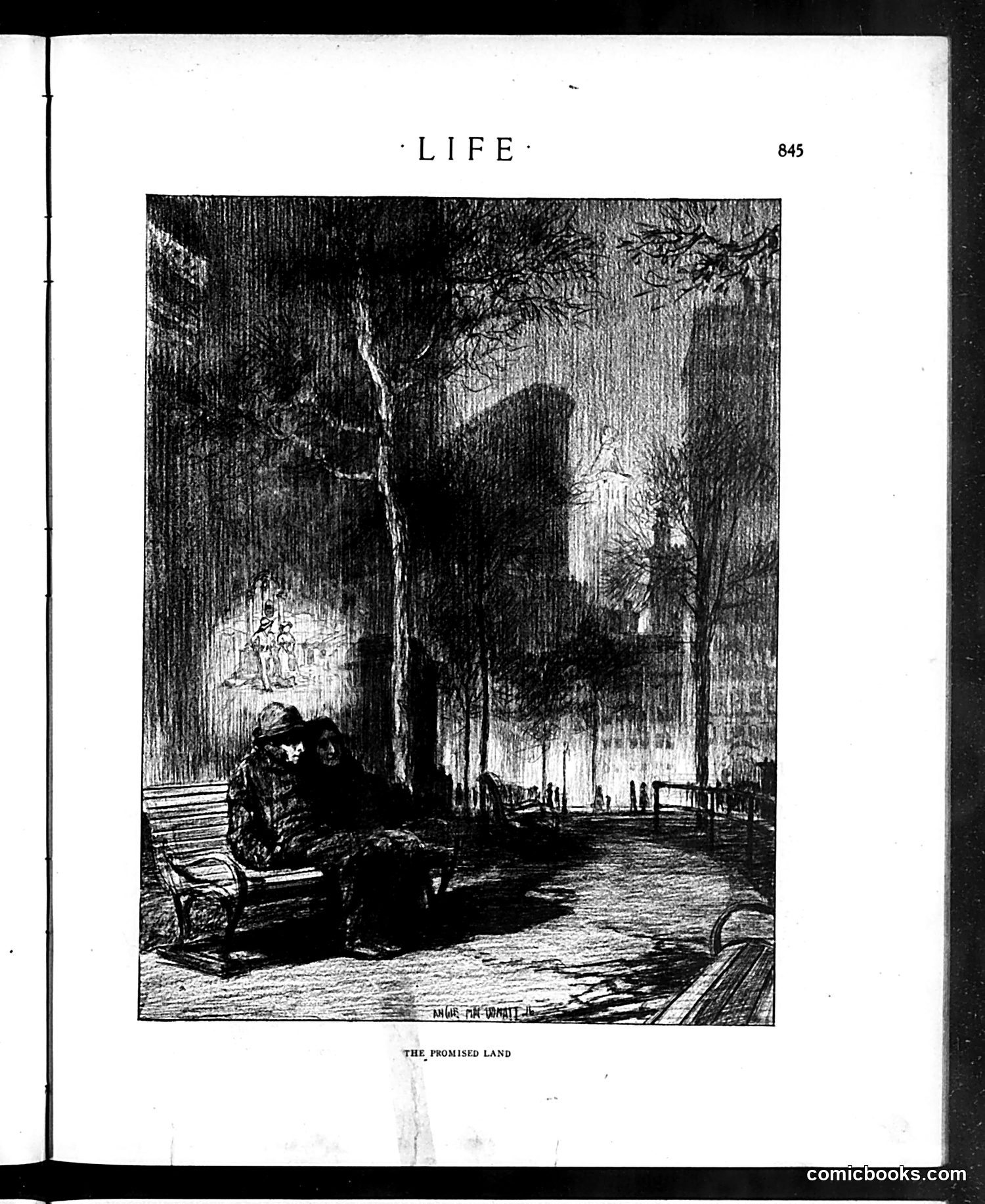
This etching depicts a nighttime park or garden scene with figures on benches beneath tall trees. The title "The Promised Land" suggests social commentary, likely referencing idealized expectations versus harsh reality. The dark, shadowy atmosphere and the figures' postures suggest melancholy or desperation rather than fulfillment. The composition—with people isolated on benches in a dimly-lit urban green space—appears to critique unfulfilled promises, possibly relating to social conditions, labor, or immigration experiences of early 20th-century America. Without additional context or a visible artist signature beyond what appears to be initials, the specific target of satire remains unclear, though the juxtaposition of "promised land" with this gloomy scene suggests ironic commentary on American ideals versus lived experience.
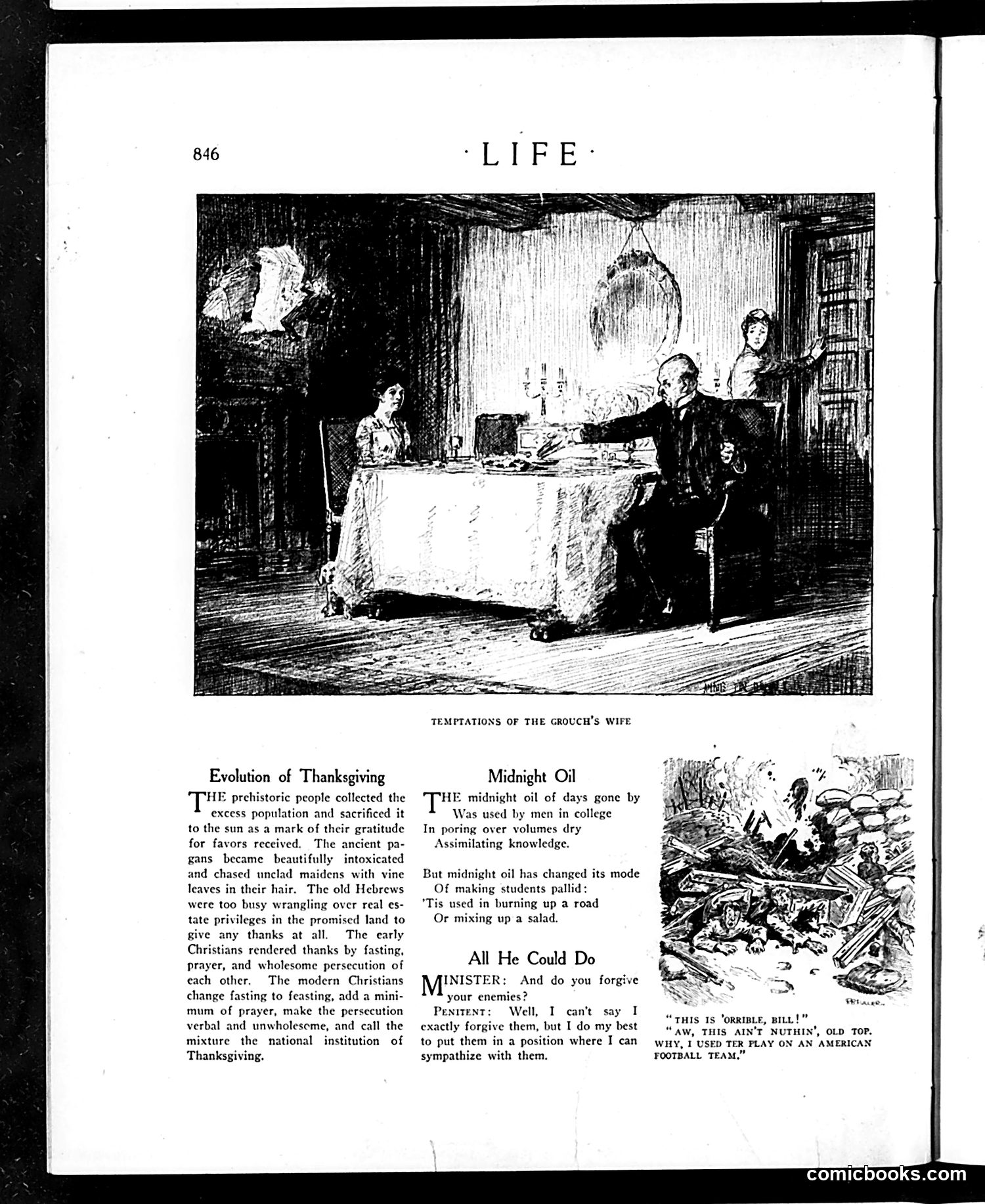
This *Life* magazine page contains three separate satirical pieces: 1. **"Temptations of the Grocer's Wife"** (main illustration): A domestic scene showing what appears to be a grocer and his wife at a table, likely depicting marital temptation or infidelity—a common Victorian/early-20th-century comedic trope. 2. **"Evolution of Thanksgiving"**: Satirizes how Thanksgiving observance changed from ancient pagan sacrifice through Christian fasting to modern secular celebration—critiquing the shift from religious meaning to commercialized tradition. 3. **"Midnight Oil"**: A joke about college students burning "midnight oil" (studying late). Modern usage has changed it from studying to other activities—here portrayed as burning oil for practical purposes instead. 4. **"All He Could Do"**: A clergy joke about forgiving enemies by strategically positioning them to be sympathized with rather than forgiven.
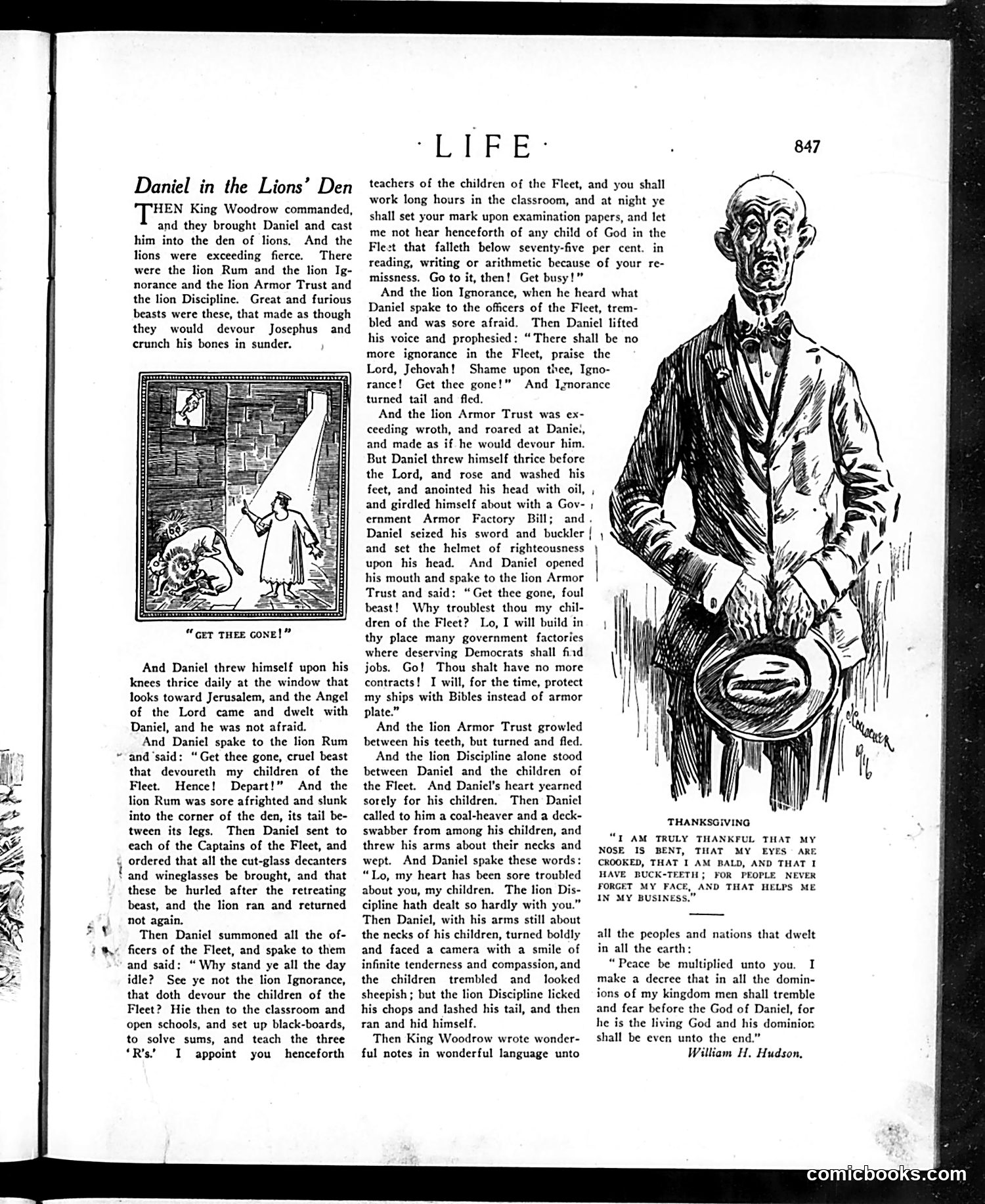
This is a satirical retelling of the biblical story, reframed as political allegory. "King Woodrow" (President Woodrow Wilson) commands that Daniel be cast into a den with lions representing government bureaucracy—specifically the "lion Ignorance," "lion Armor Trust," and "lion Discipline." The satire criticizes Wilson's educational policies and control over schools. Daniel prophesies against ignorance in the Fleet (Navy), and ultimately triumphs through faith and righteousness. The lions—representing institutional failures and corporate interests—are defeated. The illustration shows a figure (Daniel) confronting a menacing lion. This mocks Wilson's attempts to reform education and military establishments, suggesting his policies created monsters rather than solving problems. The piece critiques government overreach in schools.
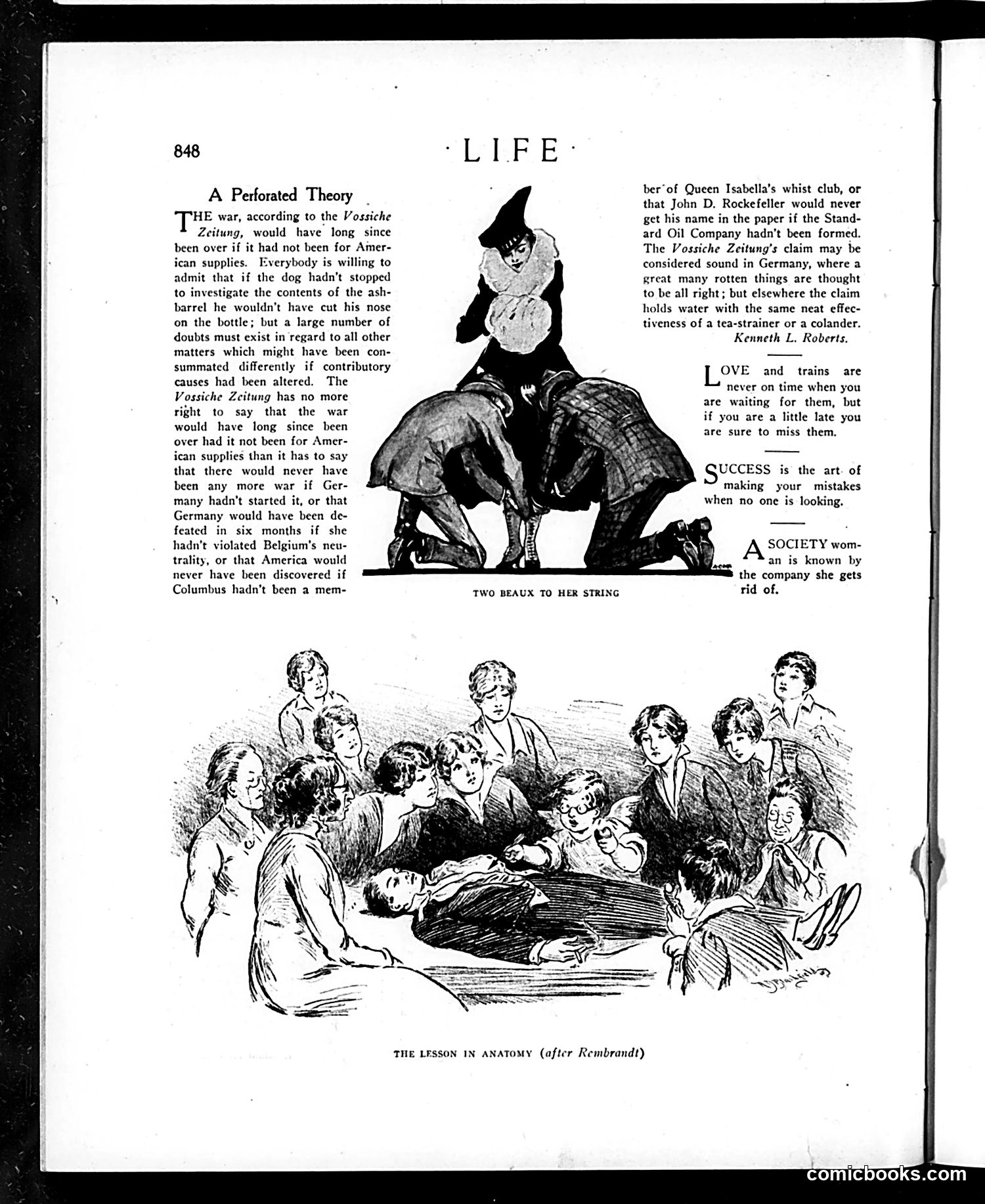
This page contains satirical commentary and illustrations typical of *Life* magazine's editorial style. **"A Perforated Theory"** argues against the *Vossische Zeitung's* claim that a dog investigating a barrel prevented American entry into WWI. The author contends that Germany's own actions—not a dog—caused American intervention, and that Germany would have lost anyway due to violating Belgium's neutrality. **The upper illustration**, "Two Beaux to Her String," depicts a woman riding two donkeys, likely satirizing female dating choices or romantic entanglements. **Below**, "The Lesson in Anatomy (after Rembrandt)" parodies the famous Rembrandt painting, substituting a woman's body for the anatomical subject—a joke about society women's superficiality or scandal. The scattered aphorisms (about love, success, society) are typical *Life* filler observations.
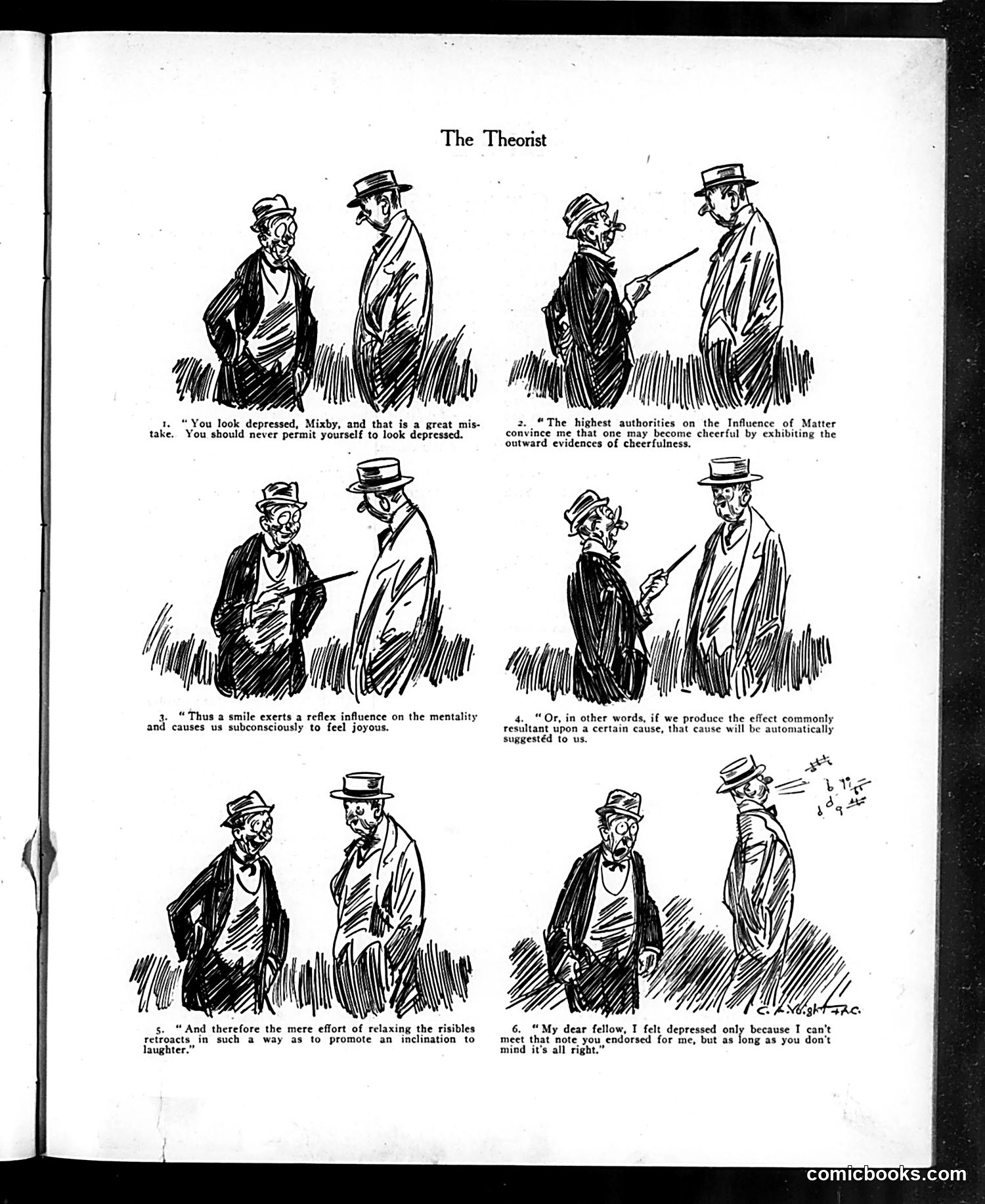
This six-panel comic satirizes a philosophical charlatan who preaches positive-thinking theory to a depressed man. The "theorist" (the taller figure in each panel) expounds pseudo-intellectual concepts about mental influence and the power of smiling, citing "highest authorities" and abstract principles about cause-and-effect on mood. The joke's progression shows the theorist becoming increasingly animated and convinced by his own theories, while the other man remains visibly miserable throughout. The final panel reveals the theorist's hypocrisy: when the depressed man can't endorse the theorist's own note, the theorist admits his depression "only because I can't meet that note you endorsed for me." The satire targets both self-help quackery and the theorist's disconnection from practical financial reality.
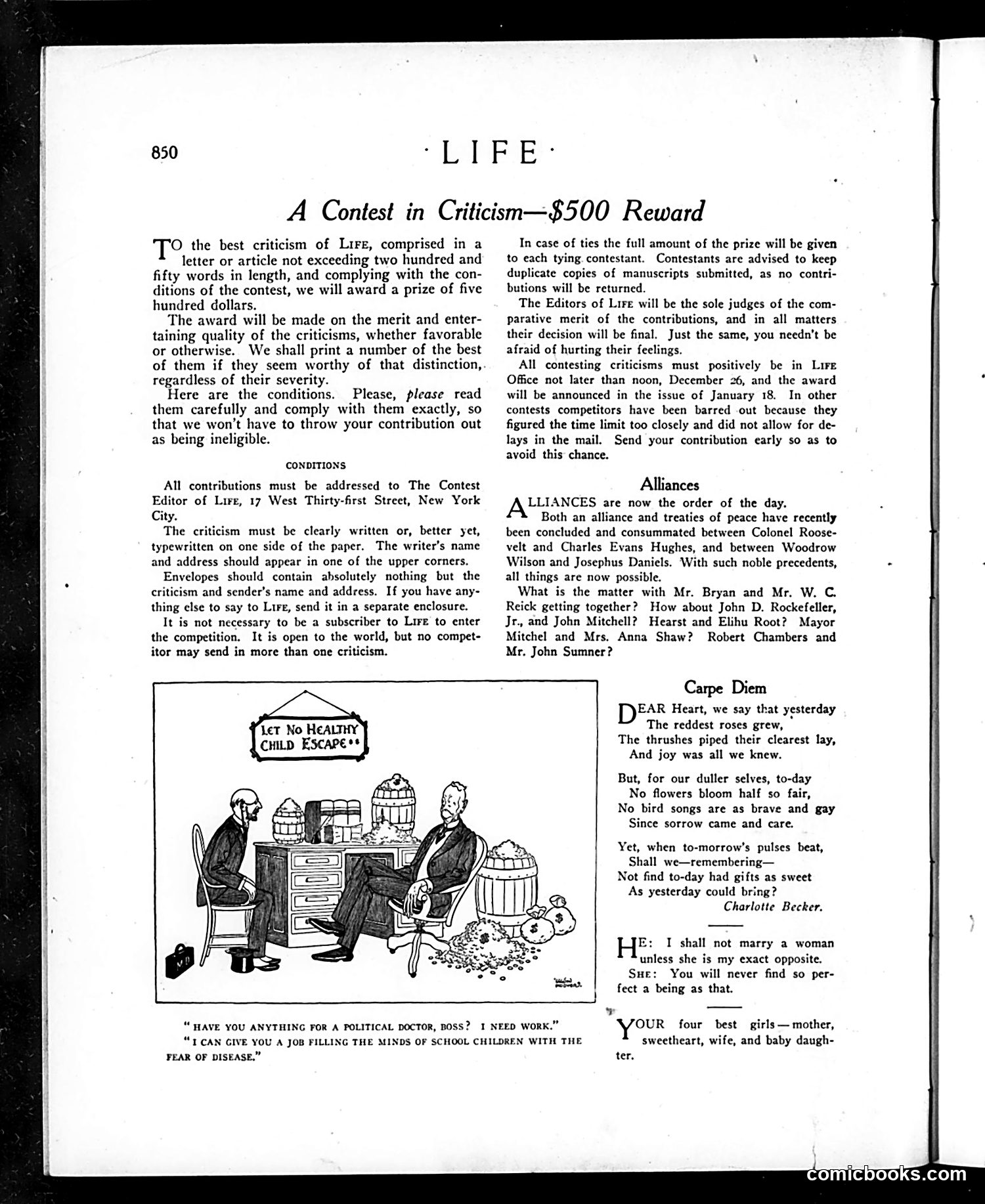
This page contains a **$500 criticism contest** announcement, a **political cartoon**, and miscellaneous literary pieces. **The Main Cartoon:** The cartoon satirizes Progressive Era health campaigns. A man labeled as seeking work offers to be a "political doctor," proposing to fill schoolchildren's minds with "fear of disease" under the banner "Let No Healthy Child Escape." This mocks overzealous public health initiatives that may have used fear-mongering tactics rather than sound education—a common Progressive-era critique of well-intentioned but heavy-handed health movements. **The "Alliances" Section:** References recent political partnerships (Roosevelt-Hughes, Wilson-Daniels) then humorously suggests absurd alliances between bitter rivals: Bryan with W.C. Reick, Rockefeller Jr. with labor leader John Mitchell, Hearst with Elihu Root, and Mayor Mitchel with suffragist Anna Shaw. The joke mocks how political expediency creates unlikely bedfellows. The remaining content—poetry and brief witticisms—serves as typical magazine filler of the era.
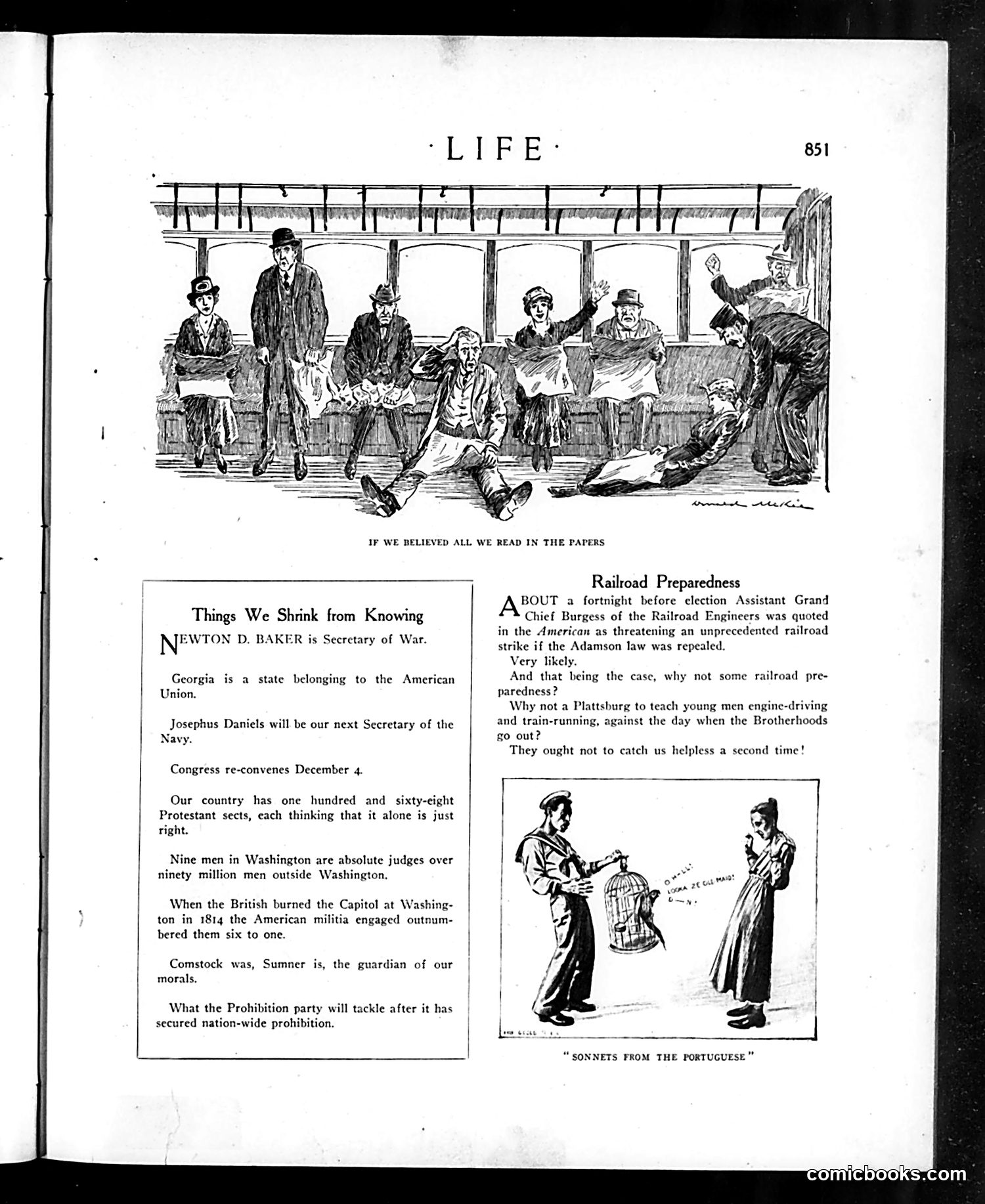
**Main Cartoon ("If We Believed All We Read in the Papers"):** Depicts commuters on public transit appearing skeptical or distressed, satirizing how newspapers present contradictory or dubious claims as fact. **"Things We Shrink from Knowing":** A satirical list of absurd or contentious statements presented as if they're controversial truths—mocking both credulous readers and sensationalist journalism. Examples include claims about cabinet appointments, religious sectarianism, and the 1814 Capitol burning. **"Railroad Preparedness":** References a threatened railroad strike over the Adamson law (which set an eight-hour workday). The author sarcastically suggests creating a "Plattsburg" training program (referencing a military preparedness camp) to train replacement workers, should the Brotherhoods (railroad unions) strike. The satire mocks both the unions' strike threat and the government's lack of preparedness—suggesting Americans shouldn't be caught helpless if labor unrest disrupts rail service. **"Sonnets from the Portuguese":** A small cartoon with unclear specific reference, appears unrelated to the page's main content.
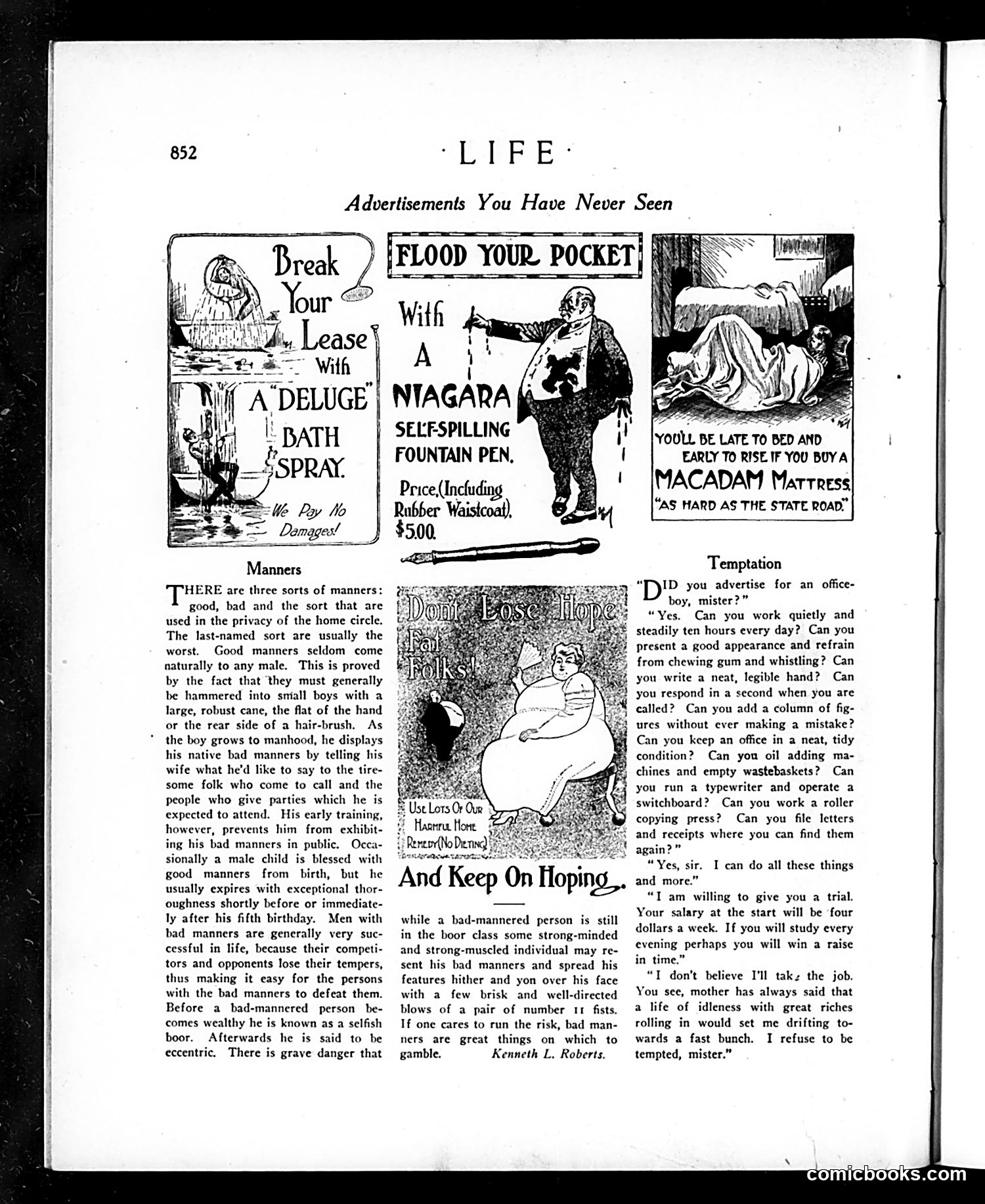
This page contains **fake advertisements** satirizing consumer products and a dialogue mocking job-seeking desperation. The fake ads ridicule absurd products: a bath spray claiming "no damages," a fountain pen that "self-spills" (defeating its purpose), and a mattress "as hard as the state road" (a complaint, not a feature). These mock aggressive marketing of obviously flawed goods. The main article, "Manners," offers cynical social commentary: it argues bad manners paradoxically succeed in business because they provoke anger in competitors, while good manners are rare and those born with them mysteriously die young. The piece suggests hypocrisy in polite society—people hide crude behavior in public while being genuinely rude at home. The "Temptation" dialogue satirizes youth unemployment and unrealistic expectations. A boy refuses a four-dollar-weekly office job because his mother warned him that idleness with wealth corrupts—the joke being that four dollars weekly is poverty, not riches, exposing the absurdity of his reasoning. Together, these pieces mock consumerism, social pretense, and economic hardship with dark humor typical of 1920s satirical magazines.
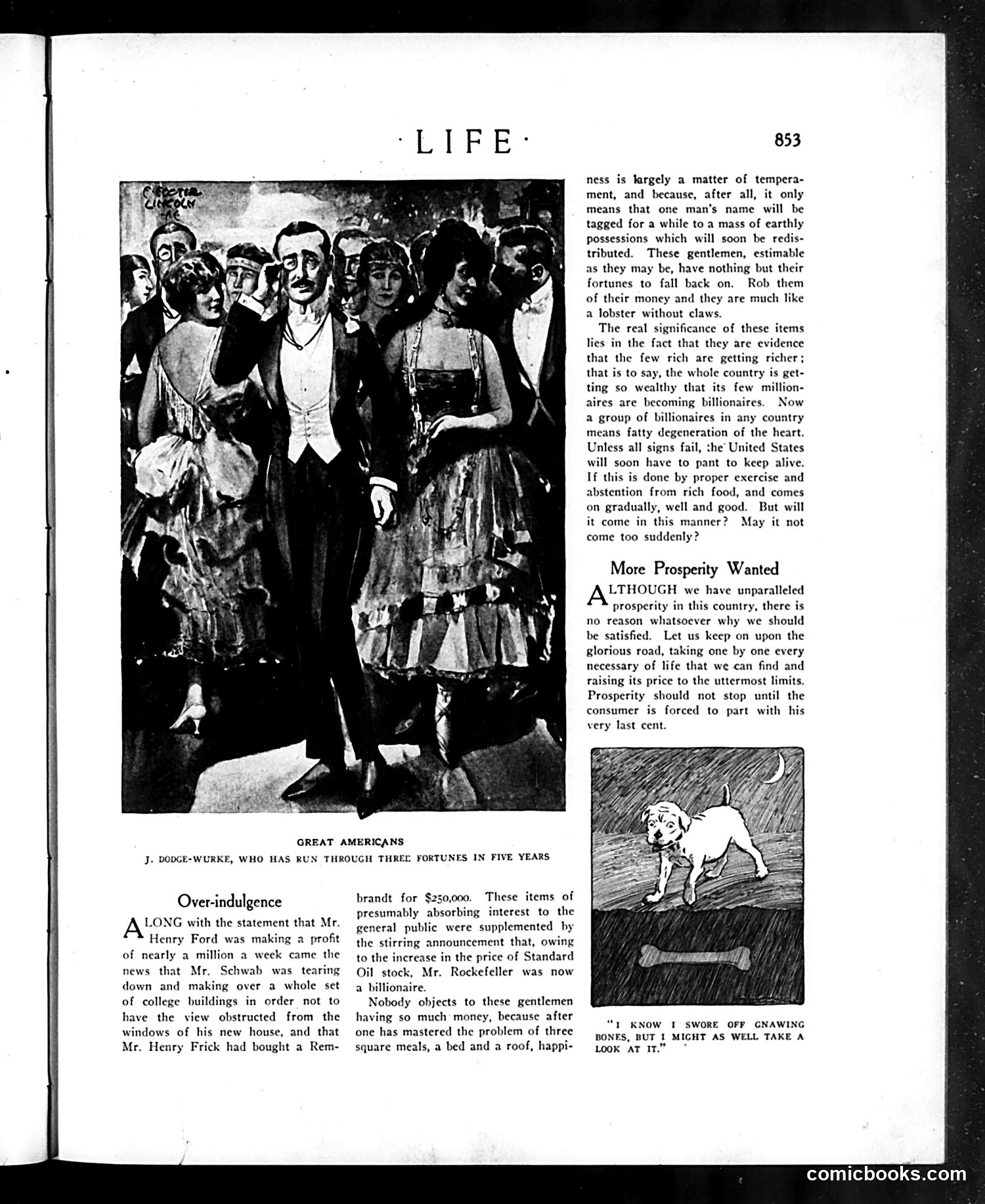
This satirical piece critiques extreme wealth accumulation among America's industrial titans (Ford, Schwab, Frick, Rockefeller) during the Gilded Age. The main illustration shows "J. Dodge-Wurke," a fictional character who squandered three fortunes in five years—likely a composite caricature representing reckless wealthy industrialists. The text argues that excessive riches concentrate in fewer hands, creating an unhealthy economy ("fatty degeneration of the heart"). The author sarcastically warns that billionaires' extravagant spending—Frick's $250,000 Rembrandt, Schwab demolishing buildings for a better view—signals the country is getting dangerously wealthy too quickly, potentially leading to economic collapse. The bottom cartoon shows a starving dog, captioned about swearing off gnawing bones—a visual metaphor for the common person struggling while the wealthy indulge, mocking the pretense of restraint. The satire warns: unchecked wealth inequality and conspicuous consumption threaten national stability.
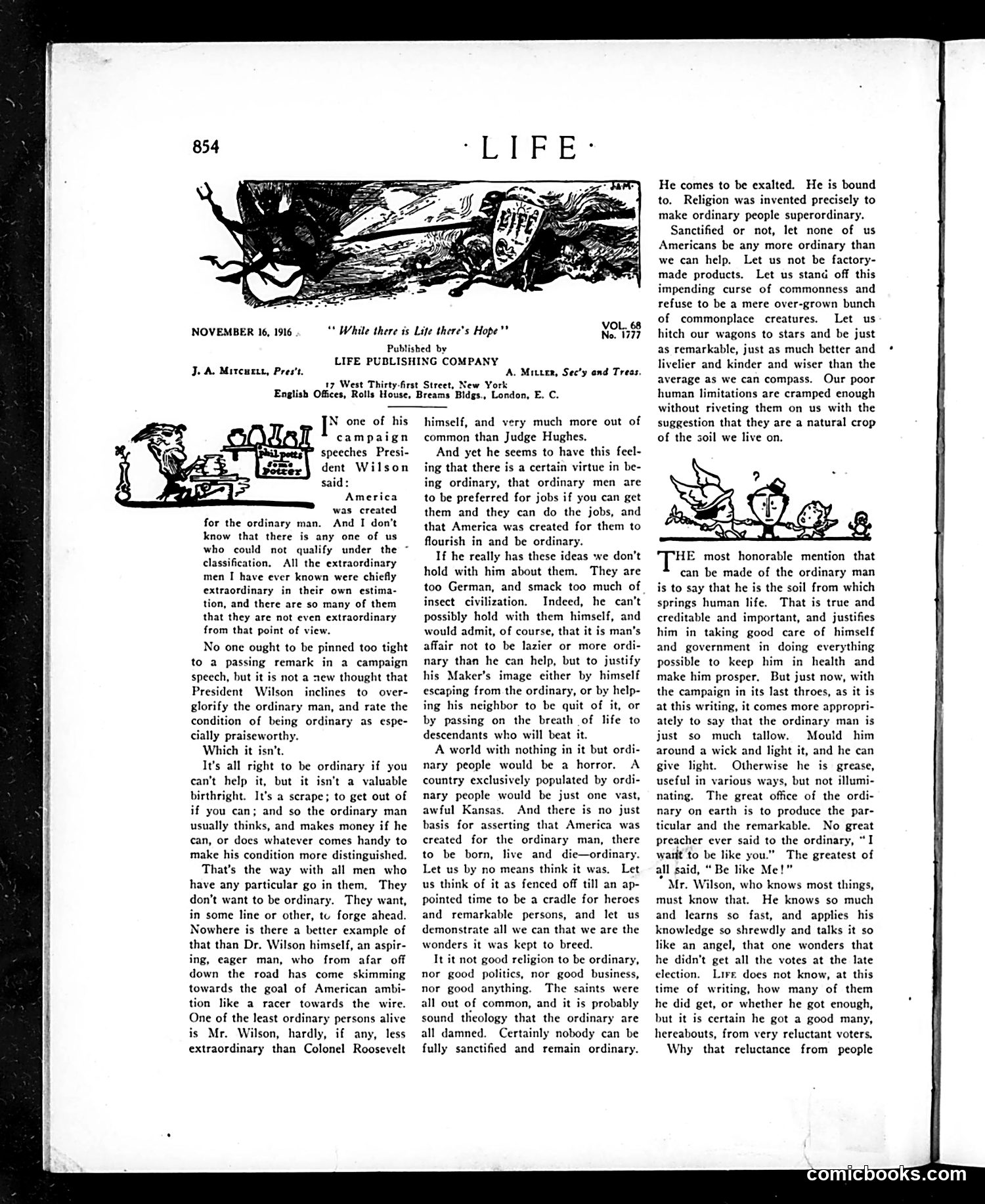
This is a satirical editorial critiquing President Wilson's campaign rhetoric celebrating "the ordinary man." The cartoonist argues Wilson's praise of ordinariness is hypocritical—Wilson himself is ambitious and extraordinary, having climbed from academic to presidential heights. The piece mocks Wilson's claim that America was created for ordinary people, calling such ideas "too German" (a damning reference during WWI era) and arguing that ordinariness is something to escape, not celebrate. The author contends a nation of only ordinary people would be "a horror" and "just one vast, awful Kansas"—mocking middle America. The satire's core point: Wilson romanticizes the common man while embodying ambition himself. The editorial advocates that Americans should aspire beyond ordinariness through religion, business, and personal achievement—rejecting the leveling ideology the author attributes to Wilson.
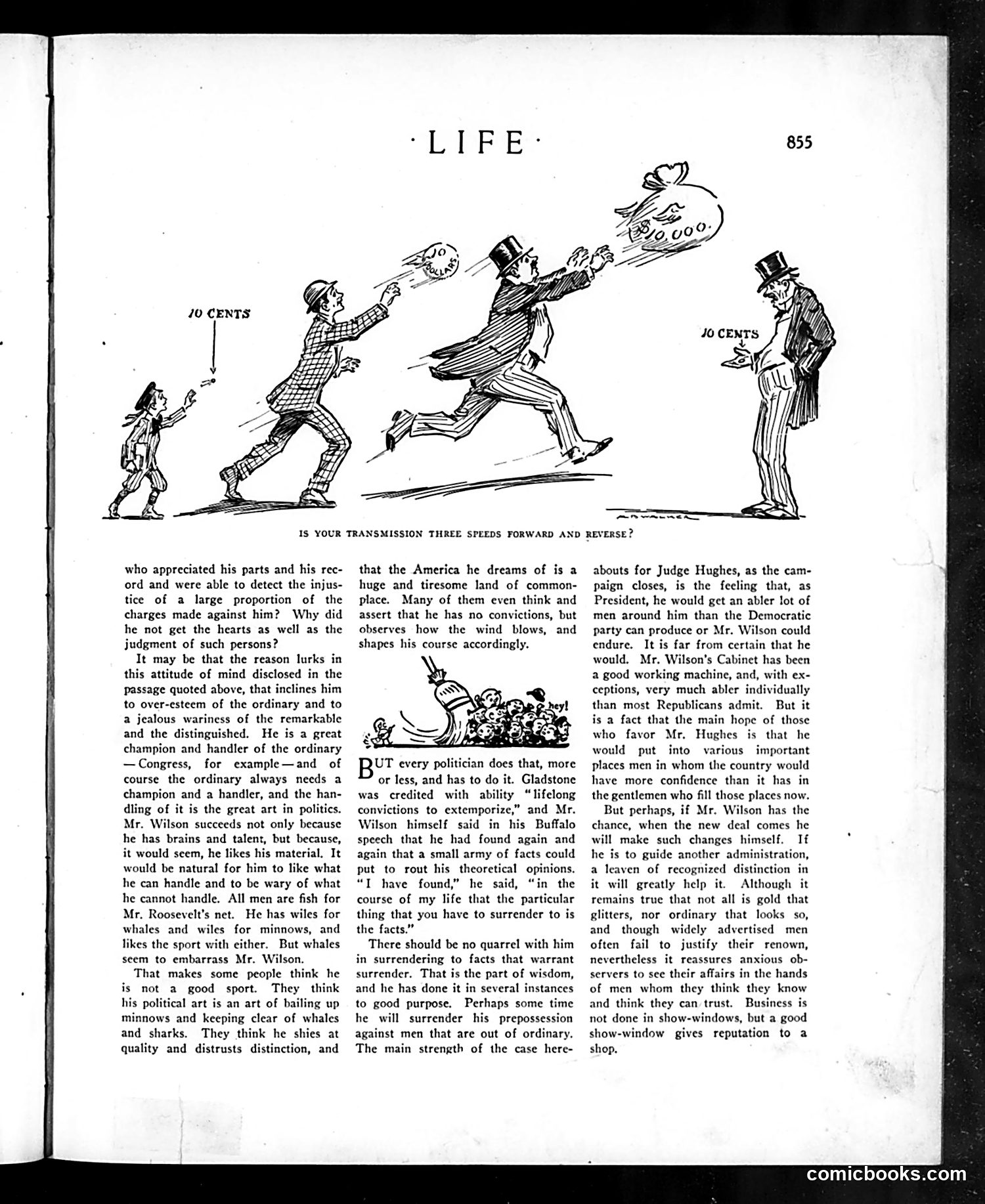
**The Cartoon**: "Is Your Transmission Three Speeds Forward and Reverse?" depicts a progression of figures juggling money bags, scaling upward from a small child labeled "10 CENTS" through increasingly well-dressed men, to a wealthy figure holding a large "$1,000,000" bag, finally confronted by a stern gentleman in a top hat. **The Satire**: This illustrates wealth accumulation and social climbing in American capitalism—the journey from poverty to riches through ambition (or luck). The final figure's stern demeanor suggests judgment or confrontation with the wealthy. **The Text's Political Context**: The article discusses President Wilson versus Judge Hughes (1916 election). It criticizes Wilson for surrounding himself with "ordinary" men rather than distinguished figures, suggesting Hughes would recruit abler advisors. The author defends Wilson's pragmatism about facts over ideology, but acknowledges voters want capable, recognizable leaders around their president. **Key Point**: Both cartoon and text examine American confidence in leadership—whether through financial success or political appointments—and question whether appearance/reputation genuinely indicates competence.
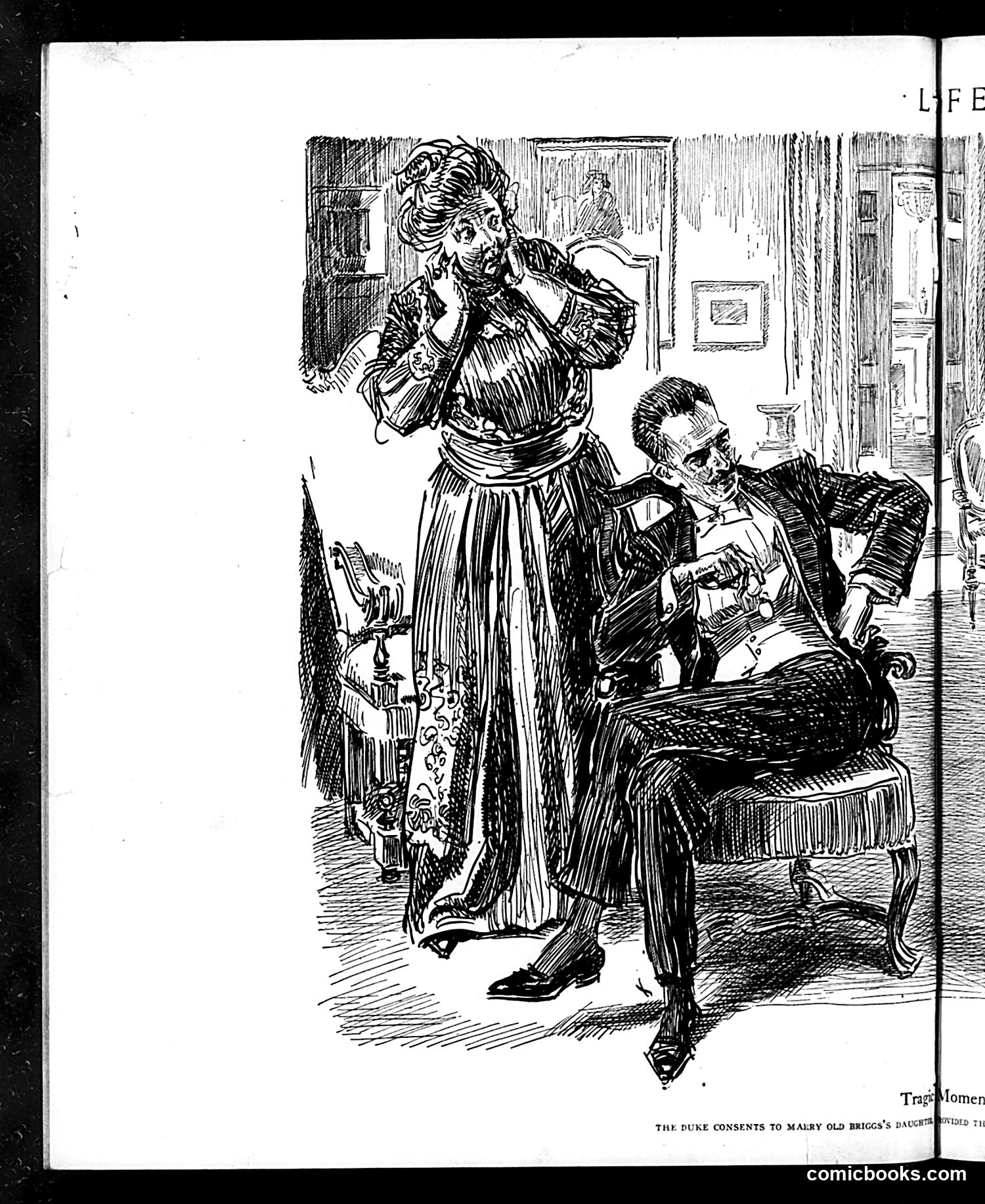
This is a satirical illustration from Life magazine depicting what appears to be a marriage negotiation or announcement. The caption reads "THE DUKE CONSENTS TO MARRY OLD BRIGGS'S DAUGHTER." The cartoon shows a wealthy or aristocratic man (identified as a "Duke") seated, while a woman stands nearby. The satire appears to target the class dynamics of marriage arrangements—specifically the union between European nobility and wealthy American families. "Old Briggs" likely refers to a wealthy American businessman, and the joke seems to be about how American industrial wealth could purchase social status through marriage to a titled European aristocrat, a common practice among the Gilded Age elite. The implicit criticism targets both the mercenary nature of such marriages and the social pretension involved in such arrangements.
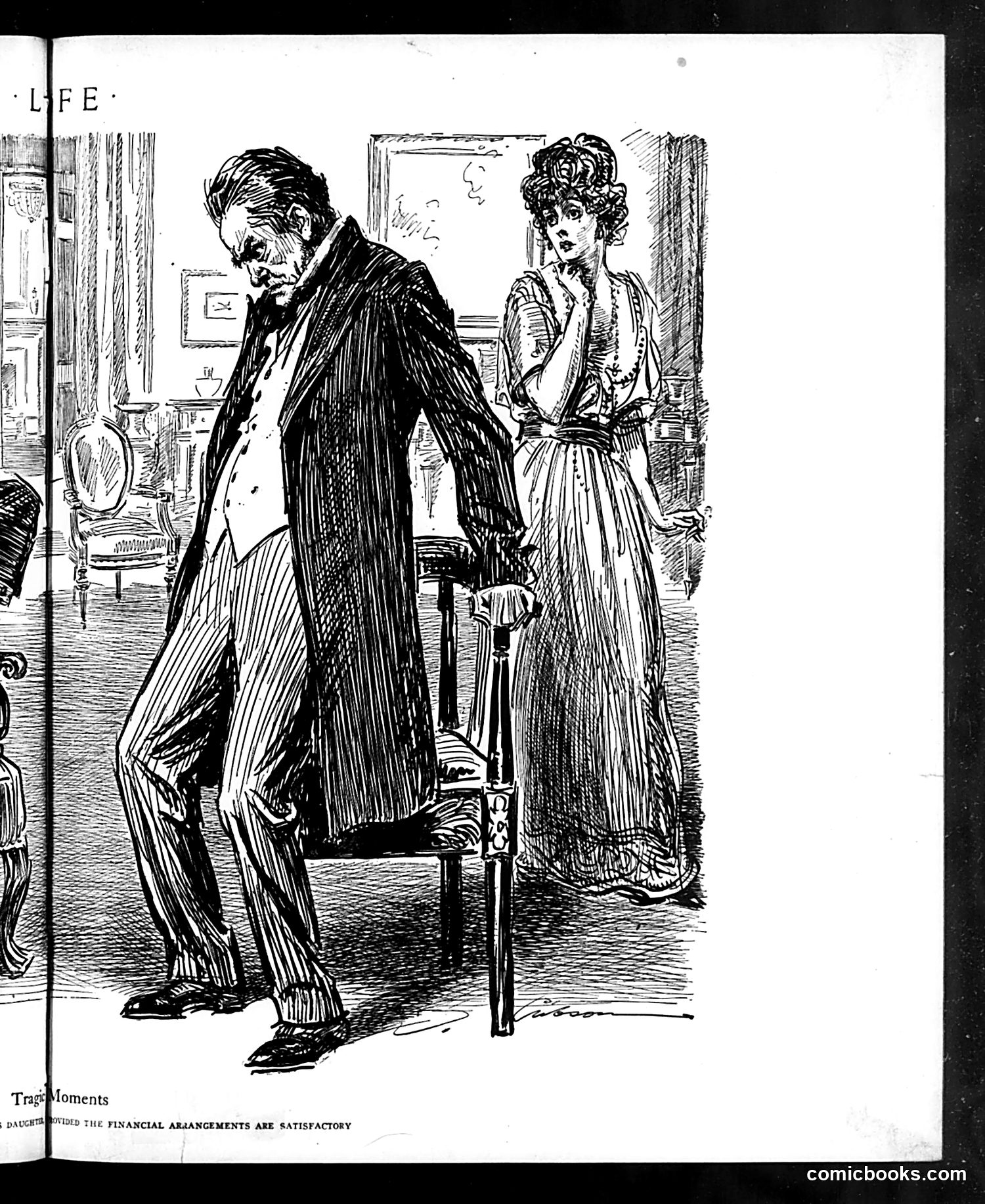
This Life magazine cartoon depicts a domestic scene where a man in formal attire stands beside a woman in an elegant dress. The caption reads "Daughter Arranged the Financial Arrangements Are Satisfactory," suggesting the cartoon satirizes marriage negotiations or financial settlements between families. The humor likely targets the transactional nature of upper-class marriages in the early 20th century, where a daughter (rather than parents) has independently negotiated favorable financial terms. This inverts traditional gender roles and patriarchal authority—instead of fathers controlling marriage contracts, this young woman has taken control of her own economic interests. The refined interior setting emphasizes the wealthy social class being mocked, portraying their materialistic approach to matrimony.
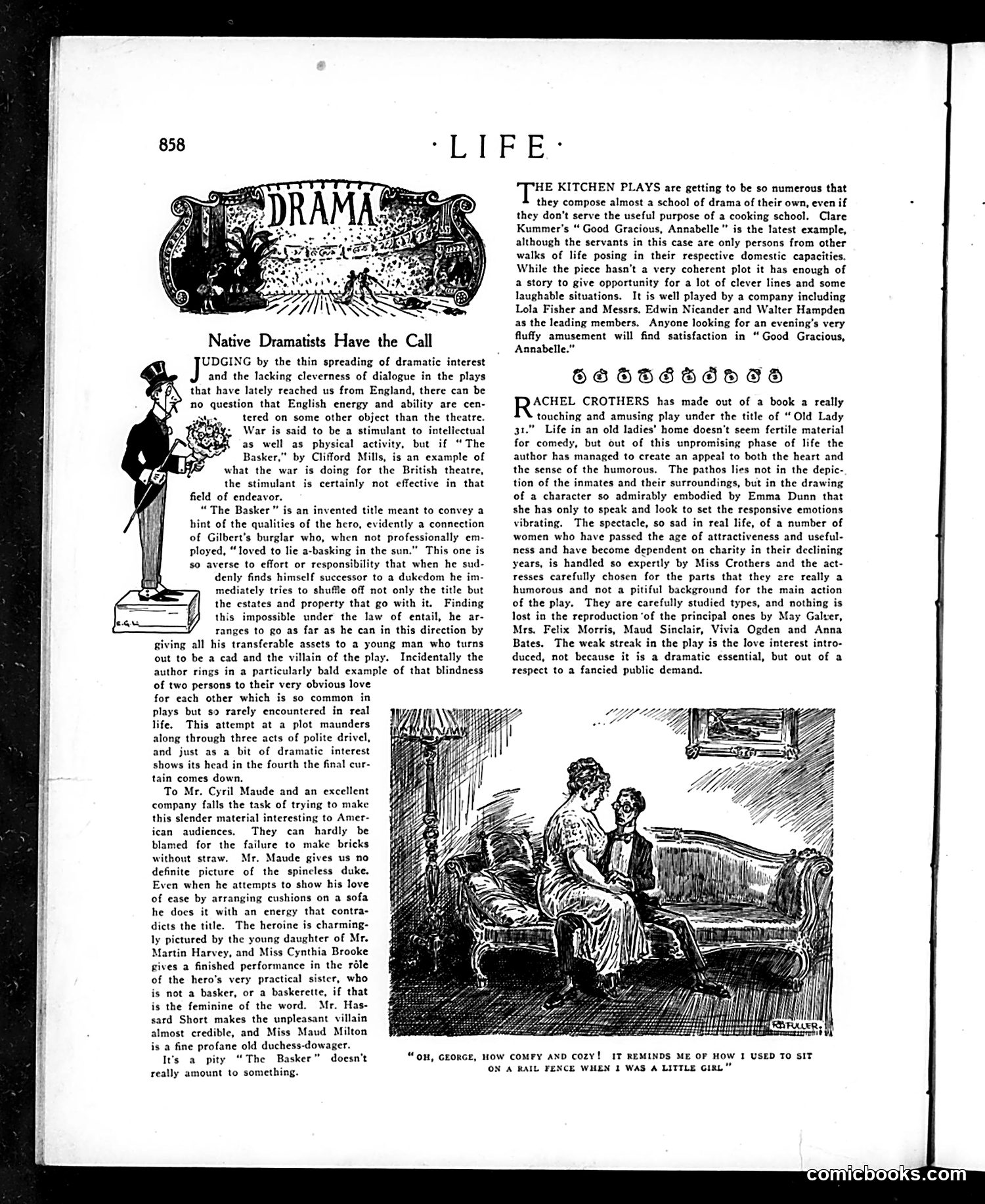
This page reviews recent theatrical productions, criticizing British drama while praising American efforts. The main article dismisses Clifford Mills's British play "The Basker" as dramatically inert—a work about a lazy duke who inherits a dukedom but lacks the energy to refuse it. The critic finds the plot tedious and poorly constructed, though praising actors like Cyril Maude for attempting to make the material work. The accompanying illustration depicts a dandified, top-hatted gentleman—representing the "basker" character—embodying indolence and frivolity. The cartoon mocks this passive archetype. Below, brief reviews praise American "kitchen plays" (domestic comedies), particularly Clare Kummer's "Good Gracious, Annabelle" and Rachel Crothers's "Old Lady 31," finding them clever and engaging despite humble settings. The overall message: American playwrights and producers are outperforming their British counterparts, even with modest material.
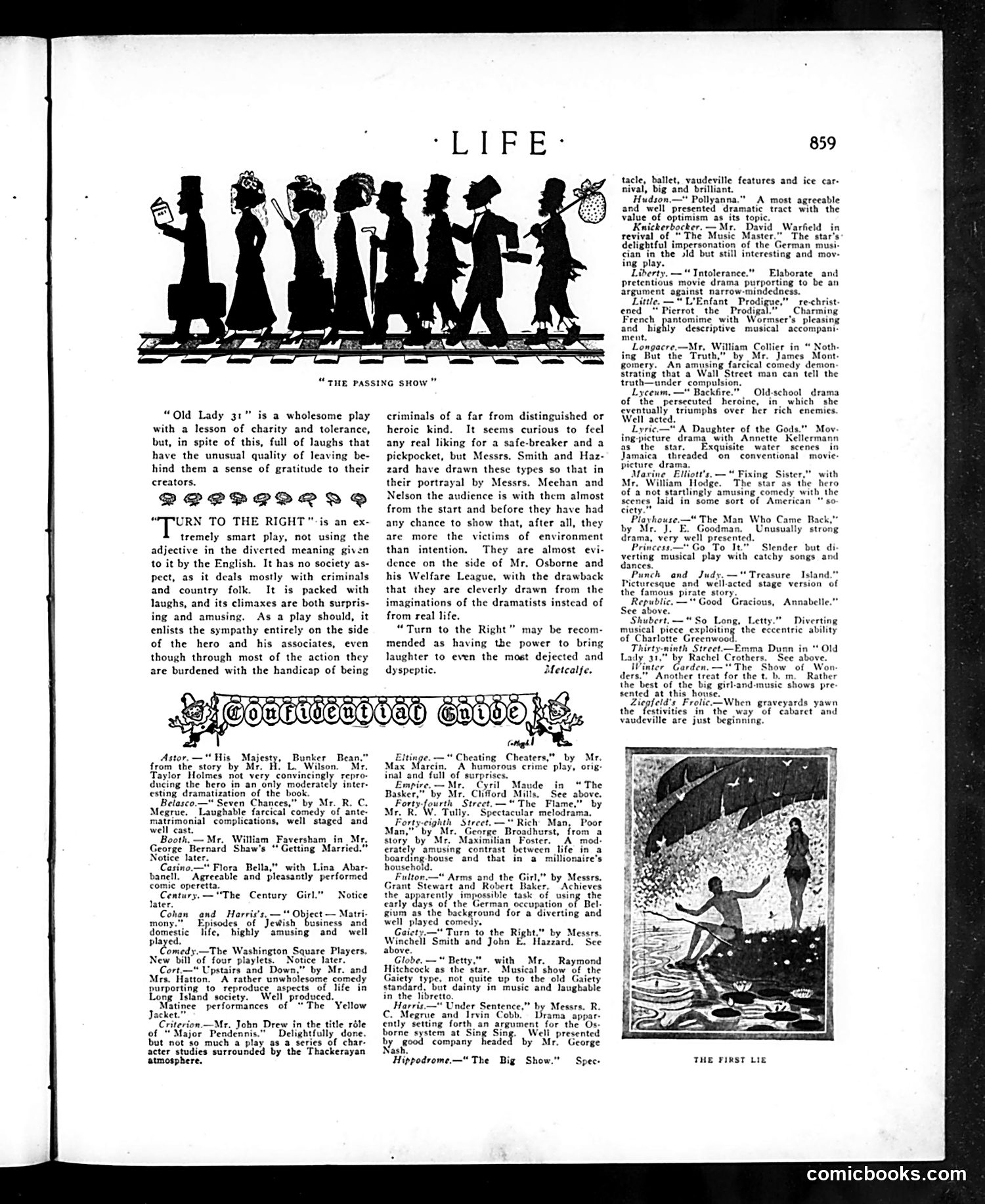
This page contains theater reviews from Life magazine's arts section. The silhouette illustration at top depicts a procession of elegantly dressed figures in top hats and formal wear—a visual representation of Broadway society and theatergoers of the era. The reviews critique several contemporary plays, focusing on character-driven comedies and melodramas. The critic notably praises "Turn to the Right" for its sympathetic portrayal of criminals and petty thieves (a safe-breaker and pickpocket) as victims of circumstance rather than inherent villainy—reflecting Progressive-era social attitudes about environmental determinism versus moral judgment. "Old Lady 31" receives praise for combining humor with "charity and tolerance." The page functions as a guide for affluent readers seeking entertainment recommendations, with reviews organized by theater venue (Astor, Belasco, Booth, Casino, etc.), reflecting New York's active early-20th-century theatrical district.
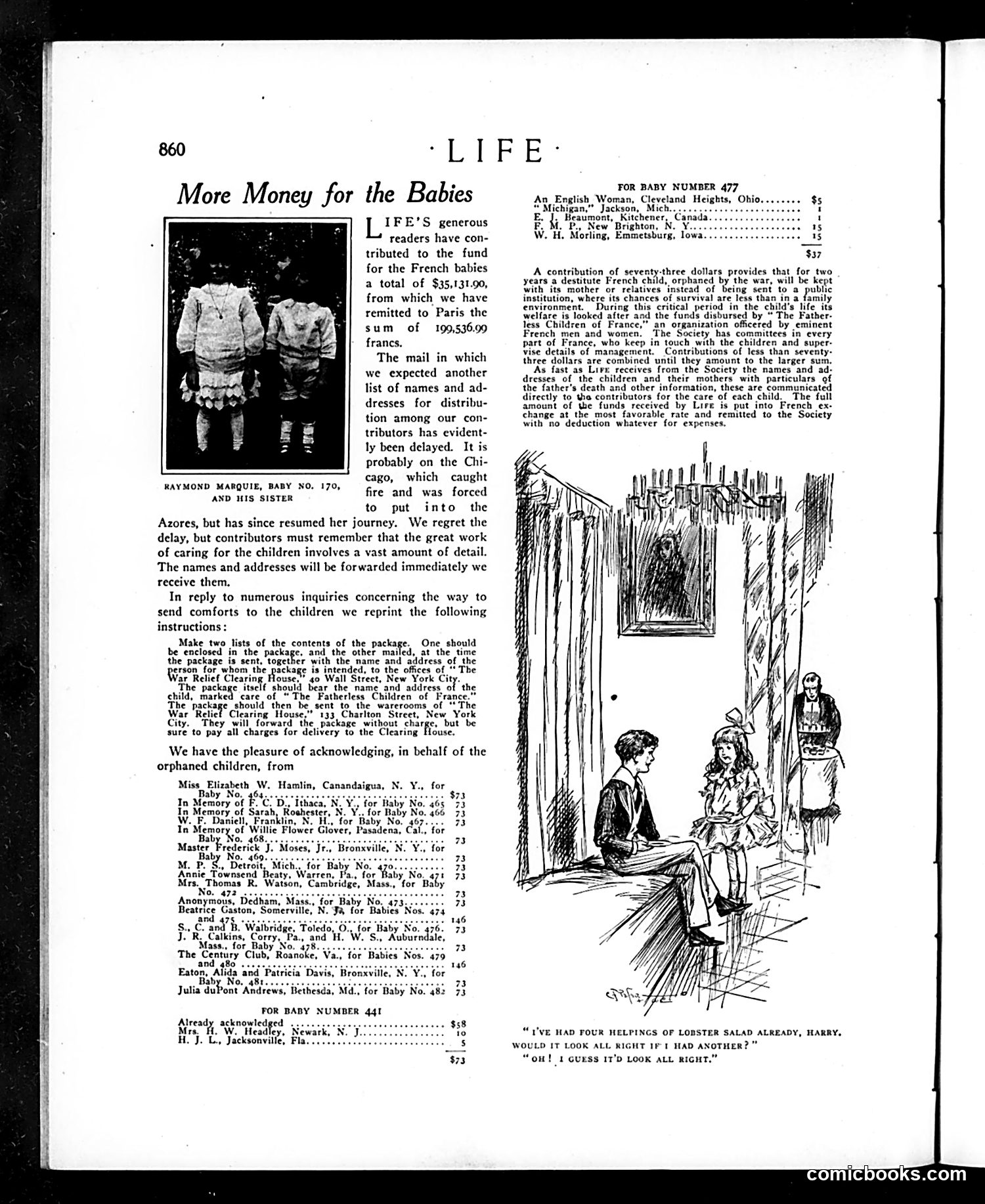
This page documents a WWI-era charitable campaign to support French orphans. The headline photo shows children in tattered clothes—victims of the war in France. The main article describes Life magazine's fund to support French war orphans, explaining that readers have contributed $15,131 toward caring for parentless children. Rather than placing them in institutions with poor survival rates, contributions ($73 each) allow children to remain with mothers or relatives for two years while the "Fatherless Children of France" organization manages the arrangement. The page lists donors and their designated baby recipients, creating a personal connection between American contributors and specific French children—a common early 20th-century charitable practice. The cartoon at bottom satirizes wealthy indulgence: a woman tells her servant she's had four lobster salads already but wants another, joking it would "look all right" if she kept ordering. This contrasts sharply with the orphan crisis described above, highlighting disparities between American comfort and European suffering.
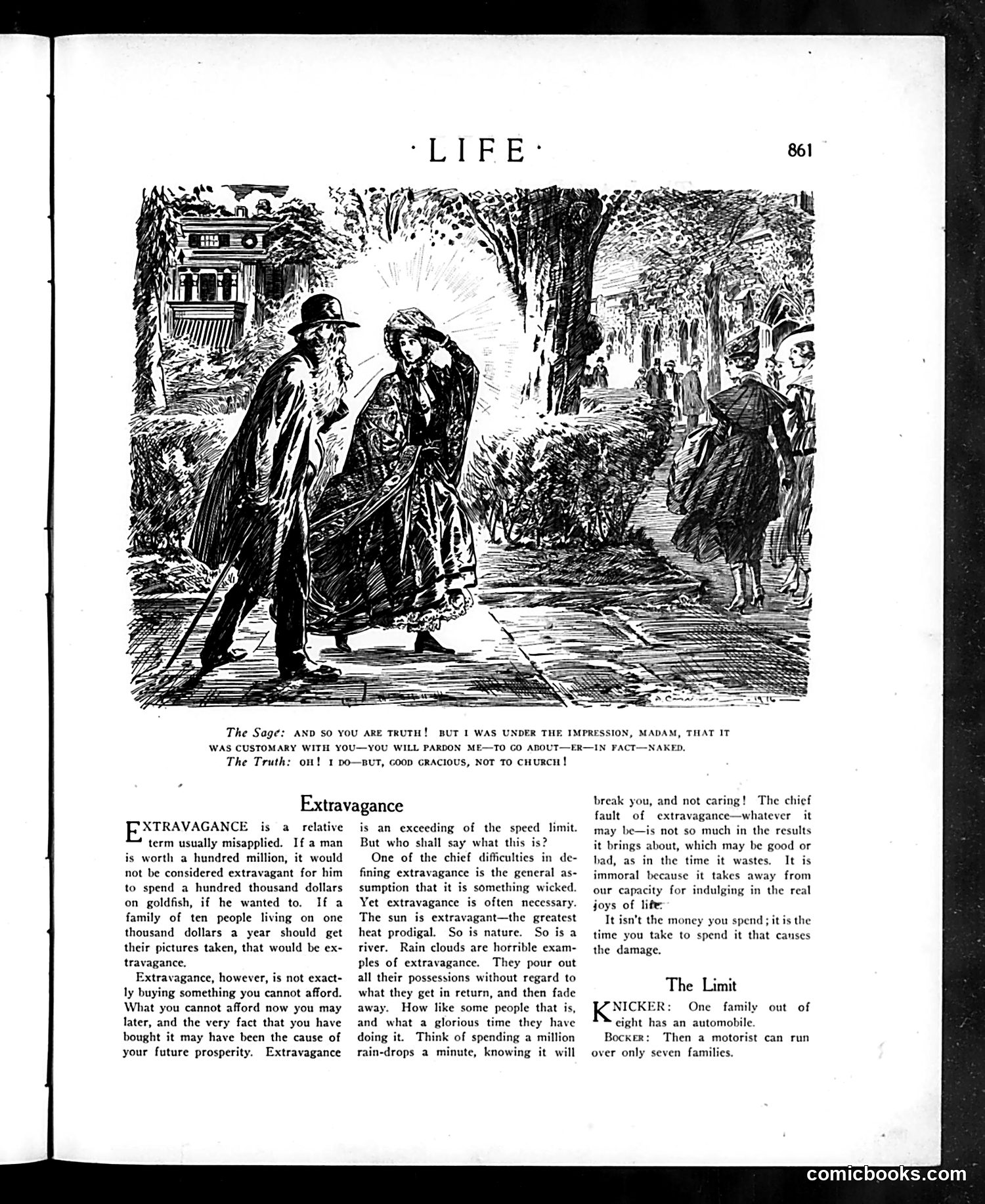
This Life magazine page contains two distinct satirical pieces: **The Cartoon (top):** A visual joke about "Truth" and propriety. A sage confronts a woman claiming to be "Truth," sarcastically noting that Truth traditionally goes around naked—so why is she dressed for church? The humor mocks hypocrisy: people invoke "truth" selectively while adhering to social conventions. **"Extravagance" (essay):** A philosophical defense of spending and excess. The author argues extravagance is relative and often necessary (citing nature as example). The real sin isn't spending money but wasting *time* doing so, which steals from life's genuine pleasures. **"The Limit" (joke):** Dark humor about automobile fatalities. If one family owns a car, a motorist can only kill seven families maximum—implying one family member will be the motorist themselves. It satirizes the period's growing concern about automobile deaths as a modern social problem. The page reflects early 20th-century anxieties about consumer culture, morality, and new technology's dangers.
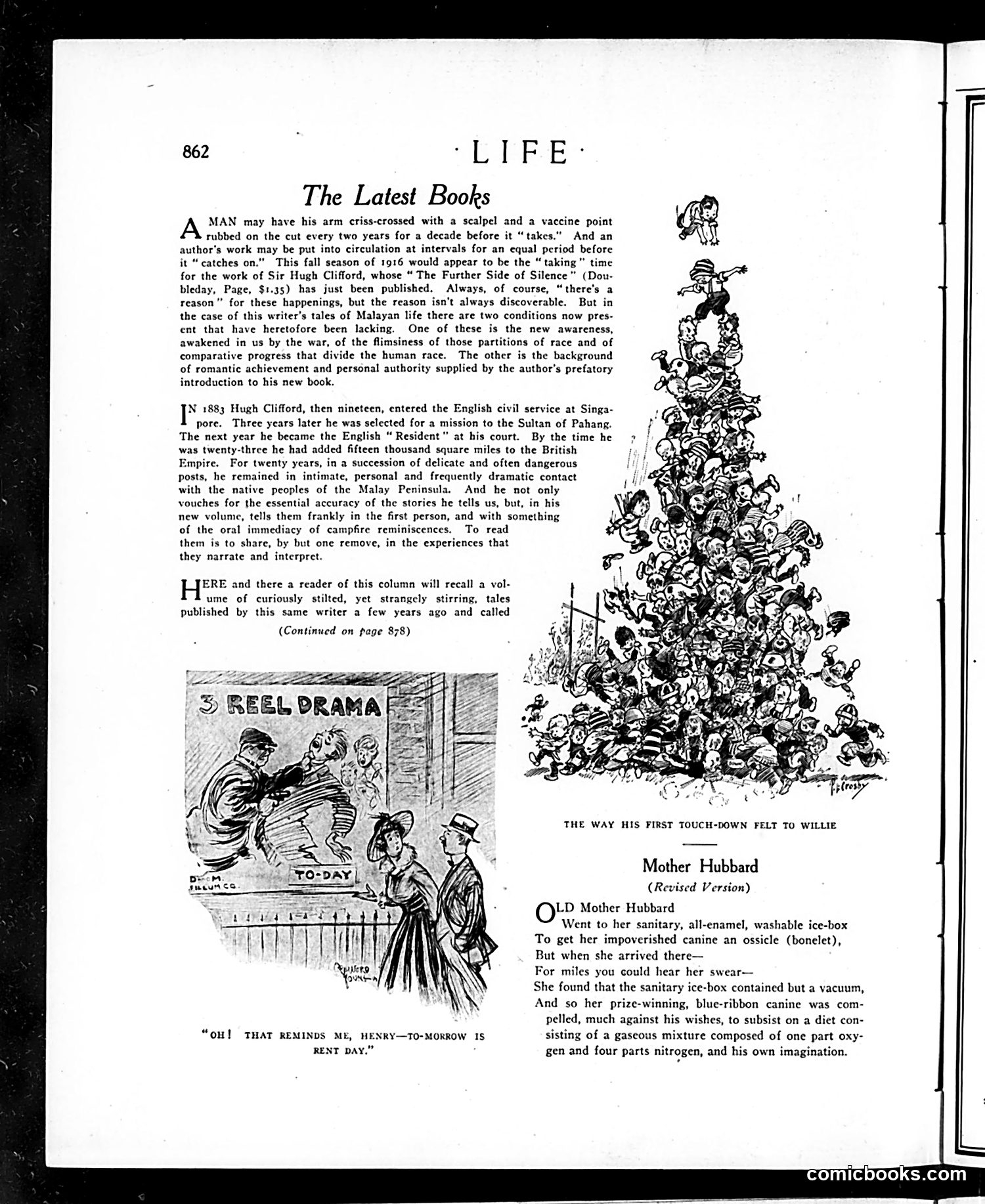
This page contains a book review of Hugh Clifford's "The Further Side of Silence" (1916), a collection of Malayan tales. The text explains Clifford's credibility: he served in the British colonial administration in Malaysia starting in 1883, becoming a "Resident" at age 22 and personally expanding British imperial territory. His firsthand experience with indigenous peoples lends authority to his fiction. The humor piece "Mother Hubbard (Revised Version)" is a satirical nursery rhyme update. It mocks modern domestic consumerism: the old rhyme's "bare cupboard" becomes a fancy "sanitary, all-enamel, washable ice-box" that's equally empty. The punchline—the starving dog must survive on "oxygen and four parts nitrogen" (air) and imagination—ridicules how advertising promises modern conveniences that don't actually improve people's material lives. The sidebar cartoon appears unrelated editorial commentary on contemporary events.
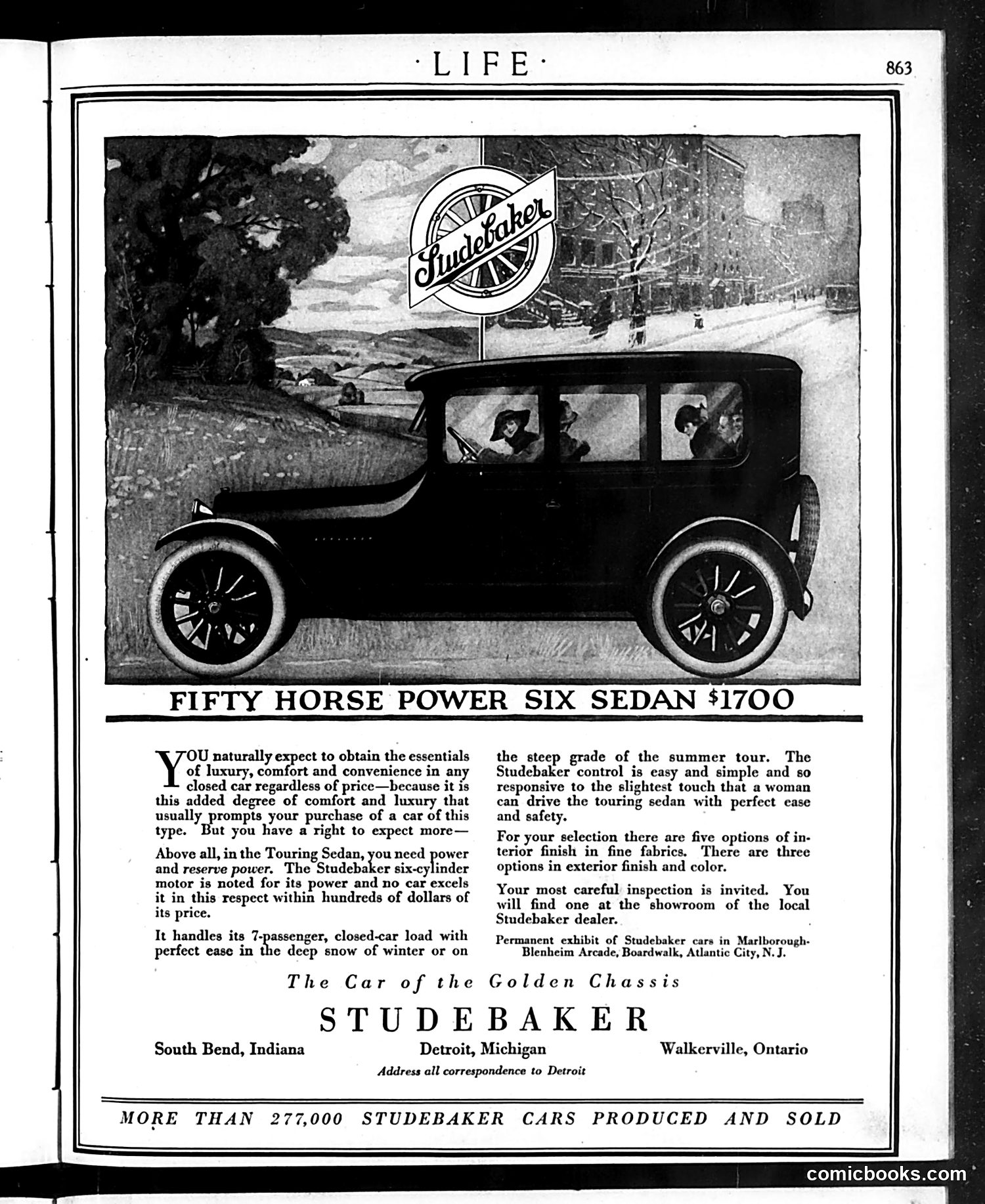
This page is **primarily automobile advertising**, not political satire or editorial cartooning. It advertises the Studebaker "Fifty Horse Power Six Sedan" priced at $1,700. The image shows a silhouetted side-view of the car with passengers visible through windows, positioned against idealized pastoral and urban backdrop scenes. The accompanying text emphasizes the car's power, reliability, ease of control ("a woman can drive the touring sedan with perfect ease"), and luxury features. The phrase "Car of the Golden Chassis" appears to be Studebaker's marketing slogan. The ad notes the company has produced over 277,000 vehicles and maintains showrooms in multiple locations. **There is no satirical content here**—this is straightforward early-20th-century automotive marketing aimed at middle-to-upper-class buyers, emphasizing mechanical superiority and comfort as selling points.
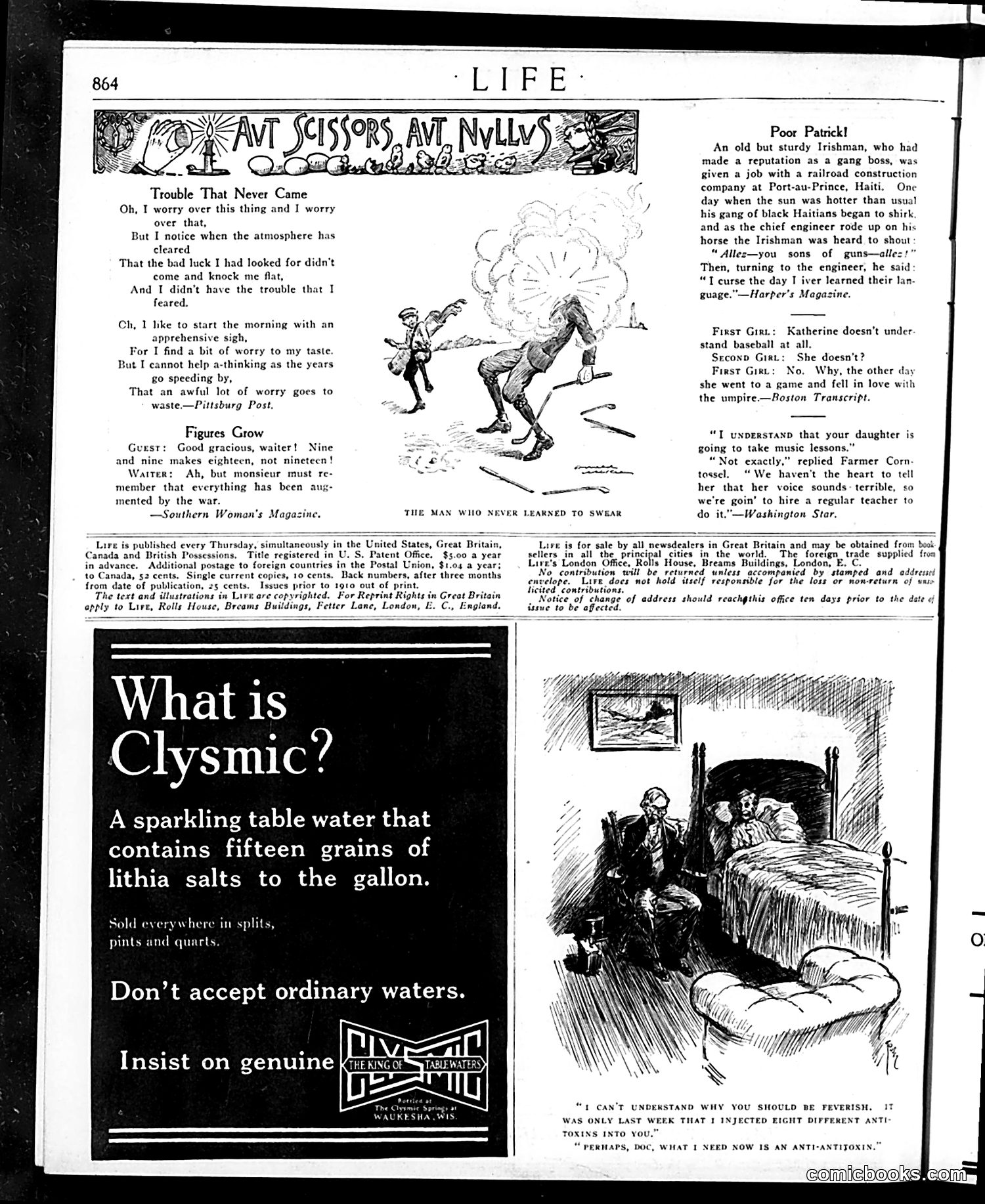
This page from Life magazine contains several short humorous pieces typical of early-20th-century satirical journalism: **"Trouble That Never Came"** — A poem about worrying over imagined problems that never materialize, suggesting people waste energy on anxiety. **"Figures Grow"** — A brief joke about wartime inflation: a waiter insists 9+9=19 because "everything has been augmented by the war," mocking how WWI drove up prices across society. **"The Man Who Never Learned to Swear"** — An Irish gang boss in Haiti curses his workers in English ("alles"), then regrets learning the local language, implying cultural/linguistic frustration in foreign work settings. The remaining items are brief jokes about baseball, music lessons, and medical treatment (the "anti-antitoxin" joke about contradictory treatments). The page also contains a Clysmic sparkling water advertisement and an unrelated cartoon about a bedridden patient. These are light, everyday humor pieces rather than political satire—typical of Life's comedic content during the WWI era.
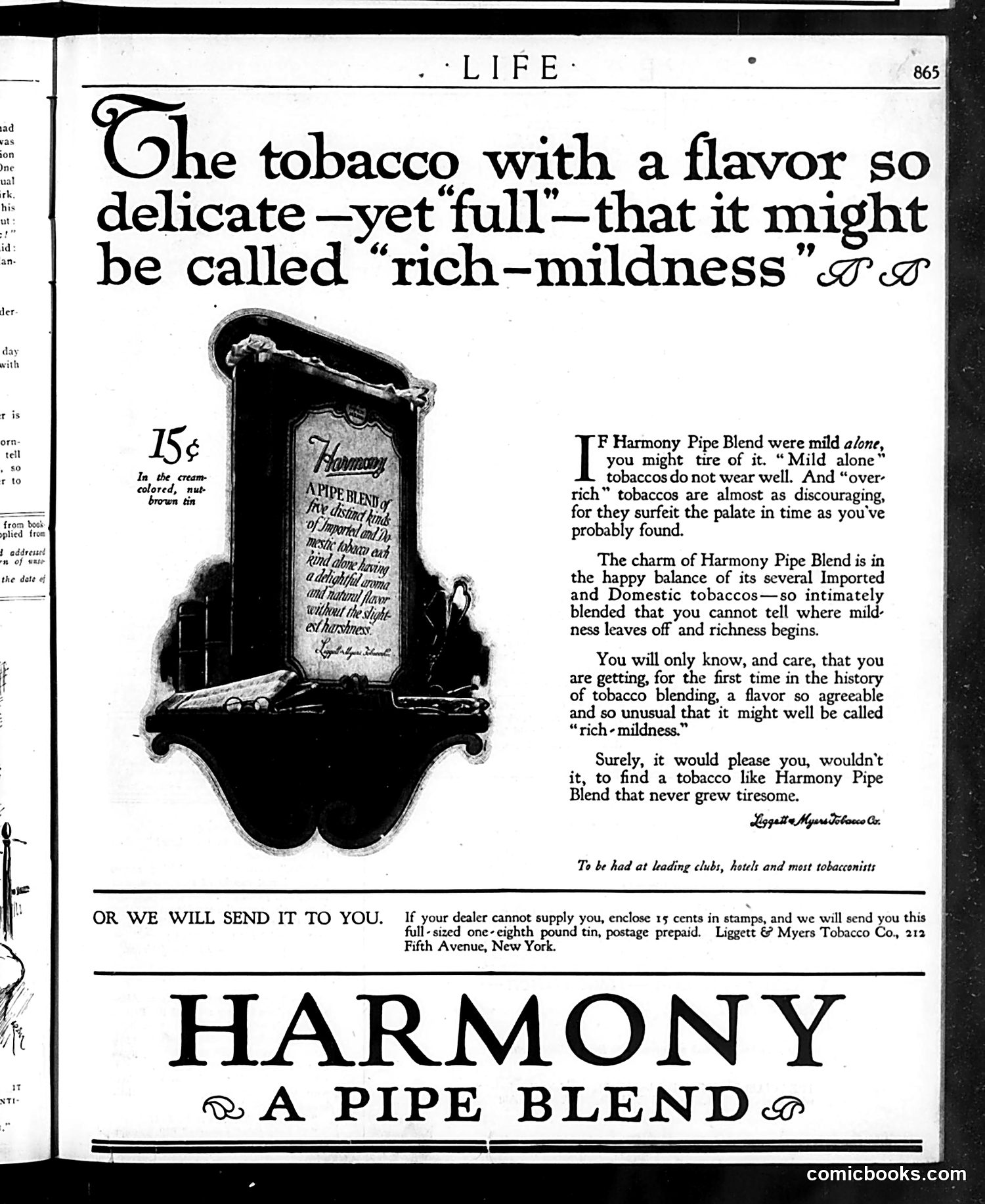
This is a **tobacco advertisement**, not satire or political commentary. It appears in *Life* magazine (page 865), promoting Harmony Pipe Blend tobacco by Liggett & Myers. The ad uses the marketing concept of "rich-mildness"—claiming the product balances two desirable but opposing qualities: mild flavor (won't tire the smoker) and richness (full taste). The decorative illustration shows a pipe tobacco tin in an ornate black frame. The pitch targets pipe smokers at "leading clubs, hotels" (upscale venues), emphasizing this blend's supposedly unique balance. The ad offers mail-order delivery for 15 cents in stamps. **For modern readers:** This represents early 20th-century tobacco marketing before health warnings, when such products were advertised in mainstream magazines as desirable consumer goods for leisured gentlemen.
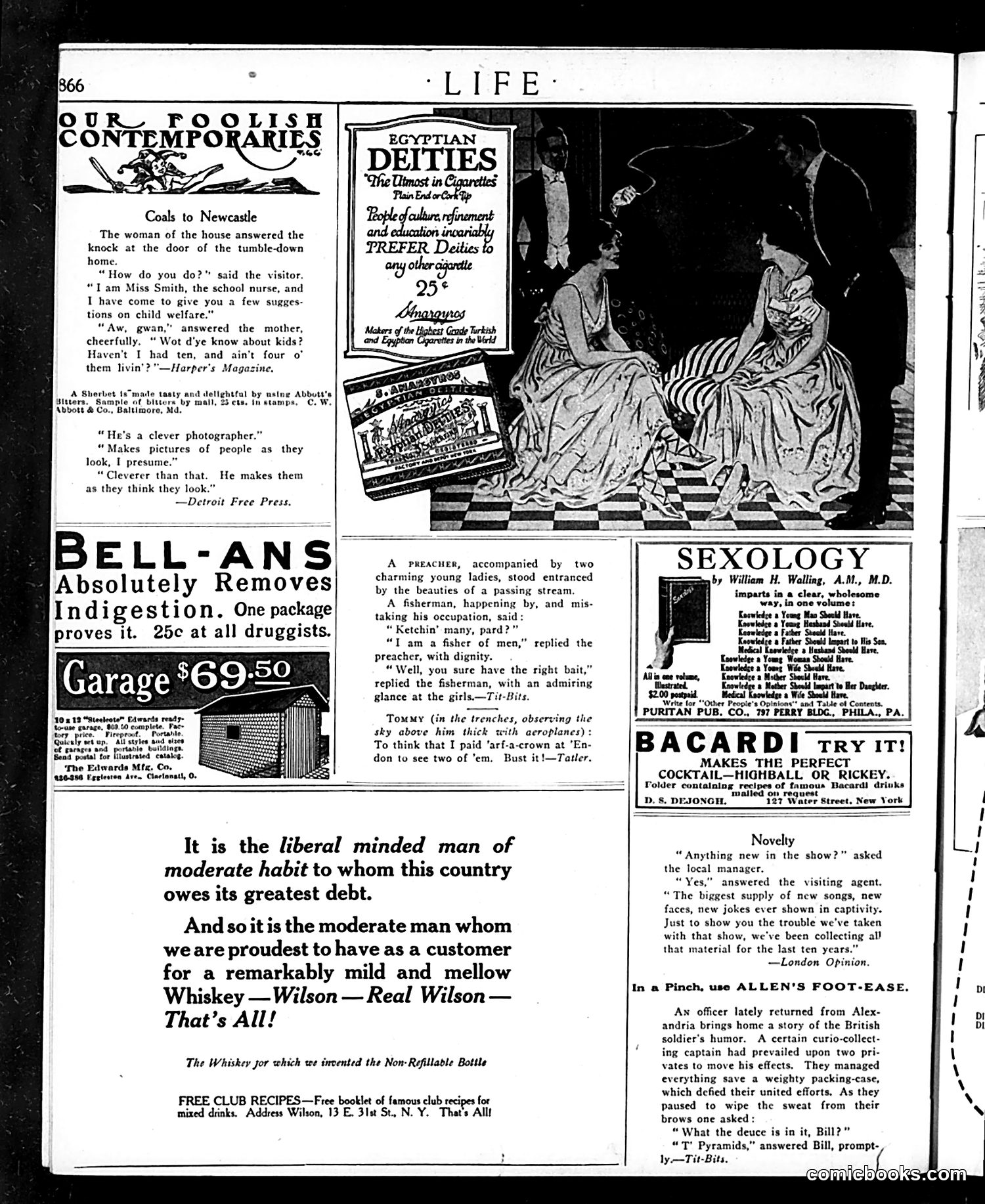
This page is primarily **advertisements and humorous anecdotes** rather than political cartoons. The layout features: **Main Content:** Several short joke pieces from publications like Harper's Magazine, Detroit Free Press, and Tit-Bits. The humor reflects early 20th-century sensibilities—a school nurse visiting a poor mother with ten children (titled "Coals to Newcastle," meaning unnecessary help), a photographer who flatters subjects, and a preacher mistaken for a fisherman by a man admiring his female companions. **One WWI Reference:** A brief joke about a British soldier in the trenches observing multiple aeroplanes overhead, comparing it unfavorably to paying admission at Hendon (an airfield) to see two aircraft—reflecting the novelty of aerial warfare. **Advertisements:** Primarily for patent medicines (Bell-Ans indigestion remedy), a prefab garage, Wilson whiskey, and a sex education book—typical early 1900s advertising. The page contains no significant political satire, just period-appropriate commercial content and light social humor.
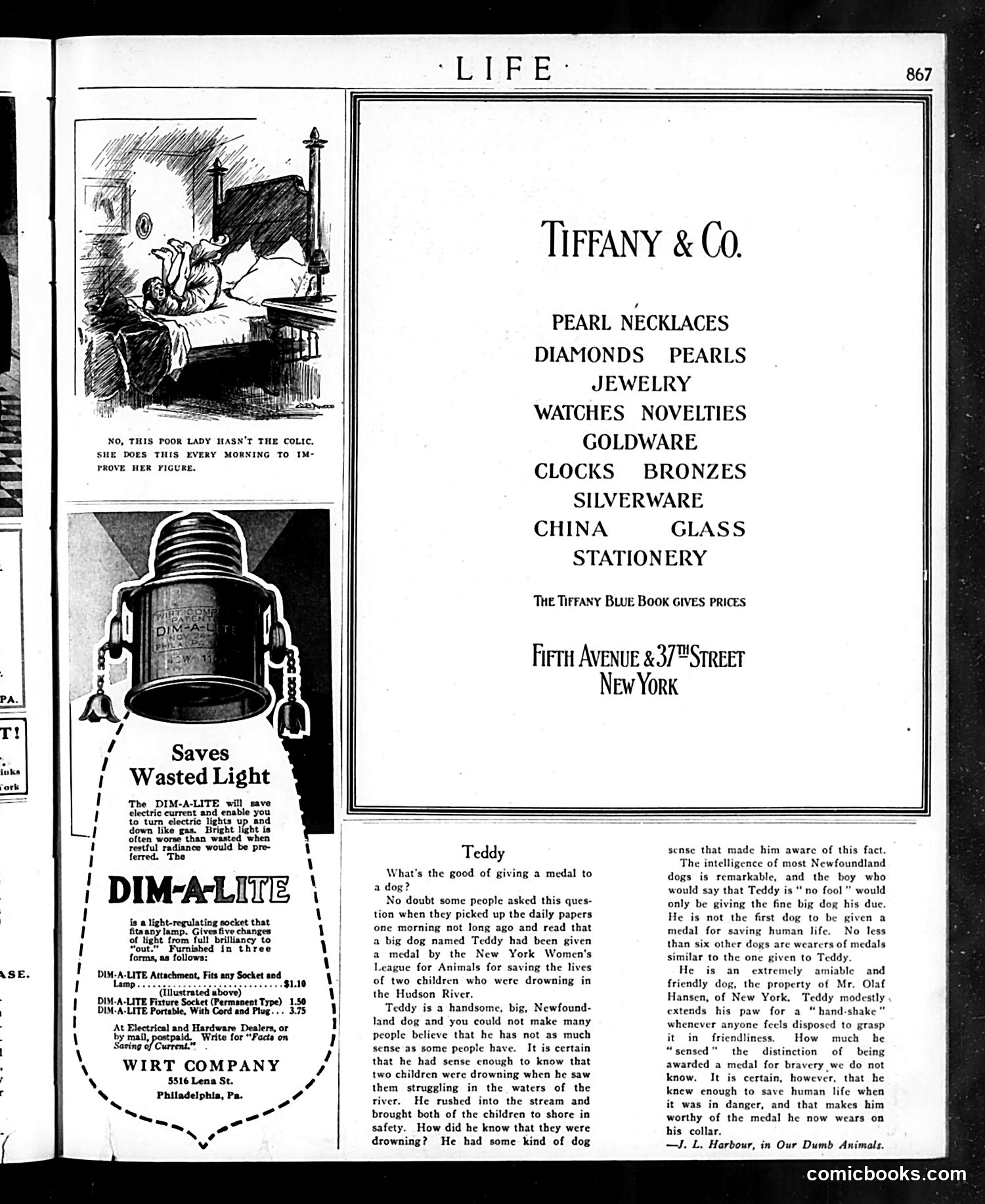
This page is primarily **advertising and feature content** rather than satirical cartoons. The top cartoon depicts a woman doing morning exercises ("improving her figure"), a social commentary on early 1900s beauty standards and women's fitness routines—likely satirizing the obsessive dedication to maintaining an idealized silhouette. The main article, "Teddy," celebrates a Newfoundland dog awarded a medal by the New York Women's League for Animals for rescuing two drowning children from the Hudson River. The piece argues dogs possess genuine intelligence and deserve recognition for heroic acts. This reflects early 20th-century sentimental attitudes toward animals and emerging animal welfare movements. The advertisements—for Tiffany & Co. jewelry and Dim-A-Lite electrical lamp dimmers—represent luxury goods and technological innovations targeting affluent readers. The page reflects Life's dual purpose: satirical commentary mixed with upscale advertising.
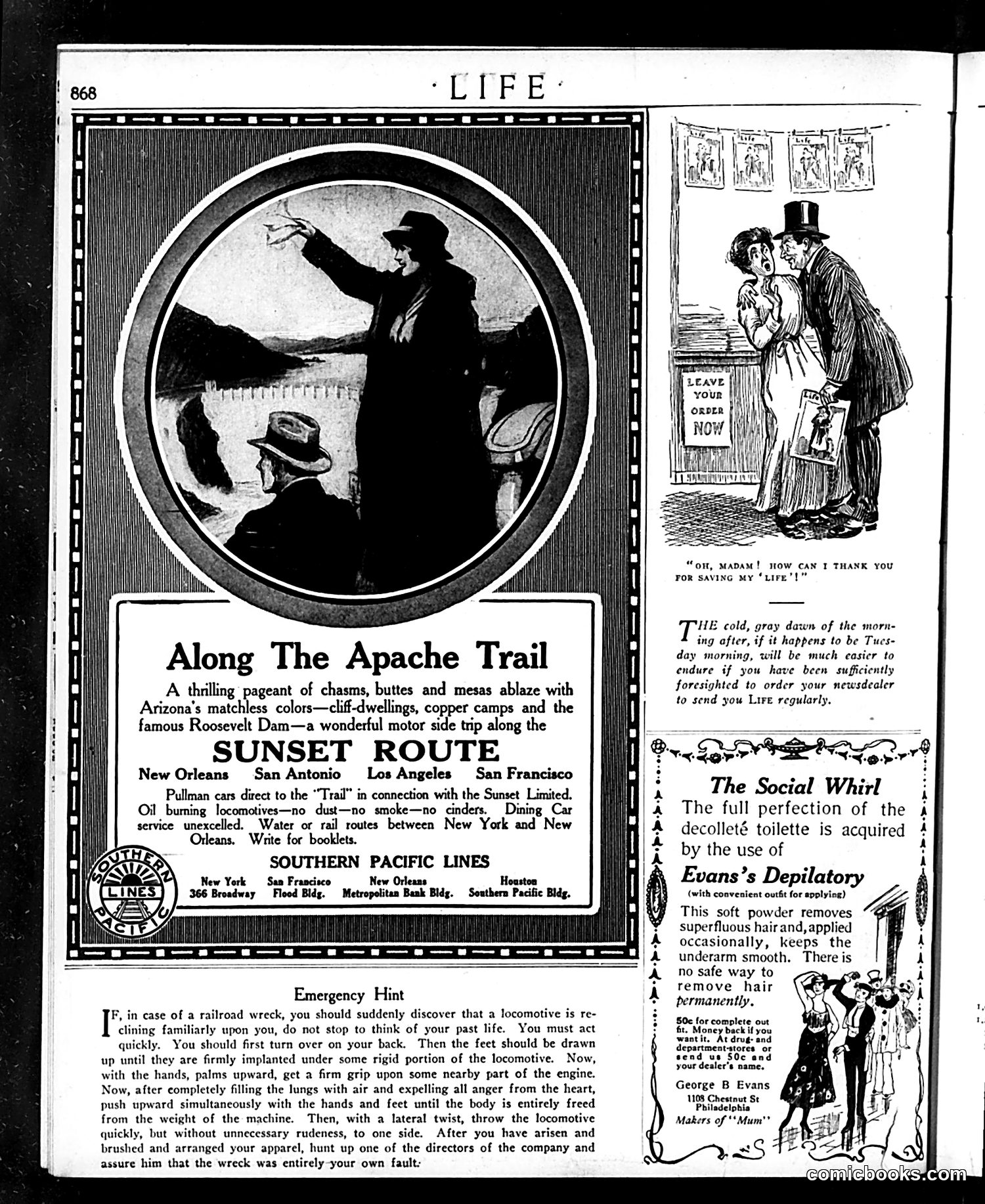
This page primarily contains **advertisements and satirical humor** rather than political cartoons. **Main Advertisement:** The large circular image promotes Southern Pacific Lines' "Sunset Route" train travel through Arizona, featuring scenic desert landscapes and the Roosevelt Dam. **Top Right Cartoon:** A man in a top hat thanks a woman for "saving my life" — the joke appears to be that she's delivered his morning newspaper, making the humorous claim that reading the news (Life magazine) is essential to survival. This satirizes the magazine's perceived importance. **"Emergency Hint" Section:** Absurdist humor offering ridiculous instructions for escaping a locomotive in a railroad wreck (turn on your back, grip the engine, throw it aside, then blame yourself to company directors). This is pure satirical comedy mocking overly-detailed survival advice. **Right Column Ads:** Include Evans's Depilatory (hair removal powder) with period-appropriate marketing about feminine grooming standards. The page reflects early 20th-century advertising culture and Life's satirical approach to contemporary concerns.
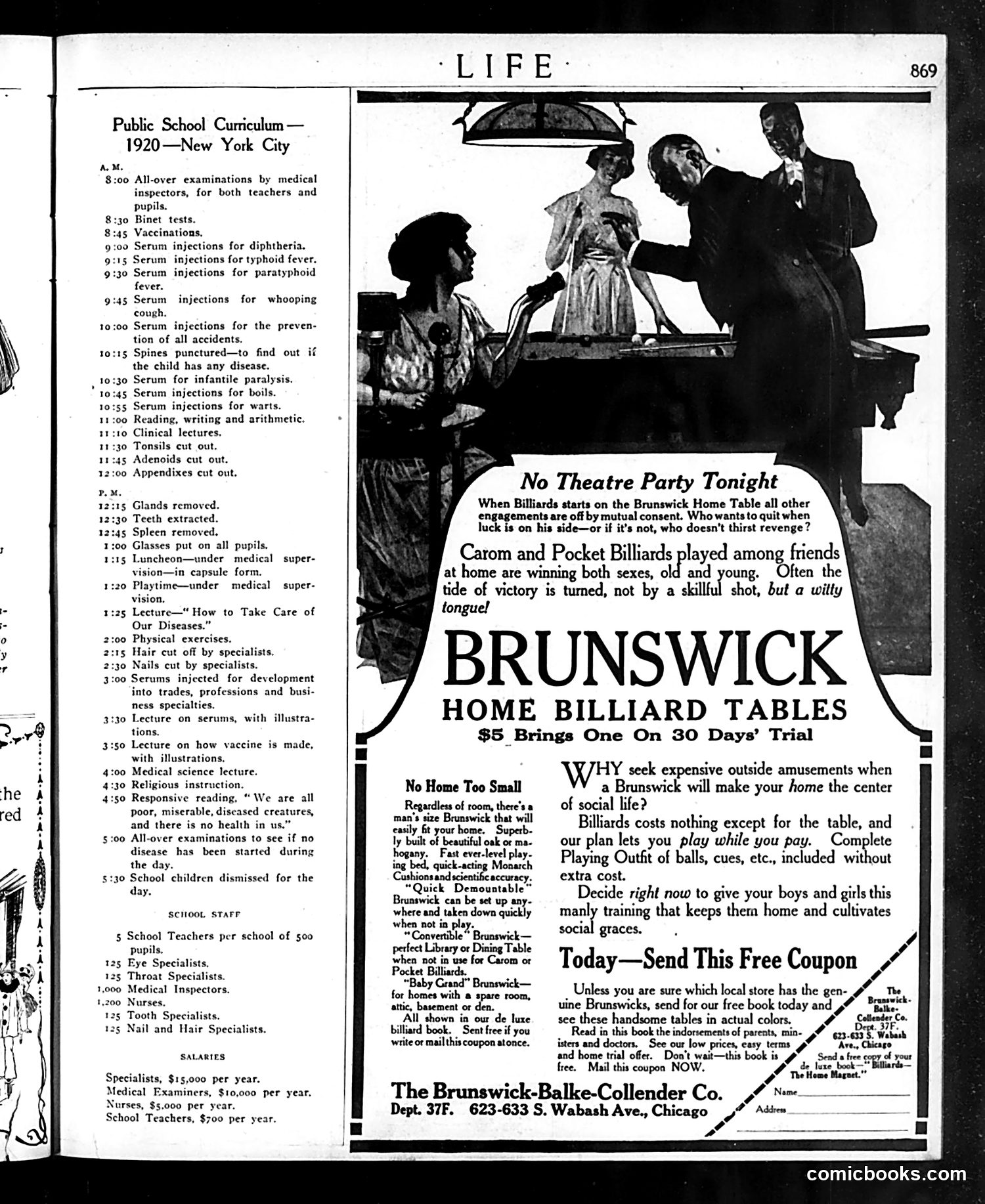
This is satirical social commentary, not an advertisement. The left column mocks the 1920 New York City public school day by listing an absurdly exhaustive medical inspection schedule—vaccinations, serum injections for numerous diseases, spinal punctures, organ removals (tonsils, adenoids, appendixes, spleen, glands, teeth)—sandwiched around minimal academic instruction ("Reading, writing and arithmetic"). The satire critiques the era's obsessive medicalization of schooling and the prioritization of health bureaucracy over education. By the day's end, students are "dismissed" after being subjected to invasive procedures. The accompanying salary table compounds the joke: school teachers earn only $700/year while specialists (eye, throat, medical inspectors) earn $10,000-$15,000, suggesting priorities are severely misaligned. The Brunswick billiard table advertisement on the right is unrelated content typical of magazine layouts.
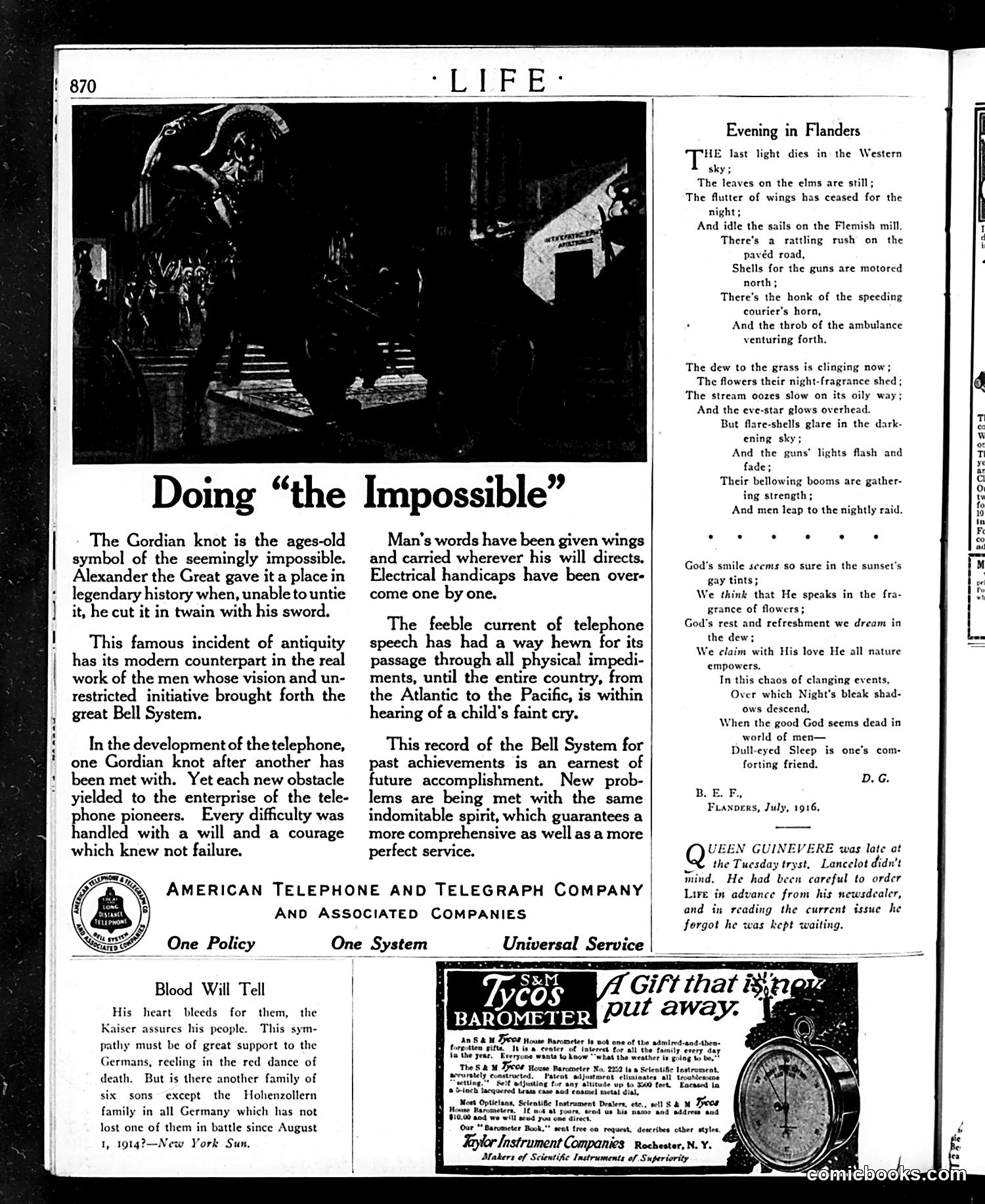
This page mixes corporate advertising with World War I content. The main illustration shows what appears to be a dramatic wartime scene—soldiers or workers in dark, industrial conditions—accompanying an ad for American Telephone and Telegraph Company. The ad uses the metaphor of the Gordian knot (the "impossible" made possible) to celebrate Bell System's technological achievements in connecting the nation. The right side includes a poem titled "Evening in Flanders" depicting the contrasts of the WWI front—nature's peace juxtaposed against artillery fire and nightly raids. It's dated "B.E.F., Flanders, July, 1916" (British Expeditionary Force), making this contemporary war reporting. Below is a satirical item titled "Blood Will Tell," mocking the German Kaiser's claimed sympathy for his people while they "reel in the red dance of death," noting the Hohenzollern family hasn't lost all six sons in battle since August 1914—an acidic comment on German military losses. The advertisements round out the page, including a barometer ad.
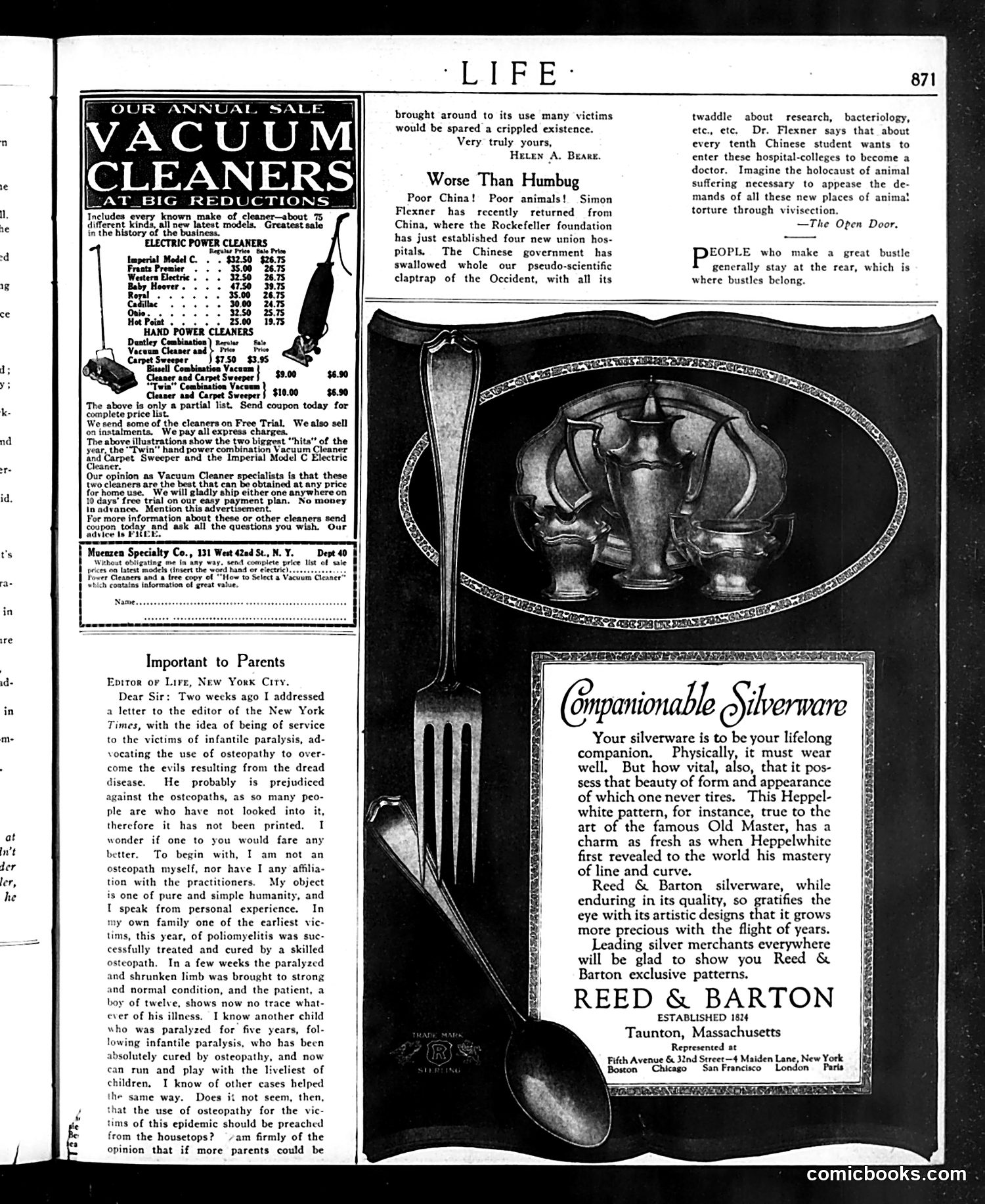
This page mixes advertisements with letters to the editor addressing contemporary social issues circa 1910s-1920s. **Main Content:** Two letters critique medical/scientific practices: 1. **"Important to Parents"** advocates osteopathy as a cure for infantile paralysis (polio), arguing it's been suppressed by mainstream medicine. The writer claims personal success stories but presents anecdotal evidence as proof. 2. **"Worse Than Humbug"** attacks Western medicine's expansion into China, specifically criticizing Simon Flexner's Rockefeller Foundation hospitals. The author opposes animal vivisection in medical research, calling Western science "pseudo-scientific claptrap." **Context:** Both letters represent early-20th-century skepticism of conventional medicine and animal testing—positions that appealed to alternative medicine advocates of the era. The page also advertises vacuum cleaners and Reed & Barton silverware, typical of Life's commercial content supporting its satirical journalism.
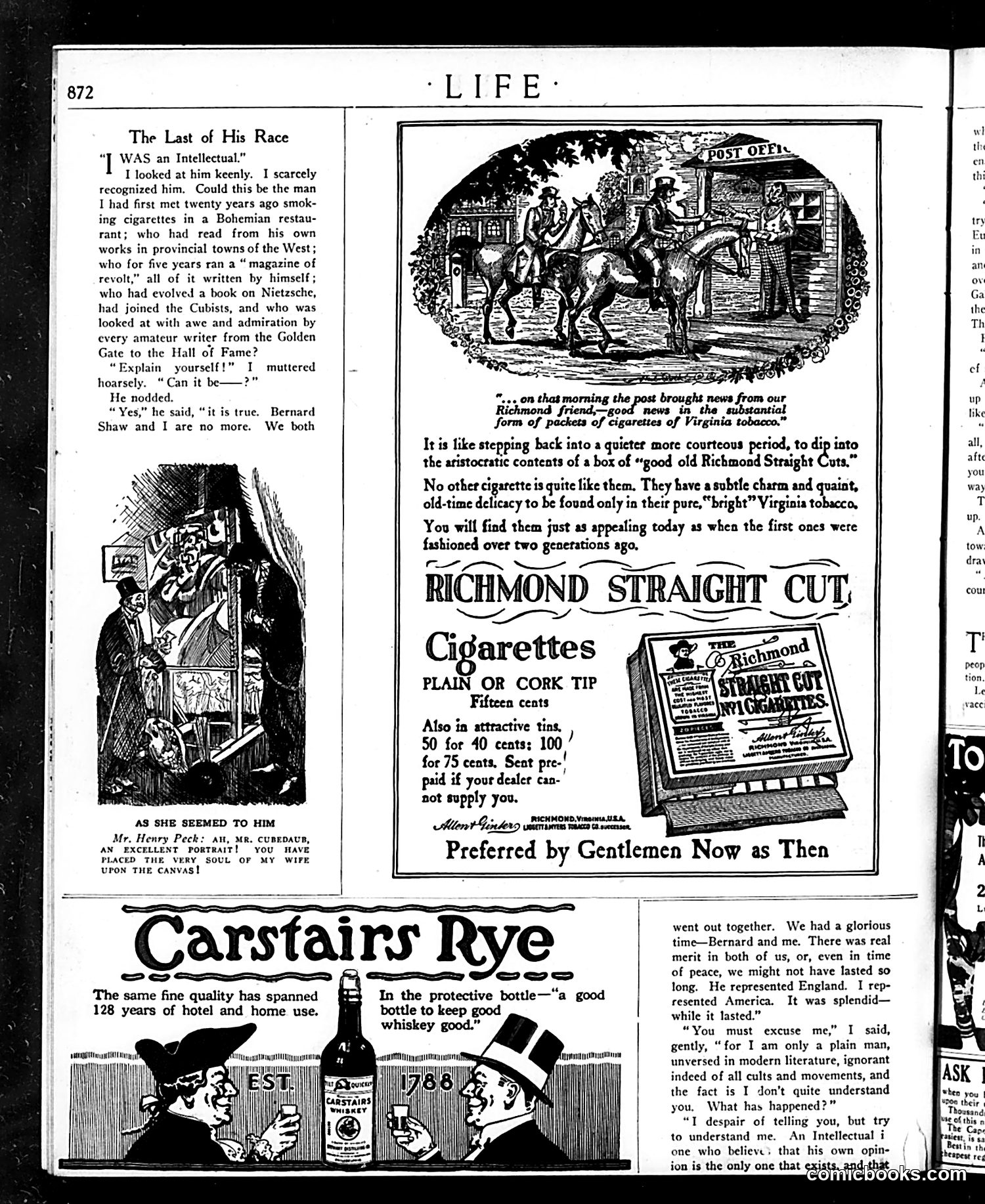
This satirical story mocks the decline of a self-styled "Intellectual"—a young Bohemian writer who once published his own avant-garde magazine, wrote about Nietzsche, joined the Cubist movement, and commanded admiration from amateur writers. The narrator encounters him years later, shocked by his apparent fall from intellectual grace. The joke targets the pretentiousness and impracticality of such aesthetic movements. The narrator's final monologue—where the Intellectual pompously defines himself by his unwavering certainty in his own opinions—suggests that his "intellectual" identity was always hollow self-regard rather than genuine achievement. The page also includes period advertisements (Richmond Straight Cut cigarettes, Carstairs Rye whiskey) and an unrelated cartoon about a portrait painter, typical of *Life* magazine's mixed editorial and advertising format from this era.
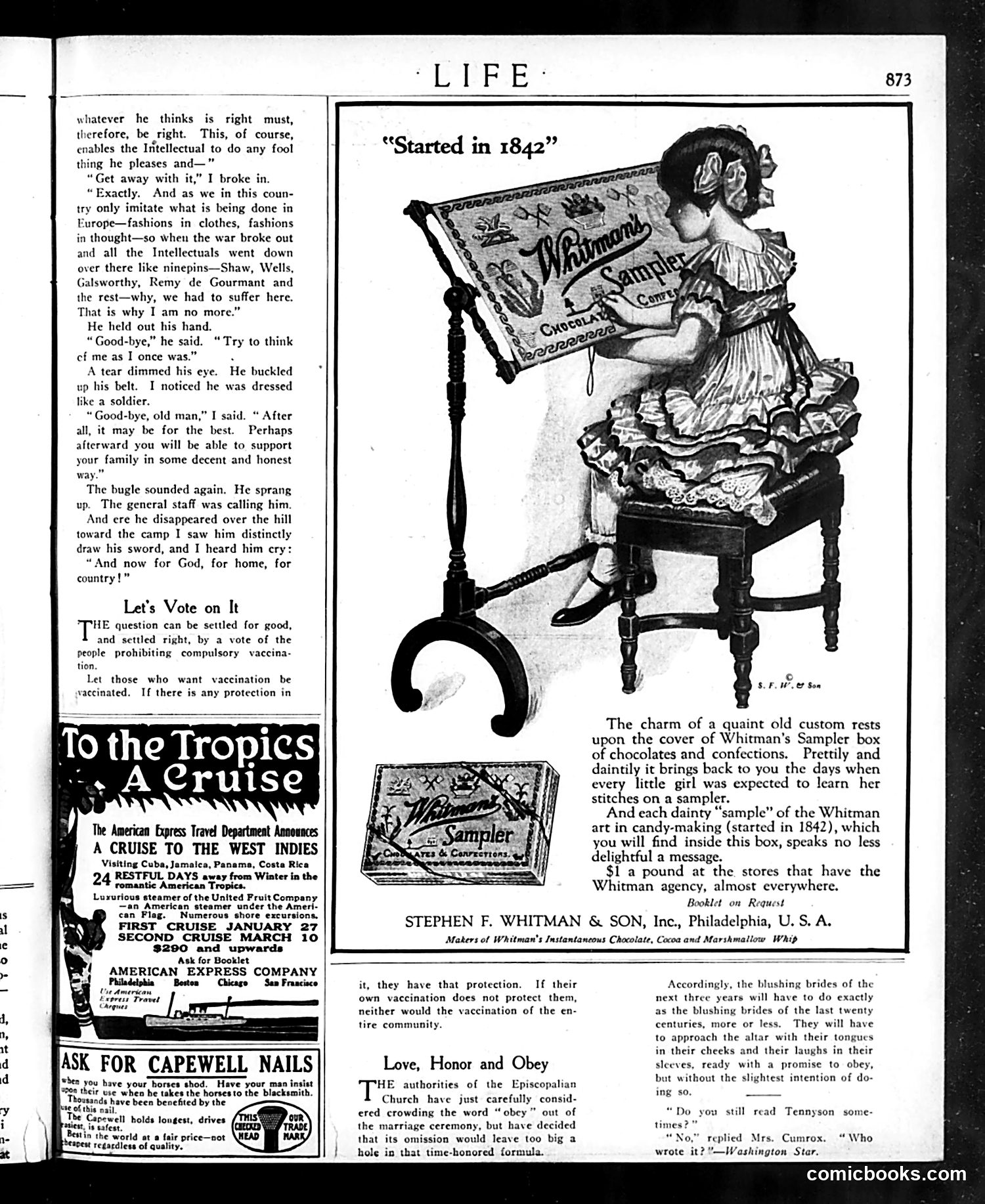
This page contains **primarily advertisements and commentary**, not political cartoons in the traditional sense. The main illustrated content is a **Whitman's Chocolates advertisement** featuring a Victorian-era girl holding a decorative sampler box (dated "Started in 1842"). This appeals to nostalgia for domestic gentility and handcraft traditions. The text sections include social commentary: 1. **A narrative about an intellectual enlisting in WWI**, critiquing European intellectuals who influenced American thought before volunteering for war. 2. **"Let's Vote on It"** — an anti-vaccination editorial arguing for voluntary rather than compulsory vaccination, framed as democratic choice. 3. **"Love, Honor and Obey"** — satirizing the Episcopal Church's decision to *keep* the word "obey" in marriage vows despite modernizing pressure. The joke: brides will promise obedience while having no intention of actually obeying. The advertisements promote cruise travel, horseshoe nails, and chocolates—typical early-20th-century Life magazine content.
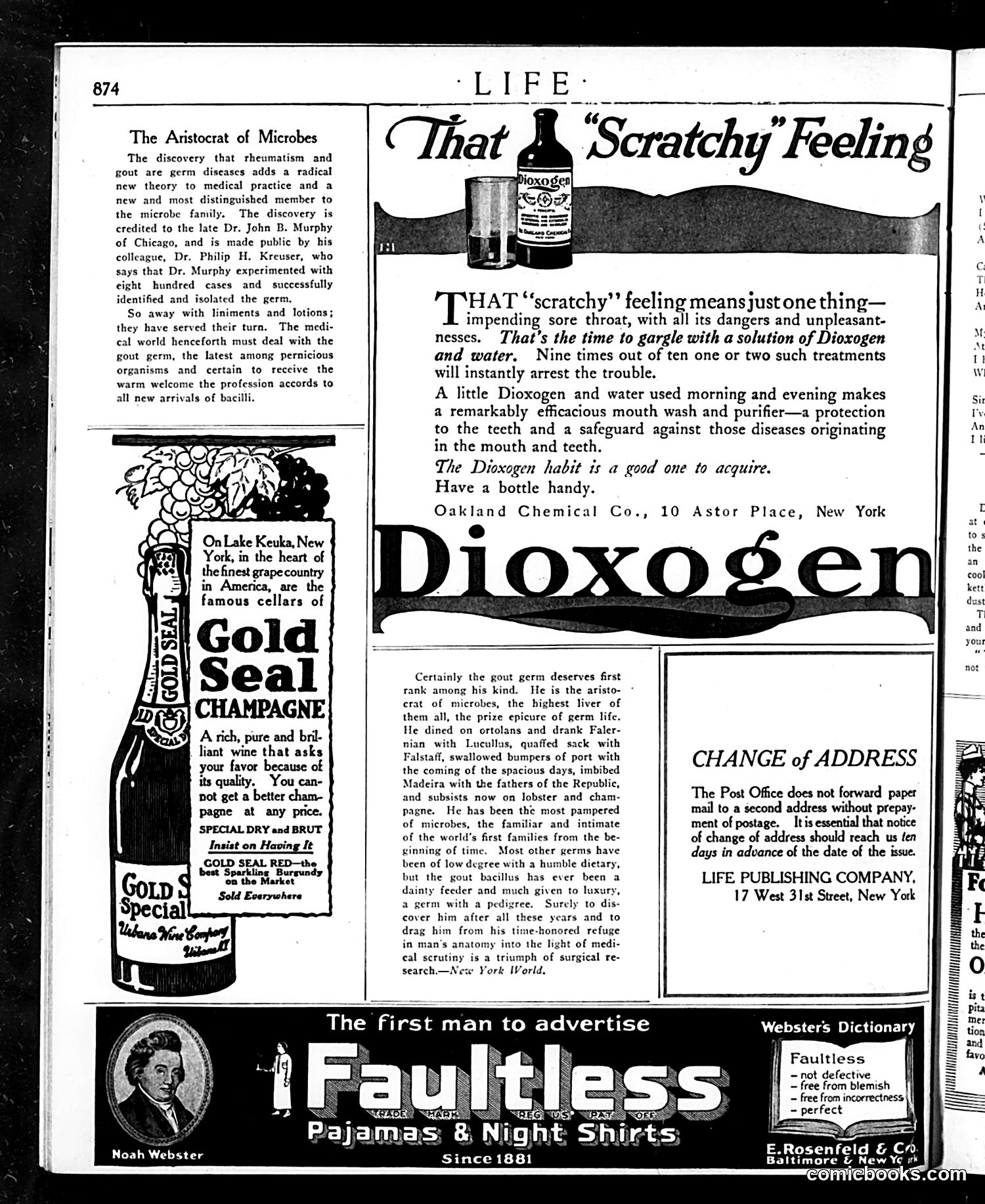
This page combines advertisements with a humorous essay. The main satirical content is "The Aristocrat of Microbes," which playfully personifies the gout bacillus (germ) recently discovered by Dr. John B. Murphy as a disease agent. The joke treats this microscopic organism as an aristocratic gentleman with refined tastes—a "pedigree" germ who has historically dined with historical figures like Lucullus and Falstaff, consuming luxurious foods (ortolans, Falernia wine, port, Madeira, champagne, lobster) rather than the "humble dietary" of common germs. The satire mocks wealthy gouty patients by suggesting their gout reflects their own decadent lifestyles: they've literally been feeding this elite microbe through excessive indulgence. By calling gout's discovery "a triumph," the author ironically suggests finally exposing this parasitic aristocrat hiding in the human body. The page is otherwise dominated by period advertisements for Gold Seal Champagne, Dioxogen (throat gargle), and Faultless Pajamas—typical early-20th-century LIFE magazine content.
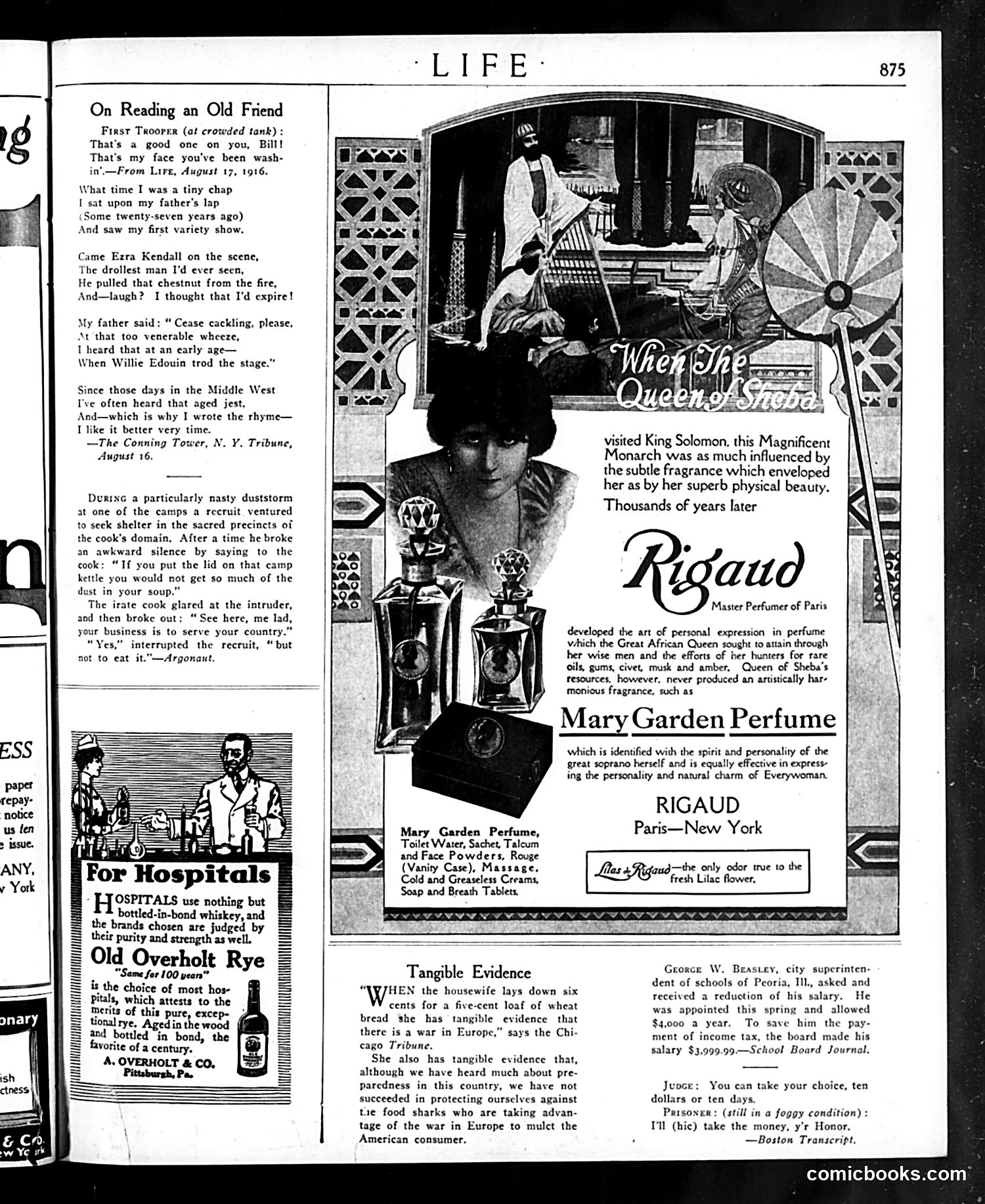
This page contains three distinct sections: **"On Reading an Old Friend"** is a nostalgic humor column about theatrical jokes that have endured for decades. It references vaudeville performers Ezra Kendall and Willie Edouin, suggesting certain jokes remain funny through repetition and time. **The main cartoon** (top right) depicts a soldier or recruit mistakenly washing his superior's face in a crowded tank/tub, thinking it was his friend "Bill." The humor relies on slapstick confusion in close quarters. **"Tangible Evidence"** (bottom) is social commentary on wartime inflation: a housewife paying six cents for a five-cent loaf of bread. The piece critiques "food sharks" exploiting the European war to inflate American prices, despite government claims of preparedness. It's wartime consumer advocacy disguised as humor. The page also includes vintage advertisements (Old Overholt Rye whiskey, Rigaud perfume) and miscellaneous jokes about military camp life and a judge offering a prisoner money or jail time.
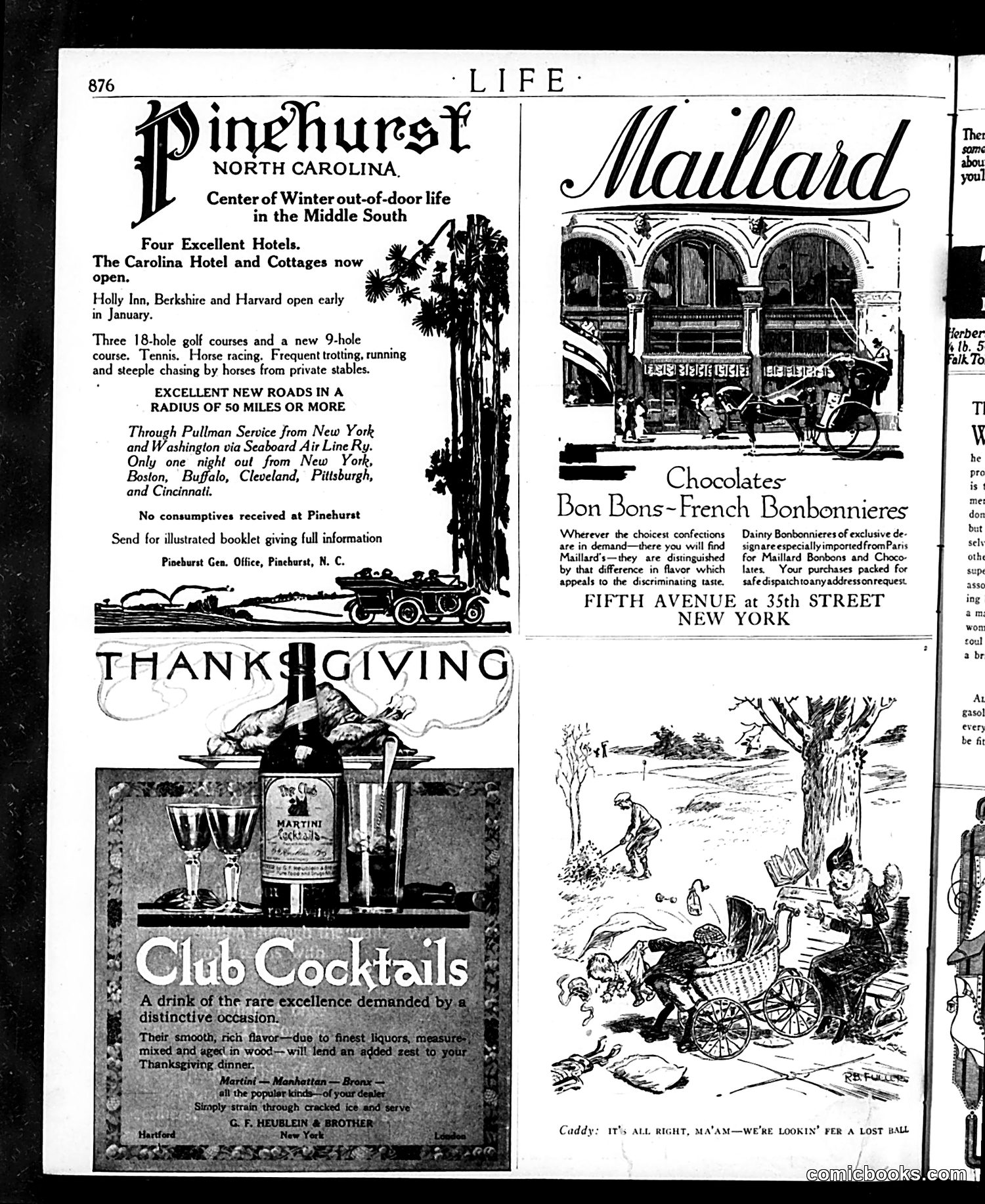
This page consists primarily of **advertisements**, not political satire. The main content includes: 1. **Pinehurst, North Carolina resort ad**: Promotes a winter destination with golf, tennis, and horse racing. The note "No consumptives received" reflects era-specific tuberculosis concerns—resorts explicitly excluded those with the disease. 2. **Maillard chocolate ad**: Luxury confectionery marketed to affluent consumers via Fifth Avenue placement. 3. **Club Cocktails ad**: A Thanksgiving-themed advertisement for premium liquor (Martini brand), emphasizing "rare excellence" for special occasions. 4. **Maillard cartoon**: A genteel comic strip showing a caddy and golfer searching for a lost ball, with the punchline playing on class dynamics and leisure culture. The page reflects 1920s consumer culture targeting wealthy Americans—luxury travel, expensive chocolates, and recreational golf were markers of upper-class status during this period.
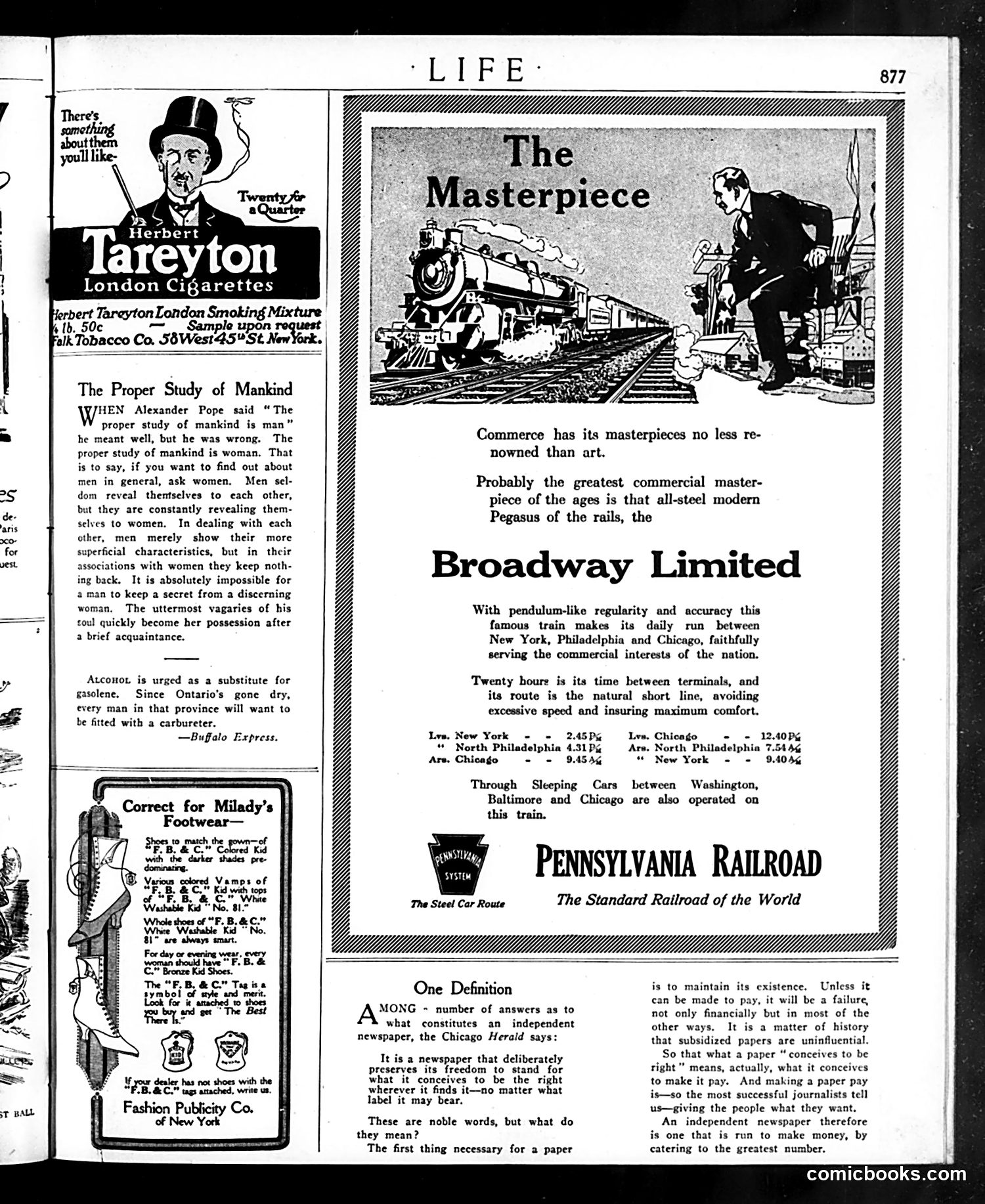
This page contains primarily **advertisements and opinion pieces** rather than political cartoons. **Key Content:** 1. **Herbert Tareyton Cigarettes ad** — a straightforward product advertisement with a man in a top hat. 2. **"The Proper Study of Mankind"** — a humorous essay arguing (tongue-in-cheek) that understanding women is the way to understand men, since men reveal themselves fully only to women they court. The tone is light domestic satire about gender relations. 3. **"The Masterpiece"** — a Pennsylvania Railroad advertisement celebrating the Broadway Limited train as a commercial achievement comparable to art. It emphasizes punctuality and comfort for business travelers between New York, Philadelphia, and Chicago. 4. **"One Definition"** — a brief editorial discussing newspaper independence. It sardonically notes that while newspapers claim editorial freedom, they actually succeed by appealing to the largest audience rather than maintaining true independence. **Historical Context:** This appears to be from the 1920s era of American magazine publishing, reflecting contemporary attitudes toward advertising, gender, and commerce.
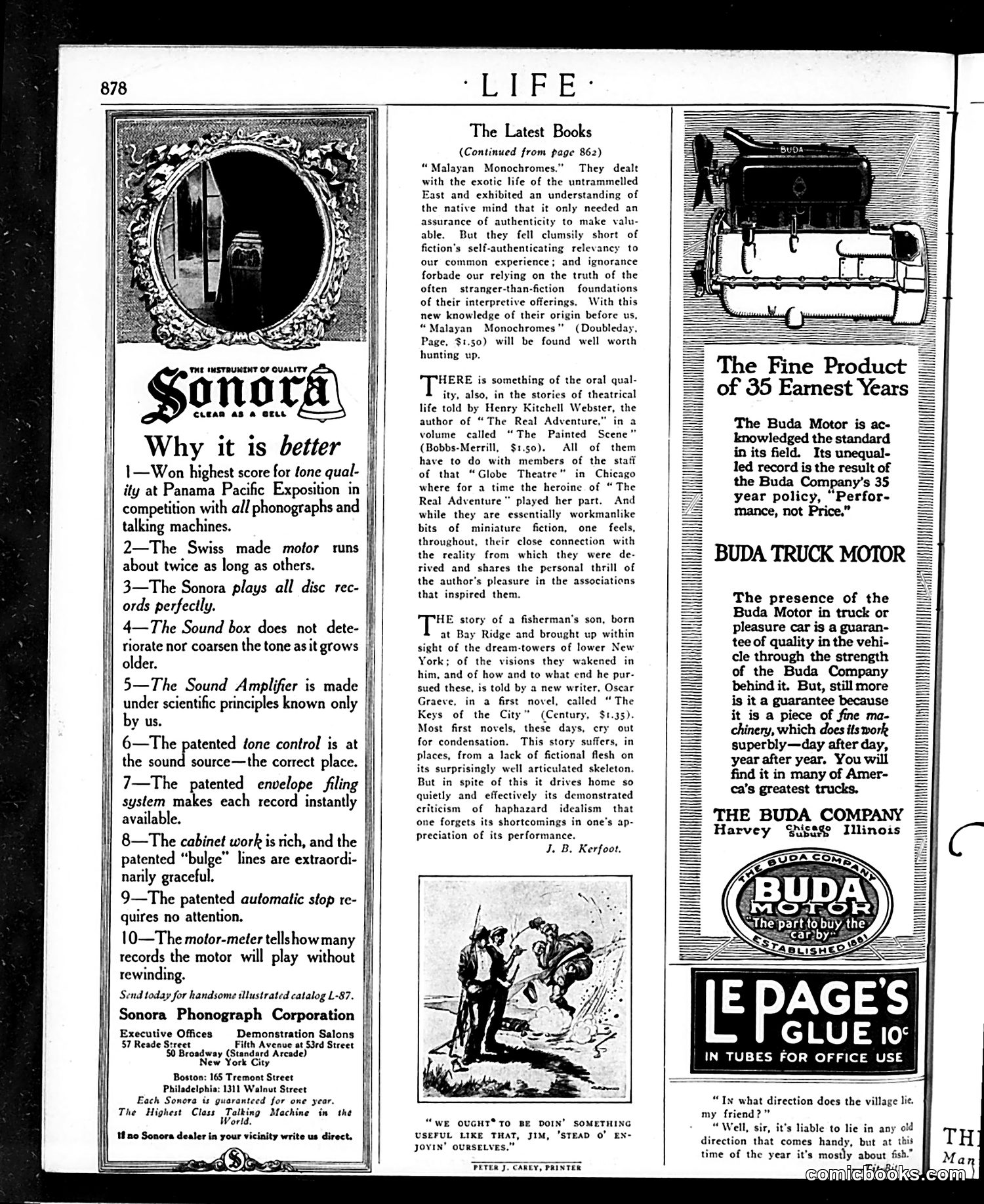
This page mixes book reviews with advertisements. The main content is "The Latest Books" section reviewing recent novels including works about Malayan life and theatrical stories by Henry Kitchell Webster. The cartoon at bottom left shows two men observing others engaged in leisure activities. One says they "ought to be doin' something useful" rather than "enjoying ourselves." This reflects early 20th-century anxieties about idleness and productivity — a common satirical theme during the Progressive Era when work ethic and social utility were heavily emphasized. The advertisements (Sonora Phonograph, Buda Truck Motor, LePage's Glue) dominate the right side, typical for Life magazine's business model. The page lacks overtly political content; instead it reflects period attitudes about entertainment, leisure, and commercial progress.
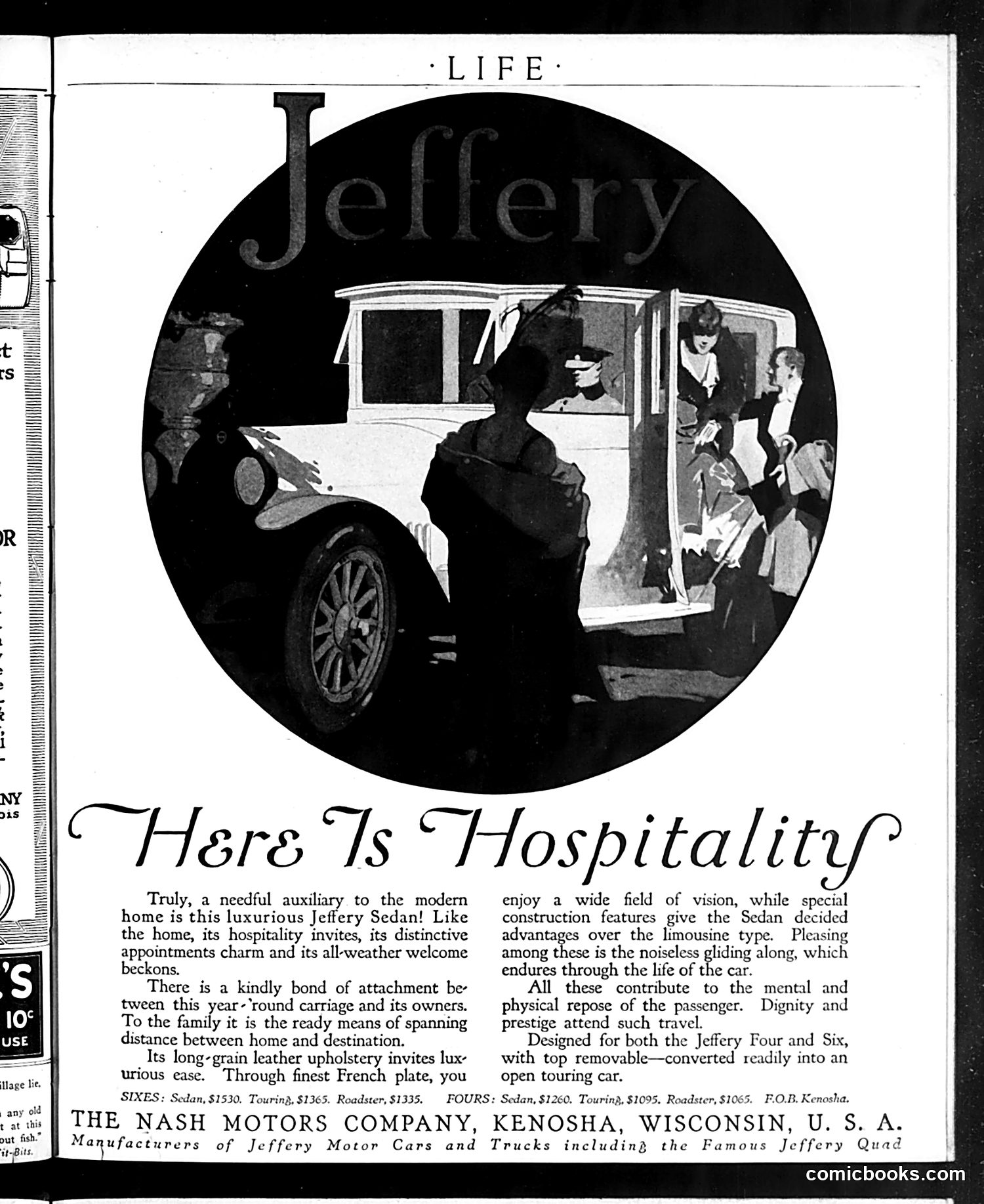
This is **not a political cartoon or satire**—it's a straightforward automobile advertisement for the Jeffery Sedan, manufactured by Nash Motors Company in Kenosha, Wisconsin. The circular image depicts a wealthy family using their Jeffery automobile as a social conveyance: well-dressed passengers (men in hats, women in coats) are shown boarding or inside the car, emphasizing the vehicle's role as an extension of home hospitality and refined travel. The ad's messaging targets middle-to-upper-class buyers by emphasizing luxury features: French plate glass windows, leather upholstery, quiet operation, convertible top design, and the car's ability to maintain "dignity and prestige" during travel. Prices range from $1,095 to $1,530—substantial sums for the era. The tone is aspirational marketing typical of 1920s advertising, positioning the automobile not merely as transportation but as a status symbol and domestic comfort equivalent.
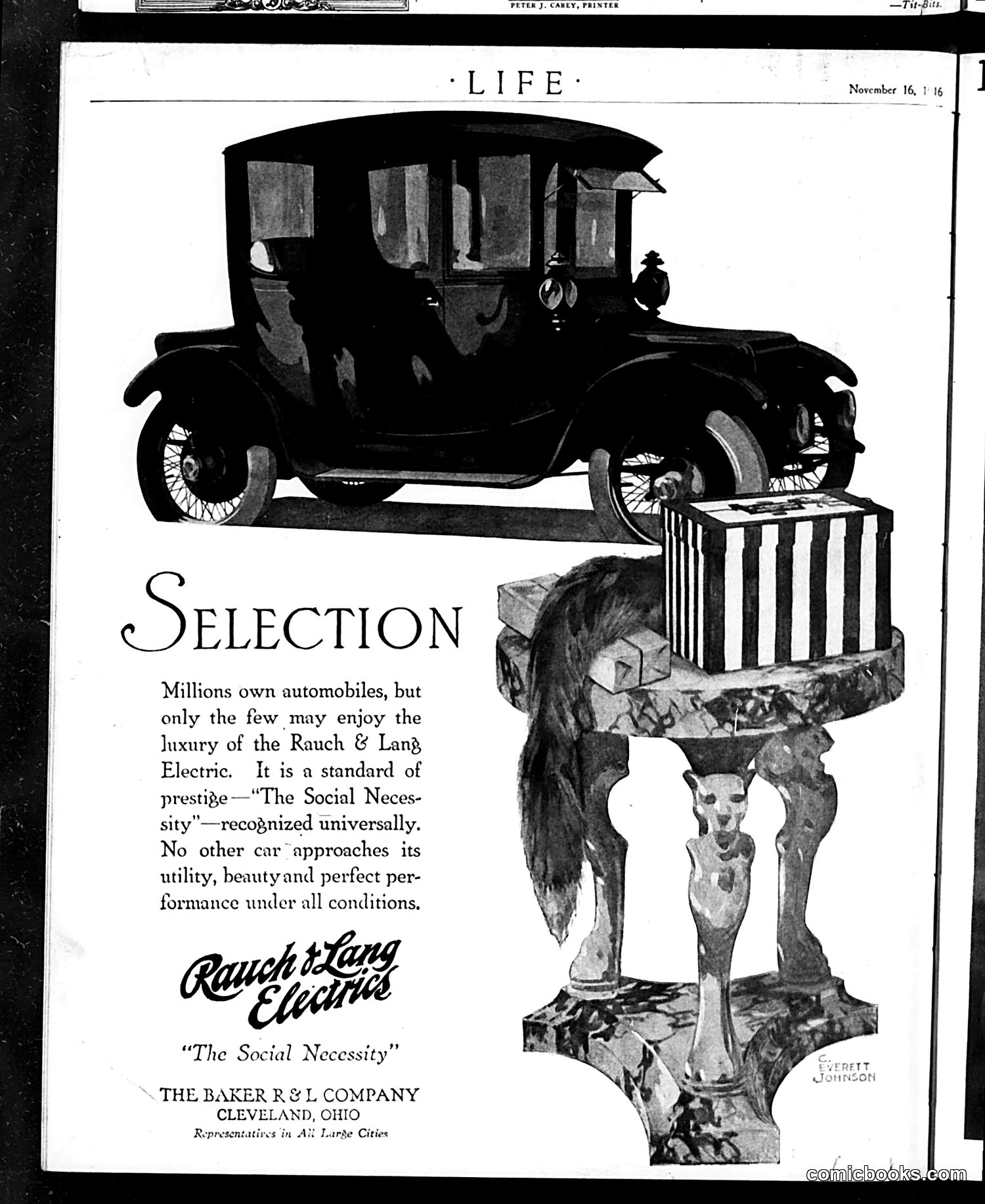
This is an **advertisement**, not satire. It promotes the Rauch & Lang Electric automobile as a luxury item, using the phrase "The Social Necessity"—a paradoxical slogan suggesting that owning this car is both a status symbol and a practical requirement. The accompanying illustration shows a stylized woman in formal dress presenting the car on a pedestal, with classical allegorical imagery (a deer, ornamental base). This visual treatment elevates the automobile to an object of prestige and refinement. For modern readers: This reflects early 1900s attitudes where electric cars (quieter, cleaner than gasoline models) were marketed to wealthy women and the upper class as signs of social standing. The "necessity" rhetoric ironically acknowledges that ownership signals wealth rather than actual practical need. The Baker R & L Company, based in Cleveland, distributed these luxury vehicles nationally.