
Life, 1916-11-16 · page 24 of 46
Life — November 16, 1916 — page 24: what you’re looking at
What you’re looking at
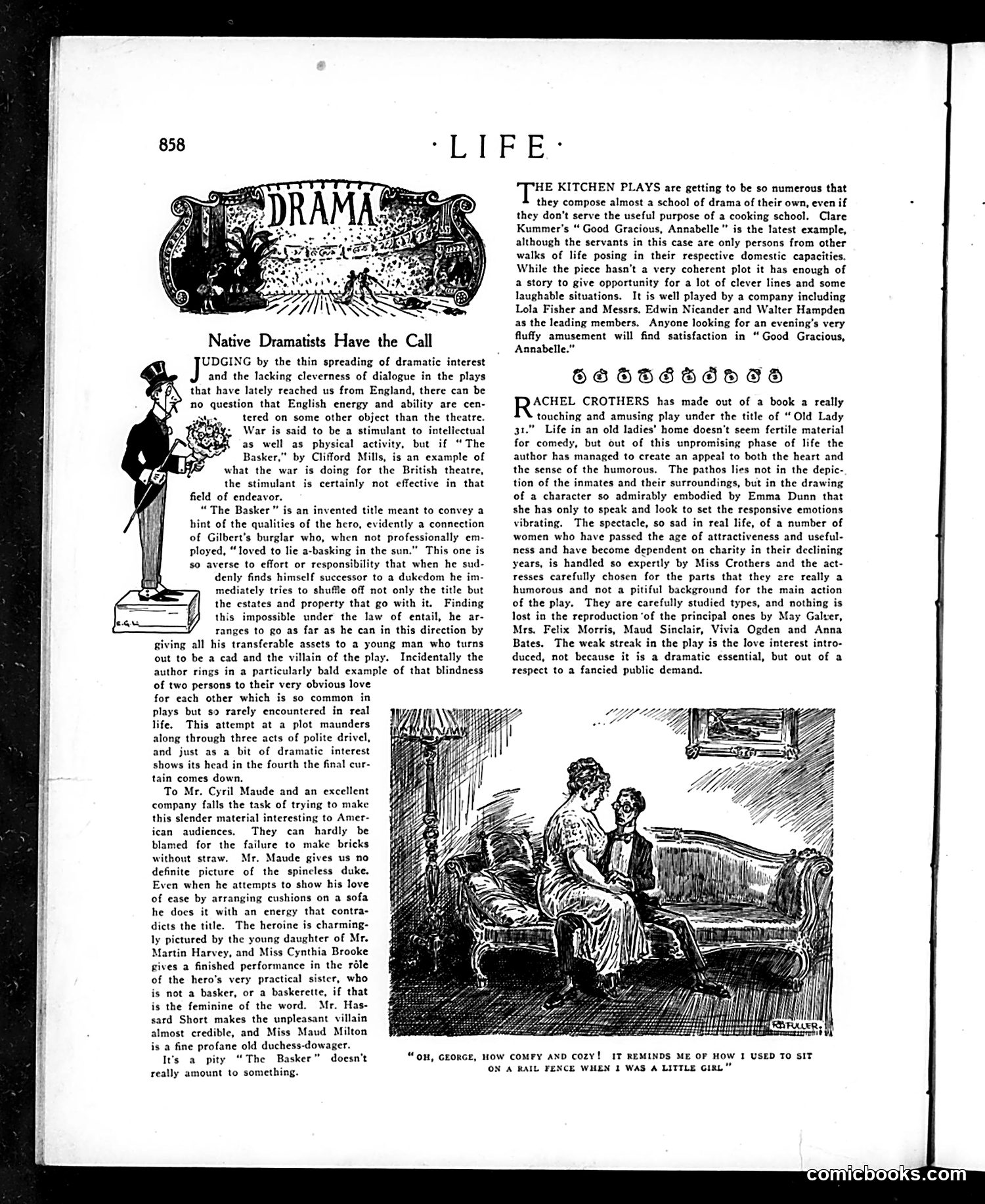
This page reviews recent theatrical productions, criticizing British drama while praising American efforts. The main article dismisses Clifford Mills's British play "The Basker" as dramatically inert—a work about a lazy duke who inherits a dukedom but lacks the energy to refuse it. The critic finds the plot tedious and poorly constructed, though praising actors like Cyril Maude for attempting to make the material work. The accompanying illustration depicts a dandified, top-hatted gentleman—representing the "basker" character—embodying indolence and frivolity. The cartoon mocks this passive archetype. Below, brief reviews praise American "kitchen plays" (domestic comedies), particularly Clare Kummer's "Good Gracious, Annabelle" and Rachel Crothers's "Old Lady 31," finding them clever and engaging despite humble settings. The overall message: American playwrights and producers are outperforming their British counterparts, even with modest material.
📄 Transcribed text from this page (OCR, searchable)
Machine-transcribed from the original scan — historical spelling and the odd misread are preserved.
‘LI Native Dramatists Have the Call UDGING by the thin spreading of dramatic interest and the lacking cleverness of dialogue in the plays that have lately reached us from England, there can be no question that English energy and ability are cen- tered on some other object than the theatre. War is said to be a stimulant to intelicctual as well as physical activity, but if “The Basker,” by Clifford Mills, is an example of what the war is doing for the British theatre, the stimulant is certainly not effective in that field of endeavor. “The Basker” is an invented title meant to convey a hint of the qualities of the hero, evidently a connection of Gilbert's burglar who, when not professionally em- ployed, “loved to lie a-basking in the sun.” This one is so averse to effort or responsibility that when he sud- denly finds himself successor to a dukedom he im- mediately tries to shuffle off not only the title but the estates and property that go with it. Finding this impossible under the law of entail, he ar- ranges to go as far as he can in this direction by giving all his transferable assets to a young man who turns out to be a cad and the villain of the play. Incidentally the author rings in a particularly bald example of that blindness ‘of two persons to their very obvious love for each other which is so common in plays but so rarely encountered in real life. This attempt at a plot maunders along through three acts of polite drivel, and just as a bit of dramatic interest shows its head in the fourth the final cur- tain comes down. To Mr. Cyril Maude and an excellent company falls the task of trying to make this slender material interesting to Amer- ican audiences, They can hardly be blamed for the failure to make bricks without straw. Mr. Maude gives us no definite picture of the spincless duke. Even when he attempts to show his love of ease by arranging cushions on a sofa he does it with an energy that contra- dicts the title. The heroine is charming- ly pictured by the young daughter of Mr. Martin Harvey, and Miss Cynthia Brooke gives a finished performance in the réle of the hero's very practical sister, who is not a basker, or a baskerette, if that is the feminine of the word. Mr. Has- sard Short makes the unpleasant villain almost credible, and Miss Maud Milton is a fine profane old duchess-dowager. It's a pity “The Basker” doesn’t really amount to something. ates. “on, GEORGE, Mow COMFY AND cozy! FE: HE KITCHEN PLAYS are getting to be so numerous that they compose almost a school of drama of their own, even if they don’t serve the useful purpose of a cooking school. Clare Kummer's “ Good Gracious, Annabelle” is the latest example, although the servants in this case are only persons from other walks of life posing in their respective domestic capacities. While the piece hasn't a very coherent plot it has enough of a story to give opportunity for a lot of clever lines and some laughable situations. It is well played by a company including Lola Fisher and Messrs. Edwin Nicander and Walter Hampden as the leading members. Anyone looking for an evening’s very fluffy amusement will find satisfaction in “Good Gracious, Annabelle.” ORG MORGEGECROROROMO) ACHEL CROTHERS has made out of a book a really ouching and amusing play under the title of “Old Lady 31.” Life in an old ladies’ home doesn’t seem fertile material for comedy, but out of this unpromising phase of life the author has managed to create an appeal to both the heart and the sense of the humorous. The pathos lies not in the depic- tion of the inmates and their surroundings, but in the drawing of a character so admirably embodied by Emma Dunn that she has only to speak and look to set the responsive emotions vibrating. The spectacle, so sad in real life, of a number of women who have passed the age of attractiveness and useful- ness and have become dependent on charity in their declining years, is handled so expertly by Miss Crothers and the act- resses carefully chosen for the parts that they are really a humorous and not a pitiful background for the main action of the play. They are carefully studied types, and nothing is lost in the reproduction ‘of the principal ones by May Galver, Mrs. Felix Morris, Maud Sinclair, Vivia Ogden and Anna Bates. The weak streak in the play is the love interest intro- duced, not because it is a dramatic essential, but out of a respect to a fancied public demand. YSLILELELSLD Za IT REMINDS ME OF HOW I USED TO SIT ON A RAIL FENCE WHEN 1 WAS A LITTLE GIRL”