
Life, 1916-11-16 · page 7 of 46
Life — November 16, 1916 — page 7: what you’re looking at
What you’re looking at
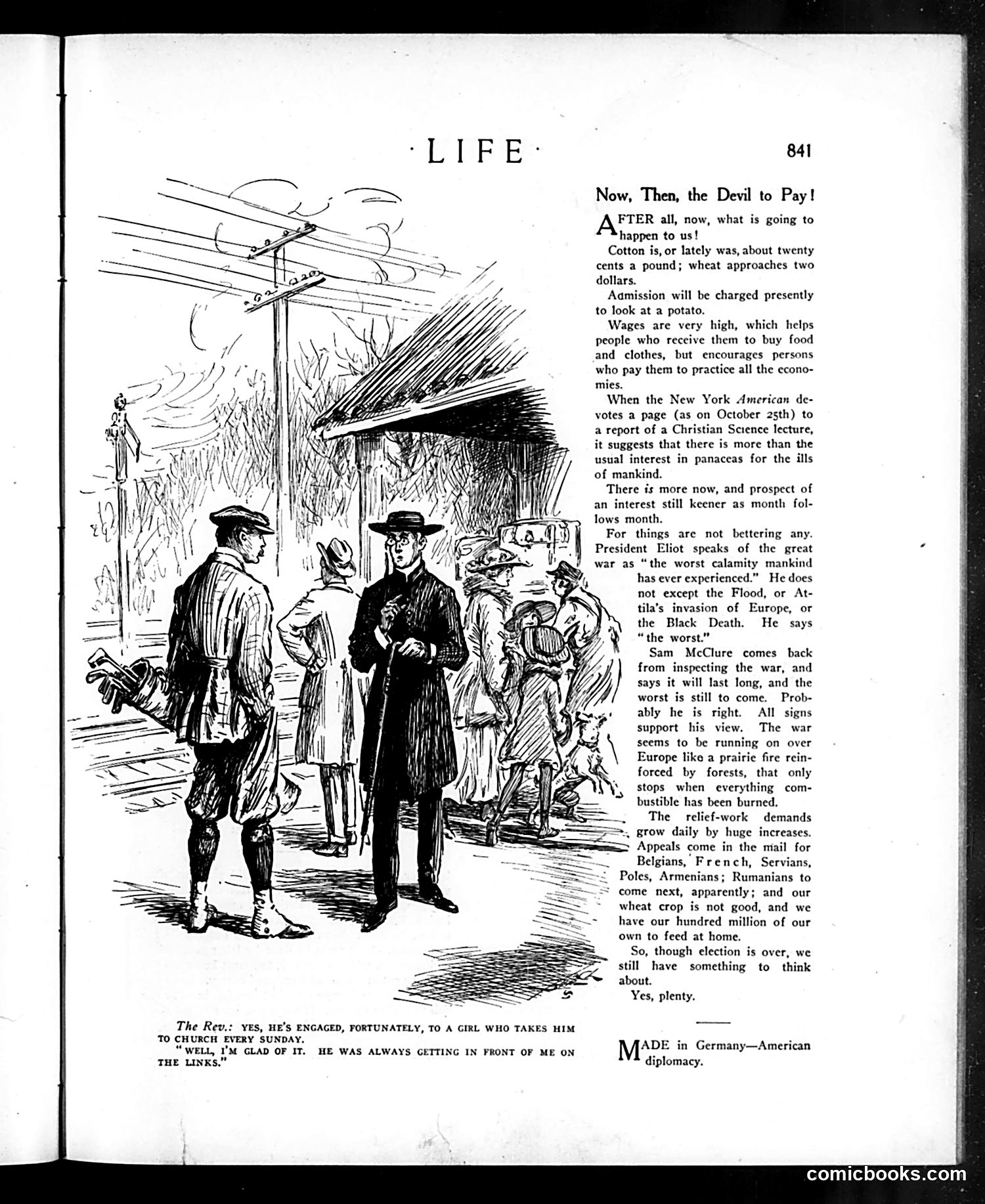
This page from *Life* magazine contains a satirical article titled "Now, Then, the Devil to Pay!" discussing post-WWI economic and social conditions. The accompanying illustration shows street figures in conversation, likely depicting everyday people confronting economic hardship. The text references President Eliot's comments on war as "the worst calamity mankind has ever experienced," and discusses ongoing relief efforts for war-affected populations (Belgians, French, Serbians, Poles, Armenians, Rumanians). It notes concerns about wheat crop failures and feeding "our own hundred million." The satire critiques post-war economic anxieties: high wages, inflation, food scarcity, and relief demands straining American resources. The caption quip about "a girl who takes him to church every Sunday" suggests domestic social commentary alongside international concerns. The cartoon depicts ordinary citizens grappling with these intersecting crises.
📄 Transcribed text from this page (OCR, searchable)
Machine-transcribed from the original scan — historical spelling and the odd misread are preserved.
841 Now, Then, the Devil to Pay! AFTER all, now, what is going to happen to us! Cotton is, or lately was, about twenty cents a pound; wheat approaches two dollars. Aamission will be charged presently to look at a potato. Wages are very high, which helps people who receive them to buy food and clothes, but encourages persons who pay them to practice all the econo- mies. When the New York American de- votes a page (as on October 25th) to a report of a Christian Science lecture, it suggests that there is more than the usual interest in panaceas for the ills of mankind. There is more now, and prospect of an interest still keener as month fol- lows month. For things are not bettering any. President Eliot speaks of the great war as “the worst calamity mankind has ever experienced.” He does not except the Flood, or At- tila’s invasion of Europe, or the Black Death. He says “the worst.” Sam McClure comes back from inspecting the war, and says it will last long, and the worst is still to come. Prob- ably he is right. All signs support his view. The war seems to be running on over Europe like a prairie fire rein- forced by forests, that only stops when everything com- bustible has been burned. The relief-work demands . grow daily by huge increases. Appeals come in the mail for Belgians,’ French, Servians, Poles, Armenians; Rumanians to = come next, apparently; and our wheat crop is not good, and we have our hundred million of our own to feed at home. So, though election is over, we still have something to think about. Yes, plenty. The Rev.: YeS, HE'S ENGAGED, FORTUNATELY, TO A GIRL WHO TAKES HIM TO CHURCH EVERY SUNDAY. ADE in G Amee “WELL, I’M GLAD OF IT. HE WAS ALWAYS GETTING IN FRONT OF ME ON M’ pee to CE TIARY == es mericeD THE LINKS,” diplomacy. comicbooks.com