
Life, 1916-11-16 · page 38 of 46
Life — November 16, 1916 — page 38: what you’re looking at
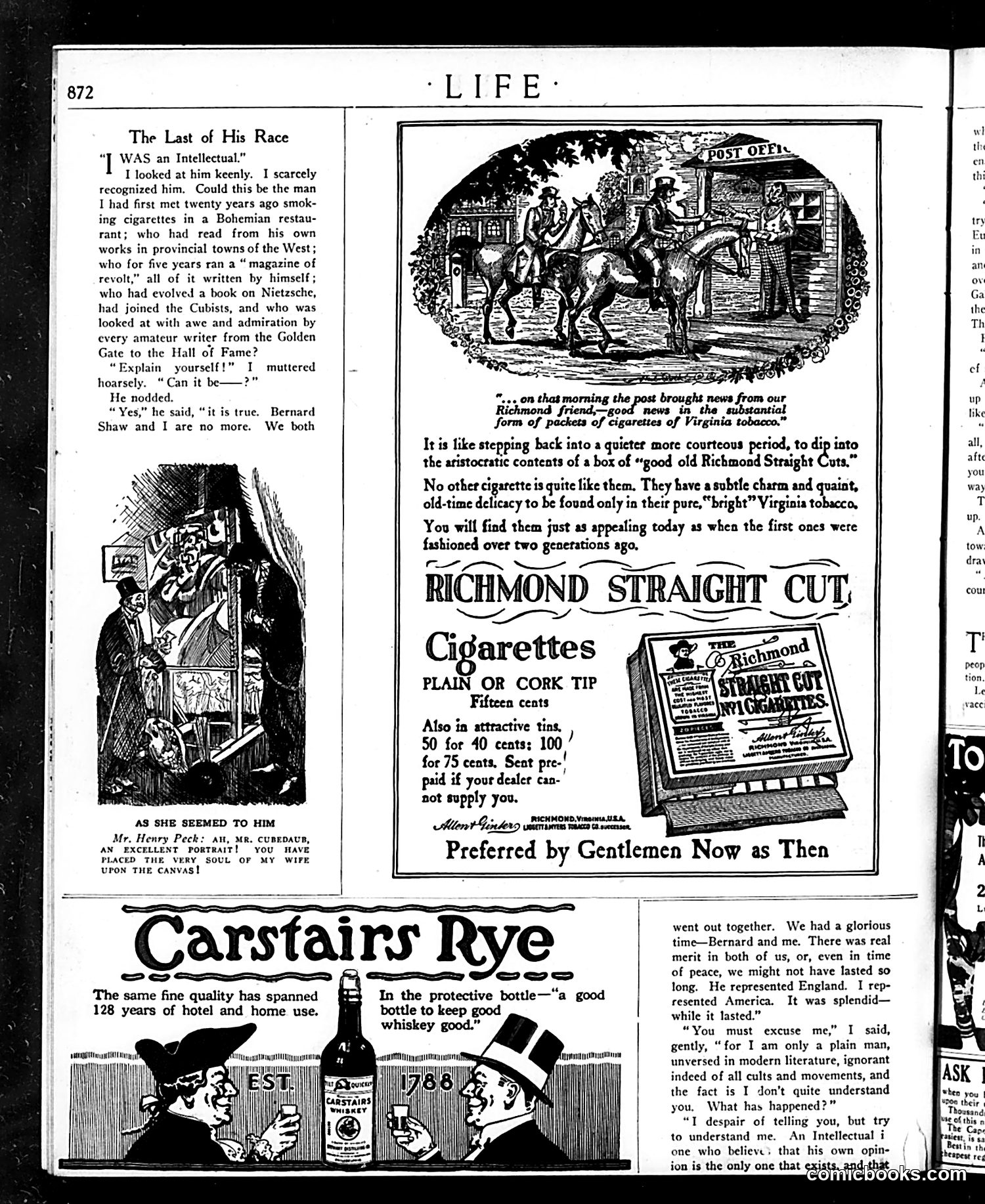
What you’re looking at
This satirical story mocks the decline of a self-styled "Intellectual"—a young Bohemian writer who once published his own avant-garde magazine, wrote about Nietzsche, joined the Cubist movement, and commanded admiration from amateur writers. The narrator encounters him years later, shocked by his apparent fall from intellectual grace. The joke targets the pretentiousness and impracticality of such aesthetic movements. The narrator's final monologue—where the Intellectual pompously defines himself by his unwavering certainty in his own opinions—suggests that his "intellectual" identity was always hollow self-regard rather than genuine achievement. The page also includes period advertisements (Richmond Straight Cut cigarettes, Carstairs Rye whiskey) and an unrelated cartoon about a portrait painter, typical of *Life* magazine's mixed editorial and advertising format from this era.
📄 Transcribed text from this page (OCR, searchable)
Machine-transcribed from the original scan — historical spelling and the odd misread are preserved.
The Last of His Race “T WAS an Intellectual.” I looked at him keenly. I scarcely recognized him, Could this be the man Lhad first met twenty years ago smok- ing cigarettes in a Bohemian restau- rant; who had read from his own works in provincial towns of the West; who for five years ran a “ magazine of revolt,” all of it written by himself; who had evolved a book on Nietzsche, had joined the Cubists, and who was looked at with awe and admiration by every amateur writer from the Golden Gate to the Hall of Fame? “Explain yourself!” I muttered . . : hoarsely. “Can it be——?” ae He nodded. 4. on that morning brou; “Yes,” he said, “it is true. Bernard Richmond “Frond Sgood news Mens tEkeanset Shaw and I are no more. We both form of packets of cigarettes of Virginia tobacco.” Iris like stepping back into a quieter mote courteous period, to dip into the aristocratic contents of a box of “good old Richmond Straight Cuts.” No other cigarette is quite like them, They have a subtle charm and quaint, old-time delicacy to be found only in their pure,“bright” Virginia tobacco, You will find them just as appealing today as when the first ones were fashioned over two genetations ago, el ee RAIGHT CUT, RICHMOND ST aes 0 OL ONT Cigarettes PLAIN OR CORK TIP Fifteen cents Also in attractive tins, 50 for 40 cents: 100 / for 75 cents, Seat pre-! paid if your dealer can- not supply you. AS SHE SEEMED TO HIM Meni Fr spear peur Mr, Henry Peck: att, sk. cUBEDAUB, AN EXCELLENT PORTRAIT! YOU HAVE PLACED THE VERY SOUL OF MY WIFE UPON THE Caxvas! went out together. We had a glorious e time—Bernard and me. There was real merit in both of us, or, even in time oa So (—T— I —} of peace, we might not have lasted so The same fine quality has spanned 4 In the protective bottle—“a good long: He reomesemed Eagan: 7 aid 128 years of hotel and home use. dott! shed keep good while it lasted.” iskey good. “You must excuse me,” I said, / : i gently, “for I am only a plain man, ian Tu | Sie ti ci veto unversed in modern literature, ignorant Nil | ! ES riiiiiere ipl: 3 Hi indeed of all cults and movements, and HT | Pe Ml | the fact is I don’t quite understand il you. What has happened?” hh ; y @ I } “I despair of telling you, but try : lll = TNS AN to understand me. An Intellectual i IMF hs atl iL | one who believe; that his own opin- ont = ion is the only one that