
Life, 1916-11-16 · page 8 of 46
Life — November 16, 1916 — page 8: what you’re looking at
What you’re looking at
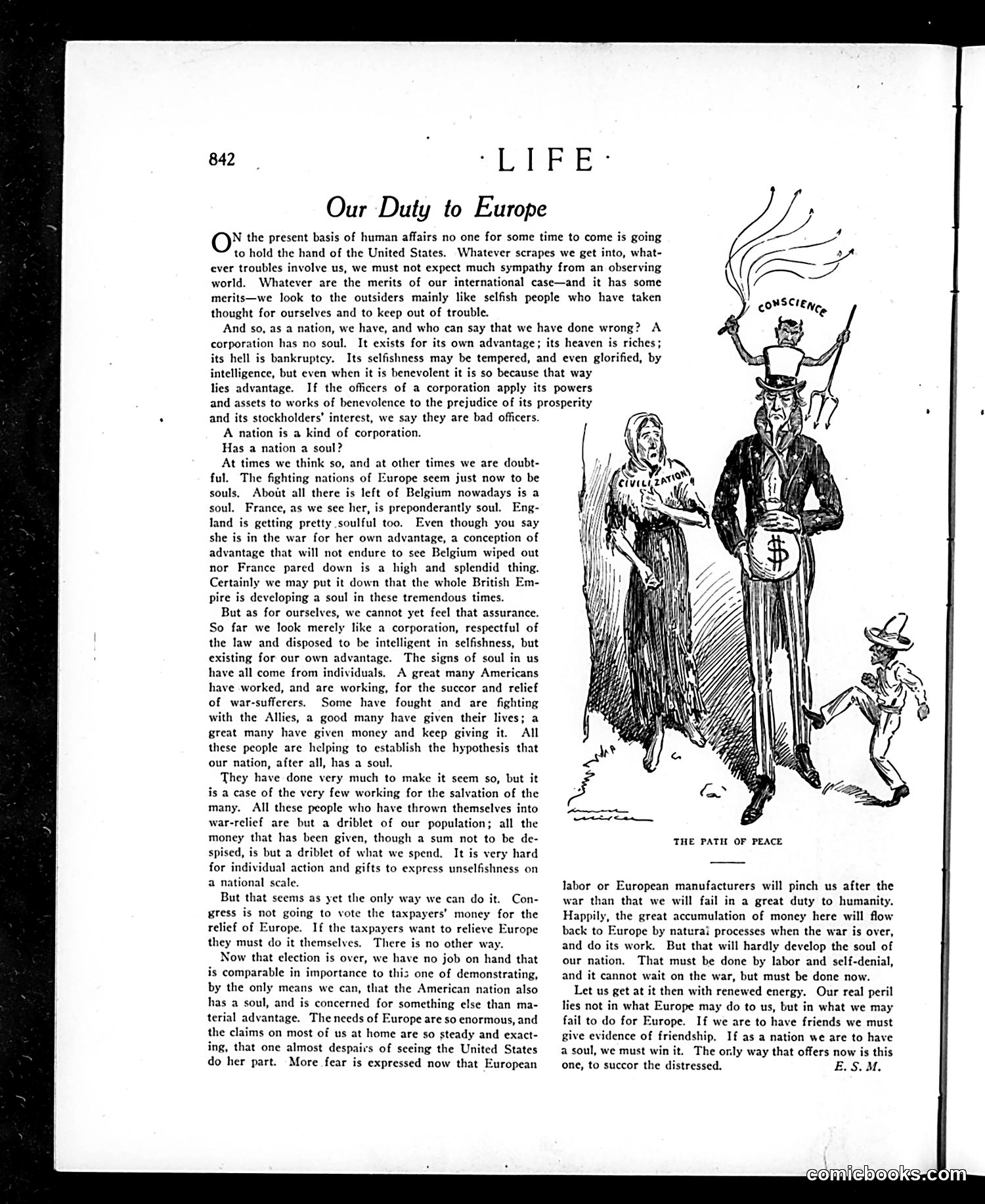
This editorial cartoon illustrates American post-WWI debate about European relief. The illustration shows three figures labeled "Civilization," "Charity," and what appears to be a soldier or wounded person, walking a difficult path while "Conscience" guides from above. The accompanying text argues that the U.S. has a moral duty to aid Europe, despite being weary from war. The author contends that Congress should fund European relief—not merely as self-interest but as evidence of national "soul." The cartoon visualizes this moral argument: civilization and charity must be supported by conscience as they navigate the dangerous "path of peace" in post-war reconstruction. Without American aid and moral leadership, the text suggests, both European recovery and American credibility will fail.
📄 Transcribed text from this page (OCR, searchable)
Machine-transcribed from the original scan — historical spelling and the odd misread are preserved.
“LIFE: Our Duty to Europe O*’ the present basis of human affairs no one for some time to come is going to hold the hand of the United States. Whatever scrapes we get into, what- ever troubles involve us, we must not expect much sympathy from an observing world. Whatever are the merits of our international case—and it has some merits—we look to the outsiders mainly like selfish people who have taken thought for ourselves and to keep out of trouble. And so, as a nation, we have, and who can say that we have done wrong? A corporation has no soul. its hell is bankruptcy. It exists for its own advantage; its heaven is riches; Its selfishness may be tempered, and even glorified, by intelligence, but even when it is benevolent it is so because that way lies advantage. If the officers of a corporation apply its powers and assets to works of benevolence to the prejudice of its prosperity and its stockholders’ interest, we say they are bad officers. A nation is a kind of corporation. Has a nation a soul? At times we think so, and at other times we are doubt- ful. The fighting nations of Europe seem just now to be souls, About all there is left of Belgium nowadays is a soul. France, as we see her, is preponderantly soul. Eng- land is getting pretty soulful too. Even though you say she is in the war for her own advantage, a conception of advantage that will not endure to sce Belgium wiped out nor France pared down is a high and splendid thing. Certainly we may put it down that the whole British Em- pire is developing a soul in these tremendous times. But as for ourselves, we cannot yet feel that assurance. So far we look merely like a corporation, respectful of the law and disposed to be intelligent in selfishness, but existing for our own advantage. The signs of soul in us have all come from individuals. A great many Americans have worked, and are working, for the succor and relief of war-sufferers. Some have fought and are fighting with the Allies, a good many have given their lives; a great many have given money and keep giving it. All these people are helping to establish the hypothesis that our nation, after all, has a soul. They have done very much to make it seem so, but it is a case of the very few working for the salvation of the many. All these people who have thrown themselves into war-relief are but a driblet of our population; all the money that has been given, though a sum not to be de- spised, is but a driblet of what we spend, It is very hard for individual action and gifts to express unselfishness on a national scale. But that scems as yet the only way we can do it. Con- gress is not going to vote the taxpayers’ money for the relief of Europe. If the taxpayers want to relieve Europe they must do it themselves. There is no other way Now that election is over, we have no job on hand that is comparable in importance to this one of demonstrating, by the only means we can, that the American nation also has a soul, and is concerned for something else than ma- terial advantage. The needs of Europe are so enormous, and the claims on most of us at home are so steady and exact- ing, that one almost despa of seeing the United States do her part. More fear is expressed now that European THE PATH OF PEACE labor or European manufacturers will pinch us after the war than that we will fail in a great duty to humanity. Happily, the great accumulation of money here will flow back to Europe by naturai processes when the war is over, and do its work. But that will hardly develop the soul of our nation. That must be done by labor and self-denial, and it cannot wait on the war, but must be done now. Let us get at it then with renewed energy. Our real peril lies not in what Europe may do to us, but in what we may fail to do for Europe. If we are to have friends we must give evidence of friendship. If as a nation we are to have a soul, we must win it. The only way that offers now is this one, to succor the distressed. E.S.M.