
Life, 1916-11-16 · page 21 of 46
Life — November 16, 1916 — page 21: what you’re looking at
What you’re looking at
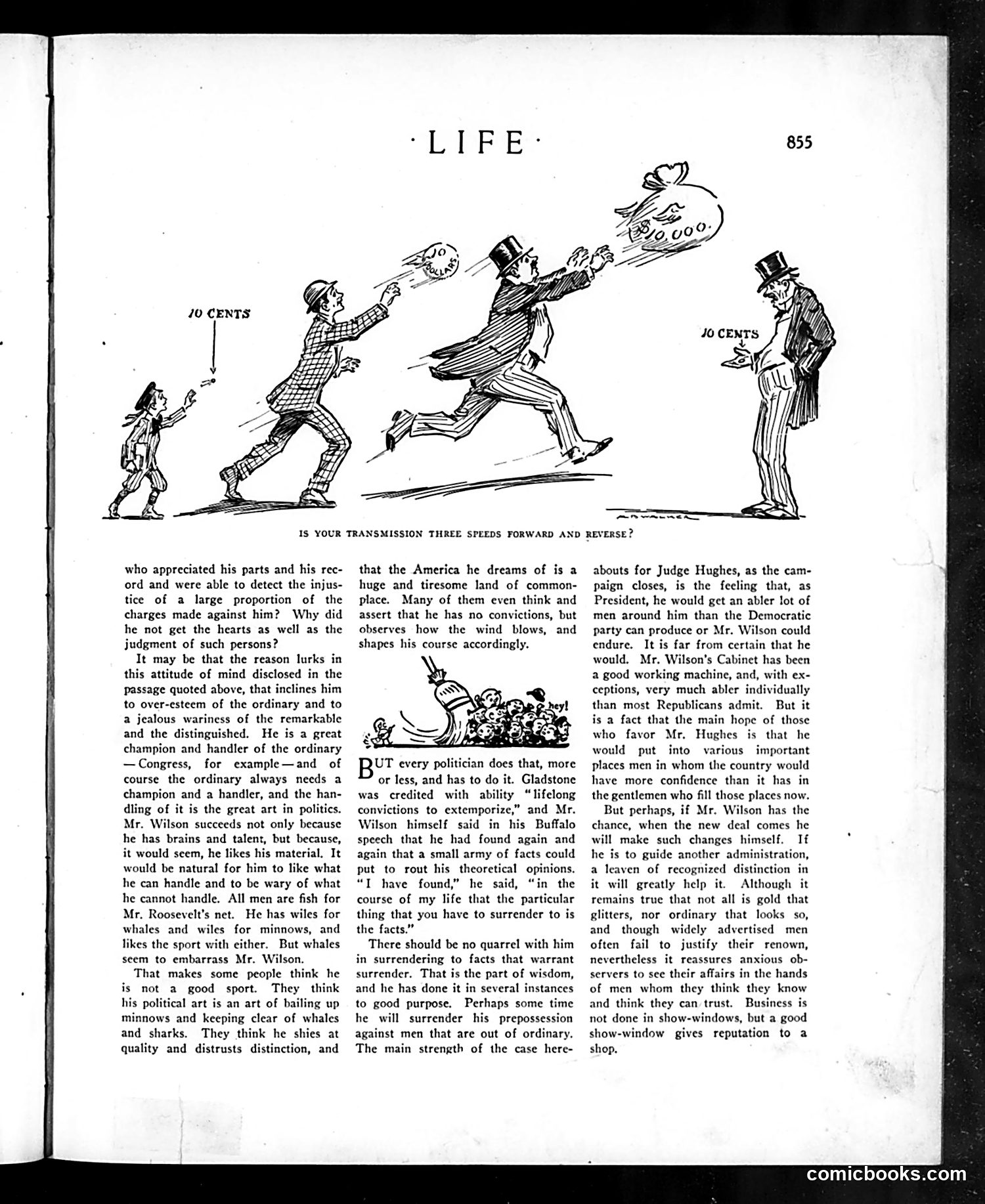
**The Cartoon**: "Is Your Transmission Three Speeds Forward and Reverse?" depicts a progression of figures juggling money bags, scaling upward from a small child labeled "10 CENTS" through increasingly well-dressed men, to a wealthy figure holding a large "$1,000,000" bag, finally confronted by a stern gentleman in a top hat. **The Satire**: This illustrates wealth accumulation and social climbing in American capitalism—the journey from poverty to riches through ambition (or luck). The final figure's stern demeanor suggests judgment or confrontation with the wealthy. **The Text's Political Context**: The article discusses President Wilson versus Judge Hughes (1916 election). It criticizes Wilson for surrounding himself with "ordinary" men rather than distinguished figures, suggesting Hughes would recruit abler advisors. The author defends Wilson's pragmatism about facts over ideology, but acknowledges voters want capable, recognizable leaders around their president. **Key Point**: Both cartoon and text examine American confidence in leadership—whether through financial success or political appointments—and question whether appearance/reputation genuinely indicates competence.
📄 Transcribed text from this page (OCR, searchable)
Machine-transcribed from the original scan — historical spelling and the odd misread are preserved.
40 CENTS ar carree IS YOUR TRANSMISSION THREE SPEEDS FORWARD AND REVERSE? who appreciated his parts and his rec- ord and were able to detect the injus- tice of a large proportion of the charges made against him? Why did he not get the hearts as well as the judgment of such persons? It may be that the reason lurks in this attitude of mind disclosed in the passage quoted above, that inclines him to over-esteem of the ordinary and to a jealous wariness of the remarkable and the distinguished. He is a great champion and handler of the ordinary —Congress, for example—and of course the ordinary always needs a champion and a handler, and the han- dling of it is the great art in politics. Mr. Wilson succeeds not only because he has brains and talent, but because, it would seem, he likes his material. It would be natural for him to like what he can handle and to be wary of what he cannot handle. All men are fish for Mr. Roosevelt's net. He has wiles for whales and wiles for minnows, and likes the sport with either. But whales seem to embarrass Mr. Wilson. That makes some people think he is not a good sport. They think his political art is an art of bailing up minnows and keeping clear of whales and sharks. They think he shies at quality and distrusts distinction, and that the America he dreams of is a huge and tiresome land of common- place. Many of them even think and assert that he has no convictions, but observes how the wind blows, and shapes his course accordingly. UT every politician does that, more or less, and has to do it. Gladstone was credited with ability “lifelong convictions to extemporize,” and Mr. Wilson himself said in his Buffalo speech that he had found again and again that a small army of facts could put to rout his theoretical opinions. “T have found,” he said, “in the course of my life that the particular thing that you have to surrender to is the facts.” There should be no quarrel with him in surrendering to facts that warrant surrender. That is the part of wisdom, and he has done it in several instances to good purpose, Perhaps some time he will surrender his prepossession against men that are out of ordinary. The main strength of the case here- abouts for Judge Hughes, as the cam- paign closes, is the feeling that, as President, he would get an abler lot of men around him than the Democratic Party can produce or Mr. Wilson could endure. It is far from certain that he would. Mr. Wilson's Cabinet has been a good working machine, and, with ex- ceptions, very much abler individually than most Republicans admit. But it is a fact that the main hope of those who favor Mr. Hughes is that he would put into various important places men in whom the country would have more confidence than it has in the gentlemen who fill those places now. But perhaps, if Mr. Wilson has the chance, when the new deal comes he will make such changes himself. If he is to guide another administration, a leaven of recognized distinction in it will greatly help it. Although it remains true that not all is gold that glitters, nor ordinary that looks so, and though widely advertised men often fail to justify their renown, nevertheless it reassures anxious ob- servers to see their affairs in the hands of men whom they think they know and think they can trust. Business is not done in show-windows, but a good show-window gives reputation to a shop. comicbooks.com